Advertisement
)
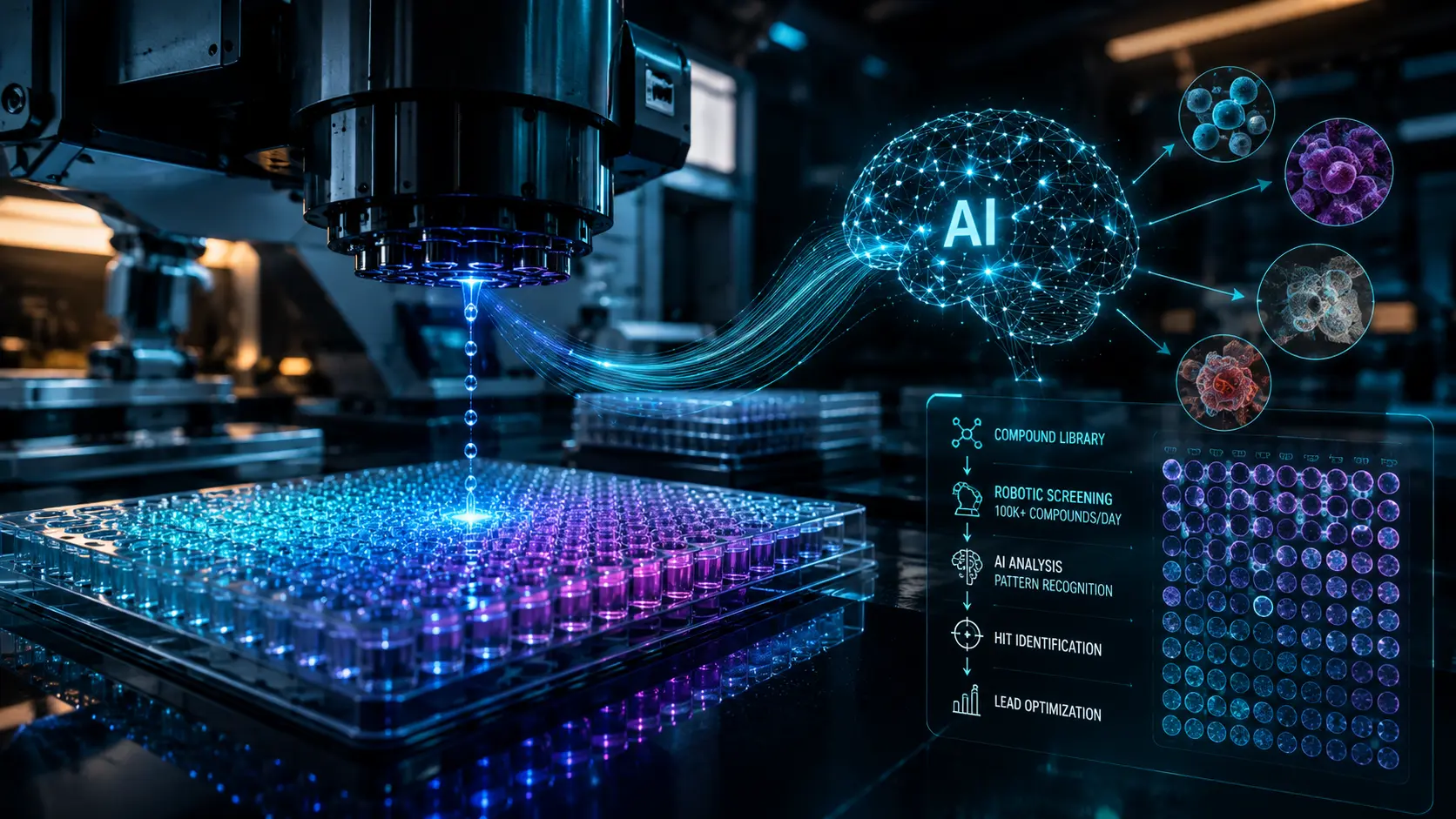

Finding a new drug is historically a game of catastrophic failure. For decades, human scientists stood at lab benches with plastic pipettes, manually dropping chemicals onto cancer cells one by one, hoping to find a reaction. This grueling, analog process is the primary reason a single new medicine takes ten years and over $2 billion to bring to market. Today, the pharmaceutical industry is removing the human hand from the equation entirely. Walk into a modern biotechnology facility, and you will not see scientists holding test tubes; you will see massive, glass-enclosed robotic assembly lines operating in total isolation.
These machines use sound waves to shoot microscopic droplets of fluid into plastic plates containing thousands of tiny wells, while artificial intelligence algorithms analyze the cellular results in real-time. Why should you care right now? Because the fusion of High-Throughput Screening (HTS) automation and AI has reduced the preclinical drug discovery timeline from years to mere months. By digitizing the physical laboratory, the biotech industry is finally scaling the hunt for cures to the speed of modern computing, generating the massive physical datasets required to map the future of human biology.
What is High-Throughput Screening (HTS) Automation?
High-Throughput Screening (HTS) automation is an advanced drug discovery process that utilizes robotics, automated liquid handling, and artificial intelligence to rapidly test millions of chemical compounds against biological targets. This autonomous infrastructure identifies active molecular “hits” in a fraction of the time required by traditional manual laboratory testing.
At a Glance
- Concept: Building a fully robotic “wet lab” where machines test tens of thousands of chemicals a day, and an AI brain learns from the results to suggest better chemicals for the robots to test tomorrow.
- Why it matters: Chemical space is practically infinite (an estimated 10⁶⁰ possible drug-like molecules). Humans cannot manually test enough compounds to find cures. HTS automation allows pharma to search massive chemical libraries at an industrial scale.
- Who uses it: Mega-pharma companies (Novartis, AstraZeneca), AI-first biotech startups (Recursion, Exscientia), and third-party automated “Cloud Labs” (Strateos, Emerald Cloud Lab).
- Biggest takeaway: AI in biotech is useless without physical data. HTS robots are the physical engines that generate the millions of data points required to train the AI models.
In Simple Words
Finding a drug is like finding the perfect key to open a very specific, microscopic lock (like a cancer cell receptor).
In the old days, a scientist would manually try a few dozen keys a day.
In High-Throughput Screening (HTS), a robot tries 100,000 keys a day. The robot uses a plastic tray the size of a smartphone that has 1,536 tiny holes in it. It puts a cancer cell in each hole, and then uses a highly precise machine to drop a different chemical “key” into every single hole to see which ones trigger a reaction.
Now, add Artificial Intelligence. Instead of making the robot try keys blindly, the AI looks at the results from the first batch and says, “Keys with jagged edges seem to work best. Tomorrow, only test jagged keys.” The AI learns the pattern, and the robot executes the physical testing. Working together in a continuous loop, the AI and the robot zero in on the perfect key in a matter of weeks instead of years.
Why This Matters
The pharmaceutical industry is suffering from a massive return on investment (ROI) crisis. The cost of bringing a drug to market has skyrocketed, while the success rate has plummeted.
For Biotech Investors and Pharma Execs, HTS automation integrated with AI represents the only viable mathematical escape from this crisis. It shifts the drug discovery pipeline from a “bespoke artisanal craft” into an industrialized, predictable engineering framework. By screening billions of compounds virtually (in silico) and instantly validating the best candidates physically via HTS robotics, companies can slash the time spent in the “Hit-to-Lead” optimization phase by 70%, radically compressing the timeline before a drug enters human clinical trials.
The Rise of Biotech Cloud Labs and BaaS
The automation of the laboratory is triggering the rise of Biotech-as-a-Service (BaaS) or “Cloud Labs.”
Historically, starting a biotech company required raising $20 million just to buy physical pipettes, mass spectrometers, and robotic arms. Today, companies like Emerald Cloud Lab and Strateos operate massive, fully autonomous, warehouse-sized HTS facilities.
A bioengineer sitting in a coffee shop in Berlin can write a Python script, send it to a cloud lab in California, and the robots will physically execute the chemical screening overnight. The data is beamed back to the engineer’s laptop the next morning. This completely separates the intellectual design of a drug from the physical execution of chemistry, democratizing drug discovery and allowing lean, AI-focused startups to compete directly with 100-year-old pharmaceutical titans.
How High-Throughput Screening Automation Works
Moving nanoliters of fluid millions of times a day with zero error requires mastering fluid dynamics and mechanical engineering. Here is the first-principles breakdown of the architecture.
1. The Fundamental Problem: Speed and Volume
To find a drug, you must test millions of compounds. If a human uses a handheld pipette to move liquid from a vial to a petri dish, it is slow, prone to human fatigue, and requires large volumes of liquid. Synthesizing large volumes of experimental chemicals is astronomically expensive.
2. The Insufficiency of Traditional Robotics
Early lab robots simply mimicked human arms, using plastic disposable pipette tips to move liquid. This was better, but still flawed: plastic tips are expensive, physically touching the liquid risks cross-contamination between samples, and traditional pipettes struggle to accurately measure anything smaller than a microliter.
3. The Core Mechanism: Microplates and Miniaturization
Modern HTS relies on extreme miniaturization. The industry standard is the microtiter plate—a standard-sized plastic rectangle containing a grid of tiny wells. While early plates had 96 wells, advanced HTS platforms use 1,536-well or 3,456-well plates. This allows thousands of distinct experiments to occur simultaneously on a piece of plastic the size of an index card, using only nanoliters (billionths of a liter) of expensive chemical reagents.
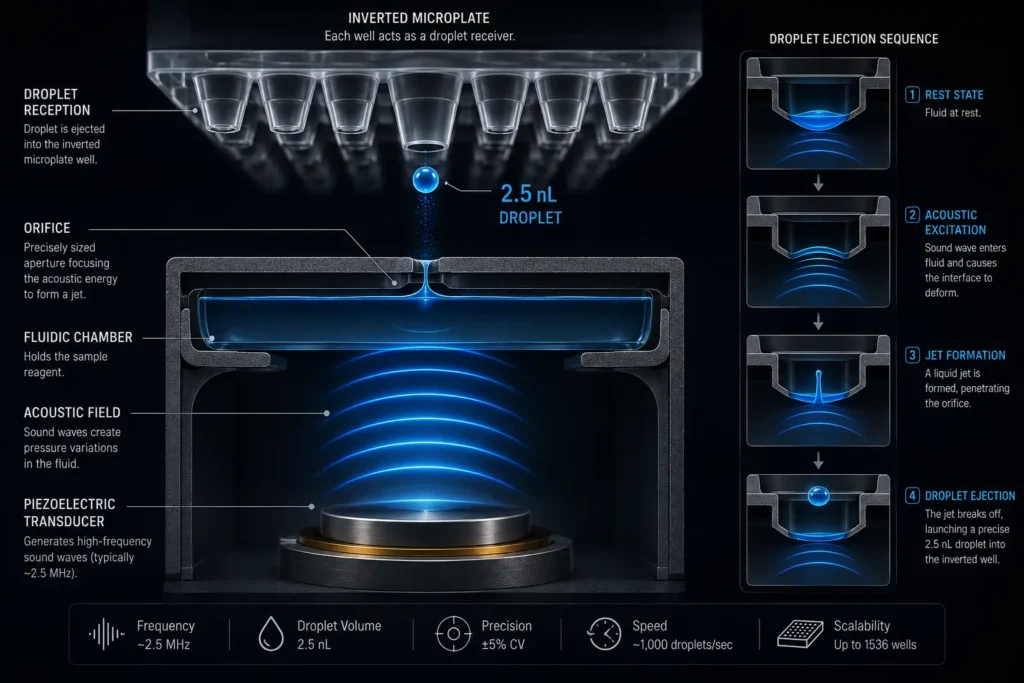
4. Technical Depth: Acoustic Droplet Ejection (ADE)
To move liquid into 3,456 microscopic holes without cross-contamination, the industry adopted Acoustic Droplet Ejection.
Instead of a physical pipette, an ADE machine (like the Echo Liquid Handler) positions an ultrasonic transducer beneath the source plate. The transducer fires a highly focused pulse of acoustic sound energy through the plastic. The sound wave hits the surface of the liquid, transferring kinetic energy that causes a perfectly sized, 2.5-nanoliter droplet of chemical to launch upward through the air, defying gravity, and sticking to an inverted destination plate suspended above it. There is zero physical contact, zero plastic waste, and absolute volumetric precision.
5. Real-World Consequences: AI Phenotypic Analysis
Once the chemical is dropped onto the cell, the reaction must be graded. Instead of a human looking through a microscope, High-Content Screening (HCS) automated microscopes photograph every single well in high definition. Computer vision AI models instantly analyze these millions of images, detecting microscopic changes in the cell’s shape or protein structure (phenotypic changes) that a human eye could never perceive, feeding this massive dataset back into the central neural network to plan the next experiment.
Applications of HTS and AI in Drug Discovery
The integration of automated HTS is tearing down the traditional silos of biological research.
Hit-to-Lead Generation: When a new disease target is identified, pharmaceutical companies use HTS to screen their entire physical library of historical chemical compounds (often numbering in the millions). Generative AI analyzes the chemical structures of the “hits” (compounds that showed slight activity) and redesigns them to be safer and more effective, transforming a weak hit into a strong “lead” candidate for animal testing in a matter of weeks.
Drug Repurposing: If a novel virus emerges globally, HTS automation allows laboratories to test every single drug already approved by the FDA against the new virus in a single weekend. By rapidly identifying existing, safe drugs that show off-target efficacy against the new threat, public health organizations can bypass years of safety testing and move directly into efficacy trials.
Targeted Protein Degradation (PROTACs): Developing complex new modalities like PROTACs (molecular glues that tag disease-causing proteins for disposal by the cell’s garbage disposal system) requires incredibly delicate, multi-part chemical screening. Automated liquid handling systems allow researchers to test complex, three-part chemical combinations across millions of variations with a precision that human pipetting could never achieve.
Economic & Strategic Impact
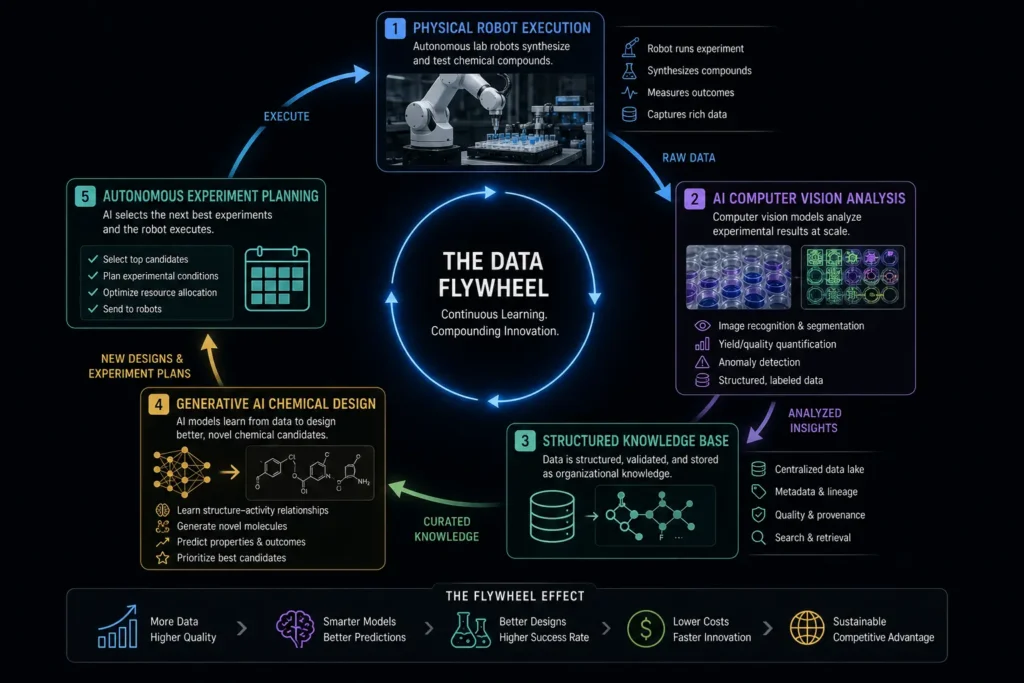
The defining strategic shift in the industry is the Data Flywheel Arbitrage.
In modern biotechnology, physical laboratory equipment is becoming commoditized. The true moat of an AI-driven pharma company is proprietary, high-quality biological data.
A startup that runs a fully automated HTS lab isn’t just looking for one drug; they are generating millions of data points on what doesn’t work. This negative data is pure gold for training machine learning models. Companies like Recursion Pharmaceuticals have accumulated petabytes of proprietary cellular images. Because they own the robotic infrastructure, they generate more biological training data in a week than an academic institution generates in a decade. This proprietary data flywheel allows them to train AI foundation models that competitors physically cannot replicate, forcing legacy pharma giants to sign multi-billion-dollar licensing deals just to access the insights.
Advantages
- Extreme Scale and Velocity: Screens up to 100,000 compounds a day, reducing the timeline for early-stage drug discovery from 4 to 5 years down to 8 to 12 months.
- Elimination of Human Error: Automated liquid handling removes the variability of human fatigue, ensuring that well #1 is treated with the exact same nanoliter precision as well #100,000.
- Resource Efficiency: Acoustic droplet ejection and 1536-well microplates drastically reduce the volume of reagents and chemicals required, saving millions of dollars in raw material costs per screening campaign.
Limitations
- The In Vitro vs. In Vivo Gap: HTS tests chemicals on isolated cells in a plastic dish (in vitro). It cannot replicate the complex, systemic environment of a living human body (in vivo). A drug that works perfectly in an automated microplate may still fail completely due to liver toxicity in a human clinical trial.
- PAINS (Pan-Assay Interference Compounds): Automated systems frequently trigger “false positives.” Certain chemicals (PAINS) naturally glow, stick to plastic, or react with everything, tricking the computer vision AI into thinking a cure has been found when the chemical is actually useless.
- Massive CapEx Requirements: Building an integrated, robotic HTS facility with acoustic liquid handlers and petabyte-scale data storage requires tens of millions of dollars in upfront capital, creating a high barrier to entry for unfunded research teams.
Common Misconceptions
Misconception: AI is going to replace the physical laboratory.
Reality: AI is completely useless without the physical laboratory. An AI model can hallucinate a brilliant new chemical structure, but until a robot actually synthesizes that chemical and physically drops it onto a living cancer cell, it is just a digital guess. AI drastically increases the efficiency of the lab, but the physical wet lab remains the absolute source of truth.
Misconception: High-Throughput Screening guarantees a successful drug.
Reality: HTS is a funnel, not a guarantee. It starts with a million compounds and narrows it down to ten highly probable candidates. Those ten candidates must still survive rigorous animal testing, toxicity screens, and three phases of human clinical trials, where the vast majority of experimental drugs still fail.
Misconception: The robots are fully intelligent and design the experiments.
Reality: The physical robots are highly precise, but fundamentally “dumb” execution machines. The intelligence resides entirely in the MLOps orchestration software sitting in the cloud, which dictates the coordinates and volumes the robots execute.
What Most People Miss
The critical transition from Target-Based Screening to Phenotypic Screening.
Historically, scientists had to know exactly what biological target they were looking for (e.g., “I need a chemical that blocks Enzyme X”).
What most people miss is that the combination of automated microscopy and AI has resurrected Phenotypic Screening. The AI looks at millions of pictures of sick cells and healthy cells. The robot drops chemicals on the sick cells. The AI doesn’t care how the chemical works; it just uses computer vision to see if the sick cell physically changes shape to look like a healthy cell. This allows scientists to discover cures for complex diseases (like Alzheimer’s or ALS) even when they don’t fully understand the underlying molecular mechanism of the disease.
Comparison Table
| Feature | Manual Bench Science | Legacy HTS (Plastic Pipettes) | AI-Driven Autonomous HTS (ADE) |
| Throughput | 10s to 100s of compounds/day | ~10,000 compounds/day | 100,000+ compounds/day |
| Liquid Transfer Method | Handheld plastic pipettes | Robotic plastic pipette heads | Acoustic sound waves (Zero contact) |
| Experiment Selection | Human intuition | Brute-force (Test everything) | AI-predicted active learning loops |
| Cross-Contamination Risk | Moderate | Low to Moderate | Virtually Zero |
| Data Analysis | Manual human observation | Basic digital thresholding | Deep Learning / Computer Vision |
Case Study
Situation: A leading AI-first biotechnology company aimed to discover a novel therapeutic for a rare, complex genetic fibrosis. The exact molecular target was poorly understood, meaning traditional target-based drug design was impossible.
Challenge: The company needed to screen a proprietary library of over 2 million chemical compounds against patient-derived cells, assess microscopic morphological changes in the cells, and identify a viable lead candidate before their venture capital runway expired.
Solution (The Autonomous Loop): The company deployed an integrated AI-HTS architecture. They used 1536-well microplates and Acoustic Droplet Ejection to rapidly physically screen subsets of their library. Automated high-content microscopes captured millions of cellular images. Instead of humans reviewing the images, a deep neural network analyzed the phenotypic changes, identified which chemical structures were working, and autonomously instructed the robots on which new chemicals to test the following day.
Outcome: By closing the loop between the AI brain and the robotic execution arm, the company evaluated the entire 2-million compound library physically and computationally in under 4 weeks. They identified a highly potent lead candidate and moved it into preclinical animal trials in 8 months—a process that traditionally takes Big Pharma three to five years.
Lessons Learned: The operation proved that the true power of automation is not just speed, but iterative learning. By allowing the AI to continuously design, execute, and learn from physical robotic experiments without human latency, the company bypassed the traditional trial-and-error bottlenecks of legacy pharmacology.
Future Outlook
Next 12–24 Months
The era of Generative AI Integration and “Self-Driving Labs”. Over the next two years, the integration of Large Language Models (LLMs) into the lab orchestration software will reach maturity. Scientists will simply type, “Design and execute an assay to test library X against target Y,” and the LLM will automatically generate the robotic machine code, configure the liquid handlers, and execute the physical experiment overnight. This conversational interface will drastically lower the software engineering barrier required to operate multi-million-dollar automated facilities.
Next 3–5 Years
The scaling of Organ-on-a-Chip Integration. The glaring weakness of HTS is that flat plastic plates do not accurately represent 3D human biology. By the late 2020s, automation will pivot to handle complex “Organ-on-a-Chip” models—microfluidic devices containing living, 3D human tissue (like mini-livers or beating heart cells). AI-driven robotic platforms will master the delicate fluid dynamics required to screen thousands of compounds directly on these living micro-organs, drastically improving the accuracy of toxicity predictions and heavily reducing the industry’s reliance on animal testing.
Next 10 Years
The Automated Synthesis Singularity. Currently, robots are great at testing chemicals, but humans still have to manually synthesize (create) the complex chemicals to be tested. By the mid-2030s, the entire supply chain will be automated. AI will hallucinate a new chemical structure, send the blueprint to a fully automated robotic chemistry synthesis lab, which will physically “brew” the novel chemical and route it directly via micro-fluidics into the HTS screening array. The entire pipeline from molecular imagination to physical validation will occur without human intervention.
Most Likely Scenario
High-Throughput Screening automation will transition from a competitive advantage into a mandatory baseline capability. As “Cloud Labs” scale, physical lab space will become fully abstracted away from the biotech startup ecosystem, much like AWS abstracted physical server racks from software companies. The victors of the biotech revolution will be the companies that construct the most efficient AI data-loops to extract biological truth from these massive, robotic factories.
Key Takeaways
- High-Throughput Screening (HTS) automation replaces manual laboratory pipetting with advanced robotics, capable of testing over 100,000 chemical compounds a day.
- Modern HTS utilizes extreme miniaturization (1536-well microplates) to test thousands of reactions on a piece of plastic the size of an index card, saving massive amounts of expensive chemicals.
- Acoustic Droplet Ejection (ADE) uses ultrasonic sound waves to shoot nanoliter-sized droplets of fluid upward with absolute precision, eliminating the plastic waste and contamination risk of physical pipettes.
- Artificial Intelligence acts as the brain of the automated lab. It analyzes the millions of microscopic cell images generated by the robots, learning the patterns of successful chemicals to suggest better targets for the next round of testing.
- This closed-loop system is drastically compressing the “Hit-to-Lead” phase of drug discovery, turning a multi-year, multi-million dollar process into an operation of a few months.
- Automated “Cloud Labs” allow scientists to rent robotic lab time remotely, democratizing drug discovery and separating the intellectual design of medicine from the physical execution.
Glossary
Acoustic Droplet Ejection (ADE): A highly precise liquid-handling technology that uses ultrasonic acoustic energy to transfer nanoliter droplets of fluid without any physical contact or disposable plastic tips.
Cloud Lab (Biotech-as-a-Service): A fully automated, centralized laboratory facility that allows scientists to design, execute, and monitor physical biological experiments entirely remotely via software.
Eroom’s Law: The observation that drug discovery is becoming slower and more expensive over time, in direct contrast to Moore’s Law. HTS automation and AI are deployed specifically to reverse this trend.
High-Content Screening (HCS): A specific type of HTS that uses automated, high-resolution microscopy and computer vision AI to capture and analyze complex visual changes inside a living cell.
Hit-to-Lead: The early phase of drug discovery where a massive chemical library is screened to find initial active compounds (“hits”), which are then optimized into stronger candidates (“leads”).
Microplate (Microtiter Plate): A flat plate with multiple “wells” used as small test tubes. They are the standardized physical canvas of HTS, enabling thousands of experiments to occur simultaneously.
Frequently Asked Questions
Does this mean drugs will be cheaper for consumers?
Not necessarily. While AI and automation drastically reduce the early preclinical R&D costs, the vast majority of a drug’s billion-dollar price tag comes from massive Phase II and Phase III human clinical trials, which currently cannot be automated and still face high failure rates.
How does the robot know what chemical to test?
In an AI-driven lab, a generative chemistry algorithm creates a virtual list of molecules it believes will work based on the structure of the disease. It sends this prioritized list to the orchestration software, which commands the robots to physically retrieve those specific chemical vials from the automated storage vault.
Can robots test medicines on actual human tissue?
They are beginning to. While most current HTS uses flat, immortalized cell lines (like HeLa cells), advanced robotic handlers are now being programmed to test chemicals on 3D cellular clusters (organoids) that more accurately mimic real human tissue.
What happens to the chemicals that don’t work?
They are highly valuable. The data generated from a failed chemical reaction is fed directly back into the AI model. Knowing exactly why a chemical failed allows the AI to map the boundaries of the biological target, improving its predictions for the next experiment.
Is human laboratory science dead?
No. While repetitive pipetting and massive chemical screening are being automated, highly complex, bespoke biological experiments and the ultimate strategic design of the therapeutic pipelines still require expert human scientists.
Sources
- Nature Reviews Drug Discovery: Artificial intelligence in drug discovery: what is realistic, what are illusions?
- Drug Discovery Today: The evolution of high-throughput screening
- SLAS Discovery: Acoustic droplet ejection: a disruptive technology for highly efficient drug discovery
- Forbes: How ‘Cloud Labs’ Are Revolutionizing The Biotech Industry
- Recursion Pharmaceuticals: Decoding Biology with an Automated Wet Lab and AI (Corporate Technical Reports)