Advertisement
)


The mRNA revolution fundamentally changed modern medicine, but it was built on a fragile foundation. Linear messenger RNA is the biological equivalent of a self-destructing text message. The human immune system is packed with aggressive enzymes known as exonucleases, which act as molecular assassins designed to hunt down free-floating RNA, latch onto their exposed ends, and shred them into pieces. Because of this, traditional mRNA therapies fade from the body in a matter of days. This transient nature is acceptable for vaccines, but it is a fatal flaw for treating chronic diseases, oncology, or complex genetic disorders that require sustained, long-term intervention.
To create lasting cures, bioengineers realized they had to hide the ends of the message. Why should you care right now? Because biotechnology has achieved this by literally tying the RNA string into a knot. By utilizing “backsplicing” to create Circular RNA (circRNA), scientists have engineered a covalently closed loop of genetic code that completely lacks the exposed ends required for exonucleases to attack. This invisible architecture is officially entering human trials in 2026, with companies like Therorna deploying circRNA to reprogram immune cells directly inside the patient’s bloodstream. It is the definitive upgrade to the mRNA platform, shifting genetic medicine from fleeting interventions to highly durable, programmable cures.
What are Circular RNA (circRNA) Therapeutics?
Circular RNA (circRNA) therapeutics are advanced genetic medicines that utilize covalently closed loops of RNA to instruct cells to produce therapeutic proteins. By eliminating the exposed ends found in traditional linear mRNA, circRNA evades rapid cellular degradation, enabling highly durable, long-lasting treatment for oncology, autoimmune disorders, and rare diseases.
At a Glance
- Concept: Taking a standard, straight line of genetic code (mRNA) and chemically fusing the tail to the head to create an endless, continuous circle.
- Why it matters: Human enzymes destroy RNA by “chewing” on the loose ends. Because a circle has no ends, the body’s natural defense enzymes cannot easily destroy it, allowing the therapy to work for weeks instead of days.
- Who uses it: Clinical-stage biotech startups (Therorna, Orna Therapeutics, Laronde) backed by top-tier venture capital, alongside major pharmaceutical partners seeking next-generation oncology portfolios.
- Biggest takeaway: In 2026, circRNA moved beyond theoretical potential. It is now being actively infused into human patients to generate in vivo CAR-T cells, turning a patient’s own body into an internal cancer-fighting factory with just a single shot.
In Simple Words
Imagine you have a piece of licorice string. If you drop it into a tank of hungry fish, they will immediately start nibbling at the two loose ends until the entire string is eaten. This is what happens to normal linear mRNA when it enters the human body; cellular enzymes (the fish) quickly chew it up from the ends.
Now, imagine taking that exact same piece of licorice and melting the two ends together to form a perfect, seamless ring. When you drop the ring into the tank, the fish swim around it, looking for an edge to start nibbling on. Because there are no loose ends, they cannot bite into it.
This is a Circular RNA (circRNA) therapeutic. Because the genetic instructions are locked in an unbreakable circle, the cellular machinery simply reads the instructions over and over again without destroying the manual. This allows a single injection to produce medicine inside the patient’s body for a massively extended period of time.
Why This Matters
For Biotech Investors and Pharma Executives, circRNA solves the primary economic and biological limitations of the $40 billion cell therapy market.
Currently, therapies like CAR-T for blood cancers are ex vivo. Doctors must harvest the patient’s cells, freeze them, fly them to a specialized lab, engineer them with slow-acting viral vectors, and fly them back. The process takes weeks and costs over $400,000 per patient. CircRNA disrupts this entirely. Because of its extreme durability, circRNA can be packaged into a targeted lipid nanoparticle (tLNP) and injected directly into the patient (in vivo). The circRNA safely reprograms the T-cells directly inside the bloodstream. This shifts life-saving cell therapy from a bespoke, million-dollar logistical nightmare into an “off-the-shelf,” mass-produced pharmaceutical vial.
Linear mRNA vs. Circular RNA (circRNA)
The leap from linear to circular RNA is a masterclass in exploiting overlooked biological phenomena.
For decades, geneticists viewed natural circRNAs merely as “splicing noise”—accidental byproducts of gene transcription with little purpose. It was only recently discovered that nature uses these highly conserved loops as microRNA sponges and transcriptional regulators specifically because of their incredible half-life. By hijacking this ancient biological architecture, modern drug developers have bypassed the need for the heavy, unnatural chemical modifications (like pseudo-uridine substitution) that linear mRNA requires just to survive transit through the bloodstream.
How circRNA Backsplicing and Translation Works
Generating endless translation from a loop requires bypassing the standard rules of molecular biology. Here is the first-principles breakdown of the architecture.
1. The Fundamental Problem: Exonuclease Degradation
Linear mRNA degrades via two primary pathways: 5′ to 3′ decay (initiated by removing the 5′ protective cap) and 3′ to 5′ decay (initiated by shortening the poly-A tail). Once these ends are exposed, ubiquitous intracellular exonucleases rapidly hydrolyze and destroy the transcript.
2. The Core Mechanism: The 3′–5′ Covalent Linkage
To manufacture circRNA, scientists induce “backsplicing.” In a bioreactor, using autocatalytic group I introns or specialized ligase enzymes, the 3′ hydroxyl group of a downstream splice donor is chemically forced to bond with the 5′ phosphate group of an upstream splice acceptor. This creates a seamless 3′–5′ phosphodiester covalent bond, perfectly closing the loop.
3. Technical Depth: Cap-Independent Translation via IRES
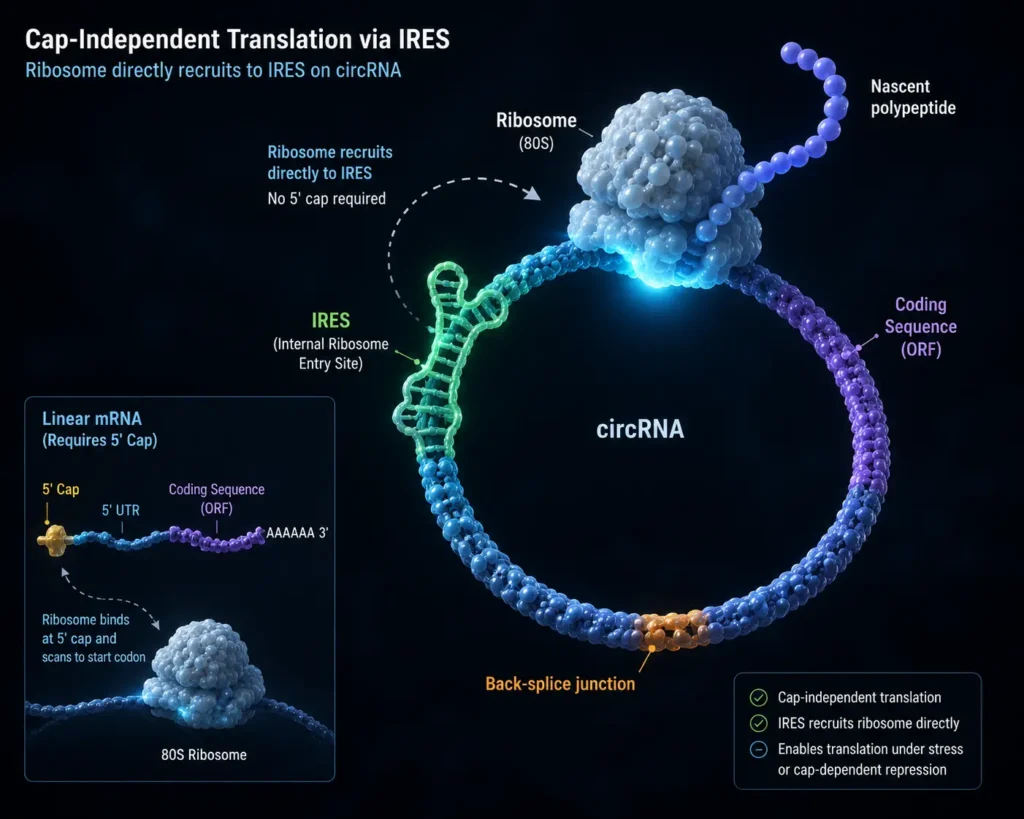
Closing the loop solves degradation, but introduces a new problem: ribosomes (the cellular machines that read RNA to make proteins) require a 5′ cap to know where to start reading. Because a circle has no 5′ cap, it should theoretically be silent.
To fix this, bioengineers insert a specific viral DNA sequence called an Internal Ribosome Entry Site (IRES) directly into the circRNA loop. The IRES acts as an internal landing pad. It physically recruits the ribosome directly to the middle of the loop, bypassing the need for a 5′ cap, and initiates continuous, rolling-circle translation of the therapeutic protein.
4. Real-World Consequences: Unbroken Expression
Because the circRNA is immune to exonucleases, it persists in the cytoplasm. The ribosome lands on the IRES, reads the sequence, produces the protein, and then simply loops back around to do it again. This allows a remarkably low dose of circRNA to generate exceptionally high, sustained levels of therapeutic antibodies, antigens, or CAR constructs over weeks, rather than the rapid spike-and-crash kinetics of linear mRNA.
Clinical Applications: In Vivo CAR-T and circRNA Vaccines
The clinical deployment of circRNA is shifting from basic vaccine research into complex oncology and autoimmune applications.
In Vivo CAR-T Therapy (Therorna TI-0032): In 2026, Therorna advanced TI-0032 into a first-in-human investigator-initiated trial for recurrent autoimmune diseases. Using a targeted lipid nanoparticle (tLNP), the circRNA is delivered directly to the patient’s T-cells in the bloodstream. The loop instructs the T-cells to express Chimeric Antigen Receptors (CARs) targeting CD19 on malignant B-cells. This achieves rapid, complete B-cell depletion in a single, off-the-shelf infusion without the toxic pre-conditioning required by traditional CAR-T.
Therapeutic Cancer Vaccines (TI-0093): Standard prophylactic vaccines need only a short burst of antigen to train the immune system. Eradicating an established solid tumor, however, requires a sustained immune assault. CircRNA cancer vaccines provide durable, long-term expression of tumor-specific antigens (such as HPV16). This sustained presentation balances T-helper support with aggressive CD8+ T-cell activation, continuously training the immune system to break through the tumor microenvironment over weeks.
Protein Replacement Therapies: For rare genetic diseases where a patient’s liver fails to produce a vital enzyme, standard linear mRNA requires highly frequent, burdensome redosing. Because a single circRNA transcript can survive and translate in the cytoplasm for vastly longer periods, the therapeutic redosing window can theoretically be extended from once a week to once a month, drastically improving patient quality of life.
Economic & Strategic Impact
The core strategic value of circRNA is the establishment of a New Intellectual Property (IP) Moat.
The linear mRNA landscape is a legal minefield. Giants like Moderna, BioNTech, and Arbutus Biopharma are locked in endless, multi-billion-dollar patent litigation over the foundational IP of lipid nanoparticles and pseudouridine chemical modifications.
CircRNA represents a clean slate. Because the molecular topology is fundamentally different, companies pioneering circRNA are establishing entirely new, unencumbered patent estates covering backsplicing mechanisms, specific IRES sequences, and “scarless” circularization methodologies. For major pharmaceutical companies looking to enter the RNA space without paying exorbitant licensing royalties to early mRNA pioneers, acquiring or partnering with circRNA platforms is the premier strategic bypass.
Advantages
- Extreme Biological Durability: The lack of 5′ and 3′ ends renders the molecule highly resistant to exonuclease-mediated degradation, significantly extending the duration of therapeutic protein expression.
- Low Innate Immunogenicity (If Pure): Unlike heavily modified linear mRNA, highly purified circRNA can evade certain cellular alarm systems (like Toll-like receptors), reducing the risk of a dangerous inflammatory response.
- Enhanced Manufacturing Efficiency: Because it does not require the expensive enzymatic addition of a 5′ cap or a poly(A) tail during manufacturing, the theoretical large-scale production cost of circRNA is inherently lower once purification hurdles are solved.
Limitations
- The Purification Bottleneck: The backsplicing manufacturing process is imperfect. It inevitably creates unwanted linear RNA fragments and double-stranded RNA (dsRNA). If these impurities are injected into a human, they trigger massive, toxic immune reactions. Developing industrial-scale purification to achieve 99.9% pure circular monomers remains the industry’s heaviest technical burden.
- IRES Optimization: Cap-independent translation via IRES is generally weaker and more difficult to control than natural cap-dependent translation. Finding the exact viral IRES sequence that drives massive protein output in a specific human tissue requires immense computational screening.
- Large Construct Complexity: While making small circRNA loops is standard, engineering massive loops (e.g., to encode a complex, multi-domain CAR-T protein) often results in the RNA tangling on itself or failing to circularize efficiently in the bioreactor.
Common Misconceptions
Misconception: CircRNA alters the patient’s DNA permanently.
Reality: Just like linear mRNA, circRNA only exists in the cytoplasm of the cell. It never enters the nucleus where the human genome is stored, and it does not integrate into the patient’s DNA. It is a highly durable, but ultimately transient, software instruction.
Misconception: CircRNA is totally invisible to the immune system.
Reality: While it avoids exonucleases, the immune system has other sensors (like RIG-I) that can detect foreign RNA shapes. CircRNA is not intrinsically “immune-silent.” Its safety depends entirely on how perfectly “scarless” the circularization is and how flawlessly the manufacturing process removes dsRNA contaminants.
Misconception: It is just an updated COVID vaccine.
Reality: While circRNA can be used for vaccines, the massive venture capital backing is focused on oncology and gene silencing. The true value of circRNA is delivering complex proteins (like monoclonal antibodies or gene editors) directly into tissues over long durations, effectively turning the patient’s own body into a localized bioreactor.
What Most People Miss
The disruptive capability of Circular Prodrug Nucleic Acids (CPNs) for Gene Silencing.
Most market analysis focuses on circRNA’s ability to express a protein. What most analysts miss is its emerging utility as a stealth delivery vehicle for gene silencing.
Companies are designing CPNs—oligonucleotides maintained in a circular form. While closed, they are totally inert and highly stable in the bloodstream. However, they are engineered to be recognized and cleaved (cut open) only when they enter a specific diseased cell (by an endogenous enzyme like RNase H or Dicer). Once the circle is cut, it instantly unfurls into active short interfering RNA (siRNA), shutting down the diseased gene. This allows massive doses of highly stable RNAi therapeutics to circulate safely, activating only precisely where the pathology exists.
Comparison Table
| Feature | Linear mRNA Therapeutics | Viral Vector Gene Therapy (AAV) | Circular RNA (circRNA) |
| Genetic Structure | Linear (Exposed ends) | Double/Single-Stranded DNA | Covalently Closed Loop |
| Duration of Expression | Short (Days) | Years to Permanent | Moderate to Long (Weeks/Months) |
| Translation Initiation | 5′ Cap-dependent | Host Cell Machinery | Cap-independent (IRES-driven) |
| Degradation Vulnerability | High (Exonucleases) | Low | Low (Resistant to Exonucleases) |
| Redosing Capability | Excellent | Very Poor (Neutralizing Antibodies) | Excellent |
| Integration Risk | Zero | Low to Moderate | Zero |
Case Study
Situation: The treatment of refractory autoimmune diseases and aggressive B-cell lymphomas heavily relies on targeting the CD19 antigen. While ex vivo CAR-T therapies successfully target CD19, they are prohibitively expensive, logistically complex, and subject patients to toxic lymphodepleting chemotherapy.
Challenge: Develop a therapy capable of reprogramming a patient’s T-cells in situ (directly inside their body) to hunt CD19 cells, requiring an RNA payload stable enough to survive the bloodstream and drive massive, durable CAR expression upon entering the T-cell.
Solution (Therorna TI-0032): In May 2026, Therorna showcased preclinical and early clinical progress for TI-0032 at the American Society of Gene & Cell Therapy (ASGCT). TI-0032 combined a CD19-directed CAR encoded on Therorna’s proprietary splint-free circRNA payload, wrapped in a specialized T-cell-targeted lipid nanoparticle (tLNP) designed to avoid accidental accumulation in the liver.
Outcome: The preclinical data was definitive. The circRNA payload generated durable CAR expression in primary human T-cells for over 14 days, achieving >95% B-cell cytotoxicity. In humanized mouse models, a single low dose resulted in robust in vivo CAR expression and complete B-cell depletion within 24 hours. This success propelled TI-0032 into a first-in-human investigator-initiated trial (IIT) for autoimmune diseases, making it the first circRNA-based in vivo CAR-T therapy to reach patients globally.
Lessons Learned: The advancement of TI-0032 verified that circRNA is the mandatory architecture for in vivo cellular reprogramming. It proved that by matching a perfectly circularized, highly durable RNA payload with precise lipid targeting, biotech can safely generate sophisticated immunotherapies on demand inside the patient, permanently decoupling cell therapy from the specialized laboratory.
Future Outlook
Next 12–24 Months
The era of Phase 1 Validation and Clean-PIE Manufacturing. Through 2026 and 2027, the industry’s focus will remain fixated on the Phase 1 safety readouts of early clinical candidates. Investors will demand proof that chronic, repeated infusions of circRNA do not trigger unwanted innate immune storms in humans. Behind the scenes, the critical battle will be won in biomanufacturing. Proprietary algorithms (like circDesign) and novel autocatalytic intron splicing techniques (like Clean-PIE) will be rapidly scaled up to guarantee the commercial production of 99.9% pure, dsRNA-free circular transcripts.
Next 3–5 Years
The scaling of In Vivo Oncology Combinations. As the safety profile is established, circRNA will move aggressively into mainstream oncology. By 2030, we will see the clinical trials of circRNA vectors encoding complex monoclonal antibodies and T-cell engagers (like Therorna’s CircMab platform). A patient with a solid tumor will receive a single injection that instructs their own body to produce massive, localized doses of immune-stimulating antibodies directly inside the tumor microenvironment, combining the precision of biologics with the low cost of RNA.
Next 10 Years
The End of Transient Genetic Medicine. By the mid-2030s, the utilization of linear mRNA will be relegated almost entirely to seasonal infectious disease vaccines. For any therapeutic application requiring sustained biological intervention—from protein replacement therapies for rare liver diseases to localized regenerative factors for heart failure—covalently closed circular architectures will be the undisputed baseline. The ability to program a genetic loop to sit safely in a cell and emit medicine for exactly 45 days will become the standard engineering module of modern pharmacology.
Most Likely Scenario
Circular RNA represents the elegant, topological solution to the fundamental fragility of nucleic acid therapeutics. While manufacturing purity remains a steep, capital-intensive barrier, the sheer pharmacokinetic superiority of an exonuclease-resistant payload guarantees its dominance. The biotechnology firms that secure the foundational patents on “scarless” loop ligation and IRES optimization will dictate the next twenty years of the programmable medicine revolution.
Key Takeaways
- Circular RNA (circRNA) therapeutics utilize a 3′–5′ covalent linkage to form a closed genetic loop, protecting the RNA from the exonuclease enzymes that rapidly destroy standard linear mRNA.
- Because it lacks exposed ends, circRNA is vastly more durable inside human cells, allowing a single dose to produce therapeutic proteins for weeks rather than days.
- A circle lacks the traditional “5′ cap” needed to start making proteins. CircRNA solves this by using an Internal Ribosome Entry Site (IRES) to act as an internal landing pad for cellular machinery.
- In 2026, companies like Therorna advanced the first circRNA-based in vivo CAR-T therapies (TI-0032) into human trials, aiming to treat autoimmune diseases with a single, off-the-shelf injection.
- The primary challenge facing the industry is manufacturing purity. During production, if stray pieces of linear RNA or double-stranded RNA are left behind, they can trigger severe, toxic immune reactions in patients.
- CircRNA provides a massive strategic advantage to pharmaceutical companies by offering a clean intellectual property (IP) landscape, entirely bypassing the multi-billion-dollar patent wars surrounding legacy linear mRNA.
Glossary
3′–5′ Covalent Linkage: The chemical bond that fuses the “tail” (3′ end) of an RNA strand to its “head” (5′ end), finalizing the unbreakable circular topology of circRNA.
Backsplicing: The biological or engineered manufacturing process where a downstream splice donor joins with an upstream splice acceptor to form a circular RNA molecule.
Exonuclease: An enzyme naturally found in human cells that degrades RNA by “chewing” it up starting from an exposed 5′ or 3′ end.
Internal Ribosome Entry Site (IRES): A specific viral genetic sequence inserted into circRNA. It physically attracts the ribosome (the cell’s protein factory) to the middle of the loop, bypassing the need for a traditional 5′ cap.
In Vivo CAR-T: An advanced therapy where genetic instructions (circRNA) are injected directly into a patient’s bloodstream to reprogram their T-cells on the fly, eliminating the need to harvest the cells and engineer them in an outside laboratory.
Targeted Lipid Nanoparticle (tLNP): A microscopic fat bubble engineered with specific homing molecules to safely deliver circRNA to a precise tissue (like a T-cell) without accidentally dumping the payload in the liver.
Sources
Business Wire: Therorna to Showcase Clinical-Ready Circular RNA in vivo CAR-T and CircRNA Pipeline at the 2026 American Society of Gene & Cell Therapy (ASGCT) Annual Meeting (May 11, 2026)
PatSnap: Circular RNA therapeutic pipeline: patents and players (April 20, 2026)
Frontiers in Immunology: Circular RNA therapeutics: a new class of long-acting RNA medicines for oncology, immunology, and rare diseases (2026)
ResearchGate: Engineering circular RNA medicines (July 10, 2026)
BIO Partnering / JPM Week 2026: Therorna Inc. Corporate Profile (January 2026)