Advertisement
)
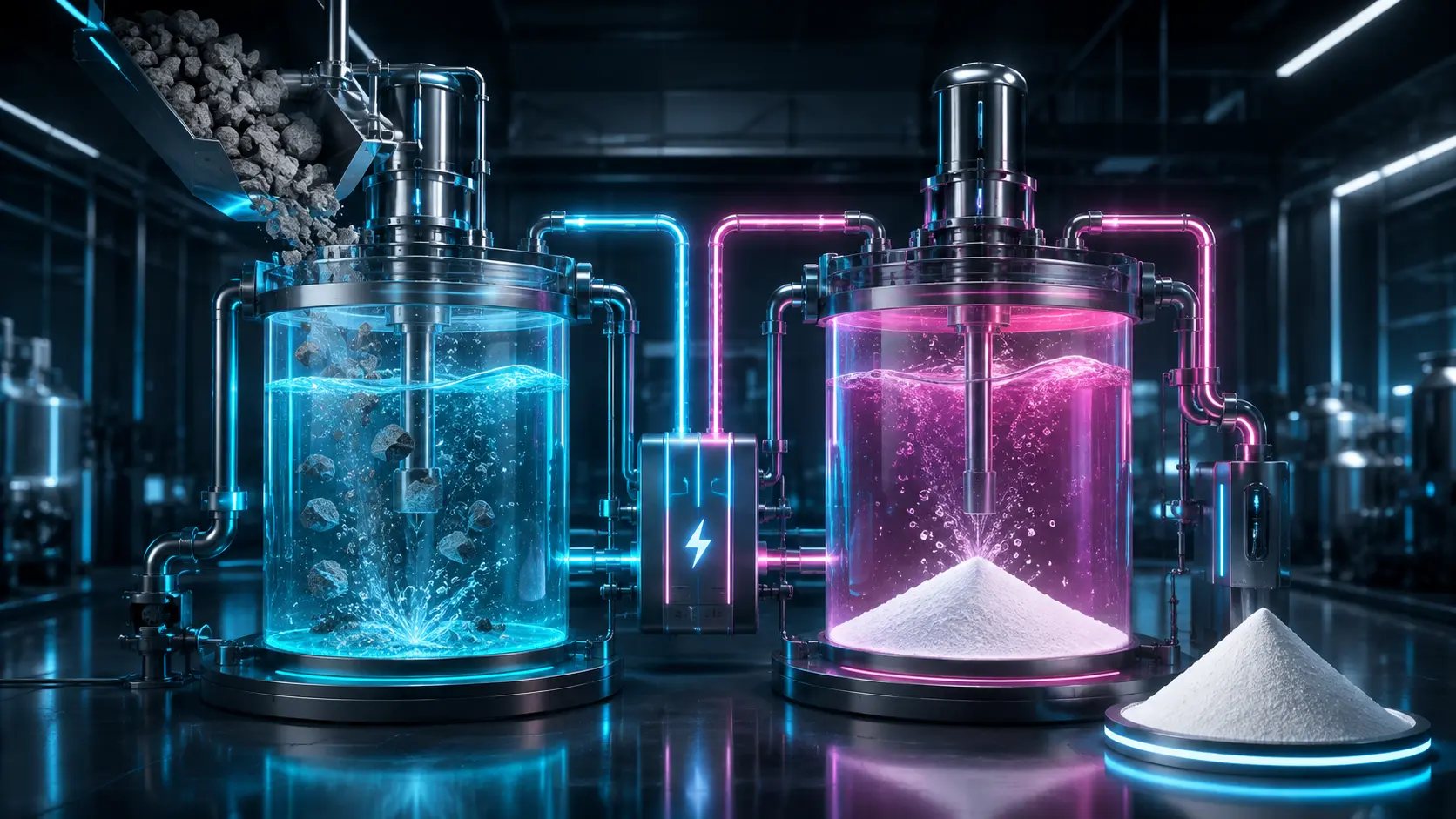

If the global cement industry were a country, it would be the third-largest carbon emitter on Earth, trailing only China and the United States. To build modern civilization, humanity crushes mountains of limestone and bakes them in colossal, coal-fired kilns at 1450°C. But the true climate threat is not just the coal. The very chemistry of baking limestone forces the rock to physically exhale massive clouds of carbon dioxide. Even if a traditional cement plant were powered entirely by zero-carbon solar panels, the rocks themselves would still bleed millions of tons of greenhouse gases into the atmosphere. For decades, engineers believed the only solution was to build multi-billion-dollar carbon capture pipelines to catch the exhaust after it was created.
Why should you care right now? Because the industrial world has just figured out how to build the foundation of our cities without ever lighting a match. By deploying “Electrochemical Cement Production,” scientists have eliminated the smokestack entirely. Instead of using fire, this technology uses renewable electricity and room-temperature water to chemically dissolve rocks and extract pure, zero-carbon cement. As companies like Sublime Systems launch their first commercial-scale manufacturing plants in 2026, this ambient-temperature breakthrough is rapidly transitioning from a laboratory experiment into a highly scalable, trillion-dollar disruption of the global construction supply chain.
What is Electrochemical Cement Production?
Electrochemical cement production is a low-temperature industrial process that manufactures cement using aqueous electrolysis rather than fossil-fueled combustion. By using an electrical current to split water into acid and base solutions, the system dissolves calcium-bearing rocks and precipitates reactive cementitious materials without releasing thermal or chemical carbon dioxide.
At a Glance
- Concept: Replacing a massive, 1450°C fiery kiln with a cool, electrified liquid bath to chemically extract the binding ingredients of concrete.
- Why it matters: Standard cement production creates 8% of all global CO2. Electrochemical cement creates 0%, solving one of the most stubborn “hard-to-abate” industrial climate problems.
- Who uses it: Deep-tech industrial startups (like Sublime Systems), green building developers, and government agencies mandating zero-carbon procurement for federal infrastructure.
- Biggest takeaway: This process can use rocks that do not contain carbon (like calcium silicates), meaning the rock doesn’t bleed CO2 when it is processed, completely eliminating the need for expensive carbon-capture smokestack retrofits.
In Simple Words
Imagine you want to extract sugar baked inside a hard, solid brick of toffee.
The Traditional Cement method is to toss the toffee brick into a massive, dirty, coal-fired bonfire. The extreme heat melts the toffee, but the fire creates a massive cloud of toxic black smoke that goes straight into the atmosphere.
The Electrochemical Cement method involves no fire at all. Instead, you place the toffee brick into a gentle bath of water. You run a clean electrical current through the water, which quietly changes the water’s chemistry. The water gently dissolves the toffee, and the pure sugar safely settles at the bottom of the bath where you can scoop it up.
By replacing the violent, dirty bonfire with a quiet, electrified liquid bath, we can extract the exact same building material without polluting the sky.
Why This Matters
For Industrial Engineers, ESG Investors, and Supply Chain Directors, cement is the ultimate bottleneck to achieving corporate “Net Zero” pledges.
Cement demand is perfectly inelastic; humanity cannot stop building bridges, dams, data centers, and housing. Historically, the only way an ESG fund could decarbonize a cement portfolio was to invest in Carbon Capture, Utilization, and Storage (CCUS)—a highly expensive, parasitic technology that attempts to scrub carbon from a factory’s dirty exhaust. Electrochemical cement skips CCUS entirely. It attacks the problem at the root chemistry. By eliminating the kiln, it drastically simplifies plant permitting, eliminates the need to route massive carbon pipelines across the country, and produces a premium, zero-carbon building material that commands massive subsidies under global green infrastructure mandates.
The Decarbonization Problem of Traditional Cement
To appreciate the elegance of electrolysis, you must understand the brutal math of traditional calcination.
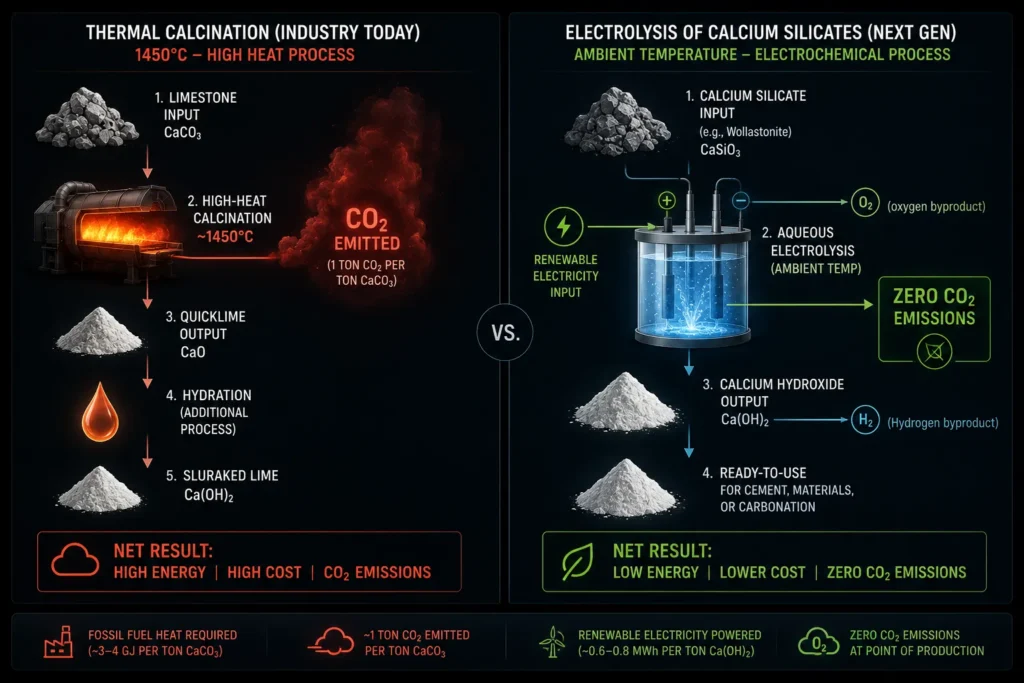
To make Ordinary Portland Cement (OPC), you must produce “clinker.” This requires heating limestone (CaCO₃) until it chemically shatters into lime (CaO) and carbon dioxide (CO₂). This chemical reaction (CaCO₃ → CaO + CO₂) is non-negotiable in traditional kilns. Roughly 60% of a cement plant’s emissions are unavoidable “process emissions” baked into the rock itself. The remaining 40% comes from the fossil fuels burned to reach 1450°C.
Electrochemical cement dismantles this entire equation. It operates at room temperature (eliminating the thermal 40%), and it utilizes non-carbonate rocks or industrial waste (eliminating the chemical 60%). It is a total, clean-sheet redesign of Roman-era construction chemistry.
How Electrochemical Cement Production Works
Extracting reactive calcium without thermal combustion requires precise manipulation of pH gradients. Here is the first-principles breakdown of the architecture.
1. The Fundamental Problem: Bound Carbon
Limestone is calcium carbonate. The carbon is physically trapped in the rock. If you use heat to extract the calcium, the carbon escapes as a gas. To make zero-carbon cement, you must either find a way to extract calcium without heat, or use a rock that doesn’t have carbon in it to begin with. Electrochemical cement does both.
2. The Core Mechanism: Aqueous Electrolysis
The heart of the process is an electrolyzer—a large tank of water equipped with specialized membranes and electrodes. When renewable electricity is pumped into the tank, the machine splits the water (H₂O) into two distinct pH gradients: a highly acidic solution at the anode, and a highly basic (alkaline) solution at the cathode.
3. Technical Depth: Dissolution and Precipitation
- The Acid Dissolution: The acidic solution is piped into a vat containing crushed calcium-silicate rocks. Unlike limestone, calcium silicates do not contain carbon. The acid aggressively dissolves the rock, stripping the calcium out into a liquid solution, leaving behind solid silica (a useful byproduct).
- The Alkaline Precipitation: The calcium-rich liquid is then routed to interact with the basic (alkaline) solution generated by the cathode. The sudden shift in pH causes the calcium to undergo precipitation, dropping out of the liquid as pure, solid, highly reactive Calcium Hydroxide (Ca(OH)₂).
4. Real-World Consequences: The Final Blend
This pure calcium hydroxide is then blended with the reactive silica created in the first step. When shipped to a construction site and mixed with water and sand, it cures into calcium-silicate-hydrate (C-S-H)—the exact same hardened, rock-solid chemical binder that gives traditional Portland cement its immense structural strength.
5. Intermittent Power Optimization
Because traditional kilns operate at 1450°C, they can never be turned off; letting the brick lining cool down destroys the furnace. The kiln must burn coal 24/7. An electrochemical bath operates at ambient temperatures. If the wind stops blowing or the sun stops shining, the plant can instantly dial down its electricity consumption, acting as a massive demand-response battery for the renewable power grid.
Commercial Deployments: Sublime Systems and Green Infrastructure
Electrochemical cement is moving off the lab bench and into foundational infrastructure.
Sublime Systems’ Holyoke Commercial Facility: In 2026, MIT spin-out Sublime Systems is spearheading the commercialization of this technology. Backed by a historic $87 million grant from the U.S. Department of Energy’s Office of Clean Energy Demonstrations (OCED), the company is scaling up its first commercial manufacturing plant in Holyoke, Massachusetts. The site, built on a former paper mill, utilizes the region’s clean hydroelectric power to run its electrolyzers, targeting tens of thousands of tons of true zero-carbon cement to supply regional green-building projects.
Green Public Procurement (Buy Clean Task Force): Governments are the largest buyers of concrete on Earth. The U.S. General Services Administration (GSA) and the Federal Highway Administration have instituted strict “Buy Clean” mandates, actively preferring construction materials with ultra-low Global Warming Potential (GWP) metrics. Electrochemical cement perfectly satisfies these requirements, allowing contractors bidding on multi-billion-dollar federal infrastructure projects (highways, military bases) to win contracts by utilizing zero-carbon foundation materials.
Hyperscaler Data Center Construction: Tech giants like Microsoft, Amazon, and Google have committed to becoming carbon negative by 2030. While they buy renewable energy for their servers, the physical concrete required to build a 1-gigawatt data center generates devastating “Scope 3” supply chain emissions. By partnering directly with advanced cement producers, these hyperscalers are eliminating the embodied carbon of their physical real estate.
Economic & Strategic Impact
The core economic disruption is the elimination of the Capital Expenditure (CapEx) of Carbon Capture.
For legacy cement giants (like Holcim, Lafarge, or Heidelberg), the mandated path to decarbonization relies on bolting massive Amine Scrubbing carbon-capture facilities onto the exhaust stacks of their existing kilns. This requires a staggering CapEx investment—often hundreds of millions of dollars per plant—plus the ongoing parasitic energy cost to run the scrubbers, and the logistical nightmare of piping the captured CO₂ into underground geological storage.
Electrochemical cement requires none of this. Because there is no CO₂ exhaust, there is no need for pipelines, scrubbers, or injection wells. The CapEx is dedicated entirely to the electrolyzers. As global electrolyzer costs plummet due to concurrent scaling in the green hydrogen industry, the electrochemical cement plant transforms from an expensive deep-tech experiment into a fundamentally cheaper, safer, and less heavily regulated industrial asset.
Advantages
- Absolute Zero-Carbon Potential: Eliminates both the fossil fuels burned for heat and the chemical carbon released from the rock, enabling true net-zero manufacturing when paired with renewable energy.
- Ambient Temperature Operations: Operating at room temperature allows the facility to quickly ramp its electricity usage up or down, acting as a flexible load to balance volatile wind and solar grids.
- Raw Material Flexibility: Can extract reactive calcium from globally abundant calcium silicate rocks, or upcycle hazardous industrial waste like steel slag and demolished concrete.
- No Carbon Pipelines: By avoiding the creation of CO2 entirely, the plant bypasses the severe regulatory, environmental, and NIMBY (Not In My Backyard) hurdles associated with building carbon capture and storage networks.
Limitations
- Massive Electrical Demand: Breaking chemical bonds with electricity requires staggering amounts of power. The process is only economically and environmentally viable if the plant is located next to a massive, incredibly cheap source of renewable electricity (like a dedicated hydro dam or a gigawatt-scale wind farm).
- Supply Chain Logistics: The global cement industry is currently built on top of limestone quarries. Shifting to calcium silicate rocks requires establishing entirely new mining and transportation supply chains for the raw feedstocks.
- Conservative Construction Standards: The construction industry is notoriously slow to adopt new materials due to catastrophic liability risks. New cement formulations must undergo agonizingly slow, multi-year certification processes (like ASTM International standards) before engineers will legally authorize them for use in load-bearing structural columns.
Common Misconceptions
Misconception: They just use electricity to heat up a traditional kiln instead of coal.
Reality: That is “electric calcination,” which still relies on 1450°C heat and still releases massive amounts of chemical CO2 from the limestone. Electrochemical cement is entirely different; it is a room-temperature, liquid-based chemical extraction process with zero combustion.
Misconception: The final concrete is weaker than traditional concrete.
Reality: Electrochemical cement cures into Calcium-Silicate-Hydrate (C-S-H), which is the exact same chemical binder that gives traditional Ordinary Portland Cement its immense strength. When mixed and cured, it meets or exceeds standard compressive strength requirements.
Misconception: Concrete and Cement are the same thing.
Reality: Cement is the “glue.” Concrete is the final product. Concrete is made by mixing roughly 10-15% cement powder with water, sand, and gravel (aggregates). The electrochemical process strictly replaces the dirty manufacturing of the 15% “glue.”
What Most People Miss
The disruptive capacity for Circular Economy Waste Upcycling.
Most analysts focus on electrochemical cement’s ability to use clean calcium silicate rocks. What they miss is the technology’s ability to operate as a massive industrial recycling engine.
Heavy industries produce millions of tons of waste that are rich in calcium but unusable in traditional kilns—most notably, steel slag (the toxic byproduct of steelmaking) and the crushed rubble of demolished concrete buildings. Because the electrochemical acid bath is highly aggressive, it can break down this waste, stripping out the pure calcium and leaving the impurities behind. This allows a cement plant to be located directly next to a steel mill or a major urban demolition site, turning a city’s architectural trash directly into pristine, zero-carbon foundation material for its next skyscrapers.
Comparison Table
| Feature | Ordinary Portland Cement (OPC) | Kiln Carbon Capture (CCUS) | Electrochemical Cement |
| Operating Temperature | 1450°C | 1450°C | Ambient (~25°C) |
| Primary Energy Source | Coal / Fossil Fuels | Coal / Fossil Fuels | Renewable Electricity |
| Limestone Required? | Yes | Yes | No (Uses Calcium Silicates) |
| Chemical CO2 Emissions | Massive | Captured (Requires Pipeline) | Zero |
| Grid Flexibility | None (Must run 24/7) | None (Must run 24/7) | High (Can ramp up/down instantly) |
Case Study
Situation: The global construction sector demanded a scalable zero-carbon cement to meet rigorous 2030 corporate sustainability goals. However, the traditional pathway—retrofitting legacy kilns with amine-scrubber carbon capture technology—proved to be astronomically expensive, parasitic to the plant’s energy grid, and heavily dependent on the existence of unbuilt carbon pipeline infrastructure.
Challenge: Prove that cementitious materials could be extracted at commercial volumes without thermal calcination, avoiding the release of chemical CO₂ while still producing a drop-in replacement binder that meets structural safety codes.
Solution (The Sublime Systems Holyoke Plant): Following successful pilot-scale validation, MIT spin-out Sublime Systems initiated the construction of its first commercial manufacturing facility in Holyoke, Massachusetts, targeted for 2026. Leveraging the region’s legacy hydroelectric infrastructure to secure cheap, reliable zero-carbon electricity, the company deployed massive, bespoke electrolyzers to scale their proprietary room-temperature dissolution process.
Outcome: Supported by an $87 million federal grant, the Holyoke facility established the critical techno-economic baseline for the industry. By successfully utilizing abundant calcium-silicate rocks and eliminating the thermal kiln, the plant demonstrated a scalable pathway to true zero-carbon cement. The facility’s output secured major advance purchase agreements from green developers and tech hyperscalers looking to eliminate Scope 3 emissions from their real estate portfolios.
Lessons Learned: The deployment validated that the highest hurdle to industrial decarbonization is not chemistry, but thermodynamics. By proving that the violent heat of the traditional kiln can be entirely replaced by the elegant precision of aqueous electrolysis, Sublime Systems demonstrated that heavy industry can be fundamentally electrified, establishing a blueprint to eradicate the 8% global carbon footprint of the cement sector.
Future Outlook
Next 12–24 Months
The era of ASTM Certification and Demonstration Plants. Through 2026 and 2027, the focus of the electrochemical cement industry will be twofold: achieving continuous, commercial-scale production at sites like Holyoke, and securing universal regulatory validation. Securing ASTM C1157 (Standard Performance Specification for Hydraulic Cement) is critical. As third-party engineers formally certify that this ambient-temperature cement meets all 28-day compressive strength, shrinkage, and durability requirements, the final legal barriers for global civil engineering adoption will fall.
Next 3–5 Years
The scaling of Co-Located Industrial Symbiosis. By the late 2020s, the model will shift from standalone pilot plants to deeply integrated industrial hubs. Electrochemical cement facilities will be built directly adjacent to major steel manufacturing hubs and massive gigawatt-scale wind/solar farms. By feeding on cheap, curtailed renewable electricity and utilizing the calcium-rich steel slag waste generated right next door, these symbiotic mega-complexes will achieve unit economics that rival, and eventually undercut, legacy fossil-fueled cement kilns facing rising global carbon taxes.
Next 10 Years
The Stranded Asset Crisis for Legacy Kilns. By the mid-2030s, the technological shift will trigger a brutal financial reckoning for the traditional cement industry. Global carbon pricing regimes (like the EU’s Carbon Border Adjustment Mechanism) will penalize CO₂ emissions so heavily that operating a coal-fired limestone kiln will become economically unviable. Companies that spent billions retrofitting old kilns with complex, failing carbon capture pipelines will be saddled with stranded assets. Electrochemical manufacturing will become the undisputed, mandated standard for all new global infrastructure development, cementing the transition to an electrified industrial base.
Most Likely Scenario
Electrochemical cement production is the ultimate “leapfrog” technology. It bypasses the agonizing, expensive attempts to capture pollution from smokestacks by simply eliminating the smokestack altogether. As renewable electricity prices continue to fall globally, the thermodynamic superiority of a room-temperature, flexible-load liquid bath ensures that electrolysis will inevitably replace thermal combustion as the definitive engine of human construction.
Key Takeaways
- Traditional cement manufacturing causes 8% of global CO2 emissions because baking limestone (
CaCO₃) in a massive, 1450°C coal-fired kiln physically releases bound carbon dioxide gas. - Electrochemical cement production eliminates the kiln entirely. It uses renewable electricity to split room-temperature water into an acid and a base.
- The acid dissolves non-carbonate rocks (like calcium silicates) or industrial waste, and the base precipitates pure, reactive calcium hydroxide to create the cement.
- Because the process uses rocks that don’t contain carbon and doesn’t require fossil fuels for heat, the process is truly zero-carbon and requires no expensive carbon capture pipelines.
- In 2026, MIT spin-out Sublime Systems began scaling this technology at its first commercial plant in Holyoke, Massachusetts, backed by major government and tech-sector funding.
- The primary challenge to scaling is the massive amount of renewable electricity required to run the electrolyzers, making cheap, green power the absolute bottleneck for the industry.
Glossary
Aqueous Electrolysis: A chemical process that uses an electrical current to drive a reaction in water, splitting it into positively charged acid and negatively charged base gradients.
Calcination: The traditional, highly polluting process of heating limestone (CaCO₃ to extreme temperatures (1450°C) to break it down into lime (CaO) and carbon dioxide (CO₂).
Calcium Silicate: A class of rocks that contain massive amounts of calcium but, crucially, do not contain carbon. They are the primary zero-carbon feedstock for electrochemical cement.
Clinker: The dark, nodular material created inside a traditional cement kiln after calcination, which is then ground into a fine powder to make Portland cement.
Scope 3 Emissions: Indirect greenhouse gas emissions that occur in a company’s value chain. For a tech company, the concrete used to build their data centers is a massive Scope 3 liability.
Sublime Systems: A leading deep-tech industrial company, spun out of MIT, that successfully commercialized the electrochemical cement manufacturing process.
Sources
Sublime Systems: Sublime Systems Awarded $87M from U.S. DOE to Scale Ultra-Low Carbon Cement Production (2026)
Sublime Systems: Our Technology – Electrochemical Cement Manufacturing
MIT Technology Review: Making cement without the massive carbon footprint
U.S. Department of Energy (DOE): Office of Clean Energy Demonstrations – Industrial Decarbonization
International Energy Agency (IEA): Cement – Tracking Clean Energy Progress