Advertisement
)
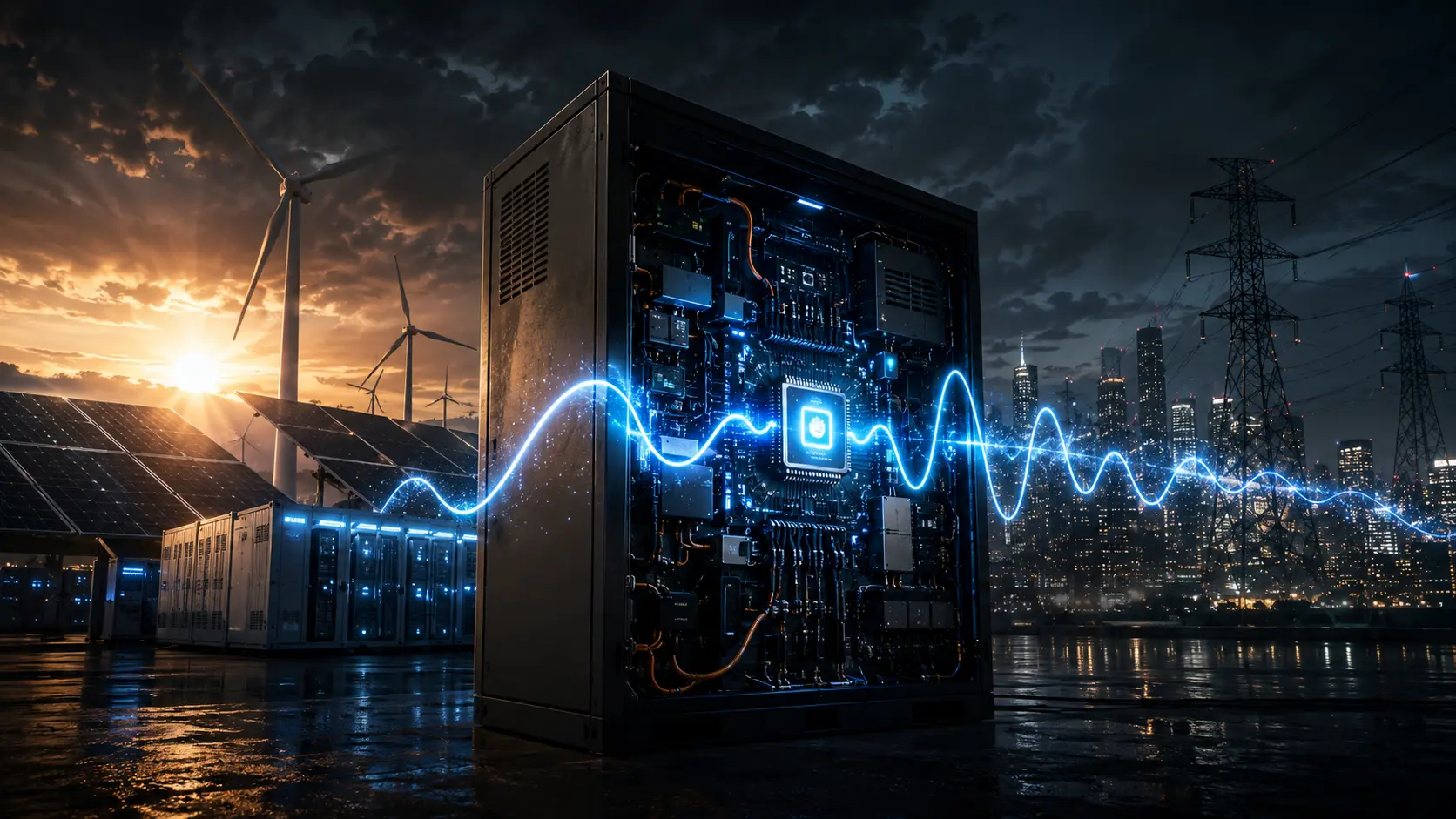

When a massive power plant suddenly trips offline, the entire electrical grid shudders. For the last century, the only thing preventing this shudder from turning into a cascading, continental blackout has been thousands of tons of spinning steel. Coal, gas, and nuclear plants use massive physical turbines that spin continuously. This heavy, rotating mass possesses kinetic energy—”inertia”—that acts as an invisible shock absorber, physically refusing to let the grid’s frequency drop too fast. But as the world replaces these spinning turbines with silent, motionless solar panels and wind farms, the grid is losing its physical shock absorbers.
Why should you care right now? Because without spinning metal, the power grid becomes dangerously brittle, prone to instantaneous collapse at the slightest disturbance. To survive, energy engineers are deploying Grid-Forming Inverters (GFIs). Instead of relying on heavy steel, these devices use advanced microchips and software to digitally hallucinate the physics of a 500-ton spinning turbine. By generating “synthetic inertia,” GFIs are the invisible software patch allowing the global economy to transition to 100% renewable energy without turning off the lights.
What is Grid-Forming Inverters (GFIs)?
Grid-Forming Inverters (GFIs) are advanced power electronics that convert direct current (DC) into alternating current (AC) while autonomously establishing and maintaining the grid’s voltage and frequency. Unlike standard inverters, GFIs utilize control algorithms to simulate the mechanical inertia of traditional spinning generators, stabilizing highly renewable power networks.
At a Glance
- Concept: Programming the computers attached to solar farms and mega-batteries to mathematically act like massive, heavy, physical steam engines.
- Why it matters: It removes the fundamental physical limit on renewable energy. Currently, grid operators have to intentionally turn off solar panels and turn on expensive gas plants just to keep enough spinning mass on the grid. GFIs make this unnecessary.
- Who uses it: Mega-battery operators (like Tesla and Fluence), island grid operators (Hawaii, Puerto Rico), and pioneering transmission networks (AEMO in Australia).
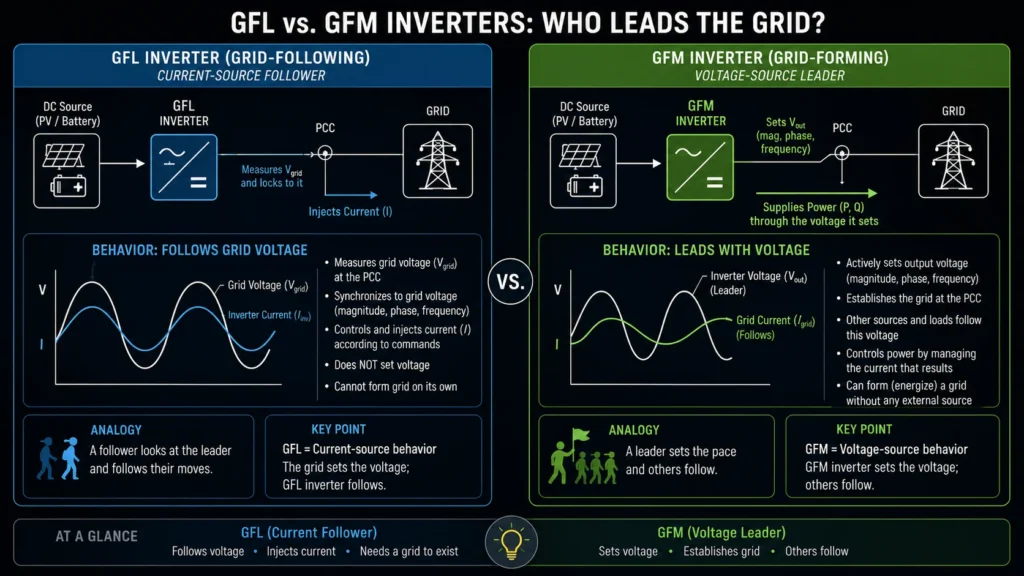
- Biggest takeaway: Standard inverters are “followers”—they need the grid to tell them what the frequency is. Grid-forming inverters are “leaders”—they dictate the frequency themselves and can actually restart a dead grid from scratch (Black Start).
In Simple Words
Think of the power grid as a massive symphony orchestra.
A traditional Coal or Gas Plant is the conductor. It sets the tempo (the grid frequency, 60Hz in the US). Because it is massive and heavy, it has a very steady, unwavering rhythm.
A standard Grid-Following Inverter (what connects almost all current solar panels to the grid) is a musician in the orchestra. It wears an earpiece, listens to the conductor, and plays along perfectly. However, if the conductor suddenly has a heart attack and stops, the musician panics, doesn’t know what tempo to play, and stops playing entirely.
A Grid-Forming Inverter (GFI) is a musician equipped with a highly advanced metronome. It doesn’t just listen to the conductor; it acts as a backup conductor. If the main conductor drops dead, the GFI instantly steps up, broadcasts the perfect 60Hz tempo, and forces the rest of the orchestra to keep playing perfectly in sync. It uses computer software to provide the exact same leadership and stability as the heavy, spinning steam turbine.
Why This Matters
For Grid Planners, Utility Engineers, and Power Electronics VCs, the lack of inertia is the single most expensive bottleneck in the energy transition.
As renewable penetration passes 50% in regions like Texas (ERCOT) or Germany, the Rate of Change of Frequency (RoCoF) during a grid disturbance becomes violently fast. To prevent collapse, grid operators regularly curtail (throw away) free wind and solar power, and pay fossil-fuel plants to spin their turbines without actually producing net electricity—a process known as “must-run” generation. This costs consumers billions of dollars annually. Grid-Forming Inverters eradicate this cost. By providing inertia synthetically through batteries or curtailed solar, GFIs decouple grid stability from carbon emissions, allowing operators to safely run grids with near-100% instantaneous renewable penetration.
The Shift from Physical to Synthetic Inertia
The evolution of the inverter is shifting the electrical grid from an electromechanical system to a purely solid-state, digitized network.
For the first 130 years of electrification, stability was dictated by Isaac Newton’s laws of motion. A grid disturbance was met by the physical resistance of rotating mass. Moving into the late 2020s, stability is dictated by lines of code written in C++ running on a Digital Signal Processor (DSP) inside an inverter cabinet. This paradigm shift means the grid can respond to disturbances not in the seconds it takes a heavy steel rotor to adjust, but in the micro-milliseconds it takes a silicon carbide (SiC) transistor to switch, offering a theoretical level of grid stability far superior to legacy fossil-fuel architecture.
How Grid-Forming Inverters (GFIs) Work
Creating synthetic inertia requires hacking the physics of alternating current (AC) power. Here is the first-principles breakdown of the architecture.
1. The Fundamental Problem: The Swing Equation
In a traditional grid, stability is governed by the swing equation:
P(mechanical) – P(electrical) = J * ω * (dω/dt)
(Where P is power, J is the physical moment of inertia of the spinning turbine, ω is the angular frequency, and (dω/dt) is the Rate of Change of Frequency). If electrical demand suddenly spikes, the frequency (ω) drops. A large physical mass (J) slows that drop down, giving the power plant time to inject more steam. Solar panels have no moving parts, so their J is exactly zero.
2. The Insufficiency of Grid-Following (GFL) Inverters
Standard GFL inverters act as Current Sources. They use a software component called a Phase-Locked Loop (PLL) to read the grid’s existing voltage sine wave, and they inject current exactly on top of it. If a short circuit happens and the grid’s voltage gets mangled, the PLL fails to find the signal. The inverter becomes “blind,” disconnects for safety, and exacerbates the blackout.
3. The Core Mechanism: The Voltage Source
A Grid-Forming Inverter (GFM) acts as a Voltage Source. It does not look for a signal to follow; it generates its own perfect, internal 60Hz voltage sine wave and pushes it through an internal impedance out onto the grid. It acts like an unyielding electrical anchor.
4. Technical Depth: Virtual Synchronous Generator (VSG)
To mimic the physical turbine, engineers program the GFI with a Virtual Synchronous Generator (VSG) algorithm. The DSP inside the inverter literally runs the mathematical swing equation in real-time. If it senses the grid frequency dropping, the software “hallucinates” that it is a heavy spinning rotor slowing down. It instantaneously commands the battery or solar array to inject a massive burst of real power (active power) into the grid to arrest the frequency drop, reacting in milliseconds.
5. Real-World Consequences: Weak-Grid Dynamic Stability
Because GFIs establish their own voltage, they do not suffer from PLL failure in “weak grids” (areas with low Short Circuit Ratios, like the end of a long rural transmission line). Furthermore, because they are voltage sources, they have Black Start capability. If a city loses total power, a GFI mega-battery can autonomously energize the dead power lines and establish the 60Hz heartbeat necessary for the rest of the grid’s standard solar and wind farms to wake up and sync to.
Commercial Applications for Grid-Forming Inverters
Grid-Forming technology is rapidly migrating from remote island microgrids into the backbone of continental infrastructure.
Mega-Battery Retrofits (Hornsdale Power Reserve): Originally famous as the “Tesla Big Battery” in South Australia, the Hornsdale facility was initially equipped with standard Grid-Following inverters. As the region’s wind and solar capacity soared, the grid became terrifyingly unstable. In 2022, Tesla deployed a massive software update, upgrading the site’s inverters to “Virtual Machine Mode” (Grid-Forming). The battery suddenly provided roughly 15% of the entire state’s required inertia, purely through algorithmic voltage control, stabilizing one of the most volatile grid segments on Earth.
100% Renewable Island Grids (Kauai, Hawaii): Islands cannot import physical inertia from neighboring countries via transmission lines; they must generate their own. On islands like Kauai, where daytime solar generation frequently exceeds 100% of consumer demand, standard inverters would crash the grid. By deploying massive solar-plus-storage facilities equipped exclusively with GFIs, the island successfully turns off its diesel generators entirely during the day, maintaining a flawless 60Hz heartbeat using purely synthetic inertia.
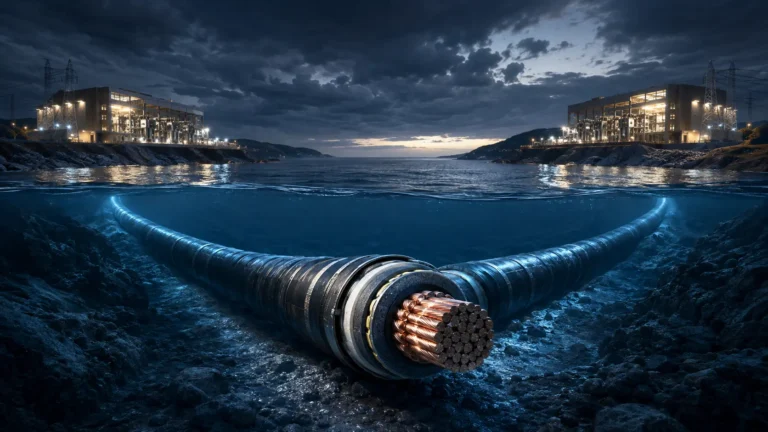
Offshore Wind High-Voltage Direct Current (HVDC) Links: When massive offshore wind farms transmit power to the mainland, the power is often converted to Direct Current (DC) for the undersea cable. When it reaches the shore, it must be converted back to Alternating Current (AC). Using grid-forming power electronics at these onshore converter stations ensures that the massive influx of offshore wind actually strengthens the coastal AC grid’s voltage stability, rather than relying on mainland fossil-fuel plants to hold the voltage steady.
Economic & Strategic Impact
The deployment of GFIs is forcing the creation of an entirely new financial market: The Inertia Market.
Historically, inertia was a free byproduct. When a utility bought power from a coal plant, they paid for the megawatts; the stabilizing spinning mass of the turbine was thrown in for free.
Because wind and solar do not provide this for free, grid operators in regions like the UK (National Grid ESO) and Australia (AEMO) are now establishing “Stability Markets” and “Fast Frequency Response” (FFR) markets. They are actively paying battery operators purely for the service of acting as a grid-forming shock absorber. For power electronics VCs and energy investors, securing grid-forming capabilities is no longer just a technical necessity; it is a highly lucrative, standalone revenue stream that drastically improves the Net Present Value (NPV) of a utility-scale battery deployment.
Advantages
- Decouples Stability from Carbon: Allows grid operators to permanently retire heavy, spinning coal and gas turbines without sacrificing the physical stability of the transmission network.
- Instantaneous Response Time: While a massive physical steel turbine takes seconds to fully react to a frequency drop, a solid-state GFI detects and reacts to the mathematical frequency derivative ((dω/dt) in under a millisecond.
- Black Start Capability: A grid-forming battery can autonomously wake up, establish a local voltage grid, and energize community power lines after a catastrophic hurricane or storm without waiting for the centralized utility to repair the main transmission lines.
Limitations
- Hardware Overcurrent Limits: A physical steel turbine can absorb a massive, temporary short-circuit current spike (up to 6 times its normal rating) without breaking. The silicon chips inside an inverter will melt instantly if current exceeds roughly 1.2 times their rating. GFIs require extremely complex, protective software algorithms to limit current during a fault, briefly compromising their “voltage source” behavior to avoid hardware destruction.
- Sub-Synchronous Resonance (SSR): When thousands of complex, algorithm-driven GFIs are attached to the same grid, their software control loops can accidentally interact with each other and the physical transmission wires. This can create invisible, high-frequency mathematical resonances that severely damage grid equipment.
- Lack of Unified Standards: Unlike the physical physics of a spinning magnet, which are universally identical, every inverter manufacturer (Tesla, SMA, Fluence) writes their proprietary GFI software differently. Ensuring these different “black box” algorithms play nicely together on the same grid remains a massive headache for utility planners.
Common Misconceptions
Misconception: Synthetic inertia requires massive batteries.
Reality: While batteries are the most common application, a wind turbine or a solar farm can provide synthetic inertia without a battery, provided it is curtailed. If a solar farm is operating at 90% capacity, it can use the reserved 10% “headroom” to instantly inject a burst of active power via a GFI to arrest a frequency drop.
Misconception: GFIs generate actual spinning mass.
Reality: There are no moving parts. “Synthetic inertia” is purely a mathematical illusion. The inverter mathematically calculates how a heavy spinning turbine would act in the current situation, and precisely injects electrical current to mimic that exact physical effect.
Misconception: Grid-following inverters will become obsolete immediately.
Reality: A grid does not need 100% grid-forming inverters. Current consensus suggests that if roughly 20% to 30% of the inverters on the grid are Grid-Forming (acting as the leaders), the remaining 70% can safely remain cheaper, standard Grid-Following inverters (acting as the followers).
What Most People Miss
The imminent demise of the Phase-Locked Loop (PLL).
For decades, the PLL has been the foundational algorithm of the renewable energy sector, allowing every solar panel on Earth to safely sync to the grid.
What most people miss is that as we approach a 100% inverter-based grid, the PLL becomes a mathematical liability. A PLL relies on measuring a strong, stable voltage wave. But if every device on the grid is just following the voltage, who is setting the voltage? It becomes a room full of followers waiting for someone else to lead. The transition to Grid-Forming architectures fundamentally rips out the PLL and replaces it with droop control and VSG logic, marking the most significant architectural rewrite of electrical engineering since the war of the currents between Edison and Tesla.
Comparison Table
| Feature | Synchronous Condenser (Spinning Steel) | Grid-Following Inverter (GFL) | Grid-Forming Inverter (GFM / GFI) |
| Inertia Type | Physical / Kinetic | None | Synthetic / Algorithmic |
| Circuit Behavior | Voltage Source | Current Source | Voltage Source |
| Synchronization | Electromechanical | Phase-Locked Loop (PLL) | Droop Control / VSG |
| Black Start Ability | Yes | No | Yes |
| Overcurrent Capacity | Extreme (High fault tolerance) | Very Low (Hardware limits) | Very Low (Requires software protection) |
| Response Speed | Slow (Seconds) | Fast (Grid-dependent) | Instantaneous (Sub-millisecond) |
Case Study
Situation: The Australian National Electricity Market (NEM) was experiencing world-leading penetration rates of distributed rooftop solar and utility-scale wind. In states like South Australia, this resulted in critically low system strength and a severe lack of mechanical inertia, leaving the grid highly vulnerable to cascading blackouts if a major interconnector to a neighboring state tripped.
Challenge: The traditional regulatory solution was to force renewable generators to curtail their output and mandate that expensive, high-emission gas generators spin continuously purely to provide inertia and system strength.
Solution (The AEMO GFM Initiative): The Australian Energy Market Operator (AEMO) collaborated with private operators to validate Grid-Forming capabilities. In 2022, the Hornsdale Power Reserve (a 150MW battery) had its inverters software-upgraded to Virtual Machine Mode. Shortly after, the massive 300MW Victorian Big Battery was also commissioned with grid-forming capabilities.
Outcome: The grid-forming batteries successfully demonstrated the ability to provide massive inertial response and establish localized voltage without relying on physical synchronous generators. The success prompted AEMO to officially draft new engineering frameworks outlining the integration of 100% inverter-based operation, proving that software-defined inertia could securely replace gigawatts of fossil-fuel baseload.
Lessons Learned: The Australian proving ground demonstrated that synthetic inertia is not just theoretically viable; it is commercially superior. By upgrading inverters via software, operators unleashed massive latent value in existing battery assets, confirming that the ultimate bottleneck to a 100% renewable grid is a software configuration, not a physical impossibility.
Future Outlook
Next 12–24 Months
The era of Mandatory GFM Interconnection Standards. In the immediate term, major transmission operators (like ERCOT in Texas and National Grid in the UK) will finalize grid codes that mandate grid-forming capabilities for all new massive Battery Energy Storage System (BESS) interconnections. Original Equipment Manufacturers (OEMs) like SMA, Sungrow, and Tesla will standardize VSG software as a baseline feature rather than an expensive, bespoke upgrade, rapidly commoditizing synthetic inertia in the utility-scale battery market.
Next 3–5 Years
The scaling of Renewable-Direct GFM (No Batteries Required). While batteries dominate the early GFM narrative, the mid-2020s will see the technology heavily integrated directly into wind turbines (Type 4 full-converter models) and massive utility-scale solar farms. By utilizing operational “headroom”—intentionally holding back 5% of their generating capacity—these wind and solar assets will use GFM algorithms to provide primary frequency response and synthetic inertia directly from the sun and wind, vastly improving the economic resilience of independent power producers.
Next 10 Years
The 100% Inverter-Based Continental Grid. By the mid-2030s, regions like California, South Australia, and parts of Europe will successfully run their transmission grids for hours or days at a time with exactly zero physical synchronous generators connected. The electrical grid will function entirely as a distributed, solid-state, algorithmic mesh. “Inertia” will no longer be viewed as a physical necessity of mass, but simply as a configurable parameter in a cloud-based grid management dashboard.
Most Likely Scenario
Grid-Forming Inverters are the definitive final puzzle piece of the renewable energy transition. While the raw energy comes from solar panels and wind blades, the actual stability that keeps modern society functioning will be provided entirely by the microchips and droop-control algorithms inside the inverters. Heavy, spinning steel will be relegated to the history books, entirely replaced by the algorithmic physics of the GFM revolution.
Key Takeaways
- Grid-Forming Inverters (GFIs) use software to mathematically simulate the massive, spinning weight of traditional fossil-fuel power plants, stabilizing renewable-heavy power grids.
- Traditional solar and wind inverters are “Grid-Following.” They need an existing, stable grid to function and will shut down if the power goes out, preventing them from fixing a blackout.
- GFIs act as “Voltage Sources,” meaning they dictate the 60Hz frequency of the grid themselves and can restart a completely dead grid from scratch (Black Start).
- They utilize Virtual Synchronous Generator (VSG) algorithms to generate “synthetic inertia,” instantly injecting power into the grid to arrest dangerous frequency drops in milliseconds.
- Because inverters are made of silicon and lack the physical robustness of a heavy steel turbine, they cannot absorb massive current spikes, requiring complex software to prevent them from melting during a short circuit.
- Pioneering projects, like the software upgrade of the Hornsdale Power Reserve in Australia, have proven that GFIs can successfully replace the inertia of retiring coal plants on a continental scale.
Glossary
Black Start: The incredibly difficult process of restoring an electric power station or a part of an electric grid to operation without relying on the external electric power transmission network. GFIs have this capability; standard inverters do not.
Grid-Following Inverter (GFL): A standard inverter that acts as a current source. It relies on a Phase-Locked Loop (PLL) to read the grid’s voltage and inject power. It cannot function without an established, strong grid.
Inertia: The kinetic energy stored in large, heavy, physically spinning objects (like the steam turbines in a coal plant). It acts as a shock absorber for the power grid, resisting sudden changes in frequency.
Phase-Locked Loop (PLL): The software algorithm used by standard grid-following inverters to detect and lock onto the grid’s existing voltage waveform.
RoCoF (Rate of Change of Frequency): A metric describing how fast the grid’s frequency drops when a power plant fails. A high RoCoF indicates a highly unstable, low-inertia grid.
Virtual Synchronous Generator (VSG): A control algorithm inside a grid-forming inverter that mathematically models the physical behavior of a traditional spinning power plant, effectively digitizing Newton’s laws of motion.
Frequently Asked Questions
Does a grid-forming inverter require a battery to work?
No, but it needs an energy buffer. While batteries are perfect because they store energy, a wind turbine or a solar farm can act as a grid-forming inverter if it is intentionally operating slightly below its maximum output (curtailed). It uses that reserved 5-10% of “headroom” to inject the burst of power needed for synthetic inertia.
If the inverter has no moving parts, where does the “inertia” come from?
The inertia is entirely synthetic. When the inverter’s computer senses the grid frequency dropping, it simply releases a massive, calculated burst of electricity from the battery. To the power grid, this sudden injection of electricity looks and acts exactly like a heavy spinning turbine pushing back against the drop.
Can an inverter survive a lightning strike on the power lines?
This is their main weakness. A traditional spinning metal turbine can easily survive a massive surge of current caused by a lightning strike or a short circuit. The silicon chips inside an inverter will melt if the current exceeds their limits, so they must rely on hyper-fast protective software to limit the current, which temporarily weakens their ability to hold the grid steady.
Will all future solar panels have grid-forming inverters?
Not necessarily. The grid only needs a certain percentage of “leaders” to maintain stability. Most experts believe that if roughly 20% to 30% of the grid consists of Grid-Forming inverters, the remaining 70% can safely remain the cheaper, standard Grid-Following inverters.
How does this impact my home solar system?
Most residential solar inverters are standard grid-following models, which is why your solar panels shut off during a neighborhood blackout. Upgrading home systems to hybrid, grid-forming setups (often paired with a home battery) allows your house to “island” itself and keep the lights on when the main utility grid collapses.