Advertisement
)

Imagine a massive, three-mile-long freight train hurtling across the Great Plains at 60 miles per hour, carrying 15,000 tons of cargo. For the last 150 years, the only thing keeping this steel behemoth from smashing into the train ahead of it has been a primitive system of physical red and green traffic lights. Because heavy freight trains require miles to physically stop, these fixed “blocks” force human dispatchers to leave massive, empty, wasted gaps between trains. In a global economy desperate for supply chain efficiency, this 19th-century traffic jam is suffocating the global logistics network.
Why should you care right now? Because the physical traffic light is officially obsolete. Major railways are ripping out static signals and handing control of the network over to advanced algorithms. By utilizing continuous GPS telemetry and real-time braking physics, a technology known as Moving Block Signaling—built upon the backbone of Positive Train Control (PTC)—allows massive freight trains to operate safely nose-to-tail. It is an algorithmic decoupling of rail freight, artificially expanding the capacity of existing railroad tracks without laying a single new piece of steel, and laying the technological groundwork for the deeply controversial era of the unmanned ghost train.
What is Moving Block Signaling (PTC)?
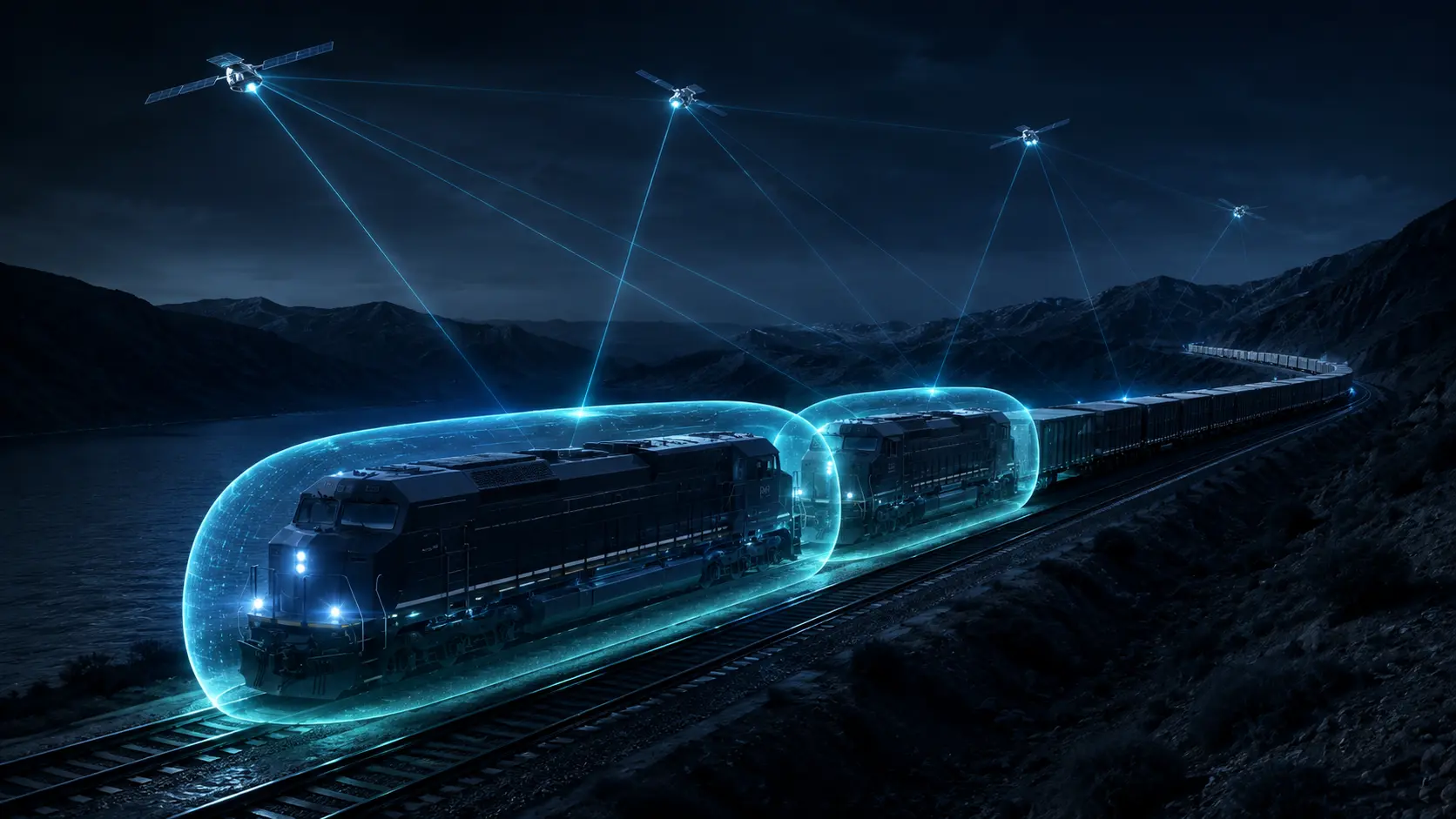
Moving Block Signaling (PTC) is an advanced railway dispatching system that replaces physical track signals with real-time, GPS-driven algorithms. By continuously calculating a train’s exact speed, weight, and braking distance, it creates a dynamic, invisible safety envelope around the train, safely allowing multiple trains to travel significantly closer together to maximize track capacity.
At a Glance
- Concept: Upgrading train networks from driving based on fixed traffic lights spaced 5 miles apart, to driving based on a highly precise, algorithmic “radar cruise control” that adjusts continuously.
- Why it matters: Building new railway tracks costs millions of dollars per mile. Moving Block software artificially increases the capacity of existing tracks by up to 40% for a fraction of the capital expenditure.
- Who uses it: Class 1 Railroads (Union Pacific, BNSF, CSX), heavy-haul mining railways (Rio Tinto in Australia), and advanced urban transit systems (using CBTC equivalents).
- Biggest takeaway: The system requires a supercomputer to calculate the exact braking physics of every single train in real-time, taking into account the train’s precise weight, the steepness of the hill, and the friction of the steel wheels.
In Simple Words
Think of a traditional highway where the rule is: Only one car is allowed between every two mile-markers. Even if the cars are driving slowly and can stop instantly, they are forced to stay a full mile apart. This is Fixed Block Signaling. It wastes an enormous amount of space because the safety rules are rigid and physical.
Now, imagine equipping every car with advanced radar and Wi-Fi. The cars talk to each other and a central computer. The computer says, You don’t need to stay a mile apart. You just need to stay exactly your braking distance apart. If you are driving slow, you can drive 20 feet behind the next car. If you speed up, the computer pushes you back to 100 feet. The safety zone “moves” with you. This is Moving Block Signaling.
By applying this to three-mile-long freight trains, railways can pack dozens of trains onto a track that previously only held a few, drastically accelerating the movement of cargo across the continent.
Why This Matters
For Logistics Executives and Supply Chain Analysts, network velocity is the ultimate metric of profitability.
Following the implementation of Precision Scheduled Railroading (PSR), Class 1 railways optimized their assets by making trains longer and heavier. However, you cannot run longer trains if the network’s physical infrastructure limits how closely they can follow each other. Moving Block Signaling is the digital key that unlocks the next phase of PSR. By condensing the spatial headway between trains, logistics companies ensure that intermodal shipping containers arriving at congested ports (like Los Angeles or Long Beach) can be evacuated inland via rail twice as fast, preventing the catastrophic port bottlenecks that paralyze global trade.
The Link Between Positive Train Control (PTC) and Moving Block
The evolution of Moving Block is deeply intertwined with the U.S. government mandate for Positive Train Control (PTC).
Following a series of fatal train collisions, Congress mandated that all major railways install PTC—a safety overlay designed to automatically brake a train if the human engineer ignored a red light or sped into a curve. The rail industry spent over $15 billion grudgingly installing the GPS antennas, track transponders, and onboard computers necessary for PTC.
However, once that massive digital infrastructure was in place, rail executives realized they had inadvertently built a continent-spanning, real-time telemetry network. By upgrading the software running on the PTC hardware, they could transition from purely defensive safety (stopping crashes) to offensive capacity building (Moving Block). They turned a $15 billion regulatory compliance cost into a permanent competitive advantage.
How Moving Block Signaling Calculates Braking Curves
Managing the kinetic energy of a 15,000-ton moving object requires absolute mathematical precision. Here is the first-principles breakdown of the architecture.
1. The Fundamental Problem: Kinetic Energy and Fixed Blocks
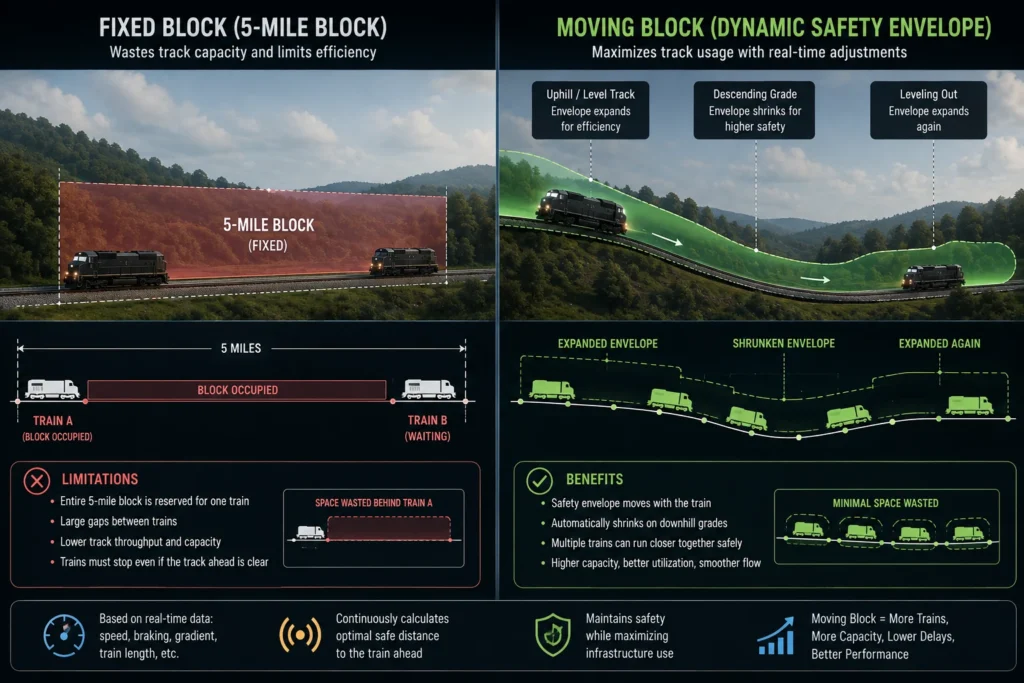
A heavy freight train cannot stop quickly; its steel wheels on steel rails provide very little friction. In legacy Fixed Block systems, the track is divided into physical segments. If a train is in Block B, Block A’s traffic light turns red. Because the dispatcher does not know exactly where the train is inside Block B, or how heavy the train behind it in Block A is, the blocks must be deliberately oversized (often 2 to 5 miles long) to account for the absolute worst-case braking scenario.
2. The Core Mechanism: Continuous Telemetry
In a Moving Block system, the physical track circuits and traffic lights are abandoned. Every locomotive is equipped with advanced GPS, inertial measurement units (IMUs), and continuous radio links (e.g., 220 MHz band) that transmit its exact coordinates, speed, and heading to a centralized Back Office Server (BOS) multiple times per second.
3. Technical Depth: Dynamic Braking Algorithms
The system calculates a dynamic “Target Speed” and a “Braking Curve” for every train. To calculate the braking curve, the onboard computer must process:
- Total train mass and length (tonnage profile).
- The number of operational braking axles.
- The exact topographical gradient (uphill vs downhill) of the track ahead.Using the kinematic equation for braking distance (s = v² / 2a), the algorithm constantly adjusts the required stopping distance.
4. The Safety Envelope
This calculation generates a virtual “Safety Envelope”—a digital red zone that extends in front of and behind the train. This envelope shrinks when the train is moving slowly uphill, and expands massively when the train is speeding downhill.
5. Real-World Consequences: Platoon Running
Because the central server knows the exact size of every train’s safety envelope, it permits the trailing train to continuously drive right up to the edge of the leading train’s envelope. The human engineer is given a screen showing a target speed. If the leading train brakes, the trailing train’s computer automatically applies its own brakes to maintain the exact mathematical distance, effectively allowing massive freight trains to “platoon” like digitally tethered autonomous trucks.
Active Deployments of CBTC and Moving Block Systems
Moving Block technology is moving from isolated mine networks to the central arteries of global commerce.
Heavy-Haul Mining Operations (Rio Tinto’s AutoHaul): The most advanced realization of this architecture is in the remote Pilbara region of Australia. Rio Tinto operates a $940 million AutoHaul network, consisting of fully autonomous, unmanned heavy freight trains moving iron ore. Because the trains operate in an isolated, private network with Moving Block dispatching, they run with absolute mathematical efficiency, executing millions of kilometers of autonomous travel without the delays of crew shift changes or human fatigue.
High-Density Passenger Corridors (CBTC): While freight is the new frontier, urban subways pioneered this concept. Known in the transit world as Communications-Based Train Control (CBTC), cities like London, New York, and Paris use moving blocks to pack subway trains 90 seconds apart during rush hour. The freight industry is actively adapting these CBTC principles—scaling them up to account for the vastly different physics of a three-mile-long cargo train.
Class 1 Mainline Integration: In North America, major railways are deploying moving block equivalents (often called “PTC 2.0” or Advanced Train Control Systems) along their most congested corridors, such as the transcontinental routes exiting the Ports of Los Angeles and Long Beach. By shrinking headways on these specific single-track bottlenecks, they avoid the multi-billion dollar cost of blasting through mountains to lay a secondary track.
Economic & Strategic Impact
The ultimate friction point of Moving Block technology is not computational; it is Labor Economics and the One-Person Crew.
For over a century, freight trains have required a minimum of two human operators in the locomotive cab (an engineer and a conductor). The rail unions argue this is essential for safety and handling mechanical failures. Rail executives argue that with Moving Block algorithms and PTC ensuring the train cannot speed or crash, the second human is entirely redundant.
This technological capability has triggered a massive geopolitical and domestic labor war. Rail executives are using the perfection of the moving block algorithm to lobby the Federal Railroad Administration (FRA) to authorize single-person crews, drastically cutting labor overhead (OpEx). If the algorithms prove flawless, the eventual goal of the capital markets is the zero-person crew—fully autonomous, algorithmic rail logistics mirroring the mining networks in Australia.
Advantages
- Massive Capacity Expansion: Can increase the throughput of an existing railway line by 20% to 40%, eliminating the need for expensive physical track expansion.
- Energy Optimization: Because trains do not have to constantly “stop and go” at physical red lights, moving blocks allow for smooth, continuous cruising. This significantly reduces the massive diesel fuel consumption required to accelerate a 15,000-ton train from a dead stop.
- Bi-Directional Flexibility: In fixed block systems, signals are often pointed in one direction. Moving block relies on GPS, allowing dispatchers to dynamically route trains in either direction on a single track with absolute safety.
Limitations
- Communications Dependency: The entire system relies on an unbroken, continuous radio and GPS link between the train and the centralized server. If a train enters a deep valley or tunnel and loses its data link, the system must immediately “fail safe” and force the train to stop, causing network-wide cascading delays.
- Mixed-Traffic Complexity: Moving block works perfectly when all trains are identical. If a slow, heavy coal train is sharing the exact same track as a fast, light passenger train (a common scenario in the U.S.), calculating the dynamic envelopes as they interact becomes an incredibly complex, chaotic computing challenge.
- Vulnerability to Cyberattack: Removing physical, hardwired relays and replacing them with a wireless, software-defined network introduces the risk of remote cyber-sabotage. Hacking the Back Office Server (BOS) could theoretically blind the entire dispatching system.
Common Misconceptions
Misconception: Moving Block means trains can stop instantly like cars.
Reality: The physics of momentum cannot be bypassed. A heavy freight train will always take miles to stop. Moving block simply means the computer knows exactly where that stopping point is down to the inch, rather than guessing and leaving a two-mile buffer.
Misconception: PTC and Moving Block are the exact same thing.
Reality: Positive Train Control (PTC) is the foundational hardware and safety overlay (the GPS and the radio). Moving Block is the advanced software application running on top of the PTC hardware to improve capacity.
Misconception: The system drives the train completely by itself.
Reality: While fully autonomous systems exist (like Rio Tinto), standard Moving Block in North American freight still relies on a human engineer. The computer provides the “target speed” and safety boundaries, and the human operates the throttle—but the computer will aggressively override and brake the train if the human ignores the boundaries.
What Most People Miss
The strategic value of Predictive Maintenance Data.
Most analysts view PTC and Moving Block purely as dispatching tools. What they miss is that a locomotive constantly broadcasting its speed, braking pressure, and track conditions creates a massive, real-time data lake.
By applying machine learning to this telemetry, railways can identify micro-anomalies. If an algorithm notices that every train passing a specific GPS coordinate experiences a slight, unexpected wheel slip, the software can predict that the physical steel rail is fracturing. Maintenance crews can be dispatched to fix the track before it breaks and causes a derailment. Moving Block transforms the train from a dumb vehicle into a hyper-sensitive, rolling diagnostic probe.
Comparison Table
| Feature | Fixed Block Signaling | Moving Block Signaling (PTC-Enhanced) |
| Separation Metric | Physical track segments (Miles apart) | Algorithmic braking curves (Dynamic) |
| Track Infrastructure | Copper circuits, physical traffic lights | GPS, Wi-Fi, Radio towers |
| Network Capacity | Low (Constrained by worst-case safety) | High (Up to 40% improvement) |
| Energy Efficiency | Poor (Frequent stop-and-go) | Excellent (Continuous optimal cruising) |
| Dependency | Physical wiring integrity | Continuous wireless data link |
Case Study
Situation: The North American Class 1 railroads were forced by congressional mandate to spend over $15 billion implementing Positive Train Control (PTC) by 2020. Wall Street viewed this purely as a massive, unrecoverable compliance expense that generated zero direct revenue, pressuring railroad executives to find a return on investment (ROI).
Challenge: Evolve the newly installed, defensive PTC hardware into an offensive, revenue-generating asset capable of moving more freight across congested transcontinental corridors without pouring new concrete.
Solution (The PTC 2.0 / Moving Block Evolution): Major carriers like Union Pacific and BNSF began aggressively developing and testing “PTC 2.0” and quasi-moving block algorithms. They transitioned their dispatching centers from legacy, human-visualized boards to AI-driven network management systems. The software utilized the continuous telemetry of the PTC hardware to calculate dynamic pacing and optimal meet-and-pass scenarios on single-track lines.
Outcome: While full, continent-wide Moving Block is still scaling, the initial application of dynamic pacing algorithms drastically smoothed out network velocity. Trains approached sidings at optimized speeds to pass each other without fully stopping, saving millions of gallons of diesel fuel annually. The continuous data link allowed the railroads to increase the density of their intermodal traffic, proving to Wall Street that the PTC mandate was actually the foundational architecture for the digital railway.
Lessons Learned: The implementation proved that physical infrastructure limits can be bypassed with software. By digitizing the exact physics of the train, logistics companies can decouple their growth from the expensive, politically difficult process of physical track expansion, securing long-term capacity through algorithmic efficiency.
Future Outlook
Next 12–24 Months
The era of Energy Management Systems (EMS) Integration. Over the next two years, the moving block dispatching algorithms will merge directly with locomotive Energy Management Systems (like Wabtec’s Trip Optimizer). The central dispatcher won’t just tell the train where it is safe to go; the software will autonomously command the locomotive’s throttle and dynamic brakes to follow the absolute most fuel-efficient curve possible, minimizing diesel burn down to the drop across an entire 2,000-mile journey.
Next 3–5 Years
The scaling of The Labor Showdown. The technological capacity for single-person crews will reach undeniable maturity. Rail operators will leverage the flawless safety data generated by moving block architectures to aggressively push the Federal Railroad Administration (FRA) to repeal two-person crew mandates. This will trigger massive, highly publicized labor strikes across the global supply chain as unions fight to prevent the algorithmic displacement of the traditional rail conductor.
Next 10 Years
The Fully Autonomous Continental Network. By the mid-2030s, the blueprint established by Rio Tinto’s AutoHaul will migrate to complex, mixed-use commercial networks. Corridors handling purely containerized freight (such as dedicated port-to-inland-hub routes) will transition to fully unmanned operations. The moving block software will achieve absolute spatial optimization, allowing ghost trains to cross the continent separated by mere hundreds of feet, managed by a handful of AI supervisors in a central command bunker, finalizing the algorithmic automation of terrestrial logistics.
Most Likely Scenario
Moving Block Signaling is the unavoidable future of rail logistics. The economic pressure to move more cargo with lower emissions ensures that physical traffic lights will go extinct. While regulatory and union friction will slow the deployment of fully autonomous ghost trains in North America, the underlying software architecture will quietly and permanently take control of the throttle, ensuring the global supply chain operates at mathematical perfection.
Key Takeaways
- Moving Block Signaling replaces physical railway traffic lights with real-time GPS and software algorithms to safely pack more trains onto existing tracks.
- Legacy “Fixed Block” systems force massive, wasted gaps between trains to account for the worst-case braking scenarios of heavy freight.
- Moving Block calculates a dynamic “safety envelope” based on the train’s exact weight, speed, and track gradient, constantly shrinking or expanding the required braking distance.
- The technology is built on the back of Positive Train Control (PTC), turning a $15 billion safety mandate into a massive capacity and efficiency upgrade for logistics companies.
- Because trains no longer have to constantly stop and wait at red lights, the system saves millions of gallons of diesel fuel by allowing continuous, optimized cruising.
- The flawless safety of the algorithm is triggering a massive labor war, as rail executives use the technology to argue that the second human in the locomotive is no longer necessary.
Glossary
Back Office Server (BOS): The centralized supercomputer that receives GPS telemetry from every train, calculates the moving blocks, and broadcasts the dynamic speed limits back to the locomotives.
Communications-Based Train Control (CBTC): The equivalent of moving block signaling used in urban subways to run passenger trains tightly together.
Fixed Block Signaling: The legacy railway system where tracks are divided into physical, electrical segments, and a train is protected by a static red traffic light behind it.
Platooning: The capability of allowing massive freight trains to drive autonomously nose-to-tail, mimicking a single, continuous convoy.
Positive Train Control (PTC): A U.S. mandated safety system using GPS and radio to automatically stop a train before it crashes or speeds. It provides the hardware backbone for Moving Block.
Precision Scheduled Railroading (PSR): A controversial logistics philosophy adopted by major railroads focused on running longer, heavier trains on rigid schedules to maximize asset utilization.
Sources
Federal Railroad Administration (FRA): Positive Train Control (PTC)
Association of American Railroads (AAR): Positive Train Control
Railway Age: Rio Tinto’s AutoHaul: The World’s First Autonomous Heavy-Haul Rail Network
Wabtec Corporation: PTC and Advanced Train Control Systems
Progress Rail (Caterpillar): Energy Management Systems and PTC Interoperability