Advertisement
)
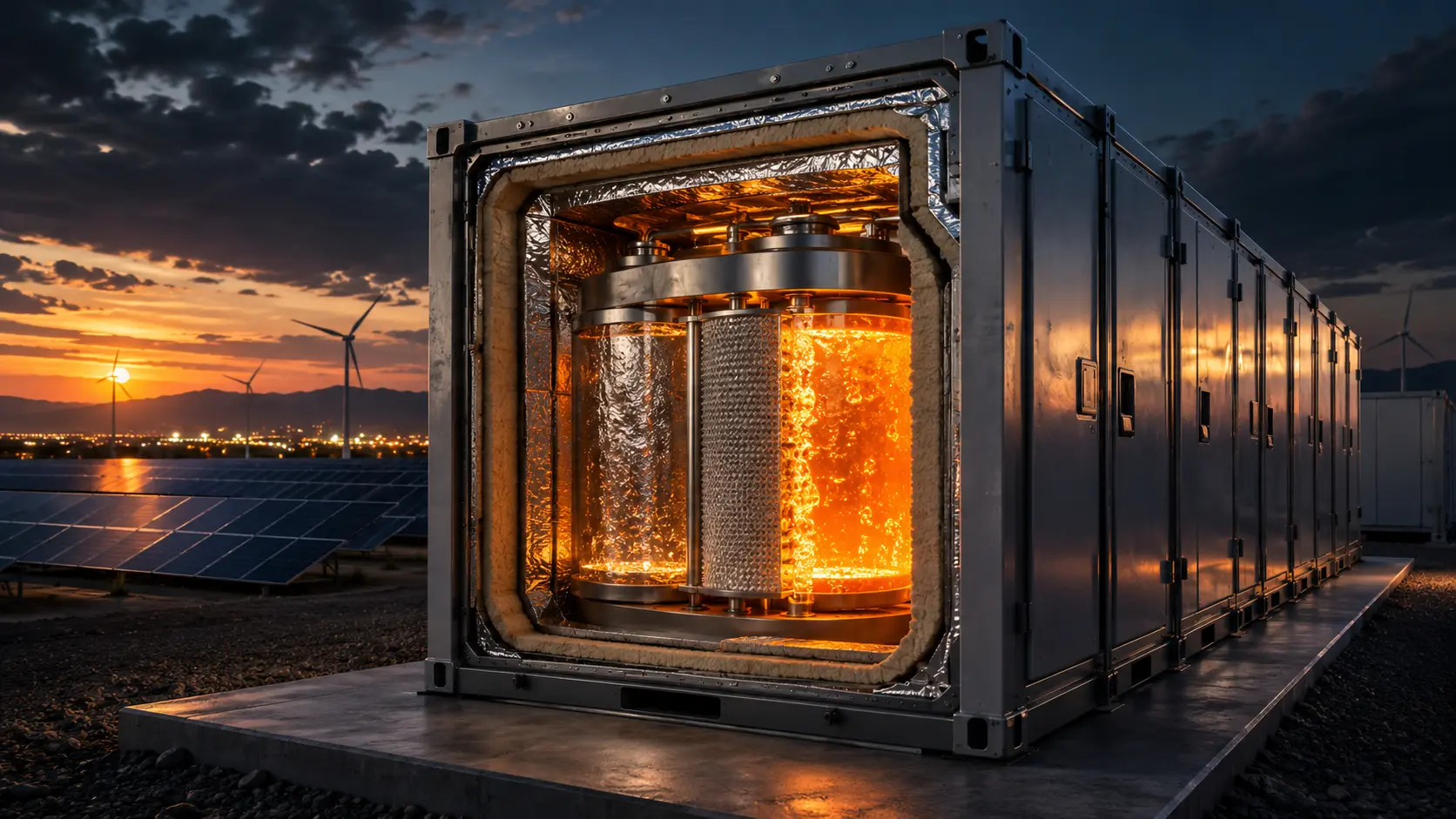

A massive solar farm is only as useful as its ability to keep the lights on after the sun sets. For the past decade, the global energy grid has attempted to solve this storage problem using lithium-ion batteries. While lithium is excellent for running a smartphone or accelerating a lightweight electric vehicle, it faces a harsh physical reality on the industrial grid: it drains completely in roughly four hours, and its chemical capacity steadily degrades with every daily cycle. Attempting to store a city’s worth of solar power to survive a multi-day winter storm using short-duration lithium-ion technology is economically and chemically unviable.
To genuinely replace fossil fuels, the electrical grid requires a battery that does not degrade over decades, can discharge massive amounts of power for extended durations, and is constructed from universally abundant materials. Why should you care right now? Because energy engineers have successfully solved this by abandoning room-temperature solid chemistry altogether. By utilizing heavily insulated shipping containers filled with molten metal operating at 300°C, global utilities are deploying High-Temperature Sodium-Sulfur (NaS) batteries. These ultra-hot liquid batteries sidestep the geopolitical lithium bottleneck entirely, utilizing cheap salt and sulfur to store gigawatts of renewable energy for the modern grid.
What are High-Temperature Sodium-Sulfur (NaS) Batteries?
High-Temperature Sodium-Sulfur (NaS) Batteries are advanced molten-salt energy storage systems that utilize liquid sodium and liquid sulfur separated by a solid ceramic electrolyte. Operating continuously at 300°C, these utility-scale batteries provide highly efficient, long-duration electrical discharge capabilities with minimal degradation, making them ideal for stabilizing massive renewable power grids.
At a Glance
- Concept: A massive industrial battery where the active chemicals are kept so hot that they melt into liquids, allowing them to react with extreme efficiency for decades.
- Why it matters: Standard lithium batteries slowly lose their ability to hold a charge after a few thousand cycles. NaS batteries can cycle every day for 20 years while losing less than 1% of their capacity annually.
- Who uses it: Major utility companies, island microgrids, and hyperscale commercial operators deploying containerized systems manufactured by giants like NGK Insulators and BASF.
- Biggest takeaway: The battery relies on a magical piece of ceramic called “BASE.” It acts as a solid physical wall between the liquid sodium and sulfur, but chemically allows individual sodium ions to pass straight through it.
In Simple Words
If you look inside a normal AA battery or a smartphone battery, you will find solid metals swimming in a liquid chemical bath (the electrolyte). Over time, charging and discharging the battery causes the solid metals to grow microscopic spikes or slowly crumble, which is why your phone battery eventually dies and needs to be replaced.
A Sodium-Sulfur (NaS) Battery perfectly flips this design upside down.
Instead of solid metals in a liquid bath, the NaS battery uses liquid metals separated by a solid wall. The battery is heated to 300°C, causing the sodium and sulfur inside it to melt into liquids. Because the active ingredients are liquids, they cannot crack, crumble, or grow physical spikes. They simply flow back and forth chemically through the solid ceramic wall. Because liquid doesn’t suffer from physical wear-and-tear the way solid metal does, the battery can be charged and discharged every single day for twenty years with almost zero drop in its performance.
Why This Matters
For Utility Planners and Cleantech Investors, Long-Duration Energy Storage (LDES) is the final puzzle piece required to shut down coal and natural gas peaker plants.
As power grids exceed 50% renewable penetration, “four-hour” lithium-ion batteries are insufficient. If a windless, cloudy weather system stalls over a region for two days, four hours of battery backup will not prevent a catastrophic blackout. Utilities require Long-Duration Energy Storage capable of discharging continuously for 6 to 12 hours or more. Because NaS batteries utilize incredibly cheap, globally abundant raw materials (sodium and sulfur) rather than expensive rare-earth metals (cobalt and lithium), the capital cost of scaling them to multi-megawatt, high-capacity installations is highly favorable for deep, utility-scale grid buffering.
The Evolution of Sodium-Sulfur (NaS) Batteries
The Sodium-Sulfur battery is a triumph of materials science, initially pioneered by Ford Motor Company in the 1960s in an early attempt to build electric cars.
While the extreme heat requirement ultimately made them impractical for passenger cars, the chemistry found its true calling in stationary grid storage. Over the last 20 years, the Japanese firm NGK Insulators refined the technology, deploying hundreds of megawatts globally. Today, driven by the intense regulatory push for decarbonization and the global race to escape the lithium supply chain, NaS technology is experiencing a massive commercial renaissance, heavily backed by partnerships with chemical giants like BASF to expand the long-duration energy market.
How Molten-Salt NaS Batteries Work
Managing highly reactive liquid metals requires flawless thermodynamic control. Here is the first-principles breakdown of the NaS architecture.
1. The Fundamental Problem: Solid Degradation
Traditional batteries rely on the physical intercalation of ions into a solid lattice (like pulling books in and out of a bookshelf). Doing this thousands of times eventually damages the solid lattice, causing irreversible capacity fade.
2. The Core Mechanism: Molten Electrodes
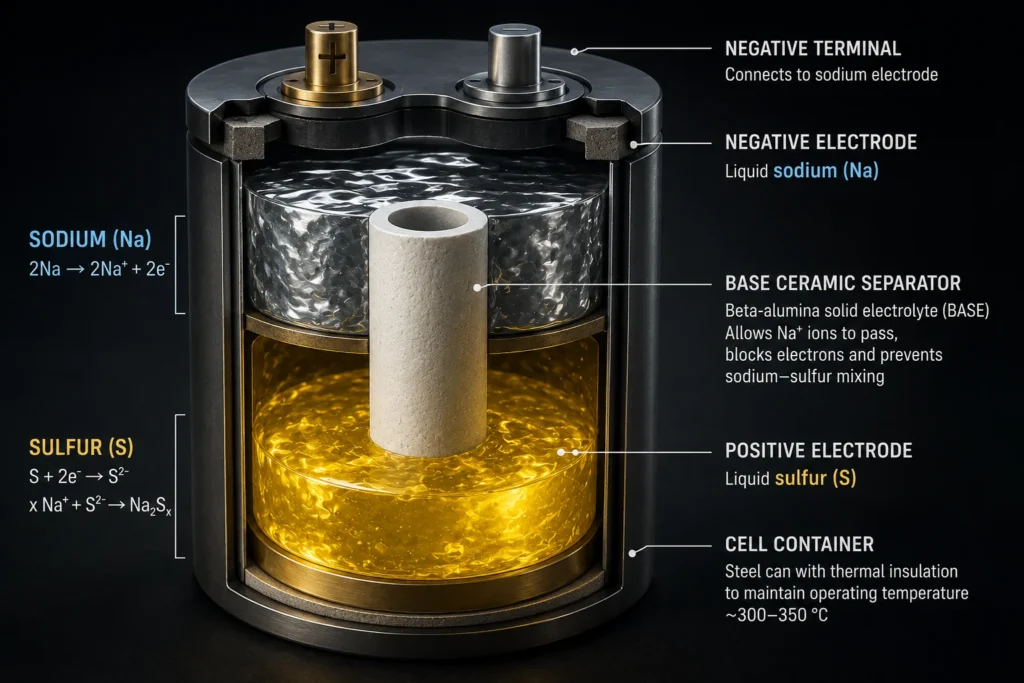
To eliminate this structural wear, the NaS battery uses molten (liquid) elemental sodium as the negative electrode (anode) and molten sulfur as the positive electrode (cathode). Because sodium melts at ~98°C and sulfur at ~119°C, the battery must be heated to approximately 300°C to ensure both materials, and their reaction byproducts, remain in a highly fluid, highly reactive liquid state.
3. Technical Depth: Beta-Alumina Solid Electrolyte (BASE)
The genius of the NaS battery is the solid separator. A cylinder made of Beta-Alumina Solid Electrolyte (BASE)—a non-stoichiometric sodium aluminate (β”-alumina)—physically separates the liquid sodium from the liquid sulfur.
BASE is an exceptional fast-ion conductor. Its unique crystal structure features microscopic channels that perfectly fit positive sodium ions (Na⁺). It selectively allows Na⁺ to pass through, but is an absolute insulator against electrons.
4. The Electrochemical Reaction
- Discharging: The liquid sodium donates an electron to the external circuit, becoming a sodium ion (Na⁺). The electron travels through the power lines (providing electricity to the grid), while the Na⁺ ion migrates straight through the solid BASE ceramic. On the other side, the electron meets the sulfur and the Na⁺ ion to form a liquid sodium polysulfide (Na₂Sₓ).
- Charging: The grid applies electricity, forcing the electrons backwards. The sodium polysulfide breaks down, pushing the Na⁺ions back through the ceramic to become pure liquid sodium again.
2Na + xS ↔ Na₂Sₓ
5. Real-World Consequences: Self-Sustaining Heat
Heating a massive container of metal to 300°C sounds like a massive energy drain. However, due to the square-cube law, giant utility-scale NaS modules retain heat incredibly well when packed in vacuum-insulated boxes. The initial heating is done via grid power, but once the battery is cycling, the internal electrical resistance and the natural exothermic (heat-releasing) chemical reactions generate enough ambient heat to keep the metals molten, requiring little to no external heating during regular daily operation.
Utility-Scale Deployments of NaS Batteries
NaS technology is transitioning from niche microgrids into heavy, utility-scale renewable buffering.
Renewable Energy Stabilization: Solar and wind farms suffer from severe power fluctuations minute-by-minute as clouds pass or wind gusts die. NaS batteries act as massive shock absorbers. A 50-megawatt NaS installation physically co-located with a solar farm absorbs the erratic spikes of mid-day energy and outputs a perfectly smooth, stable, predictable block of power to the national grid extending deep into the night.
Island and Remote Microgrids: Islands typically rely on highly expensive imported diesel to run generators. Shipping diesel is a severe economic and environmental burden. Systems deployed in places like Catalina Island (California) or remote Japanese islands use NaS modules to store excess daytime solar power, allowing the island to shut down the noisy, polluting diesel generators overnight and run entirely on stored renewable electricity.
Industrial Load Leveling (Peak Shaving): Heavy manufacturing plants pay exorbitant fees to utility companies for drawing massive amounts of power during “peak” afternoon hours. By installing a NaS battery bank on-site, the factory can charge the battery slowly during the night when electricity is practically free, and run their heavy machinery directly off the 300°C battery during the day, drastically reducing their corporate electricity bills (peak shaving).
Economic & Strategic Impact
The core strategic value of NaS batteries is Commodity Insulation and Geopolitical Independence.
The standard lithium-ion supply chain is exceptionally fragile. Lithium, cobalt, and nickel are heavily concentrated in a few geographic regions and heavily refined by a single geopolitical bloc (China). If a nation relies exclusively on lithium for its grid storage, it exposes its critical infrastructure to foreign supply chain shocks and raw material price volatility.
NaS batteries erase this vulnerability. Sodium is one of the most abundant elements on Earth (harvestable from seawater), and sulfur is a cheap, ubiquitous byproduct of global petroleum refining. The materials required to build a megawatt-scale NaS battery can be domestically sourced by virtually any country on the planet, allowing for localized manufacturing and total insulation from the volatile pricing of rare-earth metals.
Advantages
- Near-Zero Degradation: Because liquid electrodes do not suffer structural damage during cycling, modern NaS units (like the BASF/NGK NAS MODEL L24) experience less than 1% capacity degradation per year, resulting in a 20-year (7,300 cycle) functional lifespan.
- 100% Depth of Discharge (DoD): Unlike standard batteries that permanently damage their chemistry if drained to 0%, a NaS battery can be drained entirely flat on a daily basis with no damage to its lifespan.
- High Energy Density: The chemistry yields an energy density of roughly 300-400 Wh/L, allowing massive amounts of energy to be packed into standard 20-foot shipping containers.
- Temperature Immune (External): Because the inside of the battery is vacuum-sealed at 300°C, the battery doesn’t care if it is deployed in a freezing Alaskan winter or a scorching Dubai summer; the external weather has practically zero effect on its performance.
Limitations
- High Operating Temperature Requirement: The absolute reliance on maintaining 300°C means if the battery is completely shut down and allowed to cool to room temperature, the liquids freeze into solids. Thawing it out to restart the battery is a slow, careful process that can take days and wastes energy.
- Safety Complexities: Pure sodium reacts violently (explodes) if it comes into contact with water, and hot sulfur is highly flammable. While modern systems are enclosed in heavy-duty steel and vacuum boxes to prevent this, the inherent volatility of the raw materials requires strict, specialized safety protocols.
- Poor Rapid-Response: NaS batteries excel at long, steady, multi-hour discharges. They are not designed for the rapid, high-power, sub-second bursts of acceleration required by electric vehicles or high-frequency grid-frequency regulation.
Common Misconceptions
Misconception: These are the same “Sodium-Ion” batteries currently being tested for cheap electric cars.
Reality: They are completely different technologies. Room-temperature “Sodium-Ion” batteries work exactly like Lithium-ion batteries (using liquid electrolytes and solid metals). High-Temperature Sodium-Sulfur batteries (NaS) are molten-salt batteries using liquid metals and solid ceramics.
Misconception: The 300°C heat means they are a massive fire hazard to touch.
Reality: The extreme heat is strictly internal. The individual cells are packed into heavily insulated, vacuum-sealed steel modules. The outside of the container remains entirely cool and safe to the touch.
Misconception: A high-temperature battery wastes all its energy just keeping itself hot.
Reality: While they use grid power to heat up initially, massive grid-scale units are so well-insulated that the normal chemical friction (exothermic heat) generated by charging and discharging the battery daily provides almost 100% of the heat needed to maintain the 300°C temperature.
What Most People Miss
The disruptive application of the “0V Ultra-Long Shelf Life.”
If you leave a standard lithium-ion battery sitting in a warehouse at 0% charge for six months, the battery chemistry dies permanently. It turns into a brick.
What most analysts miss about molten-salt batteries is their physical inertness when cold. If a NaS battery is discharged completely to 0 Volts and allowed to cool to room temperature, the active liquids simply freeze into solid salts. The battery enters a state of suspended animation. It can sit in a warehouse or a remote military outpost for years with zero maintenance, zero trickle-charging, and zero capacity loss. When it is finally needed, you simply plug in the heater, melt the salts, and the battery wakes up with 100% of its original capabilities perfectly preserved.
Comparison Table
| Feature | Lithium-Ion (LFP / NMC) | High-Temperature Sodium-Sulfur (NaS) |
| Operating Temperature | Room Temp (Requires AC cooling) | 300°C – 350°C (Requires heavy insulation) |
| Electrolyte State | Liquid (Flammable organic solvent) | Solid Ceramic (BASE membrane) |
| Electrode State | Solid (Prone to cracking/dendrites) | Liquid Molten Metal (Zero physical wear) |
| Target Discharge Duration | 1 to 4 hours | 6 to 8+ hours (Long Duration) |
| Lifespan / Degradation | 10 years / Steady capacity fade | 20 years / <1% degradation per year |
| Raw Material Availability | Constrained (Lithium, Cobalt) | Virtually Infinite (Sodium, Sulfur, Alumina) |
Case Study
Situation: As global utility operators committed to phasing out fossil-fuel peaker plants, the need for safe, long-duration energy storage (LDES) became the dominant bottleneck. A specific utility required a massive battery installation capable of delivering continuous 6-hour power discharges every single day to stabilize a volatile regional wind network.
Challenge: Utilizing standard lithium-ion for this intense, deep-cycling requirement would result in severe chemical degradation within 5 to 7 years, forcing the utility into a costly, premature cycle of battery replacement and hazardous waste recycling.
Solution (The BASF/NGK Advanced Deployment): In 2024, BASF Stationary Energy Storage partnered with NGK Insulators to launch the NAS MODEL L24. The utility deployed this specific architecture because it utilized advanced thermal management systems to safely execute prolonged, continuous discharging for six hours.
Outcome: The NaS installation successfully absorbed the excess wind energy during the night and provided a flawless, flat plateau of electrical discharge throughout the entire duration of daytime peak demand. Operating continuously at 300°C, the system recorded a capacity degradation rate of less than 1% per year.
Lessons Learned: The deployment validated that long-duration grid storage requires moving beyond the chemical limitations of standard electric vehicle batteries. By leveraging a molten-metal chemistry that fundamentally resists physical degradation, the utility locked in a reliable, 20-year infrastructure asset, proving that the high initial CapEx of NaS containers is vastly outweighed by their multi-decade longevity and operational resilience.
Future Outlook
Next 12–24 Months
The era of Containerized Turnkey Microgrids. Through 2026 and 2027, the primary market for NaS batteries will expand heavily into the Middle East, Africa, and island nations. Because the external ambient temperature has almost zero effect on the heavily insulated, 300°C internal chemistry of an NaS container, they are vastly superior to lithium-ion for deployment in extreme desert environments (where lithium-ion requires massive, power-hungry air conditioning just to survive). NGK and BASF will scale the distribution of prefabricated, plug-and-play megawatt modules designed explicitly to eliminate diesel reliance in these remote, harsh climates.
Next 3–5 Years
The scaling of Lower-Temperature BASE Innovations. The main engineering hurdle for NaS is the 300°C threshold. By the late 2020s, materials scientists will perfect modifications to the Beta-Alumina Solid Electrolyte (BASE). By doping the ceramic with advanced oxygen getters or specialized metal coatings, researchers aim to lower the wetting point and ionic resistance of the membrane, successfully dropping the required operating temperature of molten sodium batteries closer to 200°C. This 100-degree drop will drastically reduce the insulation requirements, shrink the physical footprint of the containers, and significantly lower the initial manufacturing cost.
Next 10 Years
The Decoupling of the Global Grid from Lithium. By the mid-2030s, the energy storage market will be fully bifurcated. Lithium-ion will maintain its absolute monopoly over mobile applications (electric vehicles, smartphones, flying taxis) where lightweight, rapid burst power is mandatory. However, the stationary heavy grid will migrate almost entirely to abundant-element chemistries. Massive, monolithic rows of Sodium-Sulfur batteries will act as the silent, 20-year bedrock of the grid, quietly melting and solidifying in perfect harmony with the rising and setting of the sun, entirely insulated from geopolitical supply chain shocks.
Most Likely Scenario
High-Temperature Sodium-Sulfur batteries are the ultimate manifestation of industrial brute-force efficiency. By accepting the engineering challenge of managing 300°C liquid metals, the energy sector bypasses the fundamental chemical decay that limits standard batteries. As the demand for 8-hour and 12-hour grid buffering skyrockets globally, NaS technology guarantees a mathematically predictable, highly durable infrastructure layer required to finally make the zero-carbon grid a reality.
Key Takeaways
- High-Temperature Sodium-Sulfur (NaS) batteries are massive industrial energy storage units designed to hold renewable energy for long durations (6 to 8+ hours).
- Unlike standard batteries that use solid metals in a liquid bath, NaS batteries use liquid (molten) metals separated by a solid ceramic wall.
- They operate at 300°C to keep the sodium and sulfur melted. Because the active chemicals are liquids, they do not suffer from physical wear-and-tear, allowing the battery to cycle daily for 20 years with near-zero degradation.
- The magic of the battery is the Beta-Alumina Solid Electrolyte (BASE)—a specialized ceramic that allows sodium ions to pass directly through it while perfectly blocking electrons.
- Because they are built from sodium (salt) and sulfur, they rely on universally abundant, cheap materials, completely bypassing the geopolitical supply chain issues of lithium and cobalt.
- While incredibly efficient for large-scale grid storage, the high heat and highly reactive liquid metals make them unsuitable for consumer electronics or passenger vehicles.
Glossary
Beta-Alumina Solid Electrolyte (BASE): A highly specialized, hard ceramic membrane (β”-alumina used in NaS batteries. It is an excellent conductor of sodium ions but a perfect insulator against electrons.
Depth of Discharge (DoD): The percentage of a battery’s capacity that has been used. NaS batteries can safely operate at 100% DoD daily, unlike many other chemistries that are damaged if completely drained.
Intercalation: The physical process of ions squeezing into the solid structure of an electrode (like in lithium-ion batteries), which causes physical swelling and degradation over time. NaS batteries avoid this by using liquid electrodes.
Long-Duration Energy Storage (LDES): Technologies capable of discharging energy continuously for many hours or days (typically 6+ hours) to buffer against prolonged periods of low renewable energy generation.
Molten-Salt Battery: A class of high-temperature batteries that use melted salts as an electrolyte or active material.
Square-Cube Law: A mathematical principle stating that as an object grows in size, its volume grows faster than its surface area. For NaS batteries, this means massive grid-scale units lose heat much slower than small units, making them highly efficient.
Sources
Fortune Business Insights: Sodium Sulfur Battery Market Size, Industry Share, Forecast to 2034
Wikipedia: Sodium–sulfur battery – Electrochemistry and BASE membrane
BASF Stationary Energy Storage: BASF and NGK launch advanced NAS MODEL L24 NaS battery (June 2024)
ResearchGate: Advanced materials for sodium-beta alumina batteries: status, challenges, and perspectives
Engineers Garage: Na-S or Sodium-Sulfur Battery Structure and Operations