Advertisement
)
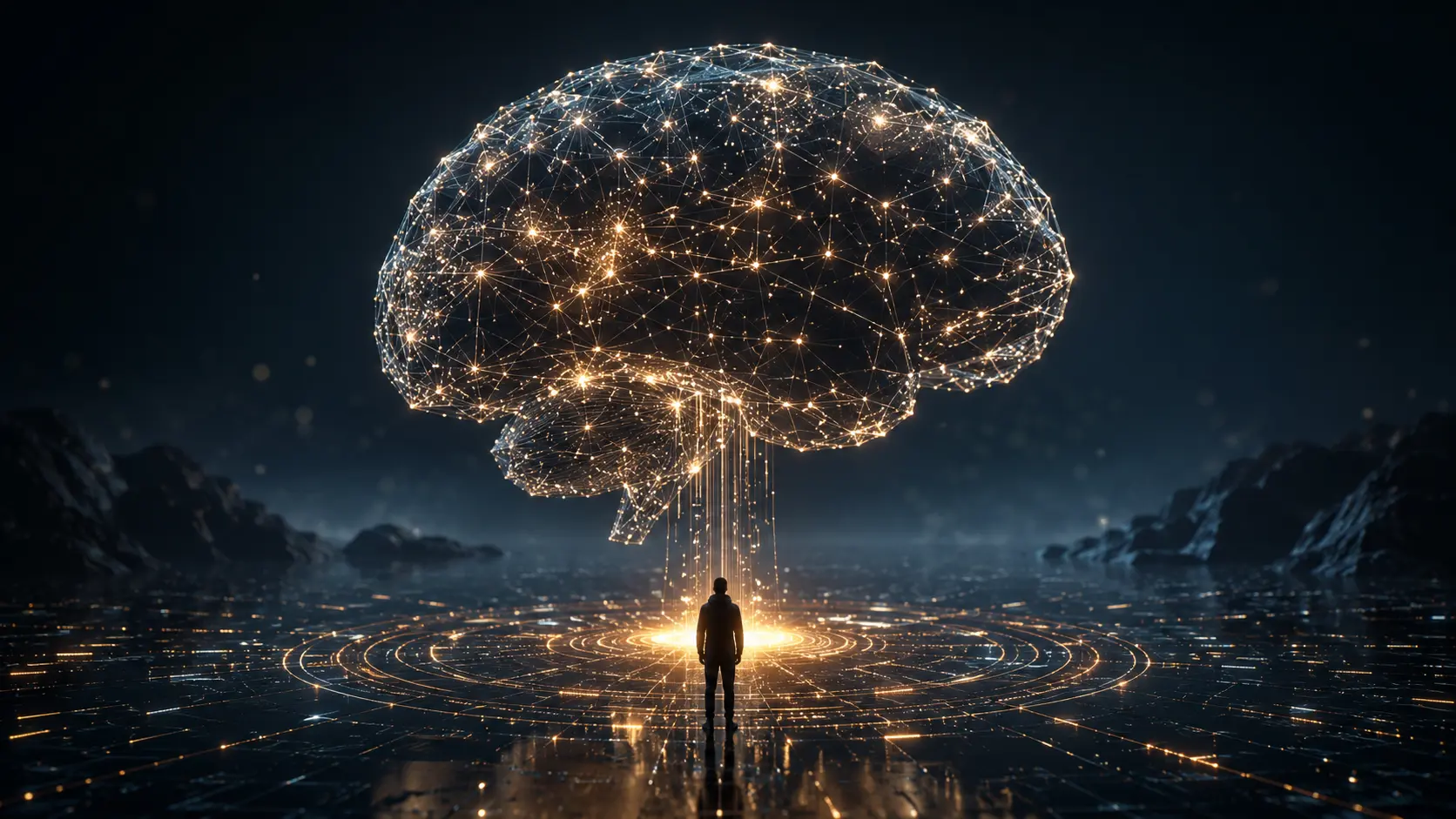

If somebody throws a baseball at your head, you do not calculate the exact trajectory of every individual photon bouncing off the leather. You do not calculate the precise wind speed ruffling the leaves on the trees in the background. Your brain instantly ignores the irrelevant noise, extracts the abstract, high-level concept—a fast-moving object is approaching my face—and you duck.
For the last decade, artificial intelligence has been fundamentally incapable of this biological efficiency. Generative AI models are obsessive micro-managers. If you ask a video-generation model to predict what happens next when a ball is thrown, the AI attempts to mathematically calculate the exact color and position of every single pixel in the background, wasting billions of calculations on irrelevant leaves and clouds. This pixel-level obsession is why deploying traditional AI into physical robots results in slow, clumsy machines that drain their batteries in minutes.
Why should you care right now? Because the architecture of artificial intelligence is pivoting away from generation and toward pure comprehension. Pioneered by Yann LeCun at Meta, the Joint Embedding Predictive Architecture (JEPA) teaches AI to stop generating pixels and start predicting abstract concepts. By moving the AI’s “thoughts” entirely into an invisible mathematical void known as latent space, JEPA allows machines to filter out the noise of the physical world and finally learn the underlying laws of physics. This is not just a new algorithm; it is the foundational “world model” required to build robots that can seamlessly navigate reality.
What is Joint Embedding Predictive Architecture (JEPA)?
Joint Embedding Predictive Architecture (JEPA) is a non-generative, self-supervised machine learning framework. Instead of recreating exact input data like pixels or text tokens, JEPA uses encoders to compress data into a hidden latent space. The model then predicts the abstract mathematical representations of missing information, enabling highly efficient, human-like physical reasoning.
At a Glance
- Concept: Teaching AI to summarize and predict the “meaning” of a video or image without forcing it to perfectly redraw the image from scratch.
- Why it matters: Predicting every pixel requires immense, wasteful computing power. By predicting abstract ideas, the AI learns 10x faster and requires vastly less data, opening the door to real-time robotic reflexes.
- Who uses it: Meta’s Fundamental AI Research (FAIR) team, robotics startups, and researchers developing “World Models” for autonomous driving.
- Biggest takeaway: JEPA prevents the AI from cheating. In older systems, the AI would just output blank data to get a perfect score. JEPA uses a clever “asymmetric” design that forces the AI’s internal target to constantly move, forcing it to actually learn physics.
In Simple Words
Imagine you are looking out a window and watching a dog run behind a solid brick wall.
A Generative AI Model tries to predict exactly what the dog will look like when it emerges on the other side. It calculates the exact color of every hair, the position of every blade of grass, and the exact shape of the shadows. Because the world is chaotic, it gets confused, hallucinates, and uses massive amounts of computer power just to guess the lighting.
A JEPA Model doesn’t care about the hairs or the grass. It uses a “latent space”—a mental notepad of abstract ideas. On this notepad, it simply registers: Object: Dog. Velocity: Fast. Direction: Right. The model easily predicts that the abstract concept of a dog will appear on the right side of the wall in two seconds.
By thinking in abstract summaries rather than exact pictures, the AI understands the physical reality of the situation instantly, using a fraction of the computational energy.
Why This Matters
For AI Researchers, Robotics Engineers, and Tech VCs, JEPA shatters the “Autoregressive Wall.”
The current AI boom is entirely driven by Large Language Models (LLMs) predicting one text token at a time. While this works brilliantly for language—which is low-bandwidth and strictly rule-based—it fails catastrophically for video and real-world robotics. The real world is high-bandwidth, continuous, and infinitely noisy. Attempting to scale LLM architecture into the physical world (embodied AI) results in massive latency and power drain. JEPA provides the definitive off-ramp. It proves that AI does not need to be a “generative” chatbot to be intelligent; it can be a purely predictive “world model,” unlocking the trillion-dollar market for autonomous humanoid robots and self-driving fleets that can navigate chaotic city streets safely.
The Shift from Generative AI to Predictive World Models
The pursuit of JEPA is rooted in Self-Supervised Learning (SSL).
Historically, AI required millions of human-labeled images (e.g., a human drawing a box around a car and labeling it “Car”). SSL eliminates human labeling. The AI learns by looking at a piece of data, hiding a portion of it from itself, and trying to predict the hidden part.
While masking and predicting text (like BERT) or pixels (like Masked Autoencoders) revolutionized early AI, Yann LeCun recognized that predicting pixels was a dead end for artificial general intelligence (AGI). JEPA represents the culmination of LeCun’s vision: an Energy-Based Model (EBM) that operates entirely in the abstract, learning the structure of reality by watching countless hours of video without ever needing a human to explain what gravity or momentum is.
How Joint Embedding Predictive Architecture Works
Bypassing pixel-level generation requires a sophisticated manipulation of encoders and latent variables. Here is the first-principles breakdown of the architecture.
1. The Fundamental Problem: Stochastic Noise
If an AI is watching a video of a busy street, it cannot perfectly predict the exact movement of every leaf on a tree or the ripples in a puddle. These events are stochastic (random). If a generative model is forced to predict them and gets the pixels wrong, the “loss function” (error rate) skyrockets. The model spends all its time trying to minimize this unavoidable error, failing to learn the important concept: a car is driving down the street.
2. The Core Mechanism: Latent Space Encoding
JEPA solves this by abandoning the pixel space.
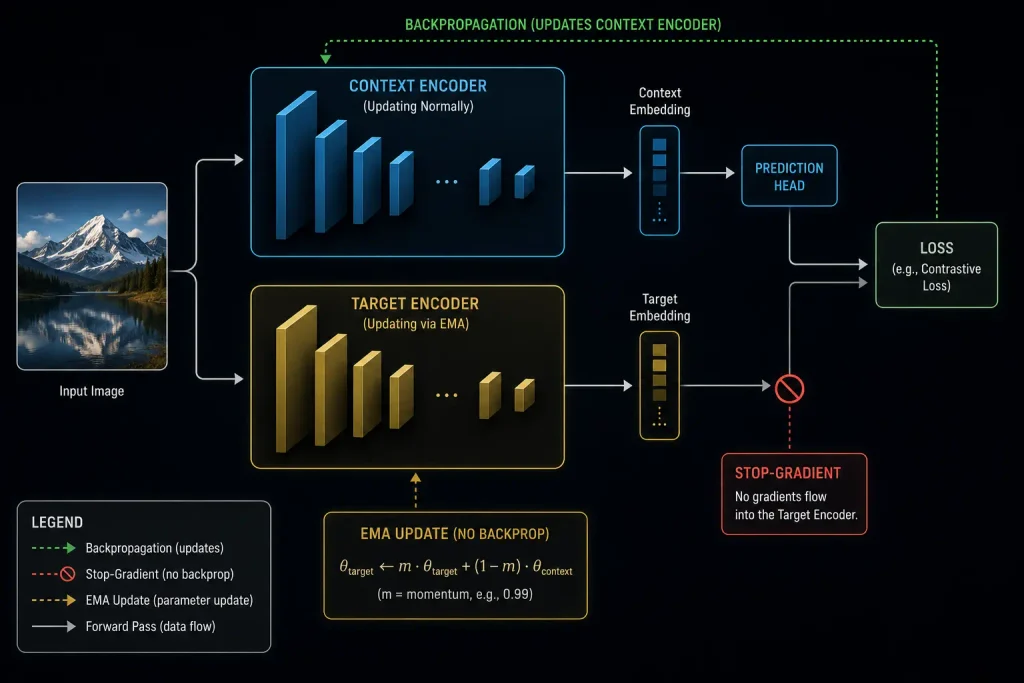
The system takes an input context (x) and a target region it wants to predict (y). Instead of predicting y directly, it passes both x and y through separate neural network Encoders. These encoders compress the visual data into abstract, low-dimensional mathematical vectors known as latent representations (s_x and s_y).
3. Technical Depth: The Predictor and The Energy Function
A third neural network, the Predictor, takes the context representation (s_x) and an optional latent variable z) which accounts for uncertainty. The Predictor attempts to output a prediction (ŝ_y) that perfectly matches the target representation (s_y).
The system is trained as an Energy-Based Model. It seeks to minimize the predictive “energy” (the distance between its prediction and the actual target) in the latent space:
E(x, y, z) = D(Predictor(sₓ, z), s_y)).
Because the encoders filter out the unpredictable stochastic noise (the leaves in the wind) before the representations reach the predictor, the AI only has to predict the high-level physical changes.
4. Bypassing Representation Collapse
The greatest threat to this system is “collapse.” If both encoders simply decide to output the exact same number (e.g.,0) for every single image, the distance D becomes zero. The model achieves a perfect score without learning anything.
Previous architectures (like SimCLR) solved this using “contrastive learning”—forcing the model to push negative, unrelated images apart. But contrastive learning is wildly inefficient at scale.
5. Real-World Consequences: The Asymmetric Stop-Gradient
JEPA solves collapse elegantly using architectural asymmetry. The Context Encoder is trained normally using gradient descent. However, the Target Encoder is heavily restricted. It receives no direct gradients (a “stop-gradient” operation). Instead, its weights are updated as an Exponential Moving Average (EMA) of the Context Encoder’s weights.
By moving slowly and ignoring direct training signals, the Target Encoder provides a stable, constantly shifting target that the Context Encoder must chase, making mathematical collapse impossible and forcing the system to learn robust physical representations.
Real-World Applications of V-JEPA and World Models
JEPA is transitioning from a theoretical paper into the foundational architecture for physical-world AI systems.
V-JEPA and Advanced Robotics: Meta’s release of V-JEPA (Video-JEPA) demonstrated the architecture’s true power. By training on unlabeled video streams, V-JEPA learned to predict what would happen in the hidden parts of a video based on abstract context. For robotics, this is the holy grail. A robotic arm powered by V-JEPA doesn’t need to be explicitly trained on how a glass shatters; it has already watched millions of videos and built an internal “world model” of physics, allowing it to adapt to dropping a glass in real-time without needing a human-coded script.
Autonomous Driving (End-to-End Control): Traditional self-driving cars rely on massive stacks of modular software: one AI detects lanes, another detects cars, and a hard-coded logic system makes decisions. JEPA allows for end-to-end learning. The cameras feed raw video into the encoder, and the predictor generates the abstract representation of the immediate future, predicting that a pedestrian will step into the road. This allows the car’s steering actuators to react to the concept of danger in milliseconds, completely bypassing the need to generate bounding boxes or semantic pixel maps.
Medical Imaging and Multimodal Diagnostics: In medical scans (like MRIs or CTs), the “noise” of human tissue often confuses generative models trying to spot microscopic tumors. By training Image-JEPA (I-JEPA) on medical imaging, the model learns to compress the scan into latent space, ignoring irrelevant biological noise and predicting the underlying abstract pathology, drastically improving the speed and accuracy of autonomous cancer detection.
Economic & Strategic Impact
The pivot to JEPA fundamentally disrupts the Generative AI Compute Monopoly.
For the past five years, NVIDIA and cloud hyperscalers have reaped trillions of dollars selling the massive GPU clusters required to train and run autoregressive generative models. LLMs are memory-bound and computationally exhaustive because predicting billions of exact tokens requires massive, continuous memory bandwidth.
Because JEPA models are non-generative, they are infinitely more lightweight during inference. Once the world model is trained, querying a JEPA predictor in latent space takes a fraction of the Floating Point Operations (FLOPs) required to generate a paragraph of text. If the robotics and autonomous vehicle industries migrate away from LLM-based logic and embrace JEPA-based world models, the inference hardware market will bifurcate. Edge devices will no longer need massive H100 GPUs; they will rely on cheap, low-power neuromorphic or specialized ASIC chips optimized purely for low-dimensional vector prediction, threatening the revenue models of current AI hardware incumbents.
Advantages
- Extreme Compute Efficiency: By predicting abstract summaries rather than exact pixels, JEPA requires significantly less compute power and memory bandwidth during inference.
- Immunity to Stochastic Noise: The encoders naturally filter out random, unpredictable background elements, preventing the AI from getting confused by irrelevant environmental changes.
- No Negative Samples Required: Unlike contrastive learning models that require carefully curated datasets of “false” images to prevent collapse, JEPA learns efficiently from a continuous stream of positive video data.
- True Physical Understanding: By building an internal “world model,” the AI learns the laws of physics (gravity, object permanence, momentum) intuitively, mirroring how human infants learn about reality.
Limitations
- Non-Generative Design: You cannot ask a standard JEPA model to “draw a picture of a cat.” Because it operates entirely in latent space, it lacks a “decoder” to translate its abstract thoughts back into human-viewable pixels. It is an engine of understanding, not creation.
- Complex Training Dynamics: Balancing the asymmetric architecture (ensuring the target encoder updates via Exponential Moving Average at the exact right speed) is highly unstable. If the hyperparameters are slightly off, the model will still collapse or fail to converge.
- The Latent Variable (z) Bottleneck: In highly uncertain situations (e.g., a coin is flipped and could land on heads or tails), the predictor relies on the latent variable z to explore multiple possible futures. Training the network to properly manage and utilize this z variable for multi-modal uncertainty remains a profound mathematical challenge.
Common Misconceptions
Misconception: JEPA is going to replace ChatGPT.
Reality: They solve completely different problems. ChatGPT (an LLM) is a generative model optimized for language and text. JEPA is a predictive model optimized for high-bandwidth physical environments (vision, video, robotics). Future AGI will likely use JEPA as its “eyes” and an LLM as its “mouth.”
Misconception: JEPA models learn by predicting the next frame of a video.
Reality: They do not predict the next frame. They look at a video, block out chunks of space or time (e.g., hiding the middle of the screen), and predict the abstract representation of what is happening behind the blocked area.
Misconception: Latent space is just a compressed image file like a JPEG.
Reality: A JPEG still contains pixel data. Latent space is a purely mathematical, high-dimensional vector space. It is a list of numbers that represent the semantic meaning of the image, stripped entirely of visual geometry.
What Most People Miss
The strategic convergence of JEPA and Reinforcement Learning (RL).
Most industry focus is on how JEPA understands video. What most analysts miss is that understanding reality is only step one. The endgame is acting in reality.
Because JEPA provides a flawlessly efficient, low-dimensional “world model,” it is the perfect sandbox for Reinforcement Learning. Before a robot ever moves its physical arm, its internal RL algorithm can simulate a million different movement paths directly inside JEPA’s latent space. Because latent space math is incredibly fast, the robot can internally “imagine” and grade a million different futures in a fraction of a second, select the optimal physical movement, and execute it flawlessly in the real world. This is the exact mechanism required to solve robotic dexterity.
Comparison Table
| Feature | Autoregressive / Generative (LLMs) | Contrastive Learning (SimCLR) | Joint Embedding Predictive Architecture (JEPA) |
| Output Goal | Exact token or pixel recreation | Representation grouping | Abstract latent prediction |
| Handling of Noise | Forced to predict it (Wasteful) | Ignores it | Filters it out via encoders |
| Collapse Prevention | N/A | Requires massive negative datasets | Asymmetric EMA encoders |
| Inference Efficiency | Very Low (Heavy compute) | Moderate | Extremely High |
| Primary Domain | Language, Image Generation | Image Classification | Video, Robotics, World Modeling |
Case Study
Situation: The advancement of robotic intelligence was bottlenecked by the “curse of dimensionality.” Attempting to train robots using generative vision models required the AI to process millions of pixels per second, leading to massive latency. The robots could not react fast enough to catch a thrown ball or navigate a cluttered room because they were wasting compute power analyzing the wallpaper.
Challenge: Develop a self-supervised vision architecture capable of building a hierarchical understanding of physics and spatial-temporal dynamics from uncurated video, without wasting compute on pixel-level reconstruction.
Solution (Meta’s V-JEPA Release): In 2024, Meta’s Fundamental AI Research (FAIR) team introduced Video-JEPA (V-JEPA). The model was trained by watching millions of hours of raw video. Researchers masked out large portions of the video both spatially (hiding parts of the screen) and temporally (hiding seconds of time). The V-JEPA model was tasked purely with predicting the latent representations of the missing chunks.
Outcome: V-JEPA successfully learned complex object interactions, object permanence, and physics without a single line of human-labeled code. When evaluated on downstream tasks (like identifying exactly when an action happened in a video), V-JEPA outperformed leading pixel-reconstruction models while requiring vastly fewer training steps and utilizing only a fraction of the fine-tuning data.
Lessons Learned: The V-JEPA deployment validated Yann LeCun’s long-standing hypothesis: generation is not a prerequisite for comprehension. By proving that a non-generative, asymmetric world model can achieve state-of-the-art physical understanding, Meta officially laid the software foundation required for the next decade of embodied AI and autonomous robotics.
Future Outlook
Next 12–24 Months
The era of Multimodal JEPA Integration (J-JEPA). The immediate future will see the architecture expand beyond pure vision. Researchers will fuse audio, proprioceptive sensor data (touch/weight), and vision into a single Joint-JEPA framework. A robot will not just predict what a glass looks like when it falls; it will simultaneously predict the latent representation of the sound of it shattering and the physical weight leaving its hand. This multimodal world model will become the standard operating system for the highly competitive humanoid robot sector (e.g., Figure, Tesla Optimus).
Next 3–5 Years
The scaling of Hierarchical Planning and Agentic Action. As JEPA models mature, they will be paired aggressively with advanced planning algorithms (like Monte Carlo Tree Search). The JEPA world model will act as the “simulator.” An AI agent tasked with driving a car through a blizzard will use JEPA to instantly simulate the latent physics of braking at different speeds, evaluate the abstract outcomes, and select the safest path in milliseconds. This will fundamentally replace the brittle, hard-coded logic currently limiting Level 5 autonomous driving.
Next 10 Years
The Obsolescence of Generative Dominance in AGI. By the mid-2030s, the concept of a monolithic, autoregressive LLM serving as the proxy for Artificial General Intelligence (AGI) will be viewed as a primitive stepping stone. True AGI will require a cognitive architecture that mirrors the human brain: a massive, highly efficient, latent-space “System 2” world model (JEPA) that hums in the background, continuously predicting and understanding reality, communicating with a lightweight generative module only when it explicitly needs to translate its thoughts into human language or art.
Most Likely Scenario
JEPA marks the definitive divergence of AI from the “chatbot” era into the “embodied” era. As the limits of text-based data exhaustion force the industry to turn to video and the physical world for new training data, joint embedding architectures are mathematically inevitable. They are the only thermodynamically viable way to process the infinite noise of reality, securing their position as the fundamental cognitive engine of the 21st-century robotics boom.
Key Takeaways
- Joint Embedding Predictive Architecture (JEPA) is an AI framework that learns to understand the world by predicting abstract, high-level concepts rather than exact pixels or words.
- Traditional generative AI wastes massive amounts of computing power trying to predict irrelevant background noise (like leaves in the wind). JEPA filters this noise out entirely.
- It operates in “latent space”—a hidden mathematical void where images and video are compressed into pure meaning (e.g., velocity, shape, momentum).
- JEPA solves “representation collapse”—the AI’s tendency to cheat by outputting blank data—by using a clever asymmetric design where the target the AI is aiming for constantly, slowly moves.
- Because it doesn’t generate pixels, JEPA is incredibly fast and compute-efficient, making it the ideal “world model” to serve as the brain for autonomous robots and self-driving cars.
- Championed by Meta’s Yann LeCun, JEPA proves that artificial intelligence does not need to be a generative chatbot to achieve deep, human-like physical reasoning.
Glossary
Autoregressive Model: A model (like ChatGPT) that generates data sequentially, one step at a time, based entirely on the previous steps. It is slow and prone to compounding errors.
Energy-Based Model (EBM): A mathematical framework where the AI learns by minimizing an “energy” function. The lower the energy, the closer the AI’s prediction is to the correct answer.
Exponential Moving Average (EMA): A mathematical trick used in JEPA. Instead of updating the Target Encoder directly with training data, its weights are updated slowly based on a rolling average of the Context Encoder, preventing the model from collapsing.
Latent Space: A hidden, multi-dimensional mathematical space where complex data (like a 4K video) is compressed into a tiny list of numbers that only represent the core semantic meaning of the data.
Representation Collapse: A catastrophic failure in self-supervised AI where the model figures out a “cheat code” to get a perfect score by outputting the exact same useless number for every single input.
Self-Supervised Learning (SSL): A method where AI learns from raw, uncurated data without humans needing to label it. It learns by hiding parts of the data from itself and trying to fill in the blanks.
Sources
Meta AI Research: V-JEPA: The next step toward advanced machine intelligence from watching videos
Yann LeCun / OpenReview: A Path Towards Autonomous Machine Intelligence Version 0.9.2
arXiv (Cornell University): Image-based Joint-Embedding Predictive Architecture (I-JEPA)
Towards Data Science: Understanding Yann LeCun’s Joint Embedding Predictive Architecture
Hugging Face Papers: Self-Supervised Learning from Images with a Joint-Embedding Predictive Architecture