Advertisement
)

The global energy transition is hurtling toward a mathematical and financial brick wall. As nations aggressively replace stable, continuous coal and natural gas plants with intermittent wind and solar farms, the grid becomes terrifyingly fragile the moment the sun sets or the wind dies. For the past decade, the default solution has been massive arrays of lithium-ion batteries. However, lithium-ion faces an inescapable economic reality: it is phenomenally expensive to scale. While a lithium battery is perfect for a four-hour evening burst, utilizing rare-earth electrochemical cells to back up an entire city for a three-day winter storm is a multi-trillion-dollar impossibility. To achieve a true, resilient net-zero grid, we do not just need larger batteries; we need a fundamentally different physics of energy storage.
Why should you care right now? Because industrial engineers are completely abandoning electrochemical batteries for long-duration storage and returning to the oldest, most reliable form of energy manipulation on Earth: heat. By deploying a breakthrough class of infrastructure known as Pumped Thermal Energy Storage (PTES), or “Carnot Batteries,” utilities are using excess solar power to run massive industrial heat pumps. These machines blast extreme thermal energy into gigantic insulated silos of crushed rock or molten salt, storing raw heat for pennies on the dollar. When the grid needs power days later, that heat is unleashed to spin heavy industrial turbines. This technology promises to permanently decouple energy storage from the volatile global supply chains of lithium and cobalt, offering a limitless, geographically independent solution to the greatest engineering challenge of the 21st century.
What is Pumped Thermal Energy Storage (Carnot Batteries)?
Pumped Thermal Energy Storage (PTES), conceptually known as a Carnot Battery, is a utility-scale energy storage system that converts electricity into thermal energy using a heat pump, stores it in cheap mediums like molten salt or rock, and later reconverts the heat back into electricity using a thermodynamic heat engine.
At a Glance
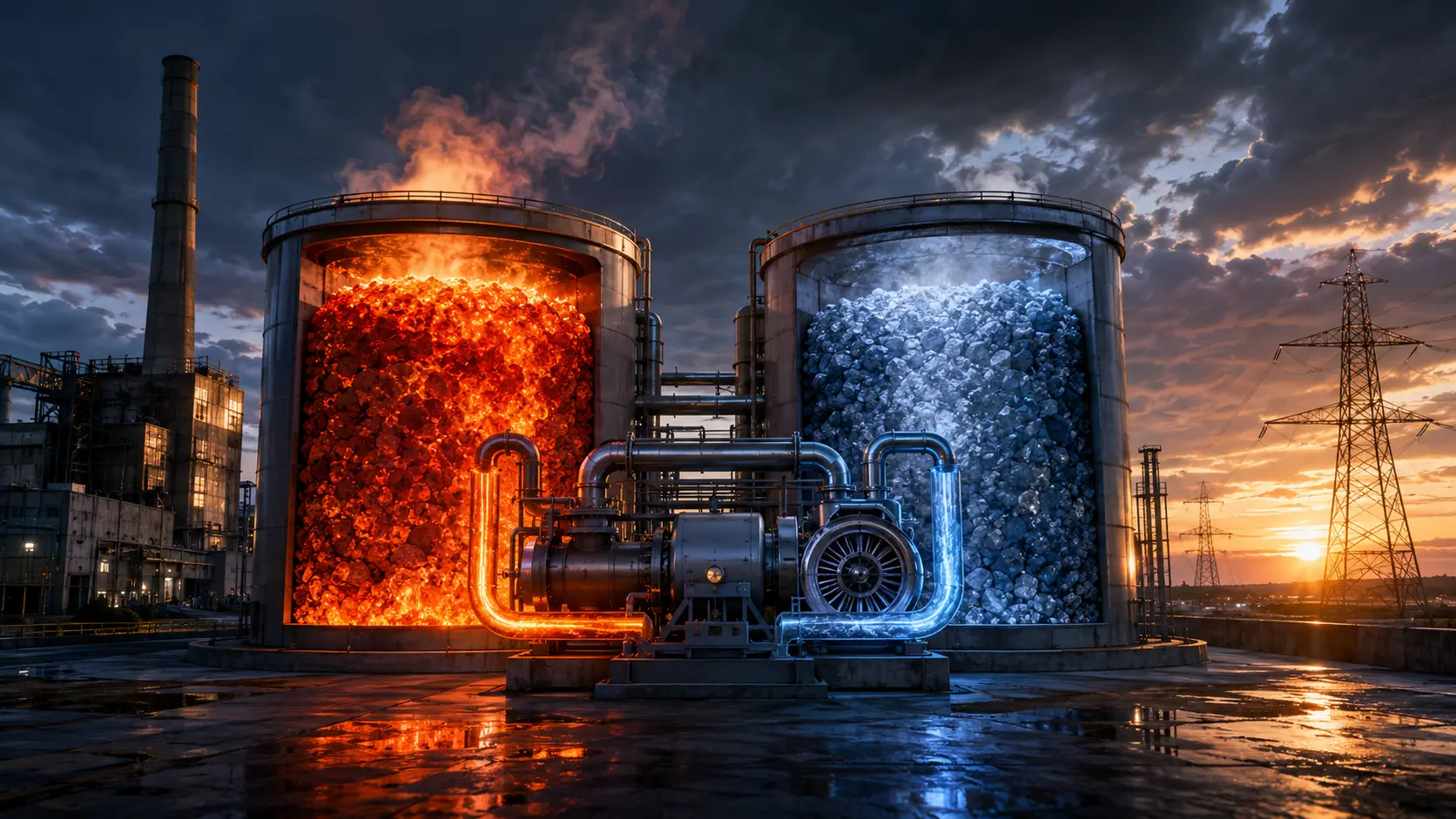
- Concept: Acting as a massive, reversible refrigerator. It uses cheap electricity to make one tank of rocks blisteringly hot and another tank freezing cold. Days later, it uses that temperature difference to generate electricity.
- Why it matters: Adding 10 more hours of storage to a lithium battery requires buying 10 more hours of highly expensive lithium cells. Adding 10 more hours to a Carnot Battery just requires dumping a few more tons of cheap gravel into a steel silo.
- Who uses it: Utility mega-corporations, grid operators, and cutting-edge Long-Duration Energy Storage (LDES) developers like Malta Inc., Siemens Gamesa, and Highview Power.
- Biggest takeaway: You can rip the dirty coal furnace out of a decommissioned power plant, drop a clean Carnot Battery in its place, and perfectly reuse the plant’s existing steam turbines and grid wires. It rescues stranded fossil-fuel assets and turns them into green energy hubs overnight.
In Simple Words
Imagine you have a massive surplus of electricity at noon because your solar panels are producing more power than your city can use.
If you use a Lithium-ion battery, you push that electricity into highly complex, expensive chemical cells. When full, if you want to store more power, you have to buy entirely new, multi-million-dollar battery containers.
If you use a Carnot Battery, you use that excess noon-time electricity to run a giant industrial air compressor. Compressing air makes it incredibly hot (just like a bicycle pump gets hot when you use it). You blow this 1,000°F air through a giant, insulated concrete silo filled with ordinary, dirt-cheap gravel. The gravel absorbs the heat and stays hot for days.
Three days later, a massive winter storm hits and the solar panels go completely dark. To get your power back, you simply run the system in reverse. You blow cold air over the scorching hot rocks. The air rapidly expands from the heat, and that violently expanding air is used to spin a mechanical turbine, generating fresh electricity for the city. You have effectively stored electricity as trapped heat in a pile of rocks.
Why This Matters
For Utility Planners, Energy Storage Engineers, and Cleantech VCs, the Carnot Battery solves the “Levelized Cost of Storage” (LCOS) Duration Dilemma.
The cost architecture of a PTES system is heavily front-loaded in its power conversion equipment (the turbines and compressors), which dictate its power capacity (Megawatts). However, its energy capacity (Megawatt-hours) is dictated purely by the size of its thermal reservoirs (tanks of salt or stone). Because the storage medium is astonishingly cheap—often costing less than $5 to $15 per kWh of capacity compared to lithium-ion’s $150+ per kWh—the economics of PTES become mathematically unbeatable once the storage duration exceeds 10 to 12 hours. For grid operators mandated to achieve 100% renewable penetration, PTES provides the only financially viable buffer capable of smoothing out multi-day, or even multi-week, seasonal weather anomalies without bankrupting the ratepayer.
The Role of Sensible Heat in Long-Duration Energy Storage
The true genius of the Carnot Battery lies in its reliance on Sensible Heat and Latent Heat Storage, a stark departure from complex chemical bonds.
Instead of fighting the delicate, degrading chemistry of dendrite formation and electrolyte exhaustion inherent in lithium or solid-state batteries, PTES relies on fundamental, unbreaking physics. A rock does not lose its ability to get hot over time. A tank of molten salt does not suffer from “capacity fade” after 5,000 cycles. By exploiting the raw thermal mass of the planet’s most ubiquitous materials, developers are engineering grid assets that boast 30-year to 50-year operational lifespans. This longevity fundamentally alters the project finance mathematics, allowing infrastructure funds to amortize their initial capital investments over half a century, radically compressing the long-term cost of capital.
How Pumped Thermal Energy Storage Works
Storing electricity as heat and recovering it later requires mastering high-temperature thermodynamics and minimizing exergy destruction. Here is the first-principles breakdown of the architecture.
1. The Fundamental Problem: Storage Cost Scaling
To achieve 24-hour backup, an energy storage system must heavily decouple the cost of power (the engine) from the cost of energy (the fuel tank). Electrochemical batteries cannot do this; the cell is both the engine and the tank. If you want a bigger tank, you must buy more expensive engines. Thermal storage fully decouples these two variables.
2. The Core Mechanism: The Charge Cycle (Heat Pump)
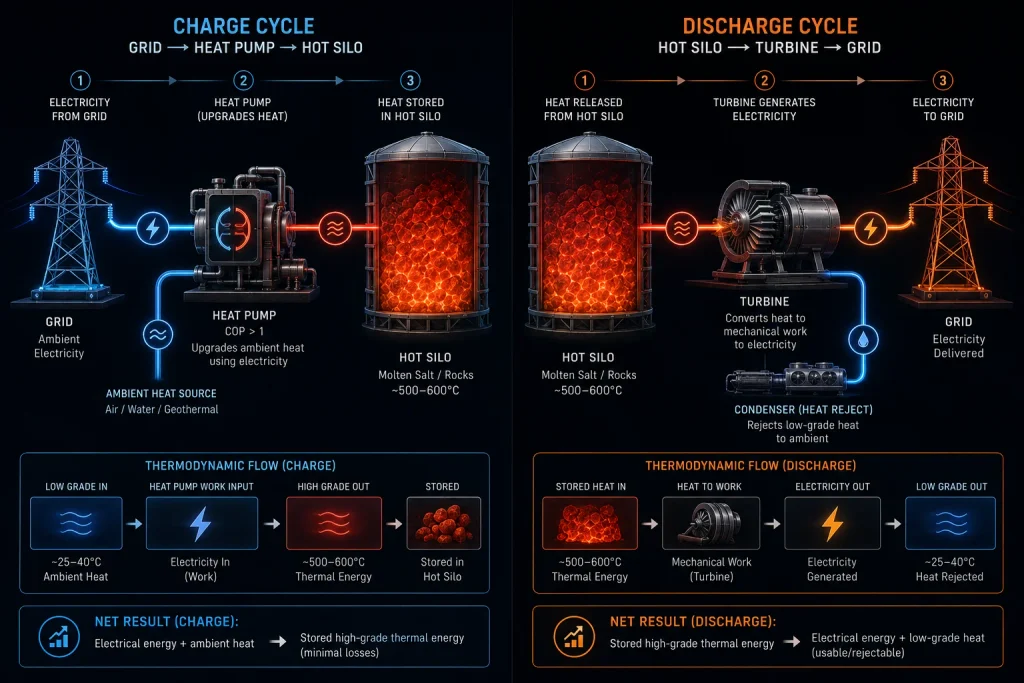
During periods of excess renewable generation, grid electricity powers a massive compressor. A working fluid (such as nitrogen, argon, or supercritical CO₂) is violently compressed. Through the basic laws of thermodynamics, increasing the pressure of a gas drastically increases its temperature.
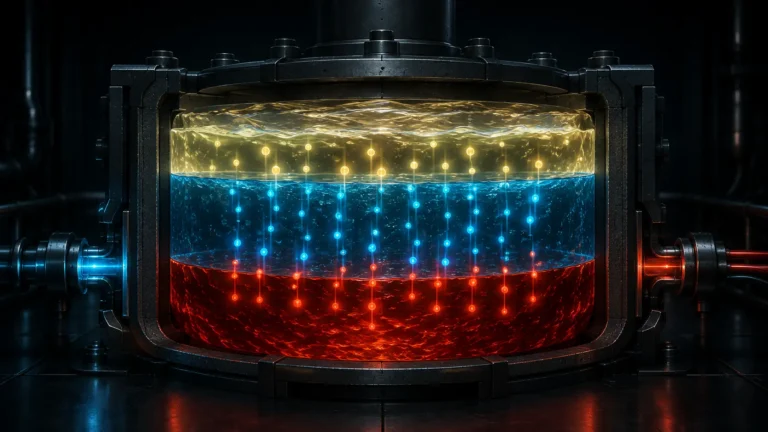
This super-hot gas is circulated through a “Hot Thermal Storage” tank—typically filled with molten nitrate salts or packed beds of volcanic basalt—transferring its heat to the medium. The now-cooled, highly pressurized gas is then passed through an expander. As it expands, its temperature plummets far below zero, and this extreme cold is transferred to a “Cold Thermal Storage” tank (often containing a water/glycol mix or chilled gravel).
3. Technical Depth: The Discharge Cycle (Heat Engine)
When the grid requires power, the cycle is reversed, acting as a thermodynamic heat engine. The working fluid is chilled by the cold tank, compressed, and then heated to extreme temperatures by the hot tank. The vast temperature differential between the hot and cold states causes massive volumetric expansion of the fluid. This rapidly expanding, high-pressure gas is forced through a heavy industrial turbine. The turbine spins a generator, dispatching electricity back to the grid.
4. The Thermodynamic Ceiling: Exergy and Carnot Limits
The efficiency of the discharge cycle is strictly governed by Carnot’s theorem. The maximum possible efficiency (η) of a heat engine relies on the absolute temperatures of the hot (T_H) and cold (T_C) reservoirs:
Efficiency (η) = 1 – (T_C / T_H)
To maximize round-trip efficiency (RTE) and minimize the destruction of “exergy” (the useful portion of energy), engineers push the hot reservoirs to blistering extremes—often exceeding 600°C to 700°C. Despite these extremes, thermodynamic losses (friction, heat bleed, compressor inefficiencies) mean that PTES systems typically achieve an RTE of 50% to 70%, trading raw efficiency for massive, low-cost capacity.
5. Real-World Consequences: Reversible Turbomachinery
To minimize the capital expenditure of building separate heat pumps for charging and heat engines for discharging, cutting-edge developers utilize Reversible Turbomachinery. A single, highly complex machine acts as both the compressor-motor during the charge cycle and the turbine-generator during the discharge cycle. While this halves the heavy machinery costs, engineering a turbine blade that can operate flawlessly in both directions under 700°C thermal stress is the ultimate metallurgical challenge defining the sector.
Commercial Carnot Battery Deployments
Carnot Battery technology is rapidly exiting the pilot phase, securing massive institutional backing for gigawatt-scale commercial deployments.
The Malta Inc. Electro-Thermal System: Originating as a project within Google’s X (the moonshot factory), Malta Inc. is commercializing a heavily optimized PTES architecture. Their system utilizes a closed-loop Brayton cycle, storing heat in molten nitrate salts (reaching 565°C) and cold in a chilled anti-freeze solution. By relying entirely on off-the-shelf components—standard heat exchangers, conventional salts, and established turbomachinery from the oil and gas sector—Malta sidesteps the “technology readiness” delays that plague exotic battery chemistries, targeting massive 10-to-100 megawatt installations for long-duration grid stabilization.
Highview Power’s Cryogenic Liquid Air Energy Storage (LAES): While technically distinct from hot-rock PTES, LAES operates on the exact same Carnot principles, leaning entirely into the cold spectrum. Highview Power uses excess electricity to super-cool ambient air to -196°C, turning it into a liquid and storing it in massive, low-pressure insulated tanks. When power is needed, the liquid air is exposed to ambient heat, causing it to rapidly expand back into a gas—expanding 700 times in volume—and driving a massive generation turbine. With major installations moving forward in the UK, LAES proves that extreme phase-change thermodynamics can execute reliable multi-day buffering without toxic battery metals.
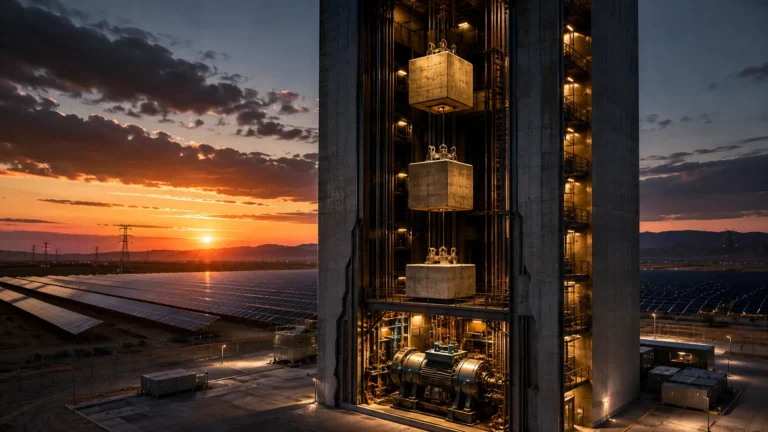
Siemens Gamesa’s Electric Thermal Energy Storage (ETES): Addressing the need for ultra-cheap thermal mediums, Siemens Gamesa developed an ETES facility in Hamburg, Germany, that utilizes 1,000 tons of crushed volcanic rock (basalt). The rocks are heated to 750°C using an industrial fan and resistance heater during times of excess wind generation. A standard steam turbine is then used to reconvert the heat into electricity. By utilizing basalt—which costs a fraction of a cent per kilogram and never degrades—the system achieves absolute cost supremacy for the bulk storage of gigawatt-hours of energy.
Economic & Strategic Impact
The most profound strategic value of the Carnot Battery is Brownfield Repurposing and the Stranded Asset Rescue.
As global mandates force the closure of coal-fired power plants, utility companies are left holding massive “stranded assets.” These sites contain multi-billion-dollar investments: heavy-duty steam turbines, massive synchronous generators, cooling towers, and, critically, high-voltage transmission lines perfectly interconnected to the national grid.
A Carnot Battery allows developers to execute an industrial organ transplant. They rip out the dirty, coal-burning boiler and replace it with a clean, electrically charged molten salt thermal reservoir. Because the steam turbine and the grid connection are preserved, the developer bypasses the punishing 5-to-10-year grid interconnection queue entirely. The utility transforms a massive climate liability into a highly profitable, zero-carbon grid asset, preserving local union jobs while executing the fastest possible timeline for adding heavy renewable storage to the network.
Advantages
- Extreme Longevity and Zero Degradation: Rocks, salts, and steel do not suffer from chemical capacity fade. A PTES facility can charge and discharge daily for 30 to 40 years with virtually identical performance, radically altering long-term financial modeling.
- Geopolitical Supply Chain Independence: By utilizing universally abundant materials (gravel, water, nitrogen, standard nitrate salts) rather than geopolitically constrained rare-earth metals (lithium, cobalt, nickel), PTES insulates national energy security from foreign export controls.
- Decoupled Power and Energy Scaling: Adding storage duration only requires building a larger, inexpensive steel silo to hold more rocks, dropping the marginal cost of multi-day storage to unmatched lows.
- Synchronous Inertia Generation: Unlike lithium-ion batteries that require complex inverters to synthesize grid stability, PTES systems use heavy, spinning physical turbines. These massive rotating masses provide vital “physical inertia” to the grid, naturally stabilizing frequency fluctuations without algorithmic intervention.
Limitations
- Moderate Round-Trip Efficiency (RTE): Dictated by the laws of thermodynamics, a standard Carnot Battery loses between 30% and 50% of the energy it absorbs due to heat bleed, friction, and compression inefficiencies. A grid operator must be willing to accept significant energy loss in exchange for massive storage duration.
- High Initial Power CapEx: While the energy (duration) is cheap, the power (the turbines and compressors) is expensive. A PTES system requires a massive upfront capital investment just to get the machinery installed, making it entirely uneconomical for short-duration (2-to-4 hour) applications where lithium-ion easily wins.
- Thermo-Mechanical Fatigue: Cycling massive steel heat exchangers and turbine blades between ambient temperature and 700°C daily induces severe thermal expansion and contraction. Managing this physical stress over decades requires excruciatingly precise metallurgical engineering to prevent catastrophic mechanical failure.
Common Misconceptions
Misconception: They only store heat to warm up buildings.
Reality: While they can provide co-generation heat for district heating networks, their primary purpose as “Carnot Batteries” is to run thermodynamic heat engines (turbines) to put actual, high-voltage electricity back onto the power grid.
Misconception: The rocks or salt must eventually catch fire or melt down.
Reality: The storage mediums are heavily vetted. Molten salts are specifically chosen because they are entirely stable and non-combustible at 600°C. Volcanic basalt is used precisely because it has already survived the extreme temperatures of the Earth’s mantle; it will not degrade in an industrial heat loop.
Misconception: New, exotic physics must be invented to make this work.
Reality: The core physics—the Brayton and Rankine thermodynamic cycles—have been fully understood and utilized in the aviation, nuclear, and fossil-fuel industries for a century. The innovation is simply running the system backward and inserting a cheap thermal reservoir in the middle.
What Most People Miss
The disruptive intelligence value of Dual-Market Revenue Stacking (Sector Coupling).
Most analysts view Carnot Batteries purely through the lens of electricity markets. What they routinely miss is that heavy industry relies more heavily on heat than on electricity.
A massive PTES installation can participate in “Sector Coupling.” While it discharges electricity to the grid during peak pricing, its “exhaust” heat is still hundreds of degrees hot. Instead of venting this lower-grade heat into the atmosphere, the facility can pipe it directly into an adjacent chemical refinery, paper mill, or district heating network. By simultaneously selling high-value electricity to the grid and bulk industrial steam to a local factory, the Carnot Battery double-dips its revenue streams, drastically shortening its return on investment (ROI) timeline in a way that standard lithium-ion batteries cannot mathematically achieve.
Comparison Table
| Feature | Lithium-Ion Grid Battery | Carnot Battery (Pumped Thermal) |
| Storage Medium | Complex chemical cells | Sensible heat (Molten Salt / Rock) |
| Round-Trip Efficiency | High (~90%) | Moderate (~50% – 70%) |
| Marginal Cost of Duration | Very High (Linear scaling) | Extremely Low (Decoupled scaling) |
| Operational Lifespan | 10 – 15 Years (Degrades daily) | 30 – 50 Years (Zero capacity fade) |
| Grid Stability Mechanism | Inverter-based (Synthetic) | Physical Rotating Inertia |
| Optimal Use Case | 2 to 4 Hour Peak Shaving | 10 to 100+ Hour Multi-Day Buffering |
Case Study
Situation: The global push to decommission coal-fired power plants created a dual crisis: a massive loss of reliable, dispatchable baseload generation required to stabilize the grid, and the economic devastation of local communities left with stranded, multi-billion-dollar infrastructure assets and unusable high-voltage transmission interconnects.
Challenge: Develop a technology capable of storing gigawatt-hours of intermittent renewable energy that could flawlessly drop into the footprint of an abandoned coal plant, reusing its existing steam turbines to deliver 24/7 power without burning a single fossil fuel.
Solution (The DLR and RWE Retrofit Model): The German Aerospace Center (DLR), in deep collaboration with utility giant RWE, pioneered the commercial deployment of Carnot Battery technology explicitly designed for brownfield repurposing. They utilized massive tanks of molten nitrate salt as the thermal storage reservoir. During times of excess wind power from the North Sea, electric resistance heaters or industrial heat pumps blasted the salt to 560°C.
Outcome: When the grid required power, the superheated salt was pumped through a steam generator, boiling water to create high-pressure steam. This steam was piped directly into the legacy coal plant’s original, existing steam turbine. The facility successfully generated clean, dispatchable electricity. The project proved that the CapEx of a long-duration storage facility could be slashed by over 40% simply by recycling the heavy rotating machinery and avoiding the agonizingly slow grid-interconnection queues that cripple new greenfield projects.
Lessons Learned: The DLR/RWE retrofit validated that the transition to a zero-carbon grid does not require the complete demolition of 20th-century infrastructure. By inserting a Carnot Battery “heart” into a legacy fossil-fuel “body,” utility companies can achieve deep decarbonization, maintain crucial grid inertia, and secure multi-day energy resilience utilizing the steel and concrete they already own.
Future Outlook
Next 12–24 Months
The era of Pilot Validation and First-of-a-Kind (FOAK) Commissioning. The immediate horizon will be defined by the successful grid synchronization of flagship commercial projects, such as Malta Inc.’s 100-megawatt deployments and Highview Power’s massive liquid air facilities in Europe. Utility planners will aggressively monitor the actual, real-world round-trip efficiency (RTE) data compared to the theoretical models. Successful FOAK validation will trigger a rapid unlocking of institutional infrastructure capital, shifting the narrative of thermal storage from high-risk R&D into a bankable, low-risk infrastructure asset class.
Next 3–5 Years
The scaling of The Coal Repurposing Land Grab. As the financial models mature, a massive real estate and asset land-grab will occur. Private equity and dedicated energy transition funds will aggressively buy up decommissioned coal and early-generation natural gas plants explicitly for their high-voltage grid interconnects. We will witness the mass deployment of “Drop-In” molten salt and advanced ceramic Carnot systems designed to perfectly interface with legacy 1980s steam turbines. The fastest path to bringing a gigawatt of storage online by 2030 will run entirely through the graveyards of the fossil fuel era.
Next 10 Years
The Phase-Change Material (PCM) Breakthrough. By the mid-2030s, the physical density of Carnot Batteries will leap forward. Current systems rely on “sensible heat” (making a rock hotter). The future relies on “latent heat”—specifically Phase-Change Materials (PCMs) like specialized metallic alloys that physically melt and solidify. Melting a material absorbs massively more energy per cubic meter than simply heating it. The integration of high-temperature PCMs will allow utilities to store triple the amount of energy in a thermal silo half the size, radically reducing the physical footprint of the plant and allowing massive thermal batteries to be deployed in densely populated urban environments.
Most Likely Scenario
Pumped Thermal Energy Storage is not a competitor to lithium-ion; it is the mandatory successor for the bulk energy market. As electrochemical batteries dominate the short-duration, high-burst markets, Carnot Batteries will quietly assume responsibility for the heavy, unglamorous reality of ensuring human survival through dark, windless weeks. By turning the Earth’s most basic materials—rocks and salt—into the ultimate thermodynamic sponges, the energy grid will secure a resilient, infinite buffer against the volatility of nature.
Key Takeaways
- Pumped Thermal Energy Storage (PTES), or Carnot Batteries, solve the massive expense of storing renewable energy for multiple days by storing it as raw heat instead of complex chemistry.
- They use excess solar or wind power to run a giant heat pump, creating extreme temperatures that are stored in ultra-cheap, abundant materials like molten salt or crushed volcanic rock.
- Because the storage medium (rocks/salt) costs pennies, adding massive amounts of energy capacity is incredibly cheap compared to buying more lithium-ion batteries.
- When the grid needs power, the system runs a heat engine (spinning a turbine using the temperature difference) to generate electricity, providing vital, heavy physical inertia to stabilize the grid.
- Unlike chemical batteries that degrade and die over a decade, a Carnot Battery relies on raw thermodynamic physics and heavy steel machinery, boasting an operational lifespan of 30 to 50 years.
- The ultimate financial hack of the technology is retrofitting old coal plants. Developers can rip out the coal furnace, drop in a thermal battery, and perfectly reuse the plant’s existing steam turbines and power lines.
Glossary
Brayton Cycle: A thermodynamic cycle used in gas turbines. In a Carnot Battery, it compresses a gas to heat it, stores the heat, and then expands the gas to spin a turbine and generate power.
Carnot Theorem: A principle of physics dictating the maximum possible efficiency of a heat engine based on the temperature difference between its hot and cold reservoirs.
Exergy: The portion of total energy that is available to perform useful work. Managing thermal storage requires maximizing the preservation of exergy, minimizing useless heat bleed.
Levelized Cost of Storage (LCOS): The total lifetime cost of building and operating an energy storage system divided by the total amount of energy it successfully delivers back to the grid.
Phase-Change Material (PCM): A substance that absorbs or releases massive amounts of energy when it changes states (e.g., from solid to liquid). Future thermal batteries will use PCMs to massively increase their storage density.
Round-Trip Efficiency (RTE): The percentage of electricity put into a storage system that is successfully retrieved. While lithium-ion is ~90%, Carnot Batteries trade a lower RTE (~50-70%) for massive, ultra-cheap storage capacity.
Sources
U.S. Department of Energy (DOE) – Office of Electricity: Pumped Thermal Energy Storage Overview
Malta Inc: Electro-Thermal Energy Storage System Architecture
Highview Power: Cryogenic Energy Storage (Liquid Air Energy Storage)
Siemens Gamesa: Electric Thermal Energy Storage (ETES) – Volcanic Rock
German Aerospace Center (DLR): Carnot Batteries – Repurposing Coal Power Plants