Advertisement
)
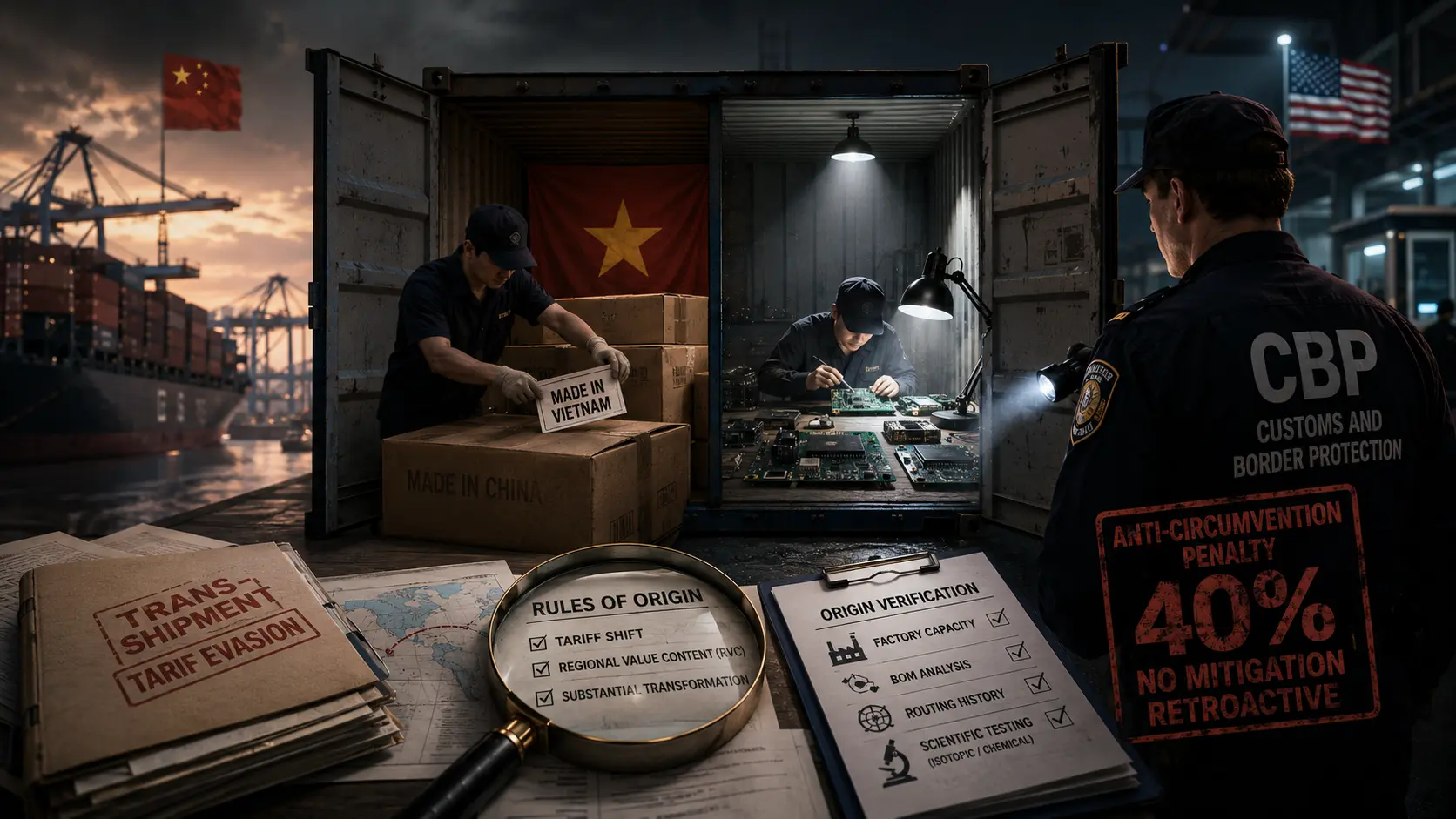

For the past several years, multinational corporations have been playing a high-stakes shell game with the global supply chain. As the United States imposed crushing tariffs on Chinese manufacturing, companies scrambled to find loopholes. The most popular strategy was “transshipment”—taking a product manufactured in China, putting it on a boat to Vietnam or Mexico, slapping a “Made in Mexico” sticker on the box, and shipping it into the U.S. tariff-free. For a brief moment, this geographic arbitrage saved importers billions of dollars.
Why should you care right now? Because the U.S. government has effectively declared war on this practice. In a sweeping regulatory crackdown culminating in a devastating 40% anti-circumvention penalty enacted in late 2025, U.S. Customs and Border Protection (CBP) has fundamentally changed the rules of global trade. Simply routing a box through a new port is now classified as illegal evasion. To survive, supply chain directors must navigate the agonizingly complex legal framework of “Rules of Origin.” They must mathematically prove that a product underwent a “Substantial Transformation” in the middleman country, utilizing dense accounting formulas like Regional Value Content (RVC) and Tariff Shifts. Understanding this legal cat-and-mouse game is no longer just for trade lawyers; it is the absolute prerequisite for defending a company’s profit margins in a deglobalizing world.
What are Rules of Origin and Transshipment?
Rules of Origin (RoO) are the legal criteria used to determine the “economic nationality” of a product, dictating what tariffs it must pay. Transshipment is the physical routing of goods through an intermediary country. While legal if significant manufacturing occurs in that third country, “illegal transshipment” (or circumvention) occurs when goods are merely passed through to falsely change their origin and evade tariffs.
At a Glance
- Concept: The mathematical and legal formulas used by border agents to figure out where a product was actually made, regardless of what the sticker on the box says.
- Why it matters: Falsifying a product’s origin to avoid a 25% tariff is a federal offense. Under new 2025/2026 rules, getting caught triggers a massive 40% penalty duty on top of standard tariffs, instantly wiping out a company’s profit margin.
- Who uses it: Customs and Border Protection (CBP) auditors, international trade lawyers, and supply chain directors auditing Tier-2 and Tier-3 suppliers.
- Biggest takeaway: Assembling parts is not enough to change a product’s origin. The process must fundamentally change the chemical, physical, or tariff classification of the goods (Substantial Transformation) to be legally recognized as a new product.
In Simple Words
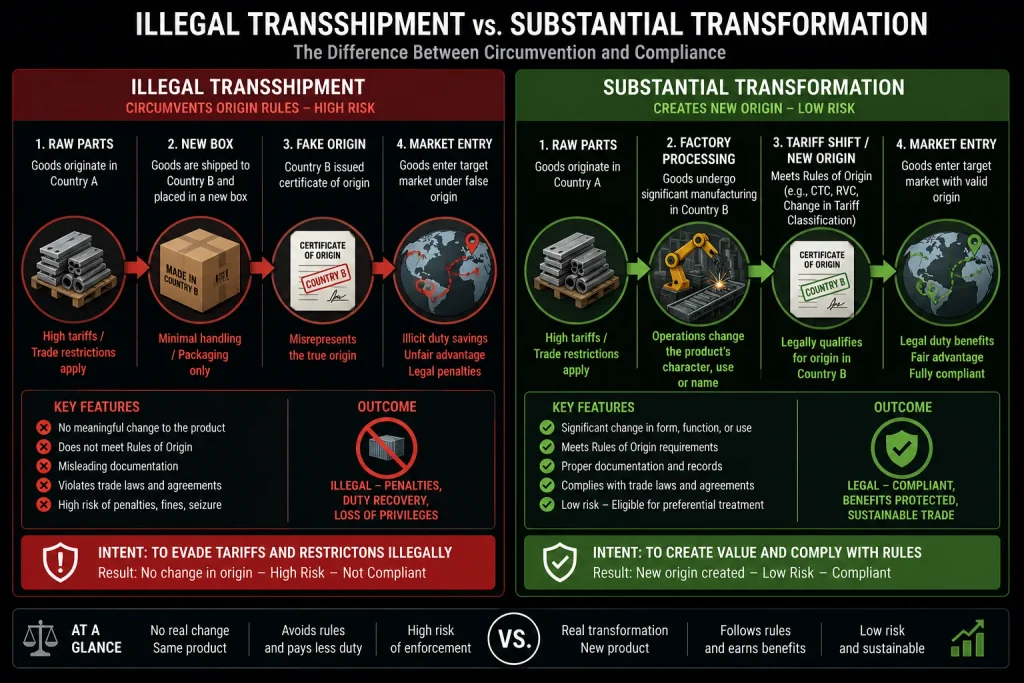
Imagine you want to import a bicycle built in Country A, but your government has placed a $100 tax on all bicycles from Country A. To avoid the tax, the factory in Country A ships the bicycle to Country B. In Country B, a worker takes the bicycle out of the box, puts a “Made in Country B” sticker on it, and ships it to you. You claim the bike is from Country B and pay no tax.
This is illegal transshipment.
Customs agents know this trick. To stop it, they enforce Rules of Origin. They demand proof of what actually happened in Country B.
If Country B just put a sticker on it, the origin remains Country A, and you get hit with massive fines. However, if Country A only shipped raw steel tubing and unshaped rubber to Country B, and workers in Country B welded the frame, molded the tires, and built the bike from scratch, the bike has undergone a Substantial Transformation. The origin legally changes to Country B, and you legally avoid the tax. The entire profession of trade law is dedicated to arguing exactly where the line between “just putting a sticker on it” and “substantial transformation” actually lies.
Why This Matters
For Trade Lawyers, Supply Chain Directors, and Macro Strategists, the era of “certificate-deep” compliance is dead.
Historically, an importer only needed a piece of paper (a Certificate of Origin) from their supplier claiming the goods were manufactured in a specific country. Today, CBP treats that certificate merely as an unverified claim. Investigators demand the underlying bill of materials, labor records, and factory electricity bills to prove the facility actually had the capacity to build the product. The White House estimates that illegal transshipment accounts for up to $75 billion in annual evasion, displacing hundreds of thousands of domestic jobs. By utilizing AI-enabled “Detective Borders” to trace raw material inputs and deploying isotopic chemical testing to verify a material’s true geographic origin, the U.S. government is turning supply chain auditing into a forensic science.
Preferential vs. Non-Preferential Rules of Origin
There are two distinct families of Rules of Origin that dictate global trade strategy.
- Preferential Rules of Origin: These are the rules written into Free Trade Agreements (like the USMCA between the U.S., Mexico, and Canada). If you meet these incredibly strict rules, your tariff is usually reduced to 0%.
- Non-Preferential Rules of Origin: These are the baseline rules used when no trade agreement exists. They are primarily used to determine if a product is subject to punitive taxes, such as Anti-Dumping/Countervailing Duties (AD/CVD) or Section 301 tariffs on Chinese goods.
The current geopolitical game involves manipulating supply chains to simultaneously dodge Non-Preferential punitive tariffs while attempting to qualify for Preferential 0% tariffs.
How to Prove Substantial Transformation
Proving that a product’s “economic nationality” has changed requires passing the legal test of Substantial Transformation.The two primary mathematical tools used to prove this transformation are the Tariff Shift and Regional Value Content (RVC).
1. The Harmonized System (HS) Code
Every product on Earth has a 6-to-10-digit identification number assigned by the World Customs Organization, known as the HS code. A raw lithium cell has one code; a finished electric vehicle battery pack has a completely different code.
2. The Tariff Shift Rule (Change in Tariff Classification)
The cleanest way to prove substantial transformation is the Tariff Shift. The rule states that the non-originating raw materials (e.g., imported from China) must have a different HS code than the finished product exported from the intermediary country (e.g., Mexico).
If a Mexican factory imports Chinese components (HS Code X) and processes them so heavily that the finished good becomes a new product (HS Code Y), a Tariff Shift has occurred. The origin legally shifts to Mexico. If the processing is minor (e.g., just painting or repacking), the HS code does not change, the tariff does not shift, and the origin remains Chinese.
3. Regional Value Content (RVC)
When a Tariff Shift isn’t enough, trade agreements demand a mathematical RVC test.This formula dictates that a specific percentage of the product’s total value must be created inside the preferred region.
Using the USMCA Net Cost method:
RVC = ((NC – VNM) / NC) × 100
Where NC is the Net Cost of the good, and VNM is the Value of Non-Originating Materials. If a car is built in Mexico, but 60% of the value of its parts comes from Asia, it will fail the USMCA’s strict 75% RVC requirement for passenger vehicles, meaning the car will be slapped with tariffs when crossing into Texas.
4. The De Minimis Safe Harbor
Trade law recognizes that modern manufacturing is complex. The De Minimis rule acts as a safe harbor. It states that if a non-originating component fails the Tariff Shift test, the final product can still claim preferential origin as long as that specific component makes up less than a tiny fraction (usually 10%) of the product’s total value.
5. Real-World Consequences: The 40% Anti-Circumvention Trap
If an importer miscalculates these formulas or relies on a fraudulent supplier certificate, the consequences are catastrophic. In August 2025, the U.S. enacted a rule imposing an automatic 40% duty penalty on goods routed through third countries with the “intent to circumvent” tariffs. Because this penalty has no phase-in period and offers zero mitigation, a single failed RVC audit can instantly bankrupt a mid-sized importing firm.
Real-World Transshipment and Tariff Evasion Cases
The enforcement of Rules of Origin has reshaped the physical flow of global commodities, particularly in highly scrutinized strategic sectors.
Southeast Asian Solar Panels: For years, Chinese solar manufacturers routed their products through Cambodia, Malaysia, Thailand, and Vietnam to avoid heavy U.S. AD/CVD duties. In response, the U.S. Department of Commerce launched massive circumvention inquiries. They ruled that because the core component (the silicon wafer) was manufactured in China, simply assembling the panels in Southeast Asia did not constitute a Substantial Transformation. The origin remained Chinese, retroactively exposing U.S. importers to billions of dollars in unexpected tariffs and completely restructuring the solar supply chain.
Mexican Automotive Manufacturing (USMCA): Under NAFTA, the RVC requirement for cars was 62.5%. The USMCA raised it to a brutal 75%, while adding complex “Labor Value Content” rules requiring 40% of the car to be made by workers earning at least $16 an hour. This mathematical fortress was designed specifically to prevent European and Asian automakers from using Mexico merely as a cheap, pass-through assembly hub for foreign parts to access the U.S. market duty-free.
The False Claims Act Weaponization: The U.S. Department of Justice (DOJ) has formed a dedicated Trade Fraud Task Force to prosecute transshipment. Rather than just assessing tariff penalties, the DOJ uses the False Claims Act. If a company knowingly imports goods using a false country of origin to avoid paying the U.S. government its owed tariffs, the DOJ sues the company for defrauding the government, resulting in massive multi-million-dollar settlements and potential criminal liability for corporate executives.
Economic & Strategic Impact
The ultimate strategic impact of aggressive RoO enforcement is the Eradication of the “Asset-Light” Arbitrage.
In the 2010s, an importer could shift their supply chain from China to Vietnam in a matter of weeks by simply finding a new contract manufacturer to assemble their Chinese parts. It was asset-light and incredibly cheap.
The 2025/2026 enforcement regime destroys this model. Because Customs requires proof of Substantial Transformation (actual, heavy manufacturing), companies can no longer use cheap assembly hubs. They must fund the construction of massive, capital-intensive foundries, chemical plants, and heavy manufacturing facilities inside the intermediary countries to ensure the raw materials undergo a legal Tariff Shift. This forces companies to deploy billions in CapEx just to legally satisfy a customs formula, massively increasing the frictional cost of globalization.
Advantages of Mastering RoO
- Tariff Evasion: Companies that legitimately understand and execute Tariff Shifts and RVC requirements can legally import goods at 0% tariffs under FTAs, securing a massive pricing advantage over competitors who pay 25% baseline tariffs.
- Supply Chain Resilience: By forcing suppliers to map their entire sub-tier material flow to calculate RVC, a company gains total visibility into its supply chain, inadvertently exposing hidden bottlenecks and supplier concentration risks.
- Penalty Avoidance: In an era of 40% retroactive anti-circumvention penalties, maintaining a pristine, auditable ledger of supplier affidavits, factory electricity bills, and bill-of-materials prevents catastrophic margin wipeouts during sudden CBP audits.
Limitations and Risks
- The Burden of Proof: A certificate of origin is no longer a shield; it is merely a claim. The importer of record bears 100% of the legal liability if their foreign supplier lies about where they bought their raw materials.
- Dynamic Rule Changes: A product might qualify for preferential origin today, but if the foreign supplier quietly decides to swap out a local component for a cheaper Chinese component next week, the RVC drops. The product quietly loses its origin status, turning all subsequent imports into customs violations without the importer realizing it.
- Subjectivity of Substantial Transformation: Non-preferential origin relies on the vague definition of “a new name, character, or use”. Because this is subjective, companies often have to spend months waiting for binding rulings from CBP to know whether their specific manufacturing process qualifies, paralyzing product launch timelines.
Common Misconceptions
Misconception: If it says “Made in Vietnam” on the box, Customs will accept it.
Reality: Customs routinely ignores the label. If data anomalies (like Vietnam exporting more of a specific product than it has the physical factory capacity to produce) trigger an AI audit, CBP will strip the label and demand the underlying factory production logs.
Misconception: Assembling the final product changes the origin.
Reality: Minor processing, packaging, dilution with water, or simple screwdriver assembly almost never satisfies the Substantial Transformation test. The chemistry or tariff classification of the core components must change.
Misconception: Rules of Origin only matter to the manufacturer.
Reality: The “Importer of Record” (usually the brand or the retailer buying the goods) pays the fines. Even logistics service providers (freight forwarders) can now be held liable and fined for indirectly participating in false origin declarations.
What Most People Miss
The disruptive intelligence value of Isotopic and Molecular Tracing.
Most companies believe they can beat a customs audit by simply forging better paperwork. What they miss is the industrialization of scientific border enforcement.
CBP is increasingly deploying isotopic ratio mass spectrometry and chemical tracing. Because the soil and groundwater in every geographic region have a unique chemical signature, agricultural goods (like cotton) and mined materials (like quartz for solar panels) carry a permanent molecular “fingerprint” of the exact location they were extracted. If your paperwork claims the raw material came from India, but the mass spectrometer detects the isotopic signature of the Xinjiang region in China, the paperwork is instantly invalidated, and the company is subjected to federal fraud investigations.
Comparison Table
| Feature | Preferential Rules of Origin (e.g., USMCA) | Non-Preferential Rules of Origin |
| Primary Purpose | Qualify for 0% or reduced tariffs | Apply quotas or punitive tariffs (e.g., Sec 301) |
| Evaluation Method | Strict formulas: Tariff Shift & RVC | Subjective: “Substantial Transformation” |
| Documentation | Detailed Certificates of Origin | Supplier affidavits, production logs, routing |
| Arbitrage Strategy | Maximize regional value-add | Move heavy manufacturing to a neutral 3rd country |
| Failure Consequence | Pay standard Most Favored Nation (MFN) tariff | Hit with 40% Circumvention Penalties |
Case Study
Situation: Following the imposition of massive Section 301 tariffs on Chinese imports, a major U.S. electronics importer shifted its entire procurement strategy. They ordered their Chinese supplier to ship the components to a new facility in Malaysia. In Malaysia, the components were assembled into finished circuit boards, boxed, labeled “Made in Malaysia,” and imported into the U.S. tariff-free.
Challenge: In late 2025, the U.S. government implemented the sweeping Anti-Circumvention Rule to close the transshipment loophole. CBP initiated an AI-driven routing audit, noticing a massive spike in Malaysian electronics exports that perfectly correlated with a drop in Chinese exports. CBP flagged the importer’s shipments for a profound origin verification audit.
Solution & Outcome: CBP demanded the factory electricity bills, labor logs, and the raw bill of materials. The audit revealed that 95% of the value was Chinese, and the Malaysian facility was merely performing “screwdriver assembly” that did not change the Tariff Classification (HS Code) of the core components. CBP ruled that no Substantial Transformation had occurred. The origin remained Chinese. Under the new 2025 mandate, the importer was hit retroactively with the original 25% Section 301 tariff plus the unmitigable 40% Anti-Circumvention penalty. The 65% total tariff assessment instantly bankrupted the product line.
Lessons Learned: The case established a terrifying new precedent for global trade. It proved that geographic routing without heavy capital investment (CapEx) is no longer a viable supply chain strategy. To legally survive in a tariff-heavy world, companies must possess deep, irrefutable, shipment-level evidence proving that actual, complex manufacturing occurred in the intermediary country.
Future Outlook
Next 12–24 Months
The era of The AI-Enabled “Detective Border”. Through 2026 and 2027, the focus of global customs enforcement will pivot entirely to data ingestion. CBP will aggressively scale its AI systems to cross-reference maritime routing histories, corporate ownership structures, and regional production-capacity indicators. If a country with only three small solar factories suddenly exports millions of solar panels to the U.S., the AI will automatically flag all shipments from that country for transshipment evasion, halting billions of dollars of inventory at the ports.
Next 3–5 Years
The scaling of Digital Supply Chain Ledgers. To survive these instantaneous AI audits, the world’s largest importers will force their suppliers onto blockchain-based or immutable digital ledgers. These ledgers will track every component from the mine to the final assembly plant, automatically calculating Regional Value Content (RVC) in real-time. If a Tier-3 supplier swaps a compliant part for a non-compliant Chinese part, the ledger will instantly warn the U.S. importer that the product’s origin status has been compromised, allowing them to stop the shipment before it triggers a federal penalty.
Next 10 Years
The End of Tariff Arbitrage and Hyper-Localization. By the mid-2030s, the cat-and-mouse game of transshipment will effectively end. The sheer cost of maintaining the forensic compliance required to prove origin, combined with unrelenting anti-circumvention penalties, will destroy the economic viability of complex, multi-nation supply chains. Multinationals will abandon the strategy of chasing cheap labor and tariff loopholes. Instead, they will pivot to hyper-localized manufacturing—building heavily automated, robotic factories directly inside the final consumer markets (e.g., building cars in Texas for the U.S. market), rendering Rules of Origin entirely irrelevant.
Most Likely Scenario
Rules of Origin and transshipment audits represent the legal weaponization of deglobalization. As tariff walls grow higher, the definition of “Substantial Transformation” will become increasingly strict and impossible to fake. Supply chain directors who master these complex accounting formulas will dictate their company’s survival, while those who rely on fraudulent “Made In” stickers will face insurmountable federal prosecution.
Key Takeaways
- Rules of Origin determine a product’s “economic nationality” and dictate whether it qualifies for 0% tariffs under a trade agreement or gets hit with massive penalty taxes.
- Illegal transshipment is the act of routing a product through a middleman country (like Vietnam or Mexico) and putting a fake origin sticker on it to dodge tariffs.
- To legally change a product’s origin, it must undergo a “Substantial Transformation” in the middleman country. Just packaging or assembling parts is not enough.
- Importers must mathematically prove this transformation using a “Tariff Shift” (changing the product’s official HS code) or “Regional Value Content” (proving a specific percentage of the value was created locally).
- In 2025, the U.S. enacted a brutal 40% Anti-Circumvention penalty on illegally routed goods. There is no phase-in period, and it applies retroactively.
- Customs agents now use AI, factory electricity bills, and even isotopic chemical testing to prove exactly where a material came from, completely nullifying fake paper certificates.
Glossary
Certificate of Origin: A document declaring the nationality of a good. In modern trade law, it is treated merely as a claim that must be backed up by massive amounts of production evidence.
De Minimis: A trade rule allowing a product to keep its preferential origin status even if a tiny percentage (usually around 10%) of its components fail the strict Tariff Shift rules.
Harmonized System (HS) Code: The internationally standardized system of names and numbers used to classify traded products. Changing a product’s HS code during manufacturing is the primary way to prove origin changed.
Regional Value Content (RVC): A mathematical formula required by free trade agreements (like USMCA) dictating that a certain percentage of a product’s value must be created inside the region.
Substantial Transformation: The legal baseline required to change a product’s non-preferential origin. It requires the raw materials to emerge from the manufacturing process with a new name, character, or use.
Transshipment: The routing of goods through an intermediary country. While common in logistics, it becomes illegal “circumvention” when done specifically to disguise the true origin and evade tariffs.
Sources
ICL Global: US Issues New Order Imposing 40% Duties and Penalties on Goods Routed Through Third Countries to Evade Tariffs
The White House: The Great Transshipment Scam
CXTMS: Tariff Evasion Through 40 Countries Raises the Bar for Transshipment Evidence
Prodensa: USMCA Rules of Origin: Criteria, RVC & Mexico Guide
Paul, Weiss: Trump Administration Heightens Enforcement Focus on Tariff Evasion and “Transshipment”