Advertisement
)
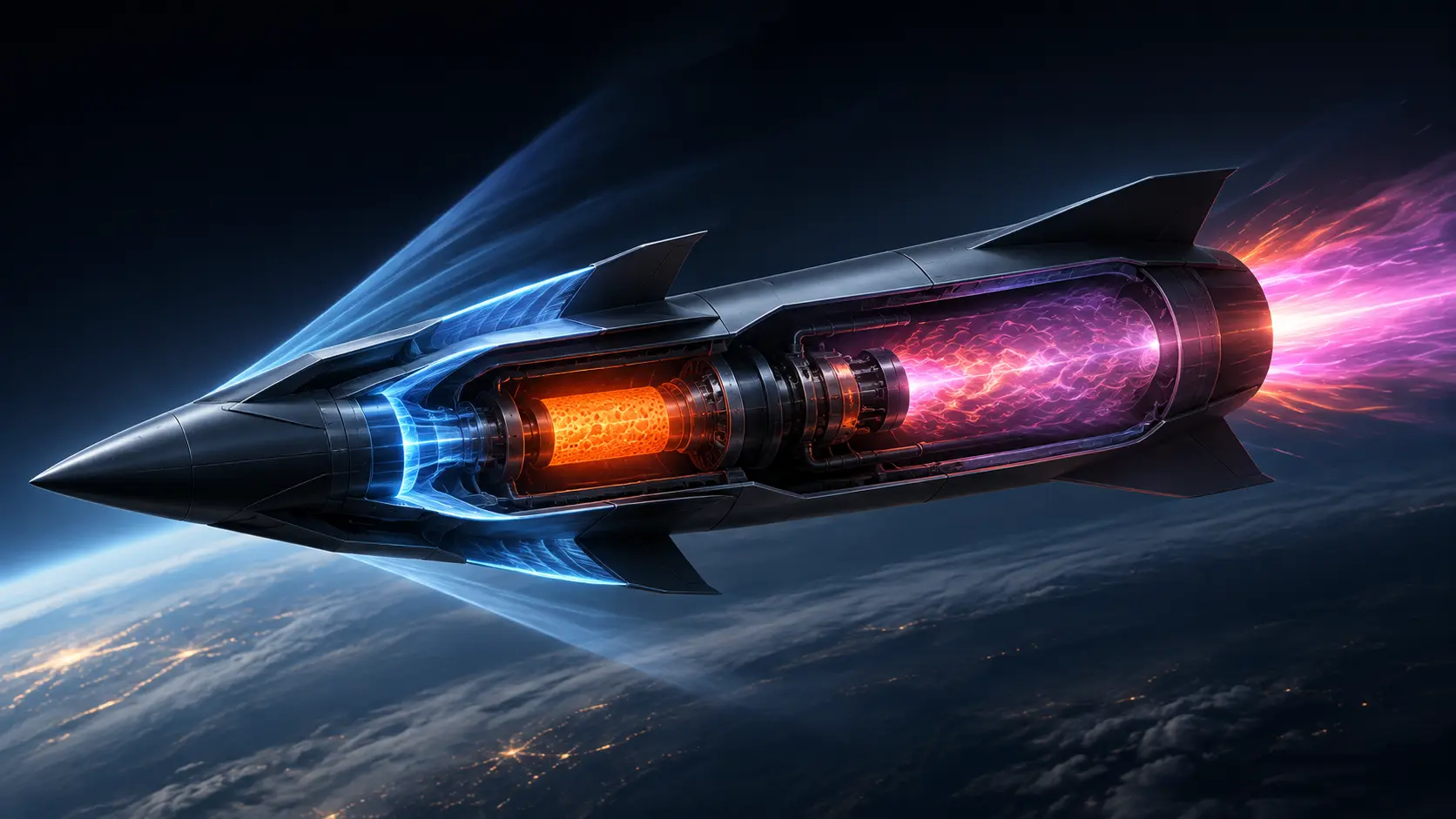

If a fighter pilot fires a standard air-to-air missile at an enemy jet 60 miles away, the missile does not fly under power the whole way. A standard missile burns through its entire fuel supply in the first ten seconds. For the remaining 59 miles, the missile is completely out of gas. It must “coast” through the air, steadily losing speed and energy to atmospheric drag. By the time it reaches the target, the missile is sluggish. If the enemy pilot pulls a violent, high-G evasive turn at the very last second, the exhausted, coasting missile simply does not have the aerodynamic energy left to turn and follow them. The enemy escapes.
Why should you care right now? Because aerospace engineers have rewritten the thermodynamics of aerial combat. To stop enemy jets from dodging missiles at the last second, the defense industry had to build a missile that never runs out of gas. By deploying Solid-Fuel Ramjets (SFRJs), engineers have created missiles that “breathe” the surrounding air to burn their fuel. Instead of exploding all their fuel at launch, they sip it, throttling their engines like a sports car. When they reach the target, they slam the throttle wide open. The missile arrives at the target flying at Mach 4 under active, roaring power, rendering any evasive maneuver physically impossible. This technology dictates the size of the “No-Escape Zone,” fundamentally redefining who controls the skies in modern warfare.
What are Solid-Fuel Ramjets (SFRJ)?
Solid-Fuel Ramjets (SFRJ), or Variable-Flow Ducted Rockets, are advanced propulsion systems that use supersonic air scooped from the atmosphere to burn a solid, fuel-rich gas generator. By throttling this gas flow, the missile conserves fuel for sustained thrust, drastically expanding its terminal kinetic energy and interception range.
At a Glance
- Concept: A missile engine that uses a solid block of fuel but doesn’t carry its own oxygen. It uses air intakes to scoop oxygen from the sky, making it vastly lighter and more efficient.
- Why it matters: It expands the “No-Escape Zone.” A standard missile arrives at the target coasting and weak. An SFRJ missile arrives actively accelerating, guaranteeing a lethal intercept against highly maneuverable targets.
- Who uses it: NATO air forces (via the MBDA Meteor missile), integrating the weapon onto Eurofighter Typhoons, Dassault Rafales, and F-35 Lightnings.
- Biggest takeaway: Standard solid rockets cannot be throttled—once lit, they burn until empty. SFRJs use a mechanical valve to squeeze the fuel flow, allowing the missile’s computer to save gas for the final, critical seconds of the dogfight.
In Simple Words
Imagine a drag race between two very different vehicles.
A Standard Solid Rocket Motor (SRM) is like a dragster. It dumps all of its explosive fuel into the engine immediately. It shoots off the starting line incredibly fast, but it runs out of gas halfway down the track. It has to roll the rest of the way in neutral. If the finish line suddenly moves to the left, the dragster doesn’t have the engine power to steer toward it; it just skids out.
A Solid-Fuel Ramjet (SFRJ) is like a high-end sports car. It accelerates smoothly off the line, actively pushing the gas pedal to maintain a fast, cruising speed. Because it is managing its fuel, it still has a full tank when it nears the end of the track. If the finish line suddenly moves, the sports car floors the accelerator, turns the wheel with massive engine power, and hits the target flawlessly.
Why This Matters
For Aerospace Engineers, Defense Strategists, and Military Contractors, the SFRJ solves the mathematical vulnerability of Beyond Visual Range (BVR) Combat.
Modern air combat is fought at extreme distances (often 50 to 100 miles away). At these ranges, the defining metric of a missile is its “kinematics”—its raw energy state upon reaching the target. A 5th-generation fighter (like the F-22 or J-20) possesses advanced radar warning receivers. The moment an incoming missile goes “active,” the targeted pilot will execute violent, energy-bleeding maneuvers (like the “F-Pole” maneuver) specifically designed to outrun a coasting missile. Without SFRJ technology, firing a missile at maximum range is mathematically useless against a competent pilot. The integration of ramjets ensures that a $2 million missile actually results in a kill, preserving the lethal credibility of the air force.
The Evolution of Ramjet Missile Propulsion
The evolution of the ramjet bridges the gap between rockets and jet engines.
A standard jet engine has heavy, spinning turbine blades to suck in and compress air. A rocket carries its own heavy liquid oxygen tanks so it can burn fuel in the vacuum of space.
A ramjet sits perfectly in the middle. It has no spinning blades, and it carries no oxygen tanks. It relies entirely on the forward speed of the missile to literally “ram” supersonic air into its intakes, compressing it naturally. By stripping away the heavy blades and heavy oxygen tanks, the missile devotes almost its entire internal volume to pure, explosive fuel, radically maximizing its range.
How Solid-Fuel Ramjets (SFRJ) Work
Extracting maximum specific impulse (I_sp) while flying at Mach 4 requires orchestrating a two-stage chemical reaction. Here is the first-principles breakdown of the architecture.
1. The Fundamental Problem: Oxidizer Weight
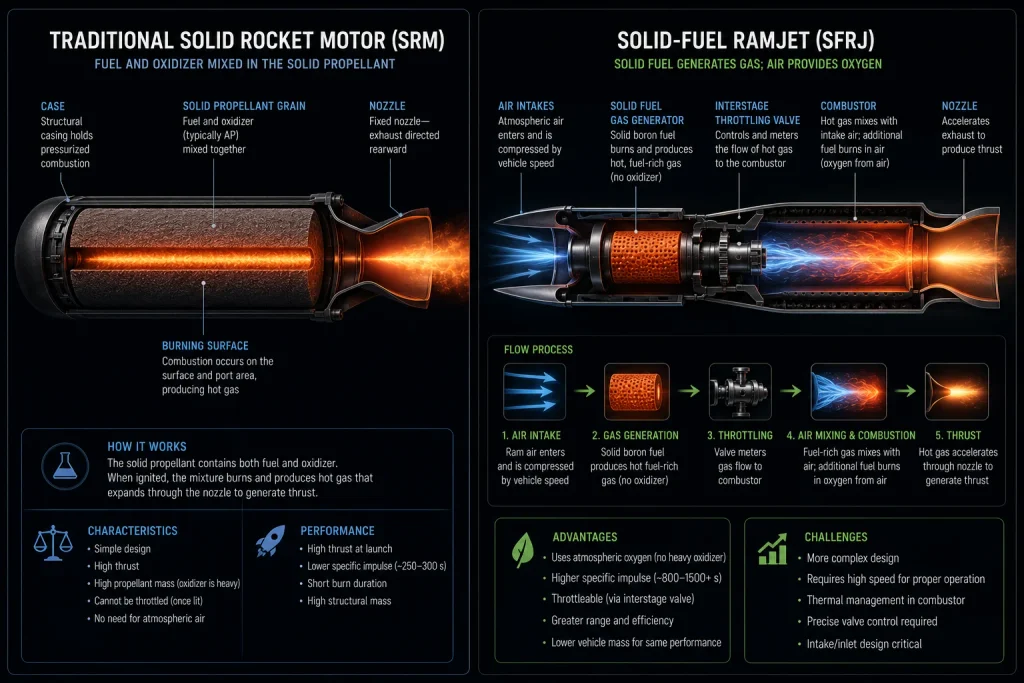
A traditional Solid Rocket Motor (SRM) mixes fuel and oxidizer (the chemical that provides oxygen) into a single, solid propellant block. The oxidizer is incredibly heavy, taking up a massive percentage of the missile’s weight and severely limiting how much actual fuel can be carried.
2. The Core Mechanism: The Boron Gas Generator
The SFRJ (specifically the Variable-Flow Ducted Rocket) removes the oxidizer. Instead, it uses a “gas generator”—a solid block of highly dense, boron-loaded fuel.
When ignited, this block burns in an oxygen-starved environment. It produces a thick, hot, fuel-rich gas, but it does not fully explode because there isn’t enough oxygen to complete the reaction.
3. Technical Depth: The Interstage Valve and Combustor
This hot, unburnt gas flows through an interstage throttling valve and into a secondary combustion chamber. Simultaneously, supersonic air from the atmosphere is channeled through the missile’s side intakes and dumped into this exact same chamber. The hot gas mixes with the oxygen-rich atmospheric air and instantly auto-ignites, generating massive, sustained thrust.
4. Throttling for the No-Escape Zone
The genius of the VFDR is the interstage valve. By opening or closing this valve, the missile’s flight computer can control exactly how much fuel-rich gas enters the combustor.
- Mid-Course Cruise: The valve closes slightly, burning just enough fuel to maintain Mach 3 and fight drag, saving gas.
- Terminal Intercept: The radar locks onto the target. The valve opens completely. The combustor floods with fuel, accelerating the missile to Mach 4+ while pulling 30-G turns, actively chasing the target down under full power.
5. Real-World Consequences: The Booster Requirement
There is a catch. Because a ramjet relies on the forward motion of the missile to “ram” and compress the air, a ramjet cannot start from zero miles per hour. If it is sitting still, no air enters the intake. Therefore, an SFRJ missile must have a traditional solid rocket booster built into its tail. The booster fires first, accelerating the missile to Mach 2. Once moving fast enough, the booster is jettisoned (or burned away), the air intakes open, and the ramjet takes over.
Operational Deployments: MBDA Meteor and Beyond
The theoretical superiority of the ducted rocket has aggressively transitioned into operational deployment, fundamentally altering NATO’s air superiority doctrine.
The MBDA Meteor (BVRAAM): The Meteor is the undisputed pinnacle of SFRJ technology. Developed by a European consortium (MBDA), the Meteor utilizes a Bayern-Chemie variable-flow ducted rocket. It is currently integrated into the Eurofighter Typhoon, the Dassault Rafale, and the Saab Gripen, and is undergoing integration into the internal weapons bays of the F-35 Lightning II. Because of its ramjet propulsion, defense analysts universally consider the Meteor to possess a “No-Escape Zone” three to five times larger than the U.S. AIM-120 AMRAAM, giving European air forces a distinct kinematic advantage in BVR combat.
Hypersonic Ground Strike: The physics of the ramjet naturally scale into the hypersonic regime (Scramjets—Supersonic Combustion Ramjets). While the Meteor slows the incoming air down to subsonic speeds before burning it, future solid-fuel scramjets are being engineered to burn the fuel while the air is still moving at supersonic speeds through the chamber. This architecture forms the basis of next-generation standoff weapons, allowing a bomber to launch a solid-fuel cruise missile that sustains Mach 5+ across hundreds of miles to strike enemy air defense radars before they can react.
Artillery Range Extension (Ramjet Shells): The technology is miniaturizing. Defense contractors (like Nammo and Boeing) are developing 155mm artillery shells equipped with miniature solid-fuel ramjets. Fired from a standard Howitzer, the shell uses its initial explosive velocity to ignite the ramjet. The continuous thrust fights the immense atmospheric drag experienced by artillery, extending the range of a standard 155mm gun from 25 miles out to nearly 90 miles, drastically out-ranging adversarial counter-battery fire.
Economic & Strategic Impact
The proliferation of SFRJ technology enforces a Generational Rewrite of Fighter Tactics.
For the past 30 years, U.S. air dominance relied on a specific formula: superior stealth (F-22/F-35) paired with the AIM-120 AMRAAM. U.S. pilots plan to shoot the enemy before the enemy ever sees them.
However, near-peer adversaries (like China) have developed their own ultra-long-range missiles (like the PL-15) and are actively researching ramjet technology. If a stealth fighter is forced into a kinetic exchange where both sides launch missiles at 80 miles, the pilot relying on the coasting SRM is at a severe disadvantage against the pilot relying on the throttling SFRJ. To maintain parity, the U.S. military is currently pouring billions into the classified AIM-260 JATM (Joint Advanced Tactical Missile) program, desperately seeking to match the kinematic dominance pioneered by the Meteor.
Advantages
- Massively Expanded No-Escape Zone (NEZ): The ability to arrive at the target under active, roaring power ensures the missile retains the aerodynamic authority to pull high-G turns, making it nearly impossible for an enemy jet to dodge.
- Fuel Efficiency (High I_sp): By using atmospheric oxygen instead of carrying heavy liquid oxidizer, the missile achieves a specific impulse three to four times higher than a traditional solid rocket.
- Energy Management (Throttling): The interstage valve allows the missile’s computer to calculate the exact distance to the target and optimize the fuel burn rate for the entire duration of the flight.
Limitations
- The Booster Penalty: The missile cannot start from a standstill; it requires a built-in solid rocket booster to reach Mach 2 before the ramjet can ignite. This booster takes up valuable space and weight inside the missile chassis.
- Altitude Constraints: Ramjets must “breathe” air. If a fighter pilot fires the missile at a target flying at extreme altitudes (e.g., 80,000 feet), the air is too thin to provide enough oxygen for combustion. The missile’s engine will “flame out” and fail.
- Extreme Metallurgical Heat: Throttling fuel-rich, boron-loaded gas creates unimaginable thermal stress. The combustor walls and the interstage valve must be constructed from highly expensive, classified superalloys and ceramics to prevent the missile from melting itself from the inside out during a 3-minute flight.
Common Misconceptions
Misconception: The missile sucks in air using a fan, like a commercial jet.
Reality: There are zero moving fan blades in a ramjet. The missile is traveling so fast (Mach 2+) that the shape of the air intakes literally crushes and compresses the incoming air purely through the physics of shockwaves.
Misconception: The United States invented the Meteor missile.
Reality: The Meteor was developed by a European consortium (MBDA). The United States has historically struggled to operationalize ramjet air-to-air missiles, relying instead on dual-pulse solid rocket motors for its primary AIM-120D arsenal.
Misconception: An SFRJ missile is faster than a standard missile.
Reality: A standard SRM missile usually has a higher top speed immediately after launch (often hitting Mach 4 or 5 right off the rail). The advantage of the SFRJ is not its top speed, but its sustained speed. It doesn’t coast and slow down; it maintains Mach 4 all the way to the target.
What Most People Miss
The disruptive intelligence value of Boron-Loaded Propellants.
When engineers transitioned from solid rockets to ramjets, they realized standard carbon-based fuels (like HTPB) didn’t pack enough punch. What most people miss is the complex chemistry required to make the SFRJ lethal.
The fuel inside an advanced SFRJ is heavily loaded with Boron particles. Boron has one of the highest volumetric energy densities of any element on Earth. When boron burns, it releases a staggering amount of thermal energy. However, burning boron is notoriously difficult because it forms a liquid oxide shell that suffocates the combustion. Engineering the gas generator to successfully ignite and cleanly burn boron-rich gas in a fraction of a second inside a Mach 3 wind tunnel is the true, highly classified secret that separates functional ramjets from explosive failures.
Comparison Table
| Feature | Standard Solid Rocket Motor (SRM) | Liquid Ramjet | Solid-Fuel Ramjet (VFDR) |
| Fuel State | Solid block (Fuel + Oxidizer) | Liquid Fuel | Solid block (Fuel only) |
| Throttling Capability | None (Burns until empty) | High | High (Via interstage valve) |
| Terminal Energy | Low (Coasting) | High | High (Active thrust) |
| Handling Safety | Very Safe | Hazardous (Toxic liquid fuels) | Very Safe |
| Complexity / Cost | Low | High (Pumps & plumbing) | Moderate to High |
Case Study
Situation: During the late 1990s and early 2000s, European defense ministries assessed that the proliferation of advanced Russian Flanker derivatives (Su-27/Su-35) posed a severe threat. These aircraft were highly maneuverable and carried long-range missiles. NATO required a Beyond Visual Range (BVR) missile that could guarantee a kill at extreme ranges, rendering the enemy’s maneuverability irrelevant.
Challenge: Standard solid rocket motors could not provide the sustained thrust required. Liquid-fueled ramjets were too complex, prone to leaking highly toxic fuels on aircraft carriers, and required too much maintenance for a front-line fighter squadron.
Solution (The MBDA Meteor): A consortium of European aerospace firms collaborated to develop the Meteor. They bypassed liquid fuels entirely and integrated a Variable-Flow Ducted Rocket (VFDR) utilizing a solid boron-loaded gas generator developed by Bayern-Chemie. The design incorporated a nozzle-less booster integrated directly into the combustor chamber. The booster accelerated the missile to Mach 2, burned away completely, and opened the chamber for the ramjet to take over.
Outcome: The Meteor successfully entered service in the 2010s, immediately resetting the global standard for air-to-air lethality. By proving that a solid-fuel gas generator could be precisely throttled via an interstage valve, the Meteor achieved an unprecedented continuous-thrust profile. It delivered a No-Escape Zone multiple times larger than any competing SRM missile, fundamentally securing European air superiority and forcing a massive strategic pivot in U.S. and Chinese missile development programs.
Lessons Learned: The Meteor program validated that the integration of air-breathing thermodynamics into solid-state weapons is the definitive requirement for 21st-century air combat. It proved that managing the energy state of the missile at the terminal phase of the intercept is vastly more important than the initial launch velocity.
Future Outlook
Next 12–24 Months
The era of F-35 Integration and Sensor Fusion. In the immediate term, the focus will be the physical and software integration of the Meteor into the internal weapons bays of the F-35 Lightning II. Because the Meteor is slightly larger than the AIM-120 due to its air intakes, integration requires careful modification. Once integrated, the F-35 will achieve a devastating synergy: utilizing its unmatched stealth and sensor fusion to silently detect enemy aircraft at extreme ranges, and firing an SFRJ missile that can chase the target down before the F-35 is ever detected.
Next 3–5 Years
The scaling of Dual-Mode Scramjets. As the technology matures, engineers will attempt to push the boundary from Ramjet (subsonic combustion) to Scramjet (supersonic combustion). The next generation of solid-fuel missiles will feature dual-mode combustors. The missile will launch and act like a standard ramjet up to Mach 4. But as it accelerates to Mach 5+, the internal geometry will actively shift, allowing the air to flow through the combustor at supersonic speeds, propelling the weapon into the hypersonic regime for unstoppable, time-critical ground strikes.
Next 10 Years
The Obsolescence of the Coasting Interceptor. By the mid-2030s, the traditional solid rocket motor will be deemed obsolete for any primary Beyond Visual Range engagement. The global standard for all tier-1 air forces will be throttleable, air-breathing propulsion. The aerodynamic dogfight between human pilots will be entirely replaced by a thermodynamic chess match between algorithms: an AI-driven fighter jet calculating the exact fuel-burn rate required for its SFRJ missile to trap an enemy drone perfectly within an inescapable mathematical energy cone.
Most Likely Scenario
Solid-Fuel Ramjets are the definitive end-state for atmospheric missile propulsion. By effectively turning the sky itself into the missile’s fuel tank, the technology overcomes the oldest limitation of rocketry. As adversaries continue to develop highly agile, thrust-vectoring fighter jets, the only mathematical countermeasure is a weapon that arrives at the target with its engine roaring, ensuring that the concept of “evasion” is permanently deleted from the modern battlefield.
Key Takeaways
- Standard air-to-air missiles burn all their fuel in the first few seconds of flight. They must coast to the target, slowly losing energy, allowing enemy fighter jets to dodge them at the last second.
- Solid-Fuel Ramjets (SFRJs) solve this by “breathing” the atmosphere. They use supersonic air scoops to grab oxygen, allowing them to burn fuel continuously for the entire flight.
- Because the missile does not carry heavy liquid oxygen tanks, it is incredibly light and fuel-efficient, drastically expanding its maximum range.
- The missile uses a mechanical valve to “throttle” its engine. It saves fuel while cruising, and then slams the throttle wide open to chase the target down at Mach 4+.
- Arriving at the target under active, roaring power creates a massive “No-Escape Zone”—a mathematical area where the missile has so much kinetic energy that the enemy jet cannot physically turn fast enough to survive.
- The European MBDA Meteor is the most famous and successful deployment of this technology, currently setting the global standard for air-to-air lethality.
Glossary
Beyond Visual Range (BVR): Air combat that occurs at distances where the pilots cannot see each other with the naked eye (typically 20 to 100+ miles), relying entirely on radar and long-range missiles.
Gas Generator: The solid block of boron-loaded fuel inside an SFRJ. It burns in an oxygen-starved environment, producing a thick, hot gas that is later mixed with atmospheric air and ignited.
Kinematics: The raw energy state (speed and maneuverability) of a missile or aircraft.
No-Escape Zone (NEZ): The specific volume of airspace in front of a firing fighter jet where a launched missile has enough kinetic energy to guarantee a hit, regardless of how aggressively the target tries to dodge.
Solid Rocket Motor (SRM): The traditional missile engine. A solid tube of explosive fuel mixed with oxygen that burns uncontrollably until empty.
Variable-Flow Ducted Rocket (VFDR): The specific technical term for an SFRJ that uses an internal valve to throttle the flow of gas, allowing the missile’s computer to control its speed.
Sources
Defense Technical Information Center (DTIC): Solid-Fuel Ramjets: A Review of the Technology and Applications
MBDA Missile Systems: Meteor – Beyond Visual Range Air-to-Air Missile
Journal of Propulsion and Power: Boron-Based Solid-Fuel Ramjet Performance
Air & Space Forces Magazine: The Race for the Next Air-to-Air Missile (AIM-260 JATM)
Royal Aeronautical Society: The kinematics of air-to-air combat and the Meteor BVRAAM