Advertisement
)
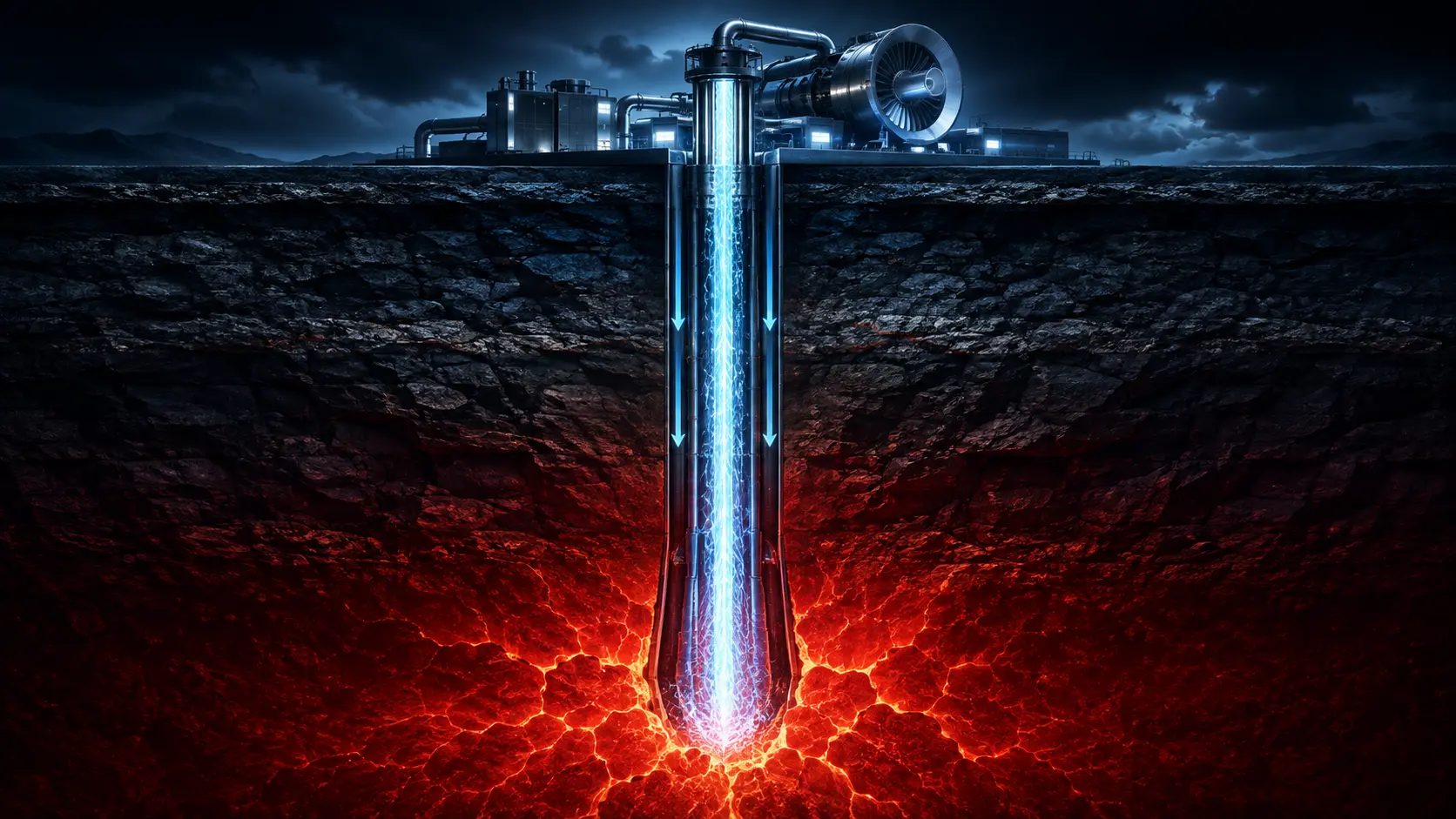

To replace a single, mid-sized coal plant, a utility must bulldoze thousands of acres of land, install millions of solar panels, and spend billions of dollars on chemical batteries to keep the grid running when the sun goes down. The spatial mathematics of the renewable energy transition are fundamentally unsustainable. Yet, directly beneath that same coal plant, located three to ten miles straight down, lies a nuclear-powered thermal battery the size of the planet itself. The Earth’s crust holds enough thermal energy to power human civilization for millions of years, but accessing the deepest, hottest layers has historically melted our drill bits and destroyed our electronics.
Why should you care right now? Because the oil and gas industry’s drilling technology has finally caught up to the geology of the deep crust. Energy companies are no longer satisfied with shallow, low-heat geothermal wells. They are driving drills into “Super Hot Rock” environments exceeding 400°C. At these extreme depths, the physical laws of water break down. It turns into a “supercritical” fluid—a hyper-fast, ultra-dense state of matter that acts like a thermal conveyor belt. By tapping into this supercritical threshold, the energy industry is preparing to unleash a limitless, zero-carbon baseload power source that operates 24/7 on a surface footprint no larger than a suburban parking lot.
What is Super Hot Rock (SHR) Geothermal?
Super Hot Rock (SHR) Geothermal is an advanced renewable energy technology that involves drilling deep into the Earth’s crust to access rock temperatures exceeding 400°C. At this depth, injected water becomes a “supercritical” fluid, possessing immense energy density that allows a single well to generate up to ten times more electricity than conventional geothermal systems.
At a Glance
- Concept: Drilling miles underground to reach rock so hot that it boils water into a bizarre, high-energy plasma-like state, extracting massive amounts of electricity from a tiny pipe.
- Why it matters: Solar and wind need huge amounts of land and batteries. SHR geothermal runs 24/7, works anywhere on Earth if you drill deep enough, and uses almost no surface space.
- Who uses it: Cutting-edge energy startups (Quaise Energy, Fervo Energy, AltaRock Energy), national laboratories, and advanced metallurgy drilling contractors.
- Biggest takeaway: Supercritical water isn’t steam. It moves as fast as a gas but holds heat like a liquid. This freak of physics allows a single geothermal well to jump from producing 5 Megawatts of power to producing 50 Megawatts.
In Simple Words
Imagine you are trying to move energy out of a deep, hot cave using a bucket of water.
In Standard Geothermal, the cave is warm (150°C). You lower a bucket of water, it turns into standard steam, and you pull it up. Because steam is fluffy and takes up a lot of space, you can only pull up a small amount of actual energy per bucket. You need hundreds of buckets to power a city.
In Super Hot Rock Geothermal, you drill much deeper until the cave is terrifyingly hot (400°C) and under crushing pressure. When you lower the water into this environment, it hits the Supercritical Threshold. It refuses to turn into normal steam. Instead, it turns into a bizarre, dense, glowing fog. This fog squeezes massive amounts of thermal energy into a tiny space and shoots up the pipe with almost zero friction. Because the “fog” is so dense with heat, one bucket of supercritical water holds ten times more energy than a bucket of standard steam.
Why This Matters
For Utility Planners, Energy Investors, and ESG Analysts, SHR Geothermal definitively solves the Baseload Land-Use Crisis.
To power a 1-Gigawatt artificial intelligence data center using solar power, a developer must acquire up to 10,000 acres of land, navigate agonizing multi-year environmental impact studies, and install $2 billion worth of lithium-ion batteries to provide nighttime power.
A 1-Gigawatt SHR geothermal facility can be constructed on approximately 10 to 15 acres of land. Because the Earth’s heat is constant, the capacity factor exceeds 90%, matching the reliability of a nuclear reactor. While the initial capital expenditure (CapEx) to drill a 5-mile-deep well is exceptionally high, the Levelized Cost of Energy (LCOE) over a 30-year lifespan plunges due to the minimal surface footprint, zero fuel costs, and absence of battery requirements. SHR is the only renewable technology capable of dropping directly into the footprint of an abandoned coal plant and perfectly replacing its grid output.
The Evolution of Geothermal: EGS to Super Hot Rock
The evolution of the Earth’s thermal battery is mapped in three distinct generations:
- Hydrothermal (Gen 1): You only drill where nature has perfectly combined heat, water, and cracked rock (e.g., Iceland, geysers). It is cheap but geographically limited to 1% of the Earth.
- Enhanced Geothermal Systems / EGS (Gen 2): You drill into hot, dry rock (200°C), use oil-field fracking technology to artificially crack the rock, and pump your own water down. It works almost anywhere, but the energy output per well is low.
- Super Hot Rock (Gen 3): You push EGS technology past the absolute limits of mechanical engineering, drilling into 400°C environments to weaponize the thermodynamics of supercritical fluids. This maximizes the energy output per well, making geothermal mathematically competitive with cheap natural gas.
How Super Hot Rock (SHR) and Supercritical Fluids Work
Extracting energy from supercritical fluids requires surviving the most violent thermodynamic environment on Earth. Here is the first-principles breakdown of the architecture.
1. The Fundamental Problem: Low Enthalpy
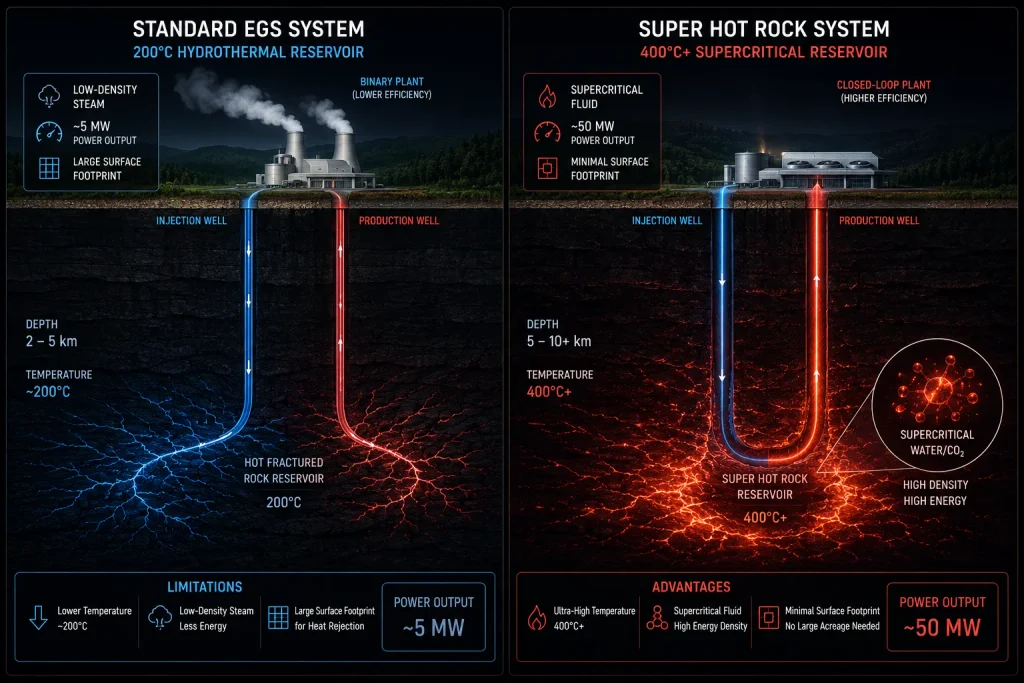
In standard EGS, water is circulated through 200°C rock. When this water reaches the surface, its enthalpy (the total heat content of a system) is sufficient to spin a binary-cycle turbine, but the efficiency is poor. To generate 50 MW, a developer must drill 10 to 15 separate injection and production wells, making the project financially unviable due to astronomical drilling costs.
2. The Core Mechanism: The Supercritical Threshold
Water undergoes a phase change when it crosses its critical point: a temperature of 373.9°C and a pressure of 22.06 MPa.
Above this point, distinct liquid and gas phases cease to exist. The fluid becomes “supercritical.” It possesses the high density and thermal capacity of a liquid, but the low viscosity and high diffusivity of a gas.
3. Technical Depth: Thermodynamic Multiplication
The physics of supercritical water dictate a massive spike in energy transfer. The specific enthalpy (h) of supercritical water at 400°C is radically higher than subcritical steam. More importantly, because it flows like a gas (low viscosity), the friction inside the rock fractures drops to near zero. A pump can push supercritical fluid through the subterranean rock reservoir up to ten times faster than standard water, carrying an order of magnitude more megawatts of thermal energy up a single pipe.
4. Bypassing the Brittle-Ductile Transition
Here lies the greatest geological hurdle. To flow water through solid granite, you must crack it. At 200°C, granite is “brittle” and shatters easily. But as temperatures approach 400°C, the extreme heat and pressure cause the rock to become “ductile.” It acts like warm plastic. If you crack ductile rock, the immense pressure of the Earth simply squeezes the crack shut, sealing off the water flow. Engineers must use ultra-high-pressure injection to continuously prop open these ductile fractures, essentially fighting the Earth’s natural tendency to heal itself.
5. Real-World Consequences: High-Temperature/High-Pressure (HTHP) Metallurgy
Standard drill bits melt at 400°C. The electronics used to steer the drill bit (Measurement While Drilling, or MWD systems) fry at 150°C. Even the specialized cement used to hold the steel casing in place shatters under extreme thermal cycling. To reach SHR, the industry is inventing new classes of active-cooling drill strings, thermally insulated electronics, and specialized elastomers that can survive a descent into Hell.
SHR Geothermal Companies: Quaise, Fervo, and IDDP
The pursuit of SHR is transitioning from academic white papers into heavy industrial deployment, backed by aggressive federal funding and venture capital.
Quaise Energy and Millimeter-Wave Drilling: Because mechanical drill bits fail at 400°C, Quaise Energy is abandoning mechanical drilling entirely. Spun out of MIT, they are adapting technology used in nuclear fusion reactors (Gyrotrons). Instead of a spinning metal bit, they shoot high-power millimeter-wave electromagnetic energy down the hole. This directed energy literally vaporizes the rock, turning it into glass-like ash that is flushed out with argon gas. Because it has no moving parts, a gyrotron can drill 10 miles deep into 500°C rock effortlessly.
The Krafla Magma Testbed (KMT): In Iceland, researchers accidentally drilled directly into a shallow magma chamber at the Krafla caldera in 2009. Instead of abandoning it, the scientific community is returning. The KMT project aims to drill back into the magma-rock interface to establish the world’s first long-term, direct-observation laboratory for supercritical fluids. By testing specialized alloys and sensors directly above liquid magma, Iceland is writing the metallurgical survival guide for the rest of the global SHR industry.
Fervo Energy’s Progression: While Fervo Energy currently dominates the “Standard EGS” market (drilling highly successful, horizontal fracking wells at ~190°C to power Google data centers), their long-term roadmap relies on going deeper. As their drilling teams master the mechanics of hard-rock lateral drilling in Project Cape (Utah), the next sequential evolution is applying these proven oil-and-gas techniques to deeper, hotter crystalline basements, pushing the temperature envelope incrementally toward the 400°C threshold by the end of the decade.
Economic & Strategic Impact
The core strategic value of SHR Geothermal is Bypassing the Interconnection Queue.
Currently, the greatest bottleneck for renewable energy in the United States is the transmission grid. If a developer builds a massive wind farm in a windy desert, they must wait up to 7 years and pay millions of dollars to string high-voltage wires to a city.
Because the Earth is hot everywhere if you drill deep enough, SHR Geothermal is completely geographically agnostic. An energy company does not have to build the power plant where the wind blows or the sun shines; they can build the power plant exactly where the electricity is needed. By drilling a supercritical well directly underneath a massive semiconductor factory, an AI data center, or an urban industrial park, the developer completely bypasses the national grid, operating as a self-contained, invincible microgrid.
Advantages
- Extreme Energy Density: A single well producing supercritical fluid can yield up to 50 MW of electricity, representing a 10x improvement over standard geothermal wells and vastly reducing the number of holes that must be drilled.
- Baseload Reliability: Operates 24/7/365 regardless of weather, season, or time of day, acting as a direct, one-to-one drop-in replacement for retiring coal and nuclear plants.
- Microscopic Surface Footprint: A massive gigawatt-scale SHR facility requires less than 15 acres of surface infrastructure, eliminating the land-use conflicts, deforestation, and community opposition that plague utility-scale solar and wind projects.
- Zero Fuel Volatility: Once drilled, the “fuel” (the Earth’s core heat) is entirely free and insulated from global geopolitical supply chain shocks (unlike natural gas or uranium).
Limitations
- Geochemical Scaling (Silica Plugging): Supercritical water acts as a hyper-aggressive solvent. It dissolves the quartz and silica out of the underground rock. When this heavily saturated water is pumped to the surface and cools down in the turbine, the silica instantly drops out of the solution, precipitating like concrete. It can physically plug a $30 million well solid in a matter of weeks, presenting a devastating chemical engineering challenge.
- Astronomical Drilling CapEx: The deeper you drill, the more expensive the well becomes exponentially. A 10-kilometer deep SHR well requires highly customized drilling rigs, frequent bit replacements, and massive rig-time costs, front-loading immense financial risk before a single megawatt is generated.
- Induced Seismicity: Pumping massive amounts of high-pressure water into deep fault lines to crack the rock can trigger micro-earthquakes. While mostly imperceptible, operating SHR facilities near dense urban centers requires agonizingly precise seismic monitoring to avoid public panic and regulatory shutdowns.
Common Misconceptions
Misconception: We are drilling into liquid magma.
Reality: We are drilling into solid rock that is extremely hot (caused by magma deep below it). Drilling directly into liquid magma is catastrophic, as the liquid rock will instantly rush up the pipe, destroying the well.
Misconception: Geothermal energy causes massive, destructive earthquakes.
Reality: EGS and SHR trigger micro-seismicity (tiny fractures creating magnitude 1 or 2 tremors) which are critical to mapping the reservoir and are rarely felt on the surface. It is deeply monitored and vastly different from the high-magnitude quakes associated with unregulated wastewater injection in the oil industry.
Misconception: The heat will run out.
Reality: While a specific localized reservoir might cool down by a few degrees over 30 years if over-extracted, the Earth’s total thermal mass is effectively infinite on a human timescale, continuously replenished by the radioactive decay of isotopes in the mantle.
What Most People Miss
The disruptive intelligence value of Closed-Loop Geothermal Systems (AGS).
When discussing the difficulty of cracking ductile rock or managing silica scaling, analysts often assume that the water must touch the rock. What they miss is the alternative architecture: Advanced Geothermal Systems (AGS).
Companies like Eavor are pioneering closed-loop systems. Instead of cracking the rock and letting water flow through the cracks, they drill two massive, intersecting U-shaped pipes deep underground, acting as a giant subterranean radiator. The water flows cleanly through the sealed steel pipe, absorbing heat through conduction without ever touching the actual rock. While extracting heat via conduction is significantly slower than letting fluid touch the rock directly, a closed-loop system perfectly bypasses the devastating chemical silica-scaling problem and the ductile-rock problem, offering a slower but infinitely more predictable path to deep heat.
Comparison Table
| Feature | Hydrothermal (Gen 1) | Standard EGS (Gen 2) | Super Hot Rock (Gen 3) |
| Rock Temperature | 100°C – 200°C | 150°C – 250°C | > 400°C |
| Fluid Phase | Liquid / Steam | Liquid / Steam | Supercritical Fluid |
| Geography | Volcanic Anomalies Only | Widespread | Universal (Depth dependent) |
| Output per Well | 2 – 5 MW | 5 – 10 MW | ~ 50 MW |
| Primary Hurdle | Finding resources | Fracking solid granite | Metallurgy & Silica Scaling |
Case Study
Situation: The global push to decarbonize heavy industry required a baseload power source capable of matching the energy density of a fossil fuel plant. Conventional EGS companies had successfully proven they could frack hot granite at 200°C, but the financial math dictated that drilling ten wells to generate 50 MW was too capital-intensive to compete with cheap natural gas.
Challenge: Tap into a thermal reservoir so violently hot that the water turns supercritical, effectively multiplying the energy output of a single well by an order of magnitude.
Solution (The Iceland Deep Drilling Project – IDDP): Supported by international energy consortiums, the IDDP initiated a series of exploratory wells in Iceland. In 2017, the IDDP-2 well was drilled to a depth of 4.6 kilometers into the Reykjanes peninsula, deliberately targeting the extreme thermal gradient above the magma chamber.
Outcome: The IDDP-2 well successfully reached a measured temperature of 427°C at a fluid pressure of 34 MPa, proving definitively that supercritical conditions exist and can be physically reached. The estimated power potential of this single well was modeled at up to 50 MWe (Megawatts electric), confirming the theoretical physics. However, the extreme corrosive nature of the supercritical steam destroyed the well casing and standard valves, forcing the well to be shut down.
Lessons Learned: The IDDP-2 deployment proved that the “prize” of Super Hot Rock is real and mathematically sound. It shifted the industry’s focus away from questioning the thermodynamics, and refocused the entirety of global R&D onto materials science. The roadblock is no longer physics; it is finding a steel alloy or ceramic coating capable of surviving a hyper-corrosive supercritical plasma for 25 years.
Future Outlook
Next 12–24 Months
The era of HTHP Component Validation. The immediate future will not see commercial SHR power plants, but rather intense laboratory and shallow-testbed validation. Drilling contractors will publicly test next-generation Polycrystalline Diamond Compact (PDC) drill bits built specifically to survive 400°C friction. Concurrently, chemical engineers will trial advanced anti-scaling inhibitors—chemicals pumped down the well to stop dissolved silica from turning into concrete as the supercritical fluid races to the surface.
Next 3–5 Years
The scaling of Gyrotron and Directed Energy Drilling. As mechanical drill bits continually hit their physical limits in the deep basement rock, the industry will pivot to non-contact drilling. Startups like Quaise will move their millimeter-wave gyrotrons from MIT laboratories into the field, attempting to vaporize holes through miles of solid granite. If directed energy drilling proves commercially scalable, the cost of digging a 10-kilometer well will collapse, instantly unlocking Super Hot Rock potential beneath the eastern United States and Europe.
Next 10 Years
The Supercritical Repowering of Coal Fleets. By the mid-2030s, the first commercial SHR plants will come online. They will execute the ultimate energy arbitrage: “Repowering.” Instead of building new power plants, developers will buy decommissioned coal plants. They will drill SHR wells directly in the coal plant’s parking lot, bringing 400°C supercritical steam to the surface, and pipe it directly into the coal plant’s existing, multi-billion-dollar steam turbines and transmission wires. This will transform the dirtiest relics of the 20th century into the invincible, zero-carbon engines of the 21st century.
Most Likely Scenario
Super Hot Rock geothermal is the ultimate endgame of renewable energy. While the metallurgical and chemical challenges are agonizingly severe, the geopolitical incentive to access limitless baseload power without relying on foreign supply chains is too immense to abandon. By the 2040s, the ability to drill 10 kilometers deep and harvest supercritical energy will be viewed not as a niche geothermal technology, but as the foundational bedrock of global grid stability.
Key Takeaways
- Standard geothermal energy is geographically limited. Super Hot Rock (SHR) geothermal aims to drill up to 10 miles deep anywhere on Earth to access limitless, 400°C rock.
- At 400°C and extreme pressure, water turns into a “supercritical fluid”—a dense, plasma-like state that holds up to ten times more energy than standard steam.
- This massive energy density means a single, small drill hole can generate 50 Megawatts of power, replacing hundreds of acres of solar panels with a zero-carbon, 24/7 baseload power source.
- The primary challenge is survival. Standard steel, cement, and electronics melt or shatter at 400°C, forcing the industry to invent entirely new drilling technologies (like shooting millimeter-wave lasers to vaporize the rock).
- Deep underground, rock at 400°C behaves like ductile plastic rather than brittle glass, making it incredibly difficult to crack open to let water flow through it.
- Because supercritical water acts as a hyper-aggressive solvent, it dissolves underground silica (quartz). When pumped to the surface, the silica hardens like concrete, threatening to plug the well shut.
Glossary
Baseload Power: The minimum amount of electricity a power grid needs to function 24/7. Solar and wind cannot provide this natively; nuclear, coal, and SHR geothermal can.
Brittle-Ductile Transition: The depth underground where extreme heat and pressure cause solid rock to stop acting like breakable glass (brittle) and start acting like bendable plastic (ductile).
Capacity Factor: A measurement of how often a power plant runs at maximum power. Solar is roughly 25%; geothermal is over 90%.
Enhanced Geothermal Systems (EGS): The process of drilling into dry rock and artificially injecting high-pressure water to crack it, creating a man-made geothermal reservoir.
Enthalpy: A thermodynamic metric representing the total heat content of a system. Supercritical water has massively higher enthalpy than standard steam.
Gyrotron: A machine used in nuclear fusion that emits high-power millimeter-wave electromagnetic energy. Adapted by companies like Quaise to literally vaporize rock instead of drilling it.
Supercritical Fluid: A state of matter reached at extreme temperature and pressure where distinct liquid and gas phases do not exist, allowing it to move rapidly while carrying immense heat.
Sources
Clean Air Task Force (CATF): Super Hot Rock Geothermal: A Vision for Zero-Carbon Energy Everywhere
Quaise Energy: Millimeter Wave Drilling for Deep Geothermal
Iceland Deep Drilling Project (IDDP): Drilling into Supercritical Geothermal Systems
Fervo Energy: Advancing Enhanced Geothermal Systems (EGS) Through Horizontal Drilling
U.S. Department of Energy (DOE): Geothermal Technologies Office – Supercritical Resources