Advertisement
)
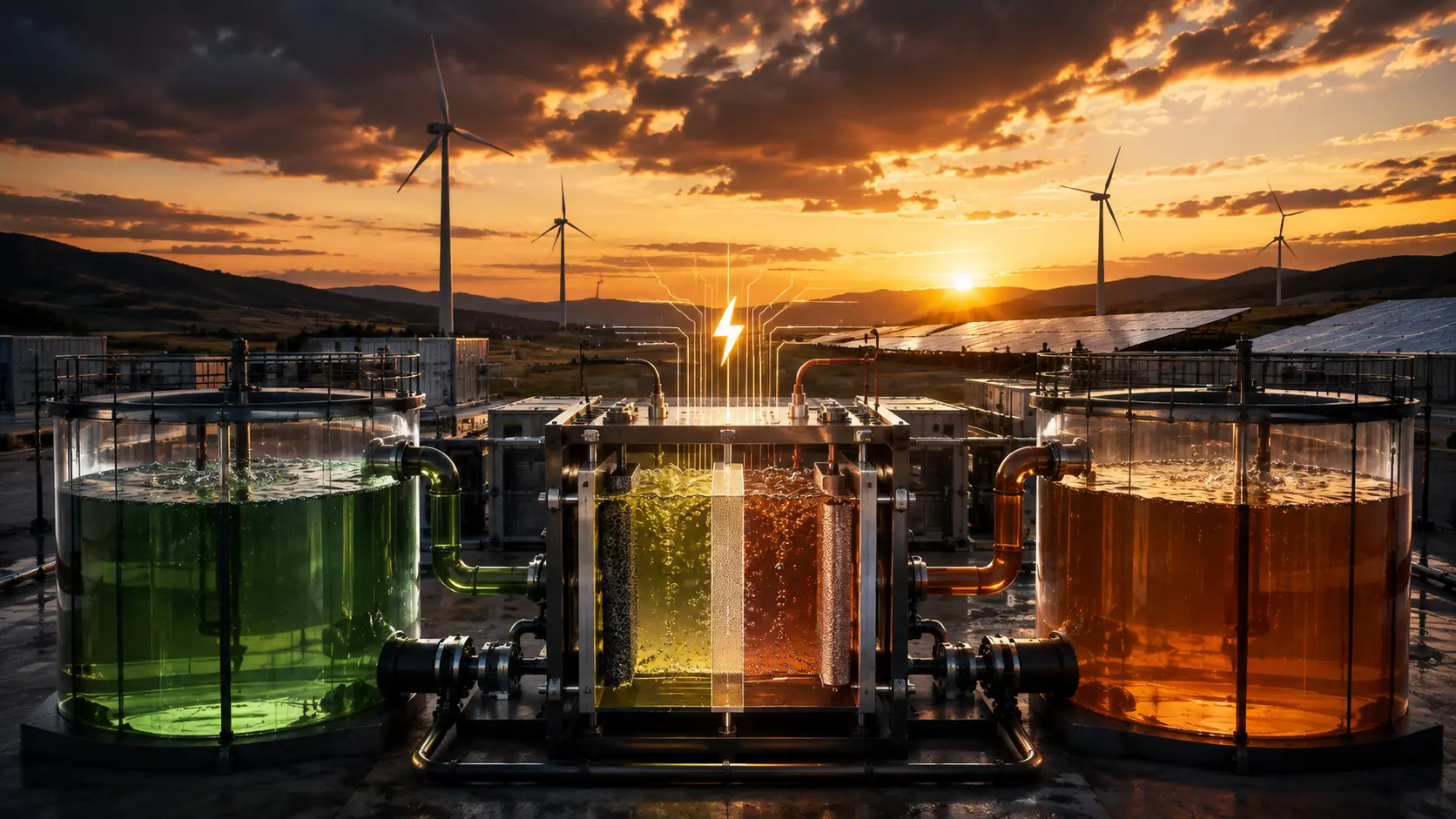

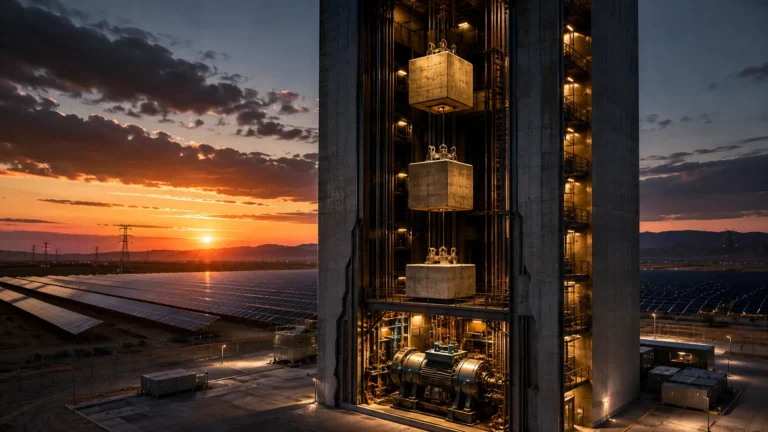
The modern electrical grid is fighting a war against the setting sun. As the world covers millions of acres in solar panels, we generate staggering amounts of electricity at noon. But when the sun goes down, that power vanishes precisely when entire cities turn on their air conditioners and plug in their electric vehicles. To keep the lights on, utility companies must store solar energy in massive battery farms. Unfortunately, relying on standard lithium-ion batteries to discharge power for 12 straight hours is a mathematical and financial dead end. Stacking thousands of highly flammable lithium cells creates a multi-billion-dollar fire hazard with a lifespan of less than a decade.
Why should you care right now? Because grid engineers have stopped trying to brute-force lithium into doing a job it was never designed for. The industry is rapidly pivoting to liquid flow batteries, but instead of using expensive, price-volatile chemicals like vanadium, they are using the cheapest, most abundant metals on Earth. Iron Flow Batteries (IFBs) run on nothing but iron, salt, and water. These massive, non-flammable liquid batteries effectively never degrade. They are driving the Levelized Cost of Storage (LCOS) to absolute rock bottom, allowing humanity to bottle the sun in giant tanks of saltwater without relying on foreign supply chains or exotic mineral monopolies.
What are Iron Flow Batteries (IFBs)?
Iron Flow Batteries (IFBs) are large-scale electrochemical energy storage systems that decouple power from capacity by pumping liquid electrolytes through a central reaction stack. By utilizing an earth-abundant electrolyte composed of dissolved iron salts and water, IFBs provide safe, non-flammable, and ultra-cheap long-duration energy storage capable of running for 25 years with zero capacity fade.
At a Glance
- Concept: Storing electricity in two massive tanks of liquid. To charge or discharge the battery, you simply pump the liquids past each other separated by a special membrane.
- Why it matters: Unlike lithium-ion batteries that permanently degrade every time you use them, iron flow batteries can be charged and discharged daily for 25 years with almost zero degradation.
- Who uses it:Utility companies replacing coal plants, hyperscale data centers requiring 24/7 clean baseload power, and manufacturers like ESS Inc.
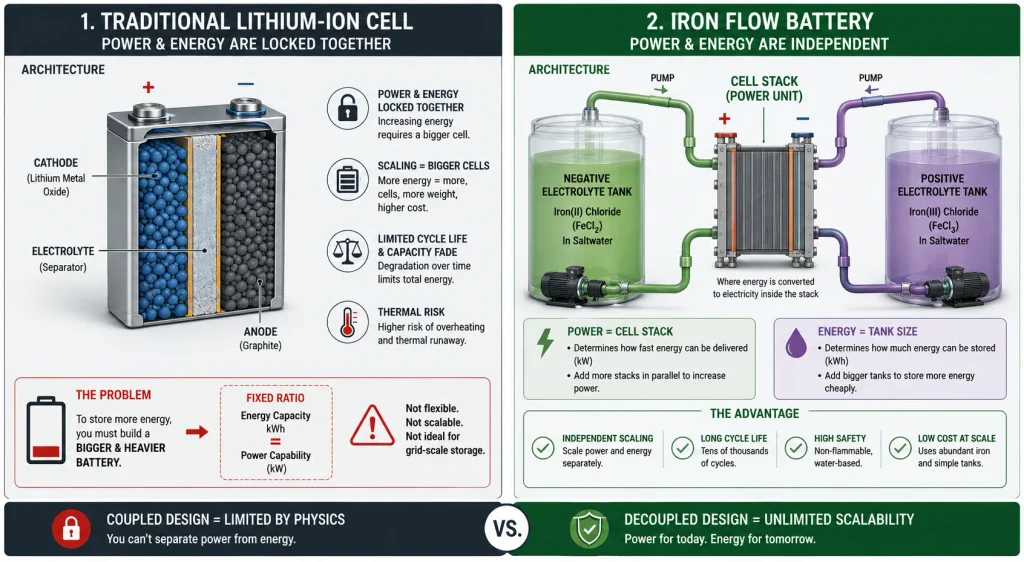
- Biggest takeaway: To double the capacity of a lithium battery, you have to buy an entirely new battery. To double the capacity of a flow battery, you just buy a bigger plastic tank and add more saltwater.
In Simple Words
Imagine a standard AA battery. The chemicals that store the energy and the hardware that delivers the power are all crammed together inside the exact same tiny metal tube. If you want more energy, you have to buy a bigger, more expensive tube. Over time, those chemicals eat away at each other, and the battery dies.
An Iron Flow Battery takes the battery apart.
It puts the energy-storing chemicals into two giant, cheap plastic swimming pools (the tanks). It puts the power-delivering hardware in a completely separate, small box in the middle (the cell stack).
To turn the battery on, pumps push the liquid from the pools through the small box. Because the liquid is just iron rust dissolved in saltwater, it can’t catch fire. Because the chemicals are stored separately from the hardware, they don’t eat away at the battery. If you want the battery to run for 4 hours, you use a small pool. If you want it to run for 24 hours, you use the exact same hardware, but you build a massive pool. You get massive energy scale for the cost of plastic and water.
Why This Matters
For Utility Planners, Energy Engineers, and Cleantech Investors, IFBs solve the Capacity Fade and Insurance Premium bottlenecks.
When utility planners model the economics of a 100-Megawatt lithium-ion storage facility, they have to factor in “augmentation”—buying new lithium cells every 5 to 7 years to replace the ones that degrade, destroying project economics. They also pay astronomical insurance premiums due to the persistent threat of “thermal runaway” (unstoppable chemical fires).
Iron flow batteries have an expected design life of 25 years and suffer zero cross-contamination capacity fade.Because the electrolyte is physically incapable of catching fire (it is literally water), IFBs require no HVAC cooling systems, no fire-suppression sprinklers, and minimal setback distances, instantly slashing the operating expenses (OpEx) and dropping the Levelized Cost of Storage (LCOS) below competing architectures.
The Evolution of Flow Batteries: Vanadium to Iron
The flow battery market has historically been dominated by the Vanadium Redox Flow Battery (VRFB). Vanadium is a fantastic, highly stable element, but it is an exotic transition metal. Its spot price is notoriously volatile, largely tethered to the steel alloy market, and production is heavily concentrated in China, Russia, and South Africa.
The All-Iron Redox Flow Battery (AIRFB) is a direct geopolitical and economic response to this vulnerability. Iron is the most abundant, stable, and transparently priced metal on the planet. By shifting the chemistry from vanadium to iron, the energy storage sector permanently decouples itself from critical mineral supply constraints, making gigawatt-scale grid storage a localized, mass-manufacturable reality.
How Iron Flow Batteries (IFBs) Work
Storing grid-scale electricity using rust and water requires mastering reversible metal electrodeposition. Here is the first-principles breakdown of the architecture.
1. The Fundamental Problem: Cross-Contamination
In traditional hybrid flow batteries (which use two different metals, like iron and chromium), the two liquids inevitably leak across the central membrane that separates them. When Iron mixes with Chromium, it permanently poisons the electrolyte, destroying the battery’s capacity to hold a charge.
2. The Core Mechanism: All-Iron Chemistry
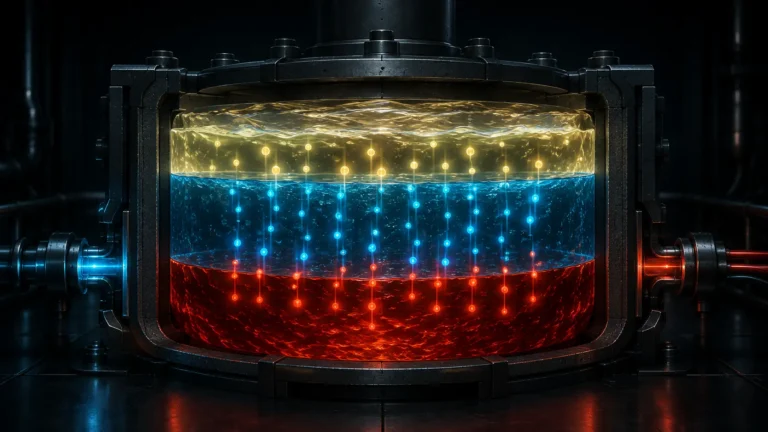
The IFB solves this by using iron on both sides of the membrane. The tanks store an electrolyte of iron chloride (FeCl₂) dissolved in water.Because both tanks use iron, if a leak occurs across the membrane, there is no irreversible poisoning.The battery’s management system simply rebalances the liquid, completely eliminating cross-contamination capacity fade.
3. Technical Depth: Plating and De-Plating
When the battery is plugged into a solar panel to charge, electricity flows into the cell stack.
- On the positive side, Iron(II) ions lose an electron and become Iron(III) ions.
- On the negative side, the electricity forces the dissolved iron ions to solidify. The iron literally plates itself onto the negative carbon electrode as a solid layer of metal.When the sun goes down and the grid needs power (the discharge phase), the process reverses. The solid iron layer slowly dissolves (de-plates) back into the liquid saltwater, releasing the stored electrons back into the power lines.
4. Bypassing the Hydrogen Penalty
The major flaw in iron chemistry is a parasitic “side reaction.” When water is electrified near solid iron, it tends to split, generating hydrogen gas (the Hydrogen Evolution Reaction, or HER). This wastes energy and lowers the battery’s round-trip efficiency. Modern IFB engineers solve this by adding specialized organic buffering agents to the electrolyte and using proprietary proton-exchange membranes that suppress the hydrogen reaction, keeping the system sealed and highly efficient.
5. Real-World Consequences: Decoupled Scaling
Because the energy is stored in the volume of the liquid, sizing the battery is wildly cheap. The cell stack (the expensive part) dictates the power output (Megawatts). The tanks (the cheap part) dictate the duration (Megawatt-hours). Upgrading a facility from 4 hours of storage to 12 hours of storage requires zero additional microchips or electrodes; it only requires a wider tank and more cheap iron-saltwater.
Commercial Deployments: ESS Inc. and Utility Microgrids
Iron flow batteries have officially crossed the “valley of death” from laboratory prototypes to utility-scale commercial deployments.
ESS Inc. and Juniper Energy Deployment: In July 2026, ESS Inc. (a leading U.S. manufacturer of IFBs) announced an agreement to deploy 500 Megawatt-hours (MWh) of long-duration storage with Juniper Energy.This massive utility-scale deployment validates that Independent Power Producers (IPPs) are actively choosing iron flow architectures over lithium-ion to handle the heavy lifting of shifting solar power deep into the night, relying on the 25-year design life to secure long-term power purchase agreements.
Microgrids in Wildfire Zones: In regions like California and Australia, where dry brush and extreme heat create perpetual wildfire risks, lithium-ion battery installations are heavily scrutinized or outright banned near residential zones. Because an IFB’s electrolyte is primarily water, the entire system acts as its own fire extinguisher. Communities and industrial parks in high-risk zones are deploying IFB microgrids precisely because they can be safely permitted directly next to buildings without massive fire-suppression infrastructure.
Peaker Plant Replacement: Traditional grids rely on natural gas “peaker plants” to ramp up quickly when demand spikes. These plants are terrible for the environment and expensive to run. Utilities are combining massive solar arrays with 12-hour IFB systems to perfectly mirror the output of a gas peaker plant. The battery charges for free during the midday solar peak and discharges smoothly from 5:00 PM to 5:00 AM, retiring the fossil fuel infrastructure permanently.
Economic & Strategic Impact
The core strategic disruption is the Commoditization of the Electrolyte.
The battery industry is heavily traumatized by supply chain volatility. When lithium or cobalt prices spike, electric vehicle and grid storage projects instantly lose their profitability.
Iron flow technology completely isolates grid storage from global commodity shocks. Iron chloride and water are ubiquitous, cheap, and easily sourced domestically in almost every nation on Earth. By turning the active material of a multi-megawatt battery into a basic, un-constrained industrial chemical, IFBs ensure that the Levelized Cost of Storage (LCOS) will only go down as manufacturing scales, immune to the geopolitical export bans and mining bottlenecks that threaten traditional battery metals.
Advantages
- Zero Capacity Fade:Unlike solid-state batteries that suffer physical stress when expanding and contracting, the liquid electrolyte in an IFB can be cycled infinitely without permanently losing its ability to hold a charge.
- Decoupled Scaling: Extending a facility from 4 hours of storage to 12 hours requires only larger plastic tanks and more saltwater, drastically reducing the marginal cost of long-duration energy.
- Absolute Safety:The electrolyte is aqueous (water-based), non-toxic, and non-flammable, rendering thermal runaway chemically impossible and vastly simplifying environmental permitting.
- Earth-Abundant Supply Chain: Relies on iron, avoiding the price volatility, human rights concerns, and geopolitical monopolies associated with cobalt, lithium, and vanadium.
Limitations
- Massive Footprint: Flow batteries are significantly less energy-dense than lithium-ion batteries. A 10 MWh IFB system requires massive shipping containers filled with tanks, pumps, and plumbing, rendering them totally useless for electric vehicles or highly constrained urban spaces.
- Lower Round-Trip Efficiency (RTE):Because electricity is consumed running the mechanical pumps that circulate the fluid, and due to minor parasitic side reactions (hydrogen evolution), the RTE of an IFB sits around 70% to 75%, compared to lithium-ion which regularly exceeds 90%.
- Plating Thickness Limits: The energy capacity of the cell stack is partially limited by how much solid iron can physically plate onto the negative electrode without restricting the flow of the liquid. The system must carefully manage the plating thickness to avoid internal mechanical clogs.
Common Misconceptions
Misconception: Iron flow batteries will replace lithium-ion batteries in cars.
Reality: Flow batteries are massive, heavy, and rely on huge liquid tanks. They have terrible energy density by weight. They will never be used in mobile applications; they are strictly designed for stationary, grid-scale power plants.
Misconception: The iron rusts and ruins the battery.
Reality: The iron is dissolved in a carefully calibrated, anoxic (oxygen-free) acidic saltwater solution. The system is completely sealed, preventing the oxidation that causes traditional atmospheric “rusting.”
Misconception: Flow batteries require constant maintenance because they use moving pumps.
Reality: While they do have moving parts, modern magnetic-drive pumps are designed for decades of continuous industrial use. The cost of occasionally replacing a simple commercial pump is exponentially lower than replacing thousands of dead lithium-ion cells.
What Most People Miss
The disruptive capability of Over-Discharge Resilience.
If you drain a standard lithium-ion battery to 0% and leave it there, you risk permanently damaging the internal chemistry. To prevent this, battery management systems “lock out” the bottom 10% to 20% of the battery, meaning you are paying for capacity you are never allowed to use.
An Iron Flow Battery can be safely discharged to an absolute State of Charge (SoC) of 0%. In fact, draining it to zero is fundamentally healthy for the battery, as it cleanly dissolves all the plated iron off the negative electrode, effectively resetting the cell stack to a pristine, factory-new state. Utility operators have full access to 100% of the nameplate capacity they purchased, maximizing their financial return on the asset.
Comparison Table
| Feature | Lithium-Ion (LFP) | Vanadium Flow (VRFB) | Iron Flow (IFB) |
| Active Material | Lithium, Phosphate | Vanadium | Iron, Saltwater |
| Duration Sweet Spot | 1 to 4 Hours | 8 to 12+ Hours | 8 to 24+ Hours |
| Round-Trip Efficiency | > 90% | ~ 75 – 80% | ~ 70 – 75% |
| Degradation / Fade | Severe (Augmentation required) | None | None |
| Fire Risk | High (Thermal Runaway) | Zero | Zero (Aqueous) |
| Commodity Risk | High | High | Near Zero |
Case Study
Situation: As solar penetration deepened across regional power grids, utility companies faced the “duck curve”—massive overproduction of electricity at noon, followed by severe energy shortages after sunset. Developers attempted to solve this by installing 4-hour lithium-ion battery parks, but quickly realized that covering an entire 12-hour night required oversizing the lithium plants, ruining the project’s financial viability and drastically increasing insurance liabilities.
Challenge: Deploy a long-duration energy storage (LDES) system capable of holding power for 12 hours, operating safely near populated areas, and avoiding the expensive supply chain traps of exotic metals.
Solution (The ESS Inc. Architecture): ESS Inc. developed a commercially scalable All-Iron Redox Flow Battery (AIRFB). By utilizing a proprietary proton exchange membrane and an anoxic iron-chloride electrolyte, they mastered the plating and de-plating dynamics of iron. This allowed the system to charge and discharge indefinitely without cross-contamination capacity fade.
Outcome: The architecture achieved a mathematically compelling Levelized Cost of Storage (LCOS). Because the electrolyte was purely iron, salt, and water, the capital cost per kilowatt-hour plummeted as the duration scaled. In 2026, ESS expanded its commercial footprint with a massive 500 MWh Letter of Intent with Juniper Energy, proving that independent power producers recognized IFBs as the definitive replacement for fossil-fueled peaker plants.
Lessons Learned: The deployment validated that grid operators do not need ultra-high energy density; they need duration, safety, and longevity. By shifting the engineering focus from expensive chemical stability (lithium) to cheap, decoupled liquid volume (iron flow), the industry proved that the cheapest way to store the sun is simply a massive tank of rust and water.
Future Outlook
Next 12–24 Months
The era of Behind-the-Meter Industrial Microgrids. In the immediate term, the deployment of iron flow batteries will heavily target commercial and industrial (C&I) clients. Large factories, data centers, and hospital complexes will install multi-megawatt IFB shipping containers directly on their property. Because the systems are inherently fire-safe, they will bypass the agonizing, multi-year permitting delays required for lithium-ion systems, allowing corporations to instantly secure 24/7 clean baseload power and disconnect from fragile public grids.
Next 3–5 Years
The scaling of Rebalancing and Additive Chemistry. As the technology matures, R&D will focus heavily on increasing the Round-Trip Efficiency (RTE) from 70% to closer to 80%.Chemists will introduce advanced organic complexing agents (like modified ascorbic or malic acids) into the iron electrolyte. These chemical additives will suppress the parasitic hydrogen evolution reaction (HER) at the negative electrode, allowing the solid iron to plate more smoothly and efficiently, vastly improving the raw electrical performance of the cell stack.
Next 10 Years
The Terawatt-Hour Seasonal Storage Infrastructure. By the mid-2030s, the concept of a “battery” will shift from a metal box to an infrastructure project. Utilities will construct gigantic, multi-acre underground reservoirs lined with plastic and filled with millions of gallons of iron electrolyte. These massive artificial lakes will act as seasonal storage, absorbing excess solar power for weeks during the sunny summer, and discharging continuously through a massive centralized cell stack to keep entire cities powered during dark, windless winters.
Most Likely Scenario
Iron Flow Batteries are the inevitable thermodynamic backstop for the renewable energy transition. While lithium-ion will forever dominate the high-speed, high-density world of electric vehicles and consumer electronics, it is mathematically unfit to balance a continental power grid. By leveraging the cheapest metal on Earth, IFBs ensure that the 21st-century electrical grid can achieve 100% decarbonization without trading a reliance on fossil fuels for a reliance on foreign battery monopolies.
Key Takeaways
- The power grid needs batteries that can discharge energy for 12 straight hours to keep cities running at night. Lithium-ion batteries are too expensive and dangerous to stack for that long.
- Iron Flow Batteries (IFBs) solve this by storing energy in two massive tanks of liquid. You simply pump the liquid past a central membrane to generate power.
- The liquid is literally just iron, salt, and water. It is earth-abundant, impossibly cheap, and physically incapable of catching fire.
- When charging, the battery turns the liquid iron into solid metal (plating). When discharging, the solid metal dissolves back into liquid (de-plating).
- Because the chemicals are separated from the hardware in massive tanks, the battery doesn’t degrade. It can run for 25 years and can be drained to 0% daily without any damage.
- To double a lithium battery’s capacity, you have to buy a whole new battery. To double an IFB’s capacity, you just buy a larger plastic tank and add more cheap saltwater.
Glossary
All-Iron Redox Flow Battery (AIRFB): A specific type of flow battery that uses iron on both the positive and negative sides of the system, preventing the battery from being ruined if the liquids accidentally mix.
Augmentation: The expensive, unavoidable process of having to buy new lithium-ion battery cells every few years to replace the ones that naturally degrade and die.
Capacity Fade: The gradual loss of a battery’s ability to hold a charge over time. IFBs have virtually zero capacity fade.
Decoupled Scaling: The engineering advantage of a flow battery where the power (the cell stack) and the energy capacity (the liquid tanks) are separate. You can increase duration cheaply just by making the tanks bigger.
Hydrogen Evolution Reaction (HER): A parasitic side-reaction where water splits into hydrogen gas instead of storing energy, which engineers suppress to make the battery more efficient.
Levelized Cost of Storage (LCOS): The true, total cost of storing a megawatt of electricity over the entire lifespan of a battery project, including installation, maintenance, and degradation.
Sources
Frost & Sullivan: Technology Innovation Leadership – ESS Inc. Iron Flow Batteries
ESS Inc. Corporate News: ESS and Juniper Energy Sign Agreement for 500 MWh+ of Energy Storage Deployments
MDPI / Batteries: Investigating the Iron Plating and Stripping of Anolytes for All-Iron Redox-Flow Batteries
Wikipedia: Iron Redox Flow Battery – Chemistry and Cross-Contamination Dynamics
ResearchGate: Levelized Cost of Storage (LCOS) of Battery Energy Storage Systems (BESS)