Advertisement
)


Right now, the global financial system is sitting on an $80 trillion mountain of hidden debt, and almost none of it appears on a formal corporate balance sheet. When a Dutch pension fund buys U.S. Treasuries to generate yield, or a Japanese automaker builds a factory in Ohio, they need massive amounts of U.S. dollars. Instead of borrowing those dollars directly from a commercial bank—which is expensive, slow, and heavily constrained by post-2008 capital regulations—these institutions use Foreign Exchange (FX) swaps to temporarily “rent” the currency. Because global accounting rules classify these swaps as derivatives rather than loans, the debt is completely invisible to standard financial audits.
Why should you care right now? Because the Bank for International Settlements (BIS) has sounded the alarm on this catastrophic regulatory blind spot. This hidden leverage is heavily concentrated in non-bank financial institutions operating with ultra-short maturity windows, meaning trillions of dollars must be mathematically “rolled over” every few weeks. If a sudden macroeconomic shock causes the global dollar supply to tighten, these institutions cannot roll over their swaps. This triggers a violent, invisible liquidity crisis that routinely forces the Federal Reserve to intervene with emergency, multi-billion-dollar central bank swap lines just to prevent a total collapse of the global economy.
What is The $80 Trillion FX Swap Market?
The $80 Trillion FX Swap Market is an opaque, over-the-counter financial network where global institutions temporarily exchange currencies to secure short-term U.S. dollar funding. Because these transactions are legally structured as derivatives rather than formal loans, the resulting debt remains hidden off-balance-sheet, creating massive, unrecorded leverage in the global economy.
At a Glance
- Concept: A legal loophole where a multi-billion-dollar currency trade acts exactly like a loan but is never recorded as debt on a company’s balance sheet.
- Why it matters: It creates an invisible $80 trillion blind spot for central banks. When the market panics, companies suddenly scramble for trillions of dollars they technically don’t “owe” on paper, crashing global liquidity.
- Who uses it: Non-Bank Financial Institutions (NBFIs) like massive Japanese life insurers, European pension funds, and global asset managers buying U.S. assets.
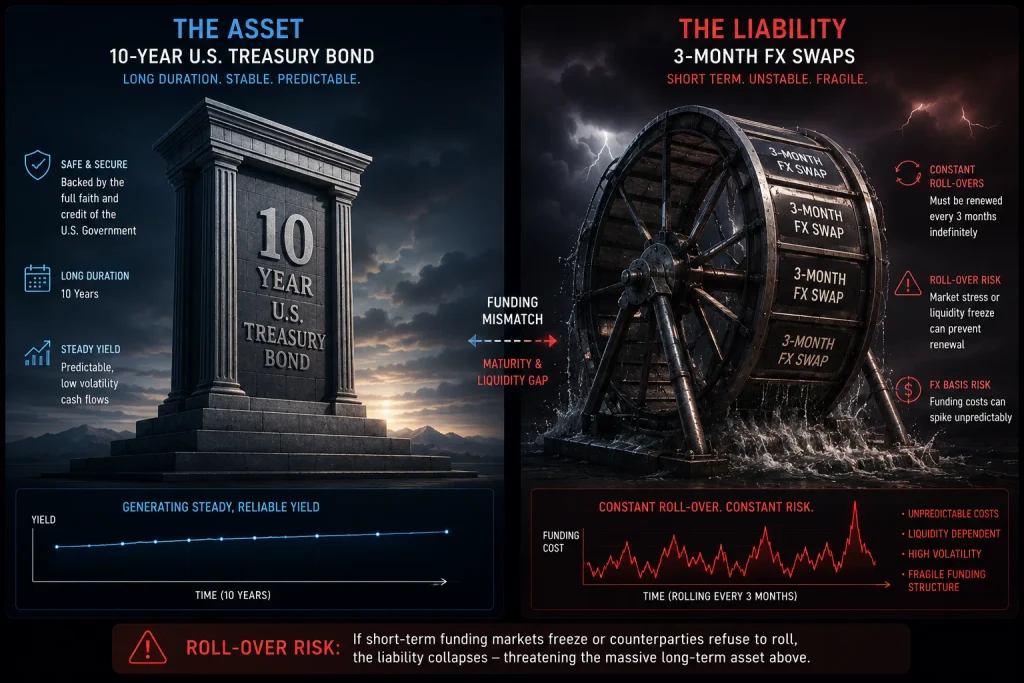
- Biggest takeaway: The system is built on a dangerous duration mismatch. Pension funds use short-term 3-month FX swaps to buy 10-year U.S. government bonds. If the 3-month swap market freezes, they are forced to sell their 10-year bonds at a massive loss, triggering a market crash.
In Simple Words
Imagine you live in Europe and want to buy a house in New York, but you only have Euros.
Instead of going to a bank and getting a traditional, heavily regulated mortgage for U.S. Dollars (which shows up on your credit report), you find a Wall Street trader. You hand the trader 1 Million Euros today, and he hands you 1.1 Million Dollars. You both sign a contract agreeing to swap the money back in exactly three months at a slightly different exchange rate.
You use the dollars to buy the house. You effectively just “borrowed” $1.1 million.
But because you technically just “traded” currencies with a promise to trade back, the accountants do not call it a loan. It never shows up on your credit report. Now imagine every major bank, pension fund, and corporation on Earth doing this simultaneously, every single day, to the tune of $80 trillion. They have built an invisible, unregulated mortgage system that the government cannot track.
Why This Matters
For Macro Economists, Institutional Traders, and Corporate Treasurers, the FX Swap market dictates the Cross-Currency Basis Premium.
According to the economic law of Covered Interest Parity (CIP), the forward exchange rate between two currencies should perfectly offset the difference in their interest rates:
F = S × [(1 + r_d) / (1 + r_f)]
However, because the global demand for U.S. dollars via FX swaps is so relentless and overwhelmingly one-sided, CIP breaks down. This breakdown creates the “Cross-Currency Basis”—a premium that foreign institutions must pay above standard interest rates simply to access dollars. Monitoring this basis spread is the ultimate leading indicator for global liquidity. When the basis drops heavily into negative territory, it signals acute dollar starvation in the shadow banking system, acting as an early warning siren for an impending market crash.
The Rise of Shadow Banking and NBFI Leverage
The 2008 Great Financial Crisis was caused by hidden leverage in the housing market (Subprime CDOs). Regulators responded by forcing strict capital requirements (Basel III) onto traditional commercial banks.
But risk never dies; it simply migrates. Because commercial banks were constrained, the massive leverage required to lubricate global trade migrated into the unregulated shadow banking sector—specifically into FX swaps executed by Non-Bank Financial Institutions (NBFIs). By attempting to make the visible banking system safer, regulators accidentally created an $80 trillion shadow ledger that is exponentially larger and more opaque than the subprime mortgage market ever was.
How the $80 Trillion FX Swap Market Hides Debt
Understanding how $80 trillion can remain hidden from auditors requires deconstructing the mechanics of derivative accounting and collateralized lending. Here is the first-principles breakdown of the architecture.
1. The Fundamental Problem: Sourcing Offshore Dollars
A Japanese life insurance company collects premiums in Yen. To generate a higher return for its retirees, it wants to buy U.S. Treasury bonds, which are priced in U.S. Dollars (USD). The insurer needs USD, but it doesn’t want to simply sell its Yen for Dollars on the open market, because if the exchange rate changes violently over the next ten years, the currency loss will wipe out the bond’s profit.
2. The Core Mechanism: The FX Swap
To eliminate currency risk, the Japanese insurer executes an FX Swap.
- The Spot Leg: The insurer gives Yen to a U.S. bank and receives USD today.
- The Forward Leg: Simultaneously, they sign a binding contract to reverse the trade in 3 months, locking in the future exchange rate today.The insurer uses the USD to buy the Treasury bond. The currency risk is perfectly hedged.
3. Technical Depth: Off-Balance Sheet Accounting
This is where the magic trick occurs. Under international accounting standards, an FX Swap is classified as a derivative. A derivative is recorded on the balance sheet strictly at its fair market value. At the exact moment the contract is signed, the spot leg perfectly balances the forward leg. The net value of the contract is mathematically zero.
Therefore, the massive $1 billion principal amount changing hands is completely ignored on the balance sheet. It is relegated to a tiny footnote in the corporate filing.
4. Bypassing Liquidity: The Roll-Over Risk (Duration Mismatch)
The Japanese insurer bought a 10-year U.S. Treasury bond, but the FX Swap contract expires in 3 months. When month 3 arrives, the insurer must “roll over” the swap—signing a brand new 3-month contract to keep the dollars.
This creates a terrifying duration mismatch. They are funding a 10-year asset with 90-day shadow debt.
5. Real-World Consequences: The Dash for Cash
If a global crisis hits (like the March 2020 pandemic crash), the banks get scared and refuse to roll over the 3-month FX swaps. Suddenly, the Japanese insurer is legally forced to return the U.S. dollars immediately. Because their money is tied up in a 10-year Treasury bond, they must fire-sale the Treasury bond into a crashing market to get the cash. This synchronized, desperate scramble for dollars across the global shadow banking system triggers a devastating liquidity vortex.
FX Swap Interventions: Federal Reserve Swap Lines
The invisible mechanics of the FX Swap market directly dictate the monetary policy interventions of the world’s most powerful central banks.
The Federal Reserve Liquidity Swap Lines: During the 2008 Financial Crisis and the March 2020 COVID-19 crash, the global FX swap market completely froze. Foreign institutions could not source the dollars they needed to roll over their hidden debt. To prevent the fire-sale of U.S. Treasuries (which would have crashed the U.S. government’s borrowing capacity), the Federal Reserve was forced to open “Central Bank Liquidity Swap Lines.” The Fed printed hundreds of billions of dollars and swapped them directly with the European Central Bank (ECB) and the Bank of Japan (BOJ), who then lent those dollars to their local pension funds to plug the shadow debt hole.
Corporate Currency Hedging: Beyond financial speculators, massive multinational corporations use FX swaps daily. If an American tech giant needs to pay suppliers in Europe over the next six months, they execute rolling FX swaps. This allows them to secure Euros precisely when needed without holding massive piles of foreign currency in overseas accounts, optimizing their corporate treasury operations while inadvertently adding to the global shadow leverage pool.
Yield Curve Arbitrage: Macro hedge funds exploit the Cross-Currency Basis. If Japanese interest rates are near 0% and U.S. interest rates are 5%, a hedge fund will borrow Yen, use an FX Swap to turn the Yen into Dollars, and invest the Dollars in high-yielding U.S. assets. Because the FX Swap perfectly hedges the currency risk, the hedge fund legally prints a risk-free profit (the arbitrage spread), continuously driving the volume of the $80 trillion market higher.
Economic & Strategic Impact
The core strategic vulnerability of this ecosystem is the Exhaustion of Dealer Bank Balance Sheets.
The FX swap market relies on global “Dealer Banks” (like JPMorgan, Citigroup, or Barclays) to sit in the middle of the trades. However, under the Basel III Supplementary Leverage Ratio (SLR) regulations, dealer banks are heavily penalized for expanding their balance sheets.
At the end of every quarter and year-end, dealer banks must shrink their balance sheets to pass regulatory audits. They drastically pull back from offering FX swaps. This regulatory “window dressing” causes severe, predictable liquidity shortages in the FX swap market every December. The cost to borrow dollars spikes violently, punishing foreign institutions simply because the intermediary banks are legally barred from providing enough pipeline capacity to service the $80 trillion demand.
Advantages
- Currency Risk Elimination: Allows global trade and cross-border investment to function smoothly by perfectly hedging against devastating currency fluctuations.
- Capital Efficiency: Because the principal amounts do not hit the balance sheet, institutions can leverage their capital vastly more effectively than through traditional loan structures.
- Deep Market Liquidity: Under normal macroeconomic conditions, the FX swap market is the deepest, most liquid financial market on Earth, processing over $3.8 trillion in volume every single day.
Limitations
- Total Lack of Transparency: Because it is an Over-The-Counter (OTC) market classified as off-balance-sheet, regulators, the BIS, and the Federal Reserve have to “guess” the total leverage using complex proxy math. No one knows exactly who owes what to whom.
- Catastrophic Roll-Over Risk: The heavy reliance on ultra-short-term swaps (under 30 days) to fund multi-year infrastructure and government bonds creates a perpetual ticking time bomb requiring constant, flawless market operation.
- Asymmetric Dollar Dependency: The system is heavily skewed toward the U.S. Dollar. It entrenches global dependency on the Federal Reserve, forcing the U.S. central bank to act as the lender of last resort for the entire world, even for institutions outside its legal jurisdiction.
Common Misconceptions
Misconception: An FX Swap is the same as trading currency at the airport.
Reality: Trading currency at the airport is a “Spot” trade—it happens once. An FX Swap is a package deal: a Spot trade combined with a legally binding contract to reverse the exact trade at a specific date in the future. It is a collateralized loan.
Misconception: The $80 Trillion represents cash sitting in bank accounts.
Reality: The $80 trillion is a notional derivative figure. It represents the value of the underlying assets tied up in these temporary exchange contracts, not physical piles of cash.
Misconception: Only banks are at risk if the market crashes.
Reality: Traditional banks are highly regulated and mostly safe. The danger lies in Non-Bank Financial Institutions (NBFIs)—the pension funds managing everyday citizens’ retirement money. If the swap market breaks, those pensions take the catastrophic losses.
What Most People Miss
The disruptive intelligence value of Margin Calls on Forward Leg Valuations.
While the principal of the FX swap is hidden off-balance-sheet, the derivative contract itself still experiences minor value fluctuations as global interest rates move. What most analysts miss is the devastating impact of Variation Margin.
If a European pension fund executes an FX swap to secure dollars, and the value of the Euro suddenly crashes (as it did during the 2022 energy crisis), the value of the “Forward Leg” of the contract swings heavily against the pension fund. The dealer bank will issue an immediate Margin Call, forcing the pension fund to post millions of dollars in cold, hard cash overnight just to keep the derivative contract open. This forces the pension fund to liquidate other healthy assets, turning a localized currency fluctuation into a cascading, cross-asset contagion event.
Comparison Table
| Feature | Traditional Bank Loan (USD) | Cross-Currency Basis Swap | Foreign Exchange (FX) Swap |
| Balance Sheet Status | On-Balance-Sheet (Visible Debt) | Off-Balance-Sheet (Derivative) | Off-Balance-Sheet (Derivative) |
| Duration Profile | Matched to asset (e.g., 10 years) | Long-Term (1 to 10+ years) | Ultra-Short-Term (Usually < 90 days) |
| Interest Rate Exchange | Borrower pays interest | Parties exchange floating rate payments | No explicit interest payments (baked into forward rate) |
| Roll-Over Risk | Low (Term funding) | Low | Extreme (Constant refinancing required) |
| Regulatory Capital Cost | High | Moderate | Low |
Case Study
Situation: In March 2020, as the global reality of the COVID-19 pandemic materialized, a violent “dash for cash” occurred across the global financial system. Asset managers, pension funds, and corporations universally sought to hoard U.S. dollars—the world’s reserve currency.
Challenge: Non-Bank Financial Institutions outside the U.S. held trillions of dollars in U.S. Treasuries, funded almost entirely by short-term FX swaps. As panic set in, the dealer banks facilitating these swaps drastically pulled back their balance sheets to protect themselves. The FX swap market froze. The Cross-Currency Basis plunged deeply negative, meaning the cost to borrow dollars via swaps reached extortionate, crisis-level premiums.
Solution (Federal Reserve Intervention): Facing a scenario where foreign institutions would be forced to dump trillions of dollars of U.S. Treasuries onto the open market to raise cash—an event that would destroy the U.S. bond market and spike borrowing costs for the American government—the Federal Reserve intervened. On March 19, 2020, the Fed announced temporary U.S. dollar liquidity swap lines with nine additional foreign central banks (adding to the standing lines with the ECB, BOJ, etc.).
Outcome: The Fed funneled nearly half a trillion dollars directly into foreign central banks, who then lent the dollars to their local NBFIs. This intervention bypassed the paralyzed private dealer banks, instantly capping the Cross-Currency Basis premium. The FX swap market stabilized, and the forced fire-sale of U.S. Treasuries was averted.
Lessons Learned: The event definitively proved the fragility of the off-balance-sheet shadow dollar system. It exposed the reality that the $80 trillion FX swap market is too large to fail, structurally requiring the U.S. Federal Reserve to act as the permanent, ultimate backstop for off-shore, unregulated dollar leverage.
Future Outlook
Next 12–24 Months
The era of Regulatory Transparency Mandates. In the immediate term, the BIS and the Financial Stability Board (FSB) will push aggressively for data unmasking. We will see targeted regulatory mandates forcing NBFIs (pension funds and asset managers) to disclose their short-term FX swap positions and exact roll-over maturity dates to centralized trade repositories. While they will still avoid putting the debt on the balance sheet, regulators will demand a clear dashboard of the risk, attempting to illuminate the blind spot before the next liquidity shock hits.
Next 3–5 Years
The scaling of Mandatory Central Clearing for FX. Currently, FX swaps operate almost entirely Over-The-Counter (OTC), relying on bilateral trust between two parties. As systemic risk fears mount, regulators will attempt to force the FX swap market into Central Counterparty Clearinghouses (CCPs). By forcing trades through a central clearinghouse, the system gains transparency and multilateral netting efficiency. However, because CCPs demand strict cash margin, this transition will drastically increase the upfront cost of executing an FX swap, heavily compressing the profit margins of international yield arbitrage.
Next 10 Years
The CBDC and Tokenized Collateral Disruption. By the mid-2030s, the mechanical plumbing of the FX swap market will be overhauled by Distributed Ledger Technology (DLT) and wholesale Central Bank Digital Currencies (wCBDCs). Platforms like the Canton Network will allow institutions to execute atomic cross-currency swaps using tokenized collateral. Because atomic settlement occurs instantly, the 24-hour settlement risk window is eliminated, drastically reducing the counterparty risk that freezes the market during panics, and permanently altering the architecture of global shadow banking.
Most Likely Scenario
The $80 trillion FX swap market is a permanent fixture of globalized trade; it cannot be dismantled without collapsing the international flow of capital. Instead of shrinking the shadow leverage, regulators will focus on building wider, stronger safety nets. The Federal Reserve’s emergency swap lines will quietly transition from “emergency tools” into permanent, standing facilities, effectively institutionalizing the U.S. central bank’s role as the infinite provider of liquidity to the offshore shadow dollar matrix.
Key Takeaways
- The global economy hides an estimated $80 trillion in U.S. dollar debt off the books.
- This debt is created using Foreign Exchange (FX) swaps, where institutions trade currencies and promise to trade them back later, effectively acting as a massive short-term loan.
- Because accounting laws classify these trades as “derivatives” with a net-zero starting value, the massive principal loan amounts never appear on a company’s balance sheet.
- The system is highly dangerous because pension funds use short-term (3-month) FX swaps to buy long-term (10-year) assets. They must constantly “roll over” the short-term debt to survive.
- If a global crisis occurs and banks refuse to roll over the swaps, institutions are forced to desperately fire-sale their long-term assets to get dollars, crashing the market.
- The system is so large and deeply ingrained that the U.S. Federal Reserve is forced to print billions of dollars during crises to bail out foreign institutions just to protect the U.S. bond market.
Glossary
Cross-Currency Basis: A premium that investors must pay above standard interest rates to borrow U.S. dollars in the FX swap market. A negative basis indicates a severe dollar shortage.
Duration Mismatch: A dangerous financial strategy where an institution buys a long-term asset (like a 10-year bond) but pays for it using short-term debt (like a 3-month FX swap).
Foreign Exchange (FX) Swap: A financial contract where two parties exchange a specific amount of currency today (Spot leg) and agree to reverse the exchange at a set date and price in the future (Forward leg).
Non-Bank Financial Institution (NBFI): Financial entities that operate outside traditional, heavily regulated commercial banking, such as pension funds, hedge funds, and life insurance companies.
Off-Balance-Sheet: Assets or debts that do not appear on a company’s formal financial statements, legally obscuring the true amount of leverage the company is using.
Roll-Over Risk: The danger that a borrower will not be able to find a new lender when their short-term debt expires, forcing them to default or fire-sale assets to pay back the original loan.
Sources
Bank for International Settlements (BIS): Dollar debt in FX swaps and forwards: huge, missing and growing
Federal Reserve Bank of New York: The FX Swap Market: A Global Dollar Lifeline
Financial Times: The $80 Trillion Blind Spot in the Global Financial System
SIFMA: Understanding Cross-Currency Swaps and Systemic Risk
International Monetary Fund (IMF): Non-Bank Financial Intermediation and Off-Balance-Sheet Leverage