Advertisement
)

The artificial intelligence boom is on a collision course with the global power grid. Today’s frontier Large Language Models (LLMs) process information using 16-bit floating-point math. To generate a single paragraph of text, an AI must execute trillions of complex multiplications across billions of parameters. This brute-force approach requires massive, power-hungry GPUs (like the NVIDIA H100) and drains so much electricity that tech giants are looking to buy entire nuclear power plants just to keep their data centers running. We have reached a thermodynamic wall; if AI cannot become mathematically cheaper, the exponential scaling of intelligence will physically halt.
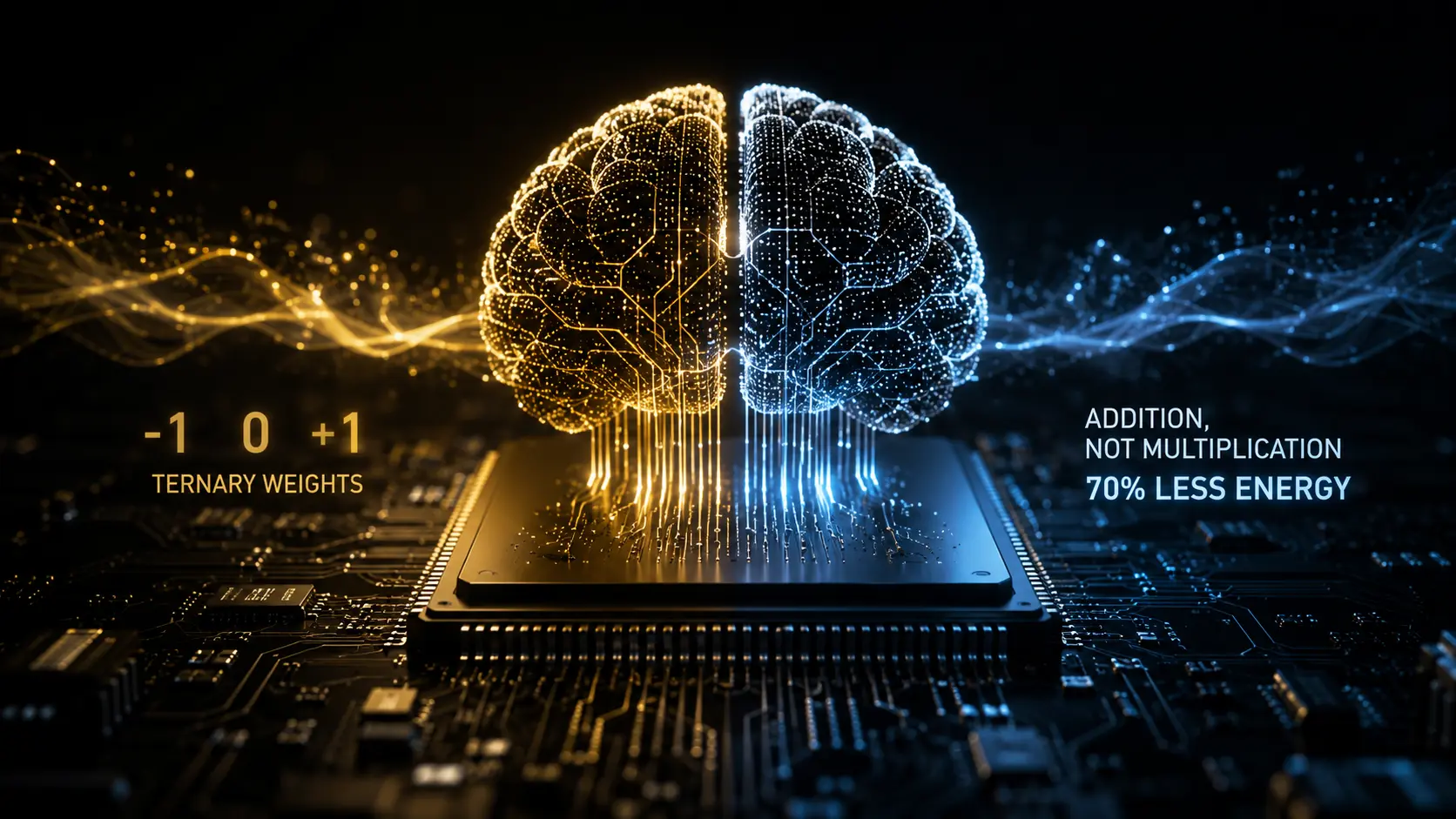
Why should you care right now? Because Microsoft researchers have engineered a breathtaking mathematical loophole that circumvents the power wall. They have created an architecture known as BitNet b1.58. Instead of allowing an AI to use infinite decimals, they forced it to build its brain using only three numbers: -1, 0, and 1. This “1.58-bit” constraint changes the fundamental physics of the microchip. Because multiplying any number by 1 or -1 is simply addition or subtraction, the AI no longer has to perform complex matrix multiplication. It simply adds numbers together. This single algorithmic hack slashes memory usage, drastically drops energy consumption, and enables massive AI models to run flawlessly on standard laptop CPUs, permanently altering the hardware trajectory of the global AI industry.
What is 1.58-bit LLMs (BitNet)?
BitNet b1.58 is an advanced neural network architecture where every parameter weight is natively constrained to a ternary value of {-1, 0, +1}. By restricting weights to these three states, the model eliminates computationally expensive floating-point multiplication, replacing it with simple integer addition. This drastically reduces memory footprints and energy consumption while matching the accuracy of traditional 16-bit models.
At a Glance
- Concept: Forcing an AI to “think” using only three basic states (-1, 0, 1) to eliminate heavy math, acting like an ultimate compression algorithm for artificial brains.
- Why it matters: Standard AI requires heavy math (multiplication) that demands massive GPUs. Ternary AI uses simple math (addition) that can run incredibly fast on standard laptop and phone processors.
- Who uses it: Microsoft Research, open-source AI developers, and semiconductor engineers designing the next generation of mobile Neural Processing Units (NPUs).
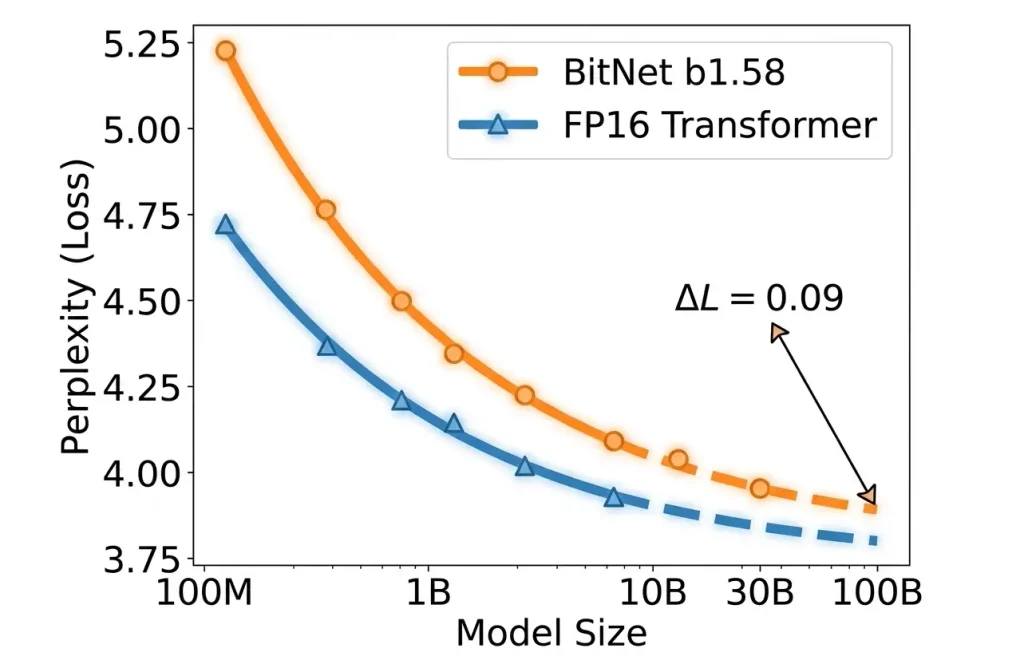
- Biggest takeaway: Many believed that squashing an AI’s brain down to 1.58 bits would make the AI stupid. Microsoft proved that once the model reaches 3 billion parameters, the 1.58-bit AI is just as smart as the massive 16-bit AI, but vastly cheaper to run.
In Simple Words
Imagine you are paying a team of accountants to calculate the cost of a million items.
In a Standard 16-bit LLM, the accountants have to calculate prices like 4.3291 × 18.7654. To do this quickly, you have to buy them thousands of incredibly expensive, power-hungry supercomputers (GPUs).
In a 1.58-bit BitNet LLM, you change the rules of the game. You mandate that the accountants are only allowed to multiply by three numbers: -1, 0, or +1.
If you multiply by 1, the number stays the same. If you multiply by -1, you just flip the sign. If you multiply by 0, the answer is zero.
Because they never actually have to “multiply” complex fractions anymore, they throw away the supercomputers. They can calculate the final sum almost instantly using basic addition in their heads. The work gets done faster, the electric bill plunges, and surprisingly, the final business decision is just as accurate.
Why This Matters
For AI Researchers, Hardware VCs, and Cloud Architects, BitNet b1.58 solves the DRAM Memory Wall.
In modern AI inference, the GPU spends the vast majority of its time and energy simply moving data from the memory chips (DRAM) into the processor (SRAM) to do the math. A 16-bit parameter takes up 16 bits of physical space on the wire. A 1.58-bit parameter requires roughly 1/10th. of that bandwidth. By aggressively compressing the weights down to ternary values, the model can instantly stream massive amounts of data directly into the processor without waiting for the memory bus to catch up. This breaks the latency bottleneck, allowing models to generate text vastly faster while cutting the server’s energy consumption by over 70%.
Post-Training Quantization vs. BitNet Architecture
The industry has attempted to compress AI models for years through a process called Post-Training Quantization (PTQ). Engineers would take a massive, fully trained 16-bit model and mathematically “squash” it down to 8-bit or 4-bit weights to save space. However, squashing it down to 1-bit or 1.58-bit using PTQ destroyed the model—the AI became lobotomized.
BitNet is a paradigm shift because it is Quantization-Aware Training. Microsoft didn’t squash a finished model; they trained the model from scratch to natively understand the world using only -1, 0, and 1. By forcing the neural network to adapt to this restriction from its very first epoch, the model learned a uniquely resilient internal geometry, proving that intelligence does not require high-precision decimals; it only requires scale.
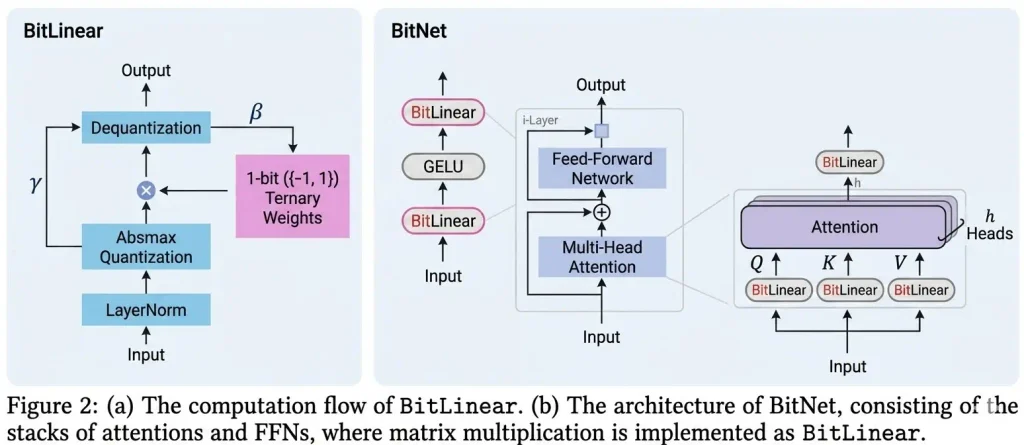
How 1.58-bit LLMs (BitNet) Execute Ternary Math
Achieving full-precision accuracy using extreme ternary quantization requires rewriting the fundamental mathematical layers of the Transformer architecture. Here is the first-principles breakdown of the mechanics.
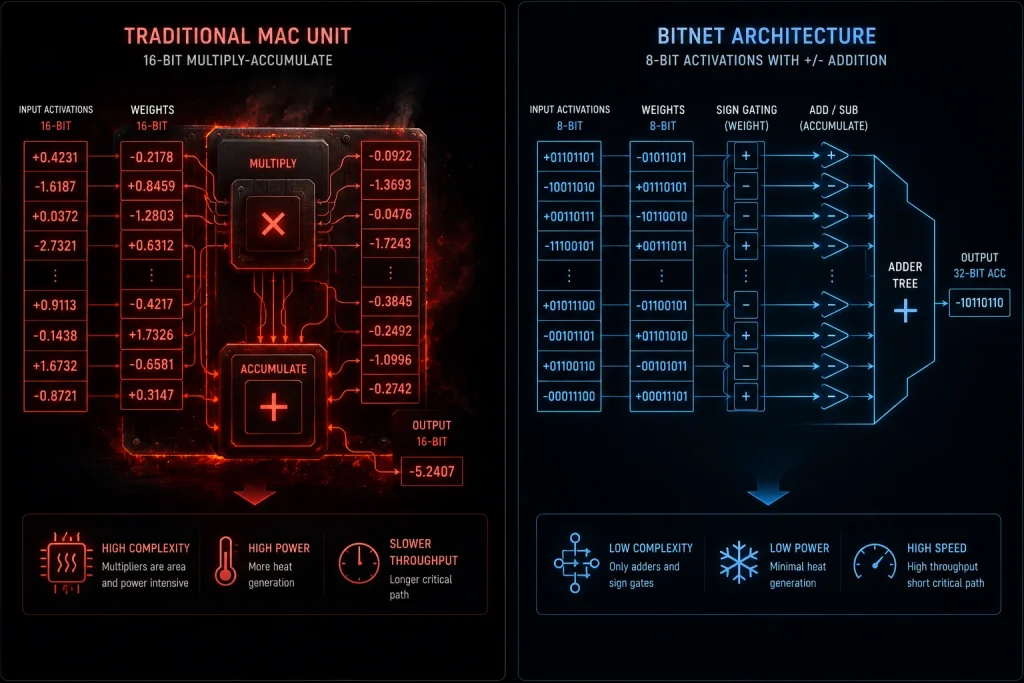
1. The Fundamental Problem: Floating-Point Multiplication
The core of every neural network is the nn.Linear layer, which executes matrix multiplications. It takes an input vector (activation) and multiplies it by a weight matrix. When both the inputs and the weights are 16-bit floating-point (FP16) numbers, the silicon chip must utilize highly complex floating-point multipliers, which consume vast amounts of surface area and wattage.
2. The Core Mechanism: The BitLinear Transform
BitNet completely rips out the nn.Linear layer and replaces it with a custom BitLinear layer. During the forward pass (when the AI is thinking), the BitLinear layer enforces strict quantization. The continuous, high-precision weights are converted into discrete ternary values: {-1, 0, +1}.
3. Technical Depth: Absmean Quantization
To convert the weights without destroying the math, BitNet uses an elegant scaling formula known as absmean quantization.
The model calculates the average absolute value of the entire weight matrix (γ). It divides the weights by this average to scale them, and then simply rounds them to the nearest integer:
W_quantized = Round( W / Mean(|W|) ) ∈ {-1, 0, +1}
Simultaneously, the inputs (activations) are quantized to 8-bit integers using absmax quantization (scaling by the absolute maximum value per token). This creates a W1.58A8 (1.58-bit weight, 8-bit activation) architecture.
4. Bypassing the Multiplier: Pure Integer Addition
Because the weights are exclusively -1, 0, or 1, the matrix multiplication physically collapses.
If a weight is 0, the operation is skipped. If it is 1, the activation is added to the sum. If it is -1, the activation is subtracted. The computationally expensive Multiply-Accumulate (MAC) operation is replaced by a vastly simpler, hyper-efficient Integer Addition/Subtraction operation.
5. Real-World Consequences: The 3-Billion Parameter Scaling Law
Initially, researchers assumed extreme quantization would always degrade reasoning. However, Microsoft published a critical scaling law: once a BitNet b1.58 model scales past 3 billion parameters, it perfectly matches the perplexity (predictive accuracy) and zero-shot benchmark performance of a full-precision 16-bit Llama LLM. The architecture proves that at scale, sheer parameter volume mathematically compensates for the loss of individual parameter precision.
Commercializing 1.58-bit LLMs: Edge AI and bitnet.cpp
The transition from theoretical whitepapers to deployable inference frameworks is happening at breakneck speed.
The bitnet.cpp Inference Engine: You cannot run a 1.58-bit model on standard AI software (like PyTorch or Hugging Face transformers) and get a speedup, because standard software forces the computer to calculate it as a floating-point decimal anyway. To solve this, Microsoft released bitnet.cpp, a highly optimized inference framework explicitly written to execute the ternary additions natively on standard CPUs. Tests on standard x86 and ARM processors demonstrated speedups of 1.37x to 5x over 16-bit baselines, firmly establishing the viability of running multi-billion-parameter LLMs locally on consumer hardware without a GPU.
Edge AI on Mobile Devices: Because BitNet requires 70% less energy to generate text, it radically alters the thermal and battery profile of running AI on a smartphone. Currently, mobile devices struggle to run 3B parameter models because the continuous matrix multiplications overheat the phone’s battery. The integer addition architecture of BitNet b1.58 means high-tier AI agents can run persistently in the background of iOS or Android devices without draining the battery, unlocking true offline, privacy-first Edge AI.
The BitDistill Pipeline: Training a 1.58-bit model from scratch costs millions of dollars. To democratize the technology, researchers developed “BitDistill.” This process takes massive, open-source 16-bit models (like Alibaba’s Qwen) and mathematically distills their knowledge down into a 1.58-bit architecture using sub-layer normalization and continual pre-training. This allows the open-source community to rapidly convert the world’s best models into hyper-efficient ternary formats.
Economic & Strategic Impact
The core strategic disruption of 1.58-bit LLMs is The Threat to the GPU Monopoly.
NVIDIA’s $3 trillion valuation is predicated on its absolute dominance in floating-point matrix multiplication via its Tensor Cores. The entire architecture of the H100 and B200 chips is designed to execute FP16 and FP8 math incredibly fast.
BitNet bypasses this math entirely. If the future of AI inference is strictly integer addition and ternary memory lookups, deploying a $30,000 GPU becomes severe overkill. The industry will pivot to Application-Specific Integrated Circuits (ASICs) or custom Neural Processing Units (NPUs) that literally lack floating-point multipliers, relying instead on massive arrays of cheap, ultra-fast adders. By shifting the mathematical paradigm, BitNet b1.58 creates an opening for fabless designers (like Groq, Apple, or AMD) to build hyper-specialized “1-bit silicon” that outperforms NVIDIA in pure inference economics.
Advantages
- Eradication of Multiplication: Completely removes floating-point Multiply-Accumulate (MAC) operations, executing inference using only highly efficient integer addition and subtraction.
- 70% Energy Reduction: The elimination of complex arithmetic and the reduction in DRAM data movement results in staggering power savings per generated token.
- Massive Memory Compression: A 3-billion-parameter model that requires 6 Gigabytes of RAM in FP16 drops to roughly 700 Megabytes in 1.58-bit, allowing advanced models to fit comfortably into the cache of edge devices.
- Zero-Shot Parity: Unlike extreme post-training quantization (which lobotomizes the model), natively trained BitNet models mathematically match the reasoning and perplexity of full-precision models at scale.
Limitations
- Training Infrastructure Dominance: While inference (running the model) is incredibly cheap, training a BitNet model from scratch still requires massive clusters of traditional GPUs to execute the backpropagation math (using a straight-through estimator and high-precision shadow weights).
- Software and Hardware Mismatch: Current GPUs are hardwired to do 16-bit or 8-bit math. Because ternary data (-1, 0, +1) does not align perfectly with standard byte boundaries, packing it efficiently into memory registers without wasting space requires highly specialized, complex kernel code (which is why frameworks like
bitnet.cppare necessary). - The Zero Weight Dilution: The “0” in the 1.58-bit paradigm acts as a feature filter. While useful for skipping operations, ensuring that the model doesn’t over-utilize zeros (which would lead to dead neural pathways and capability collapse) requires meticulous hyperparameter tuning during the training phase.
Common Misconceptions
Misconception: 1.58-bit means the model uses a tiny decimal number.
Reality: The “1.58” does not refer to the value of the weights; it refers to the information density. Because there are three states (-1, 0, +1), and log₂(3) ≈ 1.58, it technically takes 1.58 bits of computer memory to store that specific piece of data.
Misconception: We can just convert ChatGPT to 1.58-bit today to make it faster.
Reality: Standard post-training quantization fails spectacularly at 1.58 bits. To get the benefits, the model must be trained from scratch (or deeply distilled) to natively understand ternary logic, which requires thousands of hours of supercomputer time.
Misconception: BitNet is a binary (1-bit) model.
Reality: The original BitNet paper was purely 1-bit (-1 and +1). Researchers quickly discovered that giving the model the ability to use “0” (to ignore irrelevant data) massively improved its reasoning capability. The addition of the zero created the 1.58-bit (ternary) architecture.
What Most People Miss
The disruptive intelligence value of Ternary Lookup Tables.
When engineers execute BitNet math at the lowest level of the CPU, they don’t even bother doing addition. They use Lookup Tables (LUTs).
Because the activations are quantized to 8-bit integers and the weights are only -1, 0, or 1, the number of possible mathematical outcomes for a small block of data is incredibly finite. Instead of calculating the math on the fly, engineers pre-calculate every possible answer and store it in a tiny, ultra-fast cache on the processor (like a multiplication table). During generation, the CPU simply “looks up” the answer instantly, bypassing the Arithmetic Logic Unit (ALU) entirely and unlocking borderline frictionless text generation.
Comparison Table
| Feature | Standard LLM (FP16 / BF16) | 1-bit BitNet | 1.58-bit BitNet (b1.58) |
| Weight Values | Infinite decimals | {-1, +1} | {-1, 0, +1} |
| Core Operation | Matrix Multiplication (MAC) | Addition/Subtraction | Addition/Subtraction (Allows skipping 0) |
| Memory per Parameter | 16 bits | 1 bit | ~1.58 bits |
| Model Performance | Baseline / State-of-the-Art | Noticeably degraded | Matches FP16 at ≥ 3B parameters |
| Energy Consumption | Very High | Extremely Low | Extremely Low |
Case Study
Situation: The explosive scaling of Large Language Models exposed an unsustainable flaw: inference cost. Deploying a 70-billion-parameter model to millions of users required hyperscalers to absorb billions of dollars in daily GPU electricity and depreciation costs. If an LLM could not be compressed to run on end-user hardware (Edge AI), the business model of universal AI assistants was doomed by server economics.
Challenge: Develop a neural architecture capable of matching the reasoning capabilities of Llama 2 or GPT-3.5, while entirely eliminating the necessity for floating-point matrix multiplication to reduce power consumption by over 50%.
Solution (The BitNet b1.58 Era): Microsoft Research released the architecture for BitNet b1.58. They trained the model from scratch on 4 trillion tokens, utilizing the BitLinear transformation. By scaling the weights using absmean quantization and the activations using absmax quantization, they locked the mathematical operations strictly into integer addition.
Outcome: The benchmark results redefined the AI industry. The BitNet b1.58 model matched the perplexity of the full-precision 16-bit LLaMA model at the 3-billion-parameter mark. More importantly, when Microsoft deployed the model using their custom bitnet.cpp framework, it demonstrated up to a 5x speedup on standard CPUs and a staggering 70% reduction in arithmetic energy consumption. The codebase (like the 2B4T model) was open-sourced to Hugging Face, sparking an immediate industry pivot toward ternary edge computing.
Lessons Learned: The deployment validated a profound paradigm shift: AI intelligence is not derived from the infinite precision of individual parameters, but from the dense, structural routing of data. By proving that extreme quantization can achieve zero-shot parity, Microsoft established that the future of inference lies in specialized, low-bit integer hardware, fundamentally threatening the legacy ecosystem of general-purpose GPUs.
Future Outlook
Next 12–24 Months
The era of Widespread CPU Inferencing. In the immediate term, frameworks like bitnet.cpp and llama.cpp will integrate ultra-optimized ternary kernels. Millions of developers will download 1.58-bit models (like BitNet b1.58 2B4T) directly from Hugging Face and run them at 40+ tokens per second on standard MacBooks and Intel laptops without spinning up a GPU fan. This democratization will fuel an explosion of local, uncensored, privacy-preserving AI agents that process sensitive medical and financial data entirely offline.
Next 3–5 Years
The scaling of Custom “1-Bit” Silicon (ASICs). As the software matures, hardware will follow. Fabless semiconductor companies will design custom Neural Processing Units (NPUs) specifically tailored for ternary math. These chips will rip out the expensive floating-point multipliers (ALUs) and replace them with massive, dense arrays of simple adders and ternary lookup tables. These highly specialized chips will be integrated directly into smartphones, making local, instantly responsive AI standard on every consumer device, effectively decoupling mobile AI from cloud server latency.
Next 10 Years
The Hyper-Scaled Ternary Datacenter. By the mid-2030s, the training bottleneck will be addressed. If scientists figure out how to efficiently train massive 1-trillion-parameter models using sparse, low-bit methodologies (rather than just running inference on them), the design of global data centers will fracture. We will see the rise of “Integer-Only Datacenters”—facilities designed to host artificial general intelligence (AGI) at a fraction of the current megawatt footprint, stabilizing the catastrophic energy trajectory of the AI industry.
Most Likely Scenario
1.58-bit LLMs represent the thermodynamic rescue of artificial intelligence. We cannot power the future by infinitely multiplying decimals. By reverting to the elegant simplicity of basic addition and subtraction, BitNet proves that the architecture of the brain is more important than the precision of the synapse. As specialized silicon catches up to the software, ternary quantization will become the undisputed standard for all mass-market AI deployment.
Key Takeaways
- To generate text, standard AI models use 16-bit decimal numbers and perform trillions of complex, energy-devouring multiplications on massive GPUs.
- BitNet b1.58 is a new architecture from Microsoft that restricts the AI to only three numbers: -1, 0, and 1. (This mathematically represents 1.58 bits of data).
- Because multiplying by 1 or -1 is just basic addition or subtraction, the AI completely skips complex multiplication. This drops its energy consumption by 70%.
- Instead of making the AI stupid, research proved that if the model is large enough (over 3 billion parameters), a 1.58-bit AI is just as smart and accurate as a heavy 16-bit AI.
- This breakthrough allows incredibly smart AI models to run blazingly fast on standard laptop and phone processors (CPUs) without melting the battery.
- This transition threatens the monopoly of standard GPUs, opening the door for new, highly specialized microchips built entirely around simple addition.
Glossary
Absmean Quantization: The specific mathematical formula used by BitNet to scale the AI’s weights by their average absolute value, perfectly rounding them down to -1, 0, or 1.
BitLinear: The custom neural network layer in a BitNet model that replaces standard math layers. It enforces the ternary quantization of weights and 8-bit quantization of activations.
Floating-Point Multiplication: Complex math using decimals (like 3.1415 x 2.7182). It requires massive computing power and is the primary reason AI requires expensive GPUs.
Multiply-Accumulate (MAC): The core operation in a standard neural network (multiplying two numbers and adding the result to a sum). BitNet replaces this with basic addition.
Post-Training Quantization (PTQ): Taking a finished, 16-bit AI and “squashing” it down to a smaller size to save space. If squashed too far (to 1.58-bit), PTQ normally ruins the AI’s intelligence.
Ternary Weight: A parameter in an AI model that is restricted to exactly three possible states (in this case, -1, 0, and 1).
Sources
Wikipedia: 1.58-bit large language model
Microsoft Research / GitHub: microsoft/BitNet
Emergent Mind: BitNet b1.58: Ternary Quantization for LLMs
Hugging Face: microsoft/bitnet-b1.58-2B-4T
DEV Community: BitNet: Microsoft’s 1-Bit LLMs That Run on Your CPU