Advertisement
)

On Wall Street, Friday at 4:00 PM marks the end of financial reality. For the next 60 hours, the global banking system is frozen. If a macroeconomic shock hits on a Saturday, institutional traders cannot move collateral, settle trades, or adjust margin. Trillions of dollars of capital sit hopelessly trapped inside legacy clearinghouses, waiting for humans to return to their desks on Monday morning. In a hyper-connected, algorithmic global economy, forcing capital to sleep on the weekends is a catastrophic operational vulnerability.
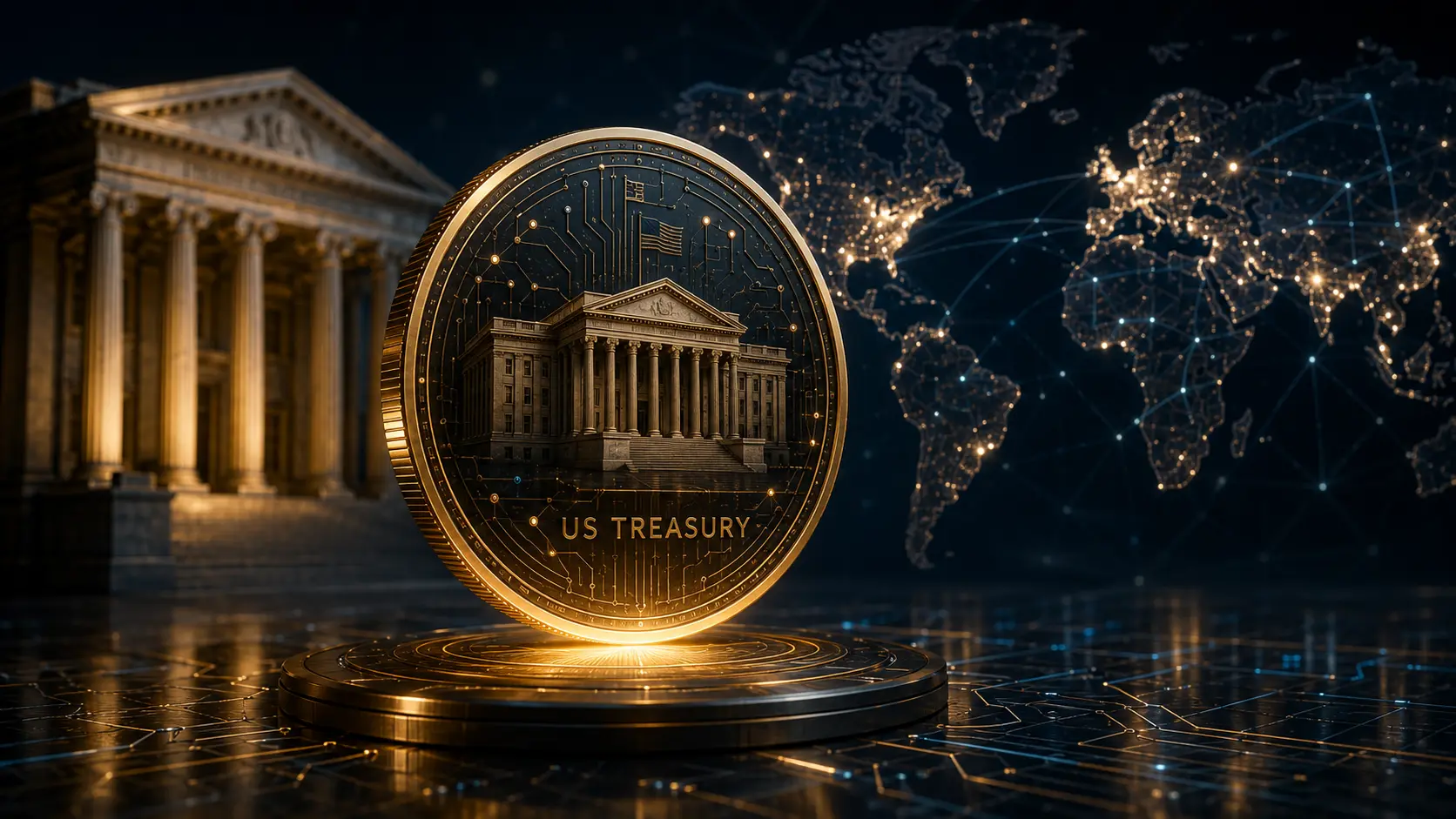
Why should you care right now? Because the largest asset managers on Earth have decided to break the clock. Led by titans like BlackRock and Franklin Templeton, Wall Street is aggressively digitizing United States government debt and placing it directly onto public blockchains. By wrapping US Treasuries in smart contracts, they have created a new, programmable asset class. These tokens do not sleep. They can be traded, pledged as collateral, and settled instantly at 2:00 AM on a Sunday. Tokenized Treasuries are rapidly replacing static stablecoins, transitioning the crypto ecosystem from a casino of speculative tokens into a highly regulated, mathematically ruthless engine for institutional yield.
What are Tokenized US Treasuries?
Tokenized US Treasuries are digital representations of United States government debt issued on a blockchain. Managed by regulated entities, these tokens represent proportional ownership in a bankruptcy-remote fund holding physical Treasury bills. They combine the risk-free yield of government debt with the instant, 24/7 settlement capabilities of smart contracts.
At a Glance
- Concept: Taking physical, paper-based US government bonds and turning them into digital crypto tokens that pay interest directly into a digital wallet every day.
- Why it matters: Traditional cash in a crypto wallet (like USDC) earns zero interest for the user. Tokenized Treasuries allow investors to hold digital cash that constantly grows, backed by the safest asset on Earth.
- Who uses it: Mega-asset managers (BlackRock, Franklin Templeton), DeFi protocols (Ondo Finance), and institutional crypto hedge funds.
- Biggest takeaway: This is not for retail day-traders. This is enterprise software for Wall Street. The primary goal is “Atomic Settlement”—the ability to instantly swap a billion dollars of bonds for cash without paying a middleman to verify the trade.
In Simple Words
Imagine you have a massive safe full of gold bars (US Treasuries).
If you want to use that gold to buy something or guarantee a loan, you have to hire armored trucks, drive the gold across town, and have an auditor weigh it. It takes days, and the bank is closed on weekends (Traditional Finance).
Now, imagine you leave the gold in the safe forever, but you print special digital tickets that represent exactly one ounce of gold. You can email these tickets to anyone in the world, instantly, at any time of day or night. Whoever holds the ticket legally owns the gold in the safe (Tokenization).
Tokenized US Treasuries do this with government debt. By turning the debt into code, Wall Street can move billions of dollars of collateral across the globe at the speed of light, while the actual, physical government bonds remain safely locked in a highly regulated vault.
Why This Matters
For Institutional Traders, Treasury Managers, and DeFi Developers, Tokenized Treasuries solve the Cash Drag of the Digital Economy.
In Decentralized Finance (DeFi), billions of dollars are held in stablecoins (like USDC or USDT) to facilitate trading. However, stablecoin issuers keep the interest generated by the reserves; the user holding the stablecoin earns 0%. In a high-interest-rate environment, holding zero-yield cash is a devastating fiduciary failure.
Tokenized Treasuries introduce the “Risk-Free Rate” to the blockchain. An institutional hedge fund can now keep its dry powder in a token that yields ~5%, but still use that token as instant collateral to execute a trade on a decentralized exchange. It entirely eliminates “cash drag,” ensuring that institutional capital is continuously compounding, even while waiting to be deployed.
The Rise of Real-World Asset (RWA) Tokenization
The crypto industry spent its first decade trying to invent new forms of money (Bitcoin) and new, highly volatile financial instruments (Yield Farming).
We have now entered the “Convergence Phase.” Wall Street realized that the software of crypto (the blockchain) is vastly superior to the 1970s mainframe computers running traditional banks. However, Wall Street has no interest in trading volatile dog coins. They want to put their existing, regulated, boring assets (like bonds and real estate) onto the superior software. Tokenized Treasuries are the “Trojan Horse” of this convergence—the first universally trusted, highly regulated asset to cross the bridge into the digital realm.
How Tokenized US Treasuries Work: SPVs & Smart Contracts
Creating a digital token that legally represents physical government debt requires a flawless fusion of smart contract code and SEC compliance. Here is the first-principles breakdown of the architecture.
1. The Fundamental Problem: T+1 Settlement Latency
In traditional finance, if a hedge fund buys a Treasury bill on Monday, the trade “settles” on Tuesday (T+1). A central clearinghouse (like the FICC) acts as the middleman to ensure the buyer has the cash and the seller has the bond. During this 24-hour waiting period, both parties must lock up excess cash (margin) to guarantee the trade won’t fail. This traps billions of dollars in dead capital.
2. The Core Mechanism: The SPV and Custodian
To tokenize the bond, the issuer (e.g., BlackRock) sets up a Special Purpose Vehicle (SPV)—a legally isolated company. Investors wire traditional fiat dollars to the SPV. The SPV uses a highly regulated traditional bank (the Custodian, like BNY Mellon) to physically purchase and hold short-term US Treasury bills. Because the SPV is bankruptcy-remote, if the token issuer goes bankrupt, the investors’ underlying bonds remain completely safe in the custodian’s vault.
3. Technical Depth: Minting and Atomic Settlement
Once the physical bond is secured in the vault, the issuer’s smart contract “mints” a digital token on a public blockchain (like Ethereum).
Because the blockchain is a decentralized ledger, it acts as its own clearinghouse. If Party A wants to trade the token for a digital dollar, they use a smart contract. The contract executes “Atomic Settlement”—the bond token and the cash token swap places in the exact same millisecond. It either happens 100% perfectly, or the trade fails. There is no T+1 waiting period, no middleman risk, and no trapped margin capital.
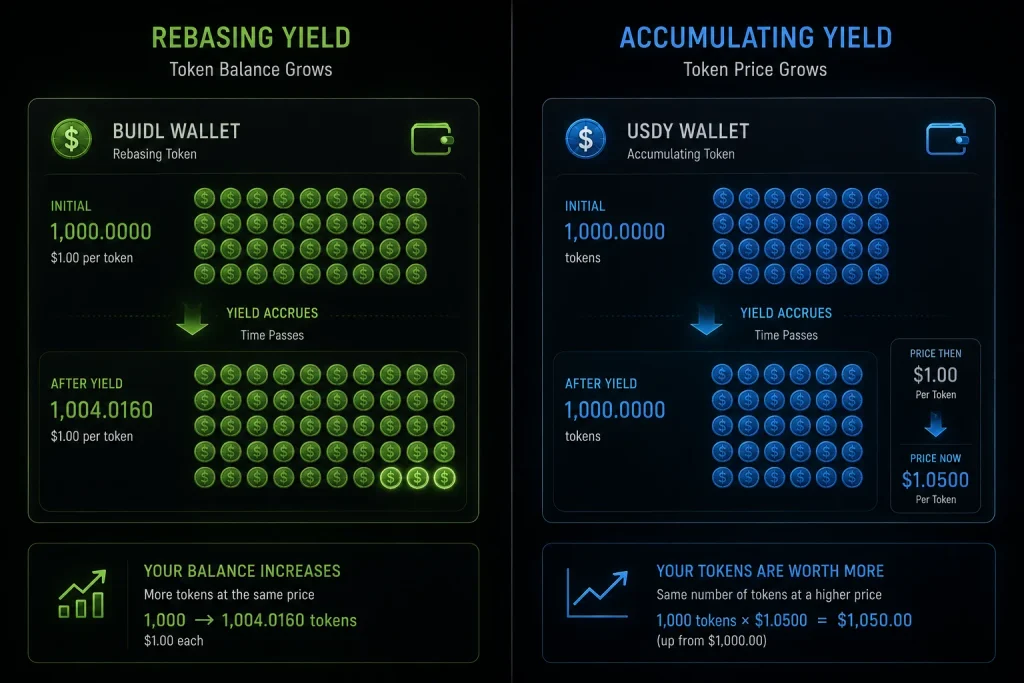
4. Technical Depth: Rebasing vs. Accumulating Yield
How does the token pay interest? There are two primary smart contract architectures:
- Rebasing (e.g., BlackRock’s BUIDL): The token price is permanently pegged to $1.00. Every day, as the underlying Treasury bills pay interest, the smart contract automatically creates new tokens and drops them into the investor’s wallet. You start the month with 1,000 tokens and end with 1,004 tokens.
- Accumulating (e.g., Ondo’s USDY): The number of tokens you hold stays exactly the same, but the value of the token slowly creeps upward every day. You buy one token for $1.00, and a year later, that single token is worth $1.05.
5. Real-World Consequences: Whitelisted Walled Gardens
Because these tokens are legally classified as securities, they cannot be anonymously traded. The smart contracts contain strict “Transfer Restrictions.” An investor cannot receive or send the token unless their specific blockchain wallet address has been verified by KYC/AML (Know Your Customer) compliance officers. The tokens exist on a public blockchain, but they operate within an invisible, highly regulated walled garden.
Tokenized Treasury Ecosystems: BlackRock BUIDL & Ondo USDY
The integration of tokenized collateral is rapidly rewriting the architecture of institutional decentralized finance.
BlackRock’s BUIDL and Securitize: Launched in March 2024, the BlackRock USD Institutional Digital Liquidity Fund (BUIDL) became the fastest tokenized treasury product to reach scale, backed by BNY Mellon custody. Securitize acts as the transfer agent, ensuring only whitelisted institutional wallets can hold the token. Because BUIDL operates on Ethereum, institutional DeFi platforms can write code to interact with it natively, allowing hedge funds to park billions in BUIDL, earn the risk-free rate, and instantly deploy it into on-chain strategies.
Ondo Finance and USDY: While BUIDL targets mega-institutions (with minimum investments often requiring millions), platforms like Ondo Finance offer USDY (US Dollar Yield). USDY is a tokenized note secured by US Treasuries and bank deposits. By acting as a bearer asset (for non-US persons in eligible jurisdictions), Ondo provides a yield-bearing alternative to standard stablecoins, bridging the gap between traditional asset management and global, permissionless DeFi utility.
Ondo’s Global Markets (OUSG) and Repo: To solve the liquidity problem, DeFi protocols are building on-chain Repurchase Agreement (Repo) markets. An institution holding OUSG (Ondo Short-Term US Government Treasuries) can pledge their tokens into a smart contract as collateral to instantly borrow USDC. This perfectly mirrors the traditional Wall Street repo market, but executes 24/7 without a bank acting as the middleman, providing infinite, algorithmic liquidity to token holders.
Economic & Strategic Impact
The core strategic consequence of Tokenized Treasuries is Capital Optimization under Basel III.
Since the 2008 financial crisis, Basel III regulations have forced major banks to hold massive amounts of High-Quality Liquid Assets (HQLA) and cash buffers to protect against settlement failures. Because traditional settlement takes 24 hours, the banks must hoard capital to cover the risk that the other guy goes bankrupt overnight.
By shifting collateral to T+0 (atomic) settlement on a blockchain, the “overnight” risk is mathematically eradicated. If there is no settlement latency, there is zero counterparty settlement risk. If there is zero risk, banks are no longer legally required by regulators to hoard billions of dollars in dead margin capital. Tokenized Treasuries will legally allow Tier-1 banks to release hundreds of millions of dollars of trapped capital back into the economy, generating massive new streams of highly profitable leverage.
Advantages
- Yield Generation: Transforms dead digital cash (standard stablecoins) into a continuously compounding asset, capturing the US government risk-free rate directly in a crypto wallet.
- Atomic Settlement: Eradicates the 24-hour T+1 settlement delay. Trades settle instantly, 24/7/365, permanently removing counterparty and clearinghouse risk.
- Programmable Composability: Because the bond is just a piece of code on a blockchain, developers can build automated algorithms that instantly post the bond as collateral, take out a loan, and invest the proceeds the millisecond the market opens.
- Fractionalization: Traditional Treasuries are traded in massive blocks. Tokenization allows a $10 million Treasury bill to be split into 10 million $1 tokens, allowing smaller funds to access institutional-grade collateral.
Limitations
- Liquidity Fragmentation: If BlackRock issues on Ethereum, and Franklin Templeton issues on Stellar, the tokens cannot easily interact. This fragments the liquidity pools. Building secure “cross-chain bridges” to move a tokenized Treasury from one blockchain to another without exposing it to North Korean hackers is currently the most terrifying vulnerability in DeFi.
- The Oracle Problem: The blockchain is blind to the real world. The smart contract relies on an “Oracle” (a data feed) to tell it the current interest rate or price of the physical Treasury bill sitting in the bank vault. If the Oracle is hacked or reports the wrong price, the smart contract will execute devastating, mathematically flawless trades based on a lie.
- Walled Garden Friction: Because of strict SEC KYC/AML rules, you cannot just send a BUIDL token to a random DeFi protocol. If the protocol’s smart contract address isn’t officially whitelisted by the issuer, the transaction is physically blocked by the code, limiting true decentralized utility.
Common Misconceptions
Misconception: Tokenized Treasuries are meant to replace the US Dollar.
Reality: They are not money; they are securities. They are not meant to buy a cup of coffee. They are strictly designed as high-grade collateral to grease the plumbing of the institutional financial system.
Misconception: If the blockchain crashes, the government bonds are deleted.
Reality: The blockchain token is merely a digital receipt. The actual, physical Treasury bill is legally held off-chain in a highly regulated, traditional bank vault (like BNY Mellon). If the blockchain goes down, the physical asset is perfectly safe, and a new digital ledger can simply be rebooted.
Misconception: Tokenized Treasuries are “DeFi” (Decentralized Finance).
Reality: They exist on a decentralized blockchain, but the asset itself is highly centralized. BlackRock or Ondo has a master “admin key.” If the government orders them to, they can instantly freeze, seize, or burn the tokens in your wallet.
What Most People Miss
The disruptive capability of Automated Intraday Margin Calls.
In traditional finance, if a hedge fund makes a bad trade, the broker calls them on the phone and demands more margin (cash) by the end of the day. It is a slow, manual process prone to human negotiation and systemic failure (e.g., the Archegos collapse).
With tokenized Treasuries pledged in a smart contract, margin calls are mercilessly algorithmic. If the value of the portfolio drops below the legal threshold at 3:14 AM, the smart contract does not make a phone call. It instantly, automatically liquidates exactly enough Tokenized Treasuries to balance the account. This absolute, emotionless enforcement of risk parameters prevents a single failing hedge fund from dragging down the rest of the financial network.
Comparison Table
| Feature | Standard Stablecoin (USDC) | Traditional Treasury Bill | Tokenized Treasury (BUIDL/USDY) |
| Yield to Holder | 0% (Issuer keeps yield) | ~5% (Risk-free rate) | ~5% (Risk-free rate) |
| Settlement Speed | Instant (T+0) | T+1 (Closed on weekends) | Instant (T+0) |
| Blockchain Utility | High (Permissionless) | Zero (Trapped in legacy tech) | Moderate (Whitelisted wallets only) |
| Regulatory Status | Money Transmitter / Unregulated | Highly Regulated Security | Highly Regulated Security |
| Collateral Value | Cash Equivalent | Premium HQLA Collateral | Premium HQLA Collateral |
Case Study
Situation: In the high-interest-rate environment of 2023-2024, institutional crypto funds faced a fiduciary dilemma. Holding billions in USDC or USDT to trade on decentralized exchanges meant forfeiting 5% annual risk-free yield. However, converting that cash back into fiat to buy traditional US Treasuries meant taking the capital off-chain, making it impossible to react instantly to crypto market volatility on weekends.
Challenge: Create a financial instrument that possessed the absolute regulatory safety and yield of a US Government bond, but functioned natively as a digital token capable of interacting with the massive, 24/7 liquidity pools of Ethereum.
Solution (The BlackRock BUIDL Launch): BlackRock, the world’s largest asset manager, partnered with Securitize to launch BUIDL on the Ethereum blockchain. They established an off-chain SPV holding Treasury bills and cash. On-chain, they engineered a rebasing token that maintained a strict $1.00 peg, paying dividends daily in the form of new tokens.
Outcome: The market response was immediate. Within months, BUIDL amassed hundreds of millions of dollars in AUM, rapidly becoming the largest tokenized treasury fund in the world. Major DeFi infrastructure providers (like Ondo Finance) immediately integrated BUIDL as a foundational layer, creating derivative products that allowed the yield to flow through the wider crypto ecosystem without breaking SEC compliance.
Lessons Learned: The deployment definitively proved that traditional Wall Street does not need to build its own private, isolated blockchains. By deploying highly regulated securities directly onto public, open-source networks like Ethereum—and enforcing compliance via smart contract whitelists—institutions can successfully harvest the technological superiority of Web3 without violating federal law.
Future Outlook
Next 12–24 Months
The era of DeFi Collateral Standardization. In the immediate term, tokenized Treasuries will become the undisputed, baseline collateral for all major decentralized lending protocols (like Aave and MakerDAO). Instead of borrowing against volatile Ethereum or Bitcoin, institutions will post BUIDL or USDY to take out stablecoin loans. This transition from volatile crypto-collateral to stable, yield-bearing government debt will mathematically de-risk the entire DeFi ecosystem, making it palatable for conservative, Tier-1 traditional finance (TradFi) adoption.
Next 3–5 Years
The scaling of On-Chain Prime Brokerage. Currently, hedge funds use traditional prime brokers (like Goldman Sachs) to manage their complex portfolios and provide leverage. Over the next five years, we will see the rise of native “On-Chain Prime Brokers.” These platforms will use smart contracts to aggregate tokenized Treasuries, tokenized corporate bonds, and tokenized private equity into a single, unified collateral pool. They will offer instant, algorithmic leverage to institutional clients, completely automating the multi-million-dollar back-office bureaucracy of Wall Street.
Next 10 Years
The Central Bank Digital Currency (CBDC) Convergence. By the mid-2030s, the final puzzle piece will click into place: wholesale CBDCs. Currently, a tokenized Treasury must often be swapped for a stablecoin (like USDC) to execute a trade. When the Federal Reserve and the European Central Bank issue their own official, programmable digital cash directly on the blockchain, tokenized Treasuries will settle directly against the sovereign CBDC. This will create a flawless, risk-free, instant atomic settlement loop, establishing the foundation for a fully digitized, post-paper global economy.
Most Likely Scenario
Tokenized US Treasuries are not a passing crypto trend; they are the permanent modernization of the global bond market. The legacy T+1 settlement system is technologically obsolete. By proving that trillion-dollar asset managers can safely and legally operate on public blockchains, Tokenized Treasuries have opened the floodgates. Over the next decade, virtually every major financial asset on Earth will be wrapped in a smart contract, converting the global financial system into a singular, programmable, continuous machine.
Key Takeaways
- Holding digital cash (like USDC) in a crypto wallet earns zero interest. Tokenized Treasuries fix this by paying the “risk-free” US government interest rate directly to your digital wallet.
- A tokenized Treasury is simply a smart contract on a blockchain that represents legal ownership of a real, physical government bond held in a highly regulated bank vault.
- Traditional finance takes a full 24 hours to clear a bond trade (T+1) and shuts down on weekends. Tokenized bonds settle instantly (Atomic Settlement) and trade 24/7/365.
- Because trades settle instantly, banks and hedge funds no longer have to lock up billions of dollars in “emergency margin” to cover the 24-hour waiting period, freeing up massive amounts of capital.
- BlackRock’s BUIDL fund is the market leader. To keep the government happy, these tokens cannot be traded anonymously; the smart contract physically blocks the trade unless your wallet is ID-verified (KYC).
- This technology turns static, boring government debt into “programmable money,” allowing computer code to automatically manage loans, margin calls, and trading strategies while humans sleep.
Glossary
Atomic Settlement: A blockchain transaction where the exchange of assets (e.g., handing over a bond and receiving cash) happens simultaneously in the exact same millisecond. If one side fails, the whole trade cancels.
BUIDL: The BlackRock USD Institutional Digital Liquidity Fund. The premier tokenized US Treasury product built on the Ethereum blockchain.
Cash Drag: The financial penalty of holding uninvested cash. Tokenized Treasuries eliminate this by ensuring cash is always earning the 5% government interest rate, even while waiting to be used in a trade.
Oracle: A secure data-feed that connects the real world to the blockchain. The smart contract relies on the Oracle to know the real-world price or interest rate of the physical Treasury bill.
Rebasing Token: A crypto token designed to always equal exactly $1.00. To pay out interest, the smart contract simply increases the number of tokens in your wallet every day.
Special Purpose Vehicle (SPV): A legally isolated company set up to hold the physical Treasury bills. If the company that issues the token goes bankrupt, the SPV ensures the underlying bonds are safe and belong only to the token holders.
Sources
BlackRock: BlackRock Launches its First Tokenized Fund, BUIDL, on the Ethereum Network
Ondo Finance: Ondo USD Yield (USDY) Overview and Mechanics
U.S. Securities and Exchange Commission (SEC): Regulation D Offerings and Tokenized Securities
Bank for International Settlements (BIS): The Tokenisation Continuum: Implications for Financial Markets
SIFMA: The Impact of T+1 Settlement on Global Financial Markets