Advertisement
)
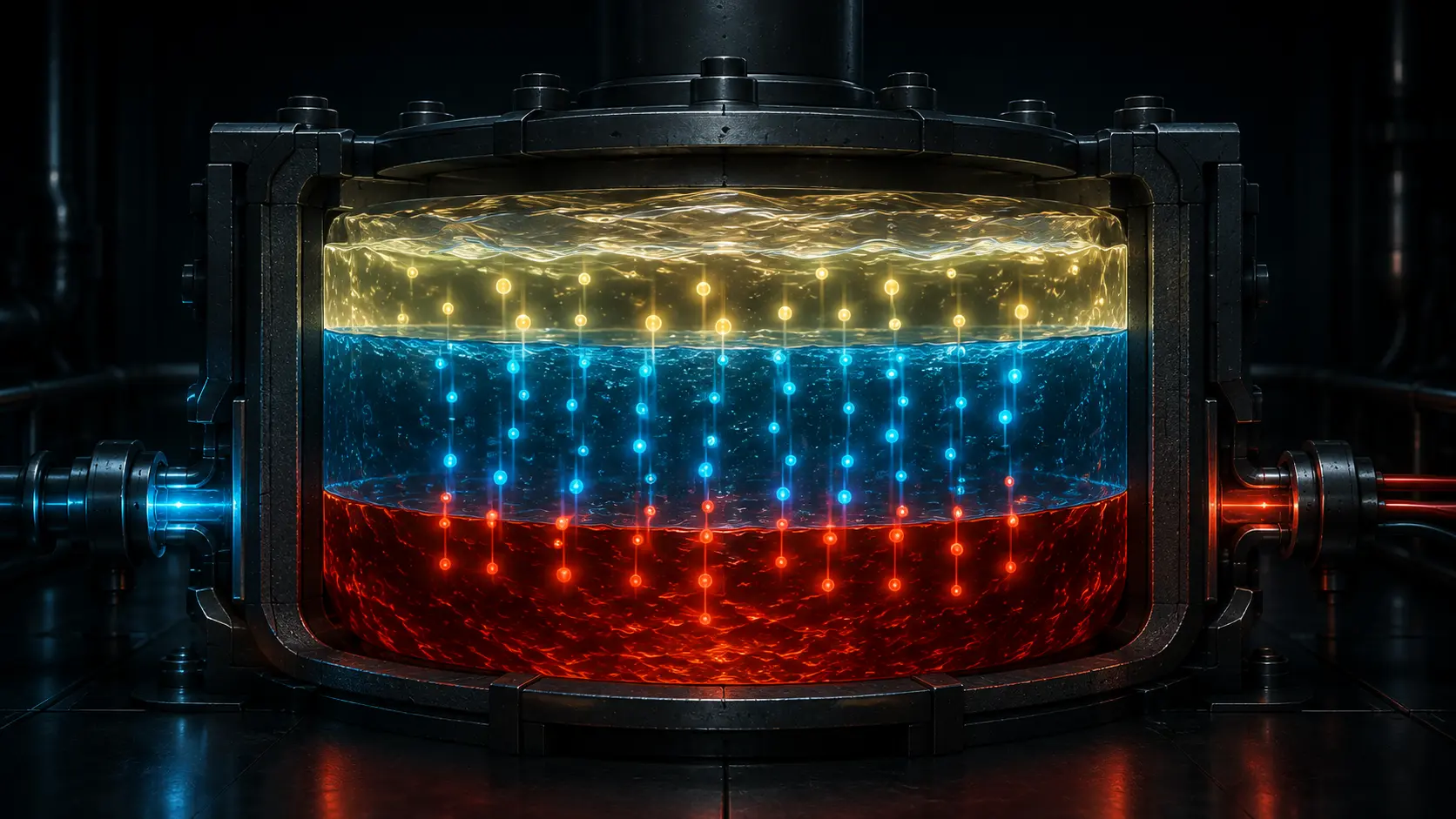

The global transition to renewable energy is mathematically doomed without massive, grid-scale batteries. When the sun sets and the wind stops, entire cities must run on stored power. For short bursts of two to four hours, lithium-ion batteries are miraculous. But asking lithium to discharge power continuously through a multi-day winter storm is a financial dead end. Stacking thousands of lithium cells creates a multi-billion-dollar fire hazard with a fundamental, inescapable flaw: solid batteries physically crack, swell, and degrade every single time you use them. After a decade of heavy use, they are dead.
Why should you care right now? Because materials scientists have abandoned solid metal entirely. Originating from the laboratories of MIT, engineers have designed a bizarre, brutalist energy storage system known as the Liquid Metal Battery. Operating at a staggering 500°C, this battery uses layers of molten calcium and liquid antimony that float on top of each other like oil and water. Because the internal components are entirely liquid, there is nothing to physically break, crack, or degrade. It is an artificial, self-healing volcano housed in an insulated steel box. While scaling this deep-tech hardware has proven financially agonizing, its physics offer the ultimate holy grail of grid storage: an ultra-cheap, fire-proof battery that can outlive the engineers who built it.
What is a Liquid Metal Battery?
A Liquid Metal Battery is a high-temperature electrochemical storage device in which the anode, cathode, and electrolyte are all maintained in a molten, liquid state. Relying on density-driven stratification, the three distinct liquid layers stack perfectly upon one another, allowing the battery to charge and discharge daily for decades with zero mechanical degradation or capacity fade.
At a Glance
- Concept: A battery where the inside is entirely melted. It uses gravity, rather than fragile plastic separators, to keep the chemicals from mixing.
- Why it matters: Solid batteries break down over time because the metal expands and contracts, causing microscopic cracks. Liquid batteries cannot crack, meaning they effectively never lose their ability to hold a charge.
- Who uses it: Utility companies, micro-grid operators, and hyperscale data centers requiring 24/7 uninterrupted baseload power.
- Biggest takeaway: The battery runs at 500°C, which sounds dangerous, but it is actually intrinsically safe. Because the electrolyte is a non-flammable molten salt rather than a volatile organic liquid, it is physically impossible for the battery to catch fire.
In Simple Words
If you pour oil, water, and sand into a jar, they don’t mix. The heavy sand sinks to the bottom, the water sits in the middle, and the light oil floats on top.
A Liquid Metal Battery works on this exact same principle of density.
Instead of oil, water, and sand, the battery uses three different earth-abundant materials heated until they melt into liquids.
- The Light Metal (Calcium) floats on top.
- The Molten Salt (Electrolyte) sits in the middle.
- The Heavy Metal (Antimony) sinks to the bottom.
When the battery discharges power, atoms from the top liquid layer drop through the middle salt layer and mix into the bottom liquid layer. When you plug the battery in to recharge it, the electricity physically pushes the atoms back up to the top layer. Because everything is a liquid, the battery flawlessly reforms its smooth layers every single time. It is a machine that constantly rebuilds itself.
Why This Matters
For Utility Planners, Energy Engineers, and Cleantech Investors, Liquid Metal Batteries solve the Augmentation Cost Nightmare.
When a utility company models the 20-year financial return of a massive lithium-ion storage farm, they must factor in “augmentation.” Because lithium degrades roughly 2% to 3% per year, the utility must continuously buy and install brand-new lithium cells every few years just to maintain the facility’s original capacity. This destroys the project’s profit margins.
Because Liquid Metal Batteries suffer virtually zero capacity fade, a 100-Megawatt system installed in 2026 will still be a 100-Megawatt system in 2046. The elimination of augmentation capital expenditure (CapEx) drastically lowers the Levelized Cost of Storage (LCOS), enabling genuine, profitable multi-day energy shifting.
The Geopolitics of Liquid Metal Battery Materials
The battery industry is locked in a geopolitical war over critical minerals. Lithium, cobalt, and nickel are subject to intense price volatility, environmental degradation, and supply chains heavily dominated by China.
The Liquid Metal Battery entirely bypasses this geopolitical chokepoint. Calcium is one of the most abundant elements on the Earth’s crust, and antimony is widely available and cheap. By utilizing heavy, abundant, and transparently priced metallurgical commodities, this architecture allows Western nations to construct gigawatt-scale grid storage without engaging in a multi-trillion-dollar bidding war for exotic battery metals.
How Liquid Metal Batteries Work: Immiscibility and Joule Heating
Achieving a perfectly stable, zero-degradation electrochemical reaction at 500°C requires exploiting the extreme thermodynamics of immiscibility. Here is the first-principles breakdown of the architecture.
1. The Fundamental Problem: Solid Microstructure Degradation
In a standard lithium-ion battery, lithium ions are physically shoved into the microscopic, solid crystal structure of a graphite anode. When the ions enter, the graphite swells; when they leave, it shrinks. Over thousands of cycles, this mechanical breathing causes the solid structure to fracture. Furthermore, metallic “dendrites” (spiky growths) form, eventually piercing the plastic separator and causing the battery to short-circuit and explode.
2. The Core Mechanism: Density Stratification
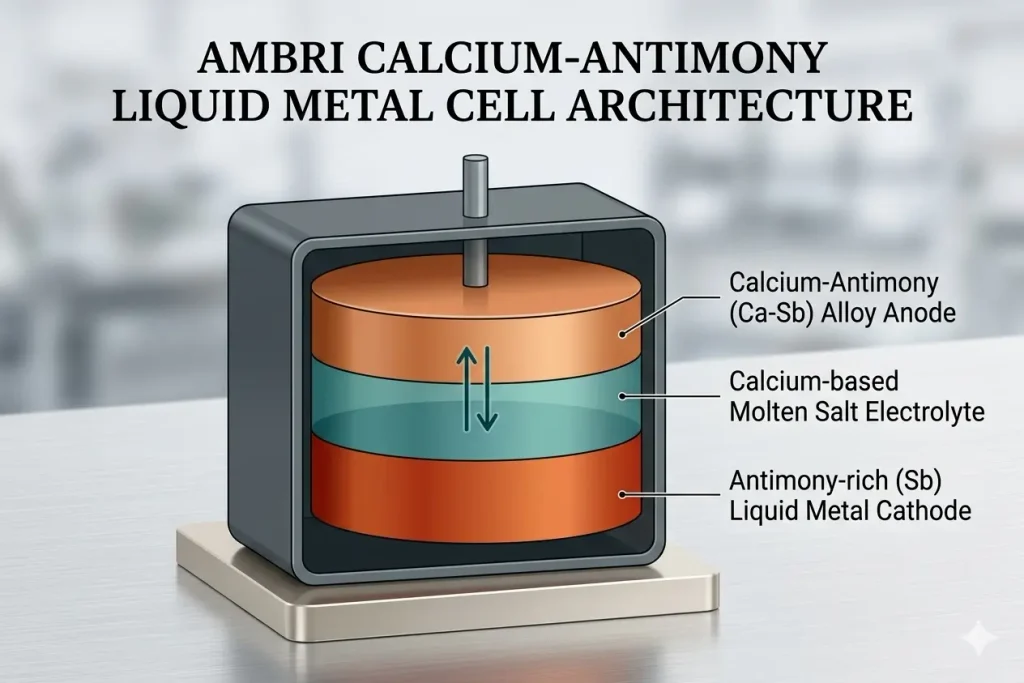
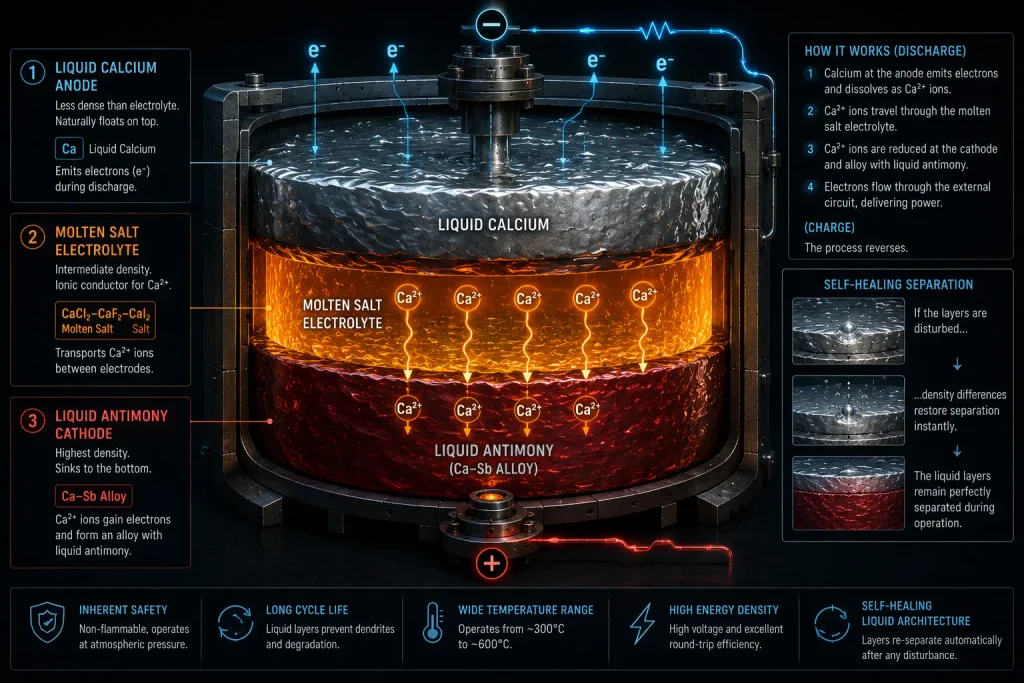
The Liquid Metal Battery (LMB) eliminates solid structures entirely. Inside the steel cell, three liquids sit on top of each other. They are “immiscible”—meaning they cannot mathematically dissolve into one another.
- The Anode: A lightweight, liquid Calcium-alloy.
- The Electrolyte: A medium-weight, liquid Calcium-Chloride molten salt.
- The Cathode: A heavy, liquid Antimony.Gravity acts as the perfect, indestructible separator.
3. Technical Depth: The Alloying Discharge
When the battery is connected to a grid to discharge power, calcium atoms in the top liquid layer shed their electrons. These electrons flow out through the power lines (providing electricity to the city). The resulting Calcium ions (Ca²⁺) drop down through the molten salt electrolyte. When they reach the bottom, they bond with the liquid antimony, creating a Calcium-Antimony intermetallic alloy. As the battery drains, the top layer shrinks, and the bottom layer grows.
4. Technical Depth: Joule Heating
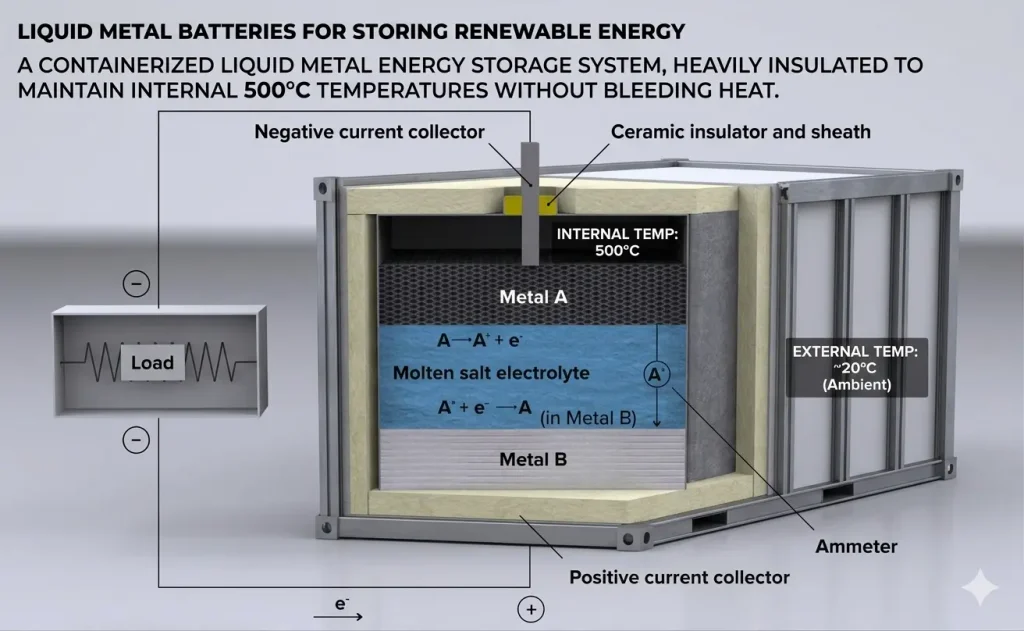
How does the battery stay at 500°C? It doesn’t need external heaters during normal operation. As the massive electrical currents flow through the molten salt, the natural electrical resistance generates intense heat (Joule heating). If the battery is cycled (charged and discharged) daily, its own internal friction generates enough thermal energy to keep the metals permanently melted inside the heavily insulated box.
5. Real-World Consequences: Infinite Cycle Life
Because the top and bottom layers are liquids, they do not have a crystalline shape to fracture. They cannot grow sharp dendrites. When the battery is recharged, the calcium is simply pushed back up to the top layer, and the perfect, smooth liquid interfaces instantly reform. The battery can be cycled 10,000 times, drained to 0%, and pushed to its absolute limits without permanently losing any capacity.
Battery Degradation Analysis
Solid-State Lithium-Ion Micro-Cracking vs. Liquid Metal Self-Healing Stratification
0 Cycles
0 (New)
5,000
10,000 (20 Years)
Retained Storage Capacity
100.0%
Internal Impedance / Fatigue
Nominal
Deploying Liquid Metal Batteries: Data Centers and Microgrids
While lithium dominates consumer electronics, Liquid Metal Batteries are targeting the heavy, stationary infrastructure required to run the digital economy.
Hyperscale Data Center Backup: Artificial intelligence data centers require hundreds of megawatts of continuous, uninterruptible power. Diesel generators are highly polluting, and lithium batteries are a massive fire liability when placed near multi-billion-dollar AI server clusters. LMBs provide a non-flammable, hyper-dense energy buffer. If the local grid fails, the LMB smoothly bridges the gap for days, keeping the cooling systems and GPUs operational without risking a catastrophic thermal runaway event.
Off-Grid Mining Operations: Deep-shaft mining in remote locations (like Western Australia or the Atacama Desert) relies heavily on trucked-in diesel fuel, which is outrageously expensive. Mining companies are pairing massive solar arrays with containerized Liquid Metal Batteries. Because the batteries thrive in extreme, hot ambient environments (the hotter the desert, the better for the battery’s insulation), they easily provide continuous, 24-hour baseload power to run the crushing and smelting equipment off-grid.
Microgrids and Island Economies: Island nations suffer from the highest electricity costs on Earth due to the importation of liquid natural gas (LNG) and fuel oil. By installing LMBs, these economies can capture their abundant daytime solar and wind energy and effortlessly shift it into the night, permanently severing their exposure to volatile ocean shipping logistics.
Economic & Strategic Impact
The core strategic reality of deep-tech energy is The Hardware Capital “Valley of Death”.
Inventing a brilliant chemistry in an MIT lab is relatively easy; scaling a massive, high-temperature manufacturing line to build tens of thousands of airtight steel battery cells is a multi-billion-dollar gauntlet.
Ambri, the primary company commercializing LMBs, experienced this brutally. Despite backing from Bill Gates and massive pilot deals, the soft capital markets and high commodity prices of the early 2020s forced Ambri into Chapter 11 bankruptcy in May 2024. However, the technology did not fail. The company was immediately acquired by its lenders, recapitalized, and restructured with a renewed focus on data center deployments. This event highlights that in the grid storage sector, surviving the physical manufacturing scale-up is a far deadlier threat than the laws of physics.
Advantages
- Zero Capacity Fade: The liquid electrodes cannot suffer micro-structural damage, allowing for infinite, deep 100% depth-of-discharge (DoD) cycling.
- Intrinsic Fire Safety: The battery contains zero volatile, flammable organic solvents. The molten salt electrolyte is completely inert. You can safely place the shipping containers directly next to critical infrastructure.
- Ambient Heat Tolerance: Because the battery needs to be 500°C inside, it thrives in hot desert environments that require massive, expensive HVAC air-conditioning systems to keep traditional lithium-ion batteries from overheating.
- Supply Chain Security: Calcium, antimony, and chloride salts are cheap, globally abundant, and entirely bypass the constrained lithium, cobalt, and graphite supply chains.
Limitations
- Low Voltage per Cell: A single Calcium-Antimony cell has an operating voltage of less than 1 volt (compared to a lithium cell at ~3.7 volts). Achieving grid voltages requires wiring thousands of heavy, molten cells together in series, increasing the complexity of the internal busbars.
- The Freezing Risk: If the battery is disconnected from the grid and unused for several days, it stops generating internal Joule heating. If the internal temperature drops below the melting point of the salt, the battery “freezes” solid. While it can be safely re-melted with external power, doing so requires massive amounts of startup electricity.
- Absolute Immobility: The system relies entirely on gravity to keep the liquid layers separated. It can never be used in a car, train, or ship. Even in a stationary setup, earthquakes or extreme vibrations require the cells to have specialized baffles to prevent the liquids from sloshing and short-circuiting.
Common Misconceptions
Misconception: Keeping the battery at 500°C wastes all its energy.
Reality: The battery acts like a massive thermos. Because it is surrounded by extreme aerospace-grade insulation, and because it generates internal friction (Joule heating) when it charges and discharges, it uses practically zero external electricity to stay hot during standard daily use.
Misconception: If it cracks, lava will melt the facility.
Reality: The cells are small steel boxes stacked inside a larger container. If a cell cracks, the molten metal hits the outer thermal insulation and instantly freezes into a harmless solid rock. It does not explode or burn.
Misconception: Liquid metal batteries are a brand new concept.
Reality: The concept is decades old, but previous iterations used highly toxic or corrosive metals. The breakthrough by Dr. Donald Sadoway was finding the exact mix of Calcium and Antimony that provided high voltage without dissolving the steel container over time.
What Most People Miss
The disruptive capability of Symmetrical Charging Profiles.
If you try to charge a lithium-ion battery from 0% to 100% in 15 minutes, the solid anode cannot absorb the ions fast enough. The lithium plates onto the surface as a solid metal, permanently ruining the battery.
A Liquid Metal Battery has no solid structure to restrict the flow. The liquid metal anode can absorb ions practically as fast as you can blast them into the cell. This means an LMB has a perfectly symmetrical profile—it can absorb a massive, violent spike of electricity from a fluctuating wind turbine just as easily as it can discharge a slow, steady trickle to a data center, providing unmatched grid-smoothing flexibility.
Comparison Table
| Feature | Lithium-Ion (LFP) | Vanadium Redox Flow | Liquid Metal Battery (Ca-Sb) |
| Active Materials | Solid / Liquid Electrolyte | Liquid Tanks / Membrane | Fully Liquid (Immiscible Layers) |
| Operating Temperature | 15°C to 30°C (Requires HVAC) | Ambient | ~500°C (Internally Heated) |
| Capacity Degradation | 2% – 3% per year | Near Zero | Near Zero |
| Fire Risk | High (Thermal Runaway) | Zero | Zero (Non-flammable salt) |
| Energy Density | High (Mobile/EV viable) | Low (Massive footprint) | Moderate (Stationary only) |
Case Study
Situation: As the renewable energy transition accelerated, utility companies faced a stark reality: Lithium-ion batteries were perfectly optimized for high-power, short-duration applications (like electric vehicles), but their degradation curves made them a financial liability for the long-duration, multi-decade storage required to replace coal plants.
Challenge: Develop a grid-scale battery architecture that could be manufactured from cheap, earth-abundant materials, operate with absolute fire safety, and completely eliminate mechanical capacity fade over a 20-year lifespan.
Solution (The MIT Immiscibility Breakthrough): Dr. Donald Sadoway and his team at MIT looked past traditional electrochemistry and borrowed techniques from heavy aluminum smelting. They engineered the Liquid Metal Battery, utilizing cheap calcium and antimony separated by a molten salt. The battery used the physics of density and immiscibility to maintain its internal structure, meaning the liquid layers would endlessly reform themselves with zero degradation.
Outcome: The technology spun out into the startup Ambri. Ambri successfully proved the physics, securing massive pilot contracts with entities like TerraScale to power green data centers. While the grueling economics of deep-tech manufacturing forced Ambri through a Chapter 11 restructuring in 2024, the underlying physics were resoundingly validated. The technology emerged from the restructuring backed directly by its institutional lenders, shifting its go-to-market strategy specifically toward the insatiable, high-margin backup power demands of the AI data center boom.
Lessons Learned: The journey of the Liquid Metal Battery proves that achieving theoretical perfection in physics is only half the battle. Surviving the “valley of death” of commercial hardware scaling requires aligning the technology not just with the broad electrical grid, but with specific, ultra-lucrative industrial niches (like AI infrastructure) that demand the unique, un-degrading capabilities the battery provides.
Future Outlook
Next 12–24 Months
The era of Data Center Microgrid Pilots. In the immediate term, post-restructuring LMB companies will strictly avoid bidding against lithium for standard 2-hour utility contracts. Instead, they will aggressively target hyperscale cloud providers (Microsoft, Amazon, Google). We will see the deployment of containerized LMB systems placed directly adjacent to new AI server farms. Because these batteries pose zero fire risk and can buffer power continuously for 24 hours, they will act as the primary, non-polluting failover mechanism to replace localized diesel generators.
Next 3–5 Years
The scaling of Automated High-Temperature Manufacturing. The primary barrier to LMB dominance is the cost of manufacturing. Over the next five years, the focus will shift entirely from chemistry to robotics. Companies will build highly automated, robotic assembly lines capable of hermetically welding the steel battery cases in extreme vacuum environments at a rate of thousands per day. Squeezing out these manufacturing efficiencies will finally allow the capital cost ($/kWh) of the liquid metal battery to undercut standard lithium-iron-phosphate (LFP) systems.
Next 10 Years
The Terawatt-Hour Baseload Replacement. By the mid-2030s, older coal and nuclear baseload plants will retire en masse. To replace them, utilities will construct massive, centralized renewable energy parks. Because LMBs thrive at scale, we will see entire multi-acre warehouses filled with stacked, 500°C liquid metal cells. These colossal facilities will absorb excess solar energy during the summer and discharge stable, uninterruptible power through multi-day winter storms, acting as the indestructible, immortal heart of the 21st-century power grid.
Most Likely Scenario
Liquid Metal Batteries represent the inevitable victory of thermodynamics over chemistry. While solid-state batteries will forever rule the mobile world, grid storage requires brutal longevity, not lightweight mobility. By harnessing the self-healing power of liquid metals, this architecture ensures that the heavy infrastructure backing the global electrical grid can operate flawlessly for decades, insulated from both physical degradation and volatile global supply chains.
Key Takeaways
- To store solar power for days at a time, the grid needs massive batteries. Lithium-ion batteries degrade and break down over time, making them too expensive to replace every 10 years.
- Liquid Metal Batteries solve this by melting all their internal components at 500°C. They use a light metal (calcium), a medium salt, and a heavy metal (antimony) that float on top of each other like oil and water.
- Because the battery is entirely liquid, it has no solid structures to crack or break. It can charge and discharge endlessly with practically zero degradation over 20+ years.
- The battery stays hot simply by being used. The natural electrical friction (Joule heating) generates enough heat to keep the metals melted inside the heavily insulated steel box.
- It is incredibly safe. Unlike lithium, which contains highly flammable liquids, the molten salt in an LMB cannot catch fire or explode, making it perfect for placement near expensive data centers.
- While scaling the manufacturing of these high-temperature steel cells is incredibly expensive and difficult, the raw materials (calcium and antimony) are dirt cheap and abundant globally.
Glossary
Augmentation: The expensive process of constantly buying new lithium-ion battery cells every few years to replace the ones that have degraded and lost their capacity.
Capacity Fade: The gradual loss of a battery’s ability to hold a charge over time. Liquid Metal Batteries have virtually zero capacity fade because their components are self-healing liquids.
Immiscibility: The chemical property where two or more liquids cannot dissolve into one another and instead separate into distinct layers based on density (like oil and water).
Intermetallic Alloy: A solid or liquid compound formed when two different metals combine during the discharge phase of the battery (e.g., when the calcium drops into the antimony).
Joule Heating: The process where electricity flowing through a material encounters resistance and generates heat. This is what keeps the Liquid Metal Battery molten at 500°C without external heaters.
Levelized Cost of Storage (LCOS): The true, total cost of storing electricity over the entire lifespan of a battery project, including the initial purchase, maintenance, and replacement costs.
Sources
MIT Department of Materials Science: Liquid Metal Batteries for Grid-Scale Energy Storage
Ambri Corporate Publications: The Liquid Metal Battery Architecture and Commercial Application
Energy-Storage.news: Ambri Liquid Metal Battery Emerges from Restructuring
Greentech Media: The Physics and Economics of Calcium-Antimony Cells
Nature Energy: High-temperature electrochemical energy storage using liquid metals