Advertisement
)
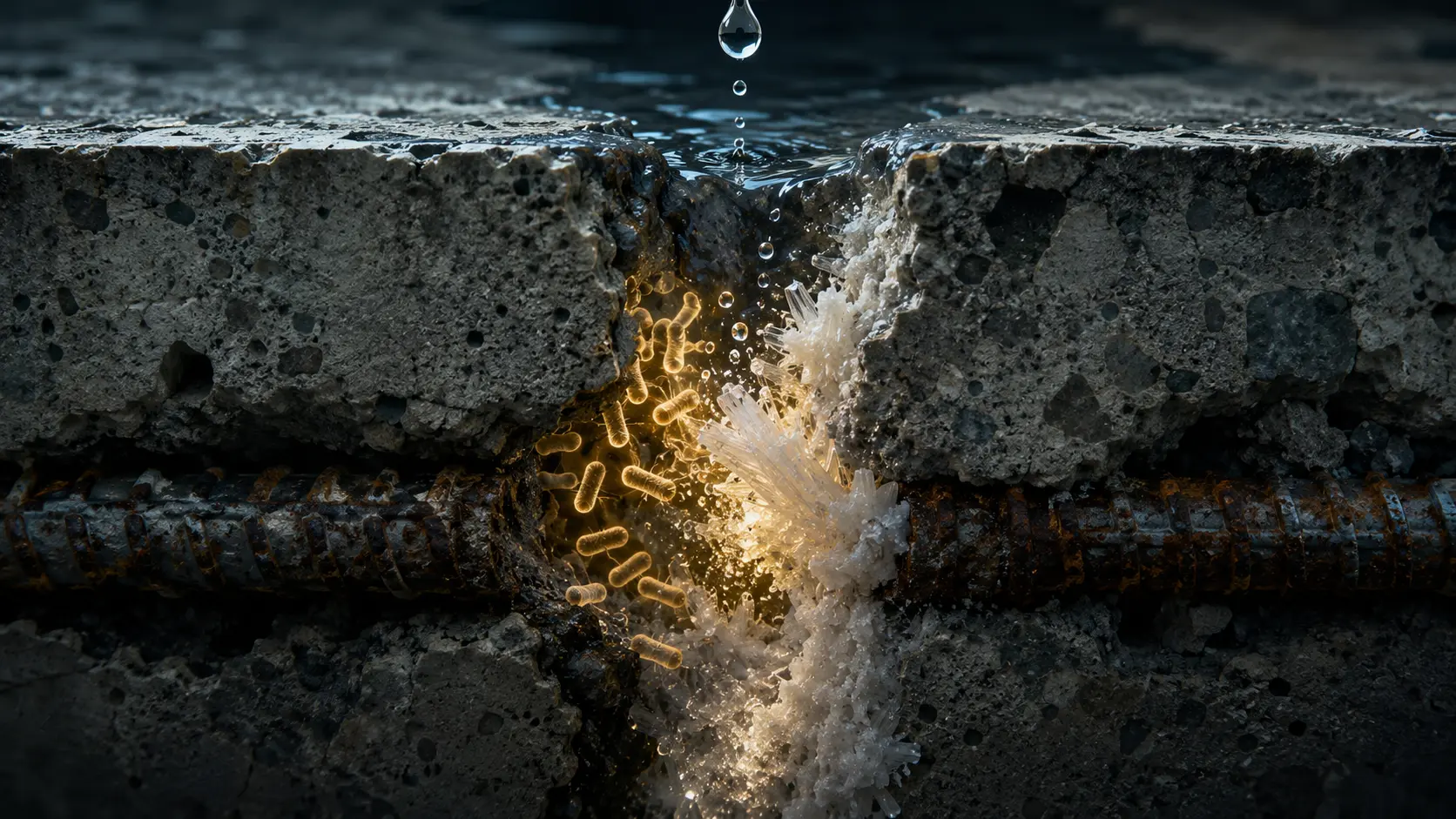

Concrete is the foundation of modern human civilization, but it is engaged in a permanent, losing war against water. Every bridge, dam, and skyscraper inevitably develops microscopic cracks. Once a crack opens, rainwater seeps in, reaches the internal steel rebar, and causes it to rust. As the steel rusts, it expands, blowing the concrete apart from the inside out in a process known as “concrete spalling.” The global economy spends billions of dollars every year manually patching these cracks to prevent catastrophic collapses. It is an endless, reactive cycle of decay and repair.
Why should you care right now? Because materials scientists are turning dead infrastructure into living organisms. By utilizing a biotechnology known as Microbial-Induced Calcite Precipitation (MICP), engineers are embedding specialized, dormant bacteria directly into the cement. When a crack forms and water enters, the bacteria wake up, consume a pre-packaged food source, and excrete solid limestone to perfectly seal the crack shut. This “self-healing concrete” operates entirely autonomously. It is transforming civil engineering by creating infrastructure that physically repairs its own wounds, drastically slashing maintenance budgets and extending the lifespan of the world’s most critical assets by decades.
What is Microbial-Induced Calcite Precipitation (MICP)?
Microbial-Induced Calcite Precipitation (MICP) is a bio-mineralization process used to create self-healing concrete. Alkaliphilic bacteria and a calcium-rich nutrient broth are embedded into the concrete mix. When cracks form and admit moisture, the dormant bacteria awaken, metabolize the nutrients via urease hydrolysis, and excrete solid calcium carbonate (limestone) to autonomously seal the fissures.
At a Glance
- Concept: Adding “sleeping” bacteria to building materials that wake up to fix cracks automatically.
- Why it matters: It stops water from reaching the steel rebar inside concrete. If the rebar doesn’t rust, the building or bridge can theoretically last centuries without requiring massive, expensive structural repairs.
- Who uses it: Vanguard civil engineering firms, marine infrastructure developers, and specialized bio-concrete startups like Basilisk.
- Biggest takeaway: The bacteria chosen for this task naturally live near highly alkaline lakes or inside active volcanoes. They are the only organisms tough enough to survive being crushed inside wet, highly toxic cement for decades without dying.
In Simple Words
If you get a small cut on your arm, you don’t need to go to a mechanic to get it welded shut. Your body detects the damage, sends platelets to the site, and builds a scab to seal the wound and stop infection.
Traditional concrete cannot do this. If it cracks, it stays cracked until a human worker patches it with chemicals.
MICP self-healing concrete borrows the concept of the human scab. Scientists mix bacterial spores (the “platelets”) into the wet concrete. These spores go to sleep. Years later, if a crack forms and rain gets inside, the water wakes the bacteria up. They start eating the food that was packed next to them. As they digest the food, they physically excrete solid rock. The rock fills the crack entirely, blocking the water and healing the structure. Once the crack is sealed and the water stops, the bacteria go back to sleep, waiting for the next injury.
Why This Matters
For Civil Engineers, Materials Scientists, and Cleantech VCs, MICP solves the OpEx Maintenance Trap.
The life-cycle cost of a concrete structure is heavily skewed toward Operational Expenditure (OpEx). Routine inspection, crack injection, and spalling repair often cost more over a 50-year period than the original cost of erecting the building. In highly inaccessible environments—like underground subway tunnels, offshore wind turbine foundations, or deep-sea retaining walls—manual crack repair is extraordinarily dangerous and financially punishing.
MICP shifts the paradigm. By paying a slight “bio-premium” upfront during the Capital Expenditure (CapEx) construction phase, asset owners effectively eliminate the need for microcrack maintenance. The infrastructure becomes an autonomous, zero-maintenance asset, drastically improving the internal rate of return (IRR) for long-term infrastructure funds.
The Carbon Mitigation Impact of Self-Healing Concrete
The cement industry is a climate disaster, responsible for roughly 8% of all global carbon dioxide ($CO_2$) emissions. Every time we tear down a decaying concrete bridge and build a new one, we emit thousands of tons of greenhouse gases.
MICP acts as a profound carbon mitigation strategy. We do not necessarily need to invent a zero-carbon cement if we can make traditional cement last three times as long. By ensuring that rebar never rusts and structures do not prematurely decay, self-healing concrete drastically reduces the global demand for replacement cement, serving as one of the most effective, indirect decarbonization tools in the construction sector.
How MICP Works: Urease Hydrolysis and Calcite Precipitation
Forcing a living organism to survive inside a solid block of stone for 50 years and then execute precision chemistry requires mastering extreme bio-mineralization. Here is the first-principles breakdown of the architecture.
1. The Fundamental Problem: The Alkaline Wasteland
Fresh concrete has a pH of roughly 13. It is a highly toxic, violently alkaline environment that instantly dissolves the cell walls of 99.9% of biological organisms. Furthermore, as concrete cures, it compresses with immense physical force and dries out completely, depriving any surviving organisms of water and oxygen.
2. The Core Mechanism: Extremophile Spores
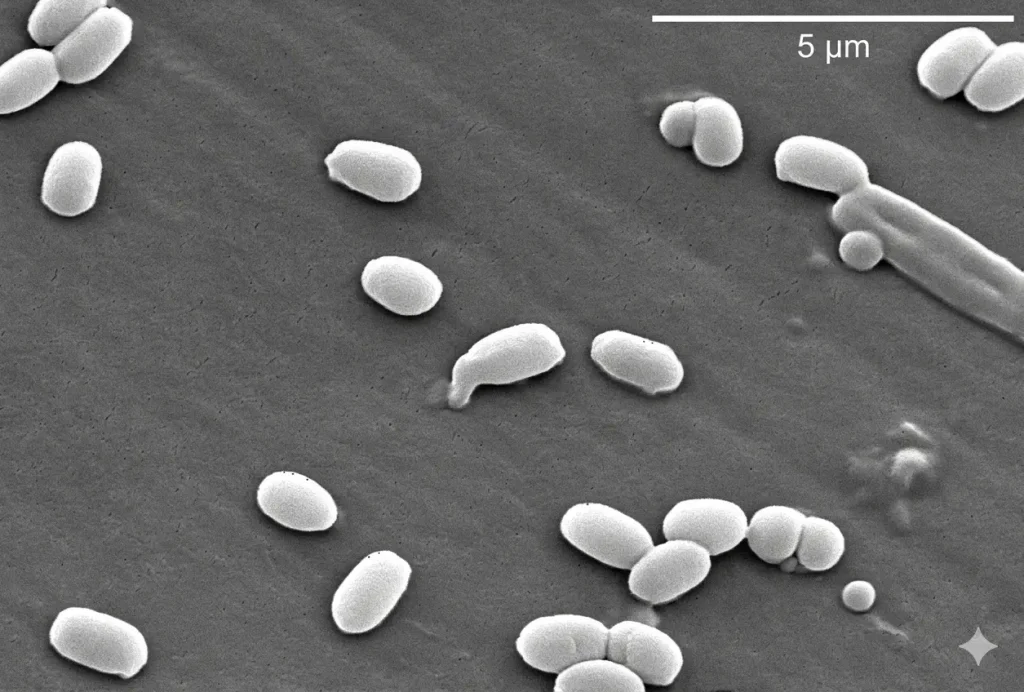
To survive, scientists select specific alkaliphilic (base-loving) bacteria, predominantly Sporosarcina pasteurii or Bacillus subtilis. When these bacteria detect harsh conditions, they transform into “endospores”—a dormant, heavily armored state that requires zero food, water, or oxygen. These spores can survive radiation, extreme heat, and the toxic alkalinity of cement for up to 200 years.
3. Technical Depth: The Healing Payload
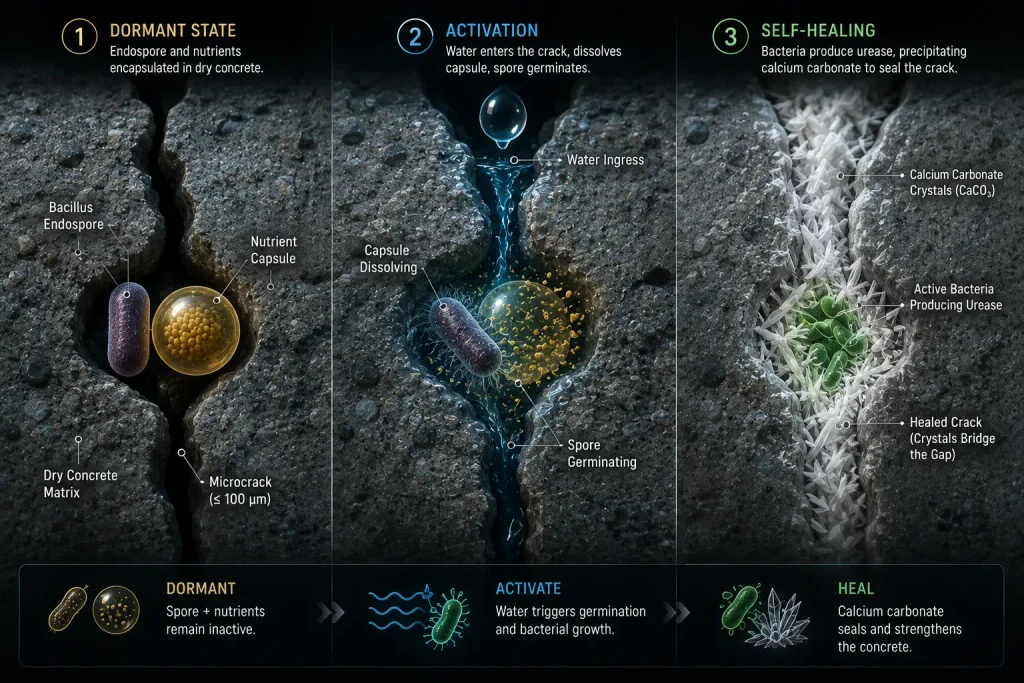
You cannot just add bacteria; you must add the building materials. The spores are mixed into the concrete alongside a payload of urea (CO(NH₂)₂) and calcium lactate (Ca(C₃H₅O₃)₂). To prevent this food from reacting with the wet cement during the initial pour, the payload is often encapsulated in microscopic, biodegradable clay or polyurethane pellets.
4. Technical Depth: Urease Hydrolysis
Fast forward a decade. A microcrack forms, and a raindrop enters the fissure. The water dissolves the protective pellet, waking up the bacterial spore.
The awakened bacteria immediately produce an enzyme called urease. The urease attacks the urea, executing a chemical hydrolysis reaction that produces ammonia (NH₄⁺) and carbonate ions (CO₃²⁻).
The chemical reaction is:
CO(NH₂)₂ + 2H₂O → 2NH₄⁺ + CO₃²⁻
5. Real-World Consequences: Calcite Precipitation
The newly created carbonate ions instantly seek out the calcium lactate that was packed alongside them. When the calcium and the carbonate bind together, they precipitate as Calcium Carbonate (CaCO₃)—solid limestone. The bacteria continuously excrete this limestone, physically bridging the gap until the crack is entirely sealed. Once the crack is sealed, no more water can enter. The bacteria, lacking water, instantly revert back into their armored spore state, ready to wake up again if the crack reopens.
Real-World Deployments: Marine Infrastructure and Subways
While still a premium product, MICP is rapidly moving from academic laboratories into critical, high-risk commercial infrastructure.
Marine and Offshore Infrastructure: Seawater is the ultimate enemy of concrete. The chlorides in salt water aggressively attack steel rebar. For offshore wind turbine foundations, sea walls, and coastal bridges, the cost of sending commercial divers to repair microcracks is exorbitant. European contractors are increasingly deploying bio-concrete in these splash-zones because the constant presence of water guarantees that any microscopic fissure is instantly healed by the bacteria before the chlorides can reach the structural steel.
Underground Tunnels and Subways: Waterproofing a subway tunnel or a deep-basement parking garage is notoriously difficult. Ground settling causes inevitable cracking, leading to constant leaks and expensive pump maintenance. By pouring the structural walls with MICP concrete, civil engineers create a permanently watertight barrier. The bacteria actively hunt down and seal the slow, weeping leaks that traditional elastomeric membranes often fail to stop.
Irrigation Canals and Dams: In agricultural sectors, massive amounts of water are lost to seepage through aging concrete irrigation canals. In earthquake-prone regions, micro-tremors constantly fracture these canals. MICP provides a dynamic, self-repairing lining. Because the bacteria can wake up repeatedly over decades, they offer continuous protection against the relentless, slow-motion damage caused by seismic settling and thermal expansion.
Economic & Strategic Impact
The core strategic hurdle for MICP is the Capital Expenditure (CapEx) vs Operational Expenditure (OpEx) Disconnect.
Adding highly engineered bacterial spores and encapsulated calcium lactate to a cement mixer increases the raw material cost of the concrete by approximately 10% to 30%. In the construction industry, the firm that builds the structure (paying the CapEx) is rarely the same entity that maintains the structure twenty years later (paying the OpEx).
Because construction firms bid on contracts based purely on the lowest upfront cost, they have zero financial incentive to buy expensive bio-concrete that saves the city money thirty years in the future. The mass adoption of MICP relies heavily on Public-Private Partnerships (PPPs) or infrastructure asset funds, where the entity paying for the concrete is also mathematically responsible for the 50-year maintenance budget, perfectly aligning the economic incentives.
Advantages
- Autonomous Maintenance: Completely eliminates the need for human inspectors to find microscopic cracks and manually inject epoxy or polyurethane sealants.
- Massive Lifespan Extension: By preventing water from reaching the internal steel reinforcement, the primary cause of structural death (concrete spalling) is neutralized, potentially doubling the safe operational lifespan of the asset.
- Deep Healing: Manual human repairs usually only seal the surface of a crack. Bacteria are carried deep into the structure by the intruding water, healing the entire three-dimensional depth of the fissure.
- Carbon Sequestration: The chemical process of producing the limestone consumes carbon dioxide and traps it permanently inside the rock, turning the healing process into a microscopic carbon sink.
Limitations
- Crack Width Limits: The bacteria are biological, not magical. They can successfully bridge microcracks up to roughly 0.8 millimeters wide. If a massive structural earthquake tears a 5-centimeter gap in a bridge pillar, the bacteria cannot physically span the void.
- The Nutrient Bottleneck: The bacteria can only heal the concrete as long as they have food. Once the embedded payload of calcium lactate is entirely consumed by repeated cracking and healing in the same location, the bacteria lose the raw materials required to make limestone, rendering that specific area “dead.”
- Harsh Curing Pressures: While the spores are tough, mixing them in standard industrial concrete trucks using heavy aggregates (like sharp gravel) can physically crush and destroy a large percentage of the encapsulated payloads before the concrete is even poured.
Common Misconceptions
Misconception: The bacteria are dangerous and will spread disease.
Reality: The strains used (like Bacillus subtilis) are naturally occurring, non-pathogenic soil bacteria. They are completely harmless to humans, animals, and the environment.
Misconception: The concrete is structurally stronger than regular concrete.
Reality: MICP concrete has the exact same initial compressive and tensile strength as standard concrete. The bio-agent does not make the concrete “stronger” when it is poured; it simply stops it from becoming weaker as it ages.
Misconception: The bacteria eat the concrete.
Reality: The bacteria do not consume the cement matrix or the steel. They only consume the specific organic nutrients (urea/calcium lactate) intentionally packed alongside them.
What Most People Miss
The disruptive capability of Bio-Liquid Remediation Sprays.
When analysts discuss MICP, they focus entirely on building new structures with bio-concrete. What they miss is the massive retrofit market for the trillions of dollars of existing decaying infrastructure.
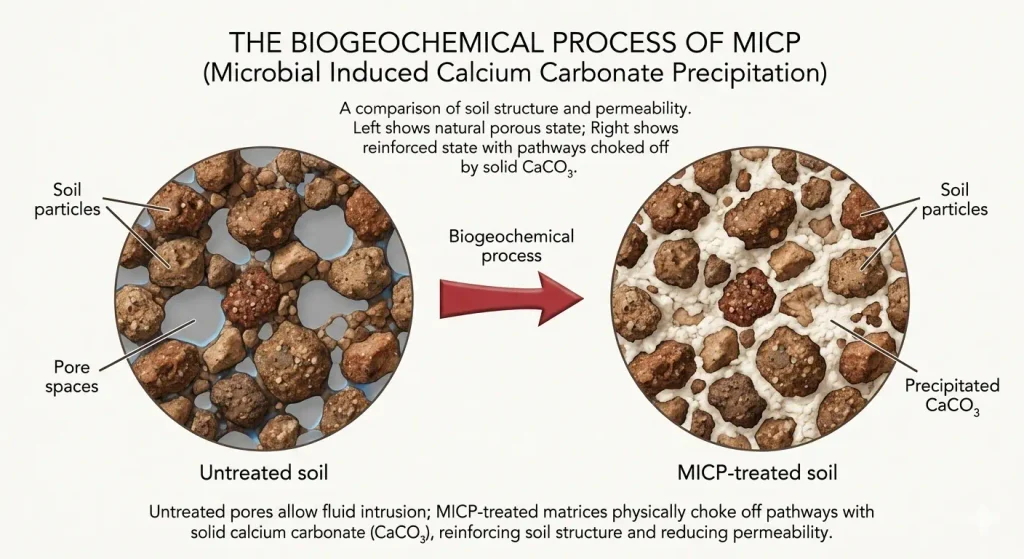
Startups are commercializing MICP bio-liquids. Instead of mixing the bacteria into a new wet pour, workers spray a liquid broth of bacteria and nutrients directly onto the surface of an old, cracking 1970s bridge. The liquid wicks deep into the existing capillary network of the old concrete. The bacteria activate, precipitate the calcite, and autonomously patch the internal micro-fissures of the legacy structure, offering a radically cheap, non-invasive method to rehabilitate failing 20th-century infrastructure.
Comparison Table
| Feature | Standard Concrete | Epoxy/Polyurethane Injection | MICP Bio-Concrete |
| Response to Cracking | Passive (Decays rapidly) | Reactive (Requires human labor) | Autonomous (Self-activates) |
| Depth of Repair | None | Surface/Moderate | Deep (Follows water flow) |
| Upfront Cost (CapEx) | Low | Low (Initial) | High (10%-30% Bio-Premium) |
| Maintenance Cost | Extremely High | High | Near Zero |
| Maximum Healing Width | N/A | Variable | ~0.8 mm |
Case Study
Situation: The Netherlands, situated largely below sea level, requires constant, massive investments in water management infrastructure. Concrete retaining walls and canal linings are subjected to relentless hydrostatic pressure and aggressive freeze-thaw cycles, leading to widespread microcracking, water intrusion, and rapid degradation of the embedded steel reinforcement.
Challenge: Develop a concrete matrix capable of autonomously sealing water-bearing microcracks in high-moisture environments, drastically reducing the reliance on manual patching by human maintenance crews in dangerous, submerged conditions.
Solution (The Basilisk Deployment): Stemming from intensive research at the Delft University of Technology (TU Delft), scientists developed a commercially viable healing agent containing Bacillus spores and calcium lactate encapsulated in biodegradable polylactic acid or expanded clay particles. This agent was commercialized under the brand Basilisk.
Outcome: The bio-agent was successfully deployed in several European pilot projects, including wastewater treatment tanks and subterranean parking garages. Field observations verified that when shrinkage cracks appeared and water breached the matrix, the encapsulated bacteria successfully germinated. Within weeks, the bacteria precipitated sufficient calcium carbonate to entirely seal cracks up to 0.8 mm in width, halting water ingress and demonstrating absolute functional autonomy under real-world weather conditions.
Lessons Learned: The deployments validated the mechanical physics of MICP outside the laboratory. It proved that while the upfront cost of bio-concrete is higher, the mathematical elimination of ongoing waterproofing failures yields massive total-cost-of-ownership savings, specifically for infrastructure exposed to constant water pressure.
Future Outlook
Next 12–24 Months
The era of Premium Liquid Remediation. In the immediate term, the high cost of mixing bacteria into fresh concrete will limit its use in massive foundation pours. Instead, the market will aggressively adopt MICP liquid sprays and bio-mortars. Infrastructure asset managers will use these bio-liquids to rehabilitate aging concrete roads and bridges, proving the efficacy of the biological healing process to skeptical civil engineering regulators without requiring them to alter their foundational building codes.
Next 3–5 Years
The scaling of Encapsulation Economics. The current bottleneck is the cost of protecting the bacterial payload from being crushed during the mixing phase. Materials scientists will introduce next-generation encapsulation techniques—such as utilizing highly porous, 3D-printed microscopic volcanic ash (pumice) or cheap hydrogels—to shelter the bacteria and nutrients for pennies on the dollar. As the “bio-premium” drops from 30% down to under 5%, MICP will transition from a niche marine application into standard commercial real estate usage.
Next 10 Years
The Living City Integration. By the mid-2030s, the concept of static, dead building materials will be obsolete. Bio-concrete will become the mandatory standard for all government-funded megaprojects. Furthermore, engineers will engineer multi-modality bacteria that not only excrete limestone to fix cracks but also actively consume atmospheric smog (NOₓ) or emit bioluminescence to light up highways at night. Urban infrastructure will transition from a decaying liability into a reactive, biological extension of the natural ecosystem.
Most Likely Scenario
Microbial-Induced Calcite Precipitation represents a permanent paradigm shift in material science. By accepting that concrete will inevitably crack, and providing it with the biological autonomy to fix itself, we are severing the most expensive maintenance loop in global engineering. As the climate crisis demands infrastructure that lasts a century rather than a decade, the integration of extremophile bacteria into our cities will become the definitive, unarguable standard for structural resilience.
Key Takeaways
- Concrete is strong but brittle. It inevitably forms microscopic cracks, allowing water to enter, rust the steel inside, and destroy the building.
- MICP solves this by mixing sleeping bacterial spores and a calcium food source directly into the wet cement.
- The bacteria survive the toxic environment by going dormant. When a crack forms and water enters, the water wakes the bacteria up.
- The bacteria eat the food and physically excrete solid limestone. The limestone perfectly fills the crack, blocking the water and saving the building from rusting.
- It operates exactly like human skin scabbing over a cut, requiring zero human intervention or maintenance crews.
- While it costs slightly more to build upfront, it saves millions of dollars over the building’s lifespan because it never requires manual waterproofing or crack-repair maintenance.
Glossary
Alkaliphilic: Organisms that thrive in highly basic (alkaline) environments, like a pH of 10 to 13. Fresh concrete is incredibly toxic and alkaline, making these specific bacteria mandatory for survival.
Bio-mineralization: The process by which living organisms produce minerals. In this case, bacteria producing solid calcium carbonate (limestone).
Concrete Spalling: The destructive process where the steel rebar inside concrete rusts, expands, and blows chunks of the concrete wall outward.
Endospore: An extremely tough, dormant state that certain bacteria can enter to survive extreme stress (heat, radiation, lack of water) for centuries.
Hydrolysis: A chemical reaction driven by water. In MICP, the bacteria use water and an enzyme to break down urea to create the building blocks for limestone.
Microbial-Induced Calcite Precipitation (MICP): The scientific term for the bio-chemical process where bacteria trigger the formation of solid calcium carbonate.
Sources
Delft University of Technology (TU Delft): Self-healing concrete: development and commercialization
Materials Today: Microbial-induced carbonate precipitation for self-healing concrete
Basilisk Contracting: Autonomous Self-Healing Concrete Technology
American Society of Civil Engineers (ASCE): Bio-inspired Materials for Infrastructure Durability
Frontiers in Microbiology: Sporosarcina pasteurii in bio-cementation processes