Advertisement
)

If you ask a state-of-the-art, million-dollar humanoid robot to pick up a raw egg, it will likely crush it into a liquid mess or drop it on the floor. Artificial intelligence has mastered computer vision; robots can “see” a room with more precision than a human. But the moment a robot’s metal fingers close around a fragile object, it goes completely blind. Traditional robots rely on crude motor torque algorithms to guess how hard they are squeezing. They lack the most critical evolutionary tool for physical interaction: a sense of touch. Without it, the physical world is too chaotic, slippery, and delicate for a machine to navigate safely.
Why should you care right now? Because materials scientists and AI researchers have just solved the robotic touch barrier. By combining squishy silicone fingertips with microscopic internal cameras, engineers have created “Elastomeric Optical Tactile Sensors.” Instead of blindly guessing how hard they are squeezing, these robotic fingers physically feel the exact microscopic texture, shear force, and slippage of any object they touch. This breakthrough gives artificial intelligence superhuman physical dexterity, permanently transforming humanoid robots from rigid, clumsy machines into delicate, general-purpose workers capable of handling everything from soft fruit to microscopic surgical tools.
What are Elastomeric Tactile Sensors?
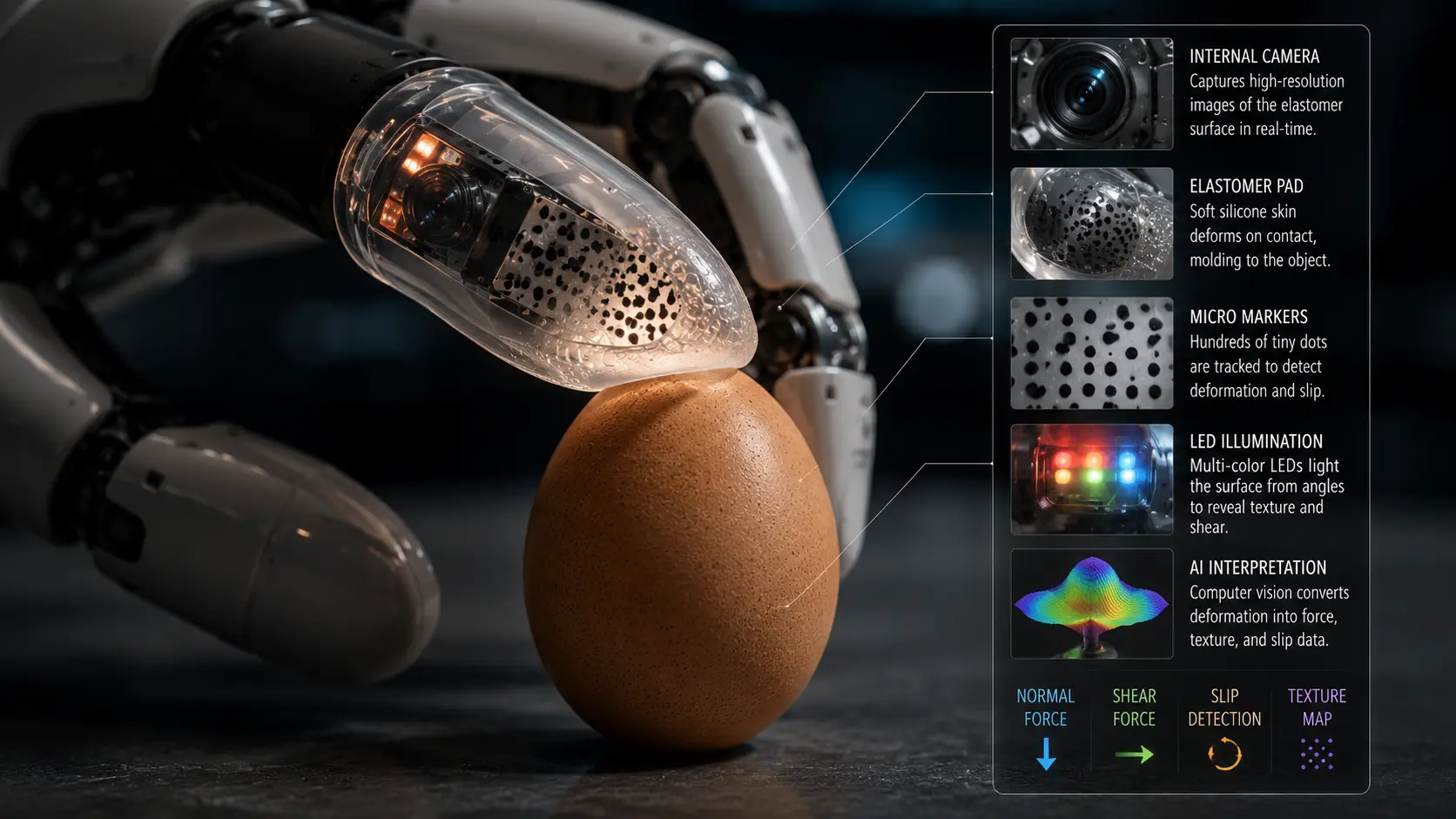
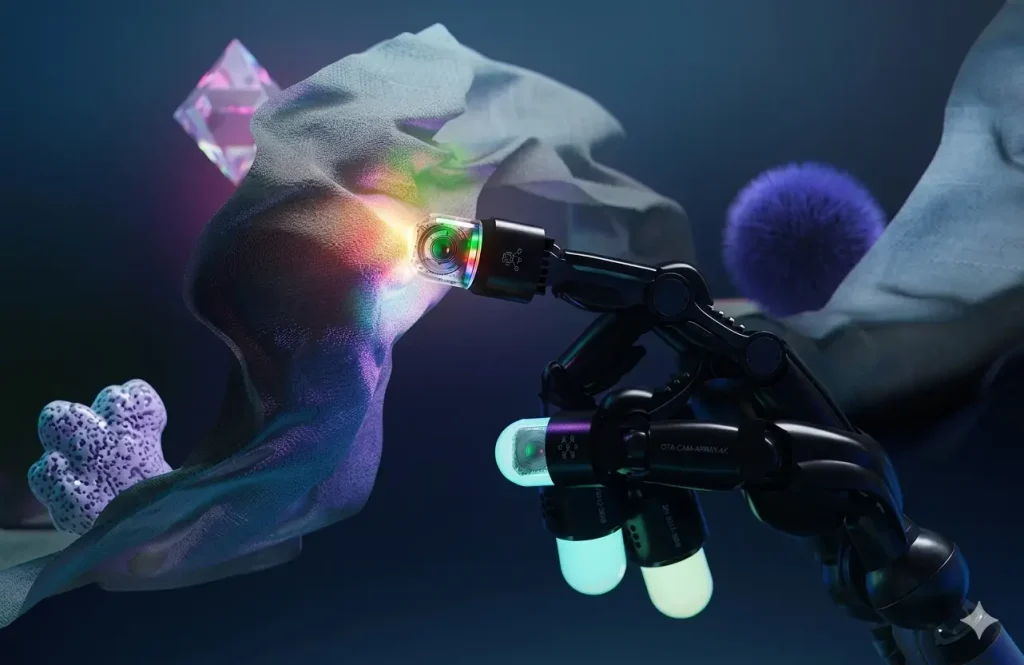
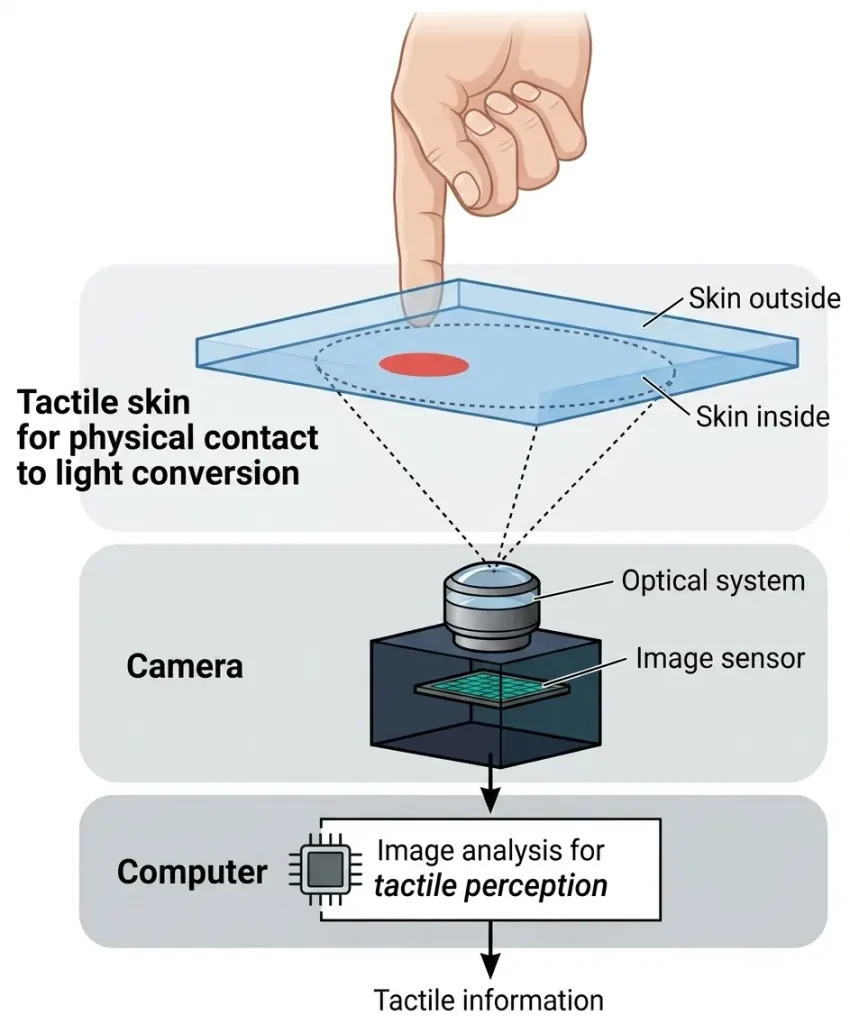
Elastomeric tactile sensors are robotic fingertips made of a soft, compliant silicone material equipped with an internal micro-camera and LED lighting. When the silicone presses against an object, it physically deforms. The internal camera tracks these microscopic deformations in real-time, translating the physical shape, texture, and shear force into high-resolution digital data.
At a Glance
- Concept: A robotic finger that is essentially a camera looking from the inside out, watching how its own “skin” stretches when it grabs something.
- Why it matters: It prevents robots from crushing or dropping objects. It allows them to feel if a glass of water is slipping from their grasp and instantly tighten their grip, just like a human reflex.
- Who uses it: Vanguard robotics labs (MIT, Stanford), humanoid developers (Figure, Tesla), and AI mega-corporations (Meta AI).
- Biggest takeaway: Because the sensor uses a camera, it turns the physical sensation of “touch” into a digital video file. This allows AI models that are already great at analyzing video to suddenly understand the physical world perfectly.
In Simple Words
If you close your eyes and pick up a coffee cup, you instantly know three things: how hard you are squeezing (pressure), if the cup is smooth or rough (texture), and if the cup is sliding out of your hand (shear force).
A traditional metal robot finger knows none of this.
An Elastomeric Tactile Sensor replicates this human ability using a clever optical trick. Imagine a hollow, clear plastic finger covered in a thick layer of soft, squishy silicone (like a gummy bear). The inside of this silicone is painted with hundreds of tiny black dots. Inside the hollow finger is a tiny camera looking at those dots.
When the robot grabs the coffee cup, the squishy silicone flattens against the cup. The camera watches the black dots move. If the dots spread apart, the robot knows it is pressing hard. If the dots start sliding downward, the robot knows the cup is slipping and it needs to squeeze harder. The robot is literally “watching” itself feel the object.
Why This Matters
For Robotics Engineers, AI Researchers, and Hardware VCs, elastomeric sensors solve the General-Purpose Manipulation Bottleneck.
For the past forty years, industrial robots succeeded because their environments were strictly controlled. A robotic arm in a car factory knows exactly where a heavy steel door is going to be down to the millimeter. General-purpose humanoid robots (designed to work in human homes, hospitals, and chaotic warehouses) do not have this luxury. They must interact with unpredictable, soft, and fragile objects.
Without high-resolution tactile feedback, a humanoid robot is commercially useless in a domestic setting. By providing millimeter-precise telemetry on shear forces and slip, elastomeric sensors bridge the gap between AI spatial reasoning and physical execution, unlocking the multi-trillion-dollar Total Addressable Market (TAM) for embodied AI in the service and healthcare sectors.
The Shift from Electrical to Optical Tactile Sensors
The integration of optical tactile sensors represents the convergence of materials science and computer vision.
Historically, engineers tried to give robots touch by wrapping their metal fingers in thousands of tiny, fragile electrical wires (capacitive or piezoresistive sensors). They broke easily, suffered from severe electrical noise, and were impossible to mass-produce.
Elastomeric optical sensors sidestep electrical engineering entirely. By utilizing the massive technological advancements in smartphone micro-cameras, they rely on cheap, indestructible lenses and software rather than fragile wiring. They transform the mechanical problem of “touch” into a software problem of “image processing,” which modern AI is uniquely built to dominate.
How Elastomeric Tactile Sensors Detect Incipient Slip
Translating the squish of a silicone pad into high-resolution, actionable robotic data requires a flawless marriage of optics, lighting, and neural networks. Here is the first-principles breakdown of the architecture.
1. The Fundamental Problem: Torque is Blind
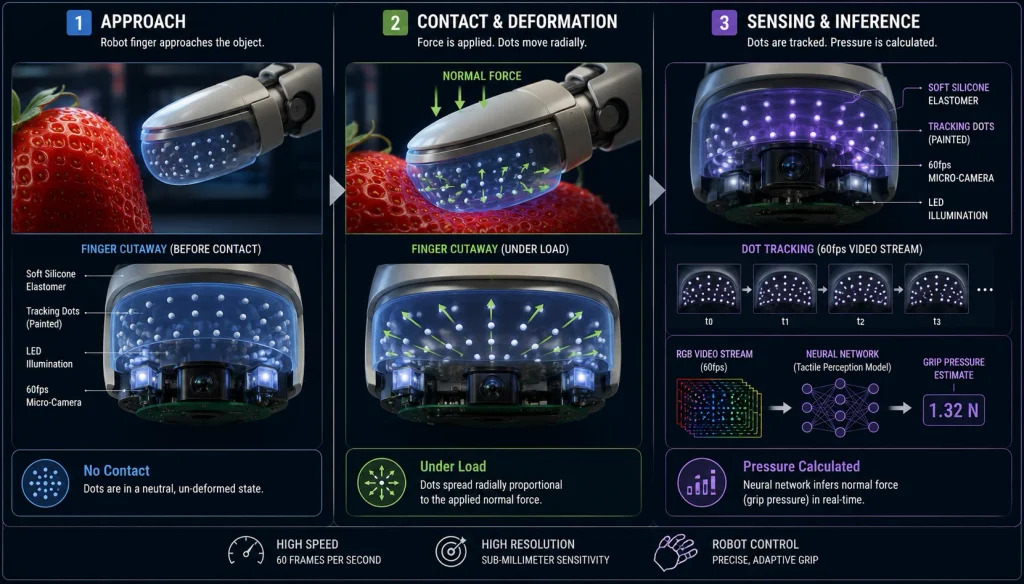
If a robot relies on the electrical current in its joint motors (torque) to gauge grip strength, it operates on a massive delay. By the time the motor registers enough resistance to realize it is holding a strawberry, the strawberry is already crushed. The robot requires immediate, localized surface data at the fingertip.
2. The Core Mechanism: The Elastomer Pad
The system begins with a highly engineered, compliant elastomer (usually a specialized silicone or polyurethane). This material is designed to mimic the exact physical compliance (squishiness) of human skin. The outer surface interfaces with the object, while the inner surface acts as a projection screen for the internal electronics.
3. Technical Depth: Directional LED Illumination
The internal geometry of the finger houses arrays of colored LEDs (often Red, Green, and Blue). These LEDs shine light onto the inner surface of the elastomer at very specific, extreme angles. When the elastomer is untouched, the light reflects uniformly. When the elastomer presses against a textured object (like the ridges of a coin or the bumps on a strawberry), the silicone physically molds into those ridges. The directional lighting hits these microscopic deformations and casts highly specific, colored shadows.
4. Technical Depth: Dot Tracking and Optical Flow
Beyond shadows, the inner layer is covered in a strict grid of microscopic tracking dots. A high-framerate micro-camera (recording at 60 to 120 fps) constantly watches this grid.
- Normal Force (Squeeze): When the robot presses inward, the camera sees the dots expand outward in a radial pattern.
- Shear Force (Friction): When the robot tries to twist a jar lid, the camera sees the entire grid of dots stretch and warp in a circular direction.
5. Real-World Consequences: Incipient Slip Detection
The true superpower of this system is detecting “incipient slip”—the microscopic sliding that occurs just before an object actually falls. Because the camera processes images at 120 frames per second, the AI can detect the tracking dots shifting by a fraction of a millimeter. The neural network recognizes this specific mathematical pattern as a slip, and fires a command to the robot’s hand to tighten its grip in less than 10 milliseconds, catching a falling glass before human eyes would even realize it dropped.
Commercial Robotics: GelSight, Meta DIGIT, and Humanoids
Elastomeric tactile sensors are transitioning from the lab bench into commercial robotic fleets, radically expanding operational capabilities.
Precision Manufacturing and Quality Control: In automotive and aerospace manufacturing, robots are tasked with inspecting the surface quality of machined parts. By pressing an elastomeric sensor against a piece of metal, the high-resolution camera maps the exact microscopic topography of the surface. It can detect invisible micro-fractures, burrs, or tooling errors with a resolution that rivals expensive, stationary laser interferometers, allowing robots to inspect parts while physically moving them down the assembly line.
Domestic Humanoid Robots: Companies like Figure and Tesla are aggressively pursuing general-purpose humanoids capable of folding laundry, washing dishes, and cooking. These tasks are impossible with rigid metal grippers. An elastomeric sensor allows a humanoid to grab a wet, soapy, slippery dish out of a sink. The internal camera instantly registers the lack of friction, calculates the exact shear force required to hold the plate, and adjusts the robot’s grip strength without cracking the ceramic.
Medical and Surgical Robotics: Telesurgery robots (like the da Vinci system) currently suffer from a lack of haptic feedback; the surgeon operating the joystick cannot actually “feel” the patient’s tissue. By equipping microscopic elastomeric sensors to the surgical pincers, the system can read the exact stiffness of a blood vessel or organ. It translates this data back to the surgeon’s joystick through force-feedback vibrations, allowing the surgeon to physically “feel” a hidden tumor beneath the tissue during a minimally invasive procedure.
Economic & Strategic Impact
The core strategic consequence of optical tactile sensing is The Rise of Vision-Language-Action (VLA) Models.
The current frontier of AI robotics is the VLA model (like Google’s RT-2). These models ingest visual data (what the robot sees) and language data (what the human tells the robot to do), and output an action (how the robot moves).
Historically, “touch” was a completely different data language, making it incredibly difficult to train an AI to understand it. Elastomeric sensors change the game because they format tactile data as images and video. The AI industry already possesses multi-billion-dollar supercomputers optimized explicitly for processing video (Convolutional Neural Networks and Vision Transformers). By turning touch into a video feed, robotics engineers can seamlessly plug tactile data directly into existing, massive AI models, instantly granting the AI an intuitive, holistic understanding of the physical world.
Advantages
- Extreme High-Resolution: Unlike traditional electrical pads that have a few dozen sensor points, an internal 1080p camera provides millions of individual data points, mapping topological textures down to the micron level.
- Immune to Electrical Interference: Because the actual sensing mechanism is purely optical (light bouncing off silicone), the sensor is completely immune to electromagnetic interference (EMI) generated by heavy industrial machinery or the robot’s own motors.
- Decoupled Durability: If a robot damages its fingertip, the expensive camera and LED array inside the finger remain perfectly safe. The operator simply unclips the torn, $5 piece of silicone and snaps on a new one, drastically lowering maintenance costs.
- Omnidirectional Force Detection: Tracks normal pressure, lateral shear, rotational torque, and slip simultaneously using a single camera feed, replacing what used to require four different, highly complex mechanical sensors.
Limitations
- Compute Latency: Streaming 60fps high-definition video from ten different robotic fingertips generates massive amounts of data. Processing this optical flow in real-time requires heavy, power-hungry GPUs mounted inside the robot. If the onboard computer lags by even 50 milliseconds, the robot will drop the object.
- Physical Bulk: You cannot shrink a camera lens and a focal length down to zero. The fingertip must be physically thick enough to house the camera, the LED array, and provide enough focal distance to see the elastomer. This makes optical tactile fingers noticeably bulkier than human fingers, restricting their ability to fit into extremely tight spaces.
- Silicone Degradation: While cheap to replace, the elastomeric pad degrades. Heavy industrial use, exposure to chemical solvents, or extreme heat causes the silicone to harden, yellow, or tear, warping the optical data and requiring constant recalibration of the AI model.
Common Misconceptions
Misconception: The robot has nerves in its fingers like a human.
Reality: The robot’s “skin” is just dead rubber. The actual “feeling” happens entirely through the camera lens hidden safely behind the rubber.
Misconception: These sensors are only for highly expensive, laboratory robots.
Reality: While early MIT GelSight prototypes were expensive, the core hardware consists of a cheap smartphone camera, a few LED lights, and a piece of silicone. The hardware is highly commoditized; the true value and complexity lie entirely in the AI software interpreting the images.
Misconception: The camera looks through the finger at the object.
Reality: The camera cannot see outside the finger. The inside of the silicone pad is opaque (often painted). The camera is only looking at the inside of the pad, reading how the rubber squishes and casts shadows when the outside touches an object.
What Most People Miss
The disruptive capability of Proprioceptive Shape Estimation.
When people think of touch, they think of the fingertip. What they miss is how tactile sensors allow a robot to understand the entire object it is holding, even parts it cannot see.
If a robot picks up a long, opaque metal pipe, its main optical cameras cannot see inside the pipe. However, the elastomeric sensors on its fingers map the exact microscopic curve and ridges of the metal. The AI uses this high-resolution tactile slice to instantly extrapolate and calculate the exact diameter, weight distribution, and center of gravity of the entire pipe. By feeling a single square inch of a surface, the AI achieves complete geometric awareness of the entire object, allowing it to swing, throw, or manipulate the item flawlessly.
Comparison Table
| Feature | Joint Torque Sensing | Piezoresistive (Electrical) Pads | Elastomeric Optical (GelSight) |
| Primary Mechanism | Motor current resistance | Electrical resistance via pressure | Internal camera tracking deformation |
| Spatial Resolution | Zero (Measures the whole arm) | Low (Dependent on wire grid) | Extreme (Millions of optical pixels) |
| Shear/Slip Detection | Very Poor | Moderate | Excellent (Direct visual tracking) |
| Data Format | 1D numerical value | 2D heat map | 3D Video / Image feed |
| Durability | High (Internal to motor) | Low (Wiring easily breaks) | High (Replaceable silicone cap) |
Case Study
Situation: As artificial intelligence companies rapidly scaled general-purpose humanoid robots, a massive hardware bottleneck emerged. AI models were successfully trained to instruct a robot to “Pick up the wine glass and hand it to the human.” However, when executing the command, the robot’s metal hands routinely shattered the glass. The robot’s primary cameras could see the glass, but the system had zero localized feedback regarding the friction coefficient of the glass surface.
Challenge: Develop a highly resilient, low-cost tactile sensor capable of delivering multi-axis force data and slip detection in a format that could be natively ingested by existing visual-processing AI supercomputers.
Solution (The Meta DIGIT Ecosystem): Researchers at Meta AI developed the DIGIT sensor, a compact, high-resolution elastomeric optical tactile sensor. They designed a compliant silicone elastomer illuminated by internal LEDs and captured by a miniaturized camera. Because DIGIT was designed for AI integration from the ground up, the tactile data was formatted as an RGB image stream.
Outcome: Meta open-sourced the DIGIT hardware designs and seamlessly integrated the sensors into robotic platforms like the Allegro Hand. Researchers demonstrated that by feeding the DIGIT optical streams directly into convolutional neural networks, the robots could autonomously learn to handle fragile objects, manipulate cables, and adjust grip strength in real-time based purely on the visual deformation of the internal elastomer.
Lessons Learned: The deployment validated that the most effective way to give AI a sense of touch is to translate tactile physics into optical data. By leveraging the existing, massive software infrastructure built for computer vision, optical tactile sensors proved to be the missing foundational layer required to unlock true embodied intelligence.
Future Outlook
Next 12–24 Months
The era of Multimodal VLA Integration. In the immediate term, tactile data will no longer be treated as a separate, secondary input. Major AI labs will release massive open-source datasets combining billions of video frames with synchronized elastomeric tactile data. Foundation models (like an upgraded GPT-4V or Gemini) will be trained natively on this multimodal data. When a user asks an AI, “Does this fabric feel soft?”, the AI will have a mathematical, structural understanding of softness derived from thousands of hours of optical tactile training.
Next 3–5 Years
The scaling of Neuromorphic Tactile Processing. The primary barrier to placing these cameras on every robot joint is computing power. Over the next five years, the industry will pivot to “Event-Based” or Neuromorphic cameras inside the fingertips. Instead of recording 60 full frames per second, these bio-inspired cameras only record the pixels that change (e.g., the exact moment the silicone starts to slip). This drops the data bandwidth by 99%, allowing a humanoid robot to cover its entire body in optical tactile sensors without overwhelming its internal processors.
Next 10 Years
The Haptic Telepresence Economy. By the mid-2030s, elastomeric sensors will drive a massive leap in remote work. A specialized worker (like a bomb disposal expert, a deep-sea welder, or an elite surgeon) will wear a haptic glove in New York. A humanoid robot thousands of miles away will execute the task. The robot’s elastomeric fingertips will read the exact microscopic texture and shear force of the object, and transmit that data back to the human’s glove in milliseconds. The human operator will literally feel the rust on a submerged pipe or the tension of a surgical suture from across the globe, dissolving the geographical constraints of physical labor.
Most Likely Scenario
Elastomeric tactile sensors are the definitive solution to the robotic manipulation crisis. The human hand is an evolutionary marvel, and attempting to replicate it with wires and electrical grids has consistently failed. By utilizing the brutal efficiency of smartphone cameras, LEDs, and squishy silicone, engineers have created a scalable, resilient, and AI-native sense of touch. As the cost of manufacturing plummets, optical tactile fingertips will become as standard and necessary on a robot as its primary visual cameras, securing the final sensory link required for true robotic autonomy.
Key Takeaways
- Robots with excellent cameras still crush fragile objects or drop slippery items because they cannot physically feel what they are holding.
- Elastomeric tactile sensors solve this by acting as squishy, high-tech robot skin. A piece of soft silicone presses against an object and molds to its shape.
- Instead of fragile electrical wires, a tiny camera and LED lights hidden inside the robot finger record exactly how the inside of the silicone stretches and warps.
- By tracking tiny painted dots inside the silicone, the robot’s AI can instantly calculate how hard it is squeezing, the texture of the object, and exactly when an object begins to slip.
- Because the sensor uses a camera, it turns physical touch into a video file. This is perfect for modern AI, which is already highly optimized for analyzing video feeds.
- This breakthrough allows robots to handle delicate tasks—from picking up a raw egg to assisting in surgery—safely and autonomously.
Glossary
Elastomer: A polymer with highly elastic properties (like rubber or silicone). It is the squishy outer “skin” of the tactile sensor that physically deforms when touching an object.
Incipient Slip: The critical micro-moment when an object just begins to slide out of a grasp, milliseconds before it actually falls. Elastomeric sensors excel at detecting this to trigger auto-grip reflexes.
Normal Force: The direct, straight-on pressure applied to an object (how hard you are squeezing it).
Optical Tactile Sensor: The broader category of sensors (like GelSight or DIGIT) that use cameras and light to measure physical touch, rather than relying on electrical resistance.
Shear Force: The sliding or twisting force acting parallel to a surface (e.g., the friction created when trying to unscrew a tight lid).
Vision-Language-Action (VLA) Model: An advanced artificial intelligence model that takes in images (Vision) and text (Language) to output physical robotic movements (Action).
Sources
MIT News: GelSight: High-Resolution Robot Touch
Meta AI Research: DIGIT: A Novel Design for a Low-Cost Compact High-Resolution Tactile Sensor
IEEE Robotics and Automation Letters: Optical Tactile Sensors for Robotic Manipulation
Stanford Artificial Intelligence Laboratory (SAIL): Integrating Tactile Feedback into Vision-Action Models
Nature Machine Intelligence: The future of robotic touch and haptic telepresence