Advertisement
)
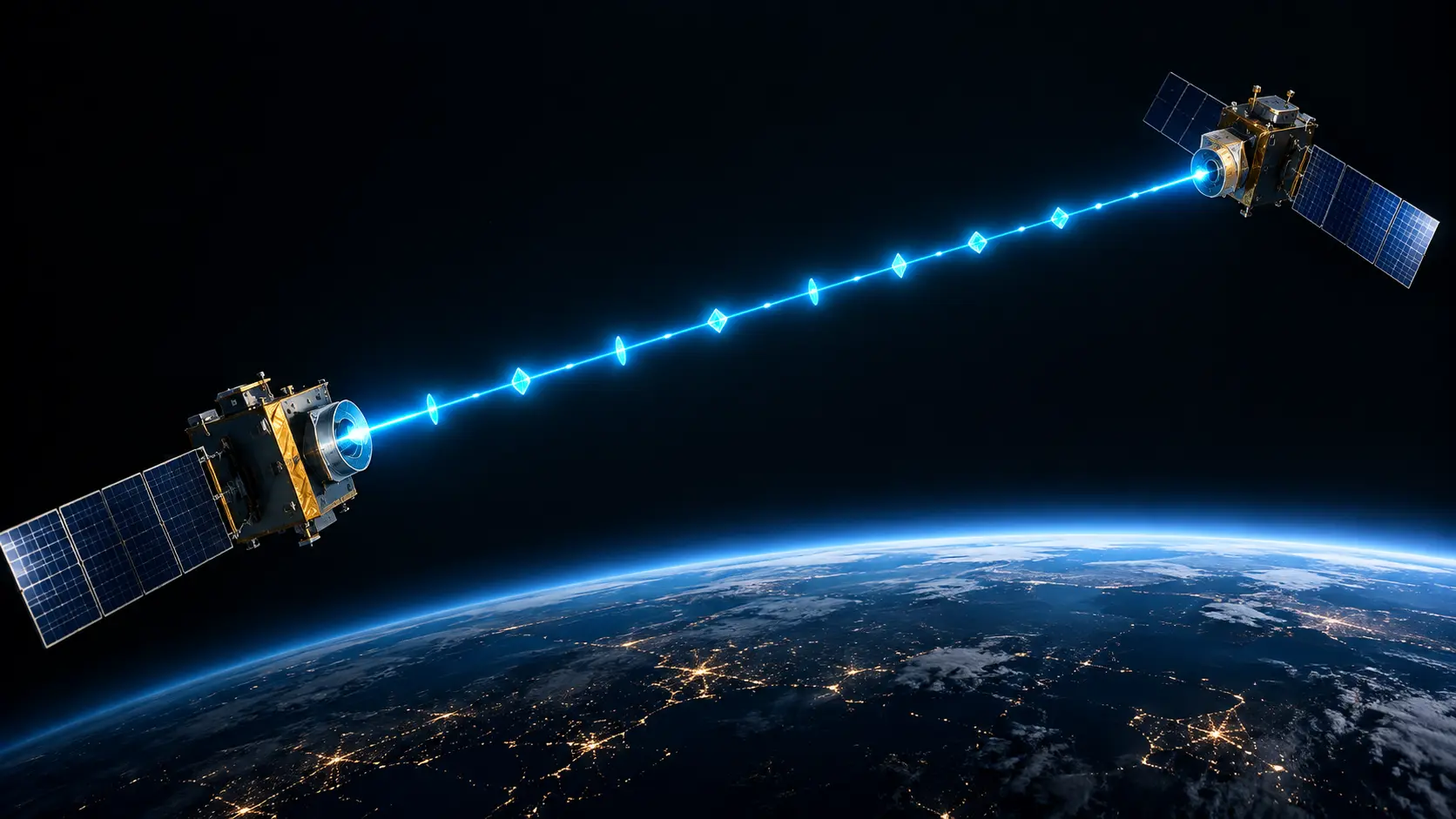

In less than a decade, the mathematical foundation protecting the global internet will collapse. Every classified military transmission, SWIFT banking transfer, and encrypted intelligence file currently circulating on the global web relies on asymmetric encryption—a mathematical puzzle that takes classical computers thousands of years to solve. But quantum computers do not think classically. Using Shor’s algorithm, a sufficiently powerful quantum computer will shatter these encryption standards in seconds. This “Store Now, Decrypt Later” threat means adversaries are already harvesting vast oceans of encrypted global data, patiently waiting for the hardware to catch up.
Why should you care right now? Because the ultimate defense against a quantum computer is not better math; it is the fundamental physics of the universe. To preempt the impending cryptography apocalypse, global superpowers are launching constellations of low Earth orbit (LEO) satellites designed to transmit encryption keys using single particles of light. By beaming polarized photons across the vacuum of space, inter-satellite Quantum Key Distribution (QKD) physically guarantees that any attempt to intercept the data alters the light itself, destroying the key and alerting the sender. This establishes a truly unhackable orbital mesh network.
What is Inter-Satellite Quantum Key Distribution (QKD)?
Inter-Satellite Quantum Key Distribution (QKD) is a cryptographic communication method that uses the quantum properties of individual photons to exchange secure encryption keys between spacecraft. By relying on the laws of physics rather than computational algorithms, it establishes unhackable optical mesh networks immune to future quantum computer attacks.
At a Glance
- Concept: Beaming single particles of light between satellites to securely exchange the passwords needed to encrypt the internet.
- Why it matters: If an enemy tries to intercept the transmission, the laws of quantum mechanics cause the light particle to physically change, immediately exposing the hacker.
- Who uses it: State-backed aerospace consortiums, intelligence agencies, and defense programs like the European Space Agency’s EAGLE-1 and China’s Micius initiative.
- Biggest takeaway: Fiber optic cables absorb light over long distances, making global terrestrial quantum networks impossible without unproven quantum repeaters. The vacuum of space allows photons to travel thousands of miles perfectly untouched.
In Simple Words
Imagine you want to send a secret code to a friend, but you know a spy is reading your mail.
Normally, you would lock the code in a strong safe (standard encryption) and hope the spy doesn’t have a good enough lockpick. But quantum computers are the ultimate lockpicks; eventually, they will open every safe.
Quantum Key Distribution (QKD) doesn’t use a safe. Instead, it writes the secret code onto a fragile soap bubble. If the spy tries to read the code, they have to touch the bubble. The instant they touch it, the bubble pops. When your friend receives a popped bubble, they immediately know the spy is listening, so they throw the code away. If the bubble arrives perfectly intact, your friend knows with absolute physical certainty that no one intercepted it. QKD satellites do this by using individual particles of light (photons) as the soap bubbles, beaming them flawlessly through outer space.
Why This Matters
For Cryptographers, Telecom Execs, and Defense Analysts, Inter-Satellite QKD solves the Fiber Optic Attenuation Wall.
Quantum states are incredibly fragile. You cannot copy or amplify a quantum photon because of the “no-cloning theorem” of quantum mechanics. In a traditional fiber optic cable on Earth, the glass absorbs and scatters the light. After roughly 100 to 200 kilometers, the single photons are lost completely. To build a global network, telecom executives would need “quantum repeaters” to boost the signal, but reliable quantum repeaters do not yet exist at commercial scale.
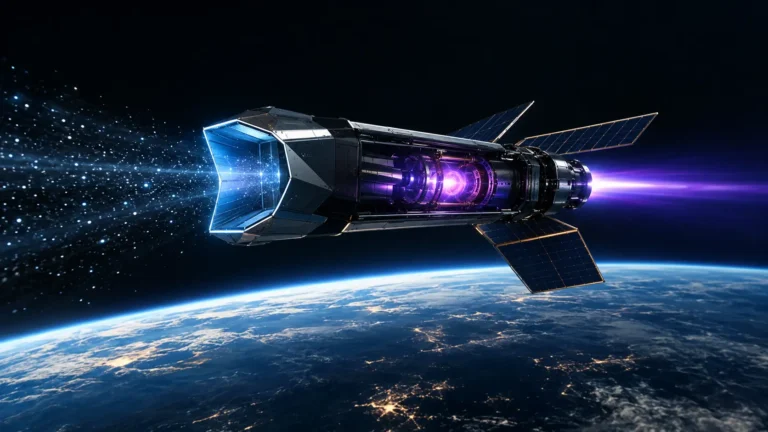
Outer space has no glass and no air. It is a vacuum. By moving the network into Low Earth Orbit (LEO), optical inter-satellite links (OISL) can shoot a single photon thousands of kilometers without it hitting a single atom. Satellites act as “trusted nodes,” receiving the key from one continent and physically carrying it across the globe before beaming it down to another continent, bypassing the terrestrial fiber wall entirely and making global quantum networking an immediate reality.
The Shift to Optical Inter-Satellite Links (OISL)
We are witnessing the militarization of Optical Free-Space Networks.
For decades, satellite communication relied on broad, messy Radio Frequency (RF) waves that sprayed data across entire hemispheres, allowing anyone with an antenna to passively collect it.
Inter-satellite QKD forces a shift to highly directional laser communications. To send a single photon from a satellite moving 17,000 miles per hour to another satellite 2,000 miles away requires Pointing, Acquisition, and Tracking (PAT) systems of staggering precision—equivalent to hitting a dime with a laser pointer from across a continent. This orbital mesh creates a closed-loop, highly centralized nervous system for military command and control, physically insulating superpower communications from both signal jamming and algorithmic decryption.
How Quantum Key Distribution (QKD) Works
Encoding data onto a single subatomic particle and guaranteeing its safety requires weaponizing the strangest quirks of theoretical physics. Here is the first-principles breakdown of the architecture.
1. The Fundamental Problem: The Impending Quantum Threat
Standard encryption uses math problems (like factoring large prime numbers) that are too hard for current computers to solve. Quantum computers, utilizing superposition, can solve these specific problems exponentially faster. Once a sovereign adversary builds a stable, fault-tolerant quantum computer, every mathematically encrypted database becomes transparent.
2. The Core Mechanism: Photon Polarization (BB84 Protocol)
To escape math, we use physics. The standard QKD protocol is BB84. A satellite generates a single photon (a particle of light). It passes this photon through a filter to “polarize” it, altering the angle at which the light wave vibrates (e.g., vertical, horizontal, or diagonal). The sender uses these angles to represent digital 1s and 0s.
3. Technical Depth: The Heisenberg Uncertainty Principle
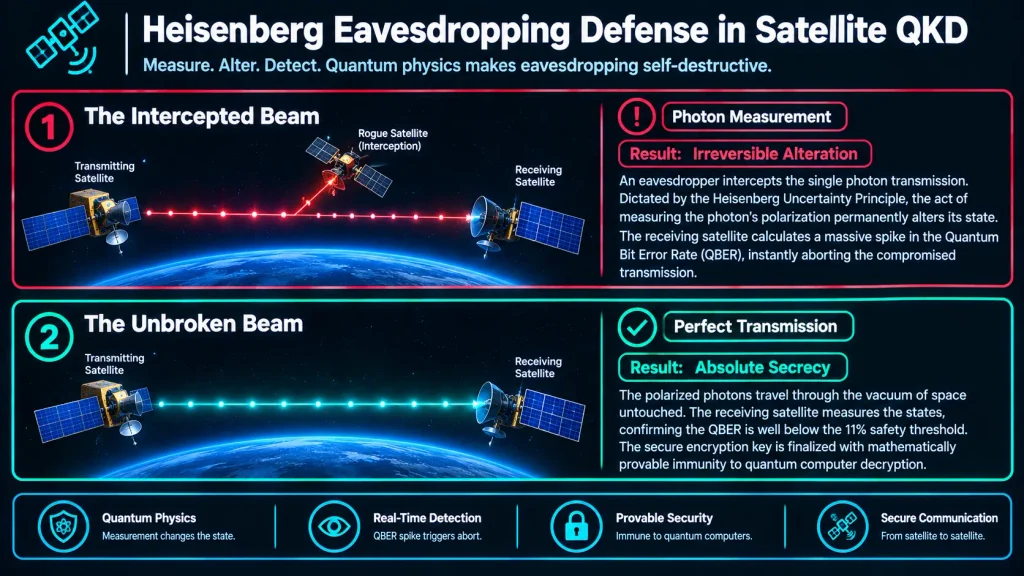
The photon is beamed to a receiving satellite. If an eavesdropper (let’s call them “Eve”) intercepts the photon in mid-air to steal the 1 or 0, she faces a physical roadblock. According to the Heisenberg Uncertainty Principle, the mere act of measuring a quantum state irreversibly alters it. When Eve reads the photon’s angle, she accidentally changes the angle.
Micro-Insight: The eavesdropper leaves a physical fingerprint on the light itself. The act of observation is an act of destruction.
4. Technical Depth: The Decoy-State Defense
In the real world, lasers are imperfect; they sometimes accidentally fire two photons instead of one. If Eve sees two identical photons, she could steal one and let the other pass untouched (a Photon-Number-Splitting attack), bypassing the Heisenberg trap. To defeat this, engineers invented the Decoy-State Protocol. The satellite randomly mixes deliberately weak “decoy” pulses into the laser stream. If Eve attempts to siphon photons, she disrupts the statistical ratio of the decoys, instantly triggering alarms.
5. Real-World Consequences: Quantum Bit Error Rate (QBER)
The receiving satellite constantly measures the Quantum Bit Error Rate (QBER). If the QBER is low (e.g., under 11%), the system mathematically proves that no one intercepted the transmission, and the key is safe to use. If the QBER spikes above the safety threshold, the system knows Eve is listening. The satellites immediately throw the compromised key away and generate a new one, ensuring the final encryption key is 100% perfectly secure.
Decoy-State QKD Simulator
Inter-Satellite Quantum Key Distribution & BB84 Eavesdropping Detection
Inter-Satellite Distance
1,000 km
100 km
5,000 km
Eavesdropper (Eve) Presence
Quantum Bit Error Rate (QBER)
0.0 %
Secure Key Rate
0 kbps
Network Integrity
STANDBY
ORBITAL MESH: OPTICAL INTER-SATELLITE LINK (OISL)
LASER LINK INACTIVE
TELEMETRY: QBER SPY DETECTION & KEY RATE
Commercial Satellite QKD Missions
Satellite QKD is shifting rapidly from academic proof-of-concept to sovereign infrastructure.
The Micius Satellite (China): Launched in 2016, Micius was the world’s first dedicated quantum science satellite. It successfully demonstrated QKD between space and ground stations separated by 1,200 kilometers, establishing a secure key between Beijing and Vienna. Micius proved that the delicate polarization of a photon survives the brutal turbulence of passing through the Earth’s atmosphere, officially kicking off the orbital quantum arms race.
The EAGLE-1 Mission (Europe): Backed by the European Space Agency (ESA) and targeting a 2025/2026 launch, EAGLE-1 is Europe’s answer to sovereign data security.Unlike early scientific satellites, EAGLE-1 is an end-to-end commercial validation system designed to integrate directly with the EuroQCI (European Quantum Communication Infrastructure).It will prove the viability of delivering keys to portable ground stations, paving the way for a fully sovereign, unbreakable European network.
Submarine Communications (Quantum Entanglement): Advanced research is investigating the use of Spontaneous Parametric Down-Conversion (SPDC) on satellites to create entangled photon pairs. If a satellite beams one entangled photon to a naval headquarters and the other to a surfaced nuclear submarine, the two locations share a perfectly correlated cryptographic key instantly, without the satellite itself ever knowing the key (an entanglement-based protocol).
Economic & Strategic Impact
The core strategic consequence of satellite QKD is the Bifurcation of the Global Internet.
Currently, the world relies on shared, open mathematical standards (like TLS and RSA) to secure data. The transition to quantum-safe communications will shatter this uniformity. Nations that successfully deploy dense orbital QKD meshes will possess impenetrable, closed-loop sovereign intranets for their financial and defense sectors.
Nations lacking space launch capabilities or advanced photonics infrastructure will be forced to lease quantum keys from allied superpowers, transforming cryptographic security from a free mathematical algorithm into a highly lucrative, geopolitical commodity sold by space-faring nations.
Advantages
- Information-Theoretic Security: Offers absolute, provable secrecy based on the laws of physics, rendering future advancements in quantum computing entirely irrelevant.
- Bypasses Fiber Attenuation: The vacuum of space allows photons to travel vastly further than in terrestrial fiber optics, unlocking intercontinental secure links.
- Tamper-Evident Design: The QBER metric guarantees that operators will instantly know if an adversary attempts to tap the line, preventing silent data harvesting.
- Decoy-State Resilience: Modern protocols completely neutralize the risk of hardware imperfections (multi-photon emissions), securing the system against real-world engineering flaws.
Limitations
- Atmospheric Turbulence: While the vacuum of space is perfect, transmitting the final key down to a ground station requires punching through clouds, smog, and atmospheric scintillation, which severely degrades the photon beam and drops the key rate.
- Low Bit Rates: Current satellite QKD systems generate secure keys at rates of a few kilobits per second. This is fast enough to encrypt a text file or update a master password, but vastly too slow to natively encrypt high-bandwidth video streams.
- Daylight Blindness: Solar radiation floods the atmosphere with rogue photons. Most current ground stations can only establish stable QKD links with satellites at night, limiting network availability.
Takeaway: QKD is not a new way to send high-speed data; it is a highly specialized pipeline used exclusively to send the passwords that protect the high-speed data.
Common Misconceptions
Misconception: QKD satellites use quantum entanglement to transmit data faster than the speed of light.
Reality: QKD does not transmit actual data or messages, and it does not break the speed of light. It only generates random strings of 1s and 0s (encryption keys) that are later used by classical computers to encrypt standard internet traffic.
Misconception: QKD is the only way to survive the quantum computing threat.
Reality: The software industry is concurrently developing Post-Quantum Cryptography (PQC)—new mathematical algorithms that are highly resistant to quantum computers. PQC is cheaper and software-based, but mathematically theoretical. QKD is hardware-based, expensive, but physically absolute. Both will be used in tandem.
Misconception: The satellite stores the keys, meaning the satellite itself can be hacked.
Reality: In “trusted node” architectures, the satellite briefly holds the key, which is a vulnerability. However, in advanced entanglement-based routing, the satellite only generates and distributes the photons; the key is generated purely at the endpoints, meaning even if the satellite is hijacked, the hacker cannot read the key.
What Most People Miss
The disruptive capability of Optical Inter-Satellite Links (OISL).
When analysts evaluate satellite QKD, they obsess over the space-to-ground link. What they miss is the horizontal architecture happening in orbit.
The ultimate vision is a constellation of hundreds of LEO satellites utilizing laser-based OISLs. Instead of beaming a key to the ground, Satellite A beams a key to Satellite B, which bounces it to Satellite C, creating an unbroken mesh of secure quantum routing thousands of miles above the Earth. This optical mesh bypasses the atmosphere entirely until the very last mile, dramatically reducing photon loss and enabling a continuous, global, 24/7 unhackable backbone for the military-industrial complex.
Comparison Table
| Metric | RSA / ECC (Current Standard) | Post-Quantum Cryptography (PQC) | Satellite QKD (BB84 / Decoy State) |
| Security Basis | Computational Math (Weak to Quantum) | Advanced Math (Resistant to Quantum) | Laws of Physics (Information-Theoretic) |
| Infrastructure Required | None (Software update) | None (Software update) | Dedicated Satellites, Lasers, Optics |
| Eavesdropping Detection | None (Silent harvesting) | None (Silent harvesting) | Absolute (Physical alteration of photon) |
| Transmission Range | Infinite (Terrestrial internet) | Infinite (Terrestrial internet) | Global (via Space Vacuum / Trusted Nodes) |
| Implementation Cost | Very Low | Low | Extremely High |
Future Outlook
Next 12–24 Months
The era of Commercial LEO Demonstrations. Through 2026, the focus will be heavily on Europe’s EAGLE-1 and private commercial startups launching micro-satellites equipped with miniaturized quantum payloads. The goal is to prove that Pointing, Acquisition, and Tracking (PAT) laser hardware can be shrunk to fit on cheap cubesats, drastically lowering the barrier to entry for space-based quantum networking.
Next 3–5 Years
The scaling of Daylight Filtering and Continuous Operations. To make QKD commercially viable, satellites must be able to distribute keys during the day. Aerospace engineers will deploy advanced spatial, spectral, and temporal filtering algorithms to suppress background solar radiation, allowing ground stations to extract the single signal photon out of the blinding glare of the sun, unlocking 24/7 key generation.
Next 10 Years
The Global Entanglement Mesh. By the 2030s, the “trusted node” vulnerability will be engineered out of the system. Satellite constellations will rely entirely on Spontaneous Parametric Down-Conversion (SPDC) to act as pure entanglement distributors. Because the satellites never measure the photons, they never hold the keys. This will result in an unhackable, decentralized global mesh network where governments can share unbreakable one-time pads instantly, permanently neutralizing the threat of quantum decryption.
Most Likely Scenario
Inter-Satellite Quantum Key Distribution represents the ultimate physical fortification of global data. While Post-Quantum Cryptography (PQC) algorithms will secure everyday consumer web traffic, the extreme cost and complexity of QKD guarantee it will be reserved for high-stakes intelligence, central banking, and nuclear command and control. As launch costs plummet, optical orbital meshes will inevitably form the unassailable backbone of sovereign security architectures in the 21st century.
Key Takeaways
- Standard encryption relies on math puzzles that future quantum computers will easily solve, threatening all global secure communications.
- Quantum Key Distribution (QKD) solves this by using single particles of light (photons) to transmit encryption keys.
- The laws of physics dictate that measuring a quantum particle alters it. If a hacker intercepts the photon in mid-air, the photon physically changes, instantly alerting the system to the hack.
- Because standard fiber optic cables absorb photons over long distances, superpowers are using satellites to beam the photons flawlessly through the vacuum of space.
- By networking these satellites together using precise lasers, militaries are creating a global, unhackable internet dedicated exclusively to securing the world’s most sensitive data.
Glossary
Asymmetric Encryption: The current standard for securing the internet (like RSA), relying on math problems that classical computers cannot solve but quantum computers can.
BB84 Protocol: The original set of rules for quantum cryptography, using the polarization angles of photons to securely transmit 1s and 0s.
Decoy-State Protocol: A security upgrade that mixes deliberately weak photon pulses into the transmission to detect and block hackers trying to steal multi-photon laser errors.
Optical Inter-Satellite Link (OISL): The use of highly precise lasers to beam data (or photons) directly from one satellite to another in outer space, forming an orbital mesh network.
Photon-Number-Splitting (PNS) Attack: A theoretical hack where an eavesdropper notices a laser accidentally fired two identical photons, steals one, and lets the other pass undetected.
Quantum Bit Error Rate (QBER): The metric used to determine if a transmission is safe. If the error rate spikes, it mathematically proves a hacker is tampering with the photons.
Sources
European Space Agency (ESA): EAGLE-1: Europe’s First Satellite Quantum Key Distribution System
German Aerospace Center (DLR): Building Europe’s First Space-Based Quantum Key Infrastructure
Nature / Science: Micius Satellite and Space-to-Ground Quantum Communications
ArXiv Physics: Decoy-State BB84 Quantum Key Distribution Over Free Space and Satellite Links
SES / EuroQCI: Next-Generation Quantum Communication Infrastructures