Advertisement
)


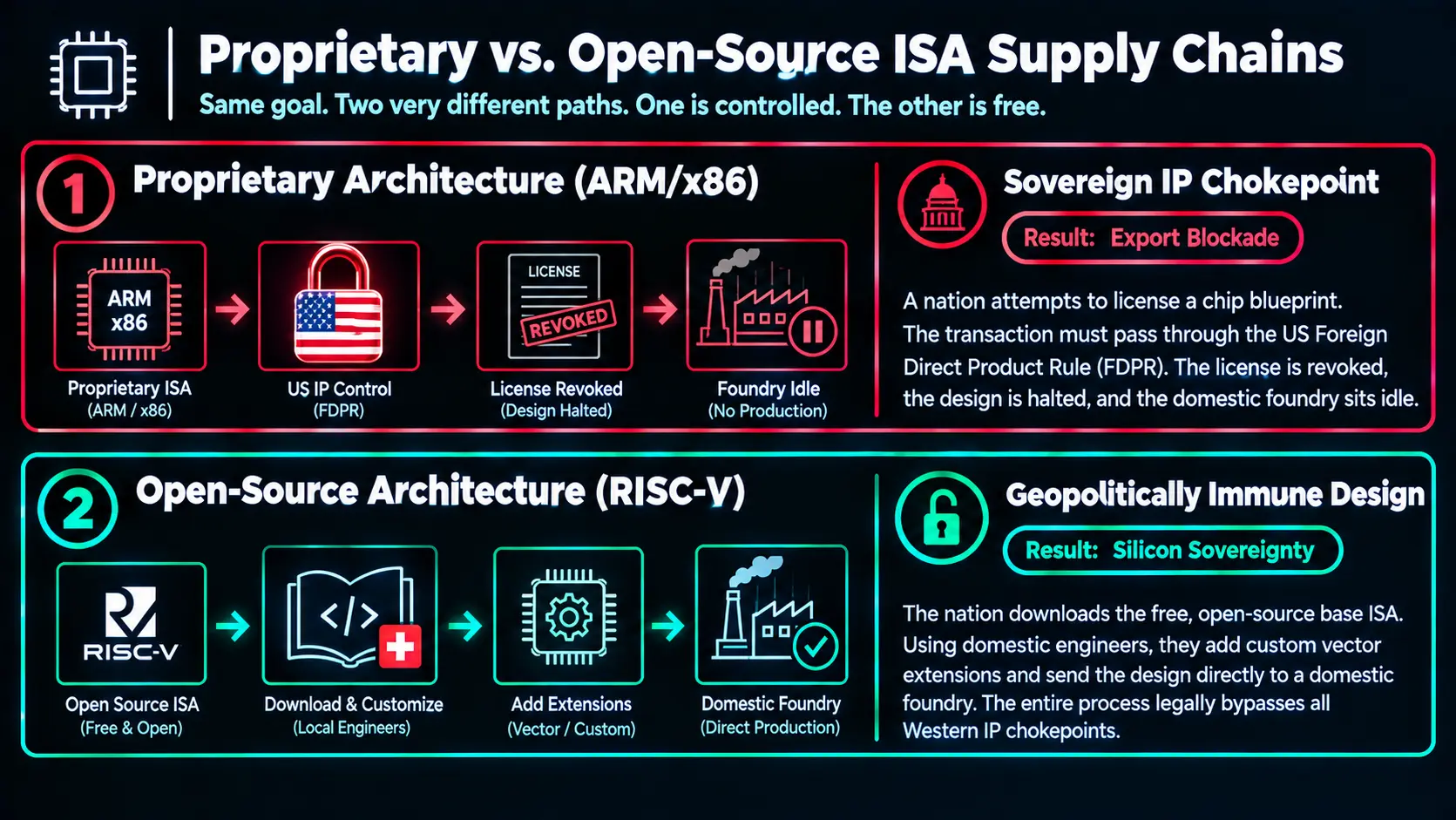
If a nation wants to build a modern smartphone, a fifth-generation fighter jet, or a sovereign artificial intelligence data center, it must pay a toll to Western intellectual property. The fundamental language of all global microchips is dominated by two proprietary architectures: x86 (US-controlled) and ARM (UK-controlled). By owning these blueprints, the United States holds a geopolitical kill-switch. When Washington wants to paralyze an adversarial economy or stall a rival’s military modernization, it simply revokes the license.
Why should you care right now? Because that ultimate geopolitical leverage is evaporating. A completely free, open-source chip architecture called RISC-V has emerged, and it is reshaping global power dynamics. With RISC-V, engineers in Beijing, Moscow, or Tehran can legally download the blueprints for advanced microprocessors without asking for Western permission, paying millions in royalties, or fearing sudden trade sanctions. This marks the definitive end of absolute US semiconductor hegemony and the birth of a bifurcated, unblockable global silicon supply chain.
What is RISC-V Geopolitics?
RISC-V geopolitics is the strategic competition surrounding the adoption of the open-source RISC-V Instruction Set Architecture (ISA). Because RISC-V is royalty-free and not controlled by any single nation, it enables countries to build advanced microchips and bypass Western semiconductor export controls, threatening historic US and European monopolies over technology hardware.
At a Glance
- Concept: The “Linux of microchips”—a free, community-built blueprint for designing semiconductors.
- Why it matters: It removes the United States’ ability to weaponize intellectual property. You cannot sanction an open-source PDF downloaded from a Swiss server.
- Who uses it: Chinese state-backed tech giants (Alibaba, Huawei), European automakers seeking supply chain independence, and agile AI hardware startups.
- Biggest takeaway: The chip war is no longer just about who can manufacture the smallest transistors; it is a legal and geopolitical battle over who controls the fundamental language the chip speaks.
In Simple Words
A microchip is like a kitchen, and the software running on it is a chef. For the chef to use the kitchen, they need a common language to identify the tools—”give me the knife,” “turn on the stove.” In computing, this language is called an Instruction Set Architecture (ISA).
For decades, if you wanted to build a kitchen (a chip), you had to rent the language dictionary from ARM or Intel. If you made them angry, they took the dictionary away, and your chef couldn’t cook. Your multi-billion-dollar chip factory became useless overnight.
RISC-V is a completely free, open-source dictionary. Anyone on Earth can download it, build a kitchen to match it, and tell the chef how to cook. Because nobody owns it, nobody can take it away. It grants absolute “silicon sovereignty” to anyone willing to build the hardware.
Why This Matters
For Semiconductor Analysts, Trade Lawyers, and Geopolitical Strategists, RISC-V solves the Sovereign IP Chokepoint.
In recent years, the US Department of Commerce has aggressively wielded the Foreign Direct Product Rule (FDPR). This trade mechanism dictates that if a product uses even a fraction of US-origin technology or IP, the US government can dictate who buys it. This allowed the US to effectively cripple Chinese tech giants like Huawei by barring them from licensing the UK-based ARM architecture (which contains US tech).
RISC-V structurally bypasses the FDPR. It is an open standard, not a proprietary product. Maintained by a non-profit foundation in Switzerland, RISC-V provides the baseline instructions to build a chip. A Chinese fabless semiconductor company can download the RISC-V standard, design a custom core around it entirely in-house, and manufacture it at a domestic foundry like SMIC. Zero US intellectual property is involved. The US government loses jurisdiction, and the export blockade fails.
The Linuxification of Semiconductor Hardware
We are witnessing the Linuxification of Hardware.
Twenty-five years ago, Microsoft’s Windows dominated the software world, operating as a closed, proprietary monopoly. Then came Linux—an open-source, community-driven operating system that was initially dismissed by elites but eventually grew to power the entire modern internet, smartphones (Android), and global supercomputers.
RISC-V is doing to silicon hardware exactly what Linux did to software. By commoditizing the fundamental architecture, value shifts away from the design blueprint and moves up the stack to custom implementation and software optimization. It turns silicon design from an exclusive, highly guarded country club into an open-source collaborative ecosystem.
How RISC-V Bypasses Proprietary ISA Blockades
Escaping a proprietary monopoly requires stripping technology down to its absolute mathematical basics. Here is the first-principles breakdown of the architecture.
1. The Fundamental Problem: ISA Bloat and Licensing
Proprietary ISAs like x86 have been building upon themselves for 40 years. To remain backwards-compatible with old software, x86 requires chips to carry thousands of legacy instructions, making them massive, hot, and power-hungry. Worse, to legally design a chip using these complex ISAs, companies must pay tens of millions of dollars in upfront licensing fees and per-chip royalties.
2. The Core Mechanism: Reduced Instruction Set Computer (RISC)
RISC-V was born at UC Berkeley. The “V” stands for the fifth generation of the Reduced Instruction Set Computer philosophy. Instead of thousands of complex instructions, the mandatory “base” of RISC-V consists of fewer than 50 ultra-simple, fundamental mathematical instructions. It is incredibly small, incredibly clean, and totally free.
3. Technical Depth: Modular Extensions
If a chip only has 50 basic instructions, it cannot run a modern AI workload. This is where RISC-V’s brilliance lies: Modularity.
Instead of forcing every chip to carry every instruction, RISC-V offers standard “extensions” (like puzzle pieces). If you are building a simple smartwatch, you use the base 50 instructions. If you are building an AI data center chip, you snap on the “Vector Math Extension” (the “V” extension) and the “Bit-Manipulation Extension.”
Micro-Insight: Proprietary ISAs are like buying a 500-piece Swiss Army Knife when you only need a screwdriver. RISC-V lets you start with just a screwdriver and bolt on exactly the tools you need, minimizing silicon area, reducing power consumption, and lowering costs.
4. Technical Depth: The Risk of Fragmentation
Because anyone can modify RISC-V, a Chinese company could add a custom extension that an American company doesn’t use. If this happens too much, software written for the American chip won’t run on the Chinese chip. This is called “fragmentation.” To prevent RISC-V from shattering into a hundred incompatible dialects, RISC-V International tightly manages “profiles”—standardized groupings of extensions that guarantee software compatibility across different manufacturers.
5. Real-World Consequences: The Custom AI Silicon Boom
AI requires highly specialized math (like matrix multiplication). With ARM, you are mostly stuck with the core they sell you. With RISC-V, agile startups can take the free base architecture, deeply customize the vector extensions specifically for neural networks, and beat legacy tech giants to market. This is why Jim Keller’s Tenstorrent and Google’s internal TPU teams are heavily leaning into RISC-V for AI hardware.
RISC-V Geopolitical Immunity Simulator
Bypassing Proprietary Supply Chain Chokepoints and Export Embargoes
Geopolitical Tension Level
Low (20%)
Peaceful Trade
Full Embargo (>70%)
Instruction Set Architecture (ISA)
Proprietary (ARM/x86)
Open-Source (RISC-V)
IP Licensing Cost
$60.0 M
Export Blockade Risk
20%
Design Flow Status
NOMINAL
IP Acquisition to Domestic Foundry Routing
Licensing Cost vs. Export Risk Over Time
Global Adoption and Silicon Sovereignty
The adoption of RISC-V is accelerating wildly, transitioning from academic experiments to national security imperatives.
Chinese Silicon Sovereignty: China is the undisputed leader in aggressive RISC-V adoption. Entities like Alibaba’s T-Head have released high-performance RISC-V processors (like the XuanTie 910) and open-sourced the designs to build a domestic ecosystem. By 2026, over 50% of all global RISC-V chips are expected to be manufactured in China. For Beijing, RISC-V is the ultimate insurance policy against US technology embargoes.
European Automotive Resilience: The EU watched the 2021 semiconductor shortage cripple its automotive sector (Volkswagen, BMW). Realizing they were overly dependent on foreign IP, a consortium of major European chipmakers (Bosch, Infineon, NXP) formed a joint venture called Quintauris, headquartered in Germany. Their goal is to commercialize RISC-V designs specifically for the automotive sector, ensuring European automakers never lose access to their fundamental hardware IP.
Western Datacenter Customization: In the US, the motivation is economics, not just geopolitics. Cloud hyperscalers (Google, Meta, AWS) are tired of paying massive margins to Intel and Nvidia. They want custom silicon tailored exactly to their AI algorithms. Because RISC-V is royalty-free and infinitely modifiable, it is the perfect chassis for hyperscalers to design their own proprietary, highly specialized AI accelerators without paying the “ARM tax.”
Economic & Strategic Impact
The core strategic consequence of RISC-V is the Bifurcation of Global Hardware Standards.
For decades, globalization drove the tech sector toward single, unified standards (like USB, Wi-Fi, and x86). Everyone used the same underlying tech to ensure global compatibility.
As the US weaponizes those unified standards, targeted nations are forced to build parallel systems. RISC-V enables the splintering of the tech world. We are moving toward a bipolar technological paradigm: a Western hemisphere operating on legacy, proprietary x86/ARM, and an Eastern/Non-Aligned hemisphere operating entirely on domestic RISC-V iterations. This bifurcation dramatically complicates the global software supply chain, as developers must now compile applications to run across two entirely separate geopolitical tech ecosystems.
Advantages
- Geopolitical Immunity: As a Swiss-based open-source standard, it cannot be weaponized by the US Department of Commerce or the UK government.
- Zero Licensing Fees: Eliminates the millions of dollars in upfront costs required to license proprietary ARM cores, dramatically lowering the barrier to entry for hardware startups.
- Extreme Customization: Engineers can strip away useless legacy instructions and build highly optimized, application-specific chips (ASICs) that run faster and cooler than generic processors.
- Auditability & Security: Because the ISA is open, government defense contractors can inspect the architecture at the fundamental level to ensure there are no “hardware backdoors” hidden by foreign powers.
Limitations
- Software Ecosystem Immaturity: You cannot easily run Microsoft Windows or standard commercial video games on RISC-V. x86 and ARM have a 30-year head start in software optimization. Convincing developers to port millions of lines of code to RISC-V is a massive, slow battle.
- The Fragmentation Threat: The freedom to customize is a double-edged sword. If every company adds its own proprietary extensions to the open base, RISC-V ceases to be a universal standard and devolves into thousands of incompatible, isolated chips.
- High-End Performance Gap: While RISC-V dominates cheap, embedded microcontrollers (like the chips inside hard drives or washing machines), competing with Apple’s M-series ARM chips or Nvidia’s AI GPUs requires billions in R&D that open-source communities struggle to coordinate.
Takeaway: RISC-V gives you the blueprint for free, but you still have to build the skyscraper yourself. Writing the software to make the skyscraper useful is often harder than pouring the concrete.
Common Misconceptions
Misconception: RISC-V is an open-source microchip.
Reality: RISC-V is not a chip. It is an Instruction Set Architecture (a set of rules and grammar). You cannot download a chip. You download the rules, and you still have to hire brilliant electrical engineers to design the physical transistors that obey those rules.
Misconception: Because it is open-source, nobody makes money.
Reality: Companies make massive profits by selling “cores.” A company like SiFive takes the free RISC-V rules, designs a highly optimized, high-performance physical core design, and sells that specific design to other companies. The rules are free; the premium implementation is highly lucrative.
Misconception: The US government could just ban RISC-V.
Reality: US lawmakers have recently panicked and proposed restricting American companies from working on RISC-V. However, because it is an open global standard, banning it would only isolate US companies from the global community, while China and Europe would continue developing it without US input. It is impossible to ban math.
What Most People Miss
The disruptive capability of The Open-Source Hardware Verification Stack.
When analysts discuss RISC-V, they focus on the ISA. What they miss is the ecosystem growing underneath it.
Designing a chip is only 30% of the cost; verifying that the chip doesn’t have bugs before sending it to a multi-billion-dollar fab is 70% of the cost. Historically, verification required proprietary software tools (EDA tools) from US monopolies like Synopsys and Cadence. The RISC-V movement is now spawning an entirely open-source ecosystem of verification tools and testbenches. This shadow ecosystem is quietly eroding the final software chokepoints held by the West, unlocking true end-to-end silicon sovereignty.
Comparison Table
| Feature | x86 (Intel / AMD) | ARM (SoftBank) | RISC-V (RISC-V International) |
| Business Model | Closed, Proprietary | Proprietary Licensing | Free, Open-Source Standard |
| Geopolitical Control | United States | UK / United States | Neutral (Switzerland) |
| Primary Market | PCs & Data Centers | Smartphones & MacBooks | Embedded IoT, AI Accelerators |
| Customization | Zero (Locked) | Architectural License Needed | Absolute Freedom (Modular) |
| Export Sanction Risk | Extremely High | Extremely High | Zero |
Future Outlook
Next 12–24 Months
The era of US Legislative Backlash. Through 2026, the US Congress will attempt to aggressively regulate American participation in RISC-V International, citing national security concerns over Chinese technology theft. However, this will face massive pushback from US tech giants (Google, Qualcomm) who rely on RISC-V to lower their own costs. The legal battles over whether the US government can regulate open-source contributions will define the tech policy landscape.
Next 3–5 Years
The scaling of Automotive and Edge AI Dominance. RISC-V will firmly conquer the automotive market. Modern electric vehicles (EVs) require hundreds of localized microcontrollers. Because automakers demand absolute supply chain security and low costs, they will mandate RISC-V for non-critical systems (windows, wipers, battery management), pushing ARM out of the entry-level and edge-computing markets entirely.
Next 10 Years
The Data Center Server Penetration. By the mid-2030s, the software ecosystem will mature. Enterprise Linux and major hyperscaler software stacks will be fully native to RISC-V. This will mark the moment RISC-V graduates from tiny embedded devices to massive, high-margin data center server CPUs. Sovereign nations and hyperscalers will deploy proprietary, custom-built RISC-V servers, breaking the 40-year x86 data center monopoly and fracturing global compute infrastructure into sovereign silos.
Most Likely Scenario
RISC-V represents the unstoppable democratization of hardware architecture. The US attempt to weaponize the global semiconductor supply chain has inadvertently created the ultimate immune response: an open-source standard that mathematically routes around proprietary chokepoints. While ARM and x86 will retain dominance in legacy PCs and smartphones due to software lock-in, RISC-V will become the default architecture for every new, emerging technological frontier—from AI to robotics—permanently decentralizing the geopolitical power of silicon.
Key Takeaways
- The United States controls the global microchip industry not just through manufacturing, but by controlling the proprietary blueprints (ISAs) like x86 and ARM.
- RISC-V is a completely free, open-source blueprint. Because it is owned by a Swiss non-profit, the US government cannot use export controls to stop adversarial nations from downloading it.
- China is heavily subsidizing RISC-V development to achieve “silicon sovereignty,” ensuring that US trade embargoes can never paralyze its tech industry again.
- Unlike bloated legacy architectures, RISC-V is modular. Engineers can start with a basic foundation and snap on custom extensions, making it perfectly suited for highly optimized AI chips.
- The primary weakness of RISC-V is “fragmentation.” If every country customizes the blueprint too much, software written in one country won’t run on a chip designed in another.
Glossary
Bureau of Industry and Security (BIS): The US agency responsible for enforcing export controls and placing foreign companies on the “Entity List,” blocking them from accessing US technology.
Foreign Direct Product Rule (FDPR): A US trade rule that allows the government to regulate foreign-made items if they are the direct product of US technology or software.
Fragmentation: The danger in open-source hardware where companies modify the base code so heavily that global software compatibility breaks down.
Instruction Set Architecture (ISA): The fundamental rulebook and vocabulary that translates human software code into the physical electrical signals that a microchip understands.
Silicon Sovereignty: A nation’s strategic ability to design, manufacture, and deploy advanced semiconductors without relying on foreign intellectual property or supply chains.
Vector Extension: A modular addition to the RISC-V architecture specifically designed to handle complex, parallel mathematics, essential for artificial intelligence and machine learning.
Sources
RISC-V International: The Open Standard Architecture Global Adoption Report
Center for Strategic and International Studies (CSIS): Open-Source Silicon and National Security Implications
Semiconductor Industry Association (SIA): The Impact of Export Controls on Global Chip Ecosystems
Wired: Why the US Government is Panicking Over RISC-V
IEEE Spectrum: How China is using RISC-V to Evade US Chip Sanctions