Advertisement
)
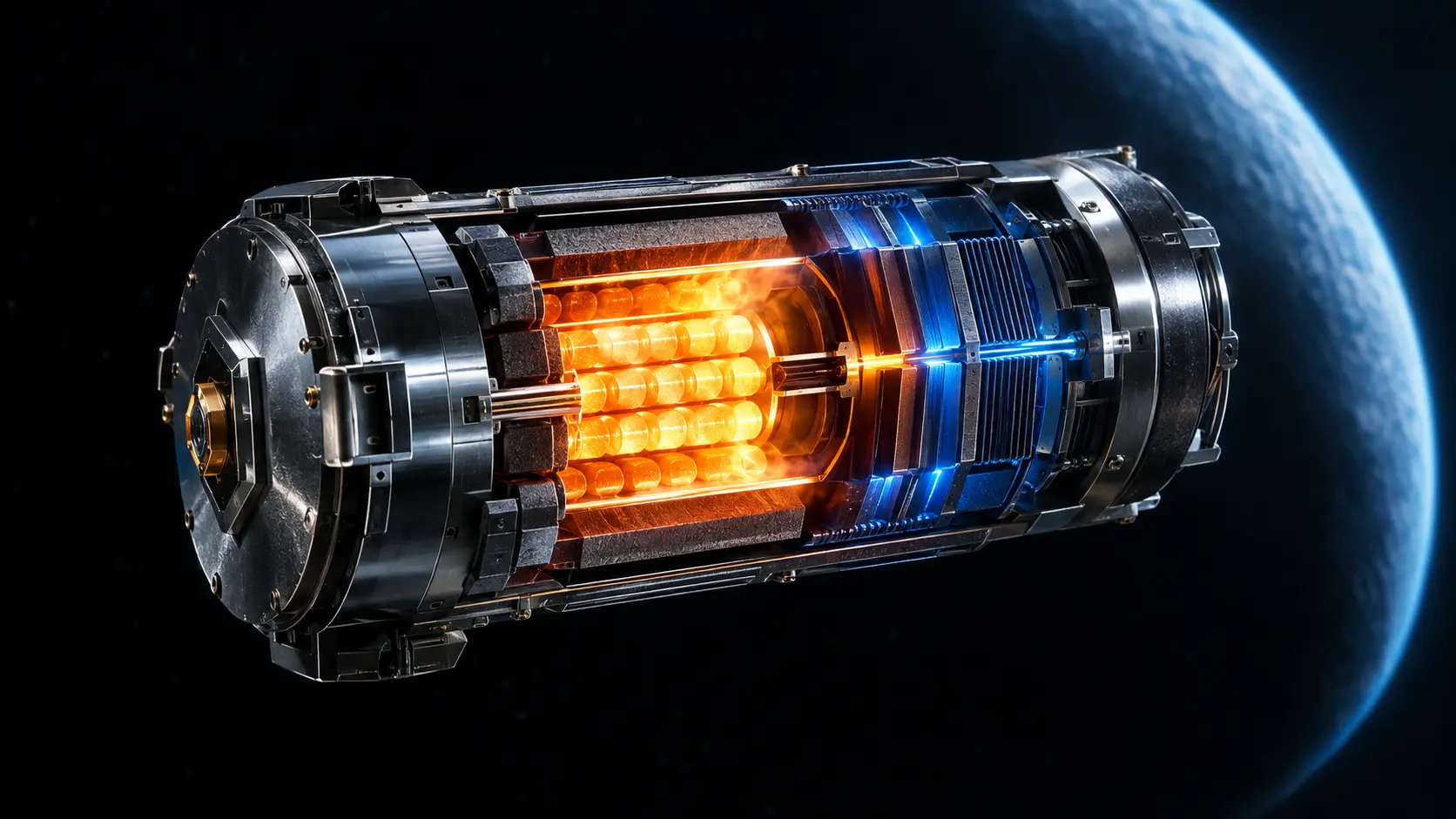

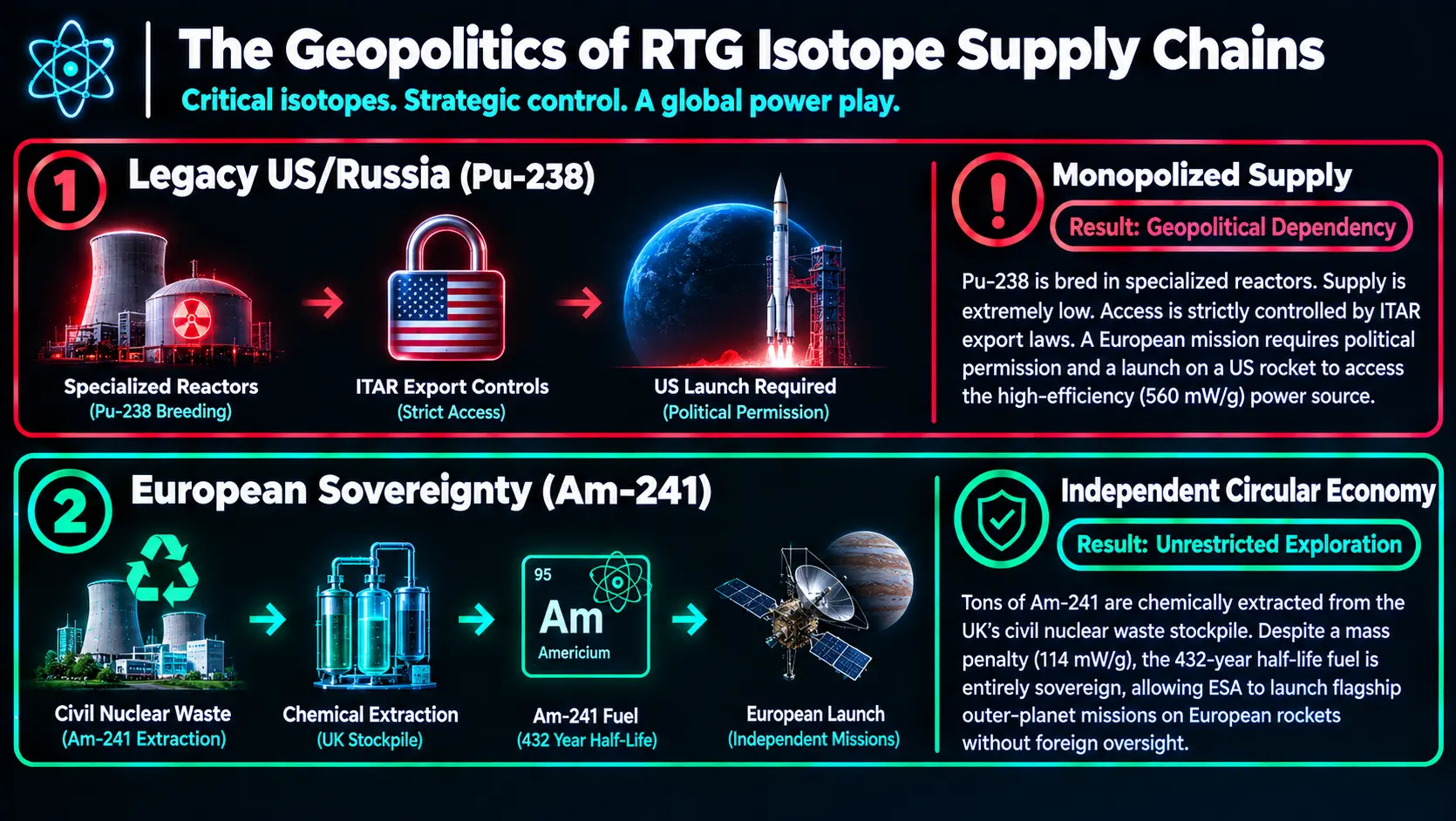
Imagine launching a multi-billion-dollar probe to Jupiter. Once you pass Mars, the sun becomes a dim star. Solar panels are utterly useless. To keep the spacecraft’s computers from freezing to death in the absolute zero of deep space, you need a nuclear battery. For six decades, the United States and Russia have held an absolute monopoly on the only fuel that works: Plutonium-238. If Europe wanted to explore the outer solar system, they had to ask Washington or Moscow for a battery.
Why should you care right now? Because the European Space Agency (ESA) just broke the monopoly. By chemically extracting a radioactive isotope called Americium-241 from decaying civilian nuclear waste, Europe is manufacturing its own deep-space power source. This breakthrough severs Europe’s reliance on foreign, highly restricted nuclear supply chains. It transforms a terrestrial waste problem into a cosmic energy solution, unlocking a fiercely independent era of European deep-space missions and permanently decentralizing the geopolitics of planetary exploration.
What are Americium-241 RTGs?
Americium-241 RTGs are deep-space nuclear batteries that generate electricity from the natural radioactive decay heat of Americium-241, an isotope extracted from civilian nuclear waste. They replace the historically monopolized Plutonium-238, providing the European Space Agency with an independent, long-lasting power source for lunar and outer-planetary exploration.
At a Glance
- Concept: Harvesting heat from decaying nuclear waste to power spacecraft in complete darkness.
- Why it matters: The US and Russia control the legacy nuclear fuel (Pu-238). Without an independent fuel source, Europe cannot launch its own flagship deep-space missions.
- Who uses it: The European Space Agency (ESA), powered by chemical extraction facilities at the UK’s National Nuclear Laboratory (NNL).
- Biggest takeaway: Americium-241 generates less heat per gram than Plutonium, making the battery heavier. However, because it decays much slower, it can power a spacecraft for over 400 years without dying.
In Simple Words
A spacecraft battery is not like a AA battery in your TV remote. Chemical batteries die quickly in the freezing cold of space.
Instead, space agencies use a Radioisotope Thermoelectric Generator (RTG). Think of an RTG as a campfire that never goes out. Inside the RTG is a glowing hot lump of radioactive metal. As the metal naturally decays, it releases pure heat. The spacecraft surrounds this “campfire” with a special metal jacket (a thermocouple). The metal jacket physically absorbs the heat and transforms it directly into electricity to run the spacecraft’s computers.
For decades, the only “firewood” that burned hot enough was a rare metal called Plutonium-238. Because the US and Russia control all the Plutonium-238, Europe was grounded. Now, European scientists have figured out how to use a different type of firewood—Americium-241—which they recycle out of the leftover waste from normal nuclear power plants. It burns a little cooler, so they need more of it, but it allows them to fly wherever they want without asking permission.
Why This Matters
For Aerospace Engineers, Nuclear Physicists, and Mission Planners, this solves the Sovereign Capability Chokepoint.
Plutonium-238 does not exist in nature. It must be artificially created by irradiating Neptunium-237 inside specialized nuclear breeder reactors. In the United States, the Department of Energy (DoE) produces only a few kilograms of Pu-238 per year, barely enough to supply NASA’s own flagship missions (like the Mars Perseverance rover).
Because of its scarcity and its military implications, Pu-238 is heavily controlled under strict export regulations (like ITAR). ESA mission planners designing probes to Saturn or Uranus faced a terrifying reality: if Washington decided to restrict access to Pu-238 due to domestic shortages or geopolitical leverage, a decade of European aerospace engineering would be grounded instantly.
By commercializing Americium-241, ESA eliminates this single point of failure. The UK has the world’s largest stockpile of separated civil plutonium at Sellafield, containing tons of decaying Americium. The fuel is abundant, unregulated by foreign powers, and entirely sovereign.
Micro-Insight: The Americium program isn’t about finding a better isotope; it is about finding an accessible isotope. In aerospace logistics, an imperfect fuel you control is infinitely more valuable than a perfect fuel you don’t.
The Circular Economy of Space Nuclear Power
We are witnessing the Circular Economy of the Cosmos.
For decades, environmentalists and governments have debated what to do with the spent fuel from civilian nuclear power plants. It is treated exclusively as a costly, dangerous liability that must be buried deep underground.
The Am-241 RTG program flips this paradigm. It treats civilian nuclear waste not as garbage, but as a strategic mineral reserve. By “mining” old reactor fuel for Americium, scientists are creating a circular economic loop where terrestrial energy waste directly enables humanity’s expansion into the outer solar system.
How Americium-241 RTGs Generate Electricity
Extracting electricity from nuclear waste requires a flawless intersection of radiochemistry and solid-state physics. Here is the first-principles breakdown of the architecture.
1. The Fundamental Problem: The Inverse-Square Law
Solar panels work well near Earth. But as you travel away from the sun, light intensity drops exponentially (the inverse-square law). By the time a probe reaches Jupiter, sunlight is 25 times weaker than at Earth. At Pluto, it is 1,000 times weaker. Deep space is freezing and dark. Without an internal heat source, fuel lines freeze, and computers die.
2. The Core Mechanism: The Seebeck Effect
To generate power without sunlight, engineers use an RTG. An RTG has no moving parts. It relies on the Seebeck effect—a phenomenon where an electrical current is created when two different types of metal are joined together, and one side is heated while the other side is exposed to the freezing cold of space. The greater the temperature difference, the more electricity is generated.
3. Technical Depth: Mining Americium-241
How do you get Americium? When standard nuclear power plants burn uranium, they create a byproduct called Plutonium-241. As this Plutonium-241 sits in storage facilities (like the massive stockpiles in the UK), it naturally undergoes “beta decay.” A neutron turns into a proton, and the element transforms into Americium-241. Scientists at the National Nuclear Laboratory use highly advanced chemical separation (solvent extraction) to wash the Americium out of the aged plutonium, creating a pure, glowing powder.
4. Technical Depth: The Thermodynamics of Specific Power
Here lies the core engineering tradeoff. Pu-238 generates roughly 560 milliwatts of heat per gram (mW/g).
Am-241 generates only 114 mW/g.
Because Am-241 produces about one-fifth the heat of Plutonium, an ESA spacecraft must carry five times as much Americium fuel to generate the exact same amount of electricity. This creates a severe “mass penalty,” making the European RTG significantly larger and heavier than its American counterpart.
5. Real-World Consequences: The 400-Year Battery
While Am-241 is cooler and heavier, it has one massive advantage: longevity. Pu-238 has a half-life of 87.7 years, meaning its heat output drops noticeably during multi-decade missions (like Voyager). Am-241 has a half-life of 432 years. An Americium RTG will output a virtually flat, stable power curve for over a century, making it the ultimate power source for establishing permanent robotic infrastructure on the dark side of the Moon or venturing into interstellar space.
RTG Isotope Thermodynamic Tradeoff
Plutonium-238 (Legacy US/Russia) vs. Americium-241 (Sovereign ESA)
Mission Timeline Scrub
100 Years
Isotope Fuel Architecture
Pu-238
Am-241
RTG Fuel Mass Penalty
9.0 kg
Live Electrical Output
300.0 W
Power Degradation
0.0%
RTG Cross-Section & Thermal Emission Profile
T+ 100 YEARS
Electrical Output Decay Trajectory (Watts)
ESA Missions Powered by Am-241 RTGs
The Americium-241 program is moving from laboratory chemistry to flight-ready hardware.
The Argonaut Lunar Lander: ESA’s flagship application for the new RTG is the Argonaut (European Large Logistics Lander). The Moon experiences a brutal 14-day lunar night where temperatures plunge to -130°C. Solar-powered rovers freeze to death. By equipping the Argonaut with an Am-241 RTG, ESA can ensure their robotic explorers survive the lunar night, enabling permanent European scientific infrastructure on the Moon independent of NASA’s Artemis architecture.
Outer Solar System Exploration (Ice Giants): ESA is conceptualizing flagship missions to Uranus and Neptune. These planets are so distant that a mission takes 10 to 15 years just to arrive. If a spacecraft used Pu-238, a significant portion of its battery would decay during the flight. By using Am-241, the spacecraft will arrive at Uranus with nearly 100% of its original power capacity intact, allowing for decades of high-powered radar mapping in the dark outer solar system.
Radioisotope Heater Units (RHUs): Before building massive electrical generators, ESA is building tiny Am-241 Heater Units. These are small pellets of Americium placed near critical computer components inside a satellite. They don't generate electricity; they just generate raw heat to keep the microchips from freezing in the shadows of asteroids or planetary craters.
Economic & Strategic Impact
The core strategic consequence of the Am-241 program is the Evasion of Export Controls and ITAR.
Historically, deep space technology was crippled by the International Traffic in Arms Regulations (ITAR). Because nuclear technology is inherently dual-use (civilian and military), importing a US-built Pu-238 RTG into a European spacecraft required agonizing, years-long bureaucratic approvals. Furthermore, the US holds a strict "no launch" policy—US nuclear material must generally launch on US rockets.
By manufacturing Am-241 domestically, ESA removes ITAR from the equation. Europe can build the battery in the UK, integrate it into a satellite in France, and launch it on a European Ariane 6 rocket from French Guiana. This creates a fully sovereign, closed-loop aerospace supply chain, shielding European space science from American geopolitical shifts or protectionist trade policies.
Advantages
- Geopolitical Independence: Eliminates reliance on the US Department of Energy and Russian nuclear state corporations.
- Abundant Fuel Supply: Extracted from massive, existing stockpiles of civilian nuclear waste, meaning supply is virtually limitless compared to rare, artificially bred Pu-238.
- Extreme Longevity: A 432-year half-life ensures flat, predictable power output for multi-century interstellar or outer-planetary missions.
- Waste Remediation: Provides a high-value, economic use-case for civilian nuclear waste that would otherwise cost billions to store safely.
Limitations
- The Mass Penalty: Generating only 114 mW/g requires the RTG to hold significantly more fuel to reach the required wattage. In aerospace, every extra kilogram of payload requires exponentially more rocket fuel to launch, eating into the budget of scientific instruments.
- Gamma Radiation Shielding: Plutonium-238 emits mostly alpha particles, which can be stopped by a piece of paper. Americium-241 emits more penetrating gamma radiation. The RTG must be wrapped in heavier radiation shielding to protect the spacecraft's delicate microchips, compounding the mass penalty.
- Manufacturing Infrastructure: While the chemical extraction works, building a fully automated, robotic assembly line capable of pressing highly radioactive Americium powder into ceramic flight pellets without exposing human workers is a massive CapEx hurdle for the UK's NNL.
Takeaway: Am-241 is a heavy, dirty battery compared to the sleek Pu-238 standard. But in the ruthless calculus of geopolitics, a heavy battery you own is infinitely superior to a light battery you are not allowed to buy.
Common Misconceptions
Misconception: The spacecraft has a nuclear reactor on board.
Reality: An RTG is not a reactor. There is no nuclear fission, no splitting of atoms, and no chain reaction. It is simply a lump of radioactive metal sitting passively in a box, slowly decaying and releasing heat according to the laws of nature. It cannot melt down or explode like Chernobyl.
Misconception: Americium-241 is highly dangerous and exotic.
Reality: You likely have Americium-241 in your home right now. It is the active ingredient used in almost all commercial smoke detectors (in microscopic quantities).
Misconception: Solar panels have made nuclear space batteries obsolete.
Reality: While solar technology (like Juno at Jupiter) has improved, solar panels become useless if you want to dive under the ice of Europa, explore the permanently shadowed craters of the Moon, or fly beyond Saturn. For true deep-space exploration, nuclear is the only physical option.
What Most People Miss
The disruptive capability of The Commercial Space Spin-off.
When analysts look at ESA's Americium program, they view it strictly as a scientific endeavor. What they miss is the impending commercialization of nuclear space power.
Currently, if a private aerospace startup (like SpaceX or Blue Origin) wants to launch a nuclear-powered mission, acquiring Pu-238 from the US government is an insurmountable regulatory nightmare. Because Europe is generating Am-241 from civilian waste streams using the National Nuclear Laboratory, there is a clear pathway to commercialize this fuel. The UK could become the global exporter of commercial space batteries, selling Am-241 RTGs to private space mining companies and lunar infrastructure startups, creating a multi-billion dollar commercial nuclear space economy.
Comparison Table
| Metric | Plutonium-238 (Legacy US/Russia) | Americium-241 (New ESA/UK) |
| Specific Power (Heat) | High (~560 mW/g) | Low (~114 mW/g) |
| Half-Life (Longevity) | 87.7 Years | 432.2 Years |
| Supply Chain | Extremely Rare (Bred in reactors) | Abundant (Extracted from civil waste) |
| Geopolitical Control | Heavily Restricted (ITAR) | Sovereign European Control |
| System Mass | Lightweight | Heavy (Requires larger core & shielding) |
Future Outlook
Next 12–24 Months
The era of Flight-Qualification Testing. Through 2026, ESA and NNL will finalize the transition from laboratory prototypes to flight-qualified hardware. The Americium pellets will be subjected to brutal vibrational testing (simulating a rocket launch) and thermal vacuum chambers (simulating deep space) to ensure the ceramic fuel does not crack or shatter under the extreme G-forces of an Ariane 6 launch.
Next 3–5 Years
The scaling of Lunar Night Survivability. By 2030, the first operational Am-241 devices will fly. They will likely not be full electrical RTGs, but rather Radioisotope Heater Units (RHUs) deployed on the lunar surface. These European heaters will keep seismic sensors and rovers alive during the freezing 14-day lunar night, proving the safety and reliability of the isotope in an operational environment.
Next 10 Years
The Flagship Outer Planet Missions. By the mid-2030s, Europe will launch its first fully independent, RTG-powered flagship mission to the outer solar system. Without needing to negotiate with NASA for power sources, ESA will design ambitious missions to explore the sub-surface oceans of the icy moons around Jupiter and Saturn. The UK’s Sellafield facility will transition into the undisputed global hub for deep-space nuclear battery manufacturing.
Most Likely Scenario
The Americium-241 program represents a masterclass in geostrategic engineering. While the physics dictates a heavier battery with lower specific power, the geopolitical advantages of total supply chain independence heavily outweigh the mass penalty. By successfully transforming the liability of civilian nuclear waste into the ultimate fuel for deep space exploration, Europe guarantees its seat at the table as humanity permanently colonizes the outer solar system.
Key Takeaways
- Spacecraft flying past Mars cannot use solar panels. They rely on Radioisotope Thermoelectric Generators (RTGs), which turn the heat from decaying radioactive metal into electricity.
- The legacy fuel, Plutonium-238, is extremely rare and monopolized by the US and Russia, leaving Europe unable to launch independent deep-space missions.
- The European Space Agency (ESA) is chemically extracting Americium-241 from the UK's stockpiles of spent civilian nuclear waste to build its own sovereign space batteries.
- Americium generates less heat per gram, meaning the battery must be heavier. However, its 432-year half-life means it can power a spacecraft five times longer than Plutonium.
- This breakthrough eliminates US export controls (ITAR) from European mission planning, allowing ESA to independently explore the Moon and the outer solar system using recycled nuclear waste.
Glossary
Americium-241 (Am-241): A radioactive isotope that decays slowly over 432 years, extracted from spent civilian nuclear fuel, now being used to power European spacecraft.
Half-Life: The time required for a quantity of a radioactive isotope to decay to half of its initial value, determining how long a nuclear battery will last.
ITAR (International Traffic in Arms Regulations): Strict US regulations that control the export of defense and space-related technologies, which historically restricted Europe's access to nuclear space batteries.
Plutonium-238 (Pu-238): The incredibly rare, high-heat radioactive isotope that has powered almost every deep-space mission in history, tightly controlled by the US and Russia.
Radioisotope Thermoelectric Generator (RTG): A nuclear battery with no moving parts that uses thermocouples to convert the natural decay heat of radioactive isotopes directly into electricity.
Seebeck Effect: A physical phenomenon where a temperature difference between two dissimilar electrical conductors produces a voltage, forming the basis of how an RTG generates power.
Sources
European Space Agency (ESA): The European Devices Using Radioisotope Energy (ENDURE) Programme
National Nuclear Laboratory (NNL): Extraction of Americium-241 from the UK Civil Plutonium Stockpile
Journal of Spacecraft and Rockets: Americium-241 for Deep Space Power Generation: Mass Penalties and Mission Profiles
Royal Astronomical Society: The Geopolitics of Deep Space Exploration and Sovereign Capability
Department of Energy (DoE): Plutonium-238 Supply Chain and Deep Space Exploration Requirements