Advertisement
)
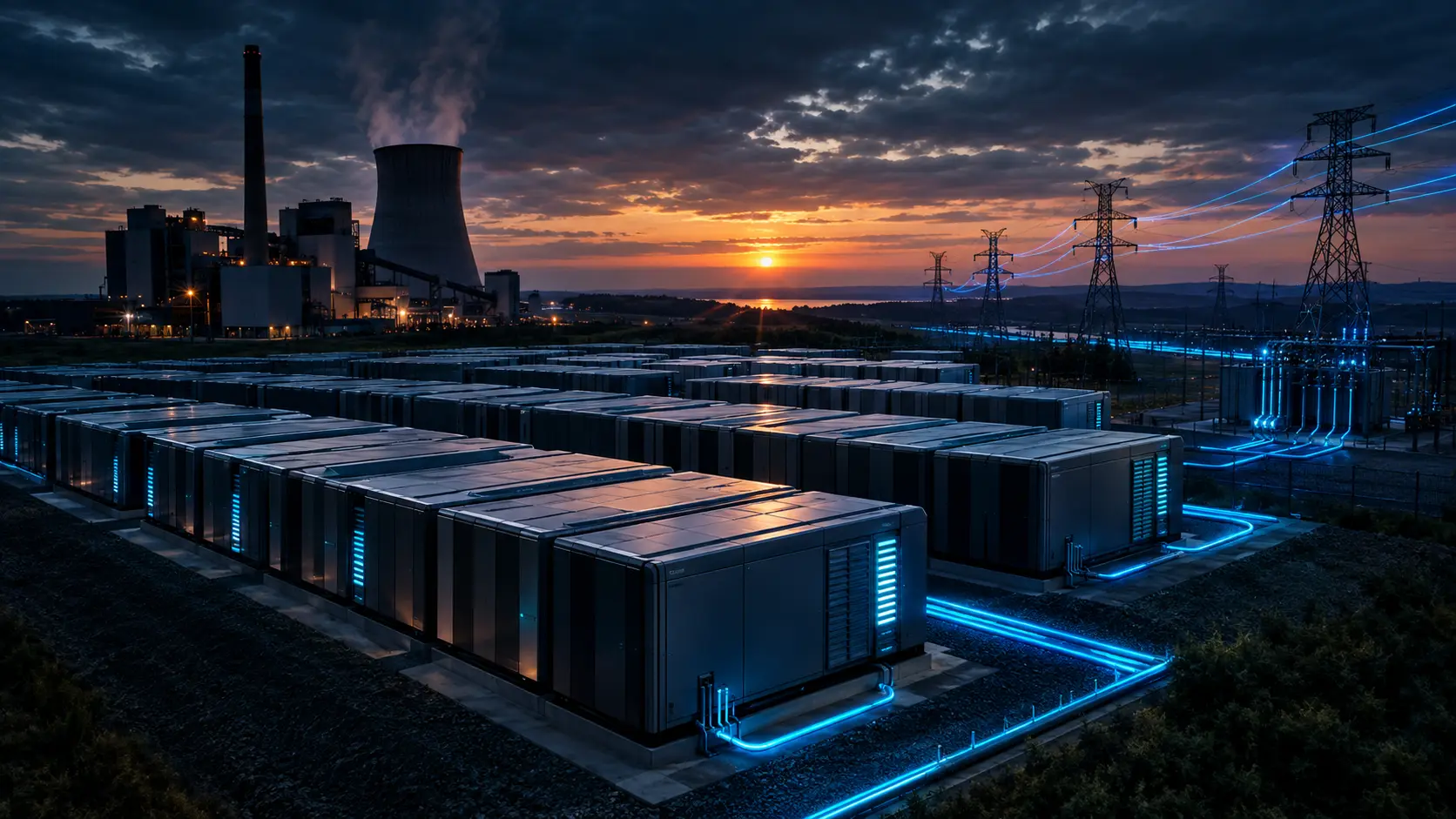

A massive winter storm hits the Midwest. Snow completely buries the solar farms, and sub-zero temperatures freeze the wind turbines. The grid instantly loses 60% of its renewable power generation. The utility company flips the switch on its state-of-the-art, billion-dollar lithium-ion battery facility. Four hours later, the batteries are completely dead. The city goes dark. This is the fatal flaw of the modern renewable energy grid: we have successfully figured out how to store electricity for an afternoon, but we have absolutely no way to store it for a long weekend.
Why should you care right now? Because grid engineers have stopped trying to solve this problem with expensive, rare-earth metals. Instead, they are turning to the cheapest, heaviest, and most abundant metal on the planet: Iron. By building multi-acre batteries that generate electricity by literally breathing in oxygen to rust iron, and storing energy by un-rusting it, the energy sector has cracked the code for Long-Duration Energy Storage (LDES). This transition from 4-hour lithium to 100-hour iron is the exact technological bridge required to permanently decommission coal plants and fully secure a 24/7 decarbonized grid.
What are Iron-Air Batteries?
Iron-air multi-day batteries are utility-scale energy storage systems that generate electricity through reversible oxidation. They discharge power by absorbing oxygen from the air to rust iron plates, and store power by using incoming electricity to convert the rust back into solid iron, providing 100 hours of continuous energy.
At a Glance
- Concept: Giant vats of iron and water that breathe oxygen to rust and un-rust on command.
- Why it matters: Lithium batteries are too expensive to power a city for more than a few hours. Iron-air batteries cost a fraction of the price, running continuously for nearly five days.
- Who uses it: State utilities (Xcel Energy, Great River Energy) and vanguard grid-storage companies like Form Energy.
- Biggest takeaway: Iron-air batteries are terrible for electric cars because they are incredibly heavy and charge very slowly. But for a stationary power plant where weight doesn’t matter, they are an economic miracle.
In Simple Words
If you leave a bicycle out in the rain, it rusts. Rusting is a chemical reaction between iron, water, and oxygen. When that reaction happens, a tiny amount of energy is released.
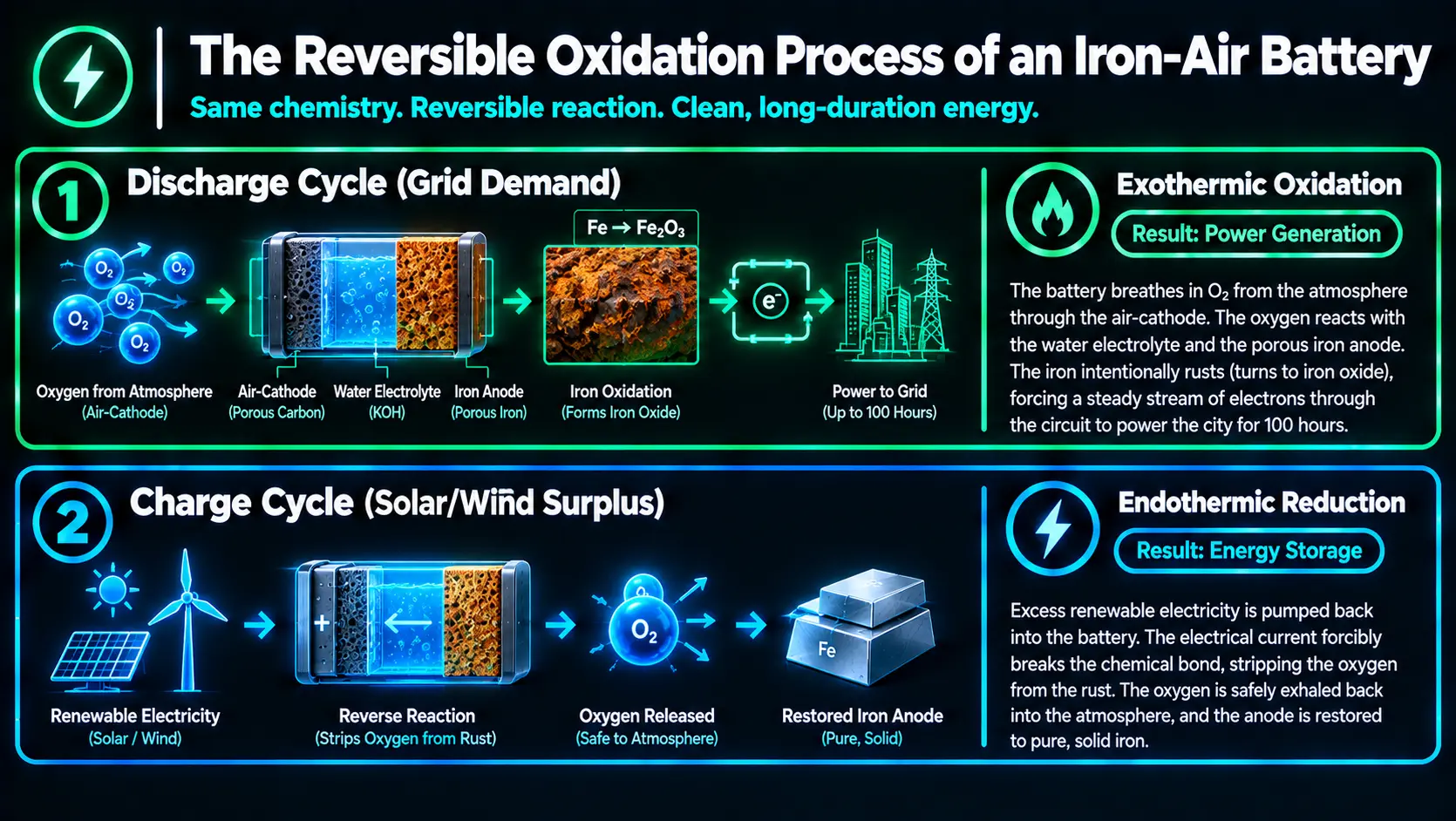
An Iron-Air Battery captures that energy. Inside the battery is a massive plate of pure iron submerged in a liquid bath. When the power grid needs electricity, the battery “inhales” oxygen from the outside air. The oxygen hits the iron, intentionally rusting it. As it rusts, it releases a steady stream of electricity into the power lines.
When the sun comes out and solar panels produce extra electricity, the battery uses that incoming power to reverse the process. It zaps the rust, stripping the oxygen away and “exhaling” it back into the atmosphere. The rust turns back into a clean iron plate, ready to be used again.
Why This Matters
For Utility Planners, Cleantech VCs, and Grid Engineers, iron-air technology solves the Levelized Cost of Storage (LCOS) Trap.
Lithium-ion batteries are sprinters. They are amazing at dumping a massive amount of power into the grid instantly to handle a sudden spike in demand (like when everyone turns on their air conditioning at 5 PM). But lithium is fundamentally too expensive to scale for endurance. If a utility wants to store 100 hours of backup power using lithium-ion, it would bankrupt the state.
Iron-air batteries are marathon runners. Iron is mined globally by the millions of tons, costing less than $1 per kilogram. The “air” is free. By building batteries out of materials that cost practically nothing, the cost of storing energy drops from $150 per kilowatt-hour to roughly $20.
This radically alters utility mathematics. For the first time in history, building a massive solar farm paired with a 100-hour iron-air battery is cheaper than keeping a legacy coal-fired power plant running on standby.
Micro-Insight: You do not use iron-air to replace lithium-ion; you use it to replace coal. Lithium handles the daily fluctuations; iron handles the multi-day weather anomalies.
The Shift to Long-Duration Energy Storage (LDES)
We are witnessing the industrialization of Long-Duration Energy Storage (LDES).
The transition to renewable energy has a gaping hole: base-load reliability. The grid must be perfectly balanced 60 times a second. Without fossil fuel plants spinning massive physical turbines continuously, a multi-day storm threatens catastrophic grid collapse.
By commercializing reversible oxidation, we are abstracting the reliability of a coal pile into a zero-carbon chemical format. Iron-air is the heavy, brutalist, unglamorous anchor that will allow the grid to safely cut its final tethers to fossil fuels.
How Iron-Air Batteries Utilize Reversible Oxidation
Turning natural degradation (rust) into a highly efficient, reversible power plant requires immense precision in electrochemistry. Here is the first-principles breakdown of the architecture.
1. The Fundamental Problem: The Cost of Cathodes
In a lithium-ion battery, the metals used in the cathode (cobalt, nickel, manganese) are rare, expensive, and toxic to mine. The physical materials make up the majority of the battery’s cost. You cannot make a cheap multi-day battery if the ingredients themselves are inherently expensive.
2. The Core Mechanism: Reversible Oxidation
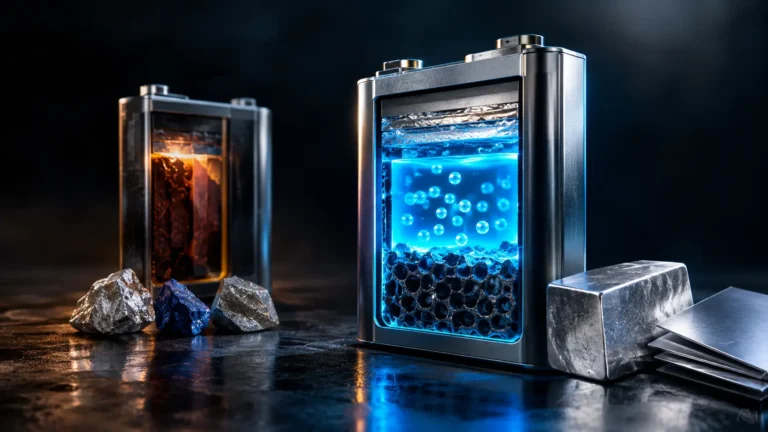
An iron-air battery fundamentally rewrites the Bill of Materials. The anode is composed of thousands of highly porous iron pellets. The electrolyte is a safe, non-toxic, water-based solution (potassium hydroxide). The cathode isn’t made of rare earth metals—it is a specialized “air-breathing” membrane.
3. Technical Depth: The Air-Breathing Cathode
When discharging (providing power to the grid), the battery pulls ambient air from the atmosphere. The air passes through the cathode, which separates out the oxygen. The oxygen reacts with the water-based electrolyte and the iron anode, forming iron oxide (rust). This specific chemical conversion releases electrons, creating a direct current (DC) that flows out to the grid.
Plain-English Takeaway: The battery “inhales” to generate power, and “exhales” to store power. It is a mechanical lung operating at the atomic level.
4. Technical Depth: Eliminating Thermal Runaway
Lithium-ion batteries are prone to “thermal runaway”—if they overheat or short-circuit, they can explode into self-sustaining chemical fires. Iron-air batteries are physically incapable of catching fire. The primary components are iron, water, and air. There are no volatile heavy metals or highly flammable organic solvents. This allows them to be deployed massively in urban environments without the extreme fire-suppression infrastructure required for lithium.
5. Real-World Consequences: Modular Acreage
Because iron is heavy and the reaction is slow, these batteries are massive. They are not built in small cabinets; they are built in modular enclosures the size of washing machines. Thousands of these modules are grouped into blocks, and dozens of blocks form a grid-scale power plant. A standard deployment delivers roughly 3 megawatts (MW) of power and 300 megawatt-hours (MWh) of energy capacity per acre of land.
Grid Resilience: LDES vs. Lithium-ion
Simulating 100-Hour Iron-Air Reversible Rusting vs 4-Hour Lithium Depletion
Winter Storm Duration (Dunkelflaute)
72 Hours
Battery Architecture
4-Hr Lithium-ion
100-Hr Iron-Air
City Grid Status
ONLINE
Battery Charge Remaining
100.0%
Simulation Time Elapsed
0 Hrs
Grid Dispatch & Chemical State Visualization
WEATHER: CLEAR
Battery State of Charge (%) vs. Time
Utility Deployments of Iron-Air Storage
Iron-air technology is officially moving from the laboratory to large-scale utility integration.
The Form Energy Maine Project: In 2024, the US Department of Energy selected Form Energy to deploy an 85-megawatt / 8,500-megawatt-hour iron-air battery system in Lincoln, Maine. This is one of the largest energy storage projects in global history. Situated at the site of a former paper mill, the installation will specifically ensure that the New England grid can survive extreme, multi-day winter storms without relying on highly volatile and expensive natural gas peaker plants.
Xcel Energy Replacement of Coal Plants: Major utility providers are using iron-air batteries as direct 1-to-1 replacements for retiring coal infrastructure. Xcel Energy is deploying multi-megawatt Form Energy systems at the sites of decommissioned coal plants in Minnesota and Colorado. By placing the batteries directly on the old coal sites, the utility can reuse the existing high-voltage transmission lines, drastically cutting deployment time and interconnection costs.
Hyperscale Data Center Buffering: AI tech giants (Microsoft, Google) have committed to "24/7 Carbon-Free Energy" matching. Currently, they buy solar during the day, but rely on fossil-fuel grids at night. Iron-air batteries allow data centers to buy excess renewable power over the weekend and slowly discharge it throughout the entire workweek, perfectly smoothing out their massive, gigawatt-scale AI workloads without burning a single cubic foot of natural gas.
Economic & Strategic Impact
The core strategic consequence of Iron-Air batteries is Decoupling Storage from Geopolitics.
The lithium-ion supply chain is an absolute geopolitical bottleneck. The mining of cobalt (DRC), lithium (Australia, South America), and the subsequent chemical refinement are heavily dominated by Chinese state-backed corporations. The US and European energy grids are deeply vulnerable to export restrictions or trade wars regarding these critical minerals.
Iron is the most mined metal in human history. It is abundantly available on every continent. The electrolyte is water and potassium. By shifting utility-scale storage to iron-air, Western energy grids completely insulate themselves from the geopolitical leverage of foreign adversaries, ensuring that the transition to renewable energy is backed by a fully sovereign, resilient supply chain.
Advantages
- Extreme Durability: Lithium-ion batteries chemically degrade after roughly 2,000 cycles. Iron-air batteries experience virtually zero chemical degradation, capable of operating for decades.
- Zero Fire Risk: The water-based electrolyte and solid iron anode eliminate the risk of thermal runaway, making them exceptionally safe for deployment near urban centers.
- Geopolitical Sovereignty: Built from iron, water, and air, the supply chain is completely immune to the rare-earth shortages and trade wars that plague lithium and cobalt.
- LCOS Economics: The marginal cost of adding another hour of storage is functionally zero (you just add more cheap iron), driving the overall cost per kWh down exponentially as the duration increases.
Limitations
- Terrible Round-Trip Efficiency (RTE): Lithium-ion returns about 90% of the energy you put into it. Iron-air returns roughly 50% to 60%. Almost half the energy is lost as heat during the conversion process. This forces utilities to overbuild solar and wind capacity simply to account for the battery's inefficiency.
- Massive Spatial Footprint: They are incredibly heavy and require vast amounts of land. You cannot put an iron-air battery inside a building or in the basement of a skyscraper. They require multi-acre industrial parks.
- Slow Response Times: You cannot draw power from an iron-air battery instantly. The rusting process takes time to spin up. If the grid needs an immediate spike of power to prevent a frequency collapse, iron-air will fail. It must be paired with small lithium-ion buffers that handle the split-second spikes while the iron-air handles the baseline marathon.
Takeaway: Iron-air is slow, heavy, and inefficient. But in utility economics, if the capital cost is cheap enough and the fuel is free, inefficiency doesn't matter. You win on scale.
Common Misconceptions
Misconception: Iron-air will replace lithium-ion batteries.
Reality: They do completely different jobs. Lithium is for high-power, fast-burst applications (EVs, 2-hour grid smoothing). Iron-air is for low-power, slow-burn applications (bridging a 4-day blizzard). Modern grids require both working in tandem.
Misconception: The batteries physically rust away and disappear.
Reality: The rust is perfectly contained and reversed. The iron oxide does not flake off or degrade into dust; it remains bonded to the anode matrix, waiting to be zapped back into solid iron.
Misconception: They run on hydrogen.
Reality: While they involve oxidation, they do not store or burn hydrogen gas. This eliminates the massive explosion risks, high-pressure tanks, and cryogenic cooling infrastructure required for hydrogen fuel cells.
What Most People Miss
The disruptive capability of Transmission Deferral.
When analysts look at batteries, they only look at energy markets (buying low, selling high). What they miss is the infrastructure value.
Building a new high-voltage transmission line to carry extra power during peak hours costs billions of dollars and takes a decade of legal permitting. Instead of building a new wire, a utility can simply place a massive iron-air battery at the end of the existing, congested line. The line slowly fills the battery over 100 hours during low-demand periods. When peak demand hits, the battery provides the extra power locally, completely eliminating the need to build the billion-dollar transmission line. This "transmission deferral" is where the true multi-billion-dollar ROI of LDES lies.
Comparison Table
| Feature | Lithium-ion (LFP / NMC) | Iron-Air (Form Energy) |
| Optimal Duration | 2 to 6 Hours | 100+ Hours |
| Capital Cost / kWh | High (~$150+) | Ultra-Low (~$20) |
| Round-Trip Efficiency | Excellent (90%+) | Poor (~50-60%) |
| Fire/Explosion Risk | Moderate to High (Thermal Runaway) | Zero (Water-based, non-flammable) |
| Primary Use Case | Frequency regulation, EVs, daily solar shifting | Replacing coal plants, multi-day weather events |
Future Outlook
Next 12–24 Months
The era of Commercial Validation. Through 2026, the industry will aggressively monitor the first full-scale deployments of Form Energy's 100-hour systems across Xcel Energy and Great River Energy territories. The primary focus is proving that the real-world Round-Trip Efficiency (RTE) holds steady above 50% during harsh winter conditions, and that the proprietary air-breathing cathode does not clog or degrade in highly polluted or humid environments.
Next 3–5 Years
The scaling of The Hybrid Storage Architecture. By 2029, utility operators will stop buying standalone storage systems. The standard deployment will be a "Hybrid Storage Park"—a massive 100-hour iron-air facility coupled directly with a smaller 2-hour lithium-ion system. Software algorithms will automatically dispatch the lithium for split-second grid stabilization, while the iron-air system acts as the deep, unshakeable baseload foundation.
Next 10 Years
The Permanent Decommissioning of Baseload Fossil Fuels. By the mid-2030s, the economic argument for keeping natural gas peaker plants and legacy coal plants online "just in case" of a severe weather event will collapse. LDES technologies like iron-air will become so cheap and ubiquitous that states will mandate 100-hour storage reserves as a standard utility requirement, definitively ending the era of fossil-fuel baseload generation on Western grids.
Most Likely Scenario
Iron-air batteries represent the ultimate triumph of brutalist industrial chemistry over delicate, expensive rare-earth physics. While they suffer from poor round-trip efficiency and massive physical footprints, their total immunity to geopolitical supply chain shocks and fire risks makes them the perfect tool for state utilities. By solving the multi-day storage gap for pennies on the dollar, iron-air ensures that the global transition to renewable energy will not be derailed by the unpredictability of the weather.
Key Takeaways
- Lithium-ion batteries are too expensive to power a city for more than a few hours, leaving renewable energy grids vulnerable to multi-day storms.
- Iron-air batteries solve this by using the cheapest metal on Earth, dropping the cost of energy storage from $150/kWh down to roughly $20/kWh.
- They work via reversible oxidation: generating power by breathing in oxygen to rust iron plates, and storing power by using electricity to turn the rust back into iron.
- Because they use an inert water-based electrolyte and solid iron, they physically cannot catch fire or explode, making them perfect for massive, multi-acre deployments near cities.
- While they lose nearly 40% of their energy as heat during the charging cycle, their sheer scale and ultra-low cost make them the only viable replacement for retiring coal power plants.
Glossary
Air-Breathing Cathode: A specialized membrane in the battery that pulls oxygen from the outside atmosphere to facilitate the rusting process, and exhales it during recharging.
Dunkelflaute: A German meteorological term meaning "dark doldrums," referring to periods of time (often days) where there is little to no wind or solar energy generation.
Levelized Cost of Storage (LCOS): The total lifetime cost of an energy storage technology divided by the total amount of energy it stores and discharges, used to compare the true cost of different batteries.
Long-Duration Energy Storage (LDES): A classification of energy storage systems designed to output power continuously for highly extended periods, generally defined as 10 hours up to several days.
Reversible Oxidation: A chemical reaction where a material (like iron) binds with oxygen (rusts) to release electrons, and can be forced backward by applying an electrical current to remove the oxygen.
Round-Trip Efficiency (RTE): The percentage of electricity put into a battery that can be retrieved later. Iron-air has a low RTE (~60%), meaning 40% of the energy is lost as heat.
Sources
Form Energy: Reversible Oxidation and the 100-Hour Multi-Day Storage Architecture
Department of Energy (DoE): Long-Duration Energy Storage (LDES) Earthshots Initiative
Xcel Energy: Coal Decommissioning and Iron-Air Battery Integration Filings
MIT Technology Review: The Rusting Batteries That Will Power the Renewable Grid
IEEE Power and Energy Magazine: The Economics of Transmission Deferral via Long-Duration Storage