Advertisement
)

Imagine a satellite drifting past Pluto, a sensor buried at the bottom of the Mariana Trench, or a pacemaker surgically implanted inside a human heart. They all share a fatal engineering flaw: when their battery dies, the mission is over. Standard chemical batteries—like the lithium-ion cells in your smartphone—rely on volatile chemical reactions that inevitably degrade after a few years. Solar panels are useless in deep space or deep tissue. To power a device in an unreachable environment, engineers are forced to use heavy, hot, and dangerous plutonium reactors.
Why should you care right now? Because aerospace engineers and nuclear physicists have discovered a way to upcycle nuclear waste into a battery that outlives human civilization. By trapping radioactive Carbon-14 inside a flawless, man-made diamond, they have created a “betavoltaic” cell. It generates a continuous trickle of electricity for over 5,000 years, physically cannot leak, and has zero moving parts. This technology permanently solves the “micro-power endurance trap,” rewriting the rules for deep space exploration, autonomous defense sensors, and medical implants by providing power that outlasts the devices it runs.
What are Betavoltaic Diamond Batteries?
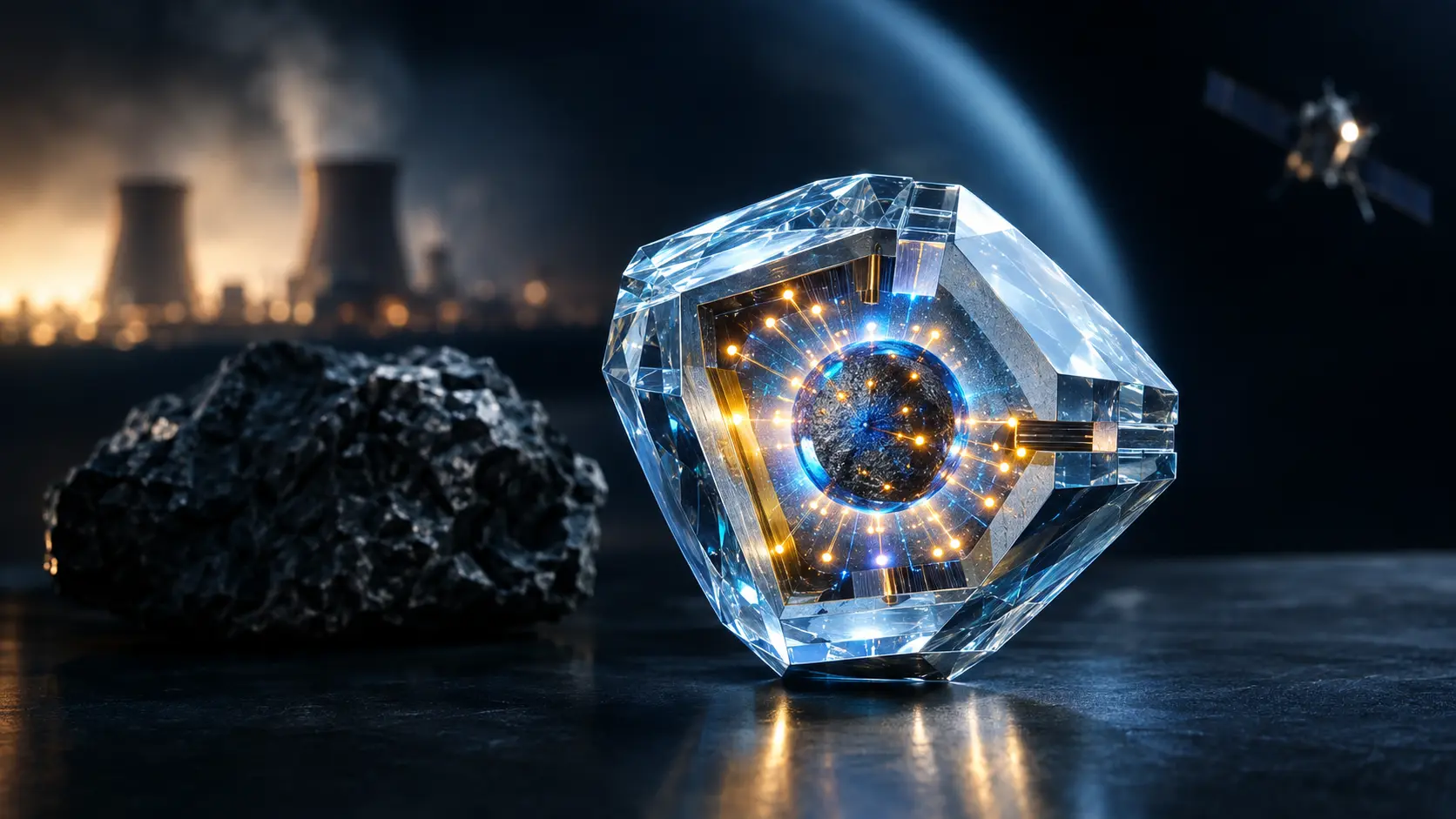
Betavoltaic diamond batteries are solid-state power sources that generate continuous electricity through nuclear decay. They encase a radioactive isotope, typically Carbon-14, inside a synthetic diamond semiconductor. As the isotope decays, it emits high-speed electrons (beta particles) that strike the diamond lattice, generating a steady micro-current of electricity lasting thousands of years.
At a Glance
- Concept: Trapping radioactive waste inside a diamond to catch the electrons it naturally spits out over millennia.
- Why it matters: Chemical batteries die in 5 years. A Carbon-14 diamond battery takes 5,730 years just to lose half its power.
- Who uses it: Aerospace agencies (NASA, ESA), medical implant designers, and deep-tech startups like NDB and Arkenlight.
- Biggest takeaway: These are not for your electric car. They generate “micro-watts” (millionths of a watt). They provide an incredibly tiny amount of power, but they do it continuously, flawlessly, and safely for generations.
In Simple Words
Think of a normal battery like a bucket of water with a hole in it. It pours out water (electricity) very quickly, but once the bucket is empty, you have to stop and refill it (recharge).
A Betavoltaic Battery is like a microscopic, slow-melting glacier. It doesn’t pour water; it only drips one drop at a time. But because it is a glacier, it will keep dripping perfectly, day and night, for 5,000 years without anyone ever needing to refill it.
The “glacier” in this case is a piece of nuclear waste (Carbon-14). Left alone, it naturally shoots out tiny particles (electrons) as it decays over thousands of years. By wrapping that nuclear waste inside a man-made diamond, scientists trap the radiation. The diamond acts like a solar panel, but instead of catching light from the sun, it catches the electrons shooting out of the nuclear waste, turning them into a permanent, tiny trickle of electricity.
Why This Matters
For Aerospace Engineers, Nuclear Physicists, and Deep-Tech VCs, this technology solves the Micro-Power Endurance Trap.
The modern world is filling up with microscopic sensors. The Internet of Things (IoT) requires billions of sensors embedded in bridges, deep-sea cables, and industrial pipelines. The problem is maintenance. Sending a technician to replace a $2 coin battery in a sensor bolted to the bottom of an offshore oil rig costs $50,000 in labor and logistics. If the battery is inside a patient’s heart, replacing it requires open-heart surgery.
Betavoltaics eradicate the concept of a “dead battery” for low-power devices. By guaranteeing that a sensor will have power for the entire structural lifespan of the bridge it is embedded in, or the biological lifespan of the patient it is implanted inside, betavoltaics completely eliminate maintenance CapEx and the risk of catastrophic power failure in inaccessible environments.
Micro-Insight: The value of a betavoltaic battery is not how much power it provides, but the absolute, mathematical certainty that the power will never stop.
Monetizing Carbon-14 Nuclear Liability
We are witnessing the Commercial Upcycling of Nuclear Waste.
For seventy years, the nuclear energy industry has struggled with a massive public relations and logistical nightmare: what to do with radioactive waste. Legacy nuclear reactors used massive blocks of graphite to control their nuclear reactions. Over decades, this graphite became highly radioactive, saturated with Carbon-14.
Betavoltaic startups are taking this expensive, dangerous liability and turning it into a lucrative asset. By mining this irradiated graphite and extracting the C-14 to build batteries, the deep-tech sector is establishing the first profitable, closed-loop recycling market for high-level nuclear waste.
Betavoltaic Semiconductor Physics and Inelastic Collisions
Extracting electricity from nuclear decay without boiling water or spinning a turbine requires advanced semiconductor physics. Here is the first-principles breakdown of the architecture.
1. The Fundamental Problem: Chemical Decay
Chemical batteries (like Lithium-ion) work by moving ions between an anode and a cathode. This physical movement slowly degrades the internal structure of the battery. Eventually, the chemicals break down, and the battery dies. You cannot build a chemical battery that lasts 100 years because the chemicals will naturally degrade and leak long before then.
2. The Core Mechanism: Beta Decay
To get energy without chemistry, scientists use atomic physics. Unstable radioactive isotopes naturally want to become stable. To do this, they shed energy. Carbon-14 (C-14) sheds energy through “beta decay”—it fires off a high-speed electron (a beta particle) as it slowly turns into stable Nitrogen. This decay process takes 5,730 years to reach its half-life.
3. Technical Depth: Inelastic Collisions
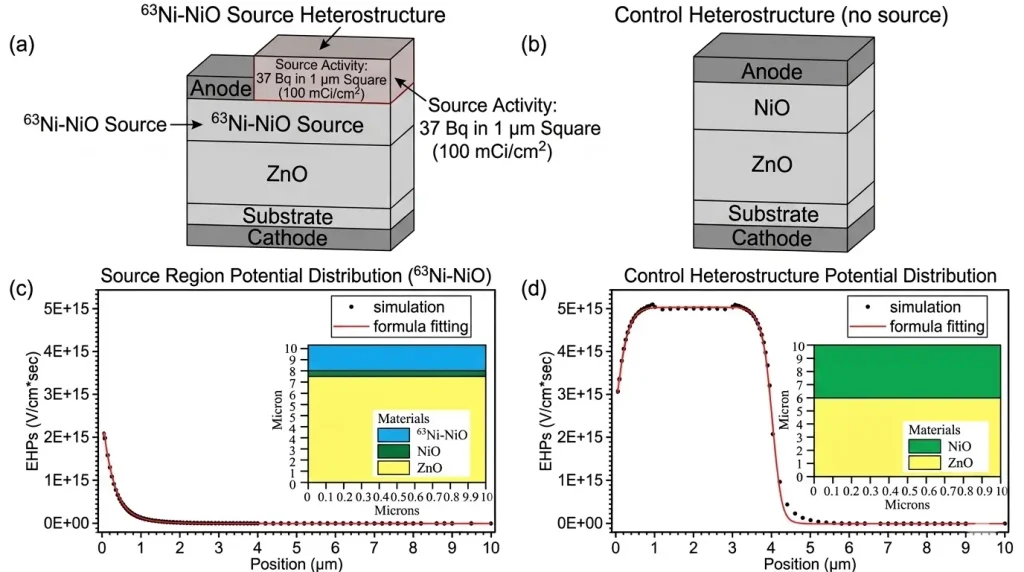
If you just have a lump of C-14, it shoots electrons uselessly into the air. To harvest the electricity, you need a transducer. In a betavoltaic, the C-14 is surrounded by a semiconductor. When the high-speed beta particle shoots out of the C-14, it smashes into the atoms of the semiconductor (an inelastic collision). This violent impact knocks thousands of other electrons loose from the semiconductor’s atomic lattice, creating “electron-hole pairs”—the exact mechanism a solar panel uses to create an electrical current.
4. Technical Depth: Diamond as the Ultimate Semiconductor
Why use diamond? Most semiconductors (like silicon) are destroyed by constant radiation. Diamond is an “ultra-wide bandgap” material with an incredibly tight carbon lattice. It is virtually immune to radiation damage.
Engineers use Chemical Vapor Deposition (CVD) to grow a microscopic, artificial diamond. They dope one side with boron and the other with phosphorus to create a “p-n junction” (the electrical circuitry). They place the radioactive C-14 in the dead center, and grow more stable, non-radioactive diamond entirely around it.
Battery Lifespan Simulator
Chemical Degradation vs. Betavoltaic Atomic Decay (C-14)
Simulation Timescale
5000 Years
Power Architecture
Chemical (Lithium-Ion)
Nuclear Betavoltaic (C-14)
Time Elapsed
0.0 Yrs
Power Output / Capacity
100.0%
Internal State
Pristine / Active
Internal Mechanism Visualization
READY
Power Output Decay Curve
5. Real-World Consequences: Impenetrable Encapsulation
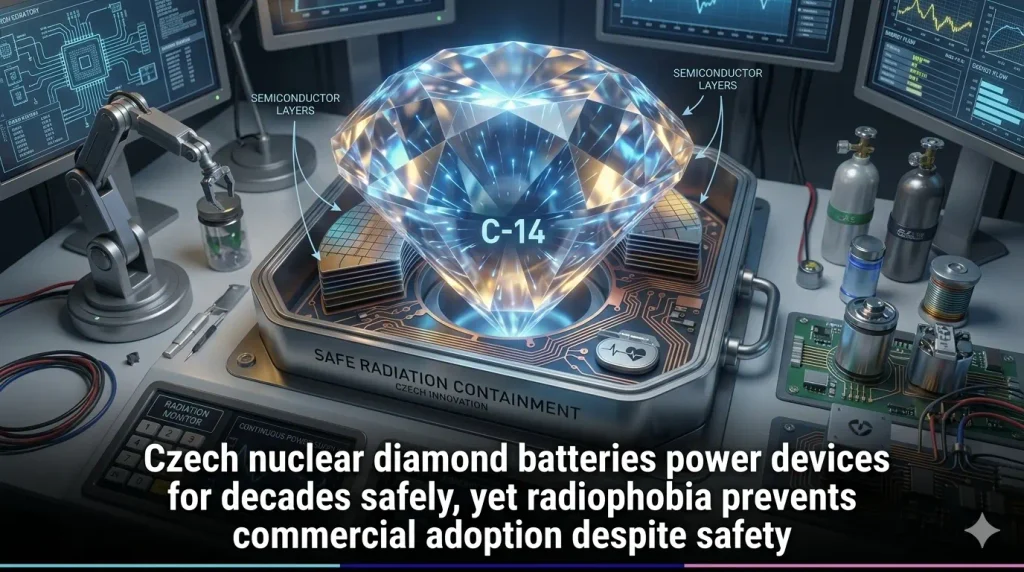
Because the C-14 is completely encased in solid, lab-grown diamond—the hardest material on Earth—it is physically impossible for the radiation to leak. Beta particles are relatively weak; they cannot penetrate the outer diamond shell. The device is safe enough to swallow. The exterior emits zero radiation, while the interior harnesses a nuclear reaction for millennia.
Deep Space Probes and Medical Implant Deployments
Betavoltaics are moving out of theoretical physics and into highly specialized niche deployments.
Deep Space Probes: NASA’s Voyager probes rely on Radioisotope Thermoelectric Generators (RTGs) that use Plutonium-238 to generate heat. RTGs are massive, heavy, and extremely dangerous if a rocket explodes in the atmosphere. For next-generation, miniaturized CubeSats exploring the outer solar system (where solar panels are useless), betavoltaic diamond batteries provide a lightweight, room-temperature power source that outlasts the multi-decade transit times required to reach the Oort Cloud.
Implantable Medical Devices (Pacemakers): In the 1970s, early pacemakers actually used plutonium, but they were abandoned due to toxicity risks. Today’s lithium pacemakers require surgical replacement every 7 to 10 years. A Carbon-14 diamond battery can be implanted once and power the pacemaker for the entire biological lifespan of the patient. Because the diamond is biologically inert and the beta radiation cannot escape the crystalline shell, there is zero risk of radioactive toxicity.
Subsea Defense Acoustic Sensors: The military monitors the oceans using networks of deep-sea acoustic sensors (SOSUS) to track enemy submarines. These sensors sit on the ocean floor under immense pressure, making battery replacement impossible. Diamond batteries provide the continuous, multi-century baseline power required to keep the acoustic listening arrays permanently active without surface tethering.
Decoupling Device Lifespan from Energy Constraints
The core strategic consequence of Diamond Batteries is the Elimination of the Charging Infrastructure Constraint.
Currently, deploying a network of IoT sensors in a smart city, an agricultural mega-farm, or a military theater requires planning how those sensors will be powered. If they use solar, they must be placed in the sun. If they use chemical batteries, a logistics network must be funded to replace them.
Betavoltaics decouple the sensor from the power grid entirely. Engineers can embed sensors inside concrete bridge pillars during construction, inside the hulls of ships, or deep underground in mining operations. By removing the need for a charging infrastructure, the total deployment cost of remote intelligence-gathering drops dramatically, enabling true “deploy and forget” architecture.
Advantages
- Extreme Longevity: Carbon-14 has a half-life of 5,730 years. The battery will provide usable power long after the device it powers has mechanically rusted away.
- Absolute Safety (No Thermal Runaway): Betavoltaics do not generate immense heat like Plutonium RTGs, and they contain no volatile liquids. They cannot catch fire or explode.
- Impenetrable Encapsulation: The radioactive material is locked inside a synthetic diamond, the hardest material known to physics, ensuring zero radiation leakage even if crushed or dropped from orbit.
- Extreme Environmental Tolerance: Diamond semiconductors operate flawlessly in extreme cold (deep space) and extreme heat (deep earth drilling), immune to the temperature sensitivity of chemical batteries.
Limitations
- Micro-Watt Power Ceiling: Betavoltaics generate an incredibly tiny amount of power (microwatts). You cannot use them to power a smartphone, a laptop, or an electric car. They are strictly for low-power sensors and microcontrollers.
- Radiochemical Supply Chain: While there is plenty of nuclear waste, safely extracting the specific Carbon-14 isotope from highly irradiated graphite blocks requires specialized, heavily regulated nuclear facilities.
- Regulatory Paranoia: Anything containing the word “nuclear” or “radioactive” faces massive public and regulatory backlash. Convincing the FDA to put a nuclear battery inside a human heart, or the FAA to allow them on commercial aircraft, requires decades of bureaucratic lobbying.
Takeaway: The physics of the diamond battery are flawless, but the power output is microscopic. They are not a replacement for lithium; they are a replacement for a power cord in places where cords cannot reach.
Common Misconceptions
Misconception: It is a mini nuclear reactor.
Reality: Nuclear reactors use fission (splitting atoms to create massive heat, boiling water to spin a turbine). Betavoltaics use decay (naturally shedding electrons). There is no splitting, no chain reaction, and no intense heat.
Misconception: You could build a big one to power a car.
Reality: The power density is too low. To get enough power to run a Tesla, the diamond battery would have to be larger and heavier than the car itself.
Misconception: It emits dangerous radiation.
Reality: Beta particles are easily stopped by a sheet of aluminum foil. The solid diamond shell completely absorbs the beta particles, turning them into electricity. A Geiger counter held next to a commercial diamond battery would register zero elevated radiation.
What Most People Miss
The disruptive capability of Supercapacitor Hybridization.
Because betavoltaics only produce microwatts of power, analysts often dismiss them as useless for devices that need to transmit data (like a satellite blasting a radio signal to Earth). What they miss is the architecture of hybridization.
Engineers do not use the diamond battery to power the radio transmitter directly. Instead, they wire the diamond battery to a supercapacitor. The diamond battery slowly, continuously “trickle charges” the supercapacitor over several days. Once the supercapacitor is full, it dumps all that stored energy in one massive, high-power burst to fire the radio transmitter for a few seconds. The system then goes to sleep while the diamond battery slowly fills the capacitor back up. This hybrid architecture allows micro-power batteries to execute high-power tasks.
Comparison Table
| Metric | Chemical (Lithium-Ion) | Betavoltaic (Diamond C-14) | RTG (Plutonium-238) |
| Power Source | Chemical Ion Exchange | Beta Particle Decay | Alpha Decay Heat |
| Lifespan | 5 to 10 Years | > 5,000 Years | ~80 Years |
| Power Output | High (Watts to Kilowatts) | Ultra-Low (Micro-watts) | Moderate (Watts) |
| Heat Generation | High (during fast charge) | Zero (Room temperature) | Extreme (Requires thermal fins) |
| Safety | Flammable / Explosive | Biologically Inert / Safe | Highly Toxic / Dangerous |
Future Outlook
Next 12–24 Months
The era of Commercial Fabrication Validation. Through 2027, startups like NDB and Arkenlight are racing to prove they can move beyond laboratory prototypes. The primary focus is establishing the supply chain: partnering with nuclear decommissioning authorities in the UK and France to secure a steady pipeline of irradiated graphite, and proving that the isotope extraction and Chemical Vapor Deposition (CVD) diamond-growing processes can be executed at a commercially viable cost.
Next 3–5 Years
The scaling of Aerospace and Defense Integration. By 2030, the first commercial betavoltaic units will be deployed in classified defense environments and low-earth orbit CubeSats. Because the defense sector is less constrained by civilian radiation regulations, it will serve as the proving ground. Engineers will focus on optimizing the supercapacitor hybrid architecture to enable deep-sea acoustic sensors and military mesh networks to transmit data bursts flawlessly without chemical battery degradation.
Next 10 Years
The Ubiquitous Medical and IoT Deployment. By the mid-2030s, the regulatory hurdles regarding civilian use will be cleared, heavily backed by data proving the absolute impenetrability of the diamond encapsulation. Betavoltaics will become the gold standard for implantable medical devices (pacemakers, neural links) and structural health monitors embedded deep inside the concrete of skyscrapers and bridges. The concept of changing a battery for low-power electronics will be viewed as an archaic practice of the past.
Most Likely Scenario
Betavoltaic diamond batteries represent a masterclass in materials science, elegantly turning a toxic liability (nuclear waste) into a permanent asset. While their microscopic power output severely restricts their use-cases, they perfectly solve the endurance bottleneck for deep-space and deep-tissue electronics. As the IoT sensor economy expands and the cost of synthetic diamond manufacturing plummets, betavoltaics will inevitably secure a highly lucrative, high-margin monopoly in environments where maintenance is physically impossible.
Key Takeaways
- Chemical batteries degrade quickly and solar panels fail in the dark, making it impossible to provide permanent power to deep-space probes or medical implants.
- Betavoltaics solve this by using the natural decay of radioactive isotopes (like Carbon-14) to generate a continuous trickle of electricity for thousands of years.
- The C-14 is trapped inside a man-made diamond. The diamond absorbs the radiation (beta particles) and turns it into electricity, preventing any radiation from leaking out.
- They generate “micro-power” (millionths of a watt). They are used to trickle-charge supercapacitors over time, which then provide short bursts of usable power for sensors.
- By extracting C-14 from old, decommissioned nuclear reactor graphite, the industry is creating a profitable, safe way to upcycle highly radioactive nuclear waste.
Glossary
Beta Decay: A type of radioactive decay where an unstable atom sheds excess energy by firing off a high-speed electron (a beta particle).
Betavoltaic Cell: A battery that generates electricity by capturing beta particles (electrons) emitted from a radioactive source using a semiconductor.
Carbon-14 (C-14): A radioactive isotope of carbon that decays very slowly, taking 5,730 years for half of it to disappear (its half-life).
Chemical Vapor Deposition (CVD): A highly advanced manufacturing process used to grow flawless synthetic diamonds in a laboratory by superheating carbon gases.
Electron-Hole Pair: The basic unit of electricity in a semiconductor. When a beta particle smashes into the diamond, it knocks an electron loose, creating a flow of current.
p-n Junction: The boundary between two different types of semiconductor materials inside the diamond that forces the knocked-loose electrons to flow in one direction, creating usable electricity.
Radioisotope Thermoelectric Generator (RTG): A different type of nuclear battery used by NASA that relies on the massive heat generated by Plutonium to create power.
Sources
University of Bristol (Cabot Institute for the Environment): Nuclear Waste to Diamond Batteries (Arkenlight)
Journal of Applied Physics: Betavoltaic Power Generation using Carbon-14 Doped Diamond
NASA Innovative Advanced Concepts (NIAC): Deep Space Power Generation via Isotope Decay
International Atomic Energy Agency (IAEA): Management and Reprocessing of Irradiated Graphite Waste
IEEE Transactions on Electron Devices: Ultra-Wide Bandgap Semiconductor Physics in Radiation Environments