Advertisement
)
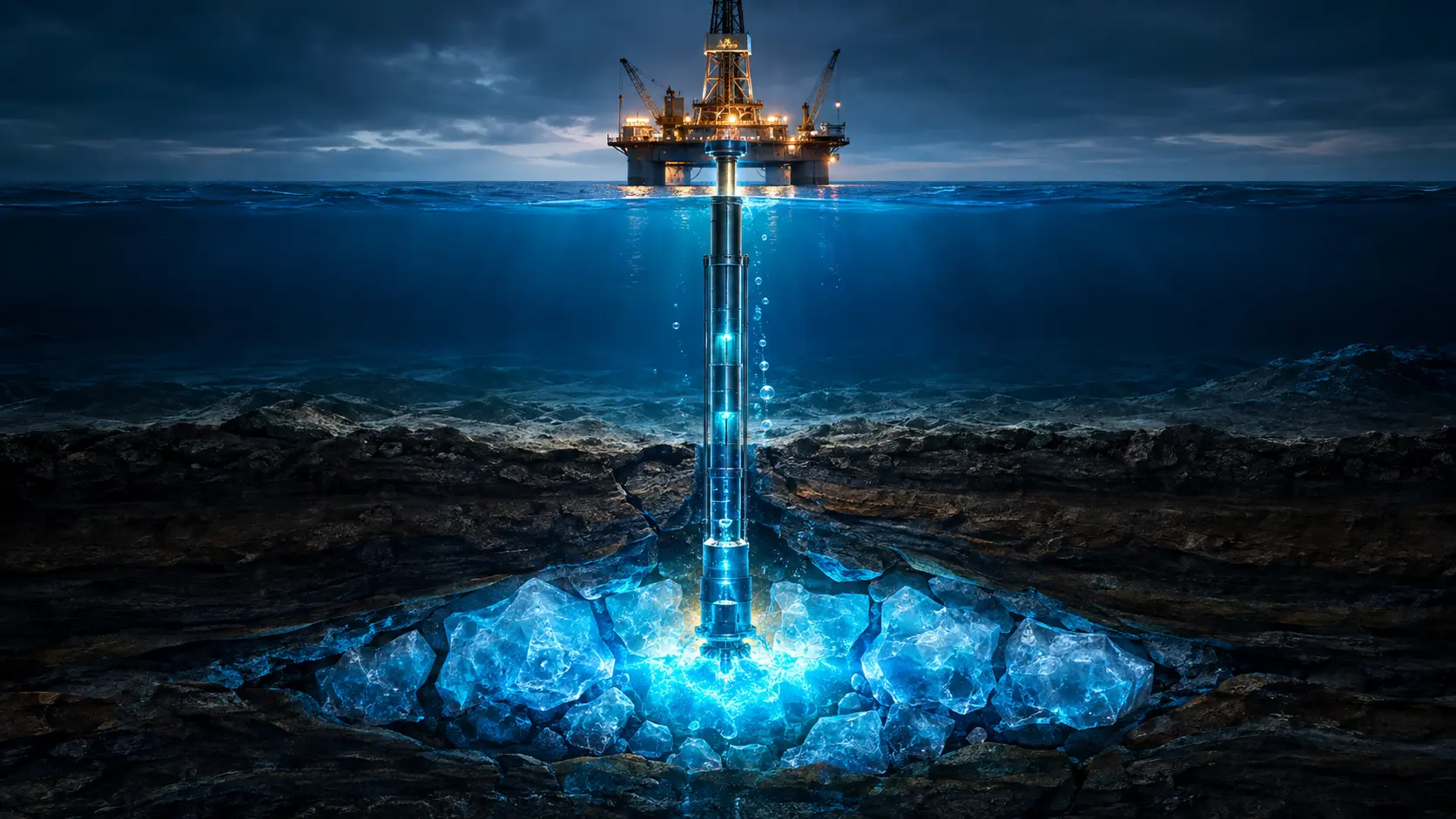

Buried deep along the world’s continental shelves lies a dormant thermodynamic anomaly containing more total energy than all the oil, coal, and conventional natural gas reserves on Earth combined. It is colloquially known as “flammable ice.” For decades, this massive reserve of subsea methane clathrate was considered an untouchable geological curiosity—an extreme environment asset entirely beyond the reach of industrial engineering. That era of deterrence has quietly ended.
Why should you care right now? Because resource-starved superpowers are actively treating the deep ocean floor as the final frontier for absolute energy sovereignty. Nations heavily dependent on energy imports, primarily Japan and China, are deploying advanced deep-water rigs to actively mine this ice, seeking to permanently sever their reliance on Middle Eastern oil and vulnerable Liquefied Natural Gas (LNG) supply chains. However, extracting it requires purposefully destabilizing the high-pressure ice that literally holds the ocean floor together. A single engineering failure during commercial extraction could trigger a massive submarine landslide, unleashing localized tsunamis and venting millions of tons of hyper-potent methane gas directly into the atmosphere. We are watching the dawn of a new global energy paradigm that balances infinite geopolitical leverage against the risk of a catastrophic environmental tipping point.
What is Methane Clathrate Extraction?
Methane clathrate extraction is the industrial process of mining “flammable ice” from the deep ocean floor or permafrost. By lowering the pressure or raising the temperature of these frozen subsea deposits, engineers force the ice lattice to melt, releasing trapped methane gas to be piped to the surface for commercial energy generation.
At a Glance
- Concept: Forcing subsea ice to melt deep underground so the trapped natural gas inside can be vacuumed up to the surface.
- Why it matters: It is the largest untapped hydrocarbon reserve on the planet. Whoever masters its extraction completely controls the global energy market for the next century.
- Who uses it: State-backed energy conglomerates in China (CNOOC) and Japan (JOGMEC), treating the technology as a matter of national security rather than immediate commercial profit.
- Biggest takeaway: You cannot simply scoop the ice up with a submarine. If you bring the ice to the surface, the drop in pressure causes it to violently melt and release the gas into the ocean. The gas must be separated from the ice while still buried under the seabed.
In Simple Words
Imagine a sponge made of pure ice. Inside every tiny hole of that sponge is a tightly packed bubble of methane gas. Because it is resting at the bottom of the ocean, the freezing water and crushing weight of the sea keep the sponge perfectly solid.
If you want the gas, you can’t just dig up the sponge. The moment you pull it up toward the surface, the weight of the water lifts, the sponge instantly melts, and all the gas bubbles float away into the atmosphere.
To harvest it, Methane Clathrate Extraction works in reverse. Engineers drill a pipe directly into the buried ice sponge. They use massive pumps to suck the surrounding water out of the pipe. This artificially lowers the pressure inside the buried sponge. Thinking it has been brought to the surface, the ice sponge begins to melt deep underground, releasing the gas bubbles directly into the pipe where they are safely vacuumed up to a ship.
Why This Matters
For Geopolitical Analysts, Energy Investors, and Oceanographers, methane clathrates solve the Sovereign Energy Deficit.
The geopolitical architecture of the 20th and 21st centuries was built entirely around the geographic luck of conventional oil and gas deposits. Nations like Japan import over 90% of their energy. Their economies are structurally vulnerable to blockades, pipeline sabotage, and Middle Eastern conflicts.
Methane clathrates rewrite the geographic lottery. Japan has an estimated 100-year supply of natural gas locked in the Nankai Trough just off its coast. China possesses massive reserves beneath the politically contested South China Sea. If these nations crack the extraction code, they transition from energy dependents to energy superpowers overnight. This technology neutralizes the geopolitical leverage of traditional petrostates (like Russia and Saudi Arabia) and heavily devalues the trillion-dollar global LNG shipping infrastructure.
Micro-Insight: Methane clathrates are not viewed by Asian superpowers as an economic investment; they are funded as a national defense mechanism. The goal is sovereign survival, not quarterly profit.
The Shift to Subsea Phase-Shifting
We are witnessing the industrialization of Subsea Phase-Shifting.
Traditional oil and gas extraction relies on fluid dynamics: finding a pool of liquid or gas and creating a hole for it to flow out of. Clathrate extraction requires actively changing the physical state of matter under extreme conditions. It demands precise thermodynamic control to force a solid to become a gas without causing the surrounding geological formation to collapse into the void. It is a transition from basic mechanical extraction to advanced geomechanical engineering.
How Does Methane Clathrate Extraction Work?
Extracting gas from a frozen, high-pressure solid requires delicate thermodynamic manipulation. Here is the first-principles breakdown of the architecture.
1. The Fundamental Problem: The Clathrate Lattice
Methane clathrate is not a chemical compound; it is a physical cage. Water molecules form a rigid, crystalline lattice under high pressure and low temperatures, physically trapping a methane molecule inside without chemically bonding to it. Because it is a solid, the methane cannot flow into a wellbore.
2. The Core Mechanism: Depressurization
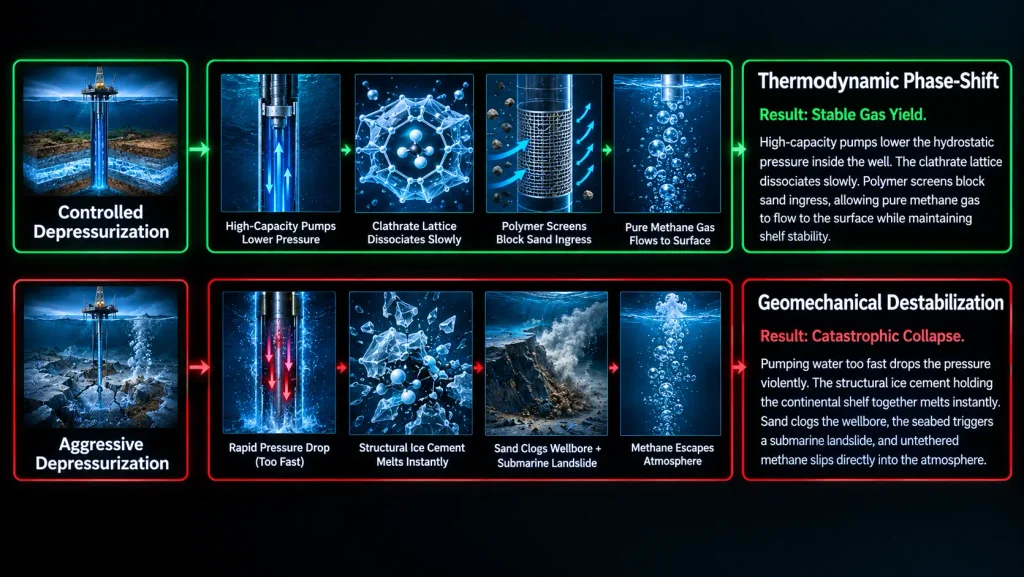
To make the gas flow, the cage must be broken. While you could theoretically pump hot water down the pipe to melt the ice (Thermal Stimulation), it wastes massive amounts of energy. Instead, engineers use Depressurization. They drill a well into the clathrate seam and pump out the surrounding pore water. This drops the localized pressure. The ice lattice becomes unstable, dissociating into liquid water and free methane gas.
3. Technical Depth: Geomechanical Destabilization
Here lies the catastrophic risk. The clathrate ice acts as the structural cement holding the sand, silt, and sediment of the continental shelf together. When you depressurize and melt the ice, the structural integrity of the seabed vanishes. The solid ground turns into a slurry of mud and gas. If extracted too aggressively, the seabed collapses, potentially triggering a submarine landslide massive enough to generate a localized tsunami.
Plain-English Takeaway: The ice is the only thing holding the underwater dirt together. When you melt the ice to get the gas, you turn a solid underwater cliff into a collapsing mudslide.
4. Technical Depth: Wellbore Sand Ingress
As the clathrate melts, the newly freed mud and sand violently rush toward the low-pressure wellbore. During early Japanese and Chinese pilot tests, this “sand ingress” completely clogged the extraction pipes within days, destroying the pumps and halting production. Modern extraction requires highly advanced, multi-stage gravel packs and microscopic polymer mesh screens to filter the gas and water from the abrasive sediment.
5. Real-World Consequences: Methane Slip
Methane is an incredibly aggressive greenhouse gas—84 times more potent than CO2 over a 20-year timeframe. If the wellhead cracks, or if the destabilized seabed opens a fissure, the methane bubbles directly into the ocean. While some is eaten by methanotrophic bacteria, a massive release will reach the surface, venting directly into the atmosphere and accelerating global warming exponentially.
Clathrate Depressurization Simulator
Thermodynamic Extraction vs. Geomechanical Destabilization
Water Pump Rate (Depressurization)
30%
Extraction Architecture
Standard Depressurization
CO₂ Molecular Swapping
Cumulative Gas Yield
0.0 m³
Seabed Structural Stability
100.0%
Methane Slip Risk
Nominal
Subsea Clathrate Lattice & Wellbore Dynamics
WELL IDLE
Thermodynamic Gas Yield vs. Geomechanical Stability
Real-World Applications
Clathrate extraction has moved from theoretical laboratory models to multi-million-dollar offshore test rigs.
The Shenhu Sea Expeditions (China): The China Geological Survey (CGS) has aggressively accelerated its clathrate program in the South China Sea. In their most recent production test, Chinese engineers utilized a horizontal wellbore technique—drilling sideways through the clathrate seam to increase the surface area of depressurization. They successfully extracted continuous methane for over a month, setting global records for daily gas yield. This proved that horizontal drilling, adapted from the shale fracking industry, is the key to scaling commercial hydrate production.
The Nankai Trough Trials (Japan): Japan’s state-owned JOGMEC executed the world’s first offshore production tests in the Nankai Trough. Japan’s primary engineering focus has been defeating the “sand ingress” problem. By deploying advanced shape-memory polymer screens that expand to perfectly fit the wellbore, they successfully blocked the destructive sediment slurry while allowing the methane gas to flow. Japan views this technology as a critical hedge against global LNG price volatility.
Arctic Permafrost Mining (Onshore Tests): Before drilling in the deep ocean, the US, Canada, and Japan partnered to test extraction techniques onshore in the frozen permafrost of the Mallik site in Canada and the North Slope of Alaska. These onshore tests validated the thermodynamic math of depressurization and thermal stimulation in a controlled, easily accessible environment, providing the baseline data required to move rigs out into the unpredictable deep ocean.
Economic & Strategic Impact
The core strategic consequence of clathrate extraction is the Devaluation of the Global LNG Fleet.
Over the last 20 years, hundreds of billions of dollars have been invested in massive Liquefied Natural Gas (LNG) export terminals (in the US, Qatar, and Australia) and specialized cryogenic shipping fleets to transport gas to energy-hungry Asian markets.
If Japan and China achieve commercial-scale, domestic clathrate extraction by 2030 at a cost-competitive rate, their reliance on imported LNG will crater. This will leave massive Western and Middle Eastern export infrastructure economically stranded. The mere threat of viable clathrate extraction acts as a powerful negotiating lever for Asian nations, allowing them to dictate lower prices in long-term global LNG contracts today based on the promise of their energy independence tomorrow.
Advantages of Flammable Ice Extraction
- Absolute Geopolitical Sovereignty: Unlocks decades of domestic energy supply for nations that currently rely on hostile or volatile foreign imports.
- Unmatched Energy Density: The crystalline structure is incredibly dense. One cubic meter of solid methane clathrate expands to release over 160 cubic meters of usable methane gas.
- Cleaner than Coal: While it is still a fossil fuel, burning methane produces roughly half the CO2 of burning coal, allowing developing nations to slash urban smog and baseline carbon emissions during their green transition.
- Leverages Existing Infrastructure: The extracted gas is chemically identical to conventional natural gas. It can be piped directly into existing power plants and municipal grids without any consumer-end retrofitting.
Limitations
- Astronomical CapEx and OPEX: Operating deep-water rigs, managing advanced sand-control telemetry, and treating massive volumes of extracted freezing water currently makes clathrate gas vastly more expensive than standard shale or offshore gas.
- Catastrophic Environmental Risk: The potential for a localized engineering mistake to trigger a massive, uncontainable methane leak presents a global climate liability.
- Geomechanical Landslides: Destabilizing the continental shelf could destroy deep-sea biodiversity and trigger tsunamis, creating severe legal and international diplomatic friction.
Takeaway: The physics of extraction are proven. The barrier to entry is no longer scientific; it is purely a calculation of financial cost versus environmental risk.
Common Misconceptions
Misconception: Flammable ice is a clean, green renewable energy.
Reality: It is fundamentally natural gas (methane). While it burns cleaner than coal, it is a fossil fuel that releases heavy carbon dioxide into the atmosphere. It does not solve the climate crisis; it merely prolongs the natural gas era.
Misconception: We can use submarines to scoop it off the ocean floor.
Reality: Methane clathrates cannot exist at standard surface pressures. If you physically dredge it up, it will violently melt into gas halfway to the surface, creating an explosive hazard for the ship above. The gas must be separated from the water while still locked under the pressure of the seabed.
Misconception: Clathrate mining will immediately lower global energy prices.
Reality: The current cost of extracting gas from clathrates is heavily subsidized by governments. It will likely take a decade of intense mechanical optimization before the gas becomes cheap enough to compete with American shale or Qatari LNG on the open market.
What Most People Miss
The disruptive capability of CO2 Molecular Swapping.
The holy grail of clathrate extraction is “molecular substitution.” Scientists have discovered that under the right pressure, CO2 molecules actually prefer to be inside the ice cage more than methane molecules.
Instead of depressurizing the ice to melt it, engineers pump liquid CO2 (captured from industrial smokestacks) directly into the frozen clathrate seam. The ice cage naturally absorbs the CO2 and spits the methane out. The methane flows up the pipe for energy, and the CO2 remains permanently locked inside the solid ice at the bottom of the ocean. This process simultaneously extracts energy, sequesters carbon dioxide, and keeps the structural ice perfectly solid, completely eliminating the risk of submarine landslides.
Subsea Clathrates vs. Conventional Gas and Shale
| Metric | Conventional Offshore Gas | Shale Gas (Fracking) | Subsea Methane Clathrate |
| Geological State | Free gas trapped under rock | Gas trapped in porous rock | Gas trapped in a solid ice lattice |
| Extraction Mechanism | Mechanical drilling & pressure | High-pressure fluid fracturing | Thermodynamic depressurization |
| Geomechanical Risk | Low (Subsidence) | Moderate (Micro-seismic activity) | Extreme (Seabed collapse) |
| Current Production Cost | Low to Moderate | Very Low | Extremely High (Experimental) |
| Global Reserve Scale | Finite / Depleting | Large but localized | Massive (Larger than all fossil fuels combined) |
Future Outlook
Next 12–24 Months
The era of Extended Production Validation. Through 2027, the focus of state-backed entities like China’s CNOOC will be sustaining production. Previous tests lasted weeks before sand ingress choked the wells. The next milestone is running a deep-water depressurization well continuously for a full calendar year. Success here will prove that the polymer sand-filtration screens and localized pressure management systems are rugged enough for long-term commercial wear and tear.
Next 3–5 Years
The scaling of Sovereign Commercialization. By 2030, we will see the first official “commercial” clathrate extraction rigs deployed in the South China Sea and the Sea of Japan. Crucially, these early operations will likely operate at a financial loss. They will be heavily subsidized by their respective governments, prioritizing energy independence and the reduction of LNG imports over immediate open-market profitability.
Next 10 Years
The Subsea Regulatory War. By the mid-2030s, the global environmental community will mount a massive legal and diplomatic offensive against clathrate mining. As operations scale, the statistical probability of a catastrophic methane slip event increases. Western nations, having abundant onshore energy, will likely push for strict United Nations treaties banning the destabilization of the continental shelf, clashing directly with Asian superpowers who view the deep-sea ice as their sovereign right to industrial survival.
Most Likely Scenario
Methane clathrate extraction represents the ultimate geopolitical trump card. The technology required to safely phase-shift the ocean floor is maturing rapidly, driven by the existential fear of energy dependence. While the economic costs are currently staggering and the environmental risks of methane venting are apocalyptic, history dictates that resource-starved superpowers will not ignore a domestic reserve capable of powering their economies for a century. Clathrate mining will be industrialized; the only question is whether the engineering can outpace the fragility of the seabed.
Key Takeaways
- Methane clathrates (“flammable ice”) contain more energy than all known global oil, coal, and natural gas reserves combined, located under deep oceans and permafrost.
- Because the gas is trapped in solid ice, it cannot be simply drilled. Engineers must use “depressurization” to lower the pressure and melt the ice deep underground to free the gas.
- Melting this ice is incredibly dangerous. The solid ice holds the underwater dirt together. Melting it risks collapsing the seabed, causing submarine landslides and massive methane leaks.
- Nations like Japan and China are leading the charge. Mastering this technology would completely end their reliance on imported foreign energy, upending global geopolitics.
- A future breakthrough called “CO2 Swapping” could allow engineers to inject carbon dioxide into the ice to push the methane out, trapping the carbon forever and keeping the seabed physically stable.
Glossary
Clathrate (Hydrate): A chemical substance consisting of a lattice of molecules (usually water) that physically traps and encages another type of molecule (like methane) without chemical bonding.
Depressurization: The primary method of clathrate extraction. Pumping water out of a wellbore to drop the localized pressure, forcing the solid ice to melt into gas and liquid.
Methane Slip: The unintended and uncontrolled release of raw methane gas directly into the atmosphere during extraction, causing severe immediate climate warming.
Molecular Substitution (CO2 Swapping): An advanced extraction theory where carbon dioxide is pumped into the clathrate lattice, forcing the methane out while keeping the solid structure intact.
Nankai Trough: A deep ocean trench off the coast of Japan containing massive deposits of methane clathrates, serving as the primary testing ground for Japanese extraction tech.
Submarine Landslide: A catastrophic collapse of the seabed slope, often triggered by destabilizing the sediments, which can sever underwater cables and trigger tsunamis.
Sources
Nature Reviews Earth & Environment: The Future of Natural Gas Hydrates: Geopolitics and Extraction
US Department of Energy (DOE) – National Energy Technology Lab: Methane Hydrate R&D Program
Japan Oil, Gas and Metals National Corporation (JOGMEC): Nankai Trough Hydrate Production Test Results
China Geological Survey (CGS): Shenhu Area Clathrate Horizontal Drilling and Sand Control
Energy Policy Journal: The Strategic Implications of Unconventional Deepwater Gas Hydrates in the South China Sea