Advertisement
)
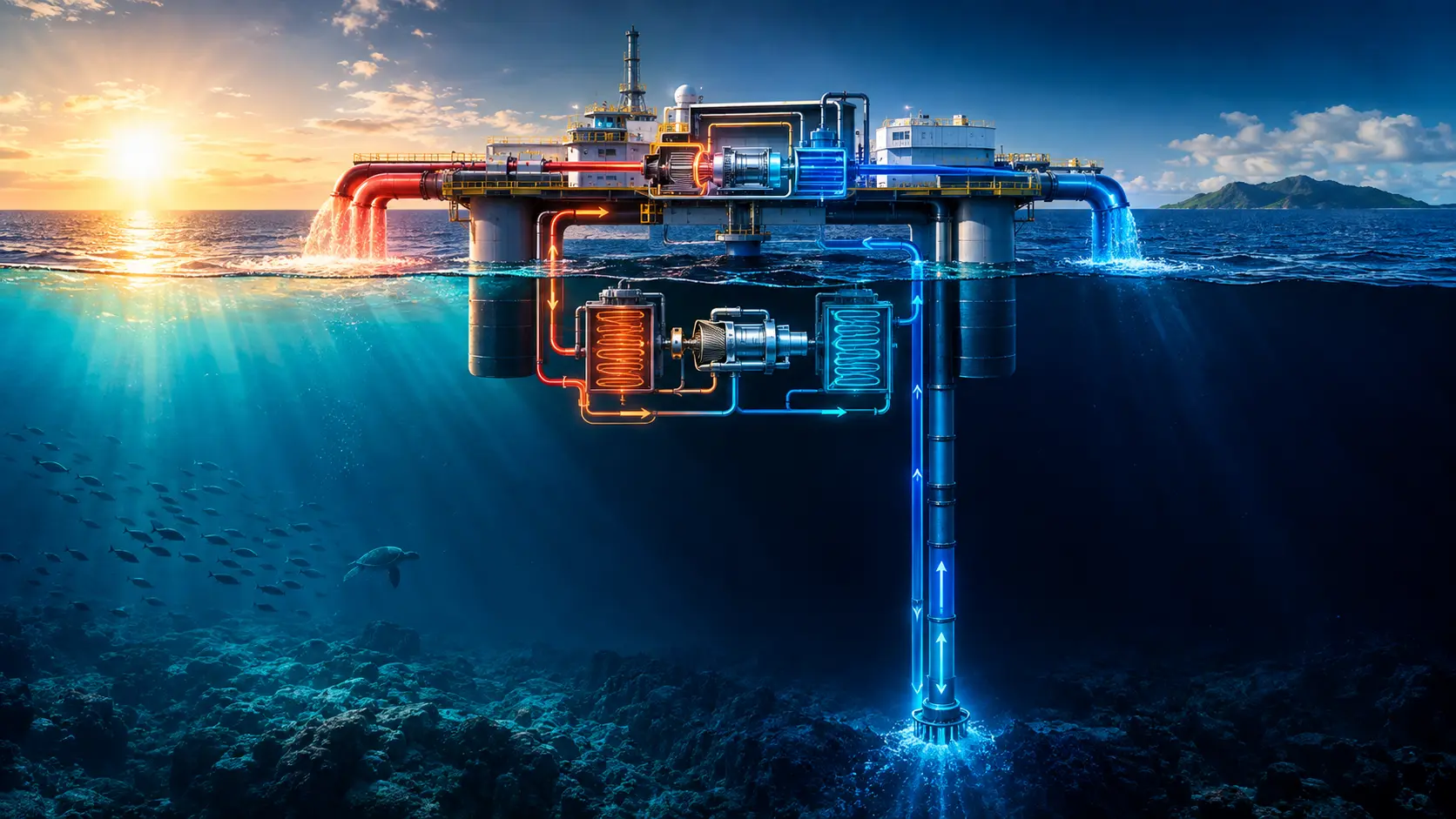

The global transition to renewable energy has a massive, multi-trillion-dollar blind spot: the sun sets, and the wind stops blowing. To keep modern electrical grids from collapsing at night, utilities are forced to build astronomically expensive lithium-ion battery banks or burn natural gas. But for island nations sitting in the middle of the equatorial belt, building batteries to store solar power is a frustrating redundancy. They are already surrounded by the largest solar battery on Earth. The surface of the tropical ocean absorbs massive amounts of solar radiation all day, storing it as heat, while a mile straight down, freezing polar currents creep silently along the seabed.
Why should you care right now? Because engineers are learning how to short-circuit this natural temperature gap. Ocean Thermal Energy Conversion (OTEC) functions like a massive refrigerator running in reverse. By simultaneously pumping warm surface water and freezing deep water through a specialized offshore rig, OTEC generates infinite, clean, 24/7 electricity. It is the holy grail of marine engineering: a permanent marine baseload power source that could completely eradicate the geopolitical chokehold of imported diesel for the entire global South.
What is Ocean Thermal Energy Conversion (OTEC)?
Ocean Thermal Energy Conversion (OTEC) is a marine renewable energy technology that generates continuous electricity. It uses warm surface seawater to boil a low-boiling-point fluid (like ammonia) into vapor to spin a turbine, and then uses freezing deep-ocean water to condense the vapor back into liquid, creating a closed-loop power cycle.
At a Glance
- The Physics Problem: Solar and wind power require expensive batteries to provide power at night.
- The OTEC Solution: Use the warm top layer of the ocean as the “sun” and the freezing bottom layer as the “exhaust.” The temperature difference drives a permanent, 24-hour steam engine.
- The Mechanism: Instead of boiling water to make steam, OTEC boils liquid ammonia, which turns into high-pressure gas at room temperature.
- The Target Market: Tropical island nations (like Hawaii or the Maldives) that currently import massive amounts of expensive diesel fuel by cargo ship just to keep their lights on.
In Simple Words
A traditional coal power plant works by burning coal to boil water into steam. The high-pressure steam spins a turbine to make electricity, and then cold river water cools the steam back down to liquid so the cycle can start again.
OTEC is a steam engine, but it removes the fire.
Because ocean surface water is only about 25 degrees Celsius (77 degrees Fahrenheit), it isn’t hot enough to boil normal water. So, OTEC uses a trick: it fills a closed pipe with liquid ammonia. Ammonia boils into a high-pressure gas at very low temperatures. When the warm ocean surface water runs over the pipe, the ammonia instantly boils, and the resulting gas spins a turbine.
To complete the cycle, you need to cool the ammonia gas back into a liquid. The OTEC plant drops a massive pipe 1,000 meters straight down into the ocean to suck up freezing cold deep-sea water. This icy water chills the ammonia back to a liquid, and the cycle repeats. You get permanent, spinning power using nothing but the natural heat of the tropical sea.
Why This Matters
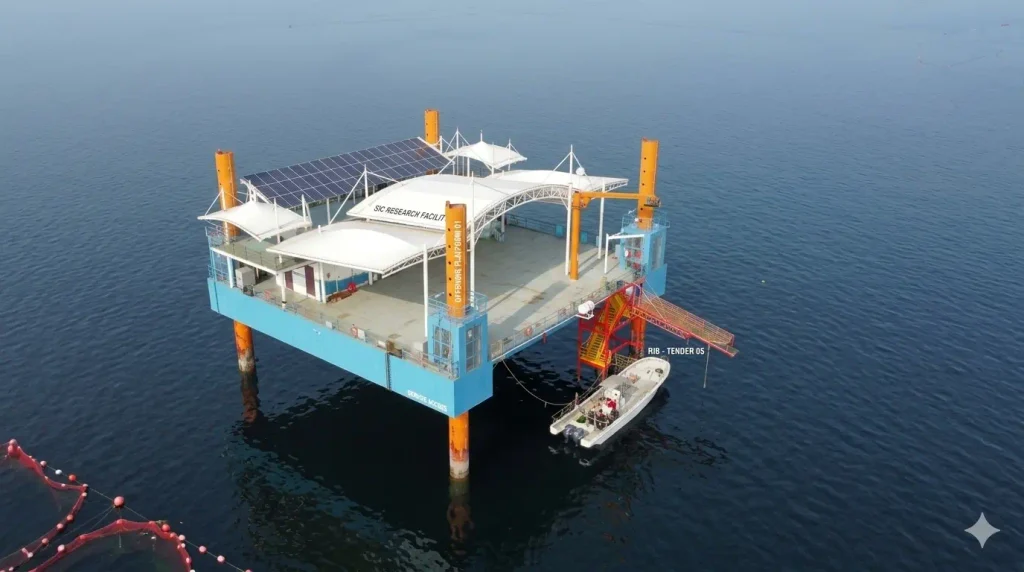
For Utility Planners, Energy Investors, and ESG Analysts, OTEC solves the Island Nation Diesel Trap.
If you live in London or Texas, you generate power using massive, interconnected natural gas or nuclear grids. If you live in a tropical island nation or a remote military base, you are entirely isolated. Most island nations generate 90 percent of their electricity by burning diesel fuel. That fuel must be purchased on volatile global markets, loaded onto tankers, and shipped thousands of miles across the ocean. This makes island electricity some of the most expensive and geopolitically vulnerable power on Earth.
OTEC completely severs this dependency. Because it requires a steep drop-off to reach deep, cold water quickly, volcanic islands (which drop straight into the abyss) are the perfect geographic beachhead for the technology. By installing a 10-megawatt OTEC plant offshore, an island nation replaces foreign diesel shipments with a sovereign, infinite, 24/7 baseload power supply, fundamentally restructuring their macroeconomic independence.
Micro-Insight: The ocean acts as a perfect thermal insulator. Even if the sun doesn’t shine for a week, the surface water remains warm enough to run an OTEC plant continuously at 100 percent capacity.
Thermodynamic Limits: The Carnot Efficiency Challenge
We are witnessing the confrontation with the Carnot Efficiency Limit.
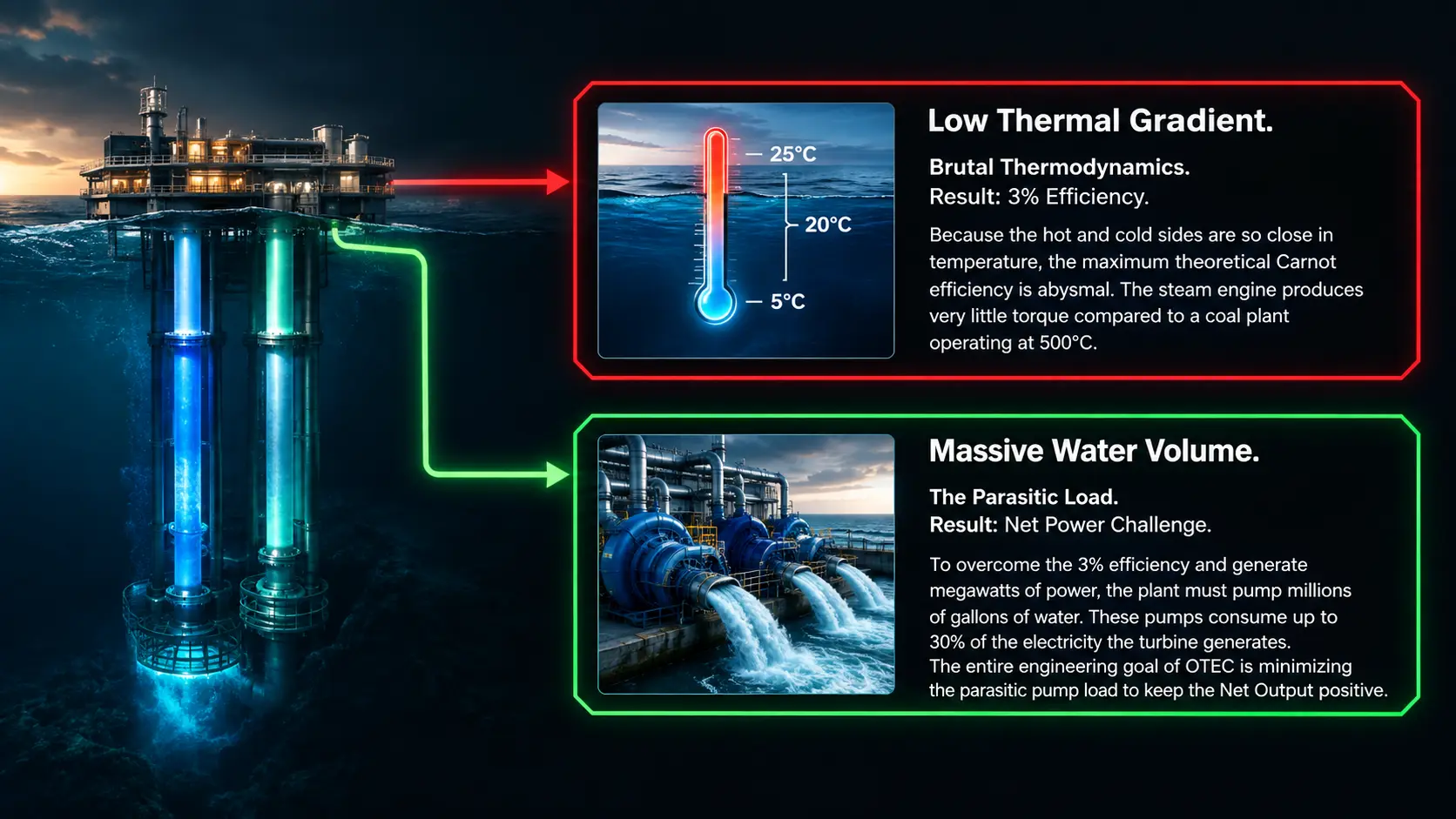
Every thermodynamic engine in the universe is bound by Carnot’s Theorem: the maximum efficiency of an engine is dictated strictly by the difference in temperature between its hot side and its cold side. A coal plant operates with a massive 500-degree temperature difference, making it highly efficient. OTEC operates with a pathetic 20-degree temperature difference.
Because the thermodynamic efficiency is so incredibly low (often practically hovering around 2 to 3 percent), an OTEC plant must move gargantuan, biblical volumes of water to extract a useful amount of energy. The story of OTEC is not a story of advanced quantum physics; it is a story of extreme, brute-force civil engineering required to pump rivers of water vertically through the ocean.
How Ocean Thermal Energy Conversion (OTEC) Works
Extracting meaningful electricity from a 20-degree temperature gap requires scaling standard refrigeration mechanics to industrial proportions. Here is the first-principles breakdown of the architecture.
1. The Fundamental Problem: Low Heat Quality
In a standard power plant, high heat means high pressure, which easily spins a small, fast turbine. Because OTEC relies on warm water that is barely 25 degrees Celsius, it has incredibly low “heat quality.” You cannot generate high pressure. Therefore, to get a turbine to spin with enough torque to generate megawatts of power, you must flow an absurd volume of working fluid through a massive, slow-moving turbine.
2. The Core Mechanism: The Closed-Cycle Rankine System
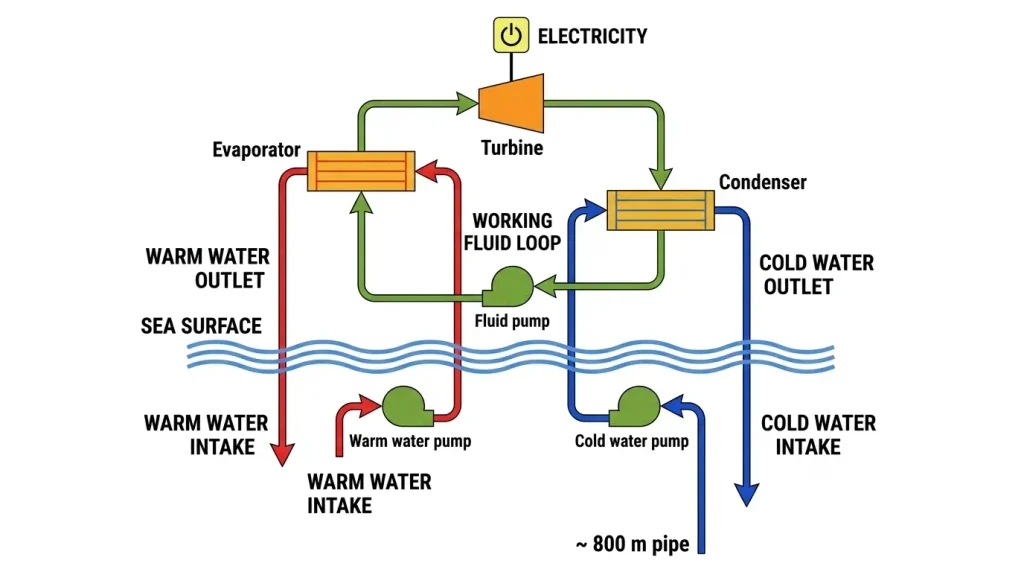
Most modern OTEC designs use a closed-cycle OTEC system. The system contains a working fluid (anhydrous ammonia) trapped in a closed loop. Ammonia is used because it boils at just -33 degrees Celsius at normal atmospheric pressure, meaning warm seawater is more than hot enough to violently vaporize it.
3. Technical Depth: Evaporation and Expansion
Pumps pull massive volumes of warm surface seawater (around 26 degrees Celsius) through a Titanium Heat Exchanger (the Evaporator). Inside the heat exchanger, the warm water transfers its heat to the closed ammonia loop. The ammonia flashes into a pressurized vapor. This vapor expands rapidly, rushing through and spinning a custom-designed, low-pressure turbine connected to an electrical generator.
4. Technical Depth: The Cold Water Pipe (CWP)
To keep the turbine spinning, the ammonia gas must be condensed back into a liquid so it can be pumped back to the start. This requires the defining component of OTEC: the Cold Water Pipe (CWP).
The plant drops a massive, rigid pipe (often made of fiberglass or high-density polyethylene) straight down to a depth of 800 to 1,000 meters. Massive pumps suck up the deep, icy ocean water (around 4 degrees Celsius). This cold water flows through a second Titanium Heat Exchanger (the Condenser), chilling the ammonia gas back into a liquid.
5. Real-World Consequences: Parasitic Load
Because OTEC efficiency is so low, it requires massive industrial pumps to constantly move millions of gallons of both warm and cold seawater through the heat exchangers. These pumps consume electricity. In many pilot plants, the pumps consume up to 30 percent of the total electricity the plant generates. This is called the “parasitic load.” If the heat exchangers foul with algae, or the pumps lose efficiency, the parasitic load can exceed the generated power, meaning the plant consumes more energy than it creates.
OTEC Thermodynamic Simulator
Closed-Cycle Marine Baseload & Temperature Gradient Dynamics
Surface Seawater Temp (T_H)
25 °C
Deep Ocean Temp (T_C)
5 °C
Carnot Efficiency Limit
6.71%
Parasitic Pump Load
-4.0 MW
Net Power Output
3.0 MW
Closed-Cycle Ammonia Architecture
STANDBY
Power Generation vs. Parasitic Load over Time
Real-World Applications
After decades of false starts, OTEC is finally moving from the theoretical fringes to active grid integration.
Makai Ocean Engineering (Hawaii): Hawaii is the global epicenter for OTEC research due to its volcanic drop-offs and crippling reliance on imported diesel. Makai Ocean Engineering operates an active 105-kilowatt closed-cycle demonstration plant at the Natural Energy Laboratory of Hawaii Authority (NELHA). This facility has proven the continuous grid-connection capability of OTEC and serves as the primary testbed for advanced, corrosion-resistant titanium and aluminum heat exchangers.
Desalination and Deep Ocean Water (DOW) Byproducts: OTEC is not just an energy play; it is an infrastructure multi-tool. Open-cycle OTEC systems (which flash seawater into vapor instead of using ammonia) produce pure, distilled freshwater as a byproduct of condensation. Furthermore, the cold water brought up from the deep ocean is pathogen-free and incredibly rich in nutrients. Facilities use this discharged cold water for massive onshore aquaculture (fish farming) and district cooling (running cold water through hotel air conditioning systems instead of using electricity).
Strategic Military Bases: The US Department of Defense has aggressively funded OTEC research for strategic installations like Diego Garcia or Guam. These remote bases currently require highly vulnerable maritime supply chains just to ship diesel for their generators. A single, submerged OTEC facility would grant these bases total energy independence, rendering a hostile blockade of fuel shipments strategically useless.
Economic & Strategic Impact
The core strategic consequence of OTEC is the Geopolitical Unlocking of the Equatorial Belt.
Currently, the geopolitical power map is defined by fossil fuels (the Middle East) and critical mineral supply chains for batteries and solar panels (China). OTEC creates an entirely new class of energy superpower: the equatorial archipelago.
Nations comprising the global “Global South” across the Pacific, Indian, and Atlantic oceans sit directly on top of the world’s most pristine, uninterrupted thermal gradients. When evaluating OTEC vs offshore wind, if commercial-scale OTEC reaches cost parity, these nations will transition from energy-impoverished importers to totally energy-sovereign entities. They hold the monopoly on the geography required for the technology.
Advantages of OTEC Marine Baseload Power
- 24/7 Baseload Power: Unlike solar or wind, OTEC operates flawlessly at night, during storms, and across seasons, entirely eliminating the need for grid-scale battery storage.
- Zero Fuel Costs: The “fuel” is the ambient temperature of the ocean, which is completely immune to geopolitical supply shocks or market volatility.
- Valuable Co-Products: Can be engineered to simultaneously produce millions of gallons of desalinated drinking water, air conditioning cooling, and nutrient-rich water for aquaculture.
- High Capacity Factor: Can routinely achieve a 90 to 95 percent capacity factor, directly matching the reliability of nuclear or natural gas plants.
Engineering Challenges: Cold Water Pipes and Biofouling
- The Cold Water Pipe Bottleneck: Suspending a rigid pipe with a 10-meter diameter over 1,000 meters into the abyss is a severe cold water pipe engineering challenge. Rogue waves and deep-sea currents exert massive shear forces that can easily snap the pipe.
- Astronomical Capital Expenditure (CapEx): Building an offshore rig, manufacturing bespoke low-pressure turbines, and assembling the titanium heat exchangers makes the upfront cost of a 100MW OTEC plant prohibitively expensive (often exceeding 1 billion dollars).
- Biofouling: The warm surface water is teeming with microscopic marine life. If barnacles and algae build up inside the microscopic channels of the heat exchangers, the thermal transfer efficiency drops to zero. The system requires constant, aggressive mechanical and chemical cleaning.
Takeaway: OTEC requires the upfront capital of a nuclear plant combined with the offshore hazard risk of an ultra-deepwater oil rig, all to capture a thermal gradient the width of a rounding error. It is a masterpiece of extreme engineering operating on the razor’s edge of physics.
Common Misconceptions
Misconception: OTEC boils water like a normal power plant.
Reality: Closed-cycle OTEC never boils water. It uses warm seawater merely as a heating pad to boil liquid ammonia, which vaporizes at room temperature.
Misconception: OTEC can be built anywhere in the ocean.
Reality: OTEC is strictly limited to the equatorial belt. You need a permanent surface temperature of at least 25 degrees Celsius, and you need a steep drop-off to reach deep water quickly. If you have to run a pipe 100 miles offshore just to reach deep water, the friction in the pipe destroys the efficiency.
Misconception: OTEC harms marine life by sucking up fish.
Reality: The intake pipes are massive, but the water velocity entering the pipes is engineered to be incredibly slow (often less than 0.5 meters per second). Fish and marine mammals easily swim away from the intake screens.
What Most People Miss
The disruptive capability of Ocean Thermal Energy for Green Hydrogen.
Because island nations have tiny electrical grids, building a massive, highly efficient 100-megawatt OTEC plant is often overkill—the island simply cannot absorb that much power.
The true endgame for utility-scale OTEC is the “Energy Island.” Instead of running a transmission cable to a tiny island, operators deploy massive, floating OTEC rigs in the deep equatorial Pacific. The rig uses 100 percent of its generated baseload electricity to power onboard electrolyzers, ripping seawater apart to create Green Hydrogen or Green Ammonia. Cargo ships arrive, load up the liquid hydrogen fuel, and transport it to Japan or Europe. OTEC transforms the empty, remote ocean into an infinite fuel refinery.
Comparison Table
| Metric | Offshore Wind | Solar Photovoltaic (PV) | OTEC |
| Availability (Capacity Factor) | ~40% – 50% (Intermittent) | ~20% – 30% (Intermittent) | ~90% – 95%(Baseload) |
| Energy Storage Required | Massive (Lithium-ion / Pumped hydro) | Massive (Lithium-ion) | None |
| Thermodynamic Efficiency | High (Kinetic) | Moderate (Photoelectric) | Extremely Low (~3%) |
| Footprint / Scale | Massive surface area required | Massive surface area required | Deep vertical infrastructure |
| Geographic Constraint | High consistent winds required | High irradiance required | Strictly Equatorial (Deep drop-offs) |
Future Outlook
Next 12–24 Months
The era of Advanced Heat Exchanger Metallurgy. Because OTEC’s margin for error is so thin, engineers must maximize thermal transfer. Titanium is perfect but too expensive. Over the next two years, the industry will pivot toward friction-stir-welded aluminum heat exchangers. By proving that cheap aluminum can withstand the corrosive marine environment for 20 years using advanced protective coatings, the capital cost of a pilot OTEC plant will plummet by up to 30 percent.
Next 3–5 Years
The scaling of 10-Megawatt Commercial Pilots. By 2030, we will see the successful deployment of the first true commercial-scale (5 to 10 MW) floating OTEC facilities, likely commissioned by a consortium in the Caribbean or Southeast Asia. These plants will serve dual purposes, generating baseload electricity while simultaneously providing millions of gallons of desalinated water to coastal resorts, proving the multi-revenue economic model required to attract Wall Street infrastructure funds.
Next 10 Years
The Deep-Water Composite Revolution. By the mid-2030s, the primary bottleneck—the Cold Water Pipe—will be solved by the aerospace industry. The same advanced carbon-fiber and thermoplastic composites used to build the fuselages of next-generation aircraft will be adapted for subsea environments. These composite pipes will be extruded continuously on-site from ships, creating seamless, lightweight, indestructible pipes capable of hanging 1,500 meters deep, definitively unlocking gigawatt-scale OTEC arrays globally.
Most Likely Scenario
OTEC is the dark horse of the renewable energy transition. While it cannot compete with the sheer cheapness of solar panels in a desert, it offers something solar never can: sovereign, infinite baseload power that does not require a single lithium-ion battery. Driven by the existential desperation of island nations trapped by diesel imports and rising sea levels, OTEC will secure a permanent, lucrative foothold in the equatorial belt, eventually scaling into floating mid-ocean refineries that export green hydrogen to the industrialized world.
Key Takeaways
- Solar and wind are intermittent. OTEC generates 24/7 baseload power by acting as a massive thermodynamic engine powered by the ocean’s natural temperature differences.
- The system boils a fluid like ammonia using warm surface water, spins a turbine, and condenses the vapor back into liquid using freezing deep-ocean water.
- Because the temperature difference is small (only 20 degrees Celsius), the theoretical Carnot efficiency is extremely low, meaning OTEC must pump biblical volumes of water to generate megawatts.
- The primary engineering challenge is the Cold Water Pipe (CWP)—suspending a massive, rigid pipe over a kilometer deep into the ocean to reach cold water without it snapping in the current.
- OTEC is the ultimate geopolitical unlock for tropical island nations, providing them with total energy independence from imported diesel fuel.
Glossary
Baseload Power: The minimum amount of electrical power needed to be supplied to the electrical grid continuously, 24/7. Solar cannot provide this without batteries; OTEC provides it naturally.
Capacity Factor: The ratio of the actual electrical energy produced by a plant over a given period compared to its maximum possible output. OTEC boasts a >90% capacity factor.
Carnot Efficiency Limit: A law of thermodynamics stating that the maximum efficiency of any heat engine depends entirely on the difference in temperature between the hot source and the cold sink.
Closed-Cycle System: An OTEC design that uses a trapped working fluid (like ammonia) that is continuously boiled and condensed, never mixing with the seawater.
Cold Water Pipe (CWP): The massive, critical infrastructure pipe dropped 1,000 meters deep into the ocean to suck up the freezing water required to condense the ammonia vapor.
Working Fluid: A substance, such as anhydrous ammonia, chosen for its low boiling point, allowing it to flash into vapor when exposed to relatively cool (25 degrees C) surface seawater.
Sources
National Renewable Energy Laboratory (NREL): Ocean Thermal Energy Conversion Technology and Economics
Makai Ocean Engineering: OTEC Development at the Natural Energy Laboratory of Hawaii Authority
International Renewable Energy Agency (IRENA): Innovation Outlook: Ocean Energy Technologies
IEEE Journal of Oceanic Engineering: Structural Analysis and Design of OTEC Cold Water Pipes
US Department of Energy (DOE): Marine Energy Basics and Closed-Cycle OTEC