Advertisement
)

Electrifying a commercial aircraft using today’s lithium-ion batteries is a mathematical impossibility. The energy density of standard battery chemistry requires so much physical weight that a plane would struggle to lift its own power supply, let alone its passengers or cargo. While electric vehicles can absorb the penalty of a heavy steel chassis, the aerospace industry operates under a brutal, unforgiving dictatorship of mass. If we want to decarbonize aviation, we must fundamentally alter the periodic table of energy storage.
Why should you care right now? Because materials scientists have finally tamed the most promising lightweight chemistry on Earth: Lithium-Sulfur. Sulfur is abundant, dirt-cheap, and offers an energy density five times higher than standard lithium-ion. Historically, these batteries were a commercial failure because the sulfur literally dissolved and destroyed the battery from the inside out after just fifty charges. However, by engineering microscopic molecular nets to trap these dissolving chemicals, researchers have neutralized this self-destruction. Lithium-Sulfur has officially crossed the 500 Wh/kg threshold, unlocking the genuine possibility of commercial electric flight.
What are Lithium-Sulfur (Li-S) Batteries?
Lithium-Sulfur (Li-S) batteries are advanced energy storage devices that utilize a lithium metal anode and a sulfur cathode to achieve exceptionally high gravimetric energy density. They store up to five times more energy per kilogram than traditional lithium-ion batteries by relying on lightweight, globally abundant chemical materials.
At a Glance
- The Physics Problem: Standard lithium-ion batteries carry dead weight. They use heavy metals (nickel, cobalt) as rigid shelves to store lithium ions.
- The Li-S Solution: Remove the heavy shelves. Lithium and sulfur react directly together, drastically reducing the physical weight of the battery.
- The Fatal Flaw: The “Polysulfide Shuttle.” When sulfur reacts with lithium, it turns into a liquid, floats across the battery, and ruins the anode.
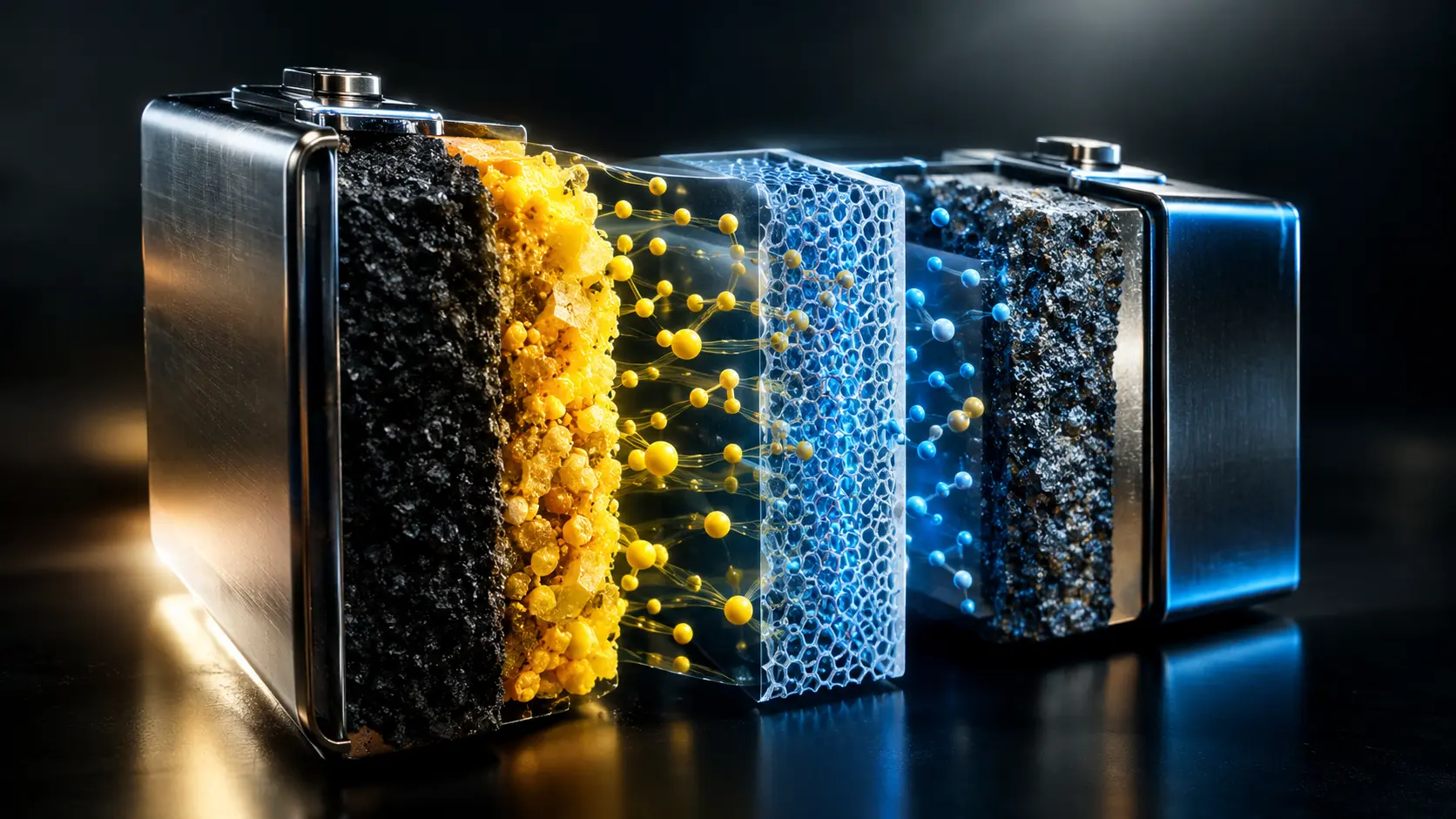
- The Fix: Inserting a microscopic, highly engineered filter (a Metal-Organic Framework) that lets power flow but traps the liquid sulfur in place.
In Simple Words
Imagine a traditional Lithium-Ion Battery as a heavy wooden bookcase. To store books (energy), you need thick, heavy shelves (cobalt and nickel). The books themselves aren’t that heavy, but the wooden shelves weigh a ton. This limits how many books you can carry on an airplane.
A Lithium-Sulfur (Li-S) Battery gets rid of the wooden shelves entirely. It stores the books in a lightweight mesh bag (sulfur). Because the bag weighs almost nothing, you can carry five times as many books for the exact same weight.
The problem was that the mesh bag used to melt. When the battery was used, the sulfur would turn into a liquid syrup, leak out of the bag, float to the other side of the battery, and permanently gum up the machinery. This is called the Polysulfide Shuttle.
To fix this, scientists installed a high-tech coffee filter down the middle of the battery. The filter’s holes are so small that the electricity can pass through, but the sticky sulfur syrup is physically blocked and forced to stay where it belongs. The battery stays light, and it stops destroying itself.
Why This Matters
For Aerospace Engineers, Battery VCs, and Supply Chain Execs, Li-S solves the Gravimetric Density Ceiling.
In the battery industry, energy density is measured in two ways: Volumetric (how much space it takes up) and Gravimetric (how much it weighs). While aerospace requires a high gravimetric energy density battery, for consumer electronics and passenger cars, volumetric density matters most; you only have so much space inside an iPhone or under a car floorboard. Lithium-ion dominates here.
However, for electric Vertical Takeoff and Landing (eVTOL) aircraft, drones, and high-altitude satellites, space is flexible, but weight is strictly lethal. Standard lithium-ion batteries mathematically max out around 300 Watt-hours per kilogram (Wh/kg). The physics simply will not allow them to get any lighter. Li-S fundamentally breaks this ceiling, routinely achieving 500 Wh/kg in commercial prototypes and charting a clear path toward 800 Wh/kg.
Micro-Insight: You do not put a Lithium-Sulfur battery in a Tesla Model 3. It takes up too much physical space. You put it in an electric air taxi, where halving the battery’s weight doubles the aircraft’s profitable payload.
Decoupling Energy Storage from Nickel and Cobalt Supply Chains
We are witnessing the Decoupling of Energy Storage from Heavy Metallurgy.
The geopolitical bottleneck of the 21st century is the refinement of rare and heavy metals—specifically cobalt, nickel, and manganese. These metals are environmentally destructive to mine, highly concentrated in vulnerable supply chains, and incredibly expensive. Sulfur is the exact opposite. It is one of the most abundant elements on Earth, often treated as an annoying, near-worthless waste byproduct of the petroleum refining industry. Li-S transitions global battery production from scarce, expensive heavy metals to abundant, dirt-cheap non-metals.
How Lithium-Sulfur (Li-S) Batteries Work
Moving from rigid heavy metals to lightweight sulfur requires abandoning “intercalation” physics and embracing “conversion” chemistry. Here is the first-principles breakdown of the architecture.
1. The Fundamental Problem: Intercalation Weight
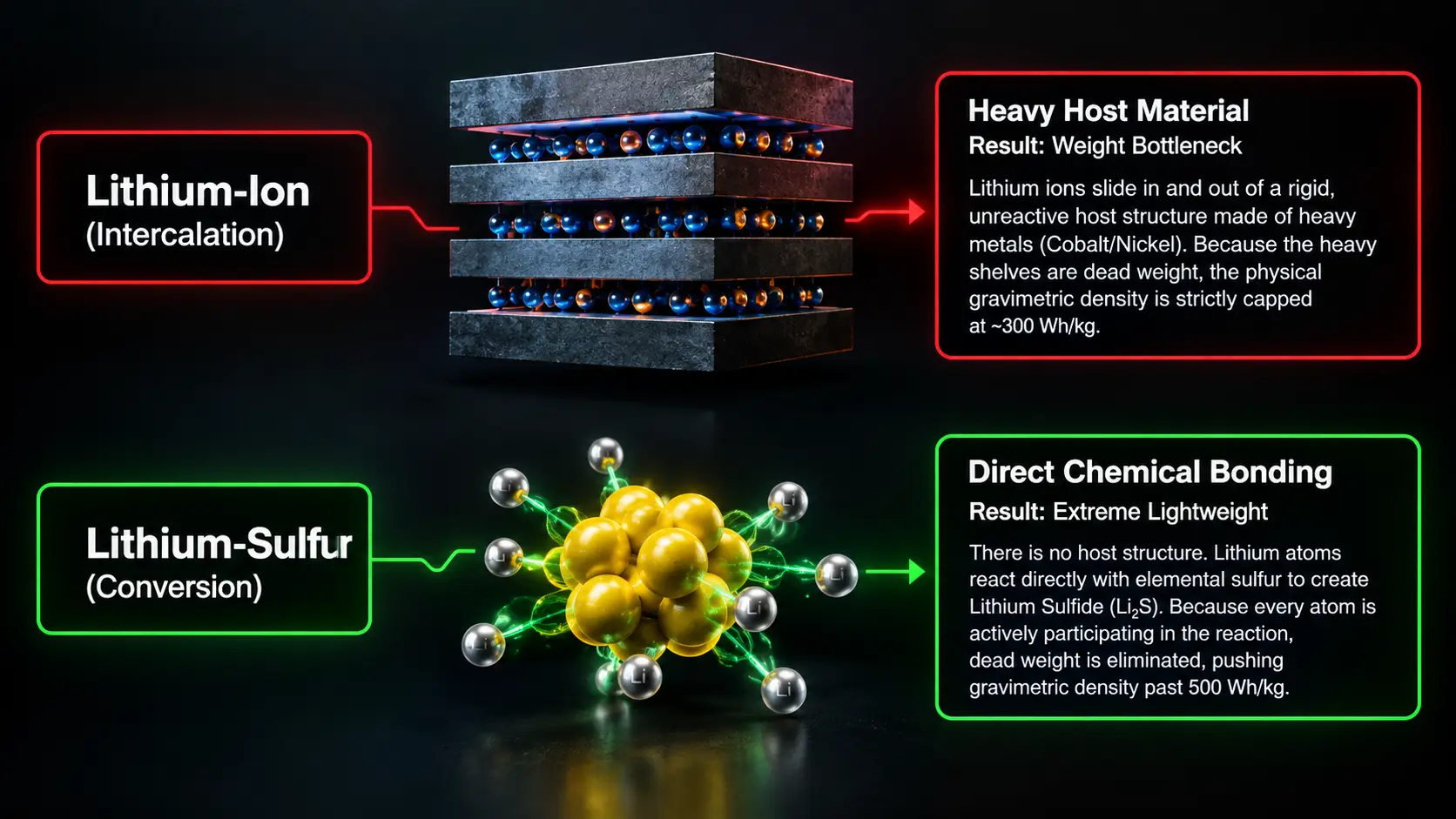
Standard batteries use intercalation. Think of it like sliding a car into a parking garage. The lithium ions are the cars, and the cobalt/graphite structures are the concrete parking garage. The garage does not react; it just holds the lithium. The concrete garage is heavy, dead weight that provides zero energy.
2. The Core Mechanism: Conversion Chemistry
Li-S uses conversion chemistry. There is no parking garage. The lithium anode physically chemically bonds with the sulfur cathode. During discharge, the solid sulfur (S₈) reacts with lithium ions to form solid lithium sulfide (Li₂S). Because every atom is actively participating in the chemical reaction, there is virtually no dead weight.
3. Technical Depth: The Polysulfide Shuttle Effect
- The reaction from S₈ to Li₂S does not happen in one clean step. It goes through intermediate phases, forming long-chain lithium polysulfides (Li₂S₈, Li₂S₆, Li₂S₄).
Here lies the fatal flaw known as the polysulfide shuttle effect: these long-chain polysulfides are highly soluble in the liquid electrolyte that fills the battery. They dissolve into a liquid, detach from the cathode, and drift across the battery to the lithium anode. Once they touch the anode, they react parasitically, permanently plating the anode with an insulating layer of sulfur. They then shuttle back to the cathode. This endless loop wastes active material, draining the battery’s capacity to zero within a few dozen cycles.
Plain-English Takeaway: As the battery discharges, the sulfur turns into a liquid and swims away, coating the engine of the battery in an insulating sludge until it chokes and dies.
4. Technical Depth: MOF Ion-Selective Separators
To stop the shuttle, engineers must separate the two sides of the battery using a barrier that only allows pure lithium ions to pass, while blocking the long polysulfide chains.
They achieve this using Metal-Organic Frameworks (MOFs). MOFs are highly engineered, crystalline materials that look like molecular scaffolding. By applying a microscopic layer of MOF to create a specialized MOF battery separator, scientists create an atomic sieve. A lithium ion is roughly 0.07 nanometers wide and passes through the MOF easily. A dissolved polysulfide chain is roughly 1.0 to 2.0 nanometers wide and crashes into the MOF barrier, physically trapping the sulfur on the correct side of the battery.
5. Real-World Consequences: Stable Cycle Life
By mechanically enforcing the separation of chemicals, MOF interlayers have effectively neutralized the polysulfide shuttle. Modern commercial Li-S prototypes can now endure hundreds of deep charge and discharge cycles with minimal capacity degradation, crossing the viability threshold required by commercial aerospace regulators.
Li-S Battery: Polysulfide Shuttle Simulator
Evaluating Capacity Fade and MOF Ion-Selective Barrier Mitigation
Charge/Discharge Rate (C-Rate)
1.0 C
Separator Architecture
Standard Polymer
MOF Barrier (Ion Sieve)
Charge/Discharge Cycles
0 / 100
Capacity Retention
100.0%
Anode Integrity Status
PRISTINE
Li-S Cell Cross-Section
STANDBY
Capacity Fade Degradation Curve
Real-World Applications
With the shuttle effect mitigated, aerospace and defense contractors are aggressively pulling Li-S out of the laboratory and into the sky.
High-Altitude Pseudo-Satellites (HAPS): Companies like Airbus are developing HAPS—massive, ultra-lightweight drones that fly in the stratosphere for months at a time, functioning as temporary cellular towers or reconnaissance platforms. Because they rely entirely on solar panels during the day, they need exceptionally light batteries to survive the night without losing altitude. Li-S is the only chemistry capable of providing the necessary overnight power density without dragging the drone back to earth.
Electric Vertical Takeoff and Landing (eVTOL): The urban air mobility market (flying taxis) is severely constrained by lithium-ion batteries. Hovering requires immense, sustained power output, which drains standard batteries rapidly, limiting flight ranges to a mere 30–50 miles. Integrating Li-S multi-layer pouch cells allows manufacturers to double the operational range of their aircraft, transitioning the business model from local city-hops to lucrative regional transport (e.g., Manhattan to the Hamptons).
Heavy-Duty Freight and Defense: While Li-S is too physically large for sleek sports cars, it is perfectly suited for heavy-duty commercial trucking and military logistics. A Class 8 semi-truck using standard lithium-ion loses thousands of pounds of cargo capacity just to haul its own battery. Replacing it with a Li-S pack returns that weight limit to the logistics company, increasing freight profitability while maintaining zero emissions.
Economic & Strategic Impact
The core strategic consequence of Li-S is The Elimination of the Cathode Supply Chain Chokehold.
The global lithium-ion market is currently held hostage by the geographical concentration of critical minerals. The Democratic Republic of Congo controls the vast majority of the world's cobalt, while a handful of nations control nickel refining. This creates severe price volatility and massive geopolitical leverage.
Sulfur is ubiquitous. It is an industrial byproduct of the oil and gas desulfurization process. Millions of tons of elemental sulfur are currently sitting in massive, bright yellow pyramids outside petroleum refineries in North America and the Middle East, practically given away for free. By swapping nickel and cobalt for sulfur, Li-S radically de-risks the battery supply chain, insulating manufacturers from geopolitical embargoes and catastrophic commodity price spikes.
Advantages of Lithium-Sulfur (Li-S) Batteries in Aviation
- Extreme Gravimetric Density: Routinely surpasses 500 Wh/kg, offering double to quintuple the energy-to-weight ratio of traditional lithium-ion.
- Abundant, Ultra-Cheap Materials: Sulfur costs mere pennies per kilogram compared to the astronomical prices of refined cobalt and nickel.
- Safety Profile: Unlike lithium-ion metal oxides, sulfur cathodes do not contain oxygen. Therefore, even if a Li-S battery is pierced or crushed, it is significantly less prone to catastrophic, oxygen-fueled thermal runaway (explosions).
Volumetric Expansion and Cycle Life Challenges in Li-S Cells
- Volumetric Expansion: Sulfur physically expands by roughly 80 percent when it absorbs lithium to become lithium sulfide. This causes the battery to swell, requiring heavy external bracing and limiting its use in tight spaces like smartphones.
- Lower Volumetric Density: While incredibly light, Li-S batteries are physically larger than Li-ion batteries of the same capacity. They take up more space.
- Electrolyte Depletion: Even with MOF separators, the liquid electrolyte is slowly consumed during the complex conversion reactions, meaning the battery eventually "dries out," limiting its total lifespan to roughly 500–1,000 cycles compared to the 3,000+ cycles of advanced Li-ion.
Takeaway: When comparing lithium-sulfur vs lithium-ion, Li-S is not a universal replacement. If you are constrained by space (a smartphone), use Li-ion. If you are constrained by weight (an airplane), use Li-S.
Common Misconceptions
Misconception: Li-S batteries will replace the batteries in our laptops and phones.
Reality: Because sulfur expands so aggressively during charging, putting a Li-S battery inside a tightly sealed smartphone chassis would cause the phone screen to crack and bulge out within a few months.
Misconception: The polysulfide shuttle causes the battery to catch fire.
Reality: The shuttle effect is a silent killer. It does not cause a fire; it simply eats the battery's active materials, causing the total amount of energy the battery can hold to rapidly fade away to zero.
Misconception: Li-S is a type of solid-state battery.
Reality: Standard Li-S batteries still use liquid organic electrolytes. However, pairing a sulfur cathode with a solid-state electrolyte is the holy grail of battery research, as a solid block of ceramic perfectly prevents liquid polysulfides from moving.
What Most People Miss
The disruptive capability of All-Solid-State Li-S (ASSLSB).
While MOFs are excellent liquid filters, the ultimate solution to the polysulfide shuttle is freezing the battery solid. Advanced researchers are currently pairing sulfur cathodes with solid sulfide or oxide ceramic electrolytes.
If there is no liquid in the battery, the polysulfides physically cannot dissolve, and therefore they cannot shuttle. By transitioning Li-S to an all-solid-state architecture, engineers permanently eradicate the shuttle effect, prevent the electrolyte from drying out, and block lithium dendrites (metal spikes) from short-circuiting the cell. Solid-state Li-S represents the absolute theoretical limit of safe, lightweight chemical energy storage.
Comparison Table
| Metric | Traditional Lithium-Ion (NMC) | Solid-State Lithium-Ion | Lithium-Sulfur (Li-S) |
| Primary Advantage | High cycle life, compact size | Extreme safety, fast charging | Extreme lightweight, low cost |
| Gravimetric Density | ~250 Wh/kg | ~350 Wh/kg | >500 Wh/kg |
| Cathode Materials | Nickel, Manganese, Cobalt | Nickel, Manganese, Cobalt | Elemental Sulfur |
| Primary Weakness | Heavy, thermal runaway risk | Manufacturing complexity at scale | Volumetric expansion (swelling) |
| Optimal Use Case | Passenger EVs, Electronics | Premium EVs, Hypercars | Aviation, Drones, Freight |
Future Outlook
Next 12–24 Months
The era of Niche Aerospace Commercialization. Over the next two years, the first commercial, multi-layer Li-S pouch cells will receive flight certification for uncrewed aerospace applications. Companies like Lyten and Sion Power will aggressively scale low-volume manufacturing lines, supplying specialized battery packs directly to defense contractors for long-endurance surveillance drones and high-altitude weather platforms where cost is secondary to weight.
Next 3–5 Years
The scaling of The eVTOL Ecosystem. By 2030, as cycle life reliably breaches the 1,000-charge threshold, Li-S will become the default architecture for the burgeoning air taxi market. Aircraft manufacturers will redesign their fuselages specifically to accommodate the volumetric swelling of Li-S packs. The resulting weight reduction will allow eVTOL operators to clear regulatory safety reserves for longer flight routes, making intra-city electric aviation economically viable for public transit.
Next 10 Years
The Solid-State Sulfur Convergence. By the mid-2030s, the current liquid-electrolyte Li-S cells will be entirely superseded by All-Solid-State Li-S (ASSLSB) architectures. This convergence will solve the electrolyte depletion and swelling issues simultaneously. As gigafactories transition to printing solid-state sulfur cells, the cost per kilowatt-hour will plummet below $50/kWh, permanently removing internal combustion engines from heavy freight, shipping, and regional commercial aviation.
Most Likely Scenario
The tyranny of weight has grounded the electrification of the aerospace industry for decades. Lithium-ion, burdened by heavy metals, has reached its physical limits. Lithium-Sulfur offers the only chemically viable exit strategy. By utilizing advanced nanotechnology (MOFs) to solve a fundamental chemical flaw (the polysulfide shuttle), materials scientists have turned an unstable lab experiment into reliable, flight-ready hardware. Li-S will not replace lithium-ion in your driveway, but it will unquestionably power the aircraft flying over your house.
Key Takeaways
- Lithium-ion batteries are too heavy for aviation because they rely on dense metals like cobalt and nickel to store energy.
- Lithium-Sulfur (Li-S) batteries swap those heavy metals for lightweight sulfur, offering up to 5 times more energy per kilogram.
- Historically, Li-S failed because of the "Polysulfide Shuttle"—sulfur would dissolve into a liquid, cross the battery, and permanently destroy the anode.
- Engineers solved this by inserting Metal-Organic Frameworks (MOFs)—microscopic sieves that trap the dissolving sulfur but allow power to flow.
- Because sulfur expands by 80% when charged, Li-S batteries swell in size, making them perfect for weight-sensitive airplanes but terrible for space-sensitive smartphones.
Glossary
Conversion Chemistry: A battery reaction where the entire structure of the material chemically changes to store energy (like Li-S), rather than just sliding ions into a rigid shelf (intercalation).
Gravimetric Energy Density: The amount of energy a battery can hold compared to its physical weight, measured in Watt-hours per kilogram (Wh/kg).
Intercalation: The process used in standard lithium-ion batteries where lithium ions are reversibly inserted into a rigid host material (like graphite or cobalt) without changing the host's structure.
Metal-Organic Framework (MOF): Highly porous, engineered crystalline materials that act as microscopic filters, used in Li-S batteries to physically block large polysulfide molecules.
Polysulfide Shuttle Effect: The destructive process in Li-S batteries where sulfur turns into a soluble chain, drifts to the anode, reacts parasitically, and shuttles back, rapidly killing the battery.
Volumetric Energy Density: The amount of energy a battery can hold compared to the physical space it takes up, measured in Watt-hours per liter (Wh/L).
Sources
Nature Energy: Mitigating the polysulfide shuttle in lithium-sulfur batteries
Faraday Institution: The Future of Lithium-Sulfur Battery Technology
Advanced Materials: Metal-Organic Frameworks as Ion-Selective Separators
Department of Energy (DOE) ARPA-E: Beyond Lithium-Ion Energy Storage Systems
Sion Power / Lyten Technical Whitepapers: Commercializing High-Energy Li-S Cells