Advertisement
)

AT A GLANCE
- Concept: Hardware Interrupts: Electronic voltage signals that physically force a processor to pause its current mathematical calculation.
- Concept: Local APIC: A dedicated silicon module attached to every single processor core to handle localized interrupts.
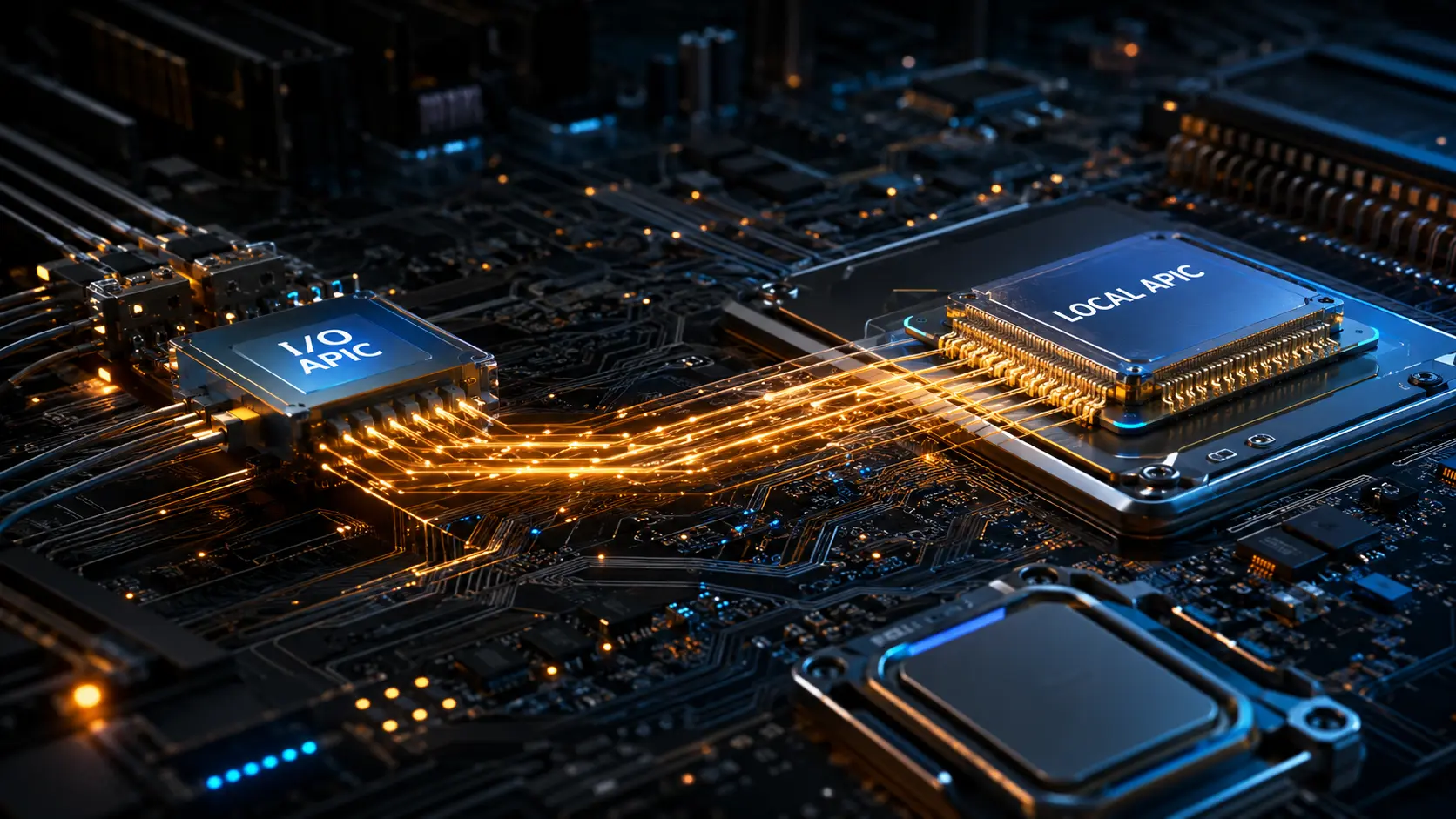
- Concept: I/O APIC: A central motherboard router that distributes external hardware signals to the correct processor core.
- Concept: Virtualization: Modern servers use software layers to intercept and reroute these physical interrupts to isolated machines.
HOW IT WORKS
A modern processor core operates blindly, executing billions of mathematical instructions in a sequential pipeline. It possesses no inherent awareness of the outside world. To read a network packet or acknowledge a keystroke, external hardware must physically interrupt the core’s pipeline.
Early computers used a simple, single-wire interrupt system that failed entirely when engineers began stacking multiple processor cores on a single motherboard. To manage the chaos of multi-core processing, hardware designers engineered the Advanced Programmable Interrupt Controller (APIC). This modern architecture splits interrupt management into two distinct physical silicon components.
The Input/Output APIC (I/O APIC) sits on the motherboard, acting as the primary switchboard for all external peripheral devices. When a network interface card receives a packet, it fires a voltage signal to the I/O APIC. The I/O APIC evaluates a routing table and forwards that signal over a dedicated system bus to a specific processor core.
Embedded directly inside every individual processor core is a Local APIC. This localized silicon receives the routed signal, calculates its priority against the core’s current workload, and decides exactly when to force the processor to stop and handle the new data.
Virtualization radically complicates this physical routing process. When a cloud server runs dozens of virtual machines, the software hypervisor must catch every physical interrupt and mathematically translate it into a virtual interrupt.
This translation introduces severe latency delays into the system. To bypass the software layer entirely, engineers develop advanced APIC virtualization (APICv) directly in the silicon, allowing virtual machines to interact with hardware interrupts at bare-metal speeds.
WHY IT MATTERS NOW
The physical routing speed of an APIC dictates the absolute latency limits of modern civilization. Consumer operating systems treat interrupt delays as mild inconveniences, tolerating milliseconds of latency while rendering a web page.
Real-Time Operating Systems (RTOS) running industrial control networks or military defense grids cannot tolerate any variance. If a hypersonic missile defense radar detects an incoming threat, the radar hardware fires an interrupt to the main processing unit.
The APIC must route that specific signal to an available processor core in strict microseconds. A delayed interrupt forces the interceptor software to calculate a firing solution based on outdated telemetry, causing a complete kinetic miss.
Hyperscale cloud providers rely heavily on APIC virtualization to maintain baseline economic profitability. Amazon Web Services and Microsoft Azure pack thousands of virtualized network functions onto a single physical server blade. Processing millions of inbound network packets requires continuous, relentless hardware interrupts.
If a server relies on the software hypervisor to translate every single network interrupt, the central processor spends its entire thermal budget managing administrative traffic instead of billing customer compute hours.
By offloading this tracking task to silicon-level APICv, cloud providers reclaim up to twenty percent of their total server processing capacity. This hardware bypass generates billions of dollars in reclaimed compute revenue across a global data center fleet.
WHAT MOST PEOPLE MISS
Software developers widely assume that application-level code controls task concurrency. They entirely miss that the operating system kernel is ultimately at the mercy of physical silicon voltage spikes.
You can write the most highly optimized, multi-threaded application on Earth, but a poorly configured APIC routing table will systematically starve your threads of CPU time. Hardware interrupts possess absolute supremacy over software commands.
If a malicious actor successfully executes an Interrupt Request (IRQ) flooding attack via a compromised network card, they weaponize the APIC against the host. The controller forces the CPU to constantly pause and evaluate millions of fake interrupts, completely paralyzing the enterprise kernel without ever executing a single line of traditional malware.
THE TRAJECTORY
Next 12–36 Months: Cloud providers will enforce strict hardware-assisted APIC virtualization across all edge computing nodes. This transition will guarantee microsecond latency bounds for containerized 5G telecommunication workloads operating outside traditional data centers.
Next Five Years: The integration of machine learning into interrupt routing logic. The I/O APIC will abandon static routing tables and use embedded neural circuits to dynamically predict and distribute interrupt loads across processor cores based on real-time thermal constraints.
Next Ten Years: The obsolescence of centralized interrupt handling in highly parallel architectures. Optical computing substrates will introduce distributed, asynchronous event notifications, replacing the rigid APIC hierarchy with decentralized light pulses that trigger individual logic gates directly.
What Could Go Wrong: Silicon-level interrupt vulnerability discovery. If researchers discover a fundamental flaw in how a Local APIC prioritizes virtualized interrupts across secure enclaves, cloud providers will face a catastrophic side-channel attack capable of breaching data isolation between competing enterprise tenants.
Most Likely Outcome: The APIC architecture will likely remain the physical heartbeat of digital infrastructure. As data velocity increases, the ability to efficiently translate physical hardware events into prioritized software actions has a high probability of dictating the ceiling of global computing performance.
KEY TERMS
- Local APIC: A specialized silicon module embedded directly inside a processor core that receives and prioritizes incoming hardware signals.
- I/O APIC: A centralized motherboard component that collects interrupt signals from external hardware and routes them to the appropriate processor core.
- Interrupt Request (IRQ): A physical or virtual hardware signal that demands immediate attention from the central processor, temporarily halting its current task.
- Hypervisor: A software layer that manages virtual machines, frequently forced to intercept and translate physical hardware interrupts into virtual signals.
- Real-Time Operating System (RTOS): An operating system mathematically guaranteed to process data and respond to hardware interrupts within a strictly defined time limit.
SOURCES
- Intel Corporation — 64 and IA-32 Architectures Software Developer’s Manual: Advanced Programmable Interrupt Controller
- Linux Kernel Organization — SMP IRQ Affinity and APIC Routing Architecture
- Institute of Electrical and Electronics Engineers (IEEE) — Hardware-Assisted Virtualization of Advanced Programmable Interrupt Controllers
- Department of Defense (DoD) — Real-Time Systems and Deterministic Latency Bounds in Military Avionics