Advertisement
)
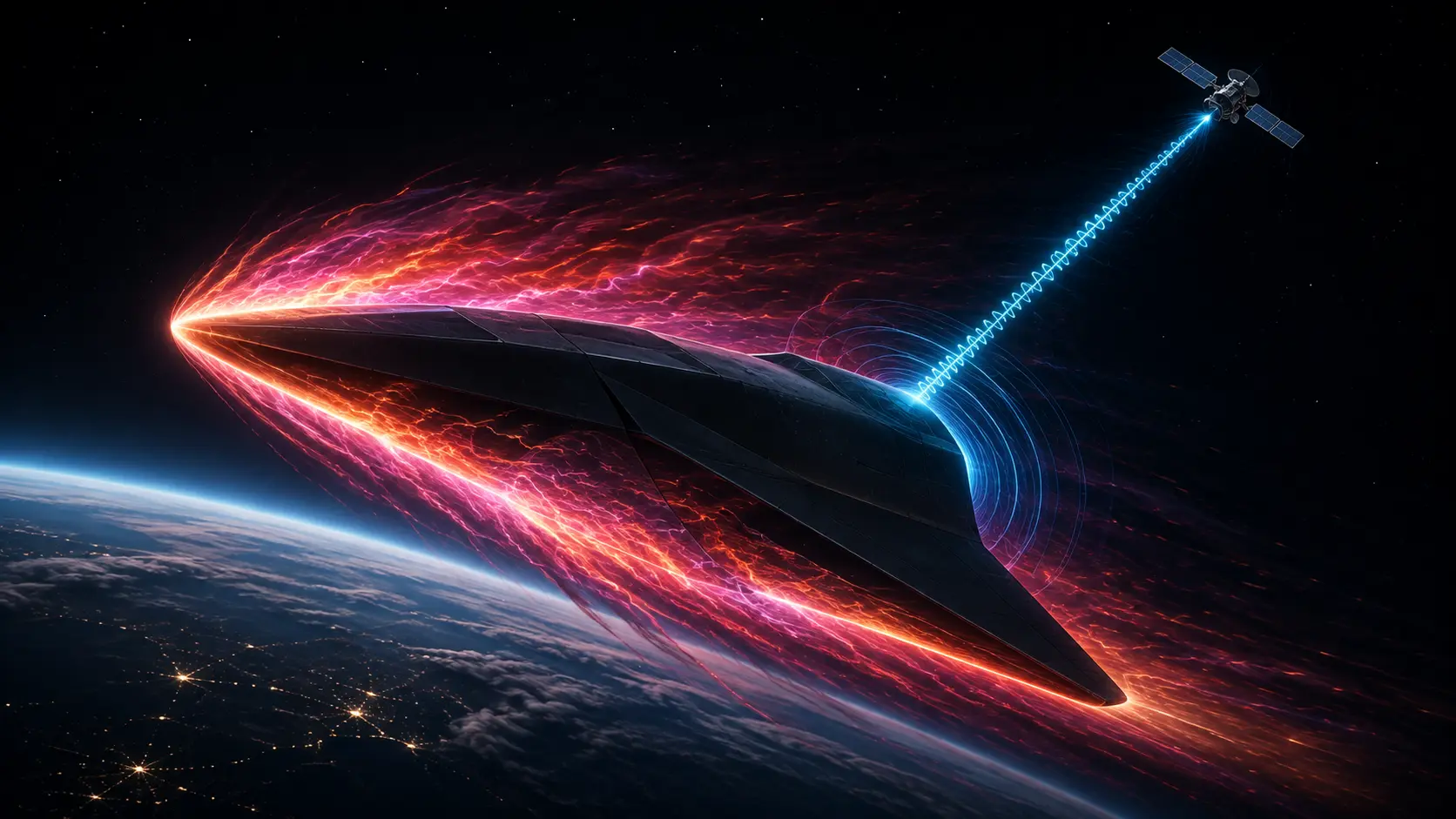

When an intercontinental ballistic missile (ICBM) falls from space, there is a terrifying three-minute window right before it hits the ground where nobody knows exactly where it is. Not the generals who fired it, and not the radar operators trying to stop it. As the warhead hits the atmosphere at Mach 20, it crushes the air in front of it with such immense violence that the air actually catches fire, turning into a superheated, electrically charged soup called a “plasma sheath.” This sheath wraps around the missile like a burning cocoon and acts as a perfect shield against all radio waves. The missile goes entirely deaf and blind—cut off from GPS, targeting data, and the outside world.
Why should you care right now? Because the rules of war are changing. The old missiles just fell in a predictable, dumb curve, so being blind didn’t matter. But the new generation of Hypersonic Glide Vehicles (HGVs) are designed to swerve, turn, and hunt down moving targets (like aircraft carriers) at Mach 10. You cannot steer a hunting missile if you cannot talk to it. The “Plasma Blackout” is the single greatest physical barrier preventing the military deployment of steerable hypersonic weapons. To solve this, aerospace engineers are weaponizing electromagnetism. By using magnetic fields to part the burning plasma like the Red Sea, or brute-forcing signals through the fire using exotic terahertz lasers, the defense industry is finally piercing the blackout, unlocking the ultimate, unstoppable weapon of the 21st century.
What is Aerothermal Plasma Blackout?
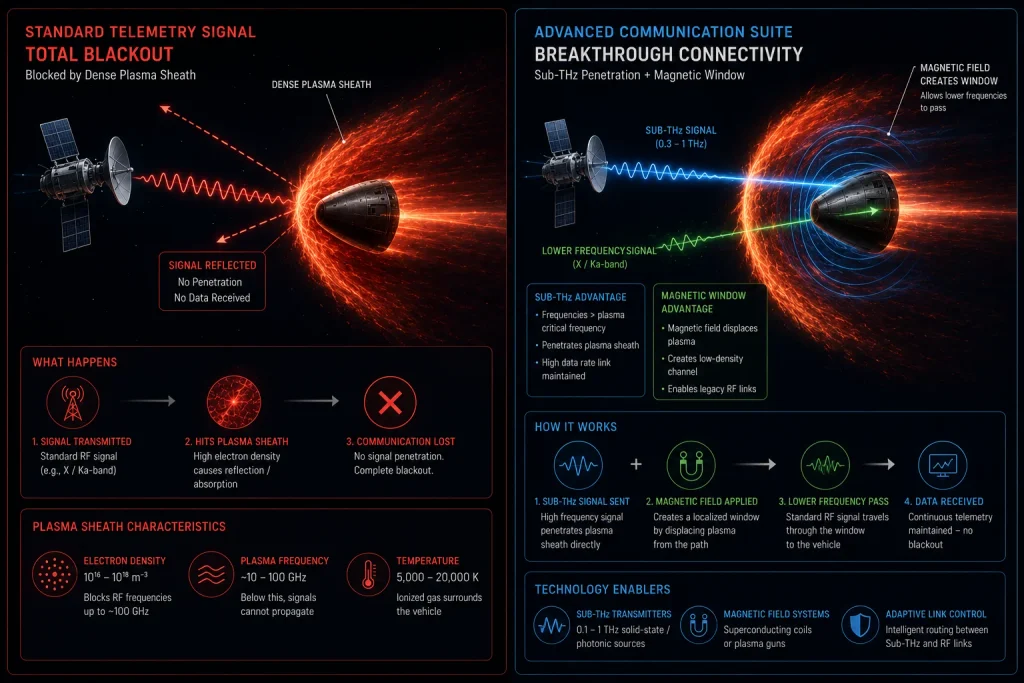
Aerothermal Plasma Blackout occurs when a vehicle traveling at hypersonic speeds (Mach 5+) compresses and superheats the surrounding atmosphere, stripping electrons from air molecules to form a conductive plasma sheath. This plasma absorbs and reflects standard radio frequencies, cutting off all GPS and telemetry communications to and from the vehicle.
At a Glance
- Concept: Flying so fast that the air in front of the vehicle turns into an electrically charged fire shield that blocks all Wi-Fi, radio, and GPS signals.
- Why it matters: Hypersonic missiles are designed to swerve and hit moving targets. If the general cannot send updated GPS coordinates to the missile while it flies, the missile will miss the target.
- Who uses it: Aerospace engineers (Lockheed Martin, Raytheon), national defense laboratories (DARPA), and telemetry specialists designing the next generation of Hypersonic Glide Vehicles (HGVs).
- Biggest takeaway: You can’t just build a louder radio to yell through the plasma. To get a signal out, engineers have to use massive magnets to temporarily change the atomic structure of the fire, opening a tiny, invisible window for the radio wave to escape.
In Simple Words
Imagine you are trying to shine a flashlight through a window to send a message to a friend outside.
Normally, the window is clear glass (regular air), and the light passes perfectly. But if you start driving your car at 5,000 miles per hour, the friction of the wind against the windshield creates so much heat that the glass literally turns into a thick layer of solid lead. Your flashlight beam bounces right back into your face. This “lead window” is the Plasma Sheath, and your flashlight is the radio signal. The missile is trapped inside.
To get the message out, you have two options. First, you can put a massive, heavy magnet next to the window. The magnet actually alters the lead, briefly turning a tiny circle of it back into clear glass so you can shine your light through (Magnetic Windowing). Second, you can throw away the flashlight and use a massive, high-powered X-ray laser that is so strong it just blasts straight through the lead wall (Sub-Terahertz Communication).
Why This Matters
For Aerospace Engineers, Defense Strategists, and Military Contractors, solving the plasma blackout is the prerequisite for the “Kill Chain.”
The entire point of a Hypersonic Glide Vehicle (HGV) is its maneuverability within the atmosphere. Unlike an ICBM that travels predictably through the vacuum of space, an HGV glides in the upper atmosphere at Mach 10 to evade radar. However, if the target is a moving aircraft carrier group, the target’s location will change during the 20-minute flight. The HGV must receive mid-course updates. Without reliable telemetry and command-link penetration through the plasma, an HGV is functionally useless as an anti-ship weapon, degrading a multi-million dollar hypersonic asset into an expensive, blind dart.
The Evolution of Hypersonic Plasma Blackout
The plasma blackout problem is as old as the Space Race. During the Apollo missions, the command capsule would lose all communication with Houston for several agonizing minutes during atmospheric reentry.
NASA solved this simply by waiting. The capsule eventually slowed down, the plasma cooled back into regular air, and the radios reconnected right before the parachutes opened. Hypersonic missiles do not have the luxury of waiting. They do not slow down; they maintain Mach 5+ all the way to impact. The plasma sheath never dissipates. Therefore, the military cannot “wait out” the blackout—they must actively engineer a way to punch through it while the missile is at maximum velocity.
How Aerothermal Plasma Blackout Works
Piercing an electrically conductive plasma sheath requires manipulating the fundamental equations of electromagnetism. Here is the first-principles breakdown of the architecture.
1. The Fundamental Problem: Plasma Frequency
When air turns into plasma, it is full of free-floating electrons. These electrons vibrate naturally at a specific speed, known as the Plasma Frequency (ω_p).
The rule of physics is absolute: If a radio wave’s frequency is lower than the plasma frequency, the free electrons will absorb the radio wave’s energy and reflect it. The signal dies. Because standard military communications (like S-Band telemetry or GPS) operate at relatively low frequencies (1 to 4 GHz), and the plasma frequency often exceeds 10 GHz during hypersonic flight, the standard signals are instantly blocked.
2. The First Solution: High-Frequency Brute Force (Sub-THz)
If a radio wave’s frequency is higher than the plasma frequency, it can punch through the sheath.
To beat the blackout, engineers are abandoning standard radio bands and moving to extreme high frequencies in the Ka-band, V-band, or even Sub-Terahertz range (>100 GHz). At these frequencies, the radio waves vibrate so incredibly fast that the plasma’s electrons cannot react quickly enough to block them. The wave slips right through the fire.
3. The Second Solution: Magnetic Windowing
Generating Terahertz signals requires delicate, power-hungry equipment. A more elegant solution uses magnetism.
By placing a permanent magnet or a superconducting electromagnet right next to the missile’s antenna, engineers create a strong static magnetic field. This magnetic field traps the free electrons in the plasma, forcing them to spiral tightly along the magnetic field lines (cyclotron resonance). Because the electrons are trapped in a tight spiral, they lose their ability to bounce around and block incoming radio waves.
4. Technical Depth: Right-Hand Circular Polarization (RHCP)
The magnetic field doesn’t just clear the air; it alters the physics of the wave itself. When a radio wave is transmitted as a “Right-Hand Circularly Polarized” wave, it interacts with the spiraling electrons in a highly specific way. The electrons essentially “guide” the radio wave through the plasma without absorbing it. This creates a microscopic, invisible “window” through the fire, allowing standard, low-frequency telemetry signals to escape the missile perfectly intact.
5. Real-World Consequences: Aerodynamic Drag Penalty
Both solutions come with severe penalties. Adding heavy electromagnets, specialized ceramic antenna windows, or cooling systems for high-frequency transceivers adds massive weight to the missile. Furthermore, altering the shape of the missile nosecone to accommodate these windows ruins the perfect aerodynamic geometry, increasing drag and reducing the overall range and terminal velocity of the weapon.
Real-World Applications: HGV Telemetry and Space Reentry
Overcoming the blackout is the primary focus of highly classified research divisions across global superpowers.
Hypersonic Glide Vehicle (HGV) Telemetry: During the testing phase of vehicles like the U.S. AGM-183 ARRW (Air-Launched Rapid Response Weapon), telemetry is more important than the explosive warhead. If the missile crashes, engineers must know why. Using advanced Ka-band antennas shielded by specialized ablative ceramics, the military forces telemetry data through the weaker sections of the plasma sheath (usually near the tail of the missile, where the plasma is thinner than at the nosecone).
Space Shuttle and Capsule Reentry: While ICBMs don’t care about the blackout, human astronauts do. During the fiery reentry of the SpaceX Crew Dragon or the Orion capsule, maintaining a voice link to Mission Control is critical. Engineers discovered that by injecting a highly specific liquid or electrophilic chemical (like Teflon or Freon) directly into the plasma stream right in front of the antenna, the chemical absorbs the free electrons, temporarily cooling the plasma and clearing a path for the radio signal.
Plasma Stealth (Active Camouflage): The very phenomenon that blocks communication can be weaponized defensively. Because a dense plasma sheath absorbs and scatters radio waves, it inherently absorbs enemy radar waves as well. By artificially generating a plasma cloud around a fighter jet or a missile (using high-power microwaves to ionize the air), an aircraft can theoretically render itself completely invisible to standard radar—a concept known as “Plasma Stealth,” which has been heavily researched by Russian and Chinese aerospace divisions.
Economic & Strategic Impact
The core strategic disruption is the Requirement for Low-Earth Orbit (LEO) Relay Constellations.
Even if a hypersonic missile punches a high-frequency (Sub-THz) signal through the plasma, that signal has a problem: high-frequency radio waves cannot travel very far in the Earth’s atmosphere before they are absorbed by rain or oxygen. The missile cannot talk directly back to a general sitting in a bunker 1,000 miles away.
To solve this, the military must talk up. The missile punches its signal straight up through the thin upper atmosphere to a satellite. This requires the deployment of massive, highly connected constellations of Low-Earth Orbit (LEO) satellites (similar to SpaceX’s Starlink, but militarized, like the U.S. Space Development Agency’s Proliferated Warfighter Space Architecture). The economics of hypersonic warfare dictate that you cannot field the missiles unless you also spend billions launching the satellite internet required to steer them.
Advantages of Piercing the Blackout
- Dynamic Targeting: Allows commanders to send updated coordinates to a missile in mid-flight, ensuring it can hit a moving aircraft carrier or evade a suddenly activated enemy air defense system.
- Kill Assessment: Enables the missile to transmit sensory data back to base right up until the millisecond of impact, confirming to the generals that the target was successfully destroyed.
- Testing and R&D: Invaluable for the engineering process. Transmitting live temperature, pressure, and aerodynamic stress data through the plasma allows engineers to fix design flaws without having to recover the wreckage of a crashed prototype.
Limitations
- Antenna Melting: To transmit through the plasma, the antenna must be exposed to the outside of the missile. Designing a material that allows radio waves to pass through it cleanly (like a ceramic radome) while simultaneously surviving 2,000°C temperatures without melting or shattering is a profound metallurgical paradox.
- The Weight Penalty: Adding superconducting magnets (for magnetic windowing) or heavy fluid-injection systems (for chemical electron depletion) takes up valuable space inside the missile. Every pound of communication equipment is a pound of explosive warhead or fuel that must be removed.
- Signal Distortion: Even if the signal punches through the plasma, the violent, turbulent nature of the fire physically distorts the phase and amplitude of the radio wave. The receiving satellite must use incredibly complex AI algorithms to “clean up” the noisy signal and decode the actual data.
Common Misconceptions
Misconception: The plasma is caused by the missile “rubbing” against the air (friction).
Reality: The primary cause of the heat is compression, not friction. The missile is moving so fast that the air in front of it cannot get out of the way. The air is violently crushed, and according to the laws of thermodynamics, extreme compression results in extreme heat.
Misconception: Hypersonic missiles fly in the vacuum of space, so there is no air to make plasma.
Reality: ICBMs fly in space. Hypersonic Glide Vehicles (HGVs) deliberately fly much lower, in the upper atmosphere (the stratosphere). They use the thin air to generate lift and steer, which is exactly why they suffer from the plasma blackout.
Misconception: We can just use lasers to talk to the missile.
Reality: While optical lasers hold massive amounts of data, the plasma sheath violently scatters and absorbs light just as effectively as it absorbs radio waves. Furthermore, trying to keep a laser perfectly pointed at a missile vibrating violently at Mach 10 is an agonizingly difficult tracking problem.
What Most People Miss
The disruptive intelligence value of Tail-End Wake Transmission.
Most diagrams show the missile completely engulfed in a uniform ball of fire. What analysts miss is the aerodynamic geometry of the plasma wake.
The plasma is overwhelmingly dense at the nosecone (the stagnation point), where the air is being crushed. But as the air flows over the body of the missile and trails behind it, the pressure drops instantly, and the plasma expands and thins out. The tail of the missile (the wake) often has a plasma density a hundred times lower than the nose. Clever aerospace engineers do not try to punch signals through the nose; they mount the antennas facing backward, transmitting the telemetry through the “weak spot” in the plasma wake to a trailing relay drone or high-altitude balloon.
Comparison Table
| Feature | Standard Radio (S-Band / GPS) | High-Frequency (Sub-THz) | Magnetic Windowing |
| Frequency Range | 1 to 4 GHz | > 100 GHz | 1 to 10 GHz |
| Plasma Penetration | Fails entirely (Blocked) | Excellent (Punches through) | Excellent (Alters plasma) |
| Atmospheric Range | Very Long (Hundreds of miles) | Very Short (Absorbed by air/rain) | Long |
| Hardware Required | Standard Antennas | Exotic Transceivers / High Power | Heavy Electromagnets |
| Implementation | Cheap, Ubiquitous | Highly Experimental | High Weight Penalty |
Case Study
Situation: During the rapid acceleration of the U.S. hypersonic weapons program, engineers faced a critical data deficit. Test flights of experimental glide vehicles were launching and crashing into the Pacific Ocean. Because the vehicles were enveloped in a plasma sheath at Mach 8, the telemetry feed went dead during the most critical phases of flight. The engineers were blind; they had no data to determine whether the failures were due to thermal melting, aerodynamic instability, or software glitches.
Challenge: Develop a telemetry system capable of maintaining a continuous data link through a 2,000°C plasma sheath during a 20-minute hypersonic glide, without altering the aerodynamic shape of the vehicle or removing explosive payload capacity.
Solution (The DARPA Blackout Mitigation Efforts): Defense research agencies pivoted away from trying to blast standard S-band telemetry through the nosecone. Instead, they adopted a multi-modal approach. They integrated extremely high-frequency (Ka-band) transmitters, whose waves were fast enough to approach the plasma frequency cutoff. Crucially, they relocated the antenna arrays to the aft (rear) section of the glide vehicle, transmitting through the rarefied plasma wake.
Outcome: During subsequent flight tests, the aft-mounted, high-frequency arrays successfully maintained a “dirty” but readable data link with tracking aircraft (like modified Gulfstream jets or high-altitude drones) flying behind the vehicle’s flight path. The data retrieved allowed engineers to identify the precise thermal failure points on the control fins, accelerating the development cycle of the weapon by years.
Lessons Learned: The initiative proved that plasma blackout is a geometry problem as much as it is a physics problem. By combining frequency shifting with strategic aerodynamic antenna placement, the defense industry validated that continuous communication with a Mach 10 asset is physically possible, permanently removing the “blind spot” from hypersonic warfare.
Future Outlook
Next 12–24 Months
The era of Ka-Band LEO Relays. In the immediate term, militaries will rely on the brute-force method. Next-generation hypersonic test vehicles will be outfitted entirely with Ka-band and V-band transceivers. Because these high frequencies cannot travel through the thick lower atmosphere, the missiles will be programmed to transmit their telemetry strictly upwards (zenith-facing) to a proliferating network of Low Earth Orbit (LEO) military tracking satellites. This establishes the absolute necessity of a survivable space layer for atmospheric combat.
Next 3–5 Years
The scaling of Active Plasma Manipulation (Electrophilic Injection). As the physical weight of electromagnets remains a bottleneck for magnetic windowing, the focus will shift to chemical manipulation. Missiles will feature microscopic “sweat glands” near the antenna arrays. When the blackout hits, the missile will “sweat” a tiny amount of liquid electrophilic chemicals directly into the plasma. These chemicals will instantly absorb the free electrons, cooling the fire and opening a physical, temporary hole in the sheath just long enough to receive a burst-transmission targeting update from the commander.
Next 10 Years
The Sub-Terahertz Solid-State Revolution. By the mid-2030s, the hardware required to generate Sub-Terahertz (>100 GHz) signals will miniaturize. Currently reliant on fragile, vacuum-tube technology, advances in Gallium Nitride (GaN) and Indium Phosphide (InP) semiconductor chips will allow for fully solid-state, unshakeable Terahertz modulators. These microchips will blast signals through any density of plasma effortlessly. The true blackout will be defeated, allowing a commander in the Pentagon to seamlessly joystick a hypersonic missile traveling at Mach 15 on the other side of the planet with the latency of a video game.
Most Likely Scenario
Aerothermal Plasma Blackout remains the final physical barrier protecting targets from hypersonic annihilation. As long as a missile is deaf and blind, it is restricted to hitting static, pre-programmed coordinates. The military that first perfects the physics of magnetic windowing or Terahertz penetration will be the first to successfully deploy hypersonic weapons against moving aircraft carriers, permanently tilting the balance of global naval power.
Key Takeaways
- When a missile flies at hypersonic speeds (Mach 5+), it crushes the air so violently that the air turns into a 2,000°C wall of charged plasma.
- This plasma sheath acts like a Faraday cage, blocking all standard radio and GPS signals. The missile goes completely blind and deaf during the flight.
- Without communication, generals cannot send mid-flight targeting updates to the missile, making it impossible to hit moving targets like ships or evasive aircraft.
- To punch through the fire, engineers use “Magnetic Windowing”—placing massive magnets near the antenna to alter the atomic structure of the plasma, opening an invisible window for the radio signal.
- Alternatively, they use ultra-high frequency (Terahertz) signals that vibrate so fast they slip right through the plasma before the charged electrons can block them.
- Because high-frequency signals cannot travel far through the atmosphere, hypersonic missiles must talk “up” to massive constellations of military satellites to stay connected.
Glossary
Aerodynamic Heating: The extreme heat generated not by friction, but by the violent compression of air in front of a vehicle traveling at hypersonic speeds.
Faraday Cage: An enclosure made of conductive material that blocks electromagnetic fields (radio waves). The plasma sheath acts as a natural Faraday cage around the missile.
Hypersonic Glide Vehicle (HGV): A weapon that is launched into space but re-enters the atmosphere to glide and steer toward its target at Mach 5+, generating a massive plasma sheath.
Matched-Filter Magnetic Windowing: Using a powerful magnetic field to trap the free electrons in the plasma, stopping them from bouncing around and blocking the radio signal.
Plasma Frequency: The specific speed at which the electrons in the plasma naturally vibrate. If a radio wave is slower than this frequency, it gets blocked. If it is faster, it punches through.
Stagnation Point: The absolute tip of the missile’s nosecone where the air is crushed the hardest, creating the thickest, most impenetrable layer of plasma.
Sources
Journal of Applied Physics: Mitigation of communications blackout for hypersonic reentry vehicles
IEEE Transactions on Plasma Science: Terahertz communication through an aerothermal plasma sheath
Defense Technical Information Center (DTIC): Electromagnetic Wave Propagation Through a Plasma Sheath
Aerospace Research Central (AIAA): Magnetic Windowing for Hypersonic Communications
U.S. Air Force Research Laboratory (AFRL): Hypersonic Telemetry and Aerothermal Challenges