Advertisement
)


The era of the “dumb bot” is over. For the past decade, enterprises spent billions deploying Robotic Process Automation (RPA) scripts to mimic human clicks and keystrokes. But RPA is brittle; if a vendor updates a web interface or a customer submits a form with a typo, the script immediately crashes, triggering a cascade of manual IT interventions. Enterprises have realized that scaling rigid rules is a thermodynamic dead end.
Why should you care right now? Because the automation paradigm is executing a massive architectural pivot from rigid scripts to autonomous reasoning. By deploying Agentic AI Orchestration platforms, IT directors are coordinating fleets of specialized, adaptive AI agents. These agents don’t just follow steps—they perceive their environment, reason about goals, handle exceptions dynamically, and intelligently hand off work to other agents or human supervisors.Backed by the explosive adoption of the Model Context Protocol (MCP) in 2026, this migration is instantly transforming legacy RPA from a fragile cost center into an adaptable, cognitive enterprise nervous system.
What are Agentic AI Orchestration Platforms?
Agentic AI orchestration platforms are enterprise software frameworks that manage, coordinate, and govern multiple autonomous AI agents.Instead of running rigid, step-by-step scripts, these platforms assign high-level goals to specialized agents, automatically handling task routing, shared memory, and cross-system integration to execute complex, unpredictable business workflows.
At a Glance
- Concept: Upgrading enterprise automation from blind, rule-following robots to teams of reasoning, adaptive AI workers.
- Why it matters: Legacy RPA breaks when anything unexpected happens. Agentic AI can self-correct, read unstructured data, and dynamically adjust its strategy, eliminating millions in bot-maintenance costs.
- Who uses it: Enterprise IT directors, Automation Centers of Excellence (CoE), and MLOps engineers leveraging frameworks like LangGraph, CrewAI, and AutoGen.
- Biggest takeaway: Orchestration platforms prevent autonomous agents from running wild. They enforce strict boundaries, manage cost-routing, and guarantee that a human is brought into the loop before any high-risk action is executed.
In Simple Words
Imagine a traditional factory assembly line (RPA). Every robot is bolted to the floor and programmed to perform exactly one motion. If a part arrives slightly out of alignment, the robot smashes it, and the entire assembly line shuts down until a human fixes it.
Agentic AI Orchestration is like hiring a team of specialized, intelligent human contractors and giving them a foreman. You don’t tell them exactly how to turn a wrench; you give them a blueprint and a goal. If a part arrives broken, the worker notices, asks the foreman what to do, routes the broken part to the repair desk, and continues working on the next item. The orchestration platform acts as the foreman—distributing the work, sharing the context between workers, ensuring no one duplicates effort, and preventing the system from ever shutting down due to a minor anomaly.
Why This Matters
For IT Directors, Enterprise Architects, and CoE Leads, this migration solves the Exception Handling Cost Spiral.
In traditional RPA, scaling automation meant scaling maintenance. Companies found that handling the “edge cases”—the 15% of transactions that deviate from the standard script—consumed 80% of their automation budget.
Agentic Orchestration eliminates the script. By embedding Large Language Models (LLMs) with retrieval-augmented generation (RAG) directly into the workflow, the system can reason through exceptions autonomously. If an invoice arrives in a completely new format, the agent reads it, understands the context, maps the fields correctly, and proceeds without human intervention. This cognitive adaptability drastically lowers the total cost of ownership (TCO) of enterprise automation, enabling straight-through processing rates previously deemed mathematically impossible.
The Migration from Single Agents to Orchestration
Enterprise AI has matured past the “single chatbot” phase. In 2024 and 2025, companies deployed isolated copilots and single agents. However, they quickly hit the Domain Overload Plateau. Asking a single AI agent to handle customer communication, credit analysis, fraud detection, and database updates simultaneously resulted in hallucinations and systemic failures.
Orchestration platforms split the brain. They introduce Multi-Agent Systems, where complex workflows are decomposed into micro-tasks and routed to narrowly focused specialist agents. The orchestration layer acts as the control plane, maintaining state, enforcing governance, and stitching the specialized outputs back together into a cohesive, highly accurate enterprise action. Anthropic’s internal research demonstrated this perfectly: an orchestrated team of specialized agents outperformed single-agent benchmarks by over 90%.
How Agentic AI Orchestration Platforms Work
Transitioning from static playbooks to adaptive agent swarms requires a robust, stateful architecture.
1. The Fundamental Problem: Stateless Fragility
RPA bots have no memory and no situational awareness. If a step fails, the bot throws an error code. It cannot rethink its approach because it lacks contextual state.
2. The Core Mechanism: The Orchestration Control Plane
An agentic platform (like LangGraph or Microsoft AutoGen) establishes a central control plane. It defines the “state” of a task (e.g., a loan application) as a graph or a shared memory object. As different agents work on the task, they read from and update this central state, ensuring everyone has the exact same context without duplicating logic.
3. Technical Depth: Goal Decomposition and Routing
When a complex objective is initiated, the orchestrator’s “Supervisor Agent” breaks it down. Using patterns like the Mixture of Agents (MoA), the supervisor intelligently routes tasks based on cost and capability. Simple data-extraction tasks are routed to fast, cheap models (like GPT-4o-mini or Claude 3.5 Haiku). Deep reasoning or logic validation tasks are routed to frontier models (like OpenAI o3).
4. Technical Depth: Tool Integration via MCP
Agents execute actions using the Model Context Protocol (MCP). By 2026, MCP has become the universal standard, providing over 200 secure, standardized connectors to enterprise systems (Salesforce, SAP, Snowflake).The orchestrator securely manages the API credentials and strict permission boundaries, ensuring an agent can only access exactly what it needs.
5. Real-World Consequences: Human-in-the-Loop Guardrails
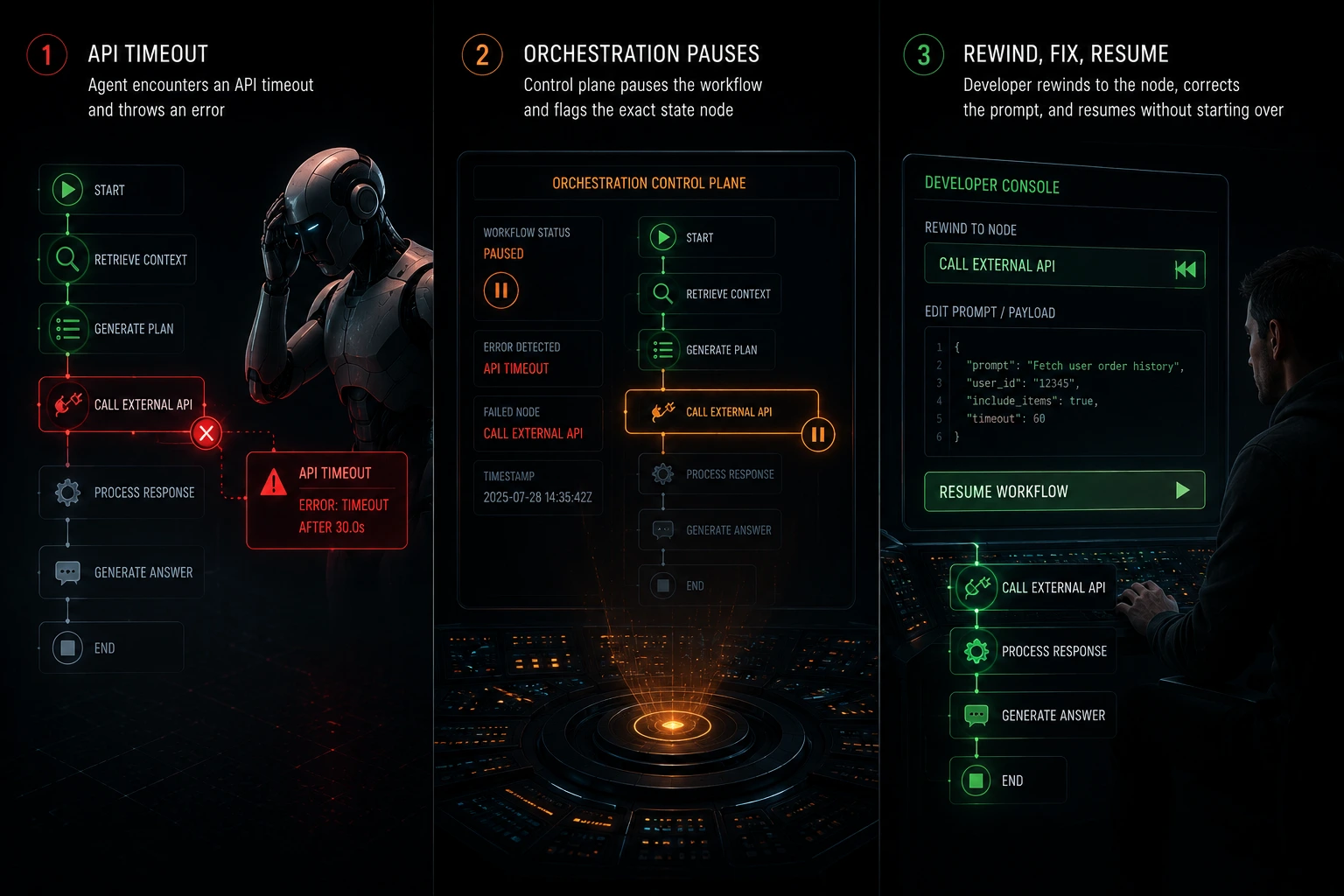
Because agents operate probabilistically (they guess the best next step), the orchestrator enforces strict risk thresholds. If a financial transaction exceeds $10,000, or if the agent’s confidence score drops below 95%, the orchestrator freezes the execution state. It packages the entire reasoning trace and pings a human operator. The human reviews the agent’s logic, clicks “Approve,” and the orchestrator instantly resumes the workflow right where it paused.
Takeaway: The true power of orchestration is not letting AI run wild; it is providing the exact containment required to make autonomous reasoning legally compliant and strictly governable.
Enterprise Applications for Multi-Agent Workflows
- Intelligent IT Service Management (ITSM): When an employee submits a vague ticket (“My email is broken”), legacy RPA routes it to a generic queue. An orchestrated agent squad tackles it dynamically. The triage agent diagnoses the root cause by checking system logs via MCP; the resolution agent resets the specific server protocol; the communication agent updates the user. First-contact resolution rates jump dramatically.
- Dynamic Supply Chain Procurement: An agent monitoring global logistics detects a port strike. It flags the delay to a pricing agent, which calculates the impact on manufacturing. A procurement agent autonomously drafts a re-order from an alternative supplier and escalates it to the human supply chain director for final, one-click approval.
- Automated Regulatory Compliance: In banking, onboarding a corporate client requires intense Anti-Money Laundering (AML) checks. Instead of one human spending days cross-referencing databases, an orchestration layer deploys a dozen agents simultaneously. They scrape global registries, summarize risk profiles, and compile a cohesive compliance dossier in seconds, drastically accelerating institutional onboarding.
Economic & Strategic Impact
The core strategic consequence is the Democratization of Cognitive Automation.
Historically, complex automation required armies of specialized Python developers and certified RPA engineers mapping out thousands of decision-tree nodes. Agentic orchestration shifts the paradigm from imperative programming (telling the computer exactly how to do it) to declarative programming (telling the computer what outcome you want).
This allows business analysts and domain experts to build and deploy complex automation using natural language prompts and visual graph builders. By radically lowering the technical barrier to entry, enterprises are rapidly automating long-tail, niche business processes that were previously too expensive for IT departments to bother scripting.
Advantages
- Adaptive Exception Handling:Agents autonomously reason through unexpected UI changes, missing data fields, and unstructured text that would instantly crash legacy RPA bots.
- Cost Optimization (MoA):Intelligently routes simple sub-tasks to inexpensive, small models, reserving high-cost frontier reasoning models only for the most complex decisions, slashing LLM overhead by up to 90%.
- Scalable Architecture:Dividing labor across multiple specialized agents prevents the accuracy degradation and context-window exhaustion seen in single-agent prompt overload.
- Stateful Recovery: If an agent encounters a system timeout, the orchestrator preserves the exact state of the workflow and seamlessly retries, rather than failing the entire process from scratch.
Limitations
- Non-Deterministic Outcomes: Because LLMs are probabilistic, the exact same input might generate a slightly different reasoning path. Auditing and guaranteeing identical execution every time is incredibly challenging for compliance departments.
- Latency Overhead: Orchestrating multiple agents passing context back and forth introduces significant computational delays compared to the millisecond execution of a hard-coded RPA script.
- “Silent Drift”: Without strict monitoring, agents can slowly deviate from optimal performance as underlying models update or external APIs change. Gartner projects that 40% of agentic initiatives may fail by 2027 if advanced observability and governance are not implemented.
Common Misconceptions
Misconception: Agents will completely replace RPA tomorrow.
Reality: RPA is still highly efficient for rigid, high-volume, perfectly structured tasks (like moving millions of rows in an Excel database). Orchestration platforms often treat existing RPA bots as “tools” that the intelligent agents can trigger when brute-force speed is needed.
Misconception: Multi-agent systems mean no humans are involved.
Reality: The most successful enterprise deployments are highly collaborative. The orchestration layer is specifically designed to facilitate seamless “human-in-the-loop” handoffs for high-risk approvals, preserving decision context for human review.
Misconception: Agents just hallucinate and make mistakes.
Reality: By enforcing Retrieval-Augmented Generation (RAG) at the orchestrator level, agents are strictly grounded in verified enterprise data. Furthermore, “peer-review” agents are often deployed specifically to double-check the work of the primary agents before execution.
What Most People Miss
The disruptive capability of State Checkpointing and “Time Travel”.
When debugging a legacy automation script, a developer usually has to read through thousands of lines of log text to figure out why it crashed.
In advanced orchestration frameworks like LangGraph, the orchestrator automatically saves the full “state” (memory and variables) after every single agent action. If an error occurs, a developer can literally “rewind” the execution graph to the exact moment before the failure, tweak the agent’s instructions, and replay the workflow from that specific node without restarting the entire process. This “time travel” capability radically accelerates enterprise debugging and continuous improvement.
Comparison Table
| Feature | Legacy RPA (e.g., UiPath 2020) | Single-Agent Copilot | Agentic Orchestration (e.g., LangGraph 2026) |
| Execution Model | Imperative (Strict Scripts) | Conversational | Declarative (Goal-Oriented) |
| Exception Handling | Fails and Halts | Asks user for help | Autonomously self-corrects |
| Data Handling | Structured data only | Unstructured text | Seamless multi-modal integration |
| Task Routing | Static | None | Dynamic Mixture of Agents (MoA) |
| Human-in-the-Loop | Manual intervention required | Direct user prompting | Programmatic, stateful escalation |
Case Study
Situation: A tier-one global logistics firm relied on a massive suite of legacy RPA bots to process customs documentation and supplier invoices. The UI of the global shipping portal frequently updated without warning, breaking the RPA CSS selectors. Additionally, suppliers submitted invoices in hundreds of different, unstructured PDF formats. The automation CoE was spending 70% of its budget simply repairing broken bots and manually processing exception queues.
Challenge: Migrate the document processing pipeline to a resilient, adaptive system capable of handling unstructured variability without requiring constant developer intervention.
Solution (The Multi-Agent Deployment): The enterprise deployed an agentic orchestration platform utilizing a Supervisor-Worker pattern. When a shipment email arrived, the orchestrator triggered a specialized “Extraction Agent” equipped with vision capabilities to read the chaotic PDFs. The data was passed to a “Validation Agent” to cross-reference enterprise inventory via the Model Context Protocol (MCP).
Outcome: When the shipping portal updated its UI, the Validation Agent simply used visual reasoning to locate the new “Submit” button and completed the task autonomously. The orchestration layer reduced exception queues by 85%. Furthermore, by utilizing MoA, the firm routed the simple extraction tasks to open-source models, cutting their projected token costs by 60% compared to using a single frontier model.
Lessons Learned: The deployment definitively proved that cognitive adaptability is far more valuable than script execution speed. By allowing agents to reason through anomalies natively, the enterprise transformed a fragile IT liability into a highly resilient operational asset.
Future Outlook
Next 12–24 Months
The era of Orchestration Framework Consolidation. Right now, enterprises are choosing between highly capable, code-heavy frameworks (like LangGraph) and rapid-prototyping platforms (like CrewAI). Over the next two years, the landscape will heavily consolidate. Major cloud providers will embed native orchestration engines directly into their enterprise ecosystems. Expect the Model Context Protocol (MCP) to become the absolute baseline for B2B software; any enterprise SaaS platform that does not offer a native MCP server for agentic interaction will be rendered entirely obsolete.
Next 3–5 Years
The scaling of Cross-Enterprise Agentic Negotiation. Currently, agents mostly operate within the walls of a single company. Within five years, orchestration platforms will establish secure, standardized protocols for agents from different companies to negotiate with each other. A retail giant’s procurement agent will directly interface with a manufacturer’s supply chain agent. They will haggle over pricing, execute contracts, and arrange logistics autonomously in milliseconds, radically accelerating B2B commerce.
Next 10 Years
The System of Action Singularity. By the mid-2030s, the traditional Graphic User Interface (GUI)—the dashboards, menus, and buttons human workers use today—will become largely obsolete for back-office operations. Enterprise software will transition completely into “Systems of Action,” designed primarily to be read and manipulated by AI agents via APIs. Human employees will shift entirely to strategic oversight and exception management, managing the orchestration layers while the autonomous multi-agent squads execute the entirety of the corporate operational workload.
Most Likely Scenario
Agentic AI orchestration is the final nail in the coffin for brittle, deterministic automation. You cannot scale a global enterprise by manually scripting every possible outcome. By providing the structural control plane required to safely govern, route, and audit autonomous AI reasoning, orchestration platforms are unleashing the true commercial value of generative models. They bridge the gap between thinking and doing, transforming AI from a passive conversational advisor into an active, highly competent digital workforce.
Key Takeaways
- Legacy Robotic Process Automation (RPA) requires strict, rule-based scripts. It is incredibly fast but highly fragile, breaking instantly if anything unexpected occurs.
- Agentic Orchestration acts as a digital foreman, coordinating multiple intelligent AI agents to solve complex problems, handle exceptions autonomously, and execute multi-step workflows.
- By using a “Mixture of Agents” approach, the orchestrator saves massive amounts of money, sending simple tasks to cheap AI models and saving the expensive, super-smart models only for difficult reasoning tasks.
- The system prevents AI from going rogue. Orchestration platforms enforce strict rules and can automatically pause a workflow, saving the exact “state” of the task, so a human can approve high-risk decisions.
- Thanks to the Model Context Protocol (MCP), these agent teams can securely plug directly into enterprise databases and software (like Salesforce or SAP) to take real-world action.
Glossary
Agentic AI: Artificial intelligence systems that can perceive their environment, reason, make decisions, and take autonomous actions to achieve a specific goal without human hand-holding.
Model Context Protocol (MCP): A standardized, secure communication protocol that allows AI agents to easily plug into and pull data from enterprise software and databases.
Mixture of Agents (MoA): A routing strategy where an orchestrator breaks a large problem into pieces and assigns different pieces to different AI models based on their cost and expertise.
Retrieval-Augmented Generation (RAG): A technique that forces an AI to read verified, internal company documents before answering a question, virtually eliminating hallucinations.
State Checkpointing: The ability of an orchestration platform to save the exact status and memory of a workflow at every step, allowing developers to rewind and replay actions if an error occurs.
Supervisor-Worker Pattern: An orchestration architecture where one “boss” agent breaks down a goal and delegates the specific sub-tasks to highly specialized “worker” agents.
Sources
Gartner: Predicts 2026: The Shift to Agentic AI and the End of Traditional RPA
Trantor: AI Agent Orchestration for Enterprise Workflows: A Practical Guide
N-iX: AI Agent Orchestration: How Enterprises Coordinate Autonomous AI
Informatica: Agentic AI Integration: Business Process Automation Guide
Appstek: What Is Agentic AI Orchestration? A Complete Enterprise Guide