Advertisement
)


Artificial intelligence is currently constrained by a brutal hardware reality: reading from memory is significantly slower than doing the math. When a Large Language Model (LLM) generates an answer, it operates autoregressively, meaning it calculates exactly one word at a time. For every single word, the multi-billion parameter model must load its entire weight matrix from the GPU’s memory into its compute cores. This creates a severe memory bandwidth bottleneck. No matter how many GPUs you link together, the model is physically trapped typing at the speed of its memory bus.
Why should you care right now? Because computer scientists have engineered a mathematical loophole to break this speed limit. Known as Speculative Decoding, this technique deploys a tiny, ultra-fast “draft” model to guess the next several words, and uses the massive “target” model merely to verify those guesses in a single parallel sweep. By transforming text generation from a sequential crawl into a parallel sprint, speculative decoding effectively triples the speed of frontier AI models with mathematically zero degradation in accuracy.
What is Speculative Decoding?
Speculative Decoding is an inference optimization technique that accelerates Large Language Model text generation. It utilizes a smaller, faster draft model to predict multiple upcoming tokens, which a larger target model then verifies simultaneously in a single parallel step, significantly reducing memory bandwidth bottlenecks without altering the final output.
At a Glance
- Concept: Having a fast, cheap assistant type out a rough draft, so the brilliant, expensive executive only has to read and approve it rather than typing it from scratch.
- Why it matters: Fast inference dictates AI enterprise economics. Faster token generation means serving more users on fewer GPUs, drastically slashing cloud computing costs.
- Who uses it: MLOps engineers running inference frameworks like vLLM, TensorRT-LLM, and TGI to serve frontier open-weight models (Llama 3, Mixtral) at scale.
- Biggest takeaway: It guarantees identical outputs. If the target model disagrees with the draft, it throws out the bad guesses and seamlessly takes over. The user gets the exact same text they would have gotten otherwise, just much faster.
In Simple Words
Imagine you are a brilliant novelist, but you type incredibly slowly—about one word per minute.
If you use Standard Generation, you slowly peck at the keyboard, writing a masterpiece one word at a time. It takes hours.
If you use Speculative Decoding, you hire a fast-typing intern who is not very creative but knows your style. The intern quickly types the next five words they think you want to say. You read the five words instantly. If they are correct, you approve them all at once, jumping five words ahead in a single second. If the intern makes a mistake on the third word, you keep the first two, delete the rest, and type the third word yourself.
Even with mistakes, reading and approving the intern’s work is overwhelmingly faster than typing everything yourself.
Why This Matters
For AI Researchers, MLOps Engineers, and Cloud Architects, speculative decoding solves the Inference Latency Trap.
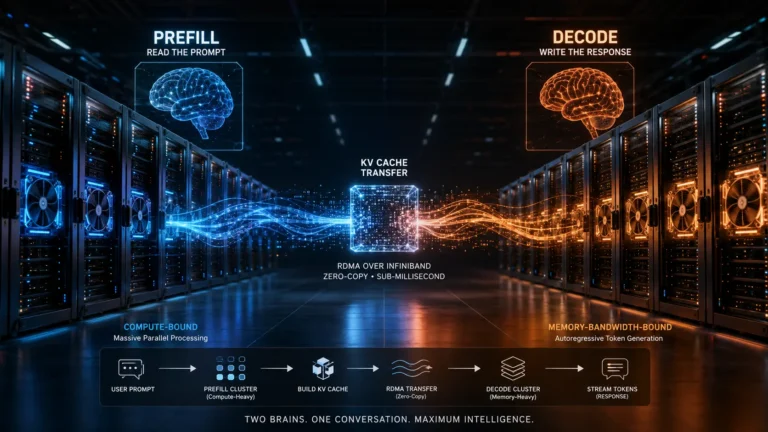
When you send a prompt to an LLM, the process splits into two phases. The “prefill” phase processes your entire prompt at once. This is compute-bound and highly efficient. The “decode” phase generates the answer one token at a time. This is memory-bound. Because modern GPUs (like the H100) have far more math cores than memory bandwidth, the math cores sit idle 90% of the time during generation, waiting for the memory to load the model’s weights.
Speculative decoding puts those idle math cores to work. By loading the target model’s weights into the cores once and forcing it to evaluate a chunk of five drafted tokens simultaneously, it achieves massive hardware utilization. You are effectively getting five tokens of output for the exact same memory-loading cost as one token.
Micro-Insight: The defining metric of modern AI infrastructure is “Time to First Token” (TTFT) and “Tokens Per Second” (TPS). Speculative decoding directly hacks the physical limitations of TPS by cheating the memory bus.
The Shift to LLM Inference Optimization
We are witnessing a shift from model training to model serving.
As open-weight models like Meta’s Llama 3 establish parity with proprietary models, the enterprise battleground has moved from capability to efficiency. A 70-billion parameter model is brilliant, but serving it to ten thousand concurrent enterprise users in real-time is ruinously expensive.
Speculative decoding changes the physics of deployment. It proves that we do not need to compress or “quantize” a model and sacrifice its intelligence to make it fast. We simply need to change how the model is queried.
How Speculative Decoding Works
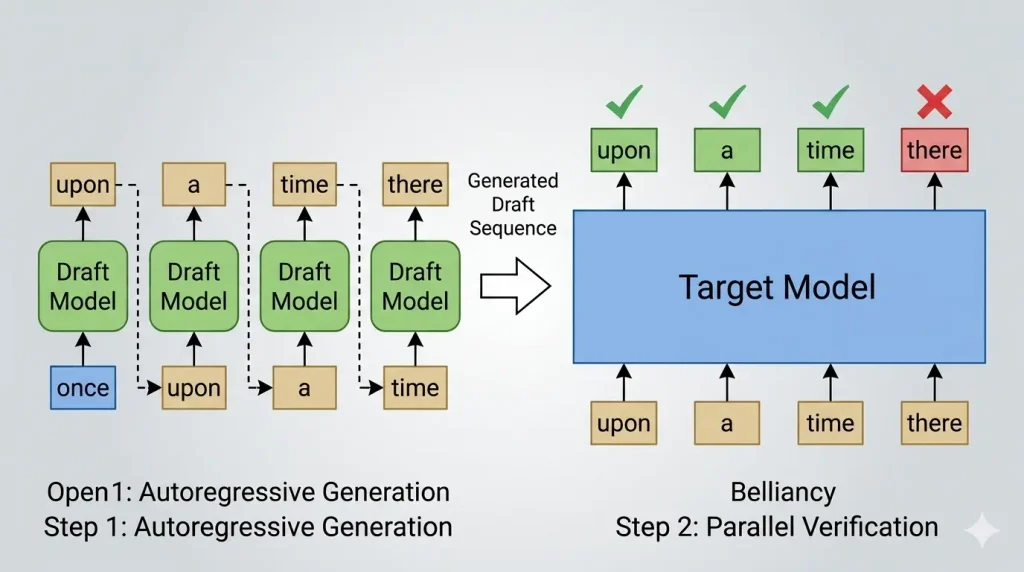
Bypassing the memory wall requires a highly synchronized ballet between two distinct neural networks. Here is the first-principles breakdown of the architecture.
1. The Fundamental Problem: Sequential Locking
In standard autoregressive generation, Token 3 cannot be calculated until Token 2 is finalized. This strict sequential lock means the GPU must execute a full memory-read cycle for every single token, throttling the entire system down to the speed of the memory bus.
2. The Core Mechanism: The Draft Model
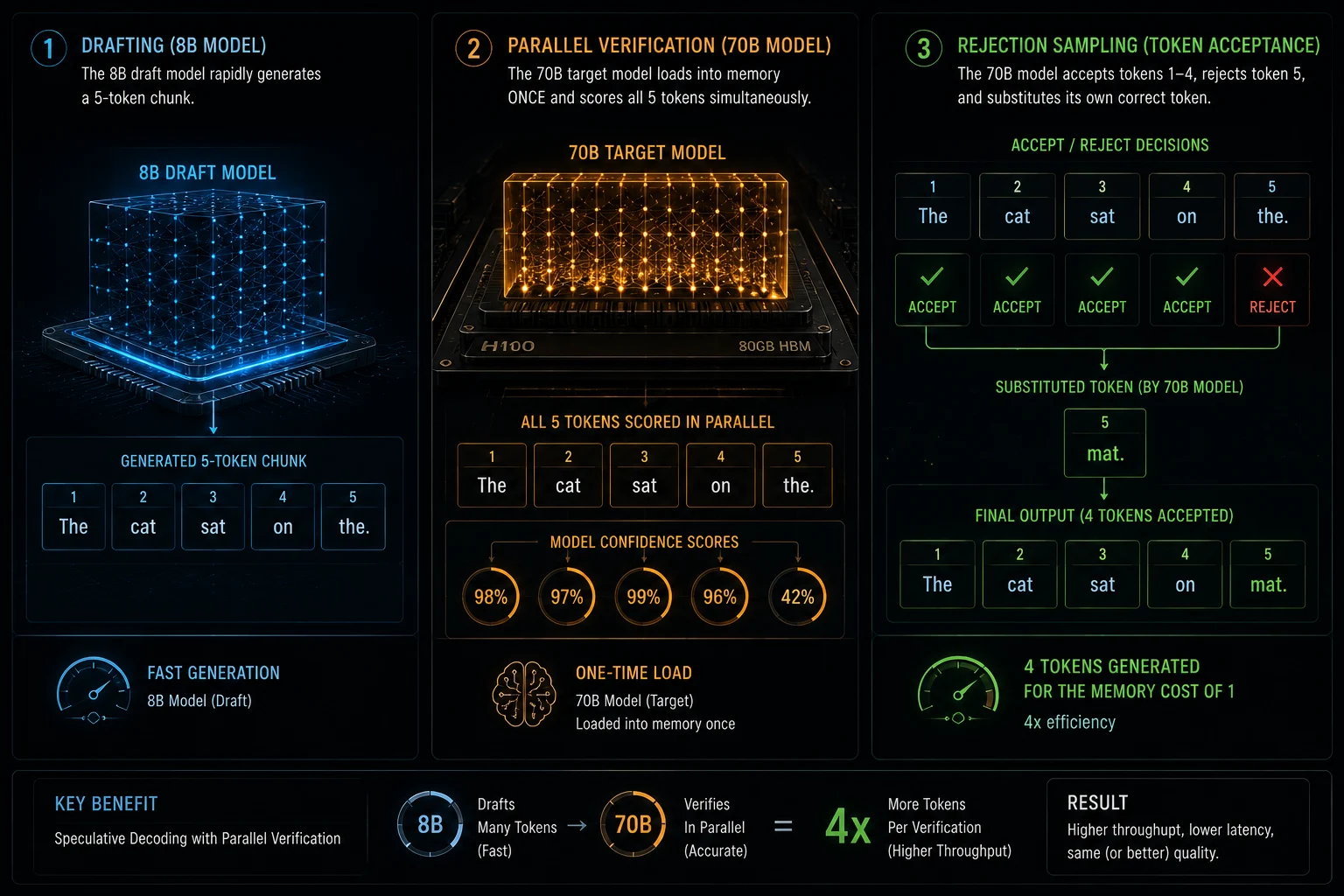
Engineers pair the massive target model (e.g., Llama-3-70B) with a highly correlated, tiny draft model (e.g., Llama-3-8B). Because the draft model is nearly a tenth of the size, it can generate tokens extraordinarily quickly. The draft model runs ahead, generating a “chunk” of tokens (usually 4 to 8).
3. Technical Depth: The Parallel Forward Pass
Once the draft model produces its chunk, the target model takes over. The target model looks at the original prompt plus the drafted chunk.
Here is the magic trick: an LLM can score a sequence of known tokens in parallel. Evaluating five tokens takes the target model the exact same amount of time as evaluating one token, because the memory loading cost is identical. The target model computes the probability distribution for every token in the drafted chunk simultaneously.
4. Technical Depth: Modified Rejection Sampling
The orchestrating software compares the probabilities. If the draft model predicted “The cat sat on the,” the target model checks if its own internal math agrees with those exact words.
If the target model’s probability for a word matches the draft’s prediction within an acceptable statistical bound, the token is accepted. If the target model disagrees at token 4, it accepts tokens 1, 2, and 3, rejects token 4, and substitutes its own correct calculation for token 4. The remaining drafted tokens are discarded, and the cycle begins again.
5. Real-World Consequences: Guaranteed Mathematical Equivalence
Unlike other optimization methods that degrade the model’s reasoning, speculative decoding is mathematically lossless. Because the target model acts as the ultimate filter using strict rejection sampling, the final generated text is proven to come from the exact same probability distribution as if the target model had typed it manually. You get 70B-parameter intelligence at 8B-parameter speeds.
Speculative Decoding Simulator
LLM Inference Latency Simulator
Autoregressive Generation vs. Speculative Decoding
80%
Low (Hallucinates)
High (Perfect Draft)
Tokens Per Second (TPS):
0.0
GPU Memory Calls:
0
Performance Insight: In Standard Autoregressive mode, the massive target model computes exactly one token per GPU memory call, throttling generation speed. In Speculative Decoding, a lightweight draft model rapidly guesses chunks of tokens (Grey). The massive target model then verifies the entire chunk in a single parallel memory call. Accepted tokens (Green) are committed instantly. Even if a token is rejected (Red), the overall Tokens Per Second (TPS) increases dramatically because multiple tokens are processed for the cost of one memory read.
Enterprise Applications for Speculative Decoding
Speculative decoding has rapidly transitioned from research papers into the default execution architecture for enterprise AI.
High-Throughput API Serving: Inference providers offering "LLM-as-a-Service" (like Together AI or Fireworks AI) use speculative decoding to maximize their margin. By serving requests 2.5x faster, they can pack exponentially more paying users onto a single physical server rack. This architectural efficiency is the sole reason open-source API providers can undercut proprietary models on price.
Real-Time Voice and Coding Assistants: Copilot tools and voice-driven AI require hyper-low latency. If an AI takes two seconds to respond verbally, the human conversation breaks down. By implementing speculative decoding on edge servers, MLOps teams push the generation speed well past human reading speed (often exceeding 100 tokens per second), achieving the instant fluidity required for real-time voice synthesis and live code autocomplete.
On-Device AI (Smartphones and Laptops): Running a 7-billion parameter model on a laptop drains the battery and overheats the chip because of constant memory thrashing. Apple and Qualcomm are aggressively integrating speculative decoding into their Neural Processing Units (NPUs). A tiny 1B parameter draft model handles the heavy lifting, only waking up the power-hungry 7B target model for rapid, parallel verification checks, drastically extending battery life during localized AI tasks.
Economic & Strategic Impact
The core strategic consequence is the Decoupling of Intelligence and Speed.
Historically, selecting an AI model was a painful compromise. You either chose a massive model that was smart but brutally slow, or a small model that was fast but prone to hallucinations.
Speculative decoding permanently shatters this trade-off. It allows enterprises to deploy massive, highly capable frontier models in production environments that demand low-latency Service Level Agreements (SLAs). For Cloud Architects, this effectively triples the return on investment (ROI) for their multi-million-dollar Nvidia GPU clusters, turning raw memory bandwidth limits into a solvable software routing problem.
Advantages
- Identical Output Quality: Mathematically guaranteed to match the exact output distribution of the target model, ensuring zero degradation in reasoning or coding ability.
- No Re-Training Required: Standard speculative decoding does not require altering or re-training the expensive target model; it works seamlessly on out-of-the-box weights.
- Massive Speedups: Routinely achieves 2x to 3x increases in token generation speeds, highly dependent on the alignment between the draft and target models.
Limitations
- The VRAM Penalty: You must physically load both the massive target model and the draft model onto your GPUs. The draft model consumes precious Video RAM (VRAM) that could otherwise be used for continuous batching or longer context windows.
- Alignment Failure: If the draft model is stupid, it makes bad guesses. If the target model constantly rejects the drafted tokens, the system actually runs slower than standard generation because it wasted compute verifying useless predictions.
- Domain Specificity: A draft model might guess perfectly when writing Python code, but fail completely when generating French poetry. The acceptance rate fluctuates wildly based on the complexity and language of the user's prompt.
Takeaway: Speculative decoding is a gamble. It only works if the cheap intern is actually good at their job. If the intern fails, the executive wastes more time fixing the draft than typing it themselves.
Common Misconceptions
Misconception: The target model merges with the draft model.
Reality: The two models remain completely distinct neural networks. The draft model simply passes a string of text over to the target model, which scores it. They do not share weights or layers.
Misconception: It degrades the intelligence of the final answer.
Reality: Because of strict rejection sampling, if the draft model suggests a token that the target model would not have chosen, it is instantly deleted. The target model retains absolute veto power over every single syllable.
Misconception: You can use any small model to draft for any large model.
Reality: While theoretically true, in practice, they must be part of the same family (e.g., a Llama-3-8B drafting for a Llama-3-70B). They must share the exact same tokenizer (vocabulary map); otherwise, passing text between them becomes computationally impossible.
What Most People Miss
The disruptive capability of Self-Speculation (EAGLE and Medusa).
When analysts evaluate speculative decoding, they point out the painful VRAM tax of loading a completely separate draft model. What they miss is that modern architectures have bypassed the separate draft model entirely.
Techniques like Medusa and EAGLE employ "Self-Speculation." Instead of running two different models, engineers surgically graft a tiny, lightweight neural "head" onto the very top of the target model. As the target model calculates the current token, this grafted head siphons off the internal math and uses it to hallucinate the next five tokens instantly. This completely eliminates the need for a separate draft model, slashing VRAM usage while maintaining the blistering parallel verification speeds.
Comparison Table
| Feature | Standard Autoregressive Generation | Classic Speculative Decoding | Self-Speculation (EAGLE / Medusa) |
| Generation Mechanism | Strictly sequential (one token per pass) | Draft model guesses, Target verifies | Extra "heads" guess, Target verifies |
| Memory Bandwidth Cost | Extremely High (Hit every token) | Low (Batched parallel verification) | Low (Batched parallel verification) |
| VRAM Requirement | Target Model Only | Target Model + Draft Model (High) | Target Model + Tiny Heads (Low) |
| Inference Latency | Slow | Fast (2x - 3x Speedup) | Ultra-Fast (>3x Speedup) |
| Output Quality | Baseline | Identical to Baseline | Identical to Baseline |
Case Study
Situation: An enterprise legal technology firm deployed a 70-billion parameter open-weight model to summarize massive corporate litigation documents in real-time for lawyers. However, the application was severely memory-bound on their internal Nvidia A100 cluster. Generating a 1,000-word summary took over 45 seconds per document. This latency was unacceptable for live client interactions, but down-sizing to a smaller 8-billion parameter model resulted in unacceptable hallucinations and legal inaccuracies.
Challenge: Drastically reduce the generation latency to under 15 seconds without compressing the 70B target model or sacrificing its complex legal reasoning capabilities.
Solution (The vLLM Speculative Deployment): The MLOps team integrated the vLLM inference engine, activating its speculative decoding pipeline. They paired the highly accurate 70B legal target model with a heavily quantized, hyper-fast 8B model trained on the exact same legal corpus. They optimized the chunk size to draft 6 tokens per forward pass.
Outcome: Because legal terminology is highly structured and predictable (e.g., "pursuant to the aforementioned"), the 8B draft model successfully predicted the correct upcoming tokens with an 84% acceptance rate. The 70B target model effortlessly verified these chunks in parallel. The text generation speed surged from 25 tokens per second to over 78 tokens per second. The 1,000-word summaries completed in 12 seconds, satisfying the strict enterprise SLA while mathematically preserving the flawless legal logic of the 70B model.
Lessons Learned: The deployment validated that high predictability in a dataset yields massive speculative speedups. By shifting the bottleneck from hardware bandwidth to software prediction, the firm secured frontier-level intelligence at commodity-level speeds.
Future Outlook
Next 12–24 Months
The era of Automated Draft Alignment. Right now, MLOps engineers must manually select and test draft models to find one that aligns well with their target model. In the immediate future, inference engines like TensorRT-LLM and TGI will fully automate this. Distillation algorithms will automatically carve out a miniaturized, perfectly correlated draft model during the target model's initial training run. Speculative decoding will transition from an optional optimization setting into the invisible, default architecture for all production AI.
Next 3–5 Years
The scaling of Tree-Based Speculation. Currently, draft models predict a single, straight line of text. Advanced research is moving toward Tree-Based Speculation. The draft model will predict multiple different branching paths simultaneously (e.g., Path A, Path B, and Path C). The target model will evaluate the entire tree structure in parallel, picking the correct branch. This geometrically increases the probability that the target model finds accepted tokens, pushing speedups from 3x toward 5x and 6x, effectively crushing the memory wall entirely.
Next 10 Years
The Hardware-Native Speculative Silicon. By the mid-2030s, chipmakers will physically hardwire speculative decoding into the silicon architectures of NPUs and GPUs. Semiconductor designs will feature asynchronous compute blocks: a dedicated, low-power cluster of arithmetic logic units (ALUs) specifically built to run endless draft predictions, feeding verified matrices instantly into a massive, centralized tensor core block. Software optimizations will become physical hardware reality, permanently redefining how computers generate thought.
Most Likely Scenario
Speculative decoding is the most elegant hack in modern artificial intelligence. It proves that the limitations of hardware can be subverted by the cleverness of algorithmic orchestration. As enterprise AI models continue to swell past hundreds of billions of parameters, sequential generation will become economically non-viable. The future of AI inference is indisputably parallel, governed by tiny, hyper-active predictors racing ahead of massive, calculating verifiers.
Key Takeaways
- Standard AI models are slow because they type one word at a time, forcing the computer to load massive amounts of data from memory for every single syllable.
- Speculative Decoding fixes this by having a tiny, fast AI model guess the next 5 words instantly.
- The massive, smart AI model reads those 5 words and verifies them all at once. Because checking homework is much faster than doing it from scratch, the system generates text up to three times faster.
- If the fast model makes a bad guess, the smart model instantly deletes the error and corrects it. The final text is mathematically guaranteed to be identical to what the smart model would have written alone.
- Advanced versions of this tech (like Medusa) don't even use a separate small model; they graft an extra "guessing head" directly onto the smart model, saving massive amounts of memory.
Glossary
Autoregressive Generation: The standard, sequential method of AI text generation where the model predicts exactly one token, outputs it, and then uses that token to calculate the next one.
Compute-Bound: A process constrained by the speed of the math processors. (The initial reading of your prompt is compute-bound).
Draft Model: The small, lightweight, ultra-fast neural network responsible for guessing the upcoming tokens.
Memory-Bound: A process constrained by how fast data can be physically moved from RAM into the processors. (Generating the answer is memory-bound).
Rejection Sampling: The strict mathematical filter used by the target model to evaluate drafted tokens. If a token falls outside acceptable probability limits, it is rejected and deleted.
Target Model: The massive, highly intelligent, but slow neural network that verifies the draft and ensures the final answer is flawless.
Tokens Per Second (TPS): The standard metric for measuring the speed of an LLM during generation.
## Frequently Asked Questions (FAQ) Does speculative decoding reduce the quality of the LLM output? No. Speculative decoding is mathematically lossless. Because the target model uses strict rejection sampling to verify every drafted token, the final generated text is mathematically guaranteed to be identical to what the target model would have produced on its own. What is the difference between Speculative Decoding and Medusa? Classic speculative decoding requires running two entirely separate models (a draft and a target). Medusa uses "self-speculation" by grafting extra neural heads directly onto the target model, eliminating the need to load a separate draft model into VRAM.
Sources
Google Research: Fast Inference from Transformers via Speculative Decoding
DeepMind: Accelerating Large Language Model Decoding with Speculative Sampling
UC Berkeley AI Research: EAGLE: Speculative Sampling Requires Rethinking Feature Extraction
Hugging Face: Introduction to Speculative Decoding and Inference Optimization
Nvidia Technical Blog: Optimizing Inference with TensorRT-LLM and Speculative Decoding