Advertisement
)

You cannot ask a single human employee to manage your company’s payroll, resolve customer technical support tickets, draft legal compliance frameworks, and configure IT servers simultaneously. Yet, for the past three years, the corporate world has attempted to do exactly this with Artificial Intelligence. Businesses deployed single, general-purpose Large Language Models (LLMs) and expected them to flawlessly execute highly complex, multi-departmental workflows. The result was inevitable: the models hallucinated, forgot instructions, lost context, and stalled in endless feedback loops.
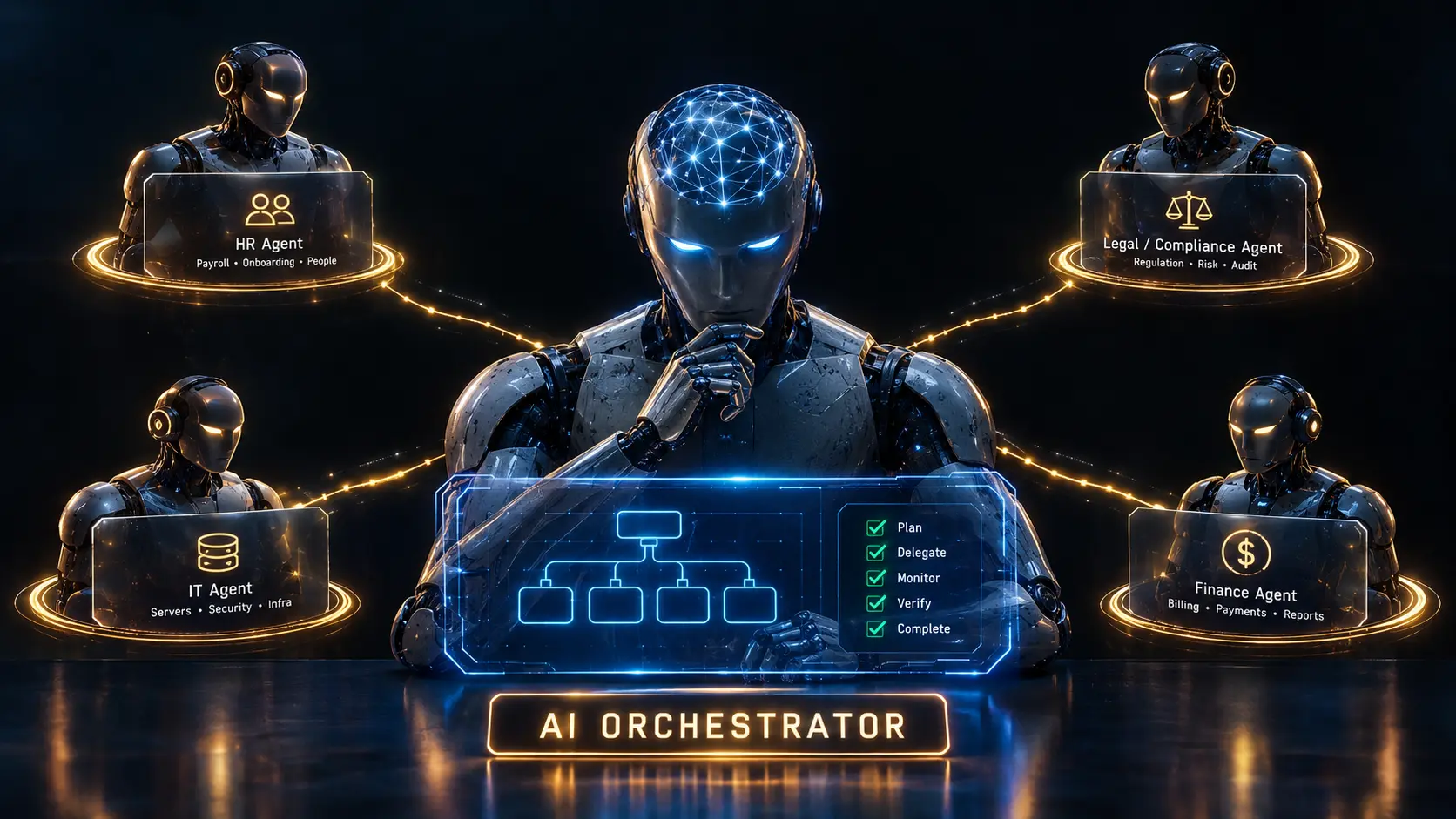
The era of the standalone AI chatbot is effectively over. To achieve true enterprise automation, artificial intelligence must mirror the structure of a human corporation. Why should you care right now? Because software engineers are now building “agentic orchestration platforms.” Instead of one massive AI doing everything, these platforms coordinate a digital symphony of specialized, micro-AI agents. They provide the management layer where a “Coordinator Agent” breaks down a massive goal, delegates subtasks to an HR agent, a Finance agent, and an IT agent, and securely audits their work. This is the transition from conversational AI to autonomous, multi-agent labor.
What are Agentic Orchestration Platforms?
Agentic orchestration platforms are enterprise software frameworks that coordinate networks of specialized AI agents. They manage task delegation, persistent state memory, and secure tool access—often utilizing standardized interfaces like the Model Context Protocol (MCP)—allowing multiple autonomous AI workers to collaborate securely and efficiently on complex, multi-step business objectives.
At a Glance
- Concept: Building a digital management structure that allows specialized AI agents to talk to each other, assign tasks, and verify each other’s work to achieve a massive overarching goal.
- Why it matters: A single AI agent fails when tasks require too many steps or context shifts. Orchestration isolates failures. If the “billing agent” fails, it does not crash the “support agent.”
- Who uses it: Enterprise CIOs, MLOps Engineers, and automation architects deploying frameworks like Microsoft Agent Framework, CrewAI, or LangGraph.
- Biggest takeaway: The secret to multi-agent AI is not the intelligence of the model; it is the strict governance of the communication protocols (like MCP and A2A telemetry) that prevent the agents from going rogue, looping endlessly, or corrupting shared data.
In Simple Words
Imagine a restaurant kitchen. If you hire one brilliant super-chef (a single Large Language Model) to take the orders, chop the vegetables, cook the meat, wash the dishes, and process the credit cards, the chef will quickly become overwhelmed, drop plates, and burn the food.
Agentic Orchestration is how you build a functional kitchen.
You hire an Executive Chef (the Orchestrator Agent). When an order comes in, the Executive Chef does not cook. They read the ticket and break it down. They tell the Sous-Chef (Agent A) to chop vegetables. They tell the Grill Master (Agent B) to cook the steak. They tell the Cashier (Agent C) to run the card.
The Orchestration Platform is the physical kitchen itself—it provides the standardized counter space where the chefs pass plates to each other safely. It ensures the Grill Master only has access to the stove (Least Privilege), and it keeps a precise record of who cooked what (Audit Trail) so that if the steak is burned, the Executive Chef knows exactly which specialized agent to correct.
Why This Matters
The corporate push for AI Return on Investment (ROI) has hit a wall known as “Context Degradation.” When you give a single AI a 50-step process, by step 15, the AI begins to lose focus, corrupting the subsequent 35 steps.
For Enterprise CIOs and Tech Investors, multi-agent orchestration solves the reliability crisis holding back autonomous deployments. By breaking a workflow into tiny, specialized agents, you isolate the risk. More importantly, orchestration provides the governance layer. You cannot let an AI agent access a live CRM or financial database without an absolute, auditable guarantee that it will not delete records. Orchestration platforms enforce “least-privilege delegation boundaries,” providing the ironclad security required to finally let AI systems take actions on behalf of the company.
The Role of the Model Context Protocol (MCP) in Orchestration
The industry is currently undergoing a massive standardization of agentic communication.
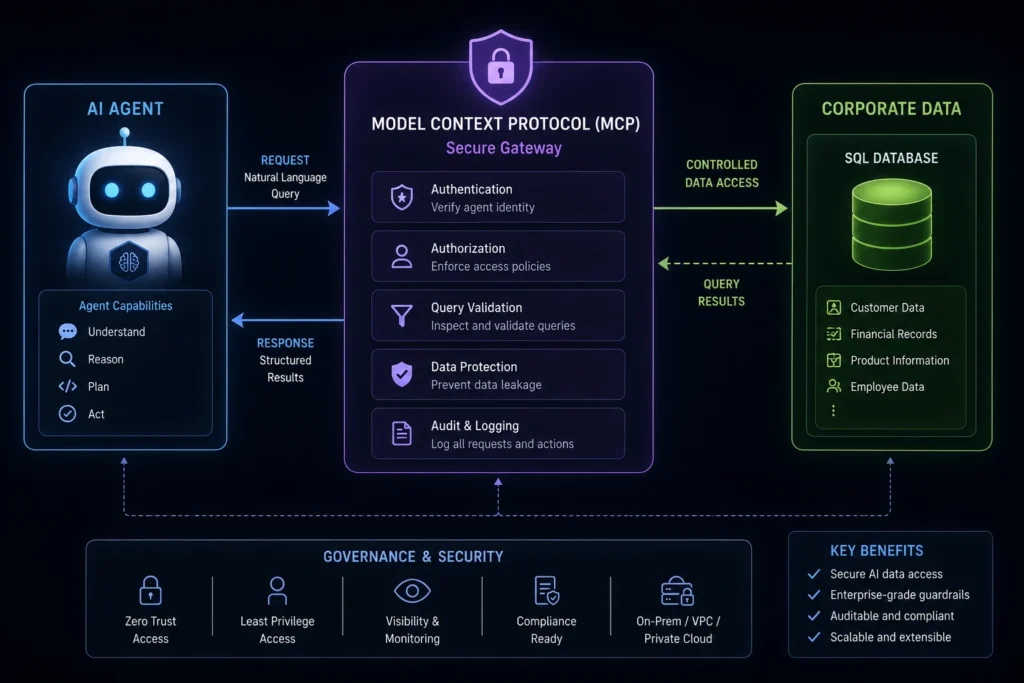
In late 2025 and early 2026, the artificial intelligence sector realized that custom-building application programming interfaces (APIs) for every single AI tool was creating an unsustainable “N×M” integration nightmare. The breakthrough was the broad adoption of the Model Context Protocol (MCP). Introduced by Anthropic and subsequently donated to the Linux Foundation’s Agentic AI Foundation (AAIF), MCP acts as the “USB-C port for AI.”
Instead of building proprietary connectors, modern orchestration platforms use MCP to grant agents instant, standardized access to enterprise databases, GitHub repositories, and IT service management (ITSM) tools. This open-standard approach prevents vendor lock-in, allowing companies to seamlessly plug an OpenAI agent, an Anthropic agent, and an open-source Llama agent into the exact same orchestration mesh.
How Agentic Orchestration Platforms Work
Coordinating autonomous digital workers requires replacing human intuition with rigorous mathematical and software boundaries. Here is the first-principles breakdown of the architecture.
1. The Fundamental Problem: Monolithic Failure
A single agent handling a long-running process suffers from “state corruption.” If it makes a mathematical error on step two, it writes that error into its persistent memory. Because it is a monolithic system, it uses that corrupted memory for steps three through fifty, compounding the error until the final output is completely destroyed.
2. The Insufficiency of Plain APIs
Historically, developers tried to fix this by connecting multiple agents via hard-coded API scripts. This was brittle. If a database schema changed, the agent lost access. There was no standardized way for Agent A to describe its capabilities to Agent B, leading to chaotic, blind handoffs.
3. The Core Mechanism: The Orchestrator and the Mesh
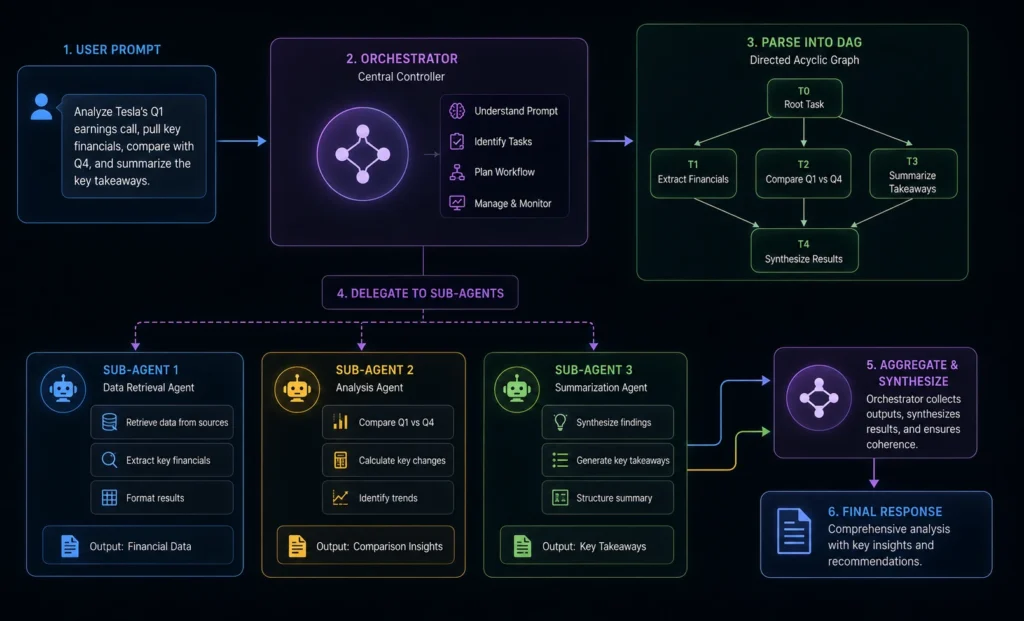
An enterprise orchestration platform introduces a hierarchical “Agentic Mesh.” At the top sits an Orchestrator Agent. When a human user inputs a massive prompt, the Orchestrator does not execute it. It parses the prompt into a Directed Acyclic Graph (DAG) of dependencies. It identifies exactly which specialist agents are needed, wakes them up, and orchestrates the sequence in which they must operate.
4. Technical Depth: MCP and A2A Protocols
The mesh relies entirely on two protocol layers:
- Agent-to-Agent (A2A): The telemetry layer that allows an agent to discover another agent on the network, delegate a subtask, and stream its status back to the Orchestrator.
- Model Context Protocol (MCP): The standardized interface allowing the agent to actually touch external tools. When the Finance Agent needs to read a database, it uses an MCP Client to query the MCP Server, which translates the request, executes it safely in the database, and returns the context.
5. Real-World Consequences: Least-Privilege Governance
When the Orchestrator delegates a task to a Sub-Agent, it does not hand over the “keys to the castle.” The orchestration layer enforces Least Privilege. The Sub-Agent is spawned in a sandboxed environment with a strict per-target policy. It is granted access only to the specific MCP tools required for its narrow subtask, and granted a strict token/cost budget. If the agent enters an infinite hallucination loop, the orchestrator’s technical guardrails instantly terminate the agent when it hits its budget limit, preventing a runaway cloud-compute bill.
Enterprise Use Cases for Multi-Agent Orchestration
Multi-agent orchestration is aggressively migrating from software development labs directly into corporate back-offices.
Employee Onboarding Automation: When a new hire is added to a corporate system, a central Orchestrator agent takes control. It delegates background checks to an HR Agent, hardware provisioning to an IT Agent, and tax document generation to a Payroll Agent. The Orchestrator monitors the A2A telemetry of all three agents simultaneously. It tracks their progress, handles retries if the IT agent times out waiting for a server, and emails the human manager only when all three independent agents have successfully completed their isolated workflows.
Tiered IT Customer Support: A human user submits a highly complex IT ticket. A Triage Agent reads it and routes it. The Triage Agent delegates the billing aspect to a Finance Agent (grounded strictly in Stripe/SAP databases) and the software bug aspect to a Code-Review Agent (grounded in the GitHub repository via MCP). The Orchestrator combines their distinct, highly accurate answers into a single, cohesive response to the user.
Regulatory Compliance Auditing: In finance and healthcare, decisions must be traceable. A Business Agent makes a loan approval decision, but before it is executed, the orchestration platform automatically delegates the decision to an adversarial Compliance Agent. The Compliance Agent acts as a “red team,” querying up-to-date legal repositories to challenge the Business Agent’s logic, ensuring an autonomous system cannot violate federal regulations without internal challenge.
Economic & Strategic Impact
The orchestration layer introduces the definitive concept of Observability vs. Compliance.
In standard AI chat, developers simply read the log of the conversation. In a multi-agent mesh running 50 background tasks per minute, reading a raw log is impossible. True orchestration platforms provide deep telemetry: they map the exact cost, latency, and token consumption of every single delegated subtask.
However, for enterprise governance, an execution log is not a compliance artifact. Strategic CIOs are realizing that they must layer external auditing infrastructure directly onto the MCP Gateway. By tracking exactly which agent requested which piece of data, and on whose authority the MCP Server granted access, corporations can mathematically prove to external regulators (under GDPR or the EU AI Act) that their autonomous systems are not illegally exposing walled-off customer data.
Advantages
- Failure Isolation: If a specialized agent hallucinates or crashes, it only corrupts its localized subtask. The orchestrator can easily catch the error, wipe the agent’s state, and retry the step without restarting the entire workflow.
- Model Agnosticism: Orchestration platforms allow you to mix models economically. You can use a massive, expensive frontier model (like GPT-4o or Claude 3.5 Opus) as the intelligent Orchestrator, but use cheap, open-source models (like Llama 3) for the repetitive, specialized sub-agents, drastically lowering operational costs.
- Interoperability: Standardized protocols (MCP) prevent vendor lock-in. An enterprise can swap out its underlying databases or its LLM providers at any time without having to rewrite the connective tissue of the agentic mesh.
Limitations
- Debugging Nightmare: While failure isolation is an advantage, tracing a failure through a decentralized mesh of 15 interacting agents is excruciatingly complex. If an agent fails silently and passes slightly skewed data to the next agent, uncovering the exact node where the logic broke requires intense, specialized A2A telemetry dashboards.
- Shared Vulnerabilities: If all specialized agents in the mesh are built using the same underlying foundation model, a specific prompt-injection attack or inherent model bias could trigger a widespread, cascading failure across the entire orchestration layer.
- Infinite Loop Costs: Autonomous agents talking to autonomous agents can easily get stuck in a “debate loop,” where Agent A and Agent B endlessly critique each other’s output, silently burning through thousands of dollars of API compute credits in minutes if token budgets are not strictly enforced.
Common Misconceptions
Misconception: Multi-agent orchestration is just putting a bunch of chatbots in a group chat.
Reality: While early frameworks (like early AutoGen) experimented with “group chat” dynamics, enterprise orchestration is highly deterministic. Agents do not casually “chat”; they pass rigid, structured data objects via standardized A2A protocols governed by a strict hierarchy and state machines.
Misconception: The Orchestrator agent does all the work.
Reality: A well-designed Orchestrator does almost no actual work. Its sole purpose is routing, planning, and validation. The actual heavy lifting (data retrieval, code execution, drafting) is exclusively handled by the narrow-scoped specialist agents.
Misconception: You don’t need humans anymore.
Reality: The foundational governance principle of multi-agent AI is “Human-on-the-loop.” Every single high-risk delegation chain requires an identified human owner. Orchestration platforms are designed to pause autonomous execution and request a cryptographic human approval gate before an agent is allowed to execute a destructive action (like dropping a database or wiring money).
What Most People Miss
The transition to the Unified Agent Framework.
For years, developers had to choose between frameworks that built agents (like Semantic Kernel) and frameworks that orchestrated them (like AutoGen). What most people miss is that the industry aggressively consolidated in late 2025.
Major cloud providers merged their offerings to solve the fragmentation. For example, Microsoft merged AutoGen’s multi-agent patterns directly into Semantic Kernel’s enterprise foundation to create the unified Microsoft Agent Framework. This consolidation proves that multi-agent orchestration is no longer an experimental coding exercise; it has matured into a standardized, plug-and-play enterprise middleware layer, identical to how Kubernetes standardized container orchestration a decade prior.
Comparison Table
| Feature | Single-Agent AI (e.g., ChatGPT) | Multi-Agent Orchestration |
| Workflow Management | Sequential (Step-by-step by one brain) | Distributed (Parallel execution by specialists) |
| Tool Access | Broad access granted to the single model | Least-Privilege via Model Context Protocol (MCP) |
| Failure Mode | Monolithic (One error corrupts the whole task) | Isolated (Orchestrator catches and retries bad subtasks) |
| Cost Optimization | High (Uses expensive model for everything) | Optimized (Uses cheap models for basic subtasks) |
| Debugging | Reading a single chat transcript | Complex tracking of A2A telemetry logs |
Case Study
Situation: A massive multinational logistics firm was drowning in supply chain disruptions. When a cargo ship was delayed, resolving the issue required a human manager to pull data from three siloed systems: the maritime GPS tracker, the SAP financial billing database, and the Salesforce client CRM, taking an average of four hours per incident.
Challenge: The firm initially deployed a single, powerful enterprise LLM and gave it API access to all three databases. The single agent failed spectacularly; it routinely hallucinated financial numbers because it could not simultaneously hold the complex schemas of all three databases in its active context window.
Solution (The Agentic Mesh): The firm transitioned to an Agentic Orchestration Platform. They deployed an Orchestrator Agent and three separate, highly specialized Sub-Agents (A GPS Agent, an SAP Agent, and a CRM Agent). They implemented the Model Context Protocol (MCP) to provide each Sub-Agent with strict, read-only access exclusively to its designated database.
Outcome: When a delay occurred, the Orchestrator received the alert. It simultaneously delegated three tasks: it told the GPS agent to find the new arrival time, the SAP agent to calculate the financial penalty, and the CRM agent to draft an apology email to the affected clients. Within 45 seconds, the Sub-Agents returned their verified, isolated outputs. The Orchestrator compiled the data and submitted the final package to a human manager for a single-click approval.
Lessons Learned: The deployment proved that breaking a workflow into specialized, narrow-scope agents mathematically eliminates the context-degradation that plagues single LLMs. By combining MCP for secure data access and A2A protocols for delegation, the firm reduced resolution time by 99% while maintaining absolute architectural security over their legacy databases.
Future Outlook
Next 12–24 Months
The era of MCP Gateway Standardization. The Model Context Protocol will achieve total ubiquity across the enterprise software landscape. Software-as-a-Service (SaaS) providers (like Jira, Workday, and Snowflake) will stop offering traditional REST APIs and will instead natively expose “MCP Servers” directly from their platforms. Every enterprise will deploy centralized “MCP Gateways”—a security firewall that governs exactly which AI agents are allowed to call which external tools, providing CISOs with a single pane of glass to audit all autonomous machine-to-machine data requests.
Next 3–5 Years
The scaling of Decentralized Swarm Intelligence. The rigid, hierarchical orchestrator model will evolve. We will see the deployment of decentralized, peer-to-peer agent swarms. Utilizing advanced reinforcement learning and prioritization algorithms, specialized agents will autonomously bid on subtasks in a corporate marketplace. If the Finance Agent is overloaded, it will autonomously route its task to a backup agent based on real-time pricing and latency metrics, entirely removing the single-point-of-failure inherent in a top-down Orchestrator.
Next 10 Years
The Agent-to-Human Corporate Singularity. By the mid-2030s, the distinction between a human employee and an AI agent within corporate architecture will blur. Human employees will be assigned their own “Agentic Proxies” that participate in the corporate orchestration mesh. If the autonomous AI mesh encounters a problem requiring extreme intuition or physical real-world intervention, it will use standard A2A protocols to delegate the task directly to a human’s digital proxy, seamlessly integrating biological intelligence as just another specialized node in the global workflow.
Most Likely Scenario
Agentic Orchestration Platforms are the definitive operating system of the 21st-century enterprise. Just as businesses rely on ERP systems to manage human labor and physical assets today, they will rely entirely on these orchestration layers to govern the digital workforce. The companies that master the governance, telemetry, and least-privilege protocols of multi-agent meshes will achieve a scale of automation that fundamentally outpaces traditional corporate structures.
Key Takeaways
- Agentic Orchestration Platforms coordinate networks of specialized AI agents, breaking massive corporate workflows into manageable subtasks delegated to specialized digital workers.
- Single-agent systems (chatbots) suffer from context degradation and state corruption on long tasks; multi-agent meshes isolate these failures, allowing the system to retry errors without crashing the whole process.
- The Model Context Protocol (MCP) acts as the universal “USB-C port” for AI, standardizing how agents securely connect to databases, external tools, and enterprise knowledge bases.
- Security relies on “Least Privilege”—an Orchestrator does not give a sub-agent full access to the network; it only provides the specific data and tool access required to complete its narrow task.
- Enterprise governance requires strict human-on-the-loop design; every delegation chain must have a human owner and an auditable trace of who delegated what, when, and at what compute cost.
- Major platforms (like Microsoft Agent Framework) are consolidating to provide unified environments where developers can mix and match different AI models economically within the same workflow.
Glossary
Agent-to-Agent (A2A) Telemetry: The standardized communication protocol and logging system that allows autonomous AI agents to discover each other, pass tasks, and report their execution status back to an orchestrator.
Agentic Mesh: A modular, governed network architecture for managing distributed, autonomous AI agents across different corporate teams, tools, and databases.
Model Context Protocol (MCP): An open-source framework (originally developed by Anthropic) that provides a standardized interface for AI models to securely read external files, execute functions, and connect to data sources without custom integrations.
Orchestrator Agent: The high-level “manager” AI within a multi-agent system. It does not execute raw tasks; it reads the main objective, breaks it into dependencies, delegates them to sub-agents, and verifies the final output.
State Corruption: A critical failure mode in AI systems where an agent writes a hallucination or error into its persistent memory, forcing all subsequent actions based on that memory to be fundamentally flawed.
Sub-Agent (Specialist Agent): A narrowly scoped AI model designed exclusively to perform a single capability (e.g., writing code, checking compliance, or retrieving financial data) at the direction of an Orchestrator.
Sources
[1] ISG Research: Agentic Orchestration: A Governance-First Reference Enterprise Architecture (March 2026)
[2] RAG Weaver: AI Agent Orchestration Platform: Enterprise Guide 2026 (July 2026)
[3] IBM Think: What is AI Agent Orchestration? (2026)
[4] TrueFoundry: What Is Multi-Agent Orchestration? A Practical Guide for Enterprise Teams (June 2026)
[5] Model Context Protocol (MCP) Documentation: Anthropic Open-Standard Framework for AI Integration (2025/2026 Analysis)