Advertisement
)
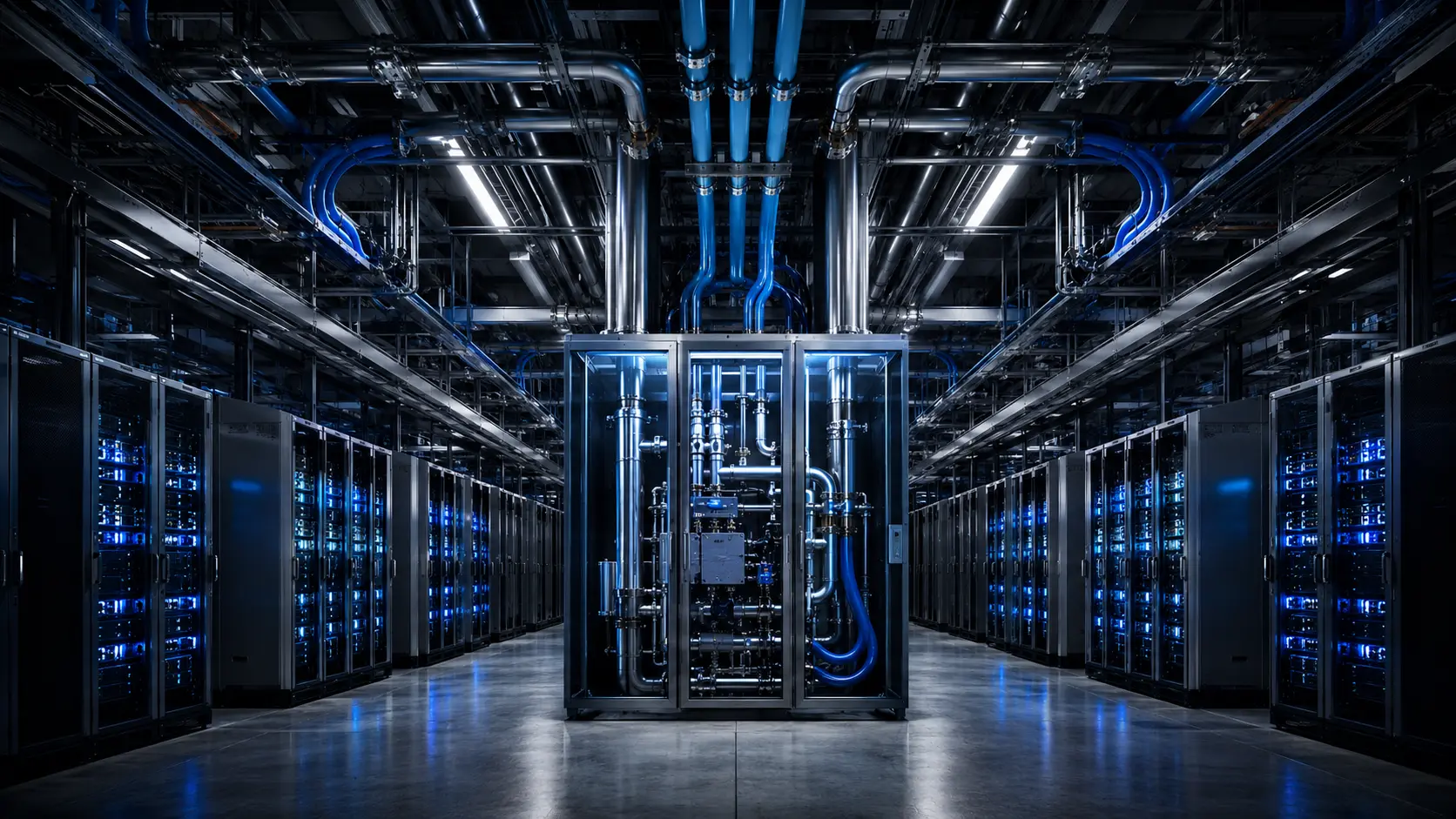

If you walk into a traditional cloud data center today, you will hear the deafening roar of massive cooling fans. But if you try to place a modern artificial intelligence cluster inside that same room, the infrastructure will literally melt. The explosive, volatile power demand of AI training is actively tearing apart legacy data center equipment, causing backup batteries, generators, and cooling systems to malfunction or wear out years ahead of schedule.
Standard internet servers operate at a predictable, steady hum, consuming roughly 2 to 4 kilowatts of power per rack. Today’s AI clusters demand upwards of 100 to 140 kilowatts per rack. You cannot solve this by simply blowing colder air; the physical volume of air required to remove that much heat exceeds the capacity of standard floor tiles and fans, hitting a hard thermodynamic wall.
Why should you care right now? Because the cloud is physically splitting in two. Cloud providers and real estate developers are being forced to build entirely new breeds of facilities—AI-optimized data centers—with reinforced structural steel, overhead liquid cooling loops, and massive dedicated power plants. For investors and architects, understanding this bifurcation is critical, as legacy data centers risk becoming obsolete, stranded assets in an era where AI dictates the future of global real estate.
What is AI-Optimized Data Centers?
AI-Optimized Data Centers are specialized computing facilities engineered specifically to handle the extreme power densities and thermal loads of artificial intelligence workloads. They abandon traditional raised-floor air cooling in favor of advanced direct-to-chip liquid cooling and structural reinforcements, enabling racks to consume over 100 kilowatts of power continuously.
At a Glance
- Concept: Redesigning the physical shell of the internet to support liquid-cooled GPU clusters operating at extreme electrical densities.
- Why it matters: Global data center electricity consumption is surging 26% to reach 565 terawatt hours (TWh) in 2026, with AI-optimized servers accounting for 31% of that power. By 2027, AI power consumption will definitively surpass conventional servers.
- Who uses it: Hyperscalers (Microsoft, Meta, Google), AI infrastructure specialists (Crusoe Energy), and specialized Real Estate Investment Trusts (REITs).
- Biggest takeaway: Designing for 100 kW per rack isn’t an incremental upgrade; it is a ground-up reimagining. Powering racks at this level breaks all legacy assumptions behind floor loading, electrical distribution, structural design, and fire protection.
In Simple Words
Imagine a city street designed for lightweight sedans. That represents a traditional data center hosting thousands of normal web servers.
An artificial intelligence model is not a lightweight sedan; it is a million-ton freight train. You cannot run a massive freight train down a standard city street—it will instantly crush the asphalt.
AI-Optimized Data Centers are the heavy-duty rail networks built from scratch to handle the freight trains. Because the AI computers work so hard, they generate an astronomical amount of heat. Standard air conditioning isn’t strong enough to cool them. So, architects remove the raised floors and install massive overhead plumbing networks that pump cold liquid directly over the computer chips. By running water directly to the “engine,” these specialized buildings prevent the world’s most expensive hardware from catching fire.
Why This Matters
The sheer scale of the artificial intelligence buildout has detached from the physical reality of the public power grid.
Gartner projects that global data center power demand will rise 27% in 2026, hitting 132 gigawatts (GW) globally. This unprecedented scale means the traditional electrical grid cannot keep up. Data center developers and utility providers are now facing terrifying “stranded power” economics. If utilities overbuild transmission lines and gas pipelines for AI demand that does not materialize at anticipated levels, they risk billions of dollars in stranded costs.
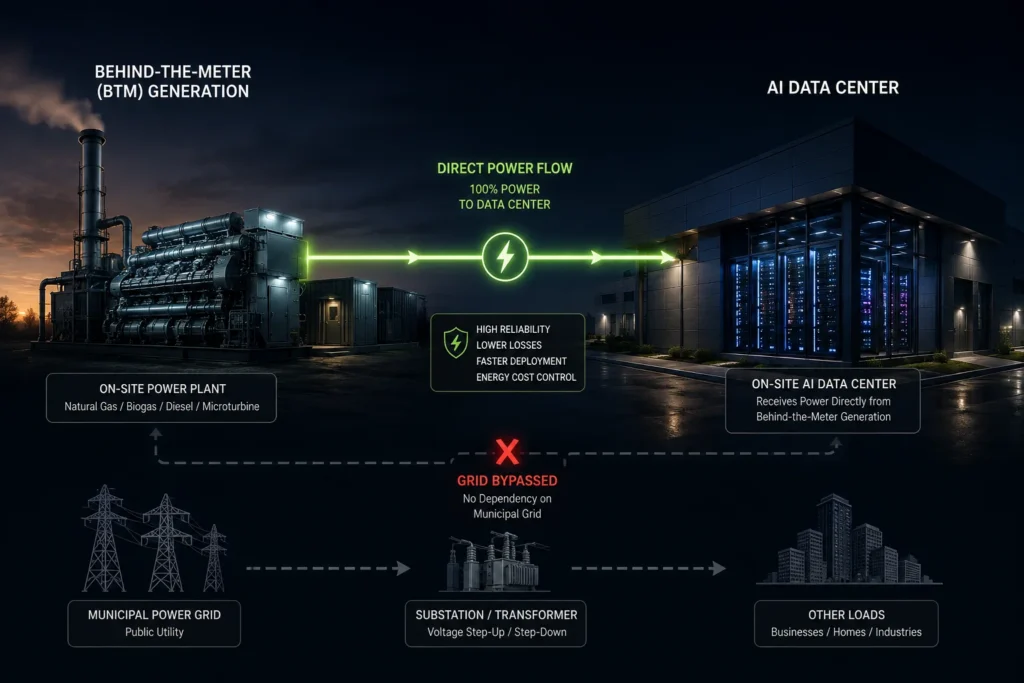
Conversely, to bypass multi-year grid connection queues, hyperscalers are aggressively deploying “behind-the-meter” (BTM) generation—building their own dedicated power plants directly next to the data center. The data center industry is transforming from an IT real estate sector into an independent energy generation sector.
The Bifurcation of Cloud Compute and AI-Optimized Data Centers
The bifurcation of cloud compute is creating two distinct real estate classes defined entirely by spatial power density.
Legacy data centers, operating at 5 to 12 kW/m², will continue hosting standard enterprise software, email, and web traffic. Meanwhile, a new class of AI dense facilities operating at 75 to 150 kW/m² is being constructed exclusively for large-scale model training and high-performance computing. You can no longer mix these workloads effectively; placing a standard server rack inside a heavy liquid-cooled AI hall is a massive misallocation of advanced thermal capital.
How Liquid Cooling in AI-Optimized Data Centers Works
Cooling a silicon chip that consumes as much electricity as a residential neighborhood requires mastering thermal fluid dynamics. Here is the first-principles breakdown of AI data center architecture.
1. The Fundamental Problem: Extreme Heat Flux
AI chips (GPUs) generate immense heat during sustained training runs. The heat flux is far too concentrated for traditional infrastructure. The power density has scaled so aggressively that a single hyperscale data center can now consume as much electricity as 50,000 homes.
2. The Insufficiency of Air Cooling
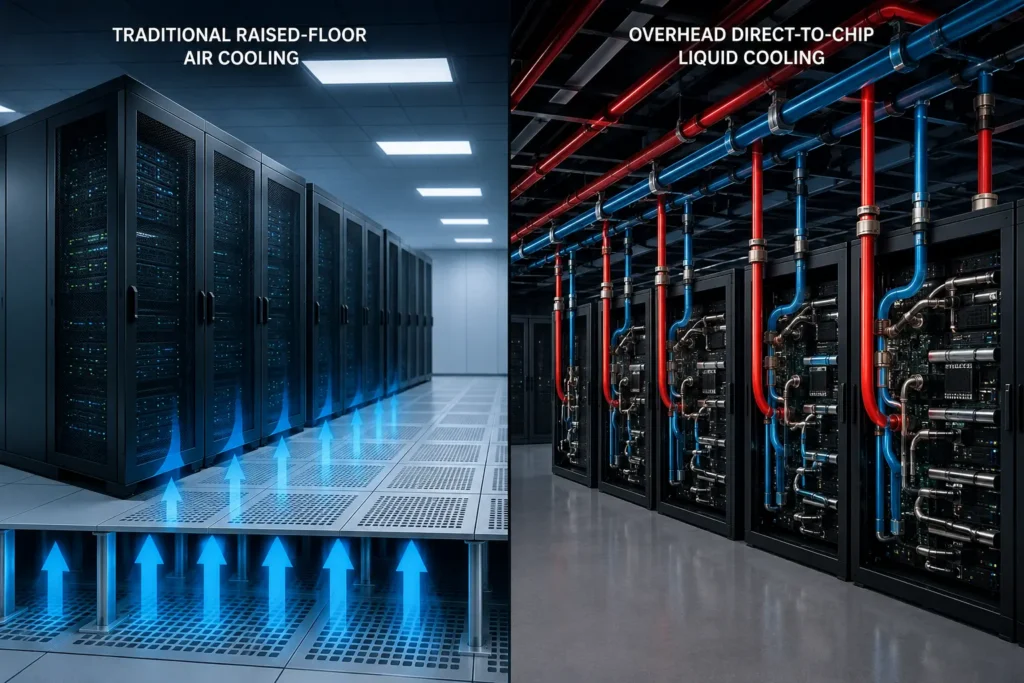
It is not a matter of simply optimizing airflow or buying bigger fans; the physics of air as a heat transfer medium cannot physically remove 100 kW from a standard 600 mm × 1,000 mm rack footprint without creating unworkable operational conditions. Pushing air cooling beyond its physical limit destroys the facility’s Power Usage Effectiveness (PUE).
3. The Core Mechanism: Direct-to-Chip Liquid Cooling
AI facilities pivot entirely to liquid cooling, which offers vastly superior thermal conductivity and volumetric heat capacity. By capturing heat directly at the silicon processor via liquid cold plates, liquid cooling operates up to 40 percent more efficiently than traditional air systems, significantly cutting energy overhead.
4. Technical Depth: The Separate Loop Architecture
The entire system revolves around the Coolant Distribution Unit (CDU). A CDU manages the heat exchange between a secondary liquid loop inside the IT equipment and the primary facility water loop. It regulates pressure, filtration, and fluid temperature precisely to ensure the stability of the entire thermal circuit.
5. Real-World Consequences: Structural Re-Engineering
Because liquid cooling relies on pipes, legacy raised floors are eliminated. All infrastructure—power busways, coolant supply and return headers, and heavy network cable trays—routes overhead. The combined weight of this fully loaded overhead infrastructure can reach 180 to 250 kg per linear meter, requiring a massive reimagining of the building’s structural steel and ceiling load capacity.
Real-World Solutions for AI Data Center Power Demand
The physical demands of AI have spawned entirely new business models for power generation and facility management.
Behind-the-Meter (BTM) Generation: Data center developers are increasingly turning to behind-the-meter models to bypass aging grids and long connection queues. By siting dedicated generation facilities—such as natural gas turbines or advanced modular reactors—directly at or near the data center, hyperscalers secure reliable, near-continuous uptime independent of public grid delays.
Stranded Energy Utilization: Companies like Crusoe Energy capture stranded energy, such as flared natural gas in remote oil fields or trapped renewable energy in West Texas, to power modular AI data centers directly at the source. By moving the compute to the energy—rather than waiting for transmission lines to move the energy to the compute—they cut the time to market for new sites by more than half.
Adaptive UPS Systems: AI training workloads impose a demanding duty cycle, characterized by sustained near-100% loads during training runs followed by rapid ramp-downs. This volatile load profile severely stresses Uninterruptible Power Supply (UPS) battery systems and generators in ways that conventional IT loads do not, forcing engineers to redesign backup architectures specifically for extreme load swings.
Economic & Strategic Impact
The transition to gigawatt-scale compute brings massive Stranded Asset Risk.
Financing structures for AI data centers have become immensely complex. Lenders are highly focused on stranded asset risk, construction delays, and the interdependence of generation and data center assets. Building infrastructure to support AI is astronomically expensive, and if demand turns out to be lower than planned, or if algorithmic efficiency radically improves, massive amounts of capital could be stranded in under-utilized liquid-cooled facilities and dedicated power plants.
Advantages
- Superior Thermal Conductivity: Shifting to liquid cooling allows for higher compute density within a smaller physical footprint while meeting strict energy efficiency mandates.
- Drastically Lower PUE: Liquid-cooled AI data centers can target significantly lower Power Usage Effectiveness (PUE) ratios because liquid cooling can be up to 40 percent more efficient than traditional air systems.
- Decreased Latency: By enabling 100kW+ racks, facilities can pack more GPUs closer together, shortening the optical fiber runs between chips and vastly improving the synchronized speed of AI model training.
Limitations
- Water Leakage Risks: Liquid cooling in AI halls involves pumping pressurized coolant directly above highly sensitive, multi-million dollar servers, necessitating flawless mechanical plumbing, BMS integration, and advanced leak detection.
- Grid Stability Threats: The rapid, volatile swings in AI data centers’ power demands are damaging vital equipment, raising downtime costs, and creating wider grid-stability risks for local utilities.
- National Electricity Drain: U.S. data centers already consumed more than 4% of the country’s total electricity in 2023; fueled by AI, that fraction is projected to rise to an unsustainable 9% by 2030.
Common Misconceptions
Misconception: We just need to build bigger air conditioners.
Reality: It is physically impossible. As GPU clusters push power densities beyond 100kW per rack, traditional air cooling reaches a hard physical limit where the volume of air required to dissipate heat exceeds the capacity of standard floor tiles and fans.
Misconception: AI data centers look just like normal data centers on the inside.
Reality: AI facilities with liquid cooling have no raised floor requirement. Instead, they rely on massive overhead structural grids to support heavy coolant pipes, thick power busways, and dense fiber networks.
Misconception: PUE is the only metric that matters for data center efficiency.
Reality: In liquid-cooled environments, the precise electromechanical regulation performed by the Coolant Distribution Unit (CDU) and the strategic utilization of stranded, behind-the-meter power are far more critical to continuous operation than simple facility overhead ratios.
What Most People Miss
The CDU acts as the biological heart of the AI data center.
If the GPU clusters are the muscles generating intense heat during a sprint, the Coolant Distribution Unit (CDU) is the heart. It doesn’t just pump fluid; it regulates pressure, filtration, and temperature to ensure the system doesn’t overheat and fail at the moment of peak exertion. Without this precise regulation, the most powerful hardware in the world is essentially a sprinter without a circulatory system. Mastering the industrial “box build” of these modular CDUs is the ultimate bottleneck in scaling modern facilities.
Comparison Table
| Feature | Legacy Cloud Data Center | AI-Optimized Data Center |
| Typical Power Density | 5–12 kW/m² | 75–150 kW/m² |
| Rack Power Load | 2–4 kW | 100–140 kW+ |
| Cooling Architecture | Raised-floor air cooling | Direct-to-chip or Immersion liquid cooling |
| Infrastructure Routing | Underneath raised floor tiles | Heavy overhead structural grids |
| Power Sourcing Strategy | Standard municipal grid connection | Behind-the-meter (BTM) & stranded energy |
Case Study
Situation: Crusoe Energy, an AI infrastructure specialist, sought to build large-scale factories for computing intelligence but faced the reality that legacy cloud infrastructure was utterly incapable of supporting 140-kilowatt AI racks.
Challenge: The unprecedented power required by AI clusters depleted existing energy availability on standard grids. Waiting for traditional utility interconnections to support multi-megawatt facilities would delay their time to market by years.
Solution (The Energy-First Approach): Crusoe adopted an energy-first strategy, building data centers in areas where they could access low-cost, abundant stranded energy resources. They localized modular computing infrastructure on top of oil flares (burning off excess natural gas) and near stranded wind and solar farms in West Texas that lacked transmission lines.
Outcome: By bringing the compute directly to the stranded energy source, Crusoe bypassed grid transmission bottlenecks entirely. This allowed them to cut the time to market for new sites by more than half, establishing a verticalized, integrated business that redefines the speed of AI deployment.
Lessons Learned: The case study proves that AI capacity is now fundamentally constrained by power availability. Infrastructure leaders must view power generation and data center construction as a single, interdependent logistical challenge, bypassing legacy grids to secure rapid, scalable growth.
Future Outlook
Next 12–24 Months
The era of CDU Manufacturing Consolidation. As 100kW+ rack densities become the standard, the margin for error in thermal management vanishes. Over the next two years, data center cooling OEMs will heavily offload the complex supply chain and electromechanical box builds of CDUs to trusted development partners, standardizing liquid cooling hardware to meet massive modular demand.
Next 3–5 Years
The Grid Capacity Collision. The scale of the power demand is staggering. Gartner estimates that global data center electricity consumption will reach 565 TWh in 2026 and surge to 702 TWh by 2027. With worldwide data center power demand projected to hit 290 GW by 2030, grid supply will be blatantly insufficient to meet the demands of future data center construction, forcing every hyperscaler to aggressively pursue off-grid, independent power generation.
Next 10 Years
The transition to Small Modular Reactors (SMRs). By the mid-2030s, the “behind-the-meter” trend will culminate in the direct integration of nuclear power. Because AI data centers require flawless, 24/7 baseload power that intermittent renewables cannot provide, tech giants will deploy commercial Small Modular Reactors physically adjacent to their multi-gigawatt liquid-cooled campuses, completely and permanently detaching the apex of human computing from the public electrical grid.
Most Likely Scenario
The physical footprint of the internet is splitting. Legacy air-cooled data centers will slowly transition into secondary storage and basic enterprise web hosting facilities. The true capital—and the future of the global AI economy—will flow exclusively into hyper-dense, liquid-cooled fortresses powered by their own private energy grids.
Key Takeaways
- Global data center electricity consumption is projected to hit 565 TWh in 2026, with AI-optimized servers accounting for 31% of the total power usage.
- Traditional air cooling hits a hard physical limit at high densities, forcing a mandatory transition to liquid cooling for GPU racks pushing beyond 100 kW.
- Liquid cooling is up to 40 percent more efficient than air cooling, drastically lowering the Power Usage Effectiveness (PUE) of the facility.
- The Coolant Distribution Unit (CDU) serves as the heart of the facility, isolating the internal IT liquid loops from the facility water while perfectly regulating pressure and temperature.
- AI’s volatile, swinging power demand actively damages physical facility equipment, stressing backup batteries and generators in unique ways.
- To bypass multi-year utility delays, developers are deploying “behind-the-meter” power generation and utilizing stranded energy (like flared gas) directly at the source.