Advertisement
)

In 2007, a single missile traveling at 18,000 miles per hour smashed into a defunct weather satellite in Low Earth Orbit (LEO). The resulting kinetic explosion did not just destroy the target; it shattered the satellite into over 3,000 pieces of jagged, hypervelocity shrapnel. This lethal debris cloud continues to threaten astronauts, the International Space Station, and multi-billion-dollar commercial satellite constellations to this day. Military commanders quickly realized a terrifying mathematical truth: if a war in space relies on blowing things up, the resulting debris will make the Earth’s orbit entirely impassable for everyone, permanently trapping humanity on the ground. A new weapon was needed—one that could kill a satellite silently, leaving absolutely no trace of debris behind.
Why should you care right now? Because the superpowers of the world have completely rewritten the rules of orbital combat. Instead of launching explosive missiles, militaries are deploying silent, invisible beams of concentrated light to blind the delicate optical sensors of enemy spy satellites. By utilizing massive ground-based lasers and autonomous orbital drones that stalk their prey in the vacuum of space, nations can now cripple an adversary’s global communications and surveillance networks without firing a single shot. This is the dawn of directed energy warfare, a shadow conflict that dictates the survival of the modern digital economy.
What are Anti-Satellite (ASAT) Lasers?
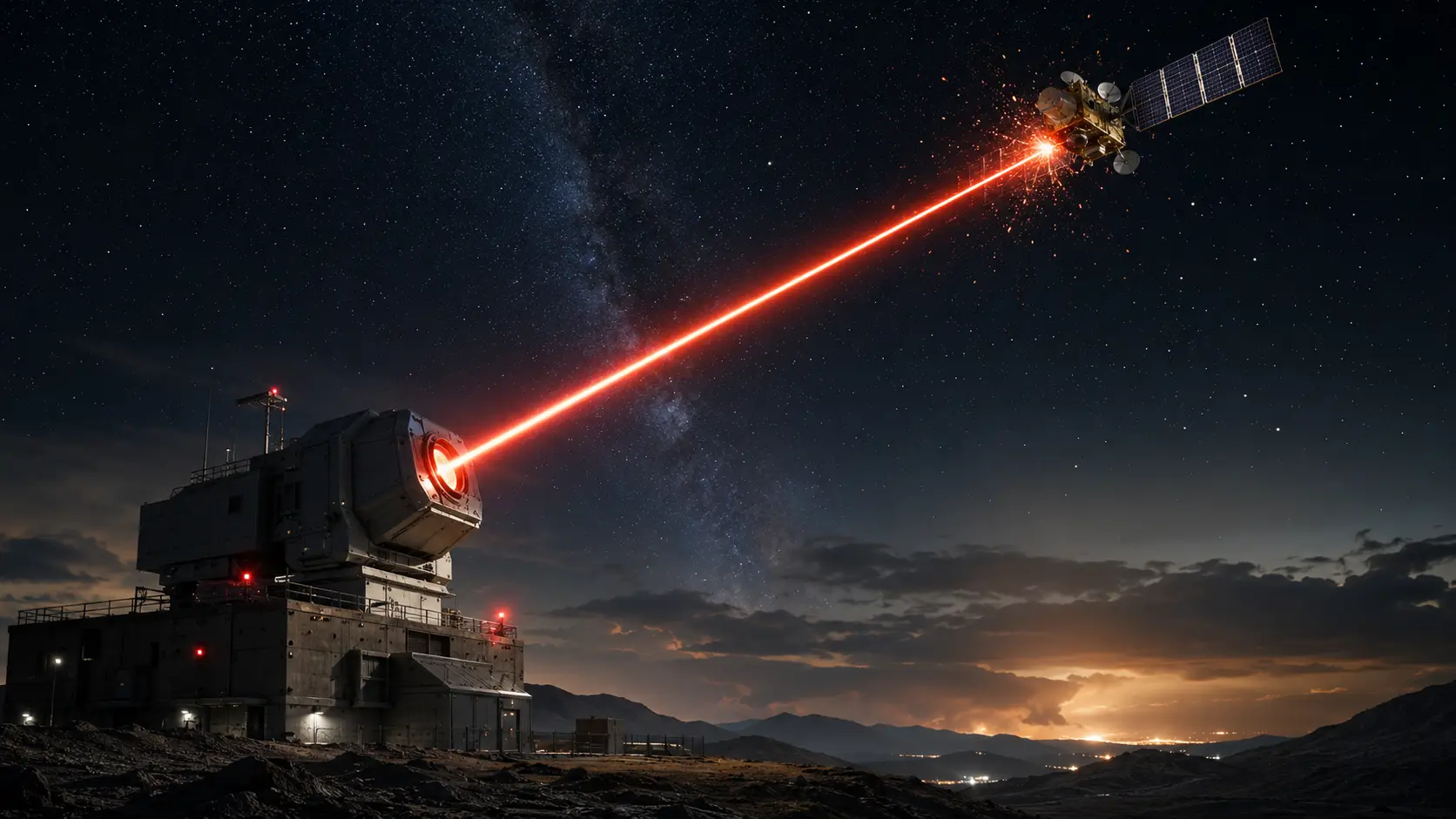
Anti-Satellite (ASAT) lasers are ground-based or space-based directed energy weapons designed to disable, blind, or destroy orbital spacecraft. Instead of using explosive kinetic projectiles that create dangerous orbital debris, ASAT lasers emit highly concentrated beams of electromagnetic energy to overload optical sensors, melt delicate solar arrays, or permanently blind enemy reconnaissance satellites.
At a Glance
- Concept: Using extreme concentrations of light and microwave energy to fry the internal electronics or blind the camera lenses of a satellite flying 300 miles above the Earth.
- Why it matters: The military runs on space. GPS targeting, drone communications, and troop movements all rely on satellites. Blinding a nation’s satellites leaves their ground forces completely deaf, dumb, and blind.
- Who uses it: The United States Space Force, the Russian Aerospace Forces, and the Chinese People’s Liberation Army (PLA) Strategic Support Force (now reorganized into specialized aerospace divisions).
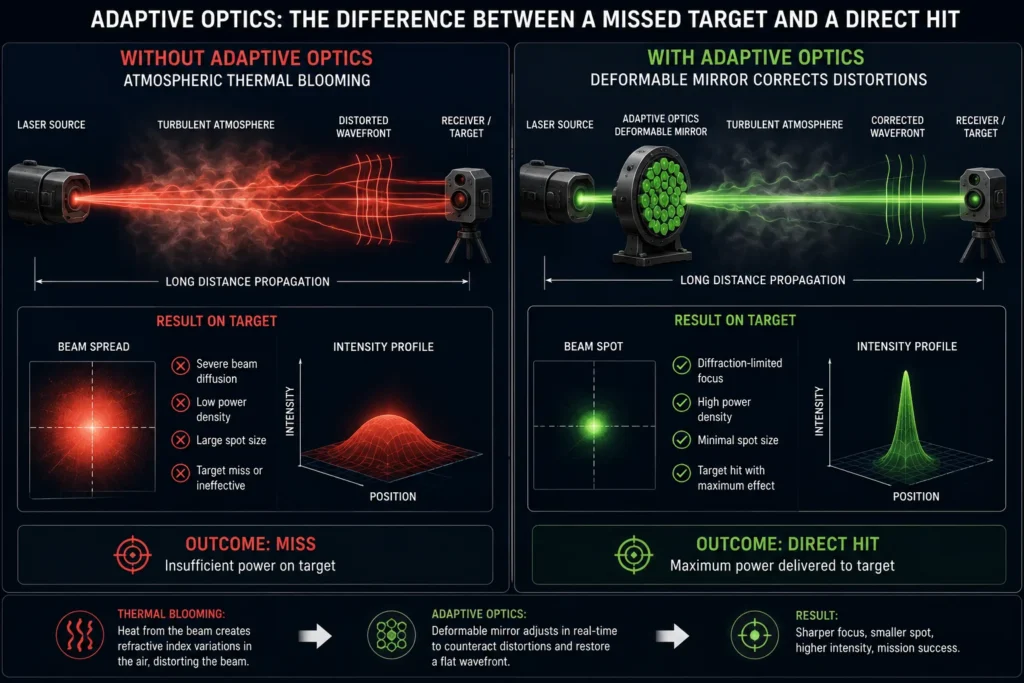
- Biggest takeaway: Shooting a laser into space is incredibly difficult because the Earth’s atmosphere distorts the beam. To successfully hit a satellite moving at Mach 25, ground-based lasers must use “adaptive optics”—mirrors that physically change shape thousands of times a second to cancel out atmospheric distortion.
In Simple Words
Imagine you are trying to spy on your neighbor’s house from a mile away using a highly sensitive pair of night-vision binoculars.
Your neighbor doesn’t want to shoot you, and they don’t want to throw a rock that breaks your binoculars. Instead, the moment they realize you are looking at them, they point an incredibly powerful, focused tactical flashlight directly into your lenses.
Because your binoculars are designed to collect tiny amounts of light, the massive flood of energy from the flashlight completely overwhelms the sensors. You see nothing but blinding white light. If the flashlight is turned off, your vision slowly returns; this is called “Dazzling”. However, if the neighbor uses a high-powered industrial laser instead of a flashlight, the intense heat will physically melt the glass and fry the digital sensors inside your binoculars. Your vision never returns; this is called “Blinding”.
In modern geopolitics, your binoculars are a $2 billion reconnaissance satellite, and your neighbor’s laser is a massive, nuclear-powered optical facility hidden in the desert.
Why This Matters
For Defense Strategists and Aerospace Engineers, mastering Directed Energy Weapons (DEW) is the only viable path to space superiority.
Kinetic ASAT weapons are politically toxic; testing them creates massive international backlash due to the reckless generation of space debris. DEWs bypass this entirely. They offer “plausible deniability.” If a satellite’s optical sensor suddenly burns out over hostile territory, it is incredibly difficult for the victim nation to definitively prove whether the failure was caused by a natural solar flare, a cosmic ray, or a targeted terrestrial laser strike. This ambiguity allows adversaries to engage in aggressive, continuous “gray-zone” warfare in orbit, degrading Western space assets without crossing the legal threshold of an armed, kinetic attack.
The Role of Space Domain Awareness (SDA)
The foundation of directed energy warfare is Space Domain Awareness (SDA).
You cannot shoot what you cannot see. A satellite in Low Earth Orbit (LEO) travels at approximately 7.8 kilometers per second. Hitting a target the size of a refrigerator from 500 kilometers away requires absolute tracking perfection. SDA relies on a global network of ground-based C-Band radars, optical telescopes, and predictive machine-learning algorithms to map the exact trajectory of every active satellite and piece of debris in orbit. The ASAT laser is merely the final trigger pull; the true strategic weapon is the multi-billion-dollar SDA architecture that mathematically calculates the intercept coordinates microseconds before the laser fires.
How Anti-Satellite (ASAT) Lasers Work
Delivering lethal gigawatts of electromagnetic energy through the atmosphere and into the vacuum of space requires defeating the fundamental laws of optical physics. Here is the first-principles breakdown of the architecture.
1. The Fundamental Problem: Speed and Distance
An ASAT laser must illuminate a target moving at Mach 25. Because light travels at 300,000 km/s, the laser beam takes roughly 1.6 milliseconds to reach a satellite at a 500 km altitude. The targeting computer must “lead” the target, calculating the exact orbital mechanics to ensure the beam intersects the satellite’s optical aperture precisely as it passes overhead.
2. The Atmospheric Barrier: Thermal Blooming
When a high-power laser fires through the atmosphere, the air molecules absorb a tiny fraction of the energy. This heats the air, causing it to expand and decreasing its local density. This density drop reduces the air’s refractive index.
Mathematically, the phase shift Δϕ caused by this heating is approximated by:
Δϕ = (2π / λ) * ∫ (∂n / ∂T) * ΔT dz
Because the refractive index (n) drops, the heated air acts like a negative lens. The laser beam effectively defocuses and scatters itself—a phenomenon known as Thermal Blooming. If uncorrected, a deadly laser beam arrives at the satellite as a harmless, diffused glow.
3. The Core Mechanism: Adaptive Optics
To defeat thermal blooming and atmospheric turbulence, ground-based ASAT lasers use Adaptive Optics (AO). The system fires a low-power “guide laser” at the target first. A wavefront sensor analyzes how the atmosphere distorts the returning light. A supercomputer calculates the inverse of that distortion and applies it to a Deformable Mirror—a mirror backed by hundreds of microscopic piezoelectric actuators that physically warp its surface thousands of times a second. When the high-power kill laser bounces off this warped mirror, it enters the atmosphere intentionally distorted, so the atmosphere naturally “corrects” the beam, ensuring a perfectly focused point of light hits the satellite.
4. Technical Depth: In-Band vs. Out-of-Band Attack
- In-Band (Dazzling/Blinding): The laser frequency perfectly matches the wavelength the satellite’s camera is designed to see (e.g., visible or infrared light). The satellite’s own lenses gather and magnify the weaponized light, focusing it directly onto its fragile internal focal plane array, melting it instantly.
- Out-of-Band (Structural Kill): The laser frequency is ignored by the camera lenses, but the beam is so massively powerful that it physically heats up the exterior hull, solar panels, or radiator fins of the satellite, causing structural failure through pure thermal overload.
5. Real-World Consequences: Co-Orbital Proximity Operations
Because ground-based lasers lose power through the atmosphere, adversaries are launching Co-Orbital ASATs. These are “inspector” satellites or microsatellites launched into orbit alongside the target. Once in space, the inspector slowly maneuvers to within a few kilometers of the victim satellite. Because there is no atmosphere in space to cause thermal blooming, a small, low-power laser or a directional High-Power Microwave (HPM) emitter attached to the inspector drone can easily fry the victim’s electronics or sever its uplink to the ground, executing a flawless, deniable kill.
Global Deployments of Directed Energy Weapons
Global superpowers have moved directed energy weapons out of the laboratory and integrated them directly into their active combat doctrines.
Russia’s Peresvet System: Named after a medieval warrior monk, the Peresvet is a highly classified, road-mobile directed energy weapon explicitly designed for air defense and anti-satellite warfare.Deployed in late 2019 alongside Russia’s mobile Intercontinental Ballistic Missile (ICBM) divisions, its primary mission is to “dazzle” passing Western optical reconnaissance satellites.By temporarily blinding the eyes in the sky, Peresvet ensures that Russian nuclear missile launchers can deploy and maneuver across the terrain without being tracked from orbit.
China’s Korla Laser Facility: The People’s Republic of China (PRC) has aggressively expanded its ASAT infrastructure under its New Concept Weapons program. Satellite imagery has revealed massive, hardened ground-based laser facilities in Xinjiang (such as the Korla site). These facilities possess the raw power required to illuminate foreign satellites traversing Chinese airspace. U.S. intelligence reports confirm that PRC defense research includes both reversible dazzling and nonreversible destruction of electro-optical sensors.
Russian and Chinese Co-Orbital Stalkers: Both nations actively deploy parasitic micro-satellites. Russian satellites like Kosmos-2542 and Kosmos-2543 have engaged in highly aggressive proximity operations, tailing highly classified U.S. National Reconnaissance Office (NRO) spy satellites. China’s Shiyan and Shijian series have similarly demonstrated the ability to approach, grapple, and potentially deploy non-kinetic RF jammers or microwave payloads against target assets, completely bypassing the need for ground-based atmospheric penetration.
Economic & Strategic Impact
The proliferation of ASAT lasers is driving a massive capital reallocation into Orbital Hardening and Satellite Proliferation.
In the past, the U.S. relied on a handful of massive, billion-dollar satellites (like the KH-11 Kennenan). These exquisite “battlestars” were single points of failure; if a ground-based laser blinded one, a massive intelligence blackout occurred.
To survive directed energy warfare, the defense industry is transitioning to Proliferated LEO Architectures (such as the Space Development Agency’s Tranche tracking layers). Instead of building one billion-dollar satellite, the military launches a decentralized mesh network of 500 cheap, interconnected satellites. If a Russian or Chinese laser blinds three satellites over their airspace, the network instantly routes the data through the remaining 497. This architectural pivot has fueled the multi-billion-dollar boom in commercial launch providers (like SpaceX) and the mass manufacturing of modular satellite buses, fundamentally altering the economics of the aerospace defense sector.
Advantages
- Zero Debris Generation: Unlike kinetic missiles, lasers do not blow the target apart. They neutralize the satellite’s capability while leaving the physical chassis intact, avoiding the politically toxic creation of orbital shrapnel.
- Speed of Light Engagement: A laser beam reaches an orbital target in milliseconds, giving the adversary zero time to execute evasive maneuvers, compared to the several minutes required for a direct-ascent missile to reach altitude.
- Deep Magazines: An ASAT missile launcher is empty after firing its payload. A ground-based directed energy weapon has an essentially infinite magazine depth, capable of firing continuously as long as it receives electrical power from the grid.
Limitations
- Atmospheric Attenuation: Ground-based lasers are heavily degraded by cloud cover, rain, dust, and thermal blooming. A perfectly targeted laser attack can be entirely neutralized by bad weather.
- Massive Power Demands:Generating a laser beam capable of burning through the atmosphere and damaging a satellite at 1,000 km requires immense megawatts of power, requiring dedicated substations and limiting portability.
- Dwell Time Requirement: Lasers are not “point-and-click” explosions. To melt an optical sensor or a solar array, the beam must stay locked on the exact same few inches of the satellite for several continuous seconds (dwell time) while the target moves at Mach 25, requiring absolute tracking perfection.
Common Misconceptions
Misconception: Laser weapons blow satellites up like the Death Star.
Reality: Ground-based ASAT lasers rarely aim to physically destroy the entire chassis of a satellite. The energy required to vaporize a titanium structure 500 kilometers away is mathematically prohibitive. They are precision tools designed to melt the highly fragile, exposed camera lenses and communication antennas.
Misconception: You can see the laser beam shooting into space.
Reality: Weaponized lasers typically operate in the infrared spectrum (like the 1.06 µm wavelength). They are completely invisible to the naked human eye.
Misconception: A mirror coating can reflect an ASAT laser.
Reality: Simple mirrors are ineffective against weapon-grade lasers. Even if a mirror is 99% reflective, the 1% of the gigawatt beam it absorbs will generate enough instantaneous heat to crack, warp, and melt the mirror, allowing the rest of the beam to punch through. True defense requires physical optical shutters that slam closed when intense light is detected.
What Most People Miss
The lethal reality of High-Power Microwave (HPM) Payloads.
While lasers get the public attention for blinding cameras, the more insidious threat in co-orbital warfare is High-Power Microwaves.
What most analysts miss is that you do not need to precisely target a camera lens to kill a satellite. A co-orbital drone can pull alongside a victim satellite and detonate an explosive flux generator or fire a directional microwave beam. The HPM pulse passes directly through the physical hull of the satellite and induces massive electrical currents in the delicate, unshielded internal wiring. This completely fries the satellite’s computer processors and memory banks simultaneously, turning a multi-million-dollar asset into a dead, orbiting brick in microseconds without causing any external physical damage.
Comparison Table
| Feature | Direct-Ascent Missile (Kinetic ASAT) | Ground-Based Laser (DEW) | Co-Orbital Stalker (Microwave/Laser) |
| Kill Mechanism | Physical Impact / Explosive Fragmentation | Intense light focusing / Thermal overload | RF/Microwave fry or proximity laser |
| Debris Generated | Extreme (Kessler Syndrome Risk) | Zero | Zero |
| Engagement Speed | Slow (Minutes to ascend) | Speed of Light (Milliseconds) | Slow to approach, instant execution |
| Primary Weakness | Politically toxic, trackable launch | Atmospheric distortion, bad weather | Requires complex orbital rendezvous |
| Deniability | Impossible to hide | High (Can mimic component failure) | Moderate (SDA networks track approaches) |
Case Study
Situation: During the 2022 invasion of Ukraine, the Russian military required maximum operational security to maneuver troops and mobile ICBM launchers. However, Western commercial and military imaging satellites, equipped with synthetic aperture radar (SAR) and high-resolution electro-optical sensors, provided continuous, real-time intelligence to Ukrainian forces.
Challenge: Russia needed to neutralize the orbital surveillance over its territory without launching kinetic missiles, which would trigger a massive international escalation and threaten their own orbital assets with debris.
Solution (The Zadira & Peresvet Deployments): The Russian Ministry of Defence mobilized the Peresvet laser complexes to cover the maneuvers of the Strategic Missile Forces.Simultaneously, Deputy Prime Minister Yury Borisov claimed the deployment of a more advanced directed-energy weapon dubbed Zadira, purportedly capable of incinerating targets up to three miles away and blinding enemy satellites in orbits up to 1,500 km.
Outcome: By illuminating passing imaging satellites with concentrated infrared energy, the Russian systems actively attempted to swamp the sensors with light (“dazzling”), temporarily depriving the satellites of their imaging capability while they traversed critical Russian airspace.
Lessons Learned: The deployment underscored that ASAT directed energy is no longer a theoretical deterrent; it is an active, operational tool of modern warfare. It proved that ground-based lasers, despite their vulnerability to bad weather, serve as an essential asymmetric shield, forcing adversaries to rely on proliferated, resilient satellite constellations rather than vulnerable, individual spy platforms.
Future Outlook
Next 12–24 Months
The era of Commercial SDA Integration. As superpowers aggressively deploy co-orbital stalkers, the military will heavily rely on the private sector. Over the next two years, commercial Space Domain Awareness companies (like LeoLabs and COMSPOC) will integrate their massive ground-based radar networks directly with military command centers.These intelligent, AI-driven SDA systems will automatically flag “unannounced satellite maneuvers” and predict collision avoidance trajectories in real-time, drastically reducing the latency in detecting hostile proximity operations.
Next 3–5 Years
The scaling of Optical Shutters and Metamaterial Shielding. To combat ground-based dazzling, the aerospace defense industry will revolutionize satellite optical arrays. By the late 2020s, next-generation reconnaissance satellites will feature ultra-fast optical shutters—mechanical or liquid-crystal diaphragms that instantly snap shut the moment incoming laser radiation is detected. Furthermore, satellite hulls will be coated in advanced metamaterials designed to rapidly dissipate thermal loads, severely extending the “dwell time” required for an enemy laser to achieve a structural kill.
Next 10 Years
The Space-to-Space DEW Arms Race. By the mid-2030s, the battleground will completely detach from the Earth’s atmosphere. Ground-based lasers will be relegated to secondary roles due to thermal blooming limitations. Instead, massive, nuclear-powered or solar-concentrating directed energy satellites will be deployed in High Earth Orbit. These space-based assets will have unimpeded, vacuum-based line-of-sight to the entire global constellation network, serving as ultimate strategic deterrents capable of blinding or frying adversary networks globally in milliseconds.
Most Likely Scenario
The future of orbital conflict will be entirely silent and invisible. The deployment of ASAT lasers guarantees that kinetic missile strikes against satellites will be globally condemned and largely abandoned. Instead, the balance of global power will be maintained through a continuous, high-stakes game of algorithmic cat-and-mouse, where co-orbital drones and ground-based adaptive optics fight to manipulate the electromagnetic spectrum without leaving physical evidence of the war.
Key Takeaways
- Anti-Satellite (ASAT) lasers are directed energy weapons designed to disable spacecraft by overloading their sensors (dazzling) or melting their internal electronics (blinding).
- Unlike traditional explosive missiles, ASAT lasers generate zero space debris, avoiding the catastrophic chain reaction known as Kessler Syndrome.
- Firing a laser through the atmosphere causes the air to heat up and expand, defocusing the beam in a process called “thermal blooming”. Engineers counter this using deformable mirrors (Adaptive Optics).
- Russia openly deploys the Peresvet laser system to blind spy satellites and protect its mobile nuclear missile launchers. China maintains massive laser bases (Korla) and co-orbital micro-satellites.
- Because shooting from the ground is difficult, adversaries launch “co-orbital stalkers”—small drones that pull up next to a target in space and fry it with a close-range laser or microwave pulse.
- To survive these attacks, the U.S. military relies heavily on Space Domain Awareness (SDA)—a global network of radars and AI that track every moving object in orbit to predict and evade attacks.
Glossary
Adaptive Optics: A technological system that uses rapidly deforming mirrors to perfectly cancel out the distortion caused by the Earth’s atmosphere, allowing a ground-based laser to remain perfectly focused in space.
Blinding: A non-reversible directed energy attack that uses intense heat to permanently burn, melt, and destroy the fragile optical sensors inside a satellite’s camera.
Co-Orbital ASAT: A weaponized satellite (or micro-satellite) that is launched into space, maneuvers to match the orbit of an enemy satellite, and attacks it at close range using lasers, microwaves, or robotic arms.
Dazzling: A reversible directed energy attack that temporarily overwhelms a satellite’s camera with brilliant light, blinding it only for the duration the laser is turned on.
Space Domain Awareness (SDA): The comprehensive capability to detect, track, identify, and predict the behavior of all objects in orbit, acting as the foundational intelligence required for any space warfare operation.
Thermal Blooming: A physical phenomenon where a high-power laser heats the air it passes through, causing the air to act like a negative lens that scatters and defocuses the weaponized beam.
Frequently Asked Questions
Why don’t we just shoot satellites with missiles?
When you blow up a satellite, it creates thousands of pieces of hypervelocity shrapnel. This debris travels at 17,500 mph and destroys everything in its path, including friendly satellites and the International Space Station. Lasers disable the enemy without creating debris.
Can you see an ASAT laser beam from the ground?
No. Military-grade lasers generally operate in the infrared spectrum, which is entirely invisible to the human eye. The attack is completely silent and visually undetectable.
How does bad weather affect ASAT lasers?
Severely. Clouds, heavy rain, fog, and atmospheric turbulence absorb and scatter laser light. An adversary can theoretically schedule sensitive military maneuvers when heavy cloud cover protects them from ground-based laser attacks.
What happens if a laser misses the satellite?
Because the laser is fired upward into the vacuum of space, if it misses the target, the beam simply continues traveling outward into the cosmos indefinitely, slowly losing cohesion over astronomical distances.
How do you protect a satellite from a laser?
Satellites can be equipped with incredibly fast optical shutters that slam closed the millisecond an intense burst of light is detected. Additionally, the satellite chassis can be coated in advanced, heat-dissipating metamaterials to prevent the laser from melting the hull.
Sources
Reddit / CredibleDefense: Kalina: a Russian ground-based laser to dazzle imaging satellites (July 2022)
Wikipedia: Peresvet (laser weapon)
RP Photonics: Thermal Blooming (November 2023)
RP Photonics: Thermal Blooming – Physical Mechanisms and Applications
SatNow: What is Space Domain Awareness? (June 2025)
SatNow: What is Space Domain Awareness? – Assets and Processes (June 2025)
Wikipedia: ASAT program of China
Wikipedia: ASAT program of China – Directed-energy weapons and Microsatellites