Advertisement
)

The modern battlefield is facing a terrifying mathematical collapse. Imagine a naval destroyer guarding a critical maritime chokepoint. On the radar, a swarm of one hundred explosive suicide drones approaches. The drones cost the enemy a total of $50,000 to manufacture. To survive, the destroyer must fire one hundred interceptor missiles, each costing $2 million. The ship successfully destroys the swarm, but in doing so, it depletes its entire kinetic magazine and spends $200 million. The ship has survived the battle, but the defender has already lost the economic war. In an era where commercial quadcopters can be weaponized in the thousands, relying on explosive kinetic missiles for air defense guarantees financial ruin and eventual exhaustion.
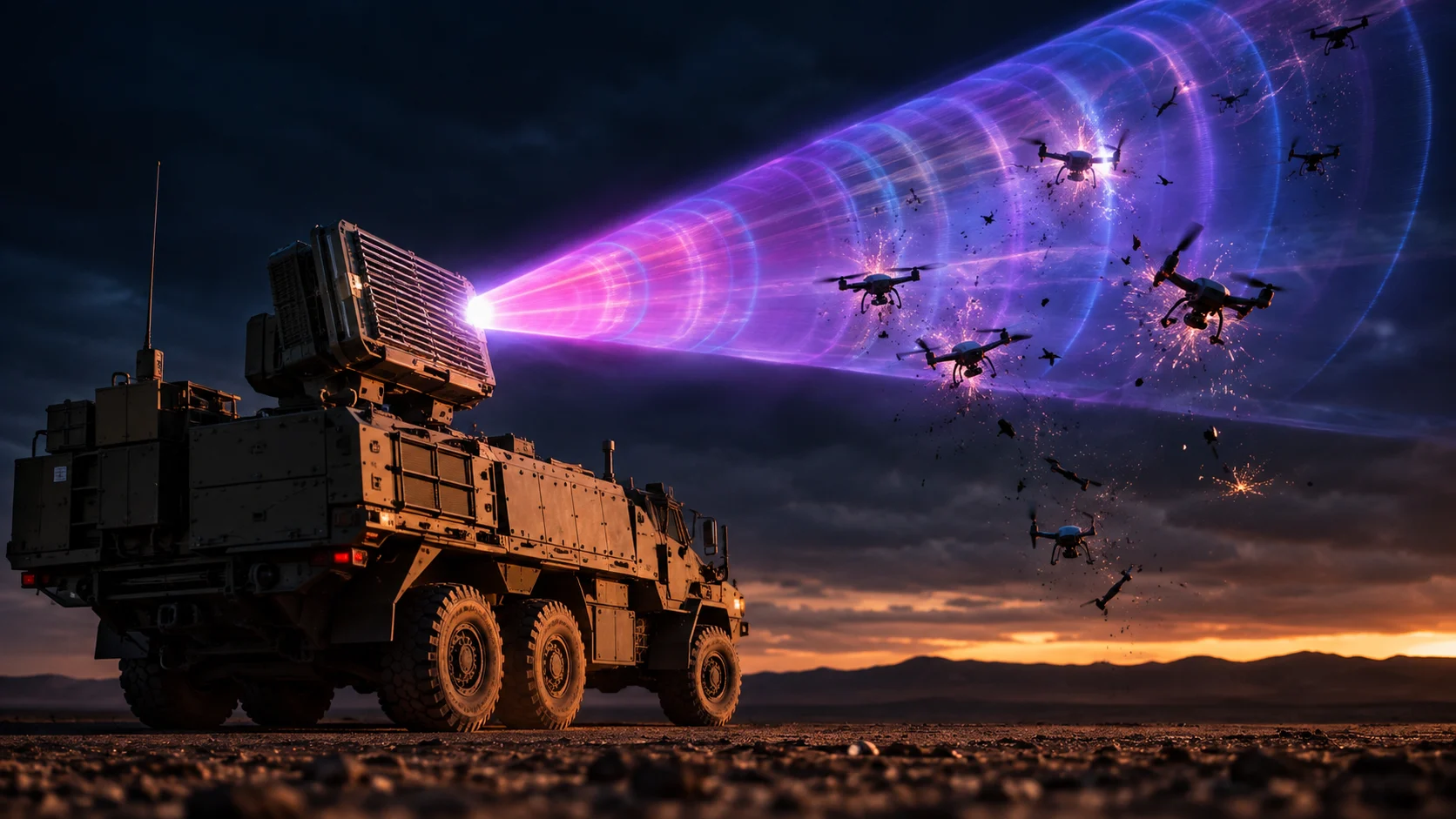
Why should you care right now? Because global militaries have realized that shooting down cheap drones with expensive rockets is an unwinnable strategy. To restore the balance of power, the defense industry has commercialized High-Power Microwave (HPM) directed energy weapons. Instead of firing physical projectiles, these systems emit a silent, invisible cone of concentrated electromagnetic radiation. Traveling at the speed of light, this energy instantly induces catastrophic voltage spikes inside the circuitry of any unshielded drone caught in its path, dropping entire swarms from the sky simultaneously. At a cost of mere pennies per shot, HPM is the ultimate asymmetric equalizer of 21st-century geopolitics.
What is High-Power Microwave (HPM) Directed Energy?
High-Power Microwave (HPM) directed energy is a non-kinetic weapon system that emits bursts of concentrated electromagnetic radiation to disable electronic devices. Instead of physically destroying a target, HPM induces massive electrical surges within a drone’s circuitry, instantly frying its processors and neutralizing entire swarms at the speed of light.
At a Glance
- Concept: Blasting the sky with an invisible wave of electromagnetic energy that acts like a localized EMP, shutting down the computers inside enemy weapons.
- Why it matters: It solves the “swarm” problem. A laser can only shoot down one drone at a time. An HPM cone can shoot down 50 drones simultaneously in a fraction of a second.
- Who uses it: The U.S. Department of Defense (AFRL, Army RCCTO), defense prime contractors (Raytheon, BAE Systems), and advanced technology startups (Epirus).
- Biggest takeaway: The technology is rapidly shifting away from old, heavy vacuum tubes to cutting-edge solid-state microchips made of Gallium Nitride (GaN), allowing these weapons to be mounted on light armored vehicles instead of requiring massive shipping containers.
In Simple Words
Imagine trying to swat 1,000 angry bees out of the air using a sniper rifle. Even if you never miss, you can only shoot one bee at a time, and eventually, you will run out of bullets before the swarm overwhelms you. This is how traditional air defense (missiles and lasers) fights a drone swarm.
A High-Power Microwave (HPM) weapon is like setting off an invisible, electronic bug bomb.
Instead of firing a bullet, the HPM system acts like an incredibly powerful, directional Wi-Fi router. It blasts a wide, invisible wave of energy into the sky. When this energy wave hits the drones, it acts like a massive static shock. The energy forces its way into the drones’ delicate wiring and overloads their computer chips. Because the energy is fired in a wide cone, it hits every single “bee” in that section of the sky at the exact same time. The drones’ brains fry, their propellers stop, and the entire swarm falls out of the sky instantly. And because it just uses electricity, it never runs out of ammo.
Why This Matters
For Defense Strategists and Military Contractors, HPM solves the “Magazine Depth” crisis.
In modern combat theaters, logistics chains are incredibly fragile. Shipping multi-ton Patriot or NASAMS interceptor missiles to remote forward operating bases is dangerous, slow, and exhaustible. An HPM system possesses a virtually infinite magazine. As long as the base has diesel to run a generator, the HPM system can fire tens of thousands of times. It shifts the paradigm of base defense from a logistics-heavy, limited-engagement model to an infinitely sustainable, permanent electronic shield.
HPM vs. High-Energy Lasers (HEL)
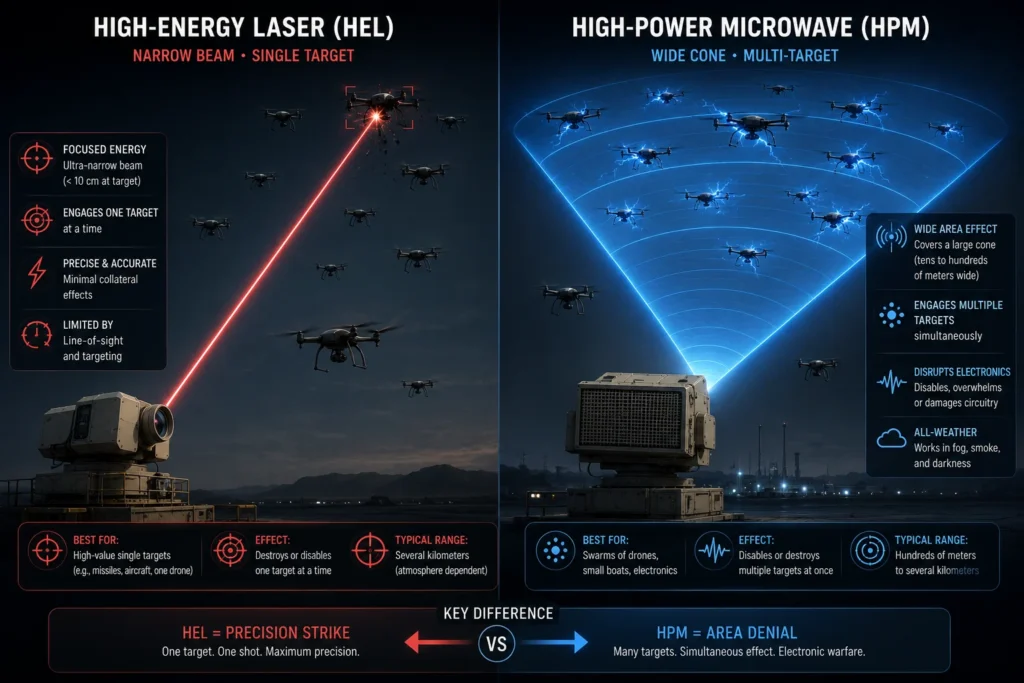
HPM is often confused with High-Energy Lasers (HEL), but they serve entirely different tactical purposes.
A laser is a sniper rifle: it focuses immense heat on a single point (the size of a coin) to physically melt the drone’s hull. This requires precise targeting algorithms and several seconds of “dwell time” per target. If 50 drones arrive simultaneously, the laser simply cannot melt them all fast enough.
An HPM is a shotgun. It does not heat or melt the physical drone. It blankets a large volume of airspace with radiation, attacking the information architecture of the drone rather than its physical hull. Lasers are for precise, long-range, single-target elimination; HPM is for close-range, massive-scale swarm eradication.
How High-Power Microwave (HPM) Weapons Work
Frying a microchip from a mile away without using a nuclear EMP requires manipulating the fundamental laws of electrodynamics. Here is the first-principles breakdown of the architecture.
1. The Fundamental Problem: Swarm Saturation
When a swarm of drones approaches a target, they operate on distributed algorithms. Destroying one or two leaders does not stop the swarm; the remaining drones autonomously re-route. The defender must disable the entire formation instantly before they cross the terminal engagement perimeter.
2. The Core Mechanism: Electromagnetic Induction
HPM weapons exploit Faraday’s Law of Induction. When a high-power electromagnetic wave washes over a drone, the fluctuating magnetic field induces an electromotive force (voltage) in any conductive material it encounters. The drone’s internal wires effectively act as unintended antennas, absorbing the microwave energy and converting it into a lethal electrical current.
3. Technical Depth: Front-Door vs. Back-Door Coupling
The microwave energy invades the drone through two primary mechanisms:
- Front-Door Coupling: The energy enters through the drone’s actual intended antennas (GPS, radio links, radar altimeters). The HPM overloads the receiving circuitry, instantly burning out the communication modules.
- Back-Door Coupling: The energy penetrates the drone through physical seams, unshielded wires, or gaps in the chassis. Once inside, the induced voltage spikes exceed the thermal limits of the microscopic transistors inside the flight controller (CPU), physically melting the silicon gates and crashing the operating system.
4. Generation Tech: Vacuum Tubes vs. Solid State
Historically, HPM systems used Magnetrons or Klystrons (vacuum tubes similar to those in a kitchen microwave or legacy radar). These generate massive peak power but are bulky, heavy, and fire a fixed, unsteerable cone of energy.
The modern revolution relies on Solid-State Active Electronically Scanned Arrays (AESA). By using thousands of small Gallium Nitride (GaN) amplifiers, solid-state systems can digitally steer the microwave beam, widening it to hit a massive swarm, or narrowing it to a tight pencil-beam to increase the range and kill a single, hardened target.
5. Real-World Consequences: The Software Kill
Because the HPM does not physically destroy the drone’s airframe, the kill is instantaneous but silent. The drone simply goes inert and follows ballistic gravity to the ground. This makes HPM highly suitable for urban environments, as there are no explosive shrapnel clouds raining down on civilian populations, unlike kinetic missile intercepts.
Active Deployments of HPM Systems
The deployment of HPM has rapidly accelerated from theoretical prototypes to active combat integration.
Forward Operating Base (FOB) Defense: The U.S. Air Force Research Laboratory (AFRL) developed the Tactical High-power Operational Responder (THOR). Housed in a standard 20-foot shipping container, THOR uses legacy vacuum tube technology to blast a massive swath of sky, providing short-range air base defense against hostile drone incursions. Its successor, Mjölnir, continues this development, proving that containerized HPM can protect static airfields from asymmetric saturation attacks.
Mobile Maneuver Defense (Epirus Leonidas): To protect moving convoys, the U.S. Army awarded contracts to Epirus for its Leonidas system. Unlike THOR, Leonidas uses solid-state GaN AESA technology. It is small enough to be mounted on a Stryker armored vehicle. Because it is solid-state, it can selectively dial its frequencies, allowing it to fry enemy drones in the sky while intentionally ignoring the frequencies used by friendly helicopters and communication gear operating in the exact same airspace.
Defeating Anti-Ship Missiles: Naval vessels face the threat of hypersonic and sea-skimming cruise missiles. Because these missiles rely on highly sensitive radar seekers to find the ship in their terminal phase, naval HPM systems are being designed to overload and fry the incoming missile’s guidance system milliseconds before impact, causing the missile to blindly plunge into the ocean.
Economic & Strategic Impact
The core strategic disruption of HPM is the realization of the “Cost-Per-Kill” Inversion.
For decades, the offense held the economic advantage. A terrorist organization or rogue state could spend $10 million to build 1,000 suicide drones, forcing a superpower to spend $2 billion in interceptor missiles to defend a base.
HPM violently flips this economic curve back to the defender. Firing an HPM pulse requires nothing more than grid electricity or diesel fuel. The cost of a single “shot” that takes down 50 drones is practically zero—measured in pennies of diesel. Furthermore, the capital expenditure (CapEx) of building an HPM system (roughly $5 million to $15 million) is equivalent to buying just three or four Patriot missiles. By rendering the enemy’s cheap mass production economically irrelevant, HPM forces adversaries to either abandon swarm tactics or spend billions trying to develop hardened, EMP-shielded drones.
Advantages
- Swarm Eradication: Emits a cone of energy that engages multiple targets simultaneously, neutralizing the primary tactical advantage of a drone swarm (saturation).
- Infinite Magazine: Never runs out of ammunition. As long as the platform has access to electrical power, the system can fire indefinitely.
- Zero-Cost Engagement: Eradicates the multimillion-dollar cost-per-kill ratio of kinetic missiles, dropping the cost of defense to the cost of electricity.
- Speed of Light: The electromagnetic wave travels at 300,000 km/s, giving the drone swarm zero milliseconds of warning or ability to execute evasive maneuvers.
Limitations
- Fratricide (Friendly Fire): Microwave energy does not distinguish between an enemy drone and a friendly communications radio. If not precisely tuned (using solid-state frequency hopping), an HPM burst will fry allied equipment, civilian pacemakers, and hospital electronics in its path.
- Shorter Effective Range: Compared to kinetic missiles that can intercept targets 100 kilometers away, HPM systems are generally short-range point-defense weapons, effectively lethal only within a few kilometers due to the inverse-square law of electromagnetic radiation dispersion.
- Atmospheric and Shielding Mitigation: While hard to achieve on cheap drones, peer adversaries can employ Faraday cages, optical data links, and advanced metallic shielding to insulate their processors, drastically reducing the effective range and lethality of the HPM pulse.
Common Misconceptions
Misconception: HPM weapons melt the drone out of the sky.
Reality: HPM does not rely on thermal heating (like a laser). It uses voltage induction. The outside of the drone remains completely cool and physically intact; only the microscopic silicon gates inside the computer chip are destroyed.
Misconception: HPM is essentially a nuclear EMP.
Reality: A nuclear High-Altitude Electromagnetic Pulse (HEMP) destroys all electronics indiscriminately across hundreds of miles. HPM is a non-nuclear, highly directional, tactical weapon that only affects a highly localized, targeted cone of airspace.
Misconception: The radiation is lethal to human soldiers.
Reality: While standing directly in front of the emitter cone is dangerous (similar to standing inside a massive microwave oven), HPM is generally considered a non-lethal weapon to humans. It is designed with frequencies that specifically target semiconductor architectures, not biological tissue.
What Most People Miss
The disruptive capability of Cognitive HPM Profiling.
Most observers view HPM as a blunt-force hammer. What they miss is that modern solid-state AESA systems (like Leonidas) are deeply integrated with artificial intelligence.
Because different drones have different wiring layouts and processors, they are vulnerable to different specific microwave frequencies. A frequency that perfectly fries a DJI quadcopter might barely tickle an Iranian Shahed drone. Modern “Cognitive HPM” systems use onboard radar and AI to identify the exact make and model of the incoming drone swarm in real-time. In milliseconds, the system automatically shifts its output waveform to perfectly match the resonant vulnerability frequency of that specific drone model, ensuring maximum lethal coupling while using the least amount of battery power.
Comparison Table
| Feature | Kinetic Interceptor (Missile) | High-Energy Laser (HEL) | High-Power Microwave (HPM) |
| Kill Mechanism | Explosive Fragmentation | Thermal Melting | Electromagnetic Interference (EMI) |
| Swarm Defense | Poor (One-to-One) | Poor (Requires Dwell Time) | Excellent (Cone Area of Effect) |
| Cost Per Shot | $100k to $4M+ | Very Low (~$10) | Zero (Pennies of electricity) |
| Magazine Depth | Highly Limited (4 to 16 per launcher) | Infinite (Requires cooling) | Infinite |
| Weather Dependency | Low | High (Defeated by fog/smoke) | Low (Microwaves penetrate weather) |
Case Study
Situation: The proliferation of Group 1 and Group 2 Unmanned Aerial Systems (UAS)—cheap, commercially available drones strapped with explosives—became the defining tactical threat for U.S. forces in the Middle East. Static bases faced the constant threat of saturation attacks intended to overwhelm base defense guns (like the C-RAM) and deplete expensive kinetic interceptor stockpiles.
Challenge: Develop and deploy a system capable of instantaneously neutralizing massive, uncoordinated drone swarms without expending kinetic ammunition or accidentally frying the base’s own sensitive communications radar networks.
Solution (The Epirus Leonidas Deployment): In 2023, the U.S. Army Rapid Capabilities and Critical Technologies Office (RCCTO) awarded a major contract to Epirus to deliver its Leonidas solid-state HPM systems. Unlike legacy vacuum-tube systems, Leonidas utilized advanced Gallium Nitride (GaN) amplifiers and an active electronically scanned array to project a steerable, precise HPM beam.
Outcome: During rigorous field testing, Leonidas successfully demonstrated the ability to drop multiple, disparate drone swarms from the sky simultaneously. Crucially, because of its solid-state software-defined architecture, operators were able to create “null spaces”—safe zones within the HPM beam where friendly drones could fly completely unaffected while hostile drones inches away were instantly fried.
Lessons Learned: The deployment validated that the era of the vacuum tube is ending. It proved that solid-state HPM is not just a blunt instrument, but a highly precise, software-defined digital weapon. By mastering frequency control and AESA beam steering, the defense industry solved the fratricide issue, officially making HPM viable for highly congested, mixed-domain combat environments.
Future Outlook
Next 12–24 Months
The era of Mobile Infantry Integration. The immediate future will see HPM technology miniaturized and integrated directly into mobile maneuver formations. Moving away from static shipping containers, systems will be bolted onto Stryker vehicles and Joint Light Tactical Vehicles (JLTVs) to provide a moving “dome” of electronic protection for armored columns. The defense supply chain will heavily prioritize the mass manufacturing of high-purity Gallium Nitride (GaN) wafers to feed the production lines of these solid-state amplifiers.
Next 3–5 Years
The scaling of Airborne and Drone-Mounted HPM. As the power-to-weight ratio of solid-state amplifiers improves, HPM will take to the skies. Militaries will deploy high-altitude, long-endurance drones equipped with downward-facing HPM arrays. These assets will act as orbital fly-swatters, loitering over critical infrastructure and blasting swarms from above. Furthermore, airborne HPM will be used offensively to execute “fly-by” frying of enemy radar installations and surface-to-air missile (SAM) sites, blinding the enemy’s air defense grid before a stealth bomber strike.
Next 10 Years
The Faraday Arms Race. By the mid-2030s, the initial shock-and-awe dominance of HPM will wane as adversaries adapt. The drone market will bifurcate: cheap, unshielded commercial drones will be entirely useless in combat zones, blocked by ubiquitous HPM fields. Peer adversaries will invest billions in “hardening” their drones—deploying complex Faraday cages, optical-fiber internal wiring, and metallic chassis designed to deflect microwave energy. This will force HPM manufacturers to exponentially increase their power outputs (moving from Megawatts to Gigawatts) to punch through the hardened shielding, sparking an invisible, electromagnetic arms race.
Most Likely Scenario
High-Power Microwave directed energy guarantees the obsolescence of the commercial drone swarm as a viable weapon against advanced militaries. By solving the cost-per-kill economic trap, HPM allows superpowers to perfectly defend their assets without exhausting their treasuries. While lasers will remain critical for long-range, single-target elimination, HPM will become the mandatory, ubiquitous close-in weapons system (CIWS) of the 21st century, rendering the sky around a military base effectively lethal to any unshielded silicon chip.
Key Takeaways
- High-Power Microwave (HPM) weapons project a wide cone of electromagnetic energy to instantly fry the internal microchips of an incoming drone swarm.
- They resolve the ultimate economic crisis of modern air defense: instead of firing a $2 million missile at a $500 drone, an HPM shot costs just pennies of electricity.
- Unlike lasers, which must focus immense heat on a single target for several seconds, HPMs attack the electronics instantly and can drop 50+ drones simultaneously.
- Microwave energy enters the drone through its antennas (“front-door”) or physical gaps (“back-door”), inducing massive voltage spikes that melt the drone’s CPU.
- The industry is shifting from bulky, vacuum-tube generators (Magnetrons) to software-defined, solid-state chips (Gallium Nitride), allowing for precise beam steering.
- Because HPM weapons are completely non-kinetic, they leave the drone’s airframe intact and do not create explosive shrapnel, making them highly safe for urban defense.
Glossary
Active Electronically Scanned Array (AESA): A computer-controlled antenna array in which the beam of radio waves can be electronically steered to point in different directions without moving the antenna physically.
Electromagnetic Interference (EMI): A disruption that affects an electrical circuit due to electromagnetic induction. HPM weapons weaponize EMI to catastrophic levels.
Faraday Cage: An enclosure used to block electromagnetic fields. It is the primary, though heavy and expensive, physical defense against an HPM attack.
Front-Door / Back-Door Coupling: The two ways microwave energy enters a target. Front-door is through the drone’s intended antennas; back-door is through unshielded wiring or physical gaps in the drone’s casing.
Gallium Nitride (GaN): A highly advanced semiconductor material used in modern solid-state HPM systems. It can handle significantly higher voltages and temperatures than traditional silicon.
Magnetron: A high-powered vacuum tube that generates microwaves using the interaction of a stream of electrons with a magnetic field. It is the legacy technology used in early HPM systems.
Sources
Epirus Inc: Leonidas High-Power Microwave System Specifications
Air Force Research Laboratory (AFRL): Tactical High-power Operational Responder (THOR)
Department of Defense (DoD): Directed Energy Weapons: Technologies, Applications, and Implications
Breaking Defense: Epirus readies high-power microwave drone-killer for Army Strykers
National Defense Magazine: Army, AFRL teaming up to blast drone swarms with high-power microwaves