Advertisement
)
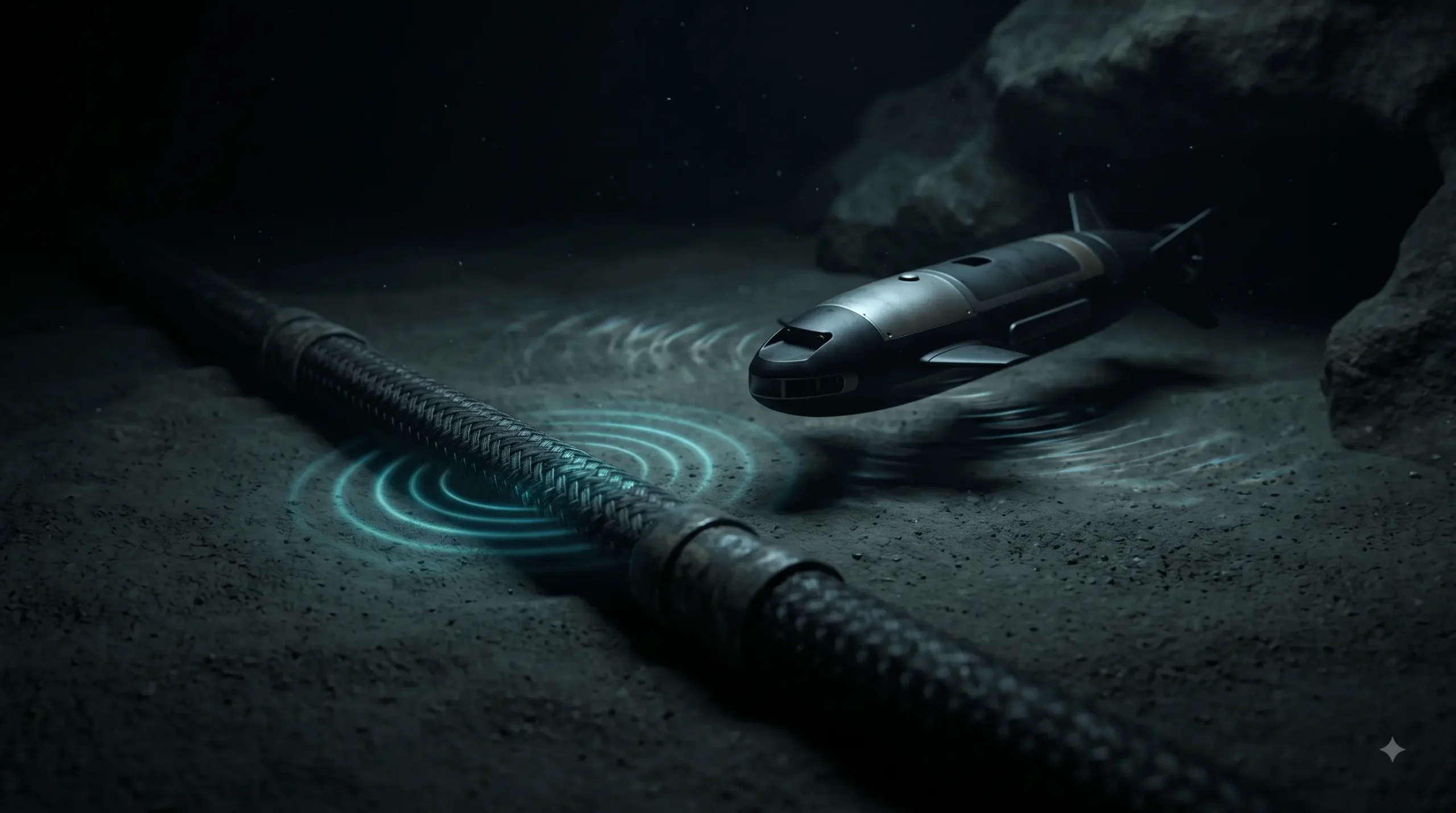

In September 2022, a series of underwater explosions ruptured the Nord Stream pipelines, instantly severing Europe’s primary energy artery. The attack was a violent wake-up call, but it was merely a preview of a much larger systemic vulnerability. Right now, 99% of all international data—every SWIFT financial transaction, military order, and global communications link—travels through physical fiber-optic cables resting completely undefended on the ocean floor. If a coordinated attack severed just a handful of these cables in a geographic chokepoint, entire continents would go dark in milliseconds. The global economy would instantly freeze.
Why should you care right now? Because the world’s superpowers are no longer just preparing for war in the air or space; they are actively weaponizing the bottom of the ocean. In a silent, lightless battlefield where radar is useless, militaries are engaged in a frantic race to master subsea acoustic warfare. By mapping the exact way sound travels through deep-sea trenches, adversaries are deploying undetectable autonomous drones to stalk, tap, or rig explosives to the physical cables that run the global internet. Understanding this lightless battlefield is essential to grasping how the next major geopolitical conflict will likely begin not with a nuclear flash, but with a sudden, silent global blackout.
What is Subsea Acoustic Warfare?
Subsea acoustic warfare is the military utilization of sound wave propagation in the ocean to detect, hide, or coordinate attacks against critical underwater infrastructure. Because light and radar cannot penetrate deep water, militaries and naval contractors use advanced sonar, sound velocity profiling, and autonomous underwater vehicles to map, defend, or sabotage global subsea internet cables and energy pipelines.
At a Glance
- Concept: Playing a high-stakes game of hide-and-seek in absolute darkness, where survival depends entirely on listening to echoes and understanding how the ocean bends sound waves.
- Why it matters: The entire cloud computing and global banking infrastructure relies on glass tubes at the bottom of the sea. Adversaries are actively mapping how to cut these tubes without being heard.
- Who uses it: Specialized naval branches like Russia’s GUGI (Main Directorate of Deep-Sea Research), the U.S. Navy, the Chinese PLA Navy, and Tier-1 global telecommunications consortiums.
- Biggest takeaway: Sound behaves bizarrely underwater. It curves toward cold water and high pressure. Submarines and drones exploit these curves to hide in “shadow zones” directly next to critical infrastructure, completely invisible to surface sonar tracking.
In Simple Words
Imagine trying to guard a vital treasure sitting in the middle of a pitch-black, massive warehouse. You cannot use a flashlight, and you cannot use radar, because the air in this warehouse absorbs light and radio waves instantly. The only way to find an intruder is to listen for their footsteps.
However, the air in this warehouse is magical. If an intruder makes a noise, the sound doesn’t travel in a straight line to your ear. It bends, curves, and bounces depending on the temperature of the air. If the intruder knows exactly where the warm and cold pockets of air are, they can stand ten feet away from you, drop a heavy box, and the sound will literally curve completely around your head. You will hear absolutely nothing.
The ocean operates exactly like this magical warehouse. Subsea Acoustic Warfare is the science of mastering how the ocean bends sound. Militaries use this science to hide autonomous drones next to vital internet cables, waiting for the command to cut them, while defenders use the exact same science to try and listen for the silent intruders before the global internet is severed.
Why This Matters
For Telecom Executives, Naval Contractors, and Geopolitical Strategists, the seafloor is the ultimate unprotected flank of globalization.
A modern hyperscale data center is protected by biometric security, armed guards, and anti-drone defenses. Yet, the multi-terabit fiber-optic cable exiting that data center eventually plunges into the ocean, where it lies exposed on the seabed for 5,000 miles. Historically, cable cuts were attributed to careless fishing trawlers or dragging ship anchors. However, the proliferation of deep-sea Unmanned Underwater Vehicles (UUVs) means state actors can now deliberately sever multiple cables simultaneously across diverse geographies. If the subsea cables traversing the Luzon Strait (connecting Taiwan, Japan, and the global semiconductor supply chain) were systematically targeted by acoustically shielded drones, the resulting data blackout would paralyze global manufacturing and trigger a multi-trillion-dollar economic collapse.
The Geopolitics of Subsea Cable Vulnerability
The geography of the ocean floor creates natural, inescapable “chokepoints” where cables and pipelines must converge.
The Red Sea and the Bab-el-Mandeb Strait carry nearly all data between Europe and Asia. The Luzon Strait connects the South China Sea to the Pacific. The GIUK Gap (Greenland, Iceland, United Kingdom) serves as the primary naval gateway into the North Atlantic. In these narrow, highly trafficked corridors, militaries do not need to search the vast, open ocean. They simply position assets in these tight geographic funnels. The superpower that masters the acoustic environment of these specific trenches effectively holds a knife to the jugular vein of the global internet.
The Physics of Subsea Acoustic Warfare
Detecting a quiet, battery-powered drone near a seabed cable requires manipulating the complex thermodynamics of ocean acoustics. Here is the first-principles breakdown of the architecture.
1. The Fundamental Problem: Electromagnetic Attenuation
In air and space, militaries use radar (radio waves) and lasers (light) to see perfectly for thousands of miles. In seawater, electromagnetic waves attenuate (die) almost instantly. Light penetrates only a few hundred meters, and radar is completely useless. The only energy wave that travels efficiently through deep water is acoustic energy (sound).
2. The Insufficiency of Direct Line-of-Sight Sonar
If sound traveled in straight lines, underwater detection would be simple geometry. However, the speed of sound in seawater is not constant. It is dictated by the Mackenzie equation, a complex function of Temperature (T), Salinity (S), and Depth/Pressure (z):
c = 1448.96 + 4.591T – 0.05304T² + 2.374 × 10⁻⁴T³ + 1.340(S – 35) + 0.01630z
Because sound waves always refract (bend) toward the region with the lowest sound speed, the ocean acts as a massive, distorting acoustic lens.
3. The Core Mechanism: Sound Velocity Profiles (SVP)
Navies drop sensors (expendable bathythermographs) to measure the temperature and pressure at different depths, creating a Sound Velocity Profile (SVP).
In the upper ocean, the sun warms the water, increasing sound speed. Deeper down, the water becomes freezing cold, slowing sound down. However, at extreme depths, the massive hydrostatic pressure causes the sound speed to increase again.
4. Technical Depth: Shadow Zones and the SOFAR Channel
This fluctuating speed creates two critical tactical realities:
- The SOFAR Channel (Deep Sound Channel): There is a specific depth (often around 1,000 meters) where sound speed is at its absolute minimum. Sound generated here is trapped, refracting endlessly up and down without hitting the surface or the bottom. A low-frequency explosion in the SOFAR channel can be heard thousands of miles away.
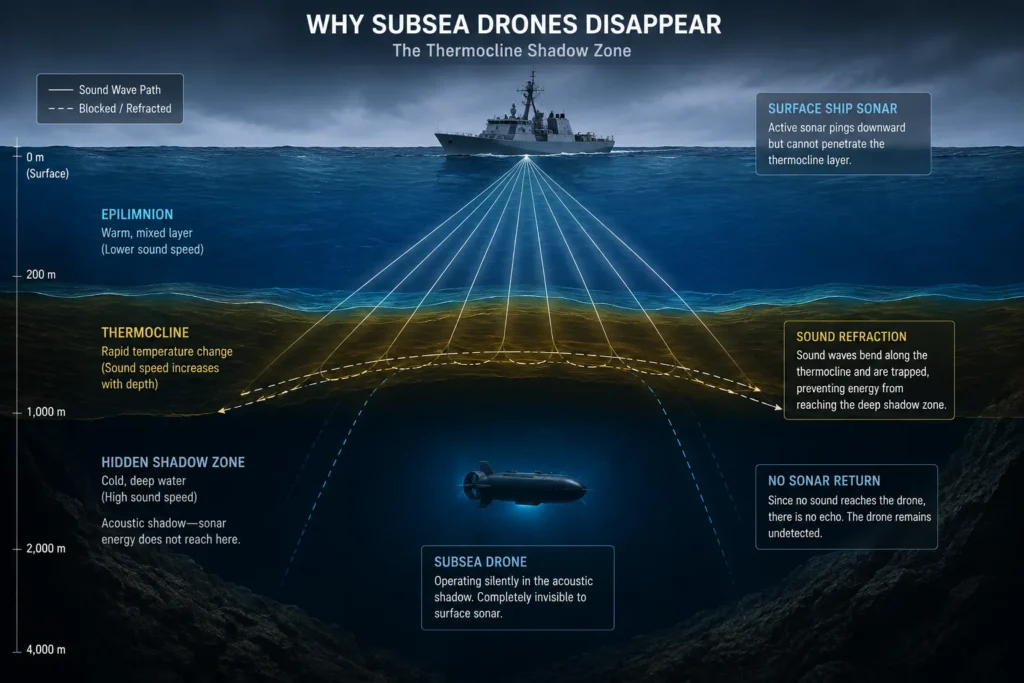
- Shadow Zones: If an autonomous saboteur drone hides beneath the “thermocline” (a layer of rapid temperature change), the sonar pings from a defending surface ship will hit the cold water and bounce sharply upward. The sound curves entirely over the drone, creating an acoustic shadow zone where the drone is mathematically invisible to the surface ship.
5. Real-World Consequences: Seabed Loitering Arrays
Adversaries map these shadow zones near vital subsea cables. They deploy Autonomous Underwater Vehicles (AUVs) that glide into these acoustic blind spots and power down, entering a dormant “loitering” mode on the seabed. Because they emit no sound and are shielded by the ocean’s thermocline, they are undetectable. They can sit adjacent to a transatlantic fiber-optic cable for months, waiting for a pre-programmed acoustic trigger or a timer to deploy cutting arms or explosive charges.
Defending Cables: Distributed Acoustic Sensing (DAS)
The defense against this silent sabotage is driving a massive technological pivot in the telecommunications and naval industries.
Distributed Acoustic Sensing (DAS): Telecom companies are no longer relying on navies to protect their cables; they are turning the cables into their own burglar alarms. DAS technology shoots a highly calibrated laser pulse down the glass fiber-optic cable. If a hostile submarine or a saboteur drone operates nearby, the microscopic acoustic vibrations in the water physically compress the glass cable by a fraction of a nanometer. The laser detects this microscopic distortion and alerts engineers instantly, turning a 5,000-mile communications cable into the largest continuous acoustic sensor array on the planet.
The “Underwater Great Wall” (SOSUS 2.0): During the Cold War, the U.S. built the Sound Surveillance System (SOSUS)—a network of underwater microphones (hydrophones) to track Soviet submarines. Today, China is aggressively deploying the “Underwater Great Wall” in the South China Sea. This modern network of seabed acoustic sensors, fiber-optic tethers, and surface buoys maps the exact acoustic signatures of foreign submarines and AUVs, creating an impenetrable detection grid over the contested waters and critical infrastructure of the Indo-Pacific.
Russian GUGI Operations: Russia’s Main Directorate of Deep-Sea Research (GUGI) operates a highly classified fleet of specialized nuclear submarines (like the Belgorod) designed expressly for seabed warfare. These massive “mother submarines” carry smaller, deep-diving nuclear-powered submersibles (like the Losharik or Paltus) capable of diving to extreme depths to tap into cables, install acoustic listening devices, or sever infrastructure. The entire operational doctrine of GUGI revolves around exploiting the deep-ocean acoustic environment to conduct deniable sabotage.
Economic & Strategic Impact
The vulnerability of subsea infrastructure is triggering a massive restructuring of Cable Routing and Insurance Liabilities.
Historically, subsea cable consortiums routed cables purely based on the cheapest, shortest geographical line between two cities. Today, geopolitical risk officers dictate routing. Because shallow, congested waters (like the Red Sea or the English Channel) are uniquely vulnerable to “accidental” anchor dragging by hostile merchant vessels or easy deployment of acoustic mines, consortiums are spending billions extra to route cables through deeper, more difficult-to-reach, politically neutral waters.
Furthermore, the maritime insurance industry is struggling to price this risk. If an autonomous drone cuts a cable, and no nation claims responsibility, is it an act of war (which nullifies standard insurance payouts via “war exclusion” clauses) or an act of vandalism? This legal and financial ambiguity is forcing tech hyperscalers (Google, Meta, Amazon), who now own the majority of new subsea cables, to absorb massive, uninsurable geopolitical risks directly onto their own balance sheets.
Advantages of Acoustic Seabed Operations
- Absolute Stealth: The inability of electromagnetic waves to penetrate water, combined with the strategic exploitation of acoustic shadow zones, provides attackers with a level of operational invisibility unmatched in air or space combat.
- Plausible Deniability: The deep ocean destroys evidence. If a cable is severed by an autonomous drone that subsequently self-destructs, attributing the attack to a specific nation-state is forensically and legally nearly impossible.
- Asymmetric Economic Damage: It costs less than a million dollars to deploy an autonomous cutting drone. Severing a Tier-1 financial data cable can cause billions of dollars in economic damage to an adversary within milliseconds, offering an extreme return on operational investment.
Limitations and Defense Friction
- Communication Blackouts: The very physics that make submarines stealthy also make them deaf. Because water blocks radio waves, a deep-sea loitering drone cannot receive live, high-bandwidth updates from headquarters. It must rely on slow, low-bandwidth acoustic modems or pre-programmed, autonomous kill-chain AI, heavily increasing the risk of an accidental strike.
- Extreme Engineering Tolerances: The seabed is hostile. At 3,000 meters deep, the hydrostatic pressure is crushing (over 4,000 psi), and the saltwater is highly corrosive. Manufacturing drones and acoustic arrays that can survive and remain operational under these conditions for months requires exotic, intensely expensive metallurgy.
- Acoustic Clutter (The Noisy Ocean): The ocean is not quiet. Whales, seismic activity, shipping traffic, and breaking waves create a massive cacophony of background noise. For a defending DAS system or SOSUS array to identify the specific hum of a tiny saboteur drone, it requires massive supercomputing power and advanced machine-learning algorithms to filter out the biological and commercial clutter.
Common Misconceptions
Misconception: If the undersea cables are cut, satellites (like Starlink) will just take over the internet.
Reality: This is a dangerous mathematical fallacy. All the satellites currently orbiting the Earth combined possess less than 1% of the bandwidth of a single modern subsea fiber-optic cable. Satellites are excellent for rural connectivity, but they are physically incapable of handling the terabits-per-second volume required by global financial centers and cloud data hubs. If the cables are cut, the internet dies.
Misconception: Cables are heavily armored and difficult to cut.
Reality: While cables near the shore are buried and heavily armored with steel wire to protect against boat anchors, the cables in the deep ocean are often no thicker than a garden hose. They rest directly on the seabed and can easily be severed by a small explosive charge or a robotic cutting claw.
Misconception: A cable cut immediately triggers World War III.
Reality: Cable cuts happen frequently (dozens of times a year) due to legitimate accidents, underwater landslides, and fishing nets. This high “background noise” of accidental breaks is precisely what provides state actors with plausible deniability when they execute an intentional attack.
What Most People Miss
The lethal evolution of Acoustic Command and Control (C2) Networks.
Most people assume that underwater drones operate entirely independently. What most analysts miss is the rapid deployment of subsea acoustic modems.
Militaries are seeding the seabed with network nodes that talk to each other using pulses of sound. This allows an adversary to place a loitering munition next to a cable, and leave it totally dormant. Weeks later, a surface ship or a low-flying aircraft can drop an acoustic buoy into the ocean hundreds of miles away. The buoy transmits an acoustic “kill code” into the SOFAR channel. The sound wave travels invisibly across the ocean, hits the dormant drone, and activates the explosive. This allows a nation to strategically pre-plant explosives across the global internet infrastructure during peacetime, and detonate them simultaneously on command during a geopolitical crisis, without any of their submarines being anywhere near the target.
Comparison Table
| Feature | Aerial/Space Warfare | Surface Naval Warfare | Subsea Acoustic Warfare |
| Primary Sensor | Radar / Electro-Optical (Light) | Radar / Visual | Sonar (Acoustics) |
| Propagation Medium | Vacuum / Atmosphere | Atmosphere / Surface | Seawater (Highly refractive) |
| Communication Speed | Speed of Light (Instantaneous) | Speed of Light | Speed of Sound (Extremely slow) |
| Stealth Mechanism | Radar-absorbing materials | Horizon curvature / Jamming | Exploiting thermoclines & shadow zones |
| Attribution of Attack | Immediate / Highly accurate | Immediate | Highly ambiguous / Plausible deniability |
Case Study
Situation: In early 2023, two critical subsea internet cables connecting Taiwan to its outlying Matsu Islands were suddenly severed within a week of each other. The cuts caused massive communications blackouts, forcing the islands’ 13,000 residents to rely on heavily throttled, severely limited microwave radio backups, effectively cutting them off from the global economy.
Challenge: Determining whether the severing of the critical infrastructure was an act of deliberate geopolitical sabotage intended to test Taiwan’s resilience, or a statistically unlikely coincidence.
Solution & Investigation: Taiwanese authorities discovered that the first cable was cut by a Chinese fishing vessel, and the second was severed by a Chinese civilian freighter. Both vessels were operating in the highly contested, acoustically complex, and shallow waters of the Taiwan Strait, an area notorious for heavy maritime traffic and geopolitical friction.
Outcome: While Taiwanese officials stopped short of formally declaring the incidents as coordinated acts of deliberate military sabotage, the event exposed a terrifying fragility. The perpetrators did not require advanced GUGI submarines or acoustic stealth drones; they weaponized “civilian” assets (anchor dragging) in a gray-zone tactic to achieve the exact same strategic blackout.
Lessons Learned: The Matsu island incident proved that subsea infrastructure is the soft underbelly of national security. It demonstrated to defense strategists globally that severing cables does not require a formal declaration of war. It validated the immediate need for continuous, real-time Distributed Acoustic Sensing (DAS) on all critical cables to differentiate between accidental commercial anchor drags and deliberate, hostile gray-zone infrastructure degradation before a massive, coordinated attack can isolate a sovereign nation.
Future Outlook
Next 12–24 Months
The era of Commercial DAS Standardization. Over the next two years, the telecommunications sector will aggressively retrofit existing subsea cables with Distributed Acoustic Sensing capabilities. Tech hyperscalers (Google, Meta, Microsoft) leading new cable consortiums will mandate that all new transoceanic builds include integrated acoustic monitoring. The sheer volume of acoustic data generated by these cables will require massive AI-driven data centers onshore to process the acoustics in real-time, attempting to filter out the noise of whales and tectonic shifts to identify the specific hum of approaching saboteur drones.
Next 3–5 Years
The scaling of Extra-Large Unmanned Underwater Vehicles (XLUUVs). The defense industry is rapidly shifting away from relying solely on multi-billion-dollar manned nuclear submarines. By the late 2020s, navies will deploy fleets of XLUUVs—massive, autonomous drone submarines like the Boeing Orca. These drones will be capable of leaving port autonomously, navigating thousands of miles utilizing advanced acoustic terrain-matching, and loitering undetected on the seabed for months at a time. Their primary mission will be to stalk enemy infrastructure and physically intercept hostile AUVs attempting to tamper with allied cables.
Next 10 Years
The Autonomous Seabed Arms Race. By the mid-2030s, the ocean floor will be heavily militarized. Superpowers will establish permanent, autonomous seabed installations located at critical acoustic chokepoints. These deep-sea bases will be powered by localized energy harvesting (or small modular reactors) and will serve as docking stations for swarms of defensive and offensive drones. The concept of “freedom of the seas” will face extreme legal and kinetic challenges as nations attempt to claim exclusive acoustic exclusion zones around their critical fiber-optic and pipeline infrastructure, threatening autonomous lethal force against any unidentified entity entering the shadow zone.
Most Likely Scenario
Subsea acoustic warfare guarantees that the bottom of the ocean will transition from a commercial transit layer into an active, highly lethal theater of operations. As global reliance on cloud computing and digital finance reaches absolute dependency, the strategic value of the physical cables will surpass the value of traditional military targets. The inability to use radar underwater ensures that victory in this domain will belong strictly to the nation possessing the superior acoustic algorithms and the deepest understanding of oceanographic thermodynamics.
Key Takeaways
- 99% of global internet and financial data travels through thin, unprotected fiber-optic cables resting on the ocean floor.
- Because electromagnetic waves (radar, light) cannot travel through deep water, underwater detection relies entirely on sound (sonar) and acoustic warfare.
- Sound bends underwater due to temperature, pressure, and salinity. Militaries exploit these curves to hide autonomous saboteur drones in “shadow zones” where sonar cannot see them.
- Adversaries are actively mapping deep-sea chokepoints (like the Luzon Strait or Bab-el-Mandeb) to position dormant drones capable of cutting cables on command.
- To fight back, telecom companies are using Distributed Acoustic Sensing (DAS) to turn the cables themselves into massive microphones, listening for the vibrations of approaching attackers.
- Cutting these cables does not require explosives; a simple robotic arm on an autonomous underwater vehicle (AUV) can sever the global internet in an untraceable, highly deniable attack.
Glossary
Autonomous Underwater Vehicle (AUV): An unmanned robotic submarine programmed to navigate, map, or execute missions without real-time human control, heavily utilized for deep-sea seabed warfare.
Distributed Acoustic Sensing (DAS): A technology that uses laser pulses to measure microscopic vibrations along a fiber-optic cable, effectively turning the entire cable into a highly sensitive, continuous microphone.
GUGI (Main Directorate of Deep-Sea Research): A highly secretive, specialized branch of the Russian Navy tasked with deep-ocean espionage, seabed warfare, and the mapping/sabotage of subsea infrastructure.
Kessler Syndrome: A theoretical scenario where the density of objects in low Earth orbit is high enough that collisions between objects could cause a cascade, creating unstoppable space debris (the primary reason kinetic ASATs are avoided, pushing conflict to the seabed).
SOFAR Channel (Deep Sound Channel): A specific depth layer in the ocean where the speed of sound is at its minimum. Sound waves get trapped in this channel and can travel for thousands of miles with very little loss of energy.
Thermocline: A distinct layer in the ocean where temperature decreases rapidly with depth, causing sound waves to refract (bend) sharply, creating acoustic shadow zones utilized for stealth.
Shadow Zone: An area of the ocean where sound waves cannot penetrate due to refraction caused by temperature or pressure gradients, rendering any object within it invisible to active sonar.