Advertisement
)

AT A GLANCE
- Concept: Language Models: The core reasoning engine that interprets instructions and selects actions.
- Concept: Tool-Calling APIs: Digital bridges allowing an AI to control external software applications independently.
- Concept: Stateful Memory: A system’s ability to remember previous actions across an extended workflow.
- Concept: Reinforcement Learning: A training mechanism where agents improve accuracy through continuous trial and error.
IN SIMPLE WORDS
For the past fifty years, software has operated as a tool. A human uses a spreadsheet, clicks buttons in a CRM, or types a query into a search engine. The human provides the logic, and the software executes the command.
Autonomous AI agents flip this dynamic. They shift software from being a tool into being a worker. Instead of asking a program to format a spreadsheet, a manager tells an AI agent to analyze last quarter’s sales, find the underperforming regions, email the directors, and summarize their replies.
The agent breaks this massive goal into smaller steps. It logs into the database, pulls the numbers, writes the emails, waits for the replies, and compiles the final report. It makes decisions, corrects its own errors, and uses other software tools independently, fundamentally replacing routine digital human labor.
HOW AUTONOMOUS AI AGENTS WORK
The core of an autonomous agent is an orchestration loop driven by a large language model. This model acts as the central reasoning engine, converting abstract human goals into a structured graph of execution steps.
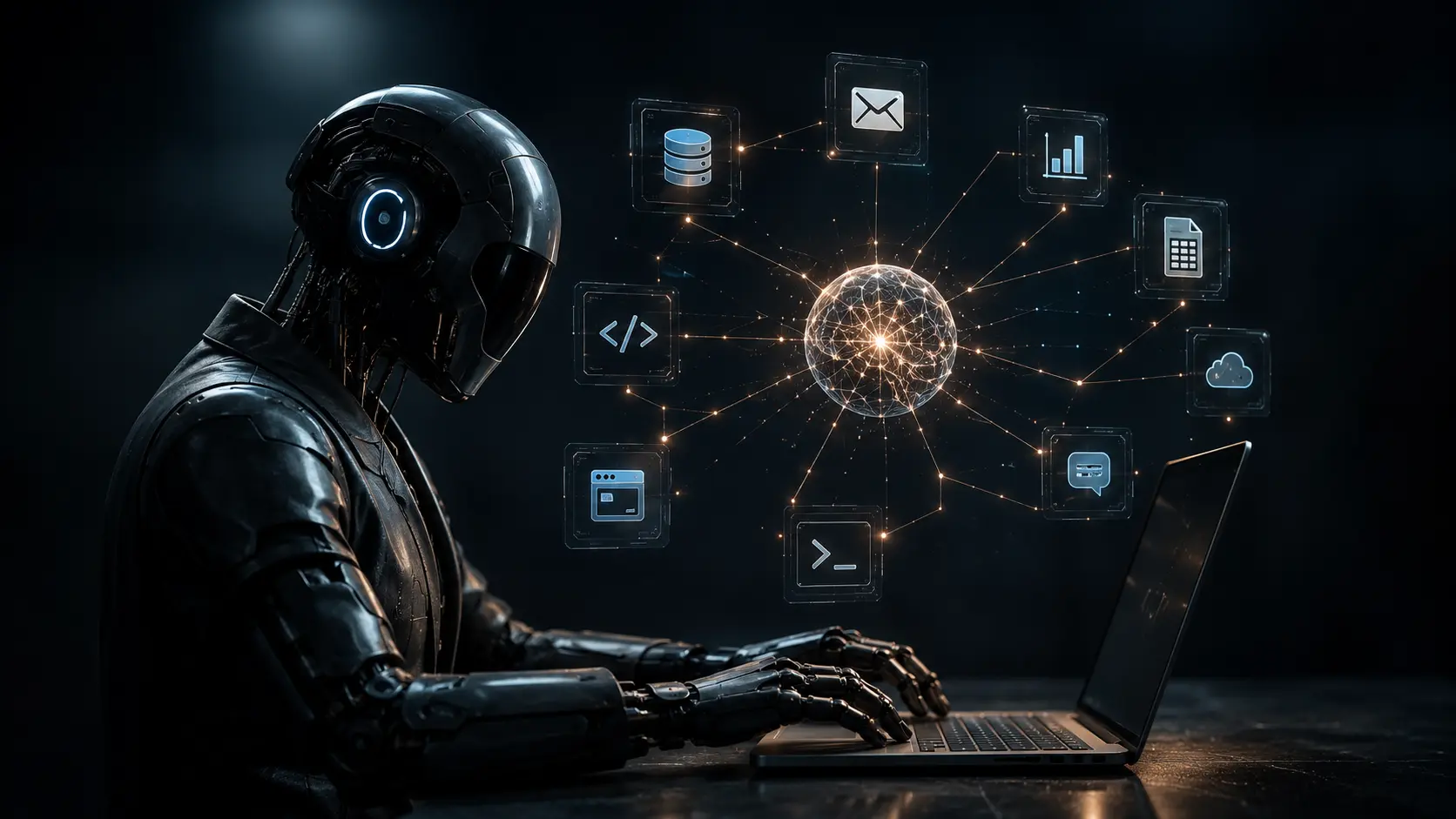
Unlike standard chatbots that simply return text, agents utilize runtime tool-calling APIs. These APIs grant the agent physical access to the outside world, allowing it to execute Python code, query SQL databases, or trigger webhooks.
When an agent encounters a complex problem, it relies on an internal reasoning framework, such as ReAct (Reasoning and Acting). The agent observes its environment, formulates a thought about the next logical step, executes an action using a tool, and observes the result.
If an API call fails or returns an error, the agent does not crash. It reads the error message, adjusts its parameters, and attempts a new solution, mimicking human trial and error.
To maintain context over long workflows, agents rely on stateful memory graphs. They store immediate actions in short-term memory and permanently log critical knowledge in long-term vector databases, allowing them to recall previous interactions instantly.
REAL WORLD EXAMPLE
Devin, created by Cognition AI, represents a functional paradigm shift in software engineering. Devin is not an autocomplete tool like GitHub Copilot; it is an autonomous software engineer.
If a human user tells Devin to build a website that tracks local weather and deploy it, Devin opens its own secure sandbox environment. It writes the code in its own code editor, reads the API documentation in its own browser, and tests the application.
If the code fails to compile, Devin reads the terminal error, debugs the script, rewrites the logic, and successfully deploys the final product without any human intervention.
WHY IT MATTERS NOW
The global economy is currently constrained by the cost and availability of skilled knowledge workers. Companies spend trillions of dollars annually on middle-management tasks, data entry, and routine software development.
AI agents fundamentally alter this economic equation. They reduce the marginal cost of intelligence to near zero, allowing a startup with three employees to wield the operational output of a massive multinational corporation.
This transition shifts corporate technology budgets away from human resources and toward agentic compute latency. Companies will no longer compete for top human talent; they will compete to secure enough graphical processing unit clusters to power their autonomous digital workforces.
Consequently, the value of traditional Software-as-a-Service platforms is collapsing. If an AI agent can instantly write a custom script to manage payroll, a company no longer needs to pay a monthly subscription for an external payroll software application.
COMMON MISCONCEPTIONS
- “Agents are just advanced search engines.” Search engines passively retrieve information. Agents actively execute tasks, manipulate external software, and make autonomous decisions to achieve a goal.
- “Agents will achieve human-level general intelligence.” Current agents do not possess consciousness or general intelligence. They are highly complex probability engines chained to strict software loops and API endpoints.
- “Agents require entirely new hardware.” While faster chips help, agents run on the exact same cloud GPU infrastructure that powers standard language models. The breakthrough is in the orchestration software, not the silicon.
- “You can just let an agent run wild.” Enterprise agents operate inside strict, sandboxed environments. They require hard-coded permission boundaries to prevent them from accidentally deleting databases or sending unauthorized emails.
WHAT MOST PEOPLE MISS
Analysts focus heavily on the intelligence of the underlying language model, but they completely overlook the latency vectors of the orchestration loop.
An agent does not make one decision; it makes hundreds of sequential decisions to complete a single task. If a model takes three seconds to process a single thought, a 100-step workflow will take five minutes. The true bottleneck in autonomous AI is not reasoning capability; it is the physical speed at which a data center can generate tokens to complete the reasoning cycle.
THE ECONOMIC AND STRATEGIC IMPACT
The primary financial beneficiaries of the agentic shift are the massive cloud infrastructure providers. Amazon, Microsoft, and Google will capture immense revenue because agent loops consume exponentially more compute power than simple, single-turn human chatbot queries.
For the labor market, this represents the total automation of middle-office operations. Roles dedicated to coordinating information—such as logistics dispatchers, compliance auditors, and entry-level financial analysts—will be entirely absorbed by specialized agent swarms.
Geopolitically, the nation that dominates agentic architecture controls the future of industrial productivity. State-backed intelligence agencies are already deploying autonomous agents to hunt for zero-day vulnerabilities in adversary networks, turning cybersecurity into a machine-versus-machine conflict that operates faster than human reaction time.
THE TRAJECTORY
Next 12–36 Months: Enterprises will deploy specialized, single-task agents within highly constrained environments. These agents will handle customer service refunds, basic code review, and automated data entry, operating under strict human-in-the-loop oversight.
Next Five Years: The rise of Multi-Agent Systems (MAS). Different specialized agents will begin communicating directly with each other. A research agent will pass data to an analysis agent, which will instruct an execution agent, creating entire digital departments that run autonomously.
Next Ten Years: The emergence of agent-to-agent economies. Corporate AI agents will negotiate contracts, purchase supplies, and execute trades directly with the AI agents of other corporations. The majority of global internet traffic will consist of autonomous machines negotiating with each other.
What Could Go Wrong: A catastrophic cascading failure. If an autonomous agent misinterprets a command and has unrestricted access to a corporate network, it could systematically overwrite critical databases or execute thousands of erroneous financial trades in milliseconds before a human can pull the plug.
Most Likely Outcome: AI agents will become the invisible operating system of the global economy. Human workers will transition from executing digital tasks to managing and directing massive swarms of hyper-efficient digital laborers.
KEY TERMS
- Autonomous Agent: An artificial intelligence program capable of planning and executing multi-step tasks without continuous human input.
- Tool-Calling API: A digital interface that allows an AI model to trigger and control external software applications, like sending emails or querying databases.
- Reinforcement Learning: A machine learning technique where an agent learns to make better decisions by receiving rewards for correct actions and penalties for mistakes.
- Stateful Memory: The ability of an AI system to remember past interactions and retain context across long, complex workflows.
- Large Language Model (LLM): A massive neural network trained on vast amounts of text, serving as the reasoning and decision-making engine for the agent.
- Vector Database: A specialized storage system that allows an agent to instantly search and retrieve relevant memories or documents based on context.
BEGINNER FAQ
What is an AI agent? It is a software program that uses artificial intelligence to act like a digital worker. You give it a goal, and it figures out the steps required to achieve that goal on its own.
How is this different from ChatGPT? ChatGPT waits for you to type a prompt, answers it, and stops. An agent keeps working in the background, interacting with other software to complete a long, multi-step project without needing you to click a button.
Can an agent use my email? Yes. If you grant it permission, an agent can read your emails, draft responses, and send them completely autonomously using standard software APIs.
How does an agent fix its own mistakes? Agents use a reasoning loop. When they try a task, they observe the result. If they get an error message, they analyze the error, rewrite their plan, and try a different approach.
Will agents replace human jobs? They will replace jobs that consist entirely of moving digital information from one screen to another. Humans will shift to managing these agents rather than doing the manual computer work themselves.
Are agents safe to use? They are safe if placed in a secure digital sandbox. Companies strictly limit what an agent is legally allowed to access, ensuring it cannot accidentally delete files or spend unauthorized money.
What is a multi-agent system? It is a network where different AI agents talk to each other. Instead of one agent doing everything, a manager agent might delegate tasks to a research agent and a coding agent.
Why did this technology suddenly appear? Recent advancements in large language models made them smart enough to understand complex logic. When engineers connected these smart models directly to software APIs, autonomous agents were born.
SOURCES
- Stanford University — Generative Agents: Interactive Simulacra of Human Behavior
- Massachusetts Institute of Technology (MIT) — ReAct: Synergizing Reasoning and Acting in Language Models
- Center for Security and Emerging Technology (CSET) — The Geopolitics of Autonomous AI Systems
- Institute of Electrical and Electronics Engineers (IEEE) — Multi-Agent Systems and Stateful Memory Architectures