Advertisement
)

AT A GLANCE
- Concept: Error Function: A mathematical formula quantifies the exact difference between the network’s prediction and the actual correct answer.
- Concept: The Chain Rule: Algorithms multiply partial derivatives backward through sequential layers to distribute the accumulated error.
- Concept: Vanishing Gradients: Multiplying many tiny fractional numbers together causes the error signal to mathematically disappear in deep networks.
- Concept: Silicon Layout: Advanced microprocessors organize their physical memory banks specifically to accelerate these exact sequential matrix multiplications.
HOW IT WORKS
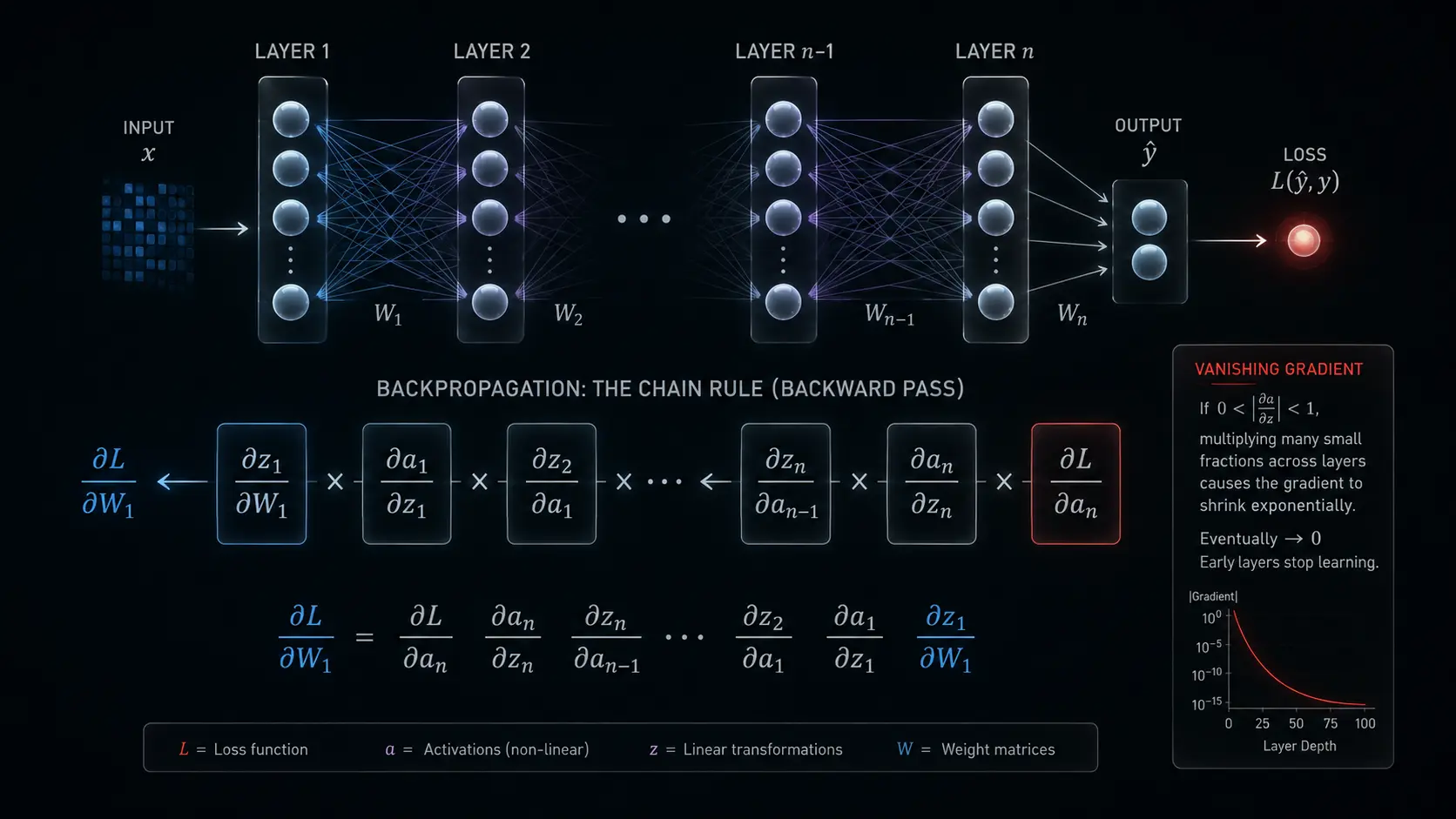
Artificial intelligence models generate predictions by passing data forward through consecutive layers of mathematical matrices. When a model outputs an incorrect prediction, a loss function quantifies the exact magnitude of that error.
To correct the mistake, the system must determine exactly which specific connection across billions of weights caused the miscalculation. Engineers use multivariable calculus to solve this attribution problem.
Backpropagation calculates the partial derivative of the final loss function with respect to every single weight matrix in the network. This mathematical operation tells the optimizer exactly what direction and magnitude to adjust each weight to minimize future errors.
Because a deep neural network is essentially a massive composite function, the algorithm relies entirely on the calculus chain rule. To find the gradient for a weight matrix buried deep in the first layer, the system multiplies the gradients of all subsequent layers moving backward from the final output:
$$\frac{\partial L}{\partial W_1} = \frac{\partial L}{\partial a_n} \frac{\partial a_n}{\partial z_n} \frac{\partial z_n}{\partial a_{n-1}} \cdots \frac{\partial z_1}{\partial W_1}$$
Where L is the loss, a represents the activation functions, z represents the intermediate linear transformations, and W denotes the target weight matrix.
This continuous multiplication creates a severe structural vulnerability known as the vanishing gradient problem. If the partial derivatives of the activation functions yield fractional values between zero and one, multiplying them together across fifty layers causes the final number to shrink exponentially.
The gradient mathematically disappears before it reaches the earliest layers, freezing their weights and permanently halting the learning process. To prevent this mathematical collapse, developers utilize specialized activation functions or establish residual connections that provide physical shortcut paths for the gradients to bypass intermediate layers. These architectural interventions force the math to resolve, ensuring the error signal survives the backward journey through the matrix chain.
WHY IT MATTERS NOW
The artificial intelligence industry currently operates under an aggressive scaling mandate. Companies like OpenAI build foundational models containing over a trillion parameters distributed across hundreds of distinct sequential layers. Calculating the backpropagation chain through a network of this sheer physical size breaks traditional computing architectures.
The computational tax of the chain rule extends far beyond simple processing speed. To calculate the backward gradients, the system must perfectly memorize every single intermediate activation value generated during the forward pass. This mathematical requirement turns the training process into an extreme memory bandwidth crisis, requiring massive clusters of high-bandwidth memory modules simply to store the temporary calculus variables.
This strict mathematical reality directly dictates the physical silicon layout of modern artificial intelligence accelerators. Hardware manufacturers like Nvidia do not design generic microprocessors; they design highly specialized matrix multiplication engines. They physically position static random-access memory blocks millimeters away from the logic cores specifically to accelerate the rapid, continuous fetching of partial derivatives required by the backpropagation loop.
Solving this specific calculus problem drives the capital expenditure of the global technology sector. Cloud providers spend tens of billions of dollars constructing massive data centers explicitly engineered to move gradient matrices between graphics processing units without latency. Mastering the physical throughput of the derivative chain separates the few corporations capable of training frontier models from the rest of the global economy.
WHAT MOST PEOPLE MISS
Software developers write deep learning code using high-level frameworks like PyTorch, typing a single command to execute the backward pass. This software abstraction creates the illusion that backpropagation is a simple, frictionless background process. They completely miss the brutal, low-level tensor operations consuming the underlying hardware.
In reality, operators constantly balance a severe thermodynamic and mathematical tradeoff called gradient checkpointing. When a model becomes too large to store all forward activations in physical memory, the system deletes them. During the backward pass, the processors must manually recalculate those missing variables from scratch, burning massive amounts of electricity and doubling the compute time simply to satisfy the chain rule equation.
THE TRAJECTORY
Next 12–36 Months: Engineers will aggressively deploy 8-bit floating-point quantization specifically for the backward pass. Shrinking the precision of the gradient matrices will instantly double the available memory bandwidth, drastically compressing the time required to update massive enterprise models.
Next Five Years: Foundries will commercialize wafer-scale integration engines designed explicitly to hold an entire neural network derivative chain on a single continuous piece of silicon. This physical architecture will eliminate the severe latency penalties of transferring gradient matrices across external copper network cables.
Next Ten Years: Researchers will develop entirely new biologically inspired learning algorithms, such as the forward-forward algorithm. These new architectures will bypass the calculus chain rule entirely, allowing networks to learn locally layer-by-layer without requiring the massive memory overhead of backpropagation.
What Could Go Wrong: Pushing quantization too far fundamentally destroys the mathematical integrity of the chain rule. If operators compress the gradient matrices into ultra-low 4-bit integers, the microscopic fractional errors will compound exponentially across the layers, reducing the precise directional updates into useless random noise.
Most Likely Outcome: The backpropagation algorithm will maintain its absolute structural dominance over artificial intelligence training for the next decade. Progress will rely entirely on hardware manufacturers physically redesigning memory topologies to accommodate the extreme tensor math required by deeper network architectures.
KEY TERMS
- Backpropagation: The primary algorithm used in machine learning to calculate weight gradients by applying the calculus chain rule backward from the output layer.
- Chain Rule: A fundamental formula in calculus used to compute the derivative of a composite function by multiplying the derivatives of the individual nested functions.
- Vanishing Gradient: A mathematical failure state in deep networks where partial derivatives shrink to zero during multiplication, permanently halting the learning process in early layers.
- Activation Function: A mathematical operation applied to a neural network node that determines its output, introducing the non-linearity required to learn complex data patterns.
- Tensor: A multi-dimensional array of numbers representing the underlying data structure used to execute complex linear algebra operations on graphics processing units.
SOURCES
- Nature — Learning Representations by Back-Propagating Errors
- Nvidia Technical Blog — Optimizing Deep Learning Training with Automatic Mixed Precision
- arXiv — Understanding the Difficulty of Training Deep Feedforward Neural Networks
- PyTorch Foundation — Autograd: Automatic Differentiation and the Backward Pass