Advertisement
)
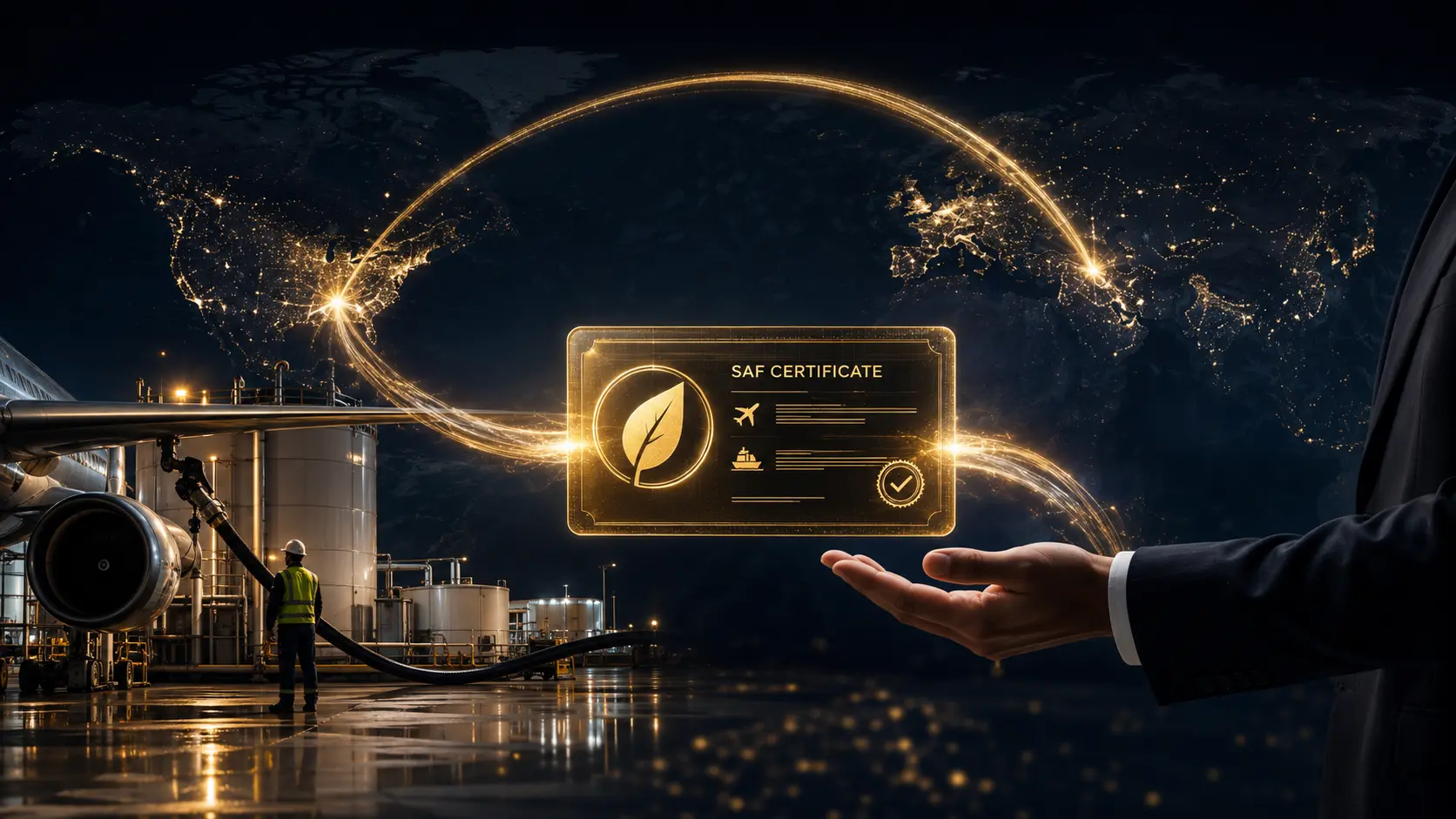

Imagine a massive multinational corporation based in London pledging to cut its corporate travel emissions to absolute zero. To execute this, the board mandates that executives only fly on planes fueled by Sustainable Aviation Fuel (SAF). There is just one devastating logistical problem: the specific airport they are flying out of does not possess a single drop of SAF in its fuel tanks, and shipping it there on a diesel-powered oceanic tanker defeats the entire environmental purpose. The global supply of sustainable fuel is heavily concentrated in a few specific geographies, creating an impossible bottleneck for the thousands of global corporations desperately attempting to decarbonize their sprawling, international supply chains.
Why should you care right now? Because financial engineers have solved this physical bottleneck by creating a radical new accounting loophole that transforms jet fuel into a digital asset. Known as “Book-and-Claim,” this system legally decouples the physical liquid from its environmental benefits. A plane in California can burn the actual green fuel, but a company in London can purchase and claim the carbon reduction to satisfy its strict ESG audits. By financializing the emissions reductions into highly regulated, tradable digital certificates, Book-and-Claim is instantly unlocking a multi-billion-dollar global market for green shipping and aviation, proving that the fastest way to fix a broken physical supply chain is to virtualize it.
What is Book-and-Claim Accounting?
Book-and-Claim Accounting is a chain-of-custody model that decouples the environmental benefits of a sustainable product from its physical presence. It allows a company to purchase and claim the carbon reduction benefits of Sustainable Aviation Fuel (SAF) through digital certificates, even if the physical green fuel is consumed by a completely different aircraft elsewhere in the world.
At a Glance
- Concept: Splitting a barrel of green fuel into two separate products: the physical liquid burned in the engine, and a digital “green certificate” that can be traded globally on the open market.
- Why it matters: You cannot build a billion-dollar SAF refinery at every single airport in the world. This system allows capital from anywhere on Earth to fund SAF production in the optimal locations.
- Who uses it: Fortune 500 companies (Microsoft, Deloitte, Amazon), major airlines (United, Delta), global shipping conglomerates (Maersk), and institutional ESG auditors.
- Biggest takeaway: This is fundamentally different from a “carbon offset.” You are not paying someone to plant a tree in the Amazon; you are directly subsidizing the aviation industry to stop pulling fossil fuels out of the ground, classifying it as “carbon in-setting.”
In Simple Words
Think about how you buy “green electricity” for your house.
When you pay your utility company extra for 100% wind or solar power, the power company does not run a private, physical wire from a wind turbine directly to your television. Your television is powered by the exact same local electrical grid as your neighbor’s, which is a mixed pool of coal, gas, and solar energy. Instead, your money pays the utility to inject an equivalent amount of green energy into the shared grid somewhere. You “claim” the green electrons, even if your house didn’t physically use them.
Book-and-Claim applies this exact same logic to jet fuel and oceanic shipping fuel.
Because green jet fuel (SAF) is mostly produced in California and Europe, it is simply injected into the fuel pipelines at airports in California and Europe (the Book phase). A company in Tokyo can then pay the extra cost for that fuel. The Tokyo company receives a digital certificate proving they funded it (the Claim phase). The physical fuel is burned in Los Angeles, but the environmental victory is legally recorded on a corporate balance sheet in Japan.
Why This Matters
For Supply Chain Executives, ESG Investors, and Corporate Treasurers, Book-and-Claim is the definitive mechanism to execute Scope 3 Decarbonization.
Global regulatory bodies (like the SEC and the EU’s CSRD) are forcing public companies to report and reduce their “Scope 3” emissions. Scope 3 includes all the carbon emitted by your supply chain—such as the cargo ships transporting your inventory from China (Category 4) and the commercial flights your employees take for business meetings (Category 6).
Historically, companies had zero control over the fuel burned by Delta Airlines or Maersk Shipping; they were victims of their vendors’ carbon footprints. Book-and-Claim grants corporate treasurers a direct financial lever. They can now actively purchase SAF Certificates (SAFc) on the open market, apply them directly to their corporate ledger, and mathematically erase their logistics-related Scope 3 emissions without waiting for the entire global transportation industry to physically upgrade its fuel tanks.
The Greenium: Subsidizing SAF via Book-and-Claim
The primary barrier to scaling sustainable fuels is the Green Premium (Greenium).
Standard fossil jet fuel costs roughly $2.00 to $3.00 per gallon. Sustainable Aviation Fuel costs roughly $6.00 to $8.00 per gallon. Airlines operate on razor-thin margins; they physically cannot absorb a 300% fuel price increase without bankrupting their business models or doubling passenger ticket prices.
Book-and-Claim bridges this funding gap by importing external capital. The airline buys the physical SAF but only pays the standard $2.00 fossil fuel price. A corporate mega-buyer (like a tech giant wanting to hit a Net-Zero target) steps in and pays the remaining $4.00 “Green Premium” in exchange for the digital SAF Certificate. The fuel producer receives their full $6.00, the airline flies on green fuel without going bankrupt, and the corporate buyer hits their ESG target. It is a flawless synchronization of disparate economic incentives.
How Book-and-Claim Accounting Works: Scope 1 vs. Scope 3
Ensuring that a digital token genuinely represents a ton of carbon kept out of the atmosphere requires rigorous, airtight cryptographic accounting. Here is the first-principles breakdown of the architecture.
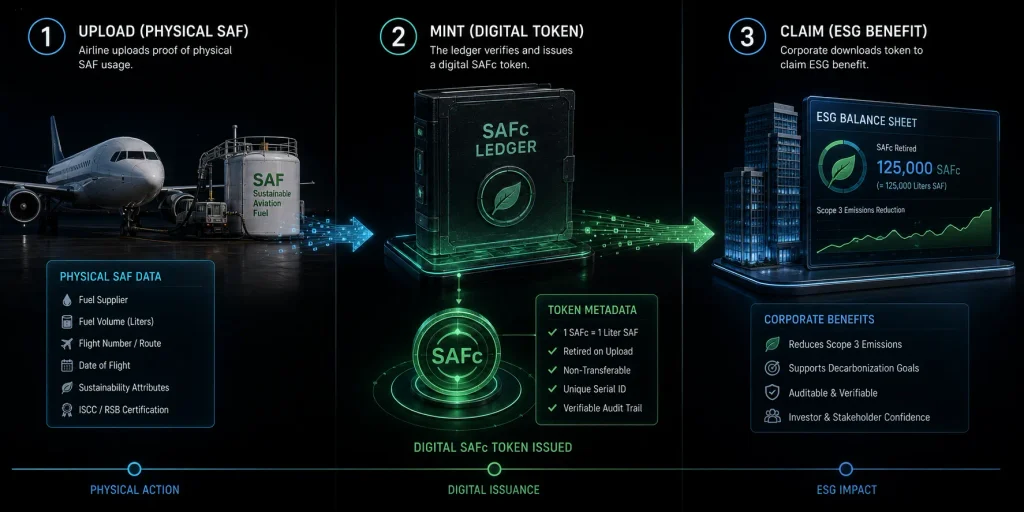
1. The Fundamental Problem: Double Counting
If a barrel of SAF is split into two products (physical fuel and a digital certificate), there is a massive risk of fraud. The airline that burns the physical fuel might claim to the government, “We flew green!” while the corporate buyer who holds the certificate claims to their shareholders, “We flew green!” This is “double counting,” and it destroys the mathematical integrity of global carbon reduction.
2. The Core Mechanism: Scope 1 vs. Scope 3 Decoupling
To solve this, international standards (like those governed by the Smart Freight Centre) strictly partition who gets to claim what based on Greenhouse Gas (GHG) Protocol scopes.
- The Airline (Scope 1): The airline physically burns the fuel in its engines. It is legally permitted to use the physical SAF to reduce its direct Scope 1 emissions for national regulatory compliance (like the EU ETS), but it cannot sell that specific flight to a passenger as a “zero-carbon flight.”
- The Corporate Buyer (Scope 3): The buyer who purchased the digital SAF Certificate (SAFc) uses it exclusively to reduce their indirect Scope 3 emissions. They legally own the right to claim that their specific business travel or freight transport was decarbonized.
3. Technical Depth: The Registry and Retirement
The entire system operates on independent, third-party ledgers (such as the RSB Book and Claim System).
When a SAF producer refines a batch of fuel, an independent auditor verifies the lifecycle carbon intensity of the batch. The producer then “books” this volume onto the digital registry, generating a SAFc. When a corporate buyer purchases the SAFc, the registry permanently “retires” the certificate. Once retired, the serial number is burned; it can never be traded, sold, or claimed by another entity ever again.
4. Technical Depth: Mass Balance Constraints
While Book-and-Claim allows global decoupling, it usually operates under “Mass Balance” constraints within a specific macro-region. To prevent absurd logistical claims, registries often dictate that if you buy a SAFc for a flight in North America, the physical fuel must have been injected into a pipeline somewhere within the North American aviation network, ensuring that regional supply actually meets regional demand.
5. Real-World Consequences: Carbon In-setting
Unlike purchasing carbon offsets (e.g., buying a $5 credit to preserve a forest in Brazil), buying a SAFc is known as In-setting. The capital never leaves the aviation ecosystem. The money spent on the certificate goes directly to the SAF refinery, subsidizing the production of the next batch of green fuel. It creates a closed-loop economic engine that aggressively accelerates the scale-up of hard-asset refinery infrastructure.
Corporate Procurement: SABA, DHL, and SAF Certificates
Book-and-Claim has transitioned from a theoretical whitepaper into the operational backbone of global green logistics.
The Sustainable Aviation Buyers Alliance (SABA): SABA is a massive consortium of mega-corporations (including Meta, JPMorgan Chase, and Boeing) committed to decarbonizing aviation. Instead of each company trying to negotiate tiny fuel contracts, SABA aggregates their buying power. In April 2024, SABA executed a landmark multi-year procurement, committing nearly $200 million to purchase SAF certificates across massive volumes of fuel. This guaranteed future demand allowed SAF producers to secure the bank loans required to physically build the refineries.
FuelEU Maritime and Shipping Pools: The maritime shipping industry relies on heavily polluting bunker fuel. The new FuelEU Maritime regulation enforces strict, decreasing limits on the greenhouse gas intensity of ship fuel. Because green methanol or e-ammonia is only available at a few ports globally, the EU explicitly allows a form of Book-and-Claim known as “Pooling.” A clean ship burning e-ammonia in Rotterdam can pool its compliance credits with a dirty ship burning diesel in Athens. The fleet achieves compliance mathematically, keeping the supply chain moving without forcing every port to rebuild its fueling infrastructure overnight.
Corporate Travel Portals: The integration is reaching the end-user interface. Corporate travel booking software (like Concur) is integrating Book-and-Claim seamlessly. When an employee books a flight, the software calculates the exact carbon footprint of that specific seat, instantly executes a micro-transaction to purchase the equivalent fractional SAFc from a central registry, and applies it to the corporate ledger, fully automating Scope 3 compliance.
Economic & Strategic Impact
The core strategic consequence of Book-and-Claim is the Democratization of ESG Action.
Prior to this accounting mechanism, only the massive, legacy airlines operating directly out of SAF-equipped hub airports (like San Francisco International or London Heathrow) could participate in aviation decarbonization. Smaller airlines or companies operating in developing nations were entirely locked out of the transition.
Book-and-Claim completely democratizes the transition. A regional logistics company operating entirely out of Southeast Asia—where physical SAF pipelines do not exist—can now legally and verifiably reach Net-Zero operations by purchasing digital SAF certificates generated by a biorefinery in Texas. It creates a unified, borderless global market for carbon reduction, allowing capital to flow instantly to the most efficient producers on Earth.
Advantages
- Eradicates Supply Chain Emissions: Completely eliminates the absurd requirement to transport green fuel thousands of miles on fossil-fueled vehicles just to burn it in a specific location.
- Subsidizes the Green Premium: Provides a direct, mathematically verifiable mechanism for external corporate capital to subsidize the extreme cost of SAF, saving airlines from bankruptcy.
- Instant Scalability: Because it relies on digital registries rather than physical pipelines, the system can scale globally as fast as software can be written, bypassing years of heavy infrastructure permitting.
- Stimulates Production Investment: Multi-year SAFc purchase agreements provide refineries with the guaranteed revenue “off-take” contracts they need to secure multi-billion-dollar construction loans from Wall Street banks.
Limitations
- Registry Fragmentation: Currently, the market is a chaotic patchwork of different registries (RSB, ISCC, national governments). If the registries do not perfectly talk to each other, a bad actor could theoretically book a certificate on one registry and book the exact same gallon of fuel on another, destroying the system’s integrity.
- The “Additionality” Debate: Some hardcore environmentalists argue that if a refinery was going to produce the SAF anyway because of government tax credits (like the U.S. IRA 45Z), selling a corporate SAFc on top of that doesn’t actually remove additional carbon from the atmosphere; it merely shifts the paperwork.
- Regulatory Uncertainty: The Science Based Targets initiative (SBTi)—the gold standard for corporate ESG auditing—is currently locked in fierce internal debate regarding exactly how and when Book-and-Claim certificates can be applied to strict Net-Zero targets. If SBTi ultimately rejects the methodology, the corporate market for SAFc could collapse overnight.
Common Misconceptions
Misconception: Book-and-Claim is just another word for Carbon Offsets.
Reality: Carbon offsets pay for external projects outside of your supply chain (like planting trees in a rainforest). Book-and-Claim is “In-setting.” You are paying specifically to remove fossil fuels from the exact transportation sector (aviation or shipping) that your company is currently polluting.
Misconception: The physical fuel is completely fake or just paperwork.
Reality: The math is absolute. Every digital certificate corresponds to a real, physical gallon of sustainable fuel that was independently verified, refined, and physically burned inside a real jet engine. The only difference is who gets to take credit for the resulting clean air.
Misconception: The airline gets to claim the green flight to passengers while selling the certificate to a corporation.
Reality: If the airline sells the Scope 3 certificate to a corporation, the airline loses the right to market that specific fuel volume as a “green flight” to the passengers sitting on the plane. The environmental attribute has legally left the building.
What Most People Miss
The disruptive capability of Tokenization and Atomic Settlement.
Currently, Book-and-Claim relies on slow, centralized databases run by NGOs, utilizing massive PDF audits and Excel spreadsheets. The reconciliation process takes months.
What the market is quietly preparing for is the blockchain tokenization of SAFc. By utilizing smart contracts on enterprise blockchains (like the Canton Network), the entire lifecycle of the fuel—from the biomass farm to the refinery to the airline—is cryptographically recorded. When a corporate buyer purchases the tokenized SAFc, atomic settlement ensures the payment, the transfer of ownership, and the permanent retirement of the credit happen simultaneously in the exact same millisecond. This will introduce high-frequency trading liquidity to the sustainable fuel markets, turning SAFc into a globally traded, highly liquid commodity class.
Comparison Table
| Accounting Mechanism | Link to Physical Product | Transport Emissions | Double Counting Risk | Scalability |
| Physical Segregation | 100% Intact (Kept isolated) | Extremely High (Requires dedicated shipping) | Low | Very Poor |
| Mass Balance | Mixed into physical supply | Moderate | Low | Moderate |
| Carbon Offsets | None (Outside the sector) | Zero | Moderate | High (But low quality) |
| Book-and-Claim (In-setting) | 100% Decoupled (Digital) | Zero | Moderate (Requires strict registry auditing) | Extremely High |
Case Study
Situation: The global aviation industry accounts for roughly 2.5% of total global CO₂ emissions. As massive corporations (from banking to big tech) attempted to honor their Net-Zero pledges, they identified business travel and air freight as massive, seemingly unsolvable Scope 3 liabilities. SAF was the only physical solution, but because it was produced almost entirely at a handful of refineries in California and Western Europe, 95% of the world’s corporate hubs had zero physical access to it.
Challenge: Create a financial and auditing infrastructure that allows a corporation in Tokyo or New York to legitimately claim the carbon reduction benefits of SAF produced and burned in Los Angeles, without violating the strict auditing standards of the Greenhouse Gas Protocol.
Solution (The Smart Freight Centre Framework): The Smart Freight Centre (SFC), alongside the MIT Center for Transportation & Logistics, established the definitive Book-and-Claim accounting framework. They created rigorous auditing rules that allowed SAF producers to “book” verified fuel volumes into a centralized, transparent ledger.
Outcome: By establishing ironclad rules separating Scope 1 airline claims from Scope 3 corporate claims, the SFC framework unlocked the market. Consortia like SABA executed multi-million-dollar SAFc purchases from producers like World Energy. The corporate buyers instantly erased massive segments of their Scope 3 liabilities on their annual ESG reports. Simultaneously, the SAF producers received massive, upfront capital injections, allowing them to rapidly scale their refinery operations without forcing airlines to bear the full cost of the green premium.
Lessons Learned: The success of the SFC framework proved that physical supply chain bottlenecks can be entirely bypassed through rigorous financial engineering. By legally decoupling the environmental attribute from the physical atom, Book-and-Claim established that in a globally interconnected atmosphere, where the carbon is reduced matters far less than ensuring the reduction actually happens.
Future Outlook
Next 12–24 Months
The era of SBTi Standardization and Registry Consolidation. The immediate future hinges on regulatory clarity. Over the next year, the Science Based Targets initiative (SBTi) is expected to formally ratify the exact conditions under which Book-and-Claim certificates can be used to meet corporate Net-Zero targets. Once this gold-standard validation is secured, the floodgates of corporate treasury capital will open. We will simultaneously see the chaotic landscape of independent registries consolidate or establish strict APIs (Application Programming Interfaces) to prevent cross-registry double counting.
Next 3–5 Years
The scaling of Maritime and Heavy Industrial Integration. While aviation pioneered the system, the maritime shipping sector is the next massive frontier. As global fleets transition to green methanol and ammonia, the logistics of distributing these novel fuels globally will be impossible. Book-and-Claim will become the default operating system for global ocean freight. Furthermore, we will see the model expand into heavy industry, allowing automakers to purchase “Green Steel Certificates” or “Green Cement Certificates” via Book-and-Claim, decarbonizing the heavy metallurgy supply chain without requiring every factory on Earth to rebuild its furnaces overnight.
Next 10 Years
The Commoditization of the Greenium. By the mid-2030s, the physical supply of sustainable fuels will have scaled massively, but the Book-and-Claim architecture will remain permanent. The system will evolve into a hyper-liquid, automated commodity market. The “Green Premium” will trade exactly like a traditional stock or bond. AI-driven corporate procurement algorithms will dynamically purchase SAFc and marine fuel certificates by the millisecond, automatically balancing a corporation’s live Scope 3 emissions against global carbon prices, turning environmental compliance into a frictionless, background software operation.
Most Likely Scenario
Book-and-Claim accounting is the definitive financial bridge of the energy transition. You cannot rebuild the physical infrastructure of the global economy in five years. By decoupling the environmental victory from the physical logistics, Book-and-Claim allows capital to move at the speed of software while physical infrastructure moves at the speed of steel. It will remain the paramount accounting mechanism until sustainable fuels achieve global, ubiquitous price parity with fossil fuels.
Key Takeaways
- Sustainable Aviation Fuel (SAF) is mostly produced in just a few locations. Shipping it around the world on diesel trucks destroys its environmental benefits.
- Book-and-Claim fixes this by splitting the fuel into two parts: the physical liquid, and a digital “green certificate” (SAFc).
- A plane in California burns the physical green fuel, but a company in London can buy the digital certificate to officially lower their corporate carbon footprint (Scope 3 emissions).
- This is called “In-setting.” Unlike planting a tree in a forest (off-setting), buying a SAFc injects corporate money directly into the aviation industry, heavily subsidizing the cost of building new green refineries.
- Strict, third-party registries ensure that once a company buys a certificate, it is permanently retired. The airline cannot claim the flight was “green” if they already sold the certificate to a corporation.
- This digital loophole instantly bypasses physical supply chain bottlenecks, allowing anyone in the world to fund and claim carbon reduction regardless of where their local airport is located.
Glossary
Carbon In-setting: Investing money to reduce carbon emissions within your own company’s supply chain (e.g., a shipping company paying for green shipping fuel), rather than paying for external projects.
Carbon Off-setting: Paying for an environmental project completely unrelated to your business operations (e.g., an airline paying to protect a rainforest) to compensate for your emissions.
Double Counting: The fraudulent or accidental practice where two different companies claim the exact same carbon reduction to the government or their shareholders.
Green Premium (Greenium): The additional financial cost required to buy a clean, sustainable product compared to its cheap, dirty fossil-fuel equivalent.
SAFc (Sustainable Aviation Fuel Certificate): The highly regulated, tradable digital token representing the environmental attributes of one metric ton of SAF.
Scope 3 Emissions: The carbon emissions generated by a company’s supply chain and vendors, rather than by the company itself. For most tech or finance companies, business flights and cargo shipping make up their massive Scope 3 liabilities.
Sources
Smart Freight Centre (SFC): Book and Claim Accounting Framework for Transport Emissions
Sustainable Aviation Buyers Alliance (SABA): Scaling SAF via Book and Claim
World Economic Forum (WEF): Clean Skies for Tomorrow: SAFc Guidelines
Roundtable on Sustainable Biomaterials (RSB): Book & Claim System and Registry
International Air Transport Association (IATA): Understanding SAF and Scope 3 Reporting