Advertisement
)


For the past five years, Wall Street has been attempting to digitize traditional finance. Trillions of dollars in U.S. Treasuries, corporate bonds, and private equity funds are slowly being converted into digital tokens on a blockchain. The promised benefits are massive: instant settlement, 24/7 trading, and the elimination of expensive back-office bureaucracy. Yet, the revolution has continuously stalled. The problem is a fatal paradox. If a bank uses a public blockchain (like Ethereum), all of its proprietary trading data is exposed to its competitors. If a bank uses a private blockchain to protect its secrets, the token is trapped in an isolated digital silo, rendering it useless to the rest of the financial system.
Why should you care right now? Because a consortium of the world’s most powerful financial institutions has officially engineered a way out of the paradox. Driven by heavyweights like Goldman Sachs, BNY Mellon, and the DTCC, Wall Street is aggressively deploying the Canton Network. Canton is not just another blockchain; it is a “network of networks.” It allows completely isolated, private banking systems to connect and seamlessly trade tokenized assets with one another, while mathematically guaranteeing that their internal data remains perfectly secret. By solving the “privacy versus interoperability” crisis, the Canton Network is poised to unify the fragmented digital economy, unleashing tens of billions of dollars in dormant tokenized real-world assets (RWAs).
What is the Canton Network?
The Canton Network is an interoperability protocol designed for institutional finance. Built using the Daml smart contract language, it connects isolated, private blockchain applications into a decentralized global network. It allows financial institutions to execute complex, cross-chain transactions with absolute atomic composability while maintaining strict, bank-grade data privacy.
At a Glance
- Concept: A digital bridge that allows different banks’ private computer systems to securely shake hands and trade tokenized assets without letting anyone see what is inside the briefcase.
- Why it matters: Tokenizing a U.S. Treasury bond is useless if you can’t seamlessly trade it for digital cash on a different network. Canton guarantees the trade happens instantly across both networks or doesn’t happen at all.
- Who uses it: Mega-custodians (BNY Mellon), clearinghouses (DTCC), and institutional trading desks tokenizing Real-World Assets (RWAs).
- Biggest takeaway: Public blockchains force everyone to share the same ledger. Canton allows every bank to keep their own private ledger, but uses a “Global Synchronizer” to perfectly coordinate the timing of trades between them.
In Simple Words
Imagine three different banks. Bank A has a vault full of digital gold. Bank B has a vault full of digital cash. Bank C is the middleman who verifies the trade.
On a Public Blockchain, all three banks have to move their safes out into the middle of the street. They can trade easily, but everyone walking by can see exactly how much gold and cash they have. Wall Street hates this.
On a Private Blockchain, Bank A and Bank B lock their vaults in separate, windowless bunkers. Their privacy is protected, but because they can’t communicate easily, doing a trade requires slow, expensive lawyers and manual verification, defeating the purpose of digital speed.
The Canton Network is like a system of secure, pressurized pneumatic tubes connecting the private bunkers. Bank A puts the gold in their tube, Bank B puts the cash in theirs. The Canton system guarantees that both tubes open at the exact same millisecond to swap the assets. The trade happens instantly, the privacy of the bunkers is maintained, and nobody on the outside street sees a thing.
Why This Matters
For Institutional Traders, Treasurers, and Macro Economists, Canton represents the eradication of Fragmented Liquidity Premia.
When an asset is trapped on an isolated private blockchain, the pool of potential buyers is incredibly small. This lack of buyers creates a “liquidity premium”—investors demand a discount (often 1% to 3%) simply because the asset is hard to sell. In a market moving trillions of dollars of U.S. Treasuries, a 1% friction cost is catastrophic.
By utilizing the Canton Network, an institution can mint a tokenized Treasury bond on their own proprietary, private network, but instantly offer it as collateral to a hedge fund operating on an entirely different private network. This unified liquidity pool collapses the bid-ask spread. It transforms tokenized RWAs from illiquid, experimental novelties into highly efficient, deeply liquid instruments capable of replacing traditional collateral in the $14 trillion global repo market.
The Evolution of Institutional Blockchain Interoperability
The evolution of institutional blockchain has shifted from “Ledger Supremacy” to “State Synchronization.”
In the late 2010s, banks wasted billions of dollars trying to build the “one true blockchain” that every bank would use (e.g., the failed R3 Corda consortia models). The industry realized that banks will never surrender control of their core ledgers to a shared system. Canton accepts this reality. It does not force banks to abandon their private databases. Instead, it provides a unifying synchronization layer that sits above the private databases, allowing them to interoperate while respecting the sovereign boundaries of each institution.
How the Canton Network and Daml Smart Contracts Work
Bridging independent private ledgers without a central clearinghouse requires mastering cryptographic state coordination. Here is the first-principles breakdown of the architecture.
1. The Fundamental Problem: The Double-Spend Paradox
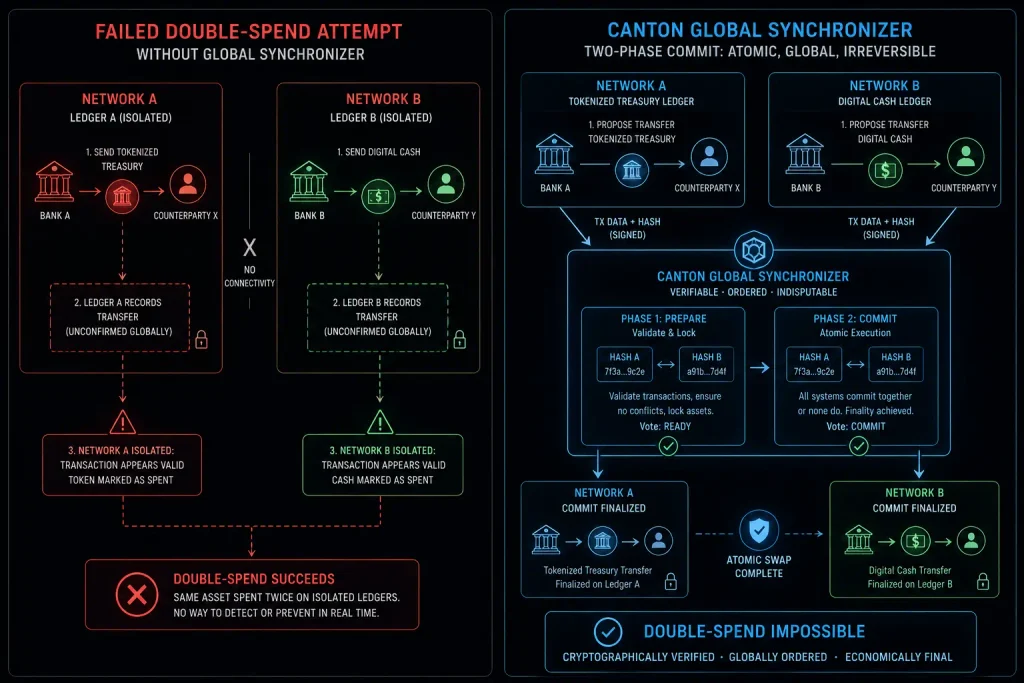
If Bank A (on Private Network X) wants to trade a tokenized bond for digital cash from Bank B (on Private Network Y), they face a “Double-Spend” risk. If the bond moves to Bank B, but Network Y crashes before the cash is sent to Bank A, Bank A is robbed. Without a central database tracking both networks, coordinating the swap perfectly is impossible.
2. The Core Mechanism: Daml Smart Contracts
Canton relies entirely on Daml (Digital Asset Markup Language). Unlike Ethereum’s Solidity, which executes logic publicly, Daml is a privacy-first language. A Daml smart contract explicitly dictates who is allowed to see the data (the “sub-transaction privacy”). If Bank A and Bank B execute a trade, the underlying code mathematically guarantees that only those two specific parties can view the details of the contract.
3. Technical Depth: The Global Synchronizer
To execute the trade between Network X and Network Y without a central database, Canton uses a decentralized “Global Synchronizer.” The synchronizer does not hold the actual data, the bonds, or the cash. It only holds cryptographic hashes (scrambled fingerprints) of the proposed transaction. The synchronizer acts as an ultra-fast traffic cop, ensuring the chronological order of the transactions across all participating networks.
4. Bypassing Intermediary Risk: Cross-Chain Atomic Composability
When the trade is initiated, the Global Synchronizer uses a cryptographic commit protocol (similar to a Two-Phase Commit). It locks the bond on Network X and the cash on Network Y simultaneously.
It then triggers the swap. If anything fails—if a server crashes, or if Bank B doesn’t actually have the cash—the entire transaction is instantly aborted, and the assets are unlocked and returned to their original owners. The transaction is “Atomic”—it is mathematically guaranteed to either happen 100% perfectly across all chains, or 0% happens. No one is ever left holding half a trade.
5. Real-World Consequences: Composable Financial Lego
Because the transactions are atomic, Canton allows for “Composability.” A trader can execute a multi-step transaction across five different banks instantly. For example: A trader pledges a tokenized Treasury bond at Bank A, borrows digital dollars from Bank B, uses those dollars to buy a tokenized private equity share from Bank C, and registers the trade with Clearinghouse D—all in a single, instantaneous, mathematically guaranteed transaction.
Canton Network Use Cases: DTCC, Broadridge, and Goldman Sachs
The Canton Network is not a speculative whitepaper; it is currently supporting the largest real-world asset tokenization initiatives on Wall Street.
DTCC and the U.S. Treasury Market: The Depository Trust & Clearing Corporation (DTCC)—the entity that physically processes almost every stock and bond trade in the United States—is aggressively testing Canton. They are exploring how to use the network to tokenize the massive U.S. Treasury repo market. By putting Treasury collateral onto a Canton-synchronized network, the DTCC can allow hedge funds to instantly move collateral between different prime brokers at 4:00 PM without waiting for archaic T+1 settlement cycles, drastically increasing the intraday liquidity of the U.S. financial system.
Broadridge and Distributed Ledger Repo (DLR): Broadridge Financial Solutions already executes over $1 trillion a day in repurchase agreements on its Distributed Ledger Repo (DLR) platform. DLR is built on Daml and operates within the Canton ecosystem. It allows buyers and sellers to agree on an overnight loan and instantly freeze the tokenized collateral in a smart contract. Because the collateral moves instantly and atomically, the banks save massive amounts of regulatory capital that would normally be tied up covering settlement risk.
Goldman Sachs Digital Asset Platform (GS DAP): Goldman Sachs launched its proprietary GS DAP to issue and manage digital bonds for its massive institutional clients. Because GS DAP is built on Canton’s underlying technology, Goldman is not creating a walled garden. In the future, a digital bond issued by Goldman Sachs in New York can be seamlessly traded and verified by a counterparty utilizing a completely different private network operated by BNP Paribas in London, creating global liquidity without Goldman surrendering control of its sovereign ledger.
Economic & Strategic Impact
The core strategic value of Canton is the Disruption of the Centralized Custodian Monopoly.
Currently, to trade an asset safely, both parties must use a mutually trusted, centralized third party (like BNY Mellon or State Street). This middleman charges massive “rent” (custody fees, settlement fees, clearing fees) simply for verifying that the trade happened correctly.
Canton decentralizes this trust. Because the Global Synchronizer mathematically guarantees that the trade executes fairly, the need for a massive, heavily capitalized middleman is drastically reduced. While custodial banks will still exist to hold the physical assets off-chain, the transactional friction is automated away. This shifts billions of dollars of revenue away from back-office clearinghouses and returns it to the front-office traders as pure margin.
Advantages
- Bank-Grade Privacy: Unlike Ethereum or Solana, transaction data on Canton is explicitly private. A competitor cannot look at the blockchain and reverse-engineer a hedge fund’s trading strategy.
- Infinite Scalability: Because Canton is a network of networks, it does not suffer from the “throughput limits” of a single blockchain. Thousands of independent networks process their own trades simultaneously, leaning on the Global Synchronizer only for cross-chain connectivity.
- Atomic Settlement: Eradicates Herstatt risk (settlement risk). A complex, multi-leg trade spanning five different financial institutions executes flawlessly as a single, indivisible action.
- Regulatory Compliance: The Daml language natively supports “Role-Based Access Control.” Regulators or auditors can be granted a specific, read-only “key” to view a bank’s transactions for compliance without exposing the bank’s data to the public.
Limitations
- The Oracle Problem: Canton is brilliant at moving a tokenized Treasury bond, but the token is useless if it doesn’t accurately reflect the real-world physical bond. The system relies entirely on trusted, off-chain entities (Custodians) to ensure the digital token is legally backed by a real asset stored in a physical vault. If the custodian lies, the flawless blockchain math is irrelevant.
- Adoption Inertia: The value of Canton scales with network effects. If a major bank builds their tokenization platform using a non-Daml language (like JPMorgan testing Onyx/Quorum), bridging that external silo into the Canton ecosystem introduces immense technical friction.
- Synchronizer Centralization Risk: While the individual networks are decentralized, the Global Synchronizer must be maintained by a consortium of highly trusted nodes. Ensuring that this synchronization layer remains robust, neutral, and secure against state-sponsored cyberattacks is a massive operational burden.
Common Misconceptions
Misconception: Canton is competing with Bitcoin or Ethereum.
Reality: Canton is entirely orthogonal to public crypto. It does not have a volatile, speculative cryptocurrency attached to it. It is enterprise software infrastructure designed strictly for licensed financial institutions to move regulated, real-world assets.
Misconception: All banks on Canton share one massive database.
Reality: Canton is specifically designed so banks do not share a database. Each bank runs its own sovereign, private network. Canton is merely the secure telephone line that allows the private networks to talk to each other.
Misconception: Blockchain instantly solves Wall Street’s speed problem.
Reality: Wall Street’s actual computers are already incredibly fast. The slowness comes from legal compliance, anti-money laundering (AML) checks, and manual verification. Canton automates the verification, but human lawyers still have to write the initial smart contracts.
What Most People Miss
The disruptive capability of Programmable Margin and Capital Optimization.
Most analysts view Canton simply as a faster way to settle a trade. What they miss is the profound impact of atomic composability on a bank’s regulatory capital.
Under Basel III regulations, banks must hold billions of dollars in idle cash (margin) to protect against settlement risk (the risk that a counterparty fails to deliver a bond 24 hours after a trade is agreed). Because Canton settles the trade atomically and instantly, the settlement risk window drops from 24 hours to zero milliseconds. If there is zero settlement risk, the bank mathematically requires zero margin buffer for that specific trade. By deploying Canton across their enterprise, a Tier-1 bank can legally release hundreds of millions of dollars of trapped regulatory capital and deploy it into high-yield investments.
Comparison Table
| Feature | Public Blockchain (Ethereum) | Isolated Private Blockchain (Hyperledger) | The Canton Network |
| Data Privacy | None (100% Transparent) | Absolute (Walled Garden) | Absolute (Sub-transaction privacy) |
| Interoperability | High | Zero | High (Global Synchronizer) |
| Transaction Execution | Sequential | Isolated | Cross-Chain Atomic Composability |
| Scalability Limit | Severely Bottlenecked | High (Within the silo) | Infinite (Parallel independent networks) |
| Primary Use Case | Retail Crypto / DeFi | Internal Bank Accounting | Global Institutional RWA Trading |
Case Study
Situation: The global financial system recognized that tokenizing Real-World Assets (RWAs) could unlock massive operational efficiencies. Dozens of Tier-1 banks spent billions launching proprietary, private blockchain platforms. However, they rapidly encountered the “silo” problem. A digital bond minted on Goldman Sachs’ network could not be seamlessly traded or used as collateral on BNY Mellon’s network. The fragmented liquidity threatened to destroy the entire RWA thesis.
Challenge: Create a technological bridge capable of executing complex, high-volume transactions across competing, sovereign bank networks without ever compromising the strict data privacy requirements demanded by federal regulators and Wall Street compliance officers.
Solution (The Canton Network Launch): In 2023, Digital Asset announced the Canton Network. Built on the privacy-centric Daml smart contract language, Canton introduced the Global Synchronizer. Instead of forcing banks to migrate to a new, shared blockchain, Canton allowed banks to retain their existing Daml-based private networks and simply “plug in” to the synchronization layer.
Outcome: The announcement triggered unprecedented institutional alignment. Major players including BNP Paribas, Cboe Global Markets, EquiLend, and S&P Global joined the Canton ecosystem. In early 2024, the network completed a massive pilot program involving 45 financial institutions, successfully executing over 22,000 seamless cross-chain transactions (including simulated digital bond settlement and margin optimization).
Lessons Learned: The pilot unequivocally proved that “interoperability without privacy” is a non-starter for institutional finance. By mathematically decoupling state synchronization from data visibility, the Canton Network validated the only viable architectural blueprint for the unification of the $100 trillion global capital markets.
Future Outlook
Next 12–24 Months
The era of Intraday Repo and Collateral Mobility. The immediate commercial focus of the Canton Network will be the Repurchase Agreement (Repo) market. High interest rates have made cash incredibly valuable. Banks can no longer afford to let collateral sit idle in T+1 settlement cycles. Throughout 2026 and 2027, prime brokers and clearinghouses will aggressively scale applications (like Broadridge’s DLR) on Canton to execute “intraday repo”—lending cash and locking collateral for exactly three hours, rather than overnight, utilizing atomic settlement to instantly free up liquidity exactly when it is needed most.
Next 3–5 Years
The scaling of Tokenized Private Equity and Illiquid Assets. The true prize of the RWA revolution is not U.S. Treasuries, but highly illiquid assets like private equity funds and commercial real estate. Because these assets are notoriously difficult to trade, they suffer massive liquidity discounts. By tokenizing a $1 billion private equity fund on Canton, a massive asset manager (like Apollo or Blackstone) can fractionalize the fund into smaller tokens. Thanks to Canton’s interoperability, these tokens can be instantly pledged as collateral across global banking networks, unlocking massive new streams of leverage for private capital.
Next 10 Years
The Central Bank Digital Currency (CBDC) Integration. By the mid-2030s, the final piece of the puzzle will be inserted. Currently, settling a tokenized bond on Canton often requires a bank to issue its own “synthetic” digital cash. The ultimate endgame is the integration of wholesale Central Bank Digital Currencies (wCBDCs). When the Federal Reserve and the European Central Bank issue their own official, programmable digital currencies directly onto Canton-compatible networks, the global financial system will achieve absolute, risk-free atomic settlement. A digital Treasury bond will swap instantly for a digital U.S. Dollar, executing cross-border sovereign trade at the speed of light.
Most Likely Scenario
The Canton Network is currently winning the institutional blockchain war because it is the only platform that accurately reflects the paranoia and sovereignty of Wall Street. Banks will never share their ledgers. By providing a decentralized synchronization bridge that rigorously protects privacy, Canton is positioned to become the invisible, foundational TCP/IP routing layer for the next century of global financial infrastructure.
Key Takeaways
- Wall Street wants to tokenize trillions of dollars of real-world assets (RWAs) to make trading faster, but they refuse to use public blockchains (like Ethereum) because it exposes their secret trading data.
- If banks build their own private blockchains to protect their secrets, the tokens get trapped in isolated “silos” and cannot be traded with other banks.
- The Canton Network solves this. It is a “network of networks” that allows different private bank blockchains to securely connect and trade with each other.
- Canton separates privacy from synchronization. It coordinates the exact timing of a trade between two banks without ever looking at the secret data inside the trade.
- It guarantees “Atomic Composability”—meaning a complex trade across multiple banks happens perfectly all at once, or it automatically cancels. No bank is ever left holding half a trade.
- By speeding up settlement to milliseconds, banks no longer have to hoard billions of dollars in emergency cash to cover settlement delays, freeing up massive amounts of capital.
Glossary
Atomic Composability: The mathematical guarantee that a complex transaction involving multiple steps and multiple blockchains will either execute 100% perfectly or fail entirely (0%).
Daml (Digital Asset Markup Language): A specialized programming language used to write smart contracts on the Canton Network. It is designed specifically to ensure absolute, bank-grade data privacy.
Double-Spend Risk: The risk in digital finance that a party manages to spend the exact same digital dollar or digital bond twice before the network catches the error.
Global Synchronizer: The decentralized traffic cop of the Canton Network. It doesn’t hold data; it only holds cryptographic fingerprints to ensure trades happen in the correct chronological order across different private networks.
Real-World Asset (RWA) Tokenization: The process of taking a traditional financial asset (like a U.S. Treasury bond or a piece of real estate) and representing its ownership as a digital token on a blockchain.
Repurchase Agreement (Repo): A short-term loan where a bank sells an asset (like a bond) and agrees to buy it back the next day. It is the core plumbing that keeps Wall Street funded.
Sources
Digital Asset: The Canton Network Whitepaper: A Network of Networks
Bloomberg: Wall Street Firms Launch Canton Network for Blockchain Interoperability
Broadridge: Distributed Ledger Repo (DLR) Platform Reaches $1 Trillion Daily Volume
SIFMA: The Tokenization of Real-World Assets and Institutional Adoption
Risk.net: How the Canton Network Solves the Blockchain Interoperability Paradox