Advertisement
)

At a Glance
- Concept: A forward-looking insurance market for the electrical grid, paying for the promise of power rather than the delivery of power.
- Why it matters: It prevents catastrophic urban blackouts by ensuring enough standby power exists to handle extreme weather or sudden demand spikes.
- Who uses it: Regional transmission organizations (like PJM in the US or the National Grid in the UK), utility regulators, and energy investors.
- Biggest takeaway: As the world shifts to intermittent renewable energy and power demand from AI data centers explodes, the cost to keep older, reliable fossil fuel plants on standby is skyrocketing.
In Simple Words
Imagine a fire department. You do not pay firefighters only when a building is burning. If you did, no one would become a firefighter, because the income would be too unpredictable. Instead, you pay them a steady salary just to sit in the station, maintain their trucks, and be ready to deploy the exact moment an emergency happens.
The electrical grid operates on the exact same logic.
If we only paid power plants when they actually produced electricity, many “peaker” plants—which might only turn on for a few hours during the hottest days of the year—would go bankrupt and shut down. To prevent this, grid operators created capacity markets.
In these markets, a power plant is paid a massive, steady sum of money simply to exist and guarantee it will be ready to turn on if the grid operators call for it. You pay for this “standby insurance” every month on your utility bill, ensuring that when everyone turns on their air conditioners at once, the grid does not collapse.
Why This Matters
The global power grid is experiencing the most profound structural shift in a century, creating an explosive financial collision.
For the last ten years, electricity demand remained mostly flat. Today, the massive power requirements of artificial intelligence data centers, combined with the electrification of vehicles and industrial heating, are driving record peak load forecasts.
At the exact same time demand is surging, traditional coal and nuclear plants are retiring. They are being replaced by wind and solar power. While renewable energy is cheap and clean, it is intermittent—it does not generate power if the wind stops blowing during a winter freeze. To keep the grid from collapsing, grid operators must pay older, reliable thermal plants to stay alive on standby.
The cost of this standby insurance is soaring. In the massive PJM Interconnection (the grid serving 65 million people across the US Midwest and East Coast), the capacity market auction for the 2026/2027 delivery year hit its maximum legal price cap of $329.17 per megawatt-day. This is an 11x price increase compared to auctions just two years prior.
This matters because these costs are passed directly to the consumer. The capacity market is no longer an obscure accounting mechanism; it is becoming one of the most expensive line items on global utility bills. Understanding how this market functions is essential for tracking the true cost of the renewable energy transition.
HOW CAPACITY MARKETS WORK
To understand capacity markets, we must start with the fundamental flaw of how electricity is priced.
1. The Fundamental Problem: Missing Money
In a standard “energy-only” market, a power plant only makes money when it generates and sells a megawatt-hour (MWh) of electricity. However, government regulators often place “price caps” on how expensive electricity can get to protect consumers. Furthermore, when the sun is shining, cheap solar power frequently pushes the wholesale price of electricity to zero.
Because of this, plants that are only needed for occasional emergencies do not earn enough money selling electricity to cover their fixed costs (maintenance, taxes, staff). They face a “missing money” problem and threaten to shut down.
2. The Dual-Market Solution
To fix the missing money problem, grid operators split electricity into two separate markets:
- The Energy Market: You get paid for the electricity you actually generate today.
- The Capacity Market: You get paid for the capacity you promise to have available three years from now.
3. Forward Capacity Auctions
Grid operators must plan years in advance. They calculate exactly how much electricity the region will need during the single most extreme hour of the year, and then add a “reserve margin” (usually around 15-20%) as a safety buffer.
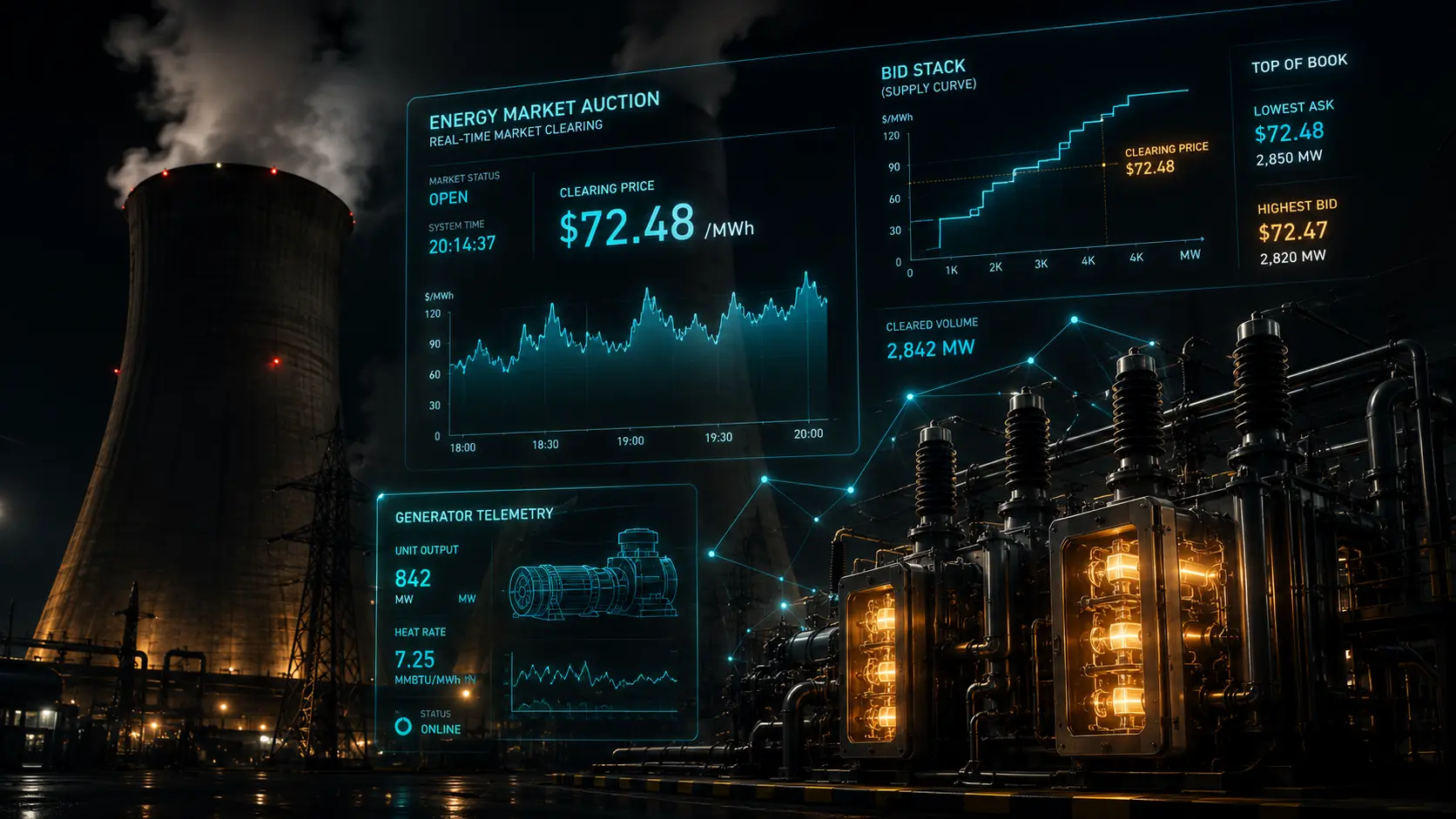
The grid operator holds a reverse auction. Power plant owners submit bids, stating the lowest price they are willing to accept to keep their plant ready for a specific future year.
4. Clearing the Market
The operator accepts the cheapest bids first, stacking them up until they reach the total required megawatt target. The price of the very last bid accepted becomes the “clearing price.” Every single power plant that successfully bid into the auction is paid that exact clearing price, guaranteeing their fixed revenues for that year.
5. Resource Accreditation (ELCC)
Not all power is created equal. A 100-megawatt natural gas plant can turn on anytime. A 100-megawatt solar farm cannot guarantee it will generate power during a 6:00 PM winter blizzard.
To solve this, markets use a mathematical formula called Effective Load Carrying Capability (ELCC). It downgrades intermittent resources. For example, a 100 MW solar farm might only be credited as providing 15 MW of true “capacity” value, severely limiting how much money it can earn in a capacity market compared to a fossil fuel plant.
Real-World Applications
Capacity markets are the invisible foundation of grid reliability across the industrialized world.
PJM Interconnection (United States): PJM operates the largest capacity market in the world, known as the Base Residual Auction. It ensures that 13 states and Washington D.C. have enough power to survive polar vortexes and extreme summer heat. When massive new data centers flooded into Northern Virginia, PJM relied heavily on its capacity market to incentivize older gas and nuclear plants to delay their retirements to handle the localized surge.
The UK Capacity Market: Faced with the rapid shutdown of domestic coal plants, the United Kingdom instituted a capacity market to guarantee winter energy security. The UK system is highly structured to prevent blackouts when offshore wind generation drops unexpectedly during dark, still winter weeks.
Demand Response Aggregation: You do not have to be a power plant to participate. Large factories and industrial facilities can bid into the capacity market by promising to turn off their machines during a grid emergency. By reducing grid demand by 50 megawatts, they provide the exact same mathematical value as a power plant generating 50 megawatts. In return, the factory is paid millions of dollars a year in capacity payments just for agreeing to power down if asked.
Economic & Strategic Impact
Capacity markets dictate the survival of global energy infrastructure.
For energy investors, capacity payments are the ultimate derisking tool. Building a new $500 million natural gas plant is incredibly risky if you only rely on fluctuating daily electricity prices. Securing a three-year capacity contract guarantees millions in fixed, predictable revenue, making it much easier to secure financing from Wall Street banks.
For consumers, capacity markets function as a hidden, mandatory insurance premium. Even if you install solar panels on your roof and use very little grid electricity, a portion of your monthly utility bill goes toward paying centralized power plants to sit on standby.
Strategically, capacity markets have become a battleground for environmental policy. Fossil fuel advocates argue that capacity markets must heavily compensate coal and gas because they are the only reliable winter backup. Climate advocates argue that capacity markets act as unfair subsidies, artificially extending the life of highly polluting power plants that would otherwise go bankrupt in a free market.
Advantages
Absolute Grid Reliability
By paying plants three years in advance, grid operators eliminate the physical risk of supply shortages, nearly guaranteeing that the lights stay on during extreme weather events.
Revenue Certainty for Investors
The missing money problem is solved. Investors can confidently build and maintain critical infrastructure because they know their fixed operational costs will be covered regardless of daily price volatility.
Incentivizes Demand Response
By allowing heavy industry to bid into the market, it financially rewards companies for upgrading their facilities to be flexible and grid-responsive, reducing overall emissions.
Limitations
Massive Consumer Costs
When supply is tight, capacity prices can spike violently. If the clearing price jumps 11x (as seen in recent PJM auctions), ratepayers absorb billions of dollars in new charges on their utility bills without receiving any extra electricity.
Over-Procurement Risk
Because grid operators are deeply risk-averse, they routinely buy more capacity than the grid actually needs. Consumers are forced to pay billions for “ghost” power plants that are almost never turned on.
The Innovation Penalty
Capacity markets inherently favor legacy thermal plants (gas, nuclear, coal) because they can guarantee 24/7 availability. This market design often struggles to fairly compensate modern, clean technologies like grid-scale battery storage.
Common Misconceptions
Misconception: Power plants only make money by selling electricity.
Reality: A significant percentage of a power plant’s total annual revenue can come from capacity payments. They are literally paid a salary to sit idle and be ready.
Misconception: Renewable energy alone is causing power bills to rise.
Reality: A major driver of rising utility bills is the soaring cost of capacity markets. Because older plants are retiring and data center demand is surging, the remaining standby plants can charge exorbitant premiums for their availability.
Misconception: Capacity markets operate in real-time.
Reality: Most capacity markets are “forward” markets. The auctions are held today to guarantee the availability of a power plant three or more years in the future, providing time to build new infrastructure if there is a shortfall.
What Most People Miss
Capacity markets are highly vulnerable to political interference.
The core logic of the missing money problem assumes that governments will not let short-term spot prices spike high enough during an emergency to keep power plants profitable. To solve this, capacity markets were created.
However, when capacity market auctions reveal that the grid is dangerously short on power, the auction prices surge to incentivize new construction. Politicians immediately panic over the resulting utility bill hikes and intervene. In 2024 and 2025, governors successfully lobbied regulators to install artificial price caps on PJM capacity auctions to protect consumers from the true cost of grid reliability.
When politicians cap the capacity price, the market cannot signal developers to build new power plants. This traps the grid in a perpetual state of fragility: regulators refuse to let energy prices spike, and they refuse to let capacity prices spike, entirely breaking the financial incentives required to maintain a modern power grid.
Comparison Table
| Feature | Energy-Only Market (e.g., ERCOT Texas) | Capacity Market (e.g., PJM) |
| Primary Compensation | Paid exclusively for MWh generated. | Paid for MW generated + MW available on standby. |
| Solving “Missing Money” | Allows real-time prices to spike massively (e.g., $5,000/MWh) during emergencies to fund plants. | Pays plants steady, massive upfront fees to prevent the need for real-time price spikes. |
| Risk of Blackouts | Higher. Relies purely on real-time market incentives; no guaranteed buffer. | Lower. Central authority mathematically guarantees a reserve margin buffer years in advance. |
| Consumer Costs | High volatility. Cheap most of the year, devastatingly expensive during crises. | Fixed, steady premiums. Everyone pays higher baseline bills for “insurance.” |
| Investment Predictability | Low. Very risky to finance a new power plant. | High. Guaranteed revenue streams for decades. |
Case Study
Situation: The PJM Interconnection manages the grid for 65 million Americans. Moving into the 2026/2027 delivery year, the region faced a severe collision of factors.
Challenge: Expanding artificial intelligence data centers in Virginia drove massive new electricity demand. Simultaneously, environmental regulations and poor economics forced the rapid retirement of regional coal plants. PJM realized its reserve margins were shrinking to their lowest levels in a decade, dropping dangerously close to the point where winter blackouts were mathematically probable.
Solution (The Auction): PJM ran its Base Residual Auction to secure standby power for 2026/2027. Because supply was incredibly tight and demand was surging, the remaining power plants commanded an massive premium.
Outcome: The auction cleared at the absolute legal maximum: $329.17 per megawatt-day. This was up 22% from the prior year and roughly 11x higher than the $28.92 rate seen just two years before. The total cost to the region surged, adding tens of thousands of dollars in new annual capacity charges for mid-sized industrial facilities.
Lessons Learned: The renewable transition is not a seamless 1-to-1 swap. When reliable thermal plants retire faster than reliable alternatives can be built, the capacity market forcefully corrects the imbalance by sending violent, record-breaking price signals to incentivize new construction and demand response participation.
Future Outlook
Next 12–24 Months
Corporate utility bills in capacity-regulated regions will see significant increases as the recent record-breaking auctions take effect. Facilities will aggressively invest in internal microgrids and battery storage. By managing their own peak load on the five hottest days of the summer, companies can artificially lower their “capacity tag,” legally avoiding the soaring capacity market surcharges.
Next 3–5 Years
Regulators will aggressively alter ELCC (Effective Load Carrying Capability) calculations. As more solar is added to the grid, its capacity value drops toward zero because the grid’s most dangerous moments will shift entirely to the hours after sunset. Standby natural gas plants and massive long-duration battery farms will capture almost all the capacity market revenue.
Next 10 Years
The concept of the centralized capacity market will face existential strain. As Virtual Power Plants (VPPs)—millions of decentralized home batteries and electric vehicles—become standard, the grid will rely less on paying massive fossil-fuel plants to sit idle. VPPs will bid into capacity markets, dynamically shifting neighborhood-level demand to provide the required safety buffer.
Most Likely Scenario
Capacity markets will survive, but they will become highly contested political battlegrounds. As the cost to keep legacy gas and nuclear plants on standby rises, consumers will rebel against the “insurance premiums” on their bills. Grid operators will be forced to redesign auctions to specifically reward fast-ramping, clean technologies over continuous, heavy-emitting thermal generation.
Key Takeaways
- Capacity markets pay power plants to exist on standby, acting as an insurance policy against grid blackouts.
- The market solves the “missing money” problem by covering the fixed costs of plants that only run during rare emergencies.
- Forward auctions secure this power up to three years in advance by determining a region-wide clearing price.
- Prices are skyrocketing globally as power demand from AI data centers collides with the rapid retirement of coal and nuclear plants.
- Intermittent resources like wind and solar are subjected to ELCC calculations, heavily discounting their payout because they cannot guarantee power during bad weather.
- Demand Response allows massive factories to earn capacity payments by simply promising to turn off their machines during a grid crisis.
- The system is deeply flawed by political interference, where regulators cap capacity prices to protect consumers, inadvertently discouraging the construction of new power plants.
Glossary
Base Residual Auction (BRA): The primary forward capacity auction run by the PJM Interconnection to secure energy resources three years in advance.
Capacity Tag: A calculation based on a customer’s electricity usage during the grid’s peak hours; dictates exactly how much of the region’s total capacity cost that specific customer must pay.
Clearing Price: The final, accepted price in a capacity auction that balances supply and demand; every successful bidder is paid this uniform price.
Demand Response: A grid management technique where consumers are paid to reduce their electricity usage during peak stress periods, acting as a virtual power plant.
Effective Load Carrying Capability (ELCC): A mathematical metric used to determine exactly how much reliable capacity an intermittent resource (like a solar farm) actually provides during a grid emergency.
Missing Money Problem: The economic theory that standard electricity markets do not allow power plants to earn enough revenue to cover their fixed maintenance costs, leading to early retirements.
Reserve Margin: The extra amount of standby power capacity a grid operator procures above the forecasted peak demand to act as an emergency buffer.
Frequently Asked Questions
Why don’t we just rely on the standard energy market?
Some regions, like Texas (ERCOT), do. They rely on real-time prices spiking to thousands of dollars per megawatt-hour to incentivize power plants. However, if the price signal fails or extreme weather hits unexpectedly, the grid collapses. Capacity markets buy a guaranteed safety buffer in advance.
Who actually pays for the capacity market?
The consumer. Utility companies buy capacity on behalf of their users, and the cost is passed down as a specific line item or built into the base rate of your monthly electricity bill.
If a power plant is paid for capacity, does it get paid again to generate electricity?
Yes. The capacity payment is simply a retainer fee for being available. If the grid actually calls the plant to turn on and produce electricity, the plant also gets paid the real-time energy market rate for the megawatts it produces.
Can a solar farm participate in a capacity market?
Yes, but heavily discounted. Because a grid operator cannot guarantee the sun will be shining during a winter storm, a 100 MW solar farm might only be credited and paid for 10 MW of true “capacity.”
What happens if a power plant takes the capacity payment but fails to turn on during an emergency?
They face catastrophic financial penalties. Grid operators strictly enforce “pay-for-performance” rules. If a plant claims to be ready but breaks down during a winter freeze, they are heavily fined, often wiping out their entire annual capacity revenue.
Why did capacity prices spike so high recently?
It is a severe supply and demand crunch. Rapidly expanding AI data centers are pulling massive amounts of new power, while older coal and gas plants are retiring due to environmental regulations. The grid has less supply to meet much higher demand, driving standby prices to the legal maximum.
How does demand response lower my utility bill?
If a factory promises to cut its power usage during the five hottest days of the year, it lowers its “capacity tag.” Because capacity charges are based on how much power you use during those specific peak hours, cutting usage during those exact moments saves tens of thousands of dollars annually.
Sources
- Enel North America: PJM 2026/2027 Capacity Auction Results
- Pilot Energy: Another Spike in PJM Capacity Prices: What It Means for Your 2026 Energy Costs
- PJM Interconnection: PJM Auction Procures 134,311 MW of Generation Resources
- Energy Institute at Haas: Remember When Capacity Markets Were the Solution to Missing Money?