Advertisement
)

For decades, global trade relied on a fragile geographical assumption: that the Suez Canal and the Red Sea would remain safe, predictable, and open. The geopolitical chaos of the mid-2020s has permanently shattered that assumption. As asymmetric warfare and missile threats force the world’s largest shipping conglomerates to reroute thousands of miles around the Horn of Africa, the global supply chain is desperately hunting for an alternative pathway to connect the factories of Asia to the consumer markets of Europe.
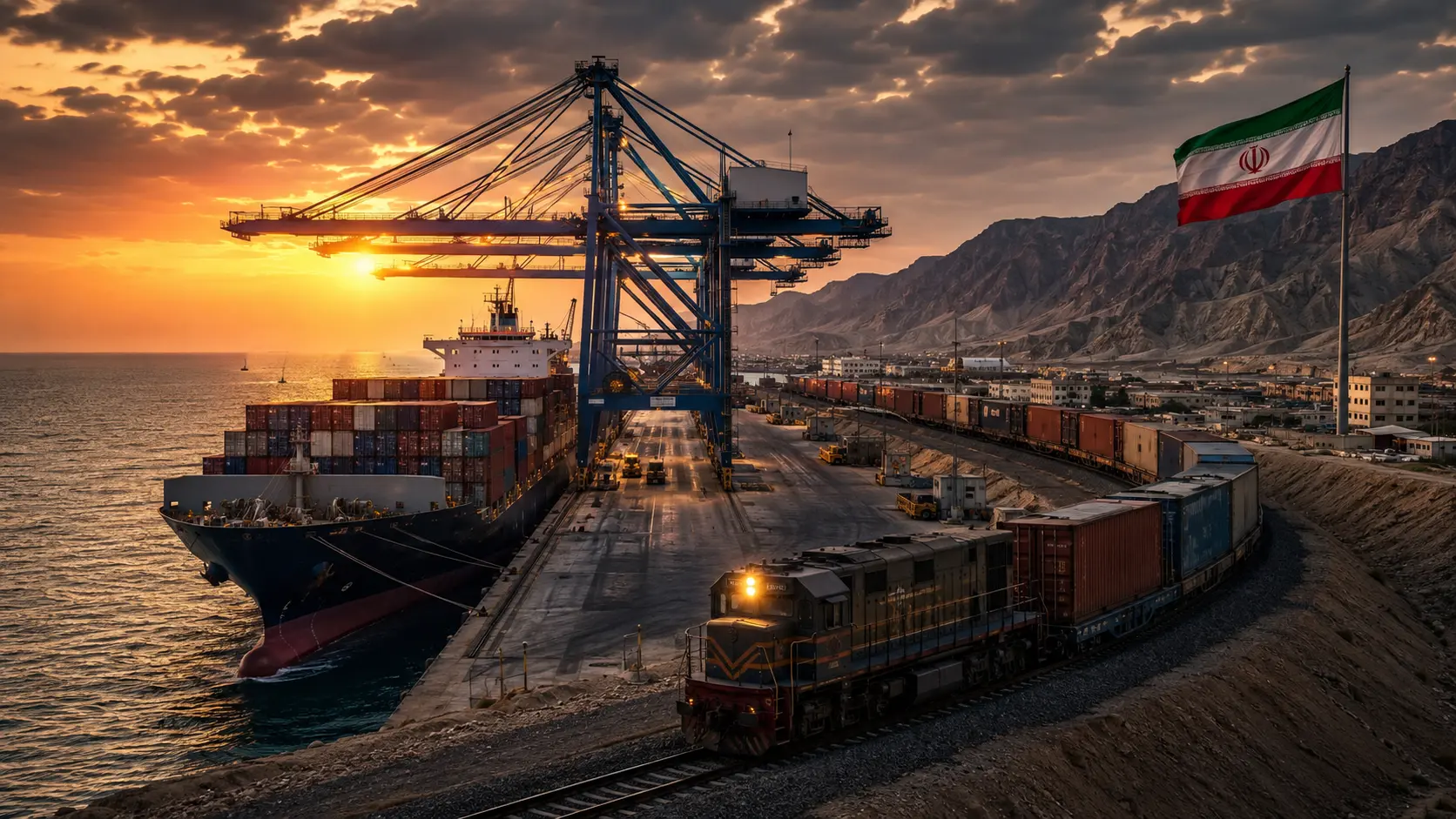
The answer lies in the sun-baked deserts of southeastern Iran. The Chabahar Port is no longer just a regional maritime facility; it is the linchpin of a massive multimodal logistics network. By linking the Indian Ocean directly to the Caspian Sea and Russia via rail, this strategic port allows massive cargo shipments to completely bypass the dangerous Red Sea choke points. Why should you care right now? Because India just signed a historic 10-year contract to take operational control of Chabahar. This unprecedented move positions India to outflank China’s Belt and Road Initiative, sidestep Pakistan entirely, and rewrite the map of Eurasian trade—provided they can navigate the tightening vice of United States sanctions that expired in early 2026.
What is the Chabahar Port Corridor?
The Chabahar Port Corridor is a strategic multimodal transit route anchored in southeastern Iran that connects the Indian Ocean to Central Asia and Eurasia. It serves as the primary maritime gateway for the International North-South Transport Corridor (INSTC), allowing global shipping to bypass Pakistan and the disrupted Red Sea routes.
At a Glance
- Concept: A deep-water seaport integrated with a cross-continental railway network, moving freight from ships directly onto trains heading north to Europe and Central Asia.
- Why it matters: It drastically reduces freight transit times between India and Europe compared to traditional ocean routes, acting as an essential hedge against Red Sea closures and Suez Canal bottlenecks.
- Who uses it: Indian exporters, the Iranian government, landlocked Central Asian republics (like Afghanistan and Uzbekistan), and Russian logistics conglomerates.
- Biggest takeaway: In May 2024, India secured a 10-year lease to operate the Shahid Beheshti terminal at Chabahar. However, the U.S. sanctions waiver protecting this project expired on April 26, 2026, injecting severe legal compliance risks into the corridor’s future.
In Simple Words
Imagine you are a delivery driver trying to deliver a package from your warehouse (India) to a customer on the other side of town (Europe/Central Asia).
Normally, you would drive straight up the main highway. But your immediate neighbor (Pakistan) refuses to let you drive through their property. So, you decide to take a massive detour by boat through the Red Sea and the Suez Canal. Suddenly, the Red Sea becomes too dangerous to navigate due to armed conflicts.
You need a new backdoor. Chabahar Port is that backdoor.
Instead of driving through Pakistan or sailing through the Red Sea, you sail your cargo just a short distance across the Arabian Sea to a friendly port in Iran (Chabahar). From there, you unload your cargo onto a train that goes straight north through Iran, into Russia, and directly into Europe. It is faster, it avoids your hostile neighbor, and it completely sidesteps the global shipping crisis happening in the Middle East.
Why This Matters
For Supply Chain Directors and Macro Economists, the Chabahar Port Corridor represents the ultimate supply chain diversification strategy. The over-reliance on single maritime choke points is a proven vulnerability. By utilizing the International North-South Transport Corridor (INSTC)—of which Chabahar is the southern anchor—companies can cut the transit time between Mumbai and Moscow by up to 40% compared to the traditional Suez Canal route.
Furthermore, Chabahar is a geopolitical counterweight. It is located near the China-controlled Gwadar Port in Pakistan. By establishing a permanent foothold in Chabahar, India asserts its status as a premier logistical power capable of projecting commercial influence deep into Eurasia, challenging China’s monopoly over trans-Asian infrastructure projects.
The 10-Year India-Iran Chabahar Port Agreement
The evolution of the Chabahar Port is an exercise in immense strategic patience. India, Iran, and Russia initially envisioned the INSTC in 2000. The specific agreement for India to develop Chabahar’s Shahid Beheshti terminal was formalized in 2016.
However, the project was plagued by delays, short-term annual contract renewals, and the looming shadow of U.S. sanctions against Iran. The paradigm shifted on May 13, 2024, when India Ports Global Limited (IPGL) signed a long-term, 10-year agreement with Iran’s Port and Maritime Organisation (PMO). This agreement ended the era of short-term uncertainty, legally cementing India’s administrative control over the terminal.
But this commercial victory collided with shifting U.S. foreign policy. In early 2026, the U.S. Treasury initiated ‘Operation Economic Fury’ targeting Iran, leading to the expiration of India’s sanctions waiver for the port on April 26, 2026. The corridor is now the epicenter of a diplomatic clash between India’s sovereign economic interests and Washington’s maximum pressure campaign.
How the Chabahar Port Corridor Operates
Transitioning from a regional port to a transcontinental trade artery requires complex logistical and financial engineering. Here is the first-principles breakdown of the corridor.

1. The Fundamental Problem: Geographical Isolation
India is physically isolated from overland trade with Central Asia and Europe because its western border with Pakistan is effectively closed to Indian transit trade. Without overland access, India historically relied entirely on slow, vulnerable maritime routes through the Suez Canal.
2. The Insufficiency of Existing Ports
Iran’s primary seaport, Bandar Abbas, is located inside the congested Persian Gulf, requiring ships to pass through the heavily monitored and constrained Strait of Hormuz. It is highly vulnerable to regional blockades.
3. The Core Mechanism: The Shahid Beheshti Terminal
Chabahar sits in the Sistan-Balochistan province directly on the Gulf of Oman, granting it immediate deep-water access to the Indian Ocean without entering the Strait of Hormuz. India took operational control of the Shahid Beheshti terminal within Chabahar, transforming it into a high-capacity maritime anchor.
4. Technical Depth: Intermodal Railway Integration
A port is only as useful as its hinterland connections. Cargo arriving at Chabahar must be unloaded and transferred to the Chabahar-Zahedan railway. This rail line moves goods north to the Iranian city of Zahedan, connecting to the broader INSTC network that runs to the Caspian Sea port of Bandar-e-Anzali. From there, goods cross the Caspian by ship to Astrakhan, Russia, and travel by rail into northern Europe.
5. Real-World Consequences: The Capital Stack
To guarantee operations, India committed roughly $120 million to equip the terminal with modern cranes and logistics technology. To solve the infrastructure deficit connecting the port to the railway, India provided a $250 million credit line dedicated exclusively to modernizing the surrounding transit infrastructure.
Strategic Impact: Bypassing the Red Sea Crisis
The Chabahar corridor is actively deployed across multiple geostrategic domains.
Bypassing the Red Sea Crisis: As Houthi militant attacks functionally closed the Bab-el-Mandeb strait to major Western shipping lines in the mid-2020s, Indian and Russian exporters redirected high-value, time-sensitive freight to the INSTC via Chabahar. This multimodal route circumvents the entire Arabian Peninsula, ensuring that critical commodities are not subjected to massive insurance premiums or 14-day rerouting delays around Africa.
Humanitarian and Trade Access to Afghanistan: Because Pakistan blocks Indian overland shipments to Afghanistan, Chabahar is the designated humanitarian gateway. India has utilized the port to ship hundreds of thousands of tons of wheat and essential medical supplies to Kabul. Beyond aid, it provides landlocked Afghan businesses a direct pathway to global ocean markets without relying on Pakistani ports in Karachi.
Eurasian Energy Security: The corridor facilitates India’s access to energy-rich Central Asian republics (like Kazakhstan and Turkmenistan). By establishing hard rail-and-port infrastructure, India secures a physical supply chain for uranium, oil, and natural gas imports that operates entirely outside the jurisdiction of NATO blockades or Chinese maritime choke points.
Economic & Strategic Impact
The core vulnerability of the Chabahar Corridor is the Secondary Sanctions Threat.
For years, the U.S. granted India a specialized sanctions waiver under the Iran Freedom and Counter-Proliferation Act (IFCA), explicitly allowing the development of Chabahar to support Afghan economic stability. However, citing escalating U.S.-Iran hostilities, Washington allowed this critical waiver to formally expire on April 26, 2026.
The expiration introduces severe compliance risks. If an Indian logistics firm or international bank finances operations through Chabahar, they risk being cut off from the U.S. dollar and the global SWIFT financial system. While the Indian government has the sovereign power to ignore U.S. pressure, the private sector—shipping lines, marine insurers, and crane manufacturers—cannot afford to violate U.S. Treasury rules. Managing this legal fallout is currently the defining obstacle to scaling the corridor’s cargo volume.
Advantages
- Geographic Bypass: Provides direct, unimpeded access to Central Asia and Russia without crossing hostile Pakistani territory or navigating the volatile Red Sea.
- Deep-Water Capacity: Situated outside the Strait of Hormuz, allowing massive cargo vessels to dock safely without entering the congested Persian Gulf.
- Time and Cost Efficiency: The INSTC integration drastically cuts the freight transit time to Northern Europe, offering a highly competitive alternative to standard ocean freight.
Limitations
- Sanctions Compliance: The expiration of the U.S. sanctions waiver in April 2026 threatens to deter private corporations and global shipping conglomerates from utilizing the port.
- Infrastructure Delays: The physical construction of the Chabahar-Zahedan railway line connecting the port to the broader Iranian rail network has suffered severe delays, slowing the seamless transfer of intermodal cargo.
- Regional Competition: Iran recently signed a 25-year strategic partnership agreement with China. This raises fears that Beijing could leverage its massive economic influence over Tehran to slow down Indian connectivity projects in favor of its own Belt and Road Initiative.
Common Misconceptions
Misconception: Chabahar and Gwadar are purely commercial competitors.
Reality: While they are rival commercial ports located geographically close to each other, they represent a deeper strategic proxy war. Gwadar is the crown jewel of the China-Pakistan Economic Corridor (CPEC), while Chabahar is India’s sovereign counterweight to prevent a Chinese logistical monopoly in the Arabian Sea.
Misconception: India owns the Chabahar Port.
Reality: India does not own the sovereign territory. India Ports Global Limited (IPGL) signed a 10-year lease to operate and equip specific terminals (Shahid Beheshti), providing administrative control and revenue sharing, but the port ultimately remains under the jurisdiction of the Iranian government.
Misconception: The port’s success relies entirely on Iran’s economy.
Reality: Chabahar is a transit hub, not an end destination. Its financial viability is based almost entirely on collecting toll and transit fees from cargo moving through Iran toward Russia, Europe, and Central Asia, effectively isolating its utility from domestic Iranian economic downturns.
What Most People Miss
The strategic significance of the India-Middle East-Europe Economic Corridor (IMEC) Hedge.
During the 2023 G20 summit, a massive alternative corridor known as IMEC was announced to connect India to Europe via the UAE, Saudi Arabia, and Israel. Many analysts assumed IMEC would render the Iran-based Chabahar route obsolete.
What most people miss is that the devastating war in Gaza and regional instability effectively paralyzed the IMEC project. With the Saudi-Israel rail link stalled indefinitely, the Indian government rapidly accelerated the 10-year Chabahar agreement in May 2024. Chabahar serves as India’s ultimate strategic hedge: if the Middle Eastern route (IMEC) fails, India retains a fully operational, sovereign-controlled Northern route through Iran and Russia.
Comparison Table
| Feature | Chabahar Port (Iran) | Gwadar Port (Pakistan) | Bandar Abbas (Iran) |
| Primary Operator / Backer | India (IPGL) | China (Overseas Port Holding) | Iran (Domestic operators) |
| Strategic Corridor | INSTC (North-South) | CPEC / BRI (East-West) | Domestic Iranian Trade |
| Location Factor | Outside Strait of Hormuz | Outside Strait of Hormuz | Inside Strait of Hormuz |
| Target Hinterland | Afghanistan, Central Asia, Russia | Pakistan, Western China | Middle East, UAE |
| Sanctions Risk | Extreme (Waiver Expired 2026) | Low to Moderate | High (Heavily Sanctioned) |
Case Study
Situation: For years, India’s involvement in Chabahar operated under temporary, one-year contracts. This short-term horizon terrified private Indian logistics companies; they refused to invest heavy capital in cranes or rail cars if their access to the port could be revoked the following year.
Challenge: India needed to lock in permanent administrative control to justify massive infrastructure investments and effectively counter China’s entrenched 40-year lease on the nearby Gwadar Port in Pakistan.
Solution (The 10-Year Agreement): In May 2024, defying looming geopolitical threats and Western pressure, the Indian Minister of Ports shipped to Tehran. India signed a landmark 10-year contract with automatic renewal provisions, committing $120 million in direct equipment and a $250 million credit window for local infrastructure.
Outcome: The agreement officially shifted Chabahar from a temporary diplomatic project to a permanent pillar of Indian trade infrastructure. It provided certainty to Indian traders and explicitly demonstrated India’s willingness to pursue independent, multi-aligned foreign policy even when it contradicted the sanctions architecture of the United States.
Lessons Learned: The case study proved that in the modern era of fragmented global trade, securing sovereign control over logistical chokepoints supersedes diplomatic compliance. By guaranteeing its own supply chain to Eurasia, India prioritized hard physical infrastructure over soft geopolitical alliances.
Future Outlook
Next 12–24 Months
The era of Sanctions Workarounds and Rupee-Rial Trade. With the U.S. waiver expired as of April 2026, India and Iran will rapidly establish “sanctions-proof” financial architectures to keep the port operational. Over the next two years, expect to see the complete exclusion of the U.S. dollar in Chabahar transactions. Trade will be settled using local currency swap mechanisms (Rupee-Rial) and alternative payment messaging systems to shield Indian operators from U.S. Treasury enforcement actions.
Next 3–5 Years
The completion of the Zahedan Rail Link. The ultimate bottleneck of the corridor is the missing rail links. By the late 2020s, the $250 million credit line provided by India will culminate in the completion of the heavy-haul railway connecting Chabahar directly to Zahedan. This will enable high-speed, seamless intermodal transfers where shipping containers are lifted off Indian vessels and placed directly onto railcars bound for Moscow, finally operationalizing the INSTC at its maximum theoretical throughput.
Next 10 Years
The Multipolar Eurasian Hub. By the 2030s, the Chabahar Port will serve as the premier logistical gateway for a multipolar Eurasia. As Europe shifts away from Russian energy, Russia will entirely re-orient its supply chains southward toward India. Chabahar will facilitate a massive, bidirectional flow of discounted Russian commodities heading south to the Indian Ocean, and Indian manufactured goods heading north, establishing an economic bloc largely immune to Western maritime blockades.
Most Likely Scenario
Despite intense pressure from Washington and competition from Beijing, the Chabahar Port Corridor will succeed because its geographical logic is flawless. In an era where global shipping is increasingly weaponized, a direct, high-capacity, non-Western multimodal corridor connecting the fastest-growing economy in the world (India) to the resources of Eurasia is a geopolitical inevitability.
Key Takeaways
- The Chabahar Port Corridor is an Iranian deep-water port operated by India, providing a direct route to Central Asia and Europe while entirely bypassing Pakistan.
- On May 13, 2024, India and Iran signed a historic 10-year agreement granting India long-term operational control over the Shahid Beheshti terminal, backed by $370 million in total commitments.
- The port is the maritime anchor of the International North-South Transport Corridor (INSTC), drastically cutting transit times for freight moving between India, Russia, and Europe.
- It serves as a strategic counterweight to China’s multi-billion-dollar investment in the nearby Gwadar Port under the China-Pakistan Economic Corridor (CPEC).
- The primary threat to the corridor is U.S. sanctions. The specific sanctions waiver granted to India expired on April 26, 2026, creating severe legal and compliance risks for private shippers.
- Chabahar acts as India’s vital strategic hedge against disruptions in the Red Sea and the stalled India-Middle East-Europe Economic Corridor (IMEC).
Glossary
China-Pakistan Economic Corridor (CPEC): A massive bilateral infrastructure project under China’s Belt and Road Initiative, featuring the Gwadar Port, which directly rivals Indian influence in the region.
India Ports Global Limited (IPGL): The Indian state-owned entity tasked with equipping and operating the Shahid Beheshti terminal at Chabahar Port.
International North-South Transport Corridor (INSTC): A 7,200-kilometer multi-modal network of ship, rail, and road routes moving freight between India, Iran, Azerbaijan, Russia, and Europe.
Operation Economic Fury: The overarching policy framework implemented by the U.S. Treasury in the mid-2020s, resulting in the aggressive enforcement of sanctions against Iranian economic assets.
Shahid Beheshti Terminal: One of the two main terminals at the Chabahar Port, and the specific facility that India signed a 10-year contract to operate and develop.
Strait of Hormuz: The highly congested and politically volatile chokepoint at the mouth of the Persian Gulf. Chabahar is uniquely valuable because it lies outside this strait on the Gulf of Oman.
Frequently Asked Questions
Does the U.S. support India’s involvement in Chabahar?
Historically, yes, but only as a carve-out for Afghan humanitarian aid. The U.S. provided a sanctions waiver for years. However, as relations deteriorated, the U.S. allowed the waiver to expire in April 2026, putting Indian operations under intense sanctions scrutiny.
Why doesn’t India just ship goods through Pakistan?
Due to decades of military and political hostility, Pakistan denies India overland transit rights for commercial trade moving toward Afghanistan and Central Asia. India physically must use the ocean to bypass Pakistani territory.
Is China trying to take over Chabahar?
China signed a 25-year strategic partnership with Iran, which includes infrastructure investments. While China officially operates the rival Gwadar port, their deepening economic ties with Tehran constantly pressure India to maintain its foothold in Chabahar to avoid being encircled.
How does cargo get from the port to Russia?
Once ships are unloaded at Chabahar, the cargo is transferred to the Iranian rail network. It travels north through Iran to ports on the Caspian Sea, crosses the sea by ship to Astrakhan, Russia, and then continues by Russian rail networks into Europe.
Why is Chabahar better than Bandar Abbas?
Bandar Abbas is Iran’s busiest port, but it is located inside the Persian Gulf. Ships must pass through the narrow Strait of Hormuz to reach it. Chabahar is a deep-water port directly on the Indian Ocean, making it faster, safer, and completely immune to blockades inside the Gulf.