Advertisement
)
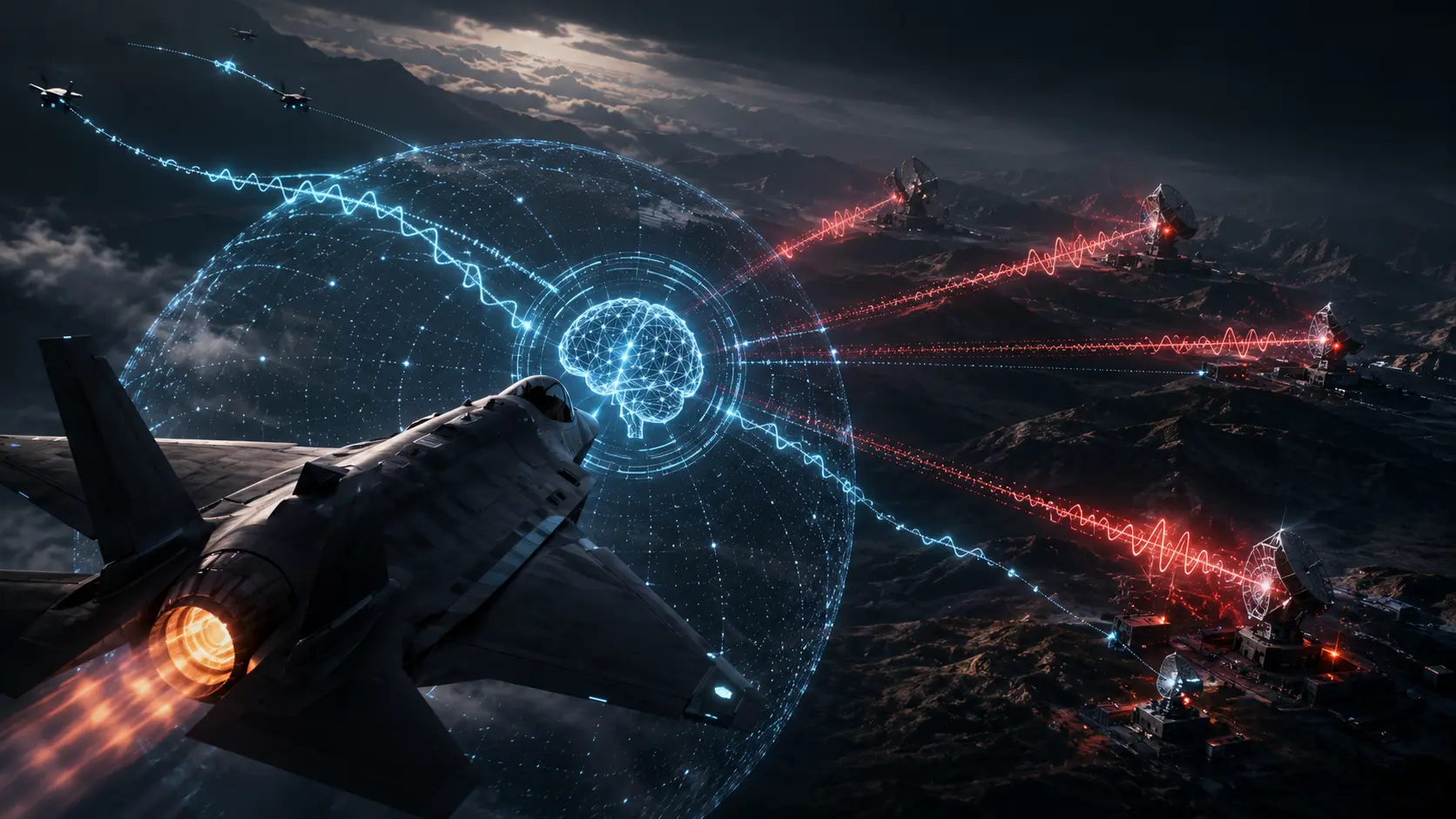

A modern fighter pilot flying into hostile airspace relies on an invisible shield to survive: Electronic Warfare (EW). For decades, this shield operated like a massive digital dictionary. When an enemy surface-to-air missile (SAM) locked onto the jet, the jet’s computer listened to the radar signal, flipped through its pre-programmed “dictionary” of known threats, found the matching signal, and played back the exact radio noise needed to jam it. But what happens if the enemy missile uses a radar signal that isn’t in the dictionary? The pilot dies.
Why should you care right now? Because modern adversaries no longer use static, predictable radars. They use software-defined systems that invent completely new, randomized radar signals on the fly. To survive this, the defense industry has fundamentally rewritten how the military fights in the electromagnetic spectrum. By integrating artificial intelligence directly into the radio antennas of fighter jets and drones, a new capability known as Cognitive Electronic Warfare (CEW) has emerged. Instead of looking up a pre-written answer, CEW uses machine learning to instantly analyze a never-before-seen radar beam, deduce how it works, and autonomously invent a custom jamming frequency to blind it in milliseconds. This is the dawn of algorithmic dogfighting.
What is Cognitive Electronic Warfare (CEW)?
Cognitive Electronic Warfare (CEW) is the application of artificial intelligence and machine learning to the electromagnetic spectrum. It utilizes software-defined radios to autonomously detect, characterize, and jam unknown or adaptive enemy radar and communication signals in real-time, completely bypassing the need for pre-programmed threat libraries.
At a Glance
- Concept: Teaching a computer chip to listen to a totally alien, hostile radio signal, figure out its pattern, and shout back the exact mathematical noise needed to cancel it out.
- Why it matters: Modern missiles change their radar frequencies constantly. If an EW system cannot adapt faster than the missile changes frequencies, the aircraft will be shot down.
- Who uses it: 6th-Generation fighter programs (NGAD), advanced F-35 upgrade blocks (AN/ASQ-239), and specialized electronic attack drones.
- Biggest takeaway: CEW shifts electronic warfare from a hardware problem to a software problem. Instead of taking months to update a jet’s threat database on the ground, the AI updates its own tactics in the middle of a dogfight.
In Simple Words
Imagine you are trying to have a secret conversation in a crowded room, but someone keeps loudly playing a specific song on a stereo to drown out your voice.
In Traditional Electronic Warfare, you have a notebook. You look up the song in your notebook, find the exact noise-canceling frequency for that specific track, and play it back to silence the stereo. This works perfectly—until your adversary suddenly plays a brand-new song that isn’t in your notebook. You don’t know what noise to make, and your secret conversation is ruined.
In Cognitive Electronic Warfare, you throw away the notebook and hire a musical genius. When the adversary plays a brand-new, never-before-heard song, the genius listens to it for half a second, instantly calculates the tempo and the notes, and immediately sings the exact inverse of the melody. The stereo is silenced instantly. In modern aerial combat, the “musical genius” is an AI algorithm, and the “song” is a deadly radar lock from a surface-to-air missile.
Why This Matters
For Defense Strategists, RF Engineers, and Cyber Warfare Analysts, control of the Electromagnetic Spectrum (EMS) is the prerequisite for all modern combat.
If a military loses the EMS, it loses GPS, communications, drone feeds, and radar. In peer-to-peer conflicts, adversaries use Agile AESA (Active Electronically Scanned Array) radars that employ “LPI/LPD” (Low Probability of Intercept/Low Probability of Detection) techniques. These radars are practically invisible to legacy sensors. CEW is the mandatory countermeasure. Without the ability to algorithmically detect and neutralize these adaptive signals in real-time, multi-billion-dollar stealth fighters become little more than expensive, flying targets.
The Evolution of Cognitive Electronic Warfare (CEW)
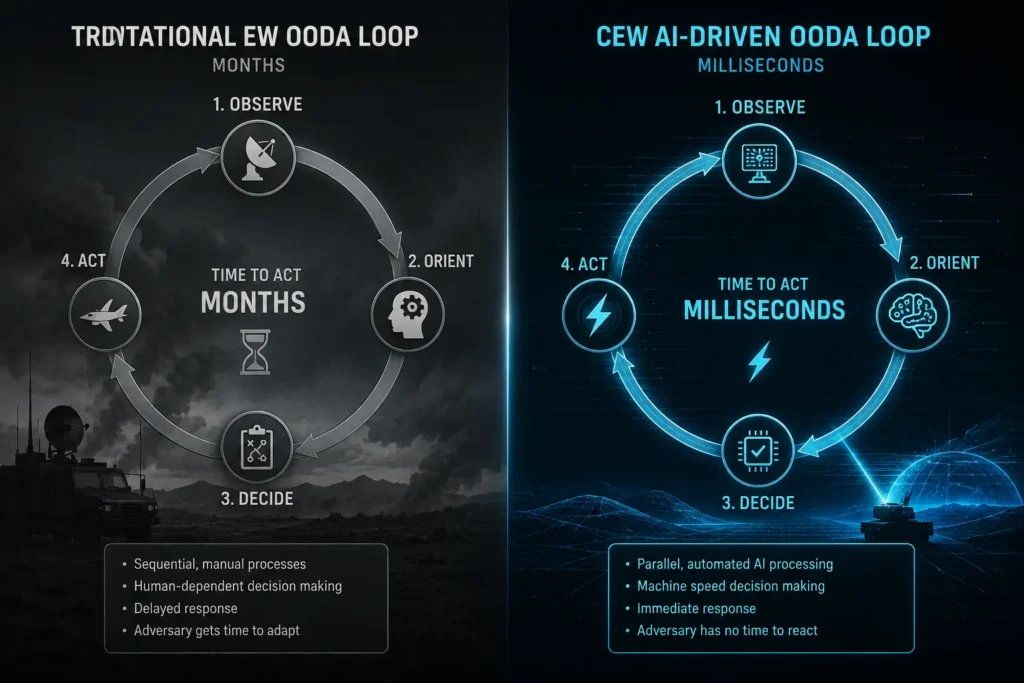
The integration of AI into electronic warfare represents the compression of the OODA Loop (Observe, Orient, Decide, Act).
Historically, the EW OODA loop took months. A spy plane would record a new Russian or Chinese radar signal. The recording was flown back to a laboratory, analyzed by human engineers over weeks, and a countermeasure was written and pushed back to the fleet via a USB drive.
Cognitive EW compresses this months-long logistical supply chain into milliseconds. The AI observes the new signal, orients its parameters, decides on a jamming technique, and acts—all while the pilot is actively flying the aircraft. The laboratory has been miniaturized and embedded directly into the wingtip of the jet.
How AI-Driven Spectrum Jamming Works
Defeating an agile radar system requires an orchestration of deep learning and extreme-speed signal processing. Here is the first-principles breakdown of the architecture.
1. The Fundamental Problem: The Threat Library
Traditional EW systems rely on Mission Data Files (MDFs), which are essentially massive lookup tables. If an incoming pulse matches a known frequency, Pulse Repetition Interval (PRI), and Pulse Width (PW) in the database, the system executes a pre-planned jam. If the radar simply randomizes its PRI by a few microseconds, it falls outside the lookup table, and the traditional EW system registers it as harmless background noise.
2. The Core Mechanism: Unsupervised Learning
CEW bypasses the database using unsupervised machine learning algorithms (like clustering and deep reinforcement learning). When a CEW system detects RF energy, the algorithm analyzes the raw physical characteristics of the wave. Even if the enemy radar is randomizing its signals, the AI can cluster the incoming pulses to identify that they are originating from the same hostile emitter, effectively “fingerprinting” the radar in real-time.
3. Technical Depth: Dynamic Waveform Synthesis
Once the threat is characterized, the CEW system must defeat it. It uses an AI technique called Reinforcement Learning. The AI hypothesizes a jamming technique and monitors the enemy radar’s response.
Using a Software-Defined Radio (SDR) and a Digital Radio Frequency Memory (DRFM) system, the CEW instantly generates a custom waveform. If the enemy radar switches frequencies to escape the jam, the AI recognizes the shift, learns from it, and instantly synthesizes a new waveform to follow the radar to the new frequency, effectively chasing it across the spectrum.
4. Technical Depth: Cognitive Radar Integration
CEW is not just defensive; it is offensive. A jet’s own radar can use CEW to avoid being jammed. The AI constantly monitors the background noise of the battlefield. It continuously shifts its own radar emissions into the quietest, least-jammed slivers of the electromagnetic spectrum, hopping frequencies autonomously to ensure its own signals punch through the enemy’s interference.
5. Real-World Consequences: The Speed of Silicon
This entire process—detection, characterization, synthesis, and transmission—must occur within the space of a few microseconds. The raw computational power required is staggering. Because standard CPUs are too slow, CEW systems are hardcoded into Field Programmable Gate Arrays (FPGAs) or Application-Specific Integrated Circuits (ASICs), ensuring the algorithmic math executes at the absolute speed of the hardware itself.
Military Deployments of Cognitive EW
The transition to algorithmic spectrum dominance is rapidly rolling out across global superpower arsenals.
F-35 Lightning II (Block 4 Upgrades): The F-35 is heavily reliant on its AN/ASQ-239 electronic warfare suite. As the aircraft undergoes its massive Block 4 modernization, the integration of cognitive processing capabilities is a primary objective. By allowing the jet’s massive sensor fusion engine to use machine learning to adapt to novel, uncatalogued threats in the South China Sea or Eastern Europe, the F-35 maintains its stealth profile not just physically, but electromagnetically.
DARPA ARC & BLADE Programs: The U.S. Defense Advanced Research Projects Agency initiated the Adaptive Radar Countermeasures (ARC) program to explicitly solve the problem of hostile, adaptive radars. ARC developed the core algorithms that allow an airborne EW system to automatically generate countermeasures against new, unknown, or ambiguous radar signals in real-time. This foundational software is currently bridging the “valley of death” into active acquisition programs for the U.S. Air Force and Navy.
Expendable Swarm Jamming (Stand-In EW): Fighter jets are expensive. To project jamming power deep into enemy territory, militaries are deploying swarms of cheap, expendable drones (like the Miniature Air-Launched Decoy – MALD). These drones carry networked CEW payloads. The swarm communicates via AI, autonomously analyzing the enemy’s air defense grid and collaboratively assigning different drones to jam different radars from multiple physical angles, overwhelming the enemy’s processing capabilities.
Economic & Strategic Impact
The core strategic shift of CEW is the transition from Hardware Superiority to Software Superiority.
Historically, upgrading a jet’s jamming capability meant physically ripping out heavy, analog radar warning receivers and installing new ones—a process requiring billions of dollars and years of depot-level maintenance.
Cognitive EW runs on Software-Defined Radios (SDR). The physical antenna is highly versatile, meaning the “weapon” is simply the algorithm. A defense contractor can develop a new machine-learning jamming technique on a Monday and push it out to the entire fighter fleet globally on a Tuesday via an encrypted over-the-air software update. This permanently shifts defense economics, directing multi-billion-dollar military budgets away from heavy aerospace manufacturing and directly toward software engineering, AI data lakes, and elite coding talent.
Advantages
- Zero-Day Threat Neutralization: Can instantly defeat “zero-day” radar emissions (signals that have never been recorded or seen by allied intelligence before) without waiting for a manual database update.
- Reduced Pilot Workload: In a dogfight, human pilots cannot manually tune radios to chase a hopping frequency. The AI handles the entire electromagnetic spectrum autonomously, allowing the pilot to focus on flying and kinetic targeting.
- Force Multiplication: A single CEW-equipped aircraft or drone can dynamically analyze and jam multiple different, uncoordinated threats simultaneously, adapting its strategy faster than the enemy operators can react.
Limitations
- Electromagnetic Fratricide: If the AI is allowed to autonomously invent and blast new, hyper-powerful jamming frequencies across the spectrum, there is a severe risk that it will accidentally jam the communications, GPS, or datalinks of friendly forces operating in the same airspace.
- Massive Compute Constraints: Running complex neural networks and reinforcement learning models requires substantial computational power. Packing server-grade AI chips into a tight, incredibly hot fighter jet wingtip without melting the hardware is an extreme thermal engineering bottleneck.
- Adversarial AI Countermeasures: If an allied jet uses AI to jam, the adversary will use AI to counter-jam. This leads to an algorithmic feedback loop where two neural networks are fighting each other at the speed of light, potentially resulting in unpredictable, chaotic spectrum behavior that neither human operator can understand.
Common Misconceptions
Misconception: Cognitive EW means hacking into the enemy’s computer network.
Reality: CEW is not cyber warfare. It does not involve stealing passwords or injecting viruses into a network. It is purely an attack on the physics of radio waves. It uses AI to mathematically manipulate the physical electromagnetic energy hitting the enemy’s radar dish to blind or confuse it.
Misconception: It requires sending data back to a supercomputer on the ground.
Reality: The entire system operates completely offline at the “Edge.” The latency of sending a radar signal to a cloud server and waiting for a response would get the pilot killed. The machine learning model is fully embedded on microchips physically located inside the jet.
Misconception: Threat libraries (Mission Data Files) will be completely deleted.
Reality: CEW does not replace the dictionary; it supplements it. If an enemy fires a known, standard missile, the jet will still use the highly efficient, pre-programmed lookup table. The AI only engages when the lookup table fails to find a match.
What Most People Miss
The disruptive intelligence value of Algorithmic Exfiltration.
Most people assume the sole purpose of an EW system is to jam the enemy. What they miss is the intelligence-gathering goldmine of a cognitive system.
When a CEW system analyzes an unknown enemy radar, it doesn’t just jam it; it records the physical properties of the new signal, records the jamming waveform it invented to defeat it, and logs how the enemy reacted. When the jet returns to base, it downloads this entirely new, AI-generated tactical playbook into the military’s central intelligence network. The AI essentially acts as an automated, flying spy, instantly reverse-engineering adversary technology and sharing the solution with the entire allied fleet.
Comparison Table
| Feature | Traditional Electronic Warfare (EW) | Cognitive Electronic Warfare (CEW) |
| Decision Engine | Mission Data Files (Look-up Tables) | Machine Learning / AI Algorithms |
| Response to Unknowns | Fails or ignores threat | Analyzes and creates custom response |
| Adaptation Speed | Months (Requires human lab update) | Milliseconds (Real-time in combat) |
| Hardware Core | Analog circuits / Hardwired systems | Software-Defined Radios (SDR) / FPGAs |
| Primary Vulnerability | Agile, frequency-hopping radars | Thermal limits of edge-compute chips / Fratricide |
Case Study
Situation: For decades, U.S. tactical aircraft relied on massive intelligence databases to survive hostile airspace. However, as near-peer adversaries modernized their Integrated Air Defense Systems (IADS) with digital, software-defined radars, the threat environments became infinitely dynamic. A radar system could alter its signature mid-flight, causing U.S. jets to lose their jamming lock and leaving them fatally exposed.
Challenge: Develop a system capable of operating inside the enemy’s OODA loop—detecting a signal anomaly, deducing its origin, and synthesizing an effective countermeasure before the enemy radar could establish a weapons-grade lock.
Solution (The DARPA ARC Program): The Defense Advanced Research Projects Agency (DARPA) launched the Adaptive Radar Countermeasures (ARC) program. They tasked defense primes like BAE Systems to develop cognitive algorithms that could run on existing military hardware. The software used advanced machine learning to isolate unknown radar signals from heavy background noise, characterize their behaviors, and autonomously generate and evaluate jamming waveforms.
Outcome: The ARC algorithms successfully demonstrated the ability to learn and adapt to entirely novel radar emissions in simulated real-time combat environments without human intervention. The success of these cognitive architectures provided the technical foundation for massive modernization efforts, prompting the integration of these AI toolsets into the electronic warfare suites of the F-15 EPAWSS (Eagle Passive Active Warning Survivability System) and 6th-generation development programs.
Lessons Learned: The DARPA ARC program proved that hardware superiority is no longer sufficient. By validating that software can autonomously learn and defeat an enemy sensor faster than a human operator, the program officially established that the future of air superiority belongs strictly to the military possessing the most agile, lightweight machine learning algorithms.
Future Outlook
Next 12–24 Months
The era of Edge AI Chip Integration. In the immediate term, defense contractors will heavily focus on the physical hardware bottleneck. To run complex neural networks inside the cramped, blistering hot wingtips of a fighter jet, the industry will deploy specialized neuromorphic chips and advanced FPGAs. These low-power, high-efficiency chips will allow CEW algorithms to run continuously without melting the aircraft’s internal cooling systems, bringing true cognitive processing to active-duty fleets.
Next 3–5 Years
The scaling of Cognitive Sensor Fusion. Currently, a jet’s radar, its electronic warfare jammer, and its infrared cameras operate somewhat independently. By the late 2020s, AI will execute total sensor fusion. The cognitive engine will seamlessly command the radar to hunt for targets, direct the EW system to jam incoming missiles, and share that data across a swarm of autonomous wingman drones (Collaborative Combat Aircraft) via laser data-links, executing a perfectly synchronized, multi-spectrum assault orchestrated entirely by algorithms.
Next 10 Years
The Photonic and Quantum Spectrum Transition. By the mid-2030s, standard silicon microchips will struggle to keep up with the processing speed required for hypersonic missile defense and hyper-agile spectrum warfare. The defense industry will pivot to Photonic Integrated Circuits (processing data using light instead of electricity) and quantum sensors. These advancements will allow cognitive EW systems to analyze the entire electromagnetic spectrum instantaneously, identifying and neutralizing threats with a level of precision and speed that permanently alters the geometry of global deterrence.
Most Likely Scenario
Cognitive Electronic Warfare guarantees the obsolescence of pre-programmed military tactics. As the electromagnetic spectrum becomes infinitely complex, the human brain is simply too slow to process the data. The survival of multi-million-dollar aerospace assets will be outsourced entirely to machine learning algorithms, turning the invisible radio waves above a battlefield into a chaotic, autonomous clash of artificial intelligences.
Key Takeaways
- Cognitive Electronic Warfare (CEW) uses Artificial Intelligence to analyze and jam enemy radar signals in real-time without relying on pre-programmed databases.
- Traditional EW uses “look-up tables” and fails instantly if an enemy radar invents a new, unknown signal.
- CEW uses machine learning to listen to an unknown signal, instantly figure out how it works, and autonomously synthesize a custom radio wave to blind it in milliseconds.
- Because modern adversaries use Active Electronically Scanned Array (AESA) radars that constantly jump between frequencies, CEW is the only mathematical way to survive a modern dogfight.
- The system relies heavily on Software-Defined Radios (SDR), meaning the weapon is primarily software. A military can upgrade its entire fleet’s jamming power overnight via a software patch.
- The biggest risk of CEW is “fratricide”—if the AI generates a massive, untested jamming signal, it might accidentally blind friendly communications and GPS systems in the same airspace.
Glossary
Active Electronically Scanned Array (AESA): An advanced radar system that uses thousands of tiny, solid-state transmitters to steer radio beams digitally. They can change frequencies thousands of times a second, making them incredibly hard to jam.
Cognitive Electronic Warfare (CEW): The integration of machine learning and AI into electronic warfare systems, allowing them to autonomously learn, adapt, and jam unknown signals in real-time.
Digital Radio Frequency Memory (DRFM): A technology that digitally records an incoming enemy radar pulse, alters it slightly (e.g., changes its timing to fake a different distance), and sends it back to trick the enemy radar.
Electromagnetic Spectrum (EMS): The entire range of light and radio frequencies. In military terms, controlling the EMS (preventing the enemy from using radios/radar while protecting your own) is critical for victory.
Mission Data Files (MDF): Massive databases loaded into an aircraft’s computer containing the known radar signatures of enemy threats.
Software-Defined Radio (SDR): A radio communication system where components that have typically been implemented in hardware (e.g., mixers, filters, amplifiers) are instead implemented by means of software on a computer, allowing immense flexibility.
Sources
Defense Advanced Research Projects Agency (DARPA): Adaptive Radar Countermeasures (ARC)
BAE Systems: Cognitive Electronic Warfare: Adapting to the Unknown
Journal of Electronic Defense: Machine Learning Applications in Cognitive Electronic Warfare
U.S. Air Force / AFRL: Cognitive Electronic Warfare and the Future of the EMS
Lockheed Martin: F-35 Electronic Warfare Suite (AN/ASQ-239)