Advertisement
)

AT A GLANCE
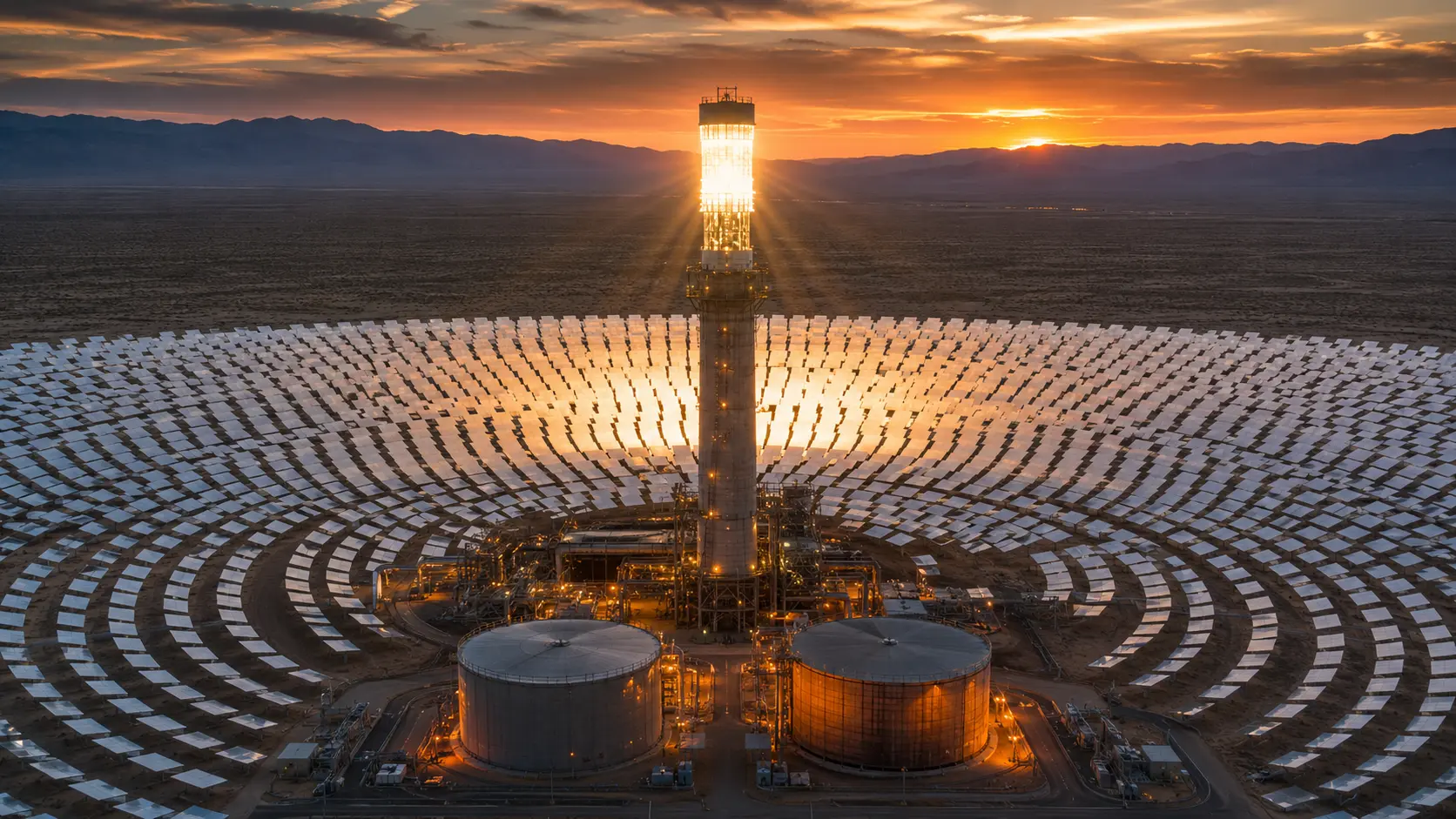
- Concept: Heliostat Field: Thousands of motorized mirrors autonomously track the sun to focus concentrated light.
- Concept: Liquid Sodium: A highly conductive molten metal that absorbs massive thermal energy without chemically degrading.
- Concept: Thermal Storage: Insulated tanks hold the superheated liquid, functioning as a massive, low-cost mechanical battery.
- Concept: Baseload Solar: The stored heat boils water into steam, spinning conventional turbines continuously through the night.
HOW CONCENTRATED SOLAR POWER WORKS
Photovoltaic panels convert sunlight directly into electricity, immediately losing power the exact moment a cloud passes. Concentrated Solar Power (CSP) abandons this direct conversion entirely. It treats sunlight purely as a source of raw thermodynamic heat.
A central receiver tower sits in the middle of a massive circular field of heliostats. These motorized mirrors reflect and concentrate sunlight onto a small focal point at the top of the tower. This focused light generates extreme temperatures exceeding 800°C.
Engineers pump liquid sodium through a dense network of receiver tubes at the focal point. Liquid sodium possesses exceptional thermal conductivity and a high boiling point, allowing it to rapidly absorb the concentrated thermal energy without vaporizing into a high-pressure gas.
Unlike molten salt, which freezes at relatively high temperatures and clogs plumbing, liquid sodium remains highly fluid. This low viscosity allows operators to pump it at extreme velocities through narrow geometries without expending massive parasitic electrical power.
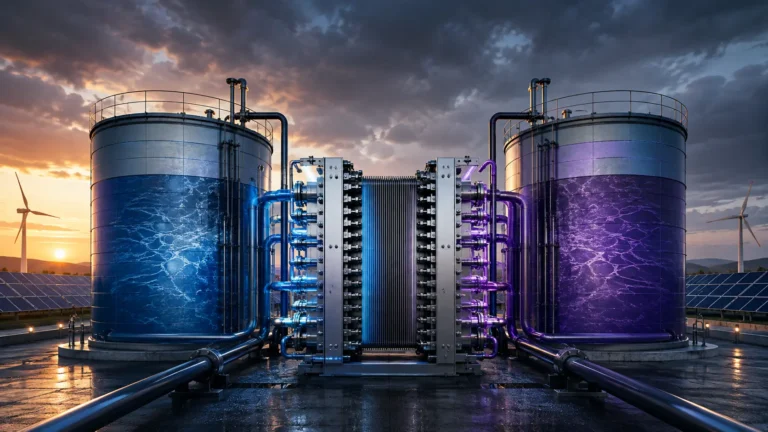
The superheated sodium flows down the tower and collects inside a massive, insulated holding tank. When the grid demands electricity, pumps push this hot sodium through a heat exchanger. The liquid metal boils adjacent water pipes into high-pressure steam, which spins a conventional kinetic turbine before the cooled sodium returns to a cold tank to repeat the cycle.
WHY IT MATTERS NOW
The global energy transition suffers from an acute chronological mismatch. Solar farms produce maximum power at noon, but human grid consumption peaks sharply in the early evening. This misalignment forces utility operators to fire up expensive natural gas peaker plants every night just to prevent regional brownouts.
Lithium-ion mega-batteries currently bridge this gap, but their capital economics restrict them to a four-hour discharge window. Building enough chemical batteries to power a mega-city through a twelve-hour winter night remains financially impossible.
Liquid sodium loops solve this exact chronological deficit. Because storing hot liquid inside a steel tank costs a fraction of manufacturing lithium-ion cells, a CSP plant easily stores up to fifteen hours of raw thermal energy. This architecture transforms intermittent solar radiation into a reliable, dispatchable baseload power plant.
A massive tank of molten metal loses less than one percent of its stored thermal energy over a 24-hour period. This incredible retention efficiency completely unlinks the act of capturing sunlight from the act of generating electricity.
The United States Department of Energy and private infrastructure funds actively finance next-generation sodium CSP pilot plants across the American Southwest. These facilities utilize the identical steam turbine infrastructure found in legacy coal plants. This allows energy companies to directly replace retiring fossil fuel boilers with zero-emission solar towers without abandoning their existing multi-billion-dollar transmission hardware.
WHAT MOST PEOPLE MISS
Clean energy commentators assume solar towers operate smoothly and continuously. They entirely miss the brutal kinetic violence of thermal cycling shock that threatens to tear the central receiver apart.
When a thick cloud passes over a massive heliostat field, the thermal input at the top of the tower drops instantly. The liquid sodium inside the receiver tubes cools and contracts in seconds, while the exterior metal pipes remain physically expanded. This extreme temperature differential induces massive mechanical shear stress, requiring highly specialized nickel-alloy expansion joints that absorb the rapid physical buckling to prevent the pipes from fracturing and spraying highly reactive liquid sodium into the open atmosphere.
Plant operators must implement highly advanced predictive weather algorithms to survive these transients. By tracking approaching cloud cover with sky-facing radar, the control system preemptively defocuses specific mirrors to intentionally cool the tower, gradually smoothing the thermal drop before the physical shadow actually arrives.
THE TRAJECTORY
Next 12–36 Months: Utility companies will begin integrating thermal energy storage with existing decommissioned coal plants. They will replace the coal furnace with a molten sodium loop, retaining the legacy steam turbines to slash capital costs by half.
Next Five Years: The commercialization of closed-loop supercritical carbon dioxide (sCO2) turbines. Engineers will replace standard water-steam cycles with highly pressurized CO2, shrinking the physical size of the turbine by a factor of ten while increasing thermal-to-electric conversion efficiency past 50 percent.
Next Ten Years: The deployment of ultra-high-temperature liquid metal receivers. Material scientists will engineer refractory metal alloys capable of containing molten sodium at 1000°C. This extreme heat will allow CSP plants to supply raw industrial process heat for cement and steel manufacturing, decarbonizing heavy industry directly.
What Could Go Wrong: Catastrophic exothermic water reactions. Liquid sodium violently explodes upon contact with liquid water. If a microscopic fracture develops inside the primary heat exchanger, the pressurized steam will mix with the molten metal, triggering an uncontrollable chemical explosion that destroys the entire generation block.
Most Likely Outcome: Concentrated solar thermal storage will establish itself as the dominant infrastructure for nighttime renewable energy generation in desert climates. The sheer physical cheapness of storing heat over storing electrons dictates its long-term financial victory.
KEY TERMS
- Concentrated Solar Power (CSP): A thermodynamic energy generation system that uses mirrors to focus sunlight, generating extreme heat to drive conventional steam turbines.
- Heliostat: A motorized, computer-controlled mirror that continuously tracks the sun to reflect light precisely onto a fixed central receiver.
- Liquid Sodium: A highly conductive alkali metal that remains in a liquid state at high temperatures, used efficiently to transport raw heat away from a solar receiver.
- Thermal Cycling Shock: The severe mechanical stress inflicted on metal components when they expand and contract rapidly due to sudden temperature changes.
- Baseload Power: The minimum amount of electrical power a grid must continuously generate to satisfy baseline human and industrial demand at any given moment.
SOURCES
- National Renewable Energy Laboratory (NREL) — Concentrating Solar Power and Liquid Metal Heat Transfer Fluids
- Department of Energy (DOE) — Generation 3 Concentrating Solar Power Systems and Thermal Energy Storage
- Sandia National Laboratories — Advanced Sodium Receiver Designs for Heliostat Power Towers
- Institute of Electrical and Electronics Engineers (IEEE) — The Economics of Thermal Storage versus Lithium-Ion in Grid Balancing