Advertisement
)

Nation-states and advanced persistent threat (APT) groups are currently executing a massive, invisible heist known as “Harvest Now, Decrypt Later.” They are indiscriminately vacuuming up petabytes of encrypted corporate, military, and financial data flowing across the global internet. Today, they cannot read it. But within the next decade, fault-tolerant quantum computers running Shor’s algorithm will possess the mathematical power to shatter modern RSA encryption, instantly unlocking every secret currently stored in adversarial data vaults.
To permanently neutralize this threat, physicists developed Quantum Key Distribution (QKD)—a method of encrypting data using the immutable laws of quantum mechanics. However, early quantum networks relied on firing individual, isolated photons through dedicated, highly expensive “dark fiber” cables, requiring fragile cryogenic detectors that shattered budgets and choked network scalability. Enter Continuous-Variable QKD (CV-QKD). By swapping delicate single photons for continuous laser waves and leveraging the standard hardware already installed in modern telecom networks, CV-QKD has effectively democratized quantum security. For Chief Information Security Officers and telecom executives, this removes the need to rebuild the internet from scratch. We can now deploy mathematically unhackable security directly over the noisy, bustling fiber-optic cables that already wire our cities together.
What is Continuous-Variable QKD (CV-QKD)?
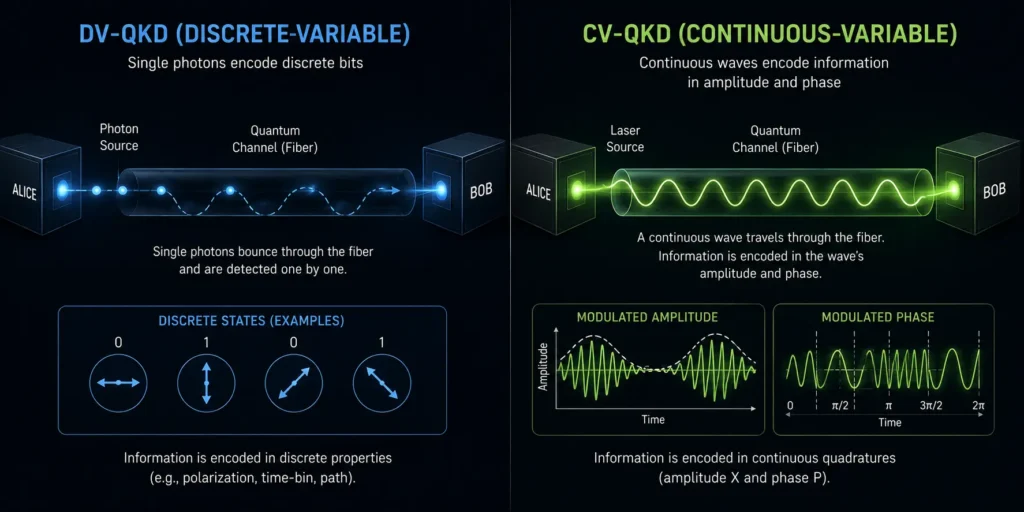
Continuous-Variable QKD (CV-QKD) is an advanced cryptographic technology that secures data using the amplitude and phase of continuous light waves. Unlike discrete-variable systems that rely on fragile single photons, CV-QKD utilizes standard telecom coherent detectors, allowing unhackable quantum encryption to be integrated directly into existing commercial fiber-optic networks.
At a Glance
- Concept: Encoding quantum cryptographic keys into the continuous wave properties (quadratures) of laser light, rather than counting discrete, individual photons.
- Why it matters: It eliminates the need for expensive Single-Photon Avalanche Diodes (SPADs). CV-QKD uses standard PIN photodiodes, dropping the cost of deploying quantum networks by orders of magnitude.
- Who uses it: Tier-1 telecom providers, financial institutions securing metropolitan data center interconnects, and healthcare organizations protecting Electronic Health Records (EHR).
- Biggest takeaway: CV-QKD is built to survive in “noisy” environments. It can run on the exact same fiber-optic cable that carries standard internet traffic (Wavelength Division Multiplexing), making it a “plug-and-play” upgrade for modern cities.
In Simple Words
Imagine trying to send a highly secret message through a long pipe.
In Discrete-Variable QKD (DV-QKD), you send the message by tossing a single, tiny ping-pong ball (a photon) down the pipe. If an eavesdropper tries to intercept it, the ping-pong ball changes color, and you know someone is listening. The problem is, catching a single ping-pong ball at the other end requires a massive, freezing-cold, ultra-expensive catcher’s mitt. Also, if anyone else is using the pipe to send normal water (standard internet data), the ping-pong ball gets totally lost in the flood.
In Continuous-Variable QKD (CV-QKD), you don’t use ping-pong balls. You send a continuous, steady stream of water (a coherent laser beam) down the pipe. You encode your secret message by creating microscopic, precise ripples (amplitude and phase) on the surface of the water. At the other end, the receiver uses a standard, high-speed camera (a homodyne detector) to perfectly measure those ripples. If an eavesdropper touches the water, they disturb the flow and add “noise” to the ripples. Because you measure the exact baseline noise of the water (shot noise), you instantly detect the tampering, securing the key without needing a million-dollar catcher’s mitt.
Why This Matters
For decades, the telecom industry viewed quantum networking as a brilliant but economically unscalable science experiment. The requirement for “Dark Fiber”—laying a brand new, empty fiber-optic cable specifically for quantum signals because classical light would blind the quantum detectors—made global deployment financially suicidal.
CV-QKD obliterates this deployment bottleneck. Because CV-QKD relies on coherent detection, the receiver acts like an ultra-precise optical filter. It can perfectly isolate the faint quantum signal even when it is buried beneath the glaring light of 100-Gigabit classical data streams running on adjacent wavelengths. This enables true Wavelength Division Multiplexing (WDM) Integration. Network architects can simply plug a CV-QKD transceiver into an existing municipal fiber ring, instantly securing banking backhauls and hospital networks without digging up a single street.
The Commercial Scaling of CV-QKD Networks
The commercial scaling of CV-QKD relies on the GG02 protocol, introduced in 2002, which utilizes continuous Gaussian modulation.
Instead of generating perfectly discrete binary states (0s and 1s), the transmitter (Alice) generates coherent states whose amplitude and phase are drawn randomly from a Gaussian (bell-curve) distribution. The receiver (Bob) uses coherent detection to measure these states. After measuring thousands of pulses, Alice and Bob openly compare a small subset of their data over a public internet channel. They mathematically calculate the exact amount of “noise” on the line.
If the noise exceeds the fundamental limits of quantum physics, they abort the key. If the noise is within safe limits, they use classical post-processing algorithms (Information Reconciliation and Privacy Amplification) to distill a perfectly matching, 100% secure cryptographic key that they can use to encrypt their massive data streams.
How Continuous-Variable QKD Works: Homodyne Detection
Eliminating the need for single-photon detectors requires manipulating the fundamental vacuum noise of the universe. Here is the first-principles breakdown of the CV-QKD hardware stack.
1. The Fundamental Problem: The Fragility of Single Photons
In traditional DV-QKD, firing a single photon over 50 kilometers of glass fiber means there is a high probability the photon gets absorbed by the glass and never arrives. To detect the few photons that survive, receivers use Superconducting Nanowire Single-Photon Detectors (SNSPDs) cooled to near absolute zero. This is exceptionally expensive, bulky, and slow.
2. The Insufficiency of Classical Receivers
Standard internet receivers measure the intensity of light to read 1s and 0s. However, to guarantee quantum security, the receiver must be sensitive enough to detect if a single photon was altered by an eavesdropper (Eve). Standard classical receivers are blinded by their own internal electronic “Johnson-Nyquist” thermal noise, masking any delicate quantum tampering.
3. The Core Mechanism: Coherent States and Quadratures
Instead of single photons, CV-QKD transmits faint laser pulses called “coherent states”. The quantum information is encoded in two continuous variables: the amplitude quadrature (X̂) and the phase quadrature (P̂) of the electromagnetic field.
4. Technical Depth: Homodyne Detection and the Local Oscillator
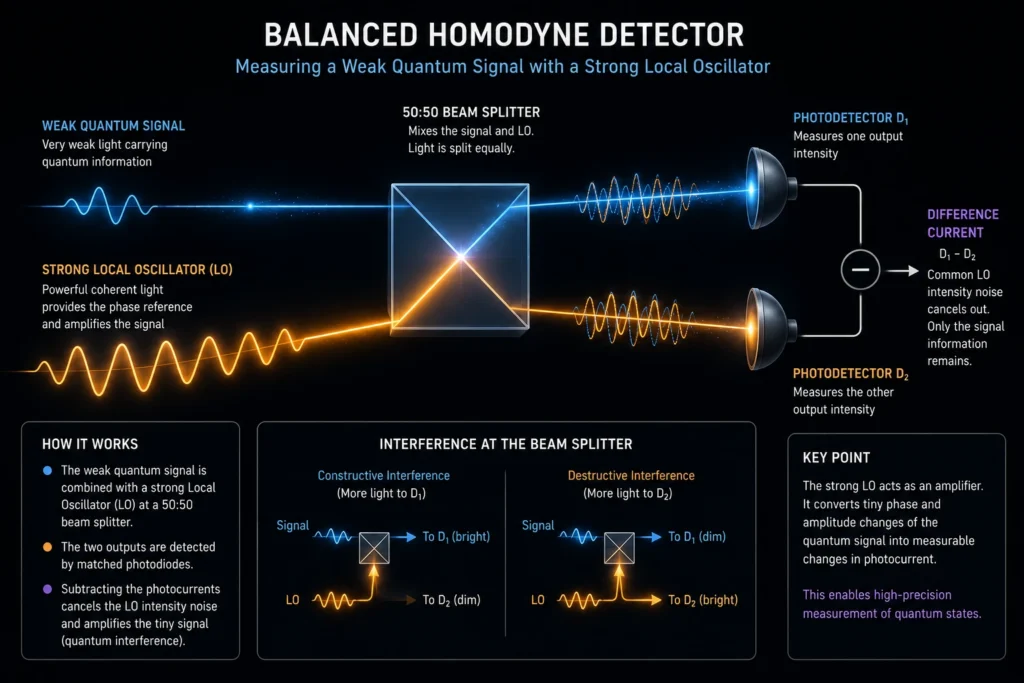
To read these delicate quadratures without being blinded by electronic noise, the receiver uses a Balanced Homodyne Detector.
The weak quantum signal enters the detector and mixes with a massive, highly powerful classical laser beam known as the Local Oscillator (LO). When the weak quantum signal and the powerful LO laser overlap at a beam splitter, they interfere. This interference brilliantly amplifies the quantum signal, boosting it high above the detector’s internal electronic thermal noise. Because the signal is amplified optically, standard, room-temperature PIN photodiodes can accurately read the quantum state.
5. Real-World Consequences: The Shot Noise Limit
The security of CV-QKD rests entirely on measuring Shot Noise. Shot noise is the fundamental, unavoidable quantum fluctuation of the bright Local Oscillator laser itself. By calibrating the homodyne detector to the exact shot-noise limit, the system establishes an absolute baseline. Any attempt by Eve to intercept, copy, or measure the quantum signal physically introduces excess noise above this baseline. If Alice and Bob detect excess variance beyond the shot noise limit, they instantly know the channel is compromised and discard the key.
Real-World Applications of CV-QKD
CV-QKD has graduated from physics laboratories into mission-critical, enterprise-grade telecommunications infrastructure.
5G and 6G Backhaul Security: Cellular networks transmit massive amounts of data from local cell towers back to core data centers. Because CV-QKD seamlessly coexists with classical signals, telecom operators are embedding CV-QKD transceivers directly into their metropolitan WDM optical rings. This secures the high-bandwidth backhaul of mobile networks against “Harvest Now, Decrypt Later” attacks without laying new fiber.
Secure Healthcare and Medical Gateways: The digitization of healthcare through Electronic Health Records (EHR) and the Internet of Medical Things (IoMT) creates a massive target for cybercriminals seeking unalterable genomic and patient data. Because traditional post-quantum cryptography (PQC) algorithms often introduce high latency or demand excessive processing power from small medical sensors, integrated CV-QKD frameworks offer ultra-low latency, unconditionally secure data transmission across hospital campuses.
Financial Data Center Interconnects: Banks operating “active-active” data centers must mirror their trading data continuously between two facilities located 50 kilometers apart. A single compromised fiber-optic cable could expose billions of dollars of proprietary algorithmic trading data. High-speed CV-QKD provides massive secret key rates (often hundreds of kilobits per second) at metropolitan distances, generating enough cryptographic material to encrypt these massive data pipes using symmetric AES-256 with keys that rotate every few seconds.
Economic & Strategic Impact
CV-QKD represents the ultimate CapEx Reduction for national quantum network deployments.
If a nation wishes to build a domestic quantum internet using DV-QKD, they face severe infrastructure constraints. They must lease expensive, unlit “dark fiber” and deploy liquid-helium-cooled SNSPD detectors at network nodes.
CV-QKD entirely shifts the burden from hardware to software. Because it relies on standard, room-temperature telecom lasers and PIN photodiodes, the hardware is inexpensive and commoditized. The true cost of CV-QKD lies in the intense computational requirements of Digital Signal Processing (DSP). Generating the secret key requires complex, real-time error-correction algorithms (like LDPC codes) to filter out phase noise. By shifting the complexity into silicon processing and utilizing off-the-shelf optics, CV-QKD makes ubiquitous, city-wide quantum security economically viable for standard enterprise budgets.
Advantages
- WDM Coexistence: Operates flawlessly on “lit” fiber optic cables carrying massive amounts of classical internet traffic without the quantum signal being destroyed by cross-talk.
- Off-the-Shelf Telecom Hardware: Uses standard room-temperature coherent receivers and lasers, drastically reducing equipment costs compared to cryogenic single-photon detectors.
- High Secret Key Rates: In metropolitan networks (under 100 km), CV-QKD typically produces significantly higher bits-per-second of secure key material than equivalent DV-QKD systems.
- Thermal Noise Tolerance:In specific channel environments featuring high thermal noise but low phase noise, CV-QKD mathematically tolerates more signal loss than discrete-variable systems.
Limitations
- Phase Noise Sensitivity:Unlike DV-QKD, CV-QKD is highly vulnerable to phase noise. Slight physical vibrations or temperature changes in the fiber-optic cable distort the delicate phase alignment of the laser, drastically reducing the effective transmission distance.
- Distance Limitations: Because the quantum signal must remain detectable above the electronic noise floor, standard CV-QKD struggles to maintain high key rates beyond 150 kilometers, whereas advanced DV-QKD systems have crossed the 400-kilometer threshold.
- Extreme Computational Burden: Reconciling continuous-variable data (which involves massive matrices of floating-point numbers) requires significantly more powerful CPUs and GPUs for post-processing error correction than the simple binary (1s and 0s) reconciliation of DV-QKD.
Common Misconceptions
Misconception: Quantum networks must send data one photon at a time.
Reality: While DV-QKD uses single photons, CV-QKD intentionally uses faint pulses of coherent laser light containing multiple photons. The quantum security comes from the Heisenberg Uncertainty Principle applied to continuous wave properties (amplitude and phase), not from isolating single particles.
Misconception: CV-QKD is theoretically less secure than DV-QKD.
Reality: Both protocols have been rigorously mathematically proven to offer “Information-Theoretic Security” against collective and coherent attacks, assuming the hardware is properly calibrated to the shot-noise limit.
Misconception: An eavesdropper can just boost the signal to hide their tampering.
Reality: Any attempt to measure, copy, or amplify an unknown quantum state inevitably introduces excess noise (the No-Cloning Theorem). Because the homodyne detector measures the absolute baseline variance, even a perfectly executed amplification attack immediately spikes the noise floor and alerts the system.
What Most People Miss
The architectural transition to the Local Local-Oscillator (LLO).
Historically, to make homodyne detection work, the transmitter (Alice) had to send the weak quantum signal and the massively bright Local Oscillator (LO) laser down the exact same fiber to the receiver (Bob).
What most observers miss is that transmitting the bright LO is a massive security risk. Eavesdroppers can attack the bright LO directly to blind the receiver. Furthermore, sending a bright laser limits the distance the quantum signal can travel due to scattering.
The industry is aggressively pivoting to “True LLO” architectures. In this setup, Alice only sends the weak quantum signal. Bob generates his own, independent Local Oscillator laser locally on his desk. Because the two lasers are not physically linked, Bob must use intensely complex Digital Signal Processing (DSP) and machine learning algorithms to perfectly phase-lock his laser to Alice’s incoming signal in real-time. LLO architectures eliminate the most severe hardware side-channel attacks and drastically extend the range of CV-QKD networks.
Comparison Table
| Feature | Discrete-Variable QKD (DV-QKD) | Continuous-Variable QKD (CV-QKD) |
| Information Encoding | Polarization or phase of single photons | Amplitude and phase quadratures of coherent states |
| Primary Detectors | SPADs or Cryogenic SNSPDs | Room-temperature PIN Photodiodes (Homodyne) |
| WDM Coexistence | Poor (Easily blinded by classical data) | Excellent (Filters classical noise via LO interference) |
| Maximum Distance | Excellent (>300 km) | Moderate (<150 km, limited by phase noise) |
| Hardware Cost | High (Requires specialized single-photon tech) | Low (Utilizes standard telecom transceivers) |
| Post-Processing Need | Low to Moderate | Extreme (High-speed DSP for error correction) |
Case Study
Situation: A major European telecommunications consortium needed to secure the metropolitan optical ring connecting dozens of corporate banking data centers against the looming threat of quantum-enabled decryption.
Challenge: Implementing a standard DV-QKD network required purchasing and dedicating hundreds of kilometers of unlit “dark fiber” exclusively for the quantum signal, as the intense light from existing commercial data traffic would instantly blind the single-photon detectors. The infrastructure cost of leasing dark fiber across an entire city rendered the project economically unviable.
Solution (The CV-QKD WDM Integration): The consortium abandoned the single-photon approach and deployed a Noise-Aware Resource Allocation (NARA) CV-QKD framework. They plugged standard CV-QKD coherent transceivers directly into the existing, highly active Wavelength Division Multiplexing (WDM) network. They assigned the quantum keys to a specific wavelength channel, while classical, high-power internet data flowed continuously on the adjacent channels.
Outcome: By utilizing strong Local Oscillators and advanced homodyne filtering, the CV-QKD receivers perfectly isolated the faint quantum quadratures from the deafening cross-talk of the classical data streams. The system achieved a secure key rate exceeding 100 kilobits per second over 50 kilometers of actively lit fiber, successfully establishing unconditionally secure, rotating symmetric encryption keys for the financial data centers without laying a single meter of new cable.
Lessons Learned: The deployment definitively proved that quantum cryptography does not require isolated, pristine laboratory conditions. By leaning into the physics of continuous variables and coherent detection, telecom providers can monetize their existing fiber infrastructure to deliver quantum-as-a-service directly to enterprise clients.
Future Outlook
Next 12–24 Months
The era of Photonic Integrated Circuits (PICs). The immediate focus of the industry is shrinking the hardware. While CV-QKD uses standard components, the current modulators and beam splitters are often housed in bulky, rack-mounted server boxes. By 2026 and 2027, companies will fully integrate the CV-QKD laser source, modulators, and homodyne detectors onto a single, millimeter-scale silicon photonic chip. This will drop the cost of a quantum transceiver from $50,000 to a few thousand dollars, allowing CV-QKD to be embedded directly into standard network routers and enterprise firewalls.
Next 3–5 Years
The optimization of Multi-Mode CV-QKD. To combat the distance limitations imposed by phase noise, researchers are deploying multi-mode Gaussian modulation. Rather than sending a single quantum state, the transmitter multiplexes multiple spatial or frequency modes simultaneously. This drastically reduces the electronic noise variance of the coherent receiver, amplifying the signal-to-noise ratio and pushing the effective transmission distance of CV-QKD well beyond the 200-kilometer threshold, encroaching on the territory previously dominated by DV-QKD.
Next 10 Years
The Quantum-Classical Converged Internet. By the mid-2030s, the distinction between classical data networks and quantum security networks will vanish. Because CV-QKD mirrors the exact modulation techniques used in modern coherent optical telecommunications (like QAM and QPSK), future optical transceivers will handle both simultaneously. A single fiber-optic laser pulse will carry terabits of classical internet data, while the microscopic, quantum-level fluctuations of that exact same pulse will carry the unconditionally secure cryptographic key required to unlock it.
Most Likely Scenario
While DV-QKD will remain the standard for extreme long-haul and satellite-to-ground quantum links, CV-QKD is poised to absolutely dominate the metropolitan and enterprise market. Its inherent compatibility with existing telecom infrastructure and reliance on off-the-shelf silicon photonics ensures it will be the primary mechanism securing the global financial and healthcare grids against the post-quantum threat.
Key Takeaways
- Continuous-Variable QKD (CV-QKD) secures data by encoding keys into the continuous amplitude and phase of a laser beam, rather than using isolated single photons.
- Because it uses standard coherent detectors, CV-QKD perfectly integrates into existing “lit” telecom fiber networks alongside normal internet traffic, avoiding the need for expensive “dark fiber.”
- The receiver uses a Balanced Homodyne Detector, which mixes the weak quantum signal with a massive Local Oscillator (LO) laser, optically amplifying the signal so standard electronics can read it.
- Security relies on precisely measuring “shot noise”—the fundamental quantum vacuum noise. Any tampering by a hacker introduces excess noise, instantly invalidating the key.
- While CV-QKD is vastly cheaper and easier to integrate than DV-QKD, it is highly sensitive to phase noise, historically limiting its effective range to metropolitan distances (<100 km).
- The future of CV-QKD relies on “Local LO” architectures, where the receiver generates its own laser and uses heavy algorithmic processing to lock the phase, closing critical security loopholes.
Glossary
Balanced Homodyne Detector: An optical receiver that splits a weak incoming signal, mixes it with a strong Local Oscillator laser, and measures the interference to extract precise amplitude or phase data while suppressing background noise.
Coherent State: A specific quantum state of a laser beam that most closely resembles a classical electromagnetic wave, defined by continuous variables (amplitude and phase) rather than discrete particle counts.
Discrete-Variable QKD (DV-QKD): The original form of quantum key distribution (e.g., BB84) that encodes information into the discrete properties (like polarization) of single, individual photons.
Local Oscillator (LO): A powerful, highly stable classical laser beam used in a receiver to mix with and amplify a weak incoming quantum signal via interference.
Phase Noise: Random fluctuations in the phase of a light wave caused by physical vibrations or temperature shifts in a fiber-optic cable, severely degrading the accuracy of CV-QKD over long distances.
Shot Noise: The fundamental, unavoidable quantum noise floor caused by the discrete nature of light (photons) hitting a detector. CV-QKD security is verified by measuring variance directly against this absolute limit.
Wavelength Division Multiplexing (WDM): A telecom technology that multiplexes multiple optical carrier signals onto a single optical fiber by using different wavelengths (colors) of laser light, allowing classical data and quantum keys to share the same cable.
Frequently Asked Questions
Does CV-QKD use quantum entanglement?
It can, but the standard, commercially deployed GG02 protocol does not require entanglement. It is a “Prepare-and-Measure” protocol. Alice prepares a specific coherent quantum state and sends it; Bob measures it. This is much easier to engineer than maintaining fragile entangled photon pairs across a city.
If CV-QKD uses normal lasers, how is it quantum?
Even though the laser is continuous, the data is encoded in the microscopic, quantum-level fluctuations (the uncertainty) of the electromagnetic field’s amplitude and phase. An eavesdropper cannot measure these specific quadratures without fundamentally altering the state and spiking the noise variance.
Can an eavesdropper just use a better detector to steal the key?
No. The security of QKD is guaranteed by the laws of quantum mechanics (specifically the No-Cloning Theorem and Heisenberg’s Uncertainty Principle), not by mathematical complexity. Even an adversary with a perfect detector and a million-qubit quantum computer cannot copy an unknown quantum state without destroying it.
Why does CV-QKD require so much computing power?
The detectors output continuous analog waveforms, which must be converted into digital data. Because the quantum signal is so faint, the raw data is incredibly noisy. Finding the matching cryptographic key hidden in that noise requires running massively complex, real-time error-correction algorithms (like LDPC codes) on powerful CPUs or GPUs.
Is CV-QKD faster than traditional internet encryption?
QKD does not encrypt the data itself; it only securely distributes the key used to lock and unlock the data. The actual internet traffic is still encrypted using high-speed, symmetric classical algorithms like AES-256. QKD simply ensures that the AES keys are unhackable and rotated continuously.
Sources
[1] Quantum Journal: Comparison of Discrete Variable and Continuous Variable Quantum Key Distribution Protocols with Phase Noise in the Thermal-Loss Channel (June 2024)
[2] Optica Publishing Group: Noise-aware resource allocation with integrated key generation and consumption for CV-QKD over WDM networks (December 2023)
[3] MDPI: Advances of Quantum Key Distribution and Network Nonlocality (September 2025)
[4] National Institutes of Health (PMC): Effective Excess Noise Suppression in Continuous-Variable Quantum Key Distribution through Carrier Frequency Switching (August 2023)
[5] Optica (JOSA B): Continuous variable quantum key distribution with multi-mode signals for noisy detectors