Advertisement
)


In 2008, the collapse of the U.S. housing market forced the federal government to execute a $190 billion bailout of Fannie Mae and Freddie Mac. The fundamental flaw was terrifyingly simple: two government-sponsored enterprises held the default risk of half the American mortgage market on their own balance sheets. When homeowners stopped paying, the taxpayers absorbed the catastrophic losses. The U.S. housing market remains the largest asset class in global capitalism, representing over $14 trillion in outstanding debt. If a massive macroeconomic shock hits the housing sector today, who is holding the bag?
Why should you care right now? Because the government quietly learned its lesson and fundamentally re-engineered the architecture of American real estate risk. Instead of holding the tail-risk of millions of mortgages, Fannie Mae and Freddie Mac are aggressively packaging that default risk into high-yield bonds and selling it directly to Wall Street hedge funds. Through a multi-billion-dollar market known as Credit Risk Transfer (CRT) securities, the government is privatizing the risk while socializing the liquidity. By shifting the financial burden of mortgage defaults onto private capital markets, regulators are actively building a shock absorber designed to shield taxpayers from the next housing crash, completely altering the yield curve for fixed-income investors.
What are Credit Risk Transfer (CRT) Securities?
Credit Risk Transfer (CRT) securities are specialized, unsecured debt instruments issued by government-sponsored enterprises like Fannie Mae and Freddie Mac. They synthetically transfer the credit risk of mortgage defaults from the government to private investors. If the underlying homeowners default, the private investors’ principal is written down, shielding taxpayers from the financial losses.
At a Glance
- Concept: Packaging the risk of homeowners defaulting on their mortgages into high-yield bonds and selling them to hedge funds and institutional investors.
- Why it matters: It acts as an insurance policy for the U.S. housing market. It ensures that private capital absorbs the first wave of losses during a housing downturn, preventing a taxpayer-funded bailout.
- Who uses it: Fannie Mae (CAS program), Freddie Mac (STACR program), Institutional Fixed Income Investors, and global reinsurers.
- Biggest takeaway: CRT bonds are synthetic. The investors do not actually buy or own the mortgages; they buy a bond whose payout is mathematically tied to a massive reference pool of mortgages. If the pool defaults, the bond is wiped out.
In Simple Words
Imagine you run a giant insurance company that guarantees millions of home loans. If a few people miss their payments, you can cover it. But if the entire housing market crashes at once, your company goes bankrupt.
To protect yourself, you go to Wall Street investors and make a bet. You say, “If you give me $1 billion right now, I will pay you a very high interest rate every month. However, if the housing market crashes and a specific group of mortgages goes into default, I get to keep your $1 billion to cover my losses.”
The investors take the bet because the interest rate is highly lucrative, and they believe the housing market is stable. You take the bet because you just successfully transferred the risk of bankruptcy off your shoulders and onto the investors.
Why This Matters
For Fixed Income Analysts and Real Estate Investors, CRT securities represent one of the most compelling floating-rate yield opportunities in the global debt markets. Because the notes pay a spread over the Secured Overnight Financing Rate (SOFR), they provide exceptional returns during elevated interest rate cycles.
For Macro Economists, the CRT market is the definitive metric for the privatization of the U.S. mortgage system. Without this continuous, multi-billion-dollar pipeline of risk transfer, the GSEs would accumulate toxic levels of systemic risk. The Enterprise Regulatory Capital Framework (ERCF) legally requires the GSEs to hold capital against their mortgage portfolios. By offloading this risk via CRTs, the GSEs drastically reduce their capital burdens, making their eventual release from government conservatorship financially viable.
The Evolution of GSE Mortgage Risk Transfer
Prior to the 2008 financial crisis, Fannie Mae and Freddie Mac operated under a dangerous “buy and hold” paradigm. They charged guarantee fees to insure mortgages, but retained nearly 100% of the catastrophic tail-risk.
The creation of the CRT market in 2013 represented a paradigm shift in federal housing policy. Instead of acting as a sponge that absorbs all market risk, the GSEs now act as a conduit, actively syndicating that risk out to the broader global capital markets. It is the ultimate alignment of incentives: the government maintains the liquidity that allows everyday Americans to secure a 30-year fixed-rate mortgage, while ruthless, data-driven private markets are forced to price and bear the true risk of those loans defaulting.
How Credit Risk Transfer (CRT) Tranches Work
Transforming the physical risk of a homeowner losing their job into a tradable, liquid security requires a flawless synthetic architecture. Here is the first-principles breakdown of the system.
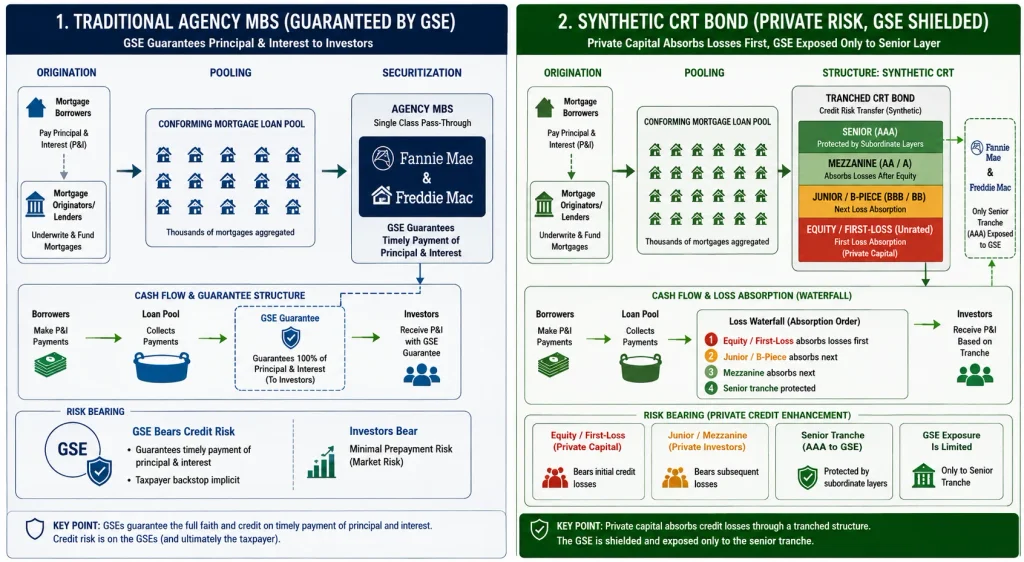
1. The Fundamental Problem: Concentrated Tail Risk
Fannie and Freddie guarantee the principal and interest on standard Mortgage-Backed Securities (MBS). If homeowners default, the GSEs must step in and pay the MBS investors with their own cash. This concentrates trillions of dollars of credit risk on the GSE balance sheets, leaving them fatally exposed to regional or national economic downturns.
2. The Insufficiency of Traditional Capital Buffers
A standard bank survives defaults by holding a capital buffer (retained earnings). However, the U.S. mortgage market is simply too massive. Expecting the GSEs to hoard hundreds of billions of dollars in cash to survive a 2008-level event is highly capital inefficient and drives up the cost of borrowing for average homebuyers.
3. The Core Mechanism: Synthetic Risk Transfer
To shed this risk without selling the actual mortgages, the GSEs create a “Reference Pool”—a massive, hand-picked group of recently originated, high-quality mortgages (often totaling $20 billion to $30 billion). They then issue a CRT security (a bond) whose payout is contractually linked to the performance of that specific reference pool.
4. Technical Depth: Tranching and Loss Absorption
The CRT bond is sliced into different layers of risk, known as “tranches”:
- First-Loss (B-Tranche): These investors demand the highest interest rates because if even a few mortgages in the pool default, their principal is immediately written down (they lose their money).
- Mezzanine (M-Tranche): These investors sit in the middle. They receive a moderate yield and only suffer losses if defaults burn completely through the first-loss tranche.
- Senior Tranche: Retained by the GSE. The GSE only suffers a loss if the housing market completely collapses and burns through all the private capital below it.
5. Real-World Consequences: Regulatory Capital Relief
When private investors buy the Mezzanine and First-Loss tranches, they hand cash to the GSEs. If the mortgages default, the GSE keeps the cash to cover the losses. If the mortgages perform well, the investors get their principal back plus high interest. Because the GSE has effectively bought private insurance, the Enterprise Regulatory Capital Framework (ERCF) rewards them by drastically slashing the amount of emergency capital they are legally forced to hold on their balance sheets.
Fannie Mae CAS, Freddie Mac STACR, and the ERCF
The theoretical risk-sharing model has rapidly expanded into a highly active, liquid sector of the global capital markets.
Fannie Mae CAS and Freddie Mac STACR: These two flagship programs—Connecticut Avenue Securities (CAS) and Structured Agency Credit Risk (STACR)—are the primary vehicles for Wall Street investors. They are issued programmatically, creating a reliable pipeline of high-yield debt. The bonds are structured as REMICs (Real Estate Mortgage Investment Conduits) to optimize tax treatment, drawing immense liquidity from sophisticated institutional buyers seeking floating-rate exposure tied to the U.S. consumer.
CIRT and ACIS (Reinsurance Integration): The GSEs do not rely entirely on hedge funds to buy bonds. They also syndicate risk directly into the traditional global reinsurance market. Through Fannie Mae’s Credit Insurance Risk Transfer (CIRT) and Freddie Mac’s Agency Credit Insurance Structure (ACIS), the GSEs purchase direct insurance policies from syndicates of global reinsurers. This diversifies their counterparty risk, ensuring that if bond markets temporarily freeze, the insurance markets can continue to absorb U.S. mortgage risk.
Enterprise Regulatory Capital Framework (ERCF) Offsets: The ERCF establishes the legal runway for the GSEs to exit conservatorship. By mid-2026, Milliman data confirms the framework requires a massive $197 billion in combined capital for Fannie and Freddie.However, because the CAS, STACR, and reinsurance programs effectively transfer the risk off the books, the GSEs receive a combined regulatory capital benefit of $40 billion. This 20% reduction proves that the CRT market is not a minor accounting trick; it is the structural cornerstone of federal housing stability.
Economic & Strategic Impact
The core economic disruption of the CRT market is the Real-Time Price Discovery of Systemic Risk.
Before 2013, it was incredibly difficult to determine exactly how much risk was buried in the U.S. mortgage market. The GSEs simply charged a flat “Guarantee Fee” (G-Fee) to lenders.
Today, the CRT market forces thousands of ruthless, highly capitalized hedge funds to analyze the reference pools and publicly bid on the tranches. The yield “spread” that investors demand to buy a CAS or STACR bond acts as a real-time, public barometer of the health of the American consumer. If Wall Street detects rising unemployment or inflation squeezing homeowners, they demand higher yields to buy the bonds. This forces the GSEs to pay more for risk transfer, which in turn forces them to raise the G-Fees they charge to originators, ultimately making mortgages slightly more expensive for new homebuyers. The CRT market directly links the macroeconomic fears of Wall Street to the interest rate on Main Street.
Advantages
- Taxpayer Shielding: Mathematically ensures that private capital absorbs the first tens of billions of dollars in losses during a severe housing downturn, protecting the federal budget from bailouts.
- Floating-Rate Protection: For investors, CRT bonds pay a spread over SOFR. When central banks raise interest rates to fight inflation, the yield on CRT bonds automatically rises, protecting the investor’s portfolio from interest rate risk.
- Capital Optimization:Drastically lowers the amount of emergency capital the GSEs are legally required to hold under the ERCF, improving their return on equity and operational agility.
- Market Discipline: Introduces rigorous, private-market pricing discipline into the government-dominated mortgage sector.
Limitations
- Permanent Profit Drag: Transferring risk is not free. The GSEs must pay billions of dollars in high-yield interest to the investors holding the CRT bonds. This is a permanent, ongoing expense that reduces the net profitability of Fannie and Freddie’s core guarantee business.
- Liquidity Freezes: During moments of acute panic (such as the March 2020 market crash), credit markets can freeze. If private investors stop buying high-yield debt, the GSEs cannot issue new CRT bonds, forcing them to retain 100% of the catastrophic tail-risk exactly when the market is most dangerous.
- Pro-Cyclical Flight: If a housing crash actually occurs and mezzanine investors are wiped out, the capital markets may refuse to purchase future CRT issuances for years, destroying the program’s utility in the aftermath of a crisis.
Common Misconceptions
Misconception: CRT investors own the actual mortgages.
Reality: CRT bonds are entirely synthetic and unsecured. The GSEs keep the physical mortgages on their own balance sheets. The CRT bond merely uses the performance data of a “reference pool” to mathematically determine if the investor’s principal should be written down.
Misconception: The U.S. Government guarantees CRT bonds.
Reality: This is the most critical distinction in housing finance. While standard Agency MBS (Mortgage-Backed Securities) are guaranteed by the GSEs, CAS and STACR bonds are explicitly not guaranteed. The entire purpose of the instrument is that the investor takes the loss if the homeowners default.
Misconception: CRTs caused the 2008 financial crisis.
Reality: CRTs were invented in response to the 2008 crisis. The 2008 crash was caused by toxic subprime MBS and opaque Collateralized Debt Obligations (CDOs). CRTs are transparent, highly regulated tools designed to protect the system from repeating those exact failures.
What Most People Miss
The disruptive intelligence value of the ERCF Countercyclical Adjustment.
Most analysts evaluating the safety of the U.S. housing market look purely at the high credit scores (FICO) and low Loan-to-Value (LTV) ratios of modern borrowers. What they miss is the aggressive, automated braking system built into the capital framework.
Within the ERCF, regulators apply a “Countercyclical Adjustment” to a loan’s LTV.If national home prices surge rapidly and become severely overvalued compared to their long-term historical growth rate, the ERCF forces the GSEs to act as if the housing market has already dropped.By mid-2026, roughly one-third of the total required capital for both Fannie Mae (28%) and Freddie Mac (31%) is driven purely by this overvaluation penalty. Because capital requirements spike when the housing market is running too hot, the GSEs are forced to issue aggressively more CRT securities to offset the burden. This algorithmic mechanism actively drains risk out of the system at the exact peak of a housing bubble.
Comparison Table
| Feature | Agency MBS (Mortgage-Backed Securities) | CRT Securities (CAS / STACR) | Non-Agency RMBS |
| Asset Backing | Actual Mortgages | Synthetic (Linked to a Reference Pool) | Actual Mortgages |
| Credit Guarantee | Yes (Principal & Interest Guaranteed by GSE) | No (Investors absorb default losses) | No |
| Yield Profile | Lower (Risk-Free rate + small spread) | High (SOFR + massive credit spread) | High |
| Primary Risk | Prepayment Risk (Interest rates drop, homeowners refinance) | Credit Risk (Homeowners default on payments) | Credit & Prepayment Risk |
| Systemic Purpose | Provide liquidity to the housing market | Protect taxpayers from GSE insolvency | Private market financing |
Case Study
Situation: Following the 2008 housing collapse, the Federal Housing Finance Agency (FHFA) placed Fannie Mae and Freddie Mac into conservatorship. To eventually release them back into the private market, the GSEs needed to build massive capital reserves and permanently shed their concentrated exposure to mortgage defaults.
Challenge: Create a highly scalable, multi-billion-dollar liquid market to transfer the credit risk of standard, 30-year fixed-rate mortgages to private investors, without disrupting the flow of capital that keeps the primary U.S. housing market functioning.
Solution (The ERCF and Programmatic Issuance): The FHFA directed the GSEs to establish programmatic issuance of CRT securities. Freddie Mac launched STACR, and Fannie Mae launched CAS. By structuring the bonds as REMICs and offering various tranches (from high-risk First-Loss to moderate-risk Mezzanine), they attracted a vast, diversified base of global hedge funds, asset managers, and sovereign wealth funds.
Outcome: The strategy radically transformed the risk profile of the U.S. government. By 2026, the ERCF framework formally recognized the success of this syndication. While the standardized approach required Fannie and Freddie to hold $197 billion in capital, the active CRT market provided an estimated $40 billion in capital relief.
Lessons Learned: The massive adoption of CAS and STACR validated that private capital markets possess the appetite and sophistication to absorb U.S. housing risk at scale. By formalizing capital relief through the ERCF, regulators established a permanent, structural incentive for the GSEs to never again hoard catastrophic tail-risk, fundamentally securing the architecture of American real estate finance.
Future Outlook
Next 12–24 Months
The era of High-Rate Normalization and LTV Shifting. In the immediate term, the CRT market will digest the impact of prolonged high interest rates. Because homeowners are reluctant to sell their houses and give up their ultra-low 3% pandemic-era mortgage rates (the “lock-in effect”), prepayments on reference pools will remain historically low. This extends the duration of the CRT bonds, forcing investors to hold the credit risk for longer periods. Simultaneously, as home price appreciation cools, the ERCF’s countercyclical adjustments will fluctuate, dynamically altering the volume of risk the GSEs are forced to push into the market.
Next 3–5 Years
The scaling of Affordability-Linked and ESG CRT Tranches. As housing affordability reaches crisis levels, the GSEs will expand their mandate to support low-income and first-time homebuyers. Mortgages supporting affordable housing initiatives inherently carry higher default risk. To manage this without endangering the GSE balance sheets, we will see the rollout of specialized, high-yield CRT tranches explicitly tied to affordable housing reference pools. These tranches will be marketed heavily to ESG (Environmental, Social, and Governance) funds and impact investors willing to absorb higher risk to fulfill institutional social mandates.
Next 10 Years
The Conservatorship Exit and Permanent Privatization. By the mid-2030s, the ultimate goal of the ERCF will be realized: the release of Fannie Mae and Freddie Mac from federal conservatorship. Operating as fully capitalized, private utilities, the GSEs will rely on a permanent, trillion-dollar CRT ecosystem. The market will evolve beyond synthetic bonds, utilizing highly advanced, AI-driven parameterization to instantly syndicate the risk of a newly originated mortgage to a global network of clearinghouses and reinsurers within seconds of closing, finalizing the absolute privatization of the American mortgage book.
Most Likely Scenario
Credit Risk Transfer securities are not a temporary experiment; they are the permanent, necessary friction of a stable housing market. The U.S. government will never again allow itself to hold the unhedged tail-risk of the real estate sector. As long as Americans demand the 30-year fixed-rate mortgage, the CRT market will stand as the mandatory, multi-billion-dollar shock absorber standing between Wall Street volatility and taxpayer solvency.
Key Takeaways
- Credit Risk Transfer (CRT) securities are high-yield bonds issued by Fannie Mae and Freddie Mac to offload the risk of mortgage defaults onto private Wall Street investors.
- The primary goal is taxpayer protection. If the housing market crashes and homeowners stop paying, the hedge funds holding the CRT bonds lose their money, sparing the government from executing another 2008-style bailout.
- CRT bonds are synthetic. Investors do not buy the actual mortgages; they buy a bond whose payout drops mathematically if the mortgages in a specific “reference pool” go bad.
- The bonds are sliced into “tranches.” First-loss investors take the highest risk for the highest reward, while the GSE retains the safest, senior portion of the risk to ensure their interests remain aligned with the market.
- Under the Enterprise Regulatory Capital Framework (ERCF), transferring this risk allows the GSEs to reduce the emergency capital they are legally required to hold by roughly $40 billion, paving the way for their eventual exit from government control.
Glossary
Connecticut Avenue Securities (CAS): The flagship Credit Risk Transfer program issued by Fannie Mae.
Conservatorship: The legal status of Fannie Mae and Freddie Mac since 2008, where the U.S. government took control of their operations to prevent their collapse during the subprime mortgage crisis.
Countercyclical Adjustment: A regulatory math equation used by the ERCF. If national home prices are rising too fast and forming a bubble, this adjustment forces the GSEs to hold extra capital and issue more CRT bonds as a safety precaution.
Enterprise Regulatory Capital Framework (ERCF): The strict set of rules dictating exactly how much cash/capital Fannie Mae and Freddie Mac must hold to survive a severe housing crash.
Mezzanine Tranche: A middle layer of risk in a CRT bond. Mezzanine investors only lose their money if the mortgage defaults are severe enough to completely wipe out the “First-Loss” investors below them.
Structured Agency Credit Risk (STACR): The flagship Credit Risk Transfer program issued by Freddie Mac.
Sources
Milliman: GSE credit risk capital monitor – Q2 2026
Federal Register: Enterprise Regulatory Capital Framework—Commingled Securities, Multifamily Government Subsidy, Derivatives, and Other Enhancements
Federal Housing Finance Agency (FHFA): Enterprise Capital Requirements
Freddie Mac Capital Markets: STACR® (Structured Agency Credit Risk) Overview
Fannie Mae Capital Markets: Single-Family Credit Risk Transfer Overview