Advertisement
)
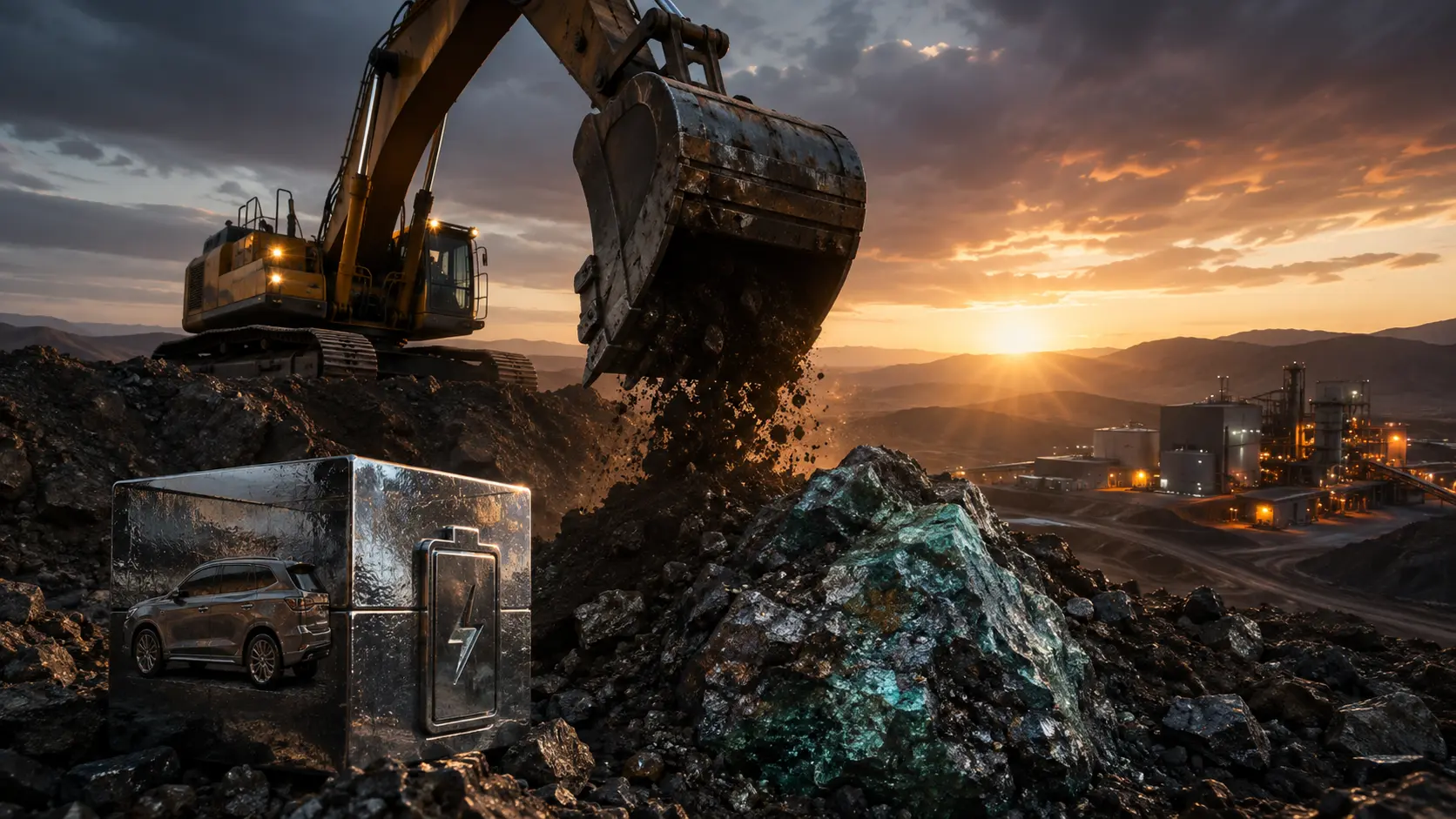

For over a century, the global automotive industry operated on a principle of absolute delegation. Car companies designed engines and bent steel, but they relied on a vast, invisible network of suppliers to source raw materials. If Ford needed aluminum, it bought it on the open market. The concept of an automaker buying an actual bauxite mine was considered a violation of basic supply chain economics. But the electric vehicle (EV) revolution has violently destroyed this paradigm. Today, the constraint on building an EV is not assembly line capacity; it is the physical availability of lithium, nickel, cobalt, and copper.
Why should you care right now? Because the world’s largest automakers have realized that the free market cannot dig fast enough to save them. Facing a geopolitical bottleneck controlled largely by China, and a Wall Street banking sector terrified of financing risky new mines, car companies have decided to become the banks themselves. In a historic reversal of globalization, OEMs are deploying billions of dollars to buy direct equity stakes in unbuilt lithium and copper mines from the Nevada desert to the Australian outback. This aggressive shift—known as the Critical Mineral Equity Offtake—is transforming car companies into hybrid mining conglomerates, permanently decoupling the future of transportation from the chaotic whims of the global commodity spot market.
What are Critical Mineral Equity Offtakes?
Critical Mineral Equity Offtakes are binding legal and financial agreements where a manufacturer guarantees the future purchase of a mine’s raw material output while simultaneously purchasing a direct ownership stake in the mining company or the specific asset. This provides junior miners with the upfront capital required to build the mine.
At a Glance
- Concept: Automakers directly funding the construction of new metal mines by becoming part-owners, rather than waiting for the metal to hit the open market and hoping they can afford it.
- Why it matters: It solves a massive financial Catch-22. Banks won’t lend a miner money to dig a hole unless the miner has a guaranteed buyer. Car companies step in, guarantee the purchase, and provide the cash to buy the bulldozers.
- Who uses it: Mega-tier OEMs like General Motors, Tesla, and Stellantis, partnering with junior mining exploration companies like Lithium Americas and Vulcan Energy.
- Biggest takeaway: This trend is heavily driven by U.S. legislation (the Inflation Reduction Act), which legally penalizes automakers if their battery materials pass through China (Foreign Entities of Concern), forcing them to rapidly fund North American and allied mining projects.
In Simple Words
Imagine you own a massive bakery, and your entire business relies on a specific, rare type of flour. Normally, you just buy the flour from a massive global grocery store (the spot market) whenever you need it.
But suddenly, there is a global flour shortage. The grocery store prices are swinging wildly, and a rival bakery across the world has started buying up all the grocery store’s stock.
To survive, you drive out to an empty field where a farmer is standing. The farmer knows the soil is perfect for growing this wheat, but he doesn’t have the money to buy a tractor or seeds.
You offer an Equity Offtake Agreement. You say, “I will give you $10 million in cash right now to buy the tractor, and in exchange, I own 30% of your farm (Equity). Furthermore, I sign a legal contract promising to buy 100% of the wheat you grow for the next 20 years at a fair price (Offtake).” You secure your flour supply for decades, the farmer gets to build his farm, and neither of you ever has to deal with the chaotic grocery store again.
Why This Matters
For Supply Chain Directors, Macro Economists, and Commodity Traders, the explosion of equity offtakes signals the “Balkanization” of global commodities.
Historically, copper or lithium extracted anywhere in the world flowed into a unified, highly liquid global pricing index (like the London Metal Exchange). Equity offtakes physically pull millions of tons of future critical minerals off the open market before they are even mined. If General Motors legally owns 100% of the output of the largest lithium mine in the U.S. for 20 years, that lithium is structurally unavailable to a rival like Ford or Toyota, regardless of how much money they are willing to pay. This creates a deeply fragmented, closed-loop supply chain that starves the open spot market of liquidity, driving up prices for any manufacturer who failed to integrate upstream.
The Impact of the Inflation Reduction Act on Mining
The integration of OEMs into upstream mining is not entirely unprecedented—Henry Ford famously bought rubber plantations and iron mines for his River Rouge complex in the 1920s to ensure total vertical integration. However, the industry spent the next 80 years unwinding that integration in favor of “Just-in-Time” procurement.
The return to “Just-in-Case” upstream ownership is entirely a reaction to the Inflation Reduction Act (IRA) and the Foreign Entity of Concern (FEOC) guidelines. By legally disqualifying any EV from a $7,500 consumer tax credit if its battery materials are extracted or processed by a Chinese-affiliated entity, the U.S. government effectively mandated that Western automakers establish a parallel, domestic supply chain from scratch. Because the traditional capital markets refused to fund this massive pivot, the balance sheets of the automakers became the lenders of last resort.
How Critical Mineral Equity Offtakes Work
Creating an unshakeable bond between an automotive assembly line and a subterranean rock formation requires bespoke, highly complex corporate financing. Here is the first-principles breakdown of the architecture.
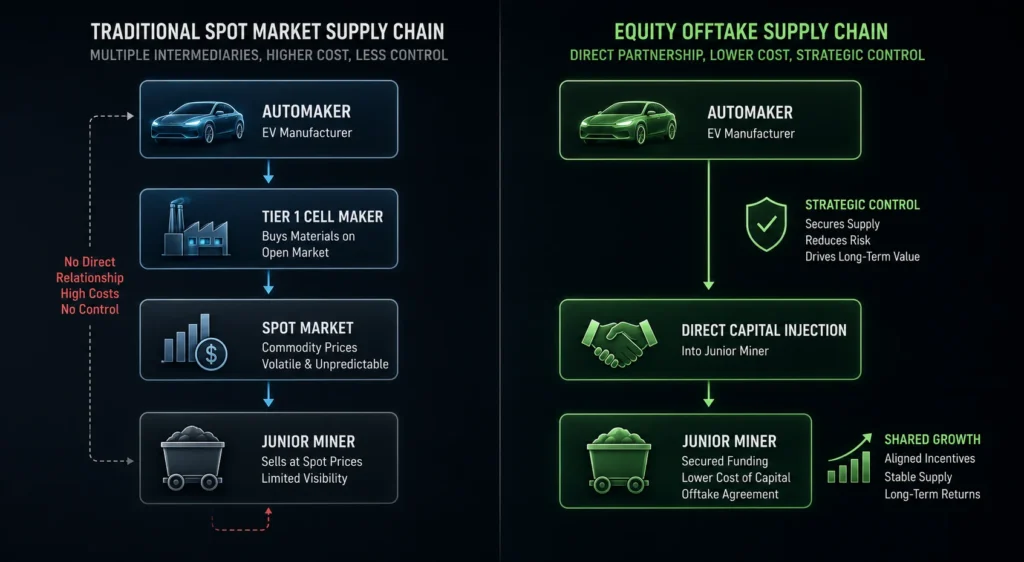
1. The Fundamental Problem: The “Bankability” Gap
Junior mining companies explore and find mineral deposits, but they do not have the $1 billion required to build the processing facilities. When they go to a commercial bank for a project finance loan, the bank refuses, citing the extreme volatility of lithium prices. Without a bank loan, the mine is never built, and the critical mineral deficit worsens.
2. The Insufficiency of Standard Offtakes
In the past, an OEM might sign a “Standard Offtake Agreement”—a promise to buy the lithium if the miner eventually produces it. However, in a high-interest-rate environment, a mere promise to buy is not considered “bankable collateral” by lenders, especially if the junior miner lacks the engineering track record to guarantee production.
3. The Core Mechanism: The Equity Injection
To bridge this gap, the OEM executes an Equity Offtake. The automaker injects hard cash (e.g., $500 million) directly into the junior mining company. This can be done by purchasing common shares of the parent company (Corporate Equity) or by forming a Joint Venture (JV) and buying a direct percentage of the specific mining site (Asset-Level Equity).
4. Technical Depth: Pre-Payment Securitization and Offtake Pricing
Alongside the equity, the OEM signs a multi-decade offtake agreement. The pricing mechanism in this agreement is critical. It is rarely fixed. It usually involves a “floor and ceiling” mechanism tied to an index.
- The Floor: Protects the miner, ensuring that even if lithium prices crash, the OEM must pay a price that covers the mine’s operating expenses (OpEx) and debt service.
- The Ceiling: Protects the OEM, ensuring that if lithium prices rocket to $80,000/ton, their purchase price is capped, securing a massive cost advantage over rivals buying on the spot market.
5. Real-World Consequences: Unlocking Sovereign Debt
The OEM’s cash injection and guaranteed offtake serve as the ultimate de-risking mechanism. Once a massive entity like General Motors takes a 38% stake and commits to a 20-year purchase, the project becomes “bankable.” Sovereign entities like the U.S. Department of Energy (DOE) Loan Programs Office will immediately step in and provide the remaining billions of dollars in debt financing required to break ground, finalizing the capitalization of the mine.
Examples of OEM Equity Offtakes in Mining
The theoretical pivot to upstream equity has aggressively materialized into headline-making mega-deals across the automotive landscape.
General Motors & Lithium Americas (Thacker Pass): This is the definitive blueprint for the modern equity offtake. GM committed a massive, multi-tranche investment to develop Thacker Pass in Nevada—the largest known lithium deposit in the U.S. By late 2024, GM restructured the deal to acquire a 38% asset-level ownership stake for $625 million, while signing a 20-year offtake agreement for up to 100% of Phase 1 production. This massive anchor commitment allowed Lithium Americas to unlock a monumental $2.3 billion loan from the DOE, effectively building the bedrock of the U.S. domestic lithium supply chain.
Stellantis’ Multi-Mineral Aggression: Stellantis (parent company of Chrysler, Jeep, and Peugeot) recognized it was behind in battery procurement and launched an aggressive global equity spree. They invested $155 million for a 14.2% stake in McEwen Copper in Argentina, took equity positions in Vulcan Energy Resources (geothermal lithium in Germany), and invested in Element 25 for manganese. Stellantis is uniquely utilizing equity not just to secure materials, but to secure geographically diverse, localized supply chains for both its European and North American manufacturing hubs.
Tesla’s Downstream Intrusion: While Tesla aggressively pursues standard offtake agreements (with giants like Albemarle and Piedmont Lithium), it has also moved past mere equity investments into direct physical processing. Tesla holds actual physical mining claims in Nevada and constructed a massive, billion-dollar in-house lithium refinery in Corpus Christi, Texas. Tesla is fundamentally blurring the line between automaker and chemical processing company to control the exact metallurgical specifications of its battery inputs.
Economic & Strategic Impact
The proliferation of these deals creates a severe Squeeze on Mid-Tier Competitors.
Mega-cap OEMs (like GM, Toyota, and Tesla) possess the multi-billion-dollar balance sheets required to inject $500 million into an unbuilt mine. Smaller, mid-tier automakers or pure-play startup EV companies simply do not have the free cash flow to execute equity offtakes.
As the mega-OEMs lock up 100% of the output of the most promising North American and allied junior mining projects for the next 20 years, mid-tier automakers will be forced to buy their materials entirely from the spot market. If geopolitical tensions flare and China restricts graphite or lithium exports, the spot market price will explode. The mega-OEMs will be financially insulated by their price-ceiling offtake agreements, while the mid-tier OEMs will be bankrupted by the raw material costs, leading to a massive consolidation of the global automotive industry.
Advantages
- Absolute Supply Security: In a resource-constrained world, securing physical volume is more important than price. An offtake ensures the OEM’s assembly lines will never shut down due to a lack of battery chemistry.
- Geopolitical Compliance: By investing in U.S., Canadian, or Australian mines, OEMs ensure their vehicles qualify for lucrative consumer tax credits (like the $7,500 IRA Section 30D credit) by avoiding Foreign Entities of Concern.
- Price Volatility Insulation: The pricing collars (floors and ceilings) embedded in these contracts allow CFOs to accurately model their battery cell costs five to ten years into the future, a feat impossible when relying on commodity spot markets.
- ESG Transparency: By owning the mine, the OEM can dictate the environmental and labor standards of the extraction process, ensuring their “green” vehicles aren’t built using materials mined with child labor or environmentally destructive practices.
Limitations
- Extreme Execution Risk: Mining is notoriously difficult. A junior miner might discover a massive lithium deposit, but fail entirely to engineer the complex chemical processing required to scale it. If the mine fails or suffers massive construction delays, the OEM loses its cash equity and is left without battery materials.
- Technological Obsolescence: An OEM might invest $1 billion into a nickel mine, only to watch the battery industry rapidly shift toward Lithium Iron Phosphate (LFP) or Sodium-Ion chemistries that do not use nickel at all, leaving the OEM holding a massively devalued, stranded asset.
- Core Competency Drift: Car companies are experts at mass manufacturing, marketing, and software. They are not geologists or metallurgists. By stepping into mining, they are taking on geological, permitting, and environmental risks they are not culturally equipped to manage.
Common Misconceptions
Misconception: The car company actually sends its own employees to dig the mine.
Reality: The OEM acts strictly as a capital partner and guaranteed customer. The junior mining company retains management control, operates the bulldozers, manages the environmental permitting, and runs the chemical processing facilities.
Misconception: These deals make EVs cheaper immediately.
Reality: Equity offtakes are long-term plays. The mines being funded today will not produce commercial-grade lithium for 5 to 7 years. These deals are about ensuring survival in the 2030s, not lowering the sticker price of a car next year.
Misconception: The spot market will completely disappear.
Reality: The spot market will remain active for marginal supply and smaller electronics manufacturers. However, for the millions of tons required for the automotive sector, the spot market will become a “market of last resort” rather than the primary procurement mechanism.
What Most People Miss
The critical bottleneck of Midstream Processing and Smelting.
Most public excitement focuses on the OEM buying the mine (the upstream extraction). What most analysts miss is that digging the rock out of the ground is only 20% of the battle.
The rock must be chemically crushed, roasted, and refined into battery-grade lithium carbonate or lithium hydroxide (the midstream processing). Currently, China controls over 60% of global lithium processing and over 80% of graphite processing. An OEM can own a pristine lithium mine in Nevada, but if they have to ship the raw ore to China to be chemically refined, the final battery still violates the IRA’s FEOC rules. True supply chain independence requires OEMs to fund not just the hole in the ground, but the multi-billion-dollar chemical refineries required to process the rock domestically.
Comparison Table
| Feature | Spot Market Procurement | Standard Offtake Agreement | Equity Offtake Agreement |
| Capital Required Upfront | None | Zero to Minimal | Massive ($100M – $1B+) |
| Supply Security | Very Low (Subject to market) | Moderate (Subject to mine survival) | Absolute (Top priority buyer) |
| Price Volatility | Extreme | Moderate (Usually indexed) | Low (Strict floors and ceilings) |
| Bankability for Miner | Zero | Low (Promises aren’t cash) | Extreme (Unlocks Govt/Bank Debt) |
| OEM Asset Liability | None | Contractual only | High (Holds direct equity risk) |
Case Study
Situation: General Motors committed to exclusively offering electric vehicles by 2035. To support this, they launched the Ultium battery platform, requiring millions of tons of lithium carbonate. Simultaneously, the U.S. government passed the Inflation Reduction Act (IRA), threatening to penalize GM if it sourced this lithium from established, Chinese-dominated supply chains.
Challenge: GM needed massive, secure, IRA-compliant lithium volumes. Lithium Americas possessed the rights to Thacker Pass in Nevada—a colossal domestic lithium deposit—but lacked the billions in capital required to build the actual mining and processing infrastructure.
Solution (The Thacker Pass Equity Offtake): In early 2023, GM agreed to a monumental $650 million equity investment across multiple tranches. As the project neared construction in late 2024, the deal was restructured: GM acquired a 38% direct asset-level ownership stake in Thacker Pass for $625 million (combining cash and letters of credit to secure the DOE loan reserves). In return, GM secured a 20-year offtake agreement for up to 100% of the Phase 1 output.
Outcome: The aggressive equity injection instantly solved the “bankability” gap for Lithium Americas, allowing them to secure a conditional $2.3 billion loan from the U.S. Department of Energy. By late 2025, the DOE deferred initial debt service, and GM modified its offtake to allow third-party sales for excess volumes, cementing the financial architecture. GM fundamentally secured a domestic, FEOC-free supply chain capable of supporting 1 million EVs annually, entirely insulating its Ultium platform from global lithium shortages for the next two decades.
Lessons Learned: The Thacker Pass deal established the modern paradigm of automotive procurement. It proved that in the era of strategic competition, OEMs cannot rely on Tier-1 battery suppliers to manage raw material risk. They must act as apex financial sponsors, utilizing their massive balance sheets to quite literally physically construct the domestic supply chains they require to survive.
Future Outlook
Next 12–24 Months
The era of FEOC Compliance Scrambling. As the strict Foreign Entity of Concern guidelines fully activate for critical minerals in 2025, any automaker relying on Chinese-processed graphite or lithium will see their vehicles disqualified from the $7,500 tax credit. We will witness a frantic rush by mid-tier OEMs to sign equity offtakes with any viable Western junior miner. Concurrently, major automakers will deploy specialized “tiger teams” of geologists and metallurgists to audit their massive investments, attempting to mitigate the extreme execution risks of the junior mining sector.
Next 3–5 Years
The scaling of Midstream Smelting and Processing JVs. The industry will realize that owning the rock is insufficient. OEMs will shift their capital from upstream extraction to midstream processing. We will see car companies forming direct Joint Ventures with chemical giants (like Albemarle or POSCO) to build massive, localized lithium hydroxide refineries and cathode-active material (CAM) plants in North America and Europe, physically connecting the mine output directly to the battery cell factories in a closed geographical loop.
Next 10 Years
The Commoditization of Automotive Capital Markets. By the mid-2030s, the world’s largest automakers will look less like assembly plants and more like vertically integrated commodity trading houses. Inside the headquarters of GM, Ford, and VW, massive raw-material trading desks will operate. Because these OEMs will legally own a massive percentage of the global critical mineral output via their decades-long equity offtakes, they will begin trading, swapping, and selling these minerals to each other, dictating the global pricing dynamics of lithium and copper long before the metals ever reach a traditional exchange.
Most Likely Scenario
The Equity Offtake represents the permanent end of the “Just-in-Time” automotive supply chain. The geopolitical reality of the 21st century dictates that critical minerals are matters of national security, not just commercial commodities. The automakers who successfully securitize their upstream assets today will dominate the electric era, while those who wait for the spot market to provide will be ruthlessly squeezed out of existence.
Key Takeaways
- Critical Mineral Equity Offtakes involve an automaker buying an ownership stake in an unbuilt mine and signing a legal contract to buy its future output for decades.
- Automakers are executing these deals to bypass the volatile commodity spot market, securing a guaranteed, predictable supply of lithium, copper, and nickel for their EV batteries.
- Junior mining companies require these deals because traditional banks refuse to lend them the billion dollars needed to build a mine without a guaranteed, massive corporate buyer.
- The U.S. Inflation Reduction Act (IRA) forces this trend by penalizing automakers who source battery materials from “Foreign Entities of Concern” (China), requiring them to aggressively fund new North American mines.
- General Motors pioneered this strategy with a $625+ million asset-level equity investment in the Thacker Pass lithium project in Nevada, securing 20 years of supply.
- The massive risk is that automakers are not geologists; if the mine fails to produce or battery chemistry changes, the automaker loses hundreds of millions in stranded capital.
Glossary
Capital Expenditure (CapEx): The massive upfront money required to physically build a mine, buy the bulldozers, and construct the chemical processing facilities.
Equity Offtake: A hybrid contract where a company promises to buy a product (offtake) and simultaneously purchases partial ownership in the company making the product (equity).
Foreign Entity of Concern (FEOC): A legal designation by the U.S. government targeting entities associated with adversary nations (primarily China, Russia, Iran, North Korea). EVs using minerals processed by FEOCs lose their tax credits.
Greenfield Mine: A completely new mining project starting from scratch on empty land, carrying high risk but massive potential upside.
Inflation Reduction Act (IRA) Section 30D: The U.S. law providing a $7,500 tax credit to consumers who buy EVs, but strictly tied to where the automaker sourced the battery’s critical minerals.
Spot Market: The public, global financial market where commodities like lithium and copper are bought and sold for immediate delivery at highly volatile, fluctuating prices.
Sources
Lithium Americas Corp: Lithium Americas Reaches Agreement with GM and U.S. DOE Regarding First Draw on DOE Loan (October 2025)
General Motors / Lithium Americas: Unlocking Thacker Pass: General Motors to Contribute Combined $625 Million in Cash and Letters of Credit to New Joint Venture (October 2024)
McCarthy Tétrault: Car and Battery Makers are Getting Closer to the Mining Business
ERA Environmental: What the Inflation Reduction Act Means for Auto Manufacturers
Critical Strategic Metals: Offtake Agreements for Critical Minerals: Structure, Financing & Supply Security