Advertisement
)
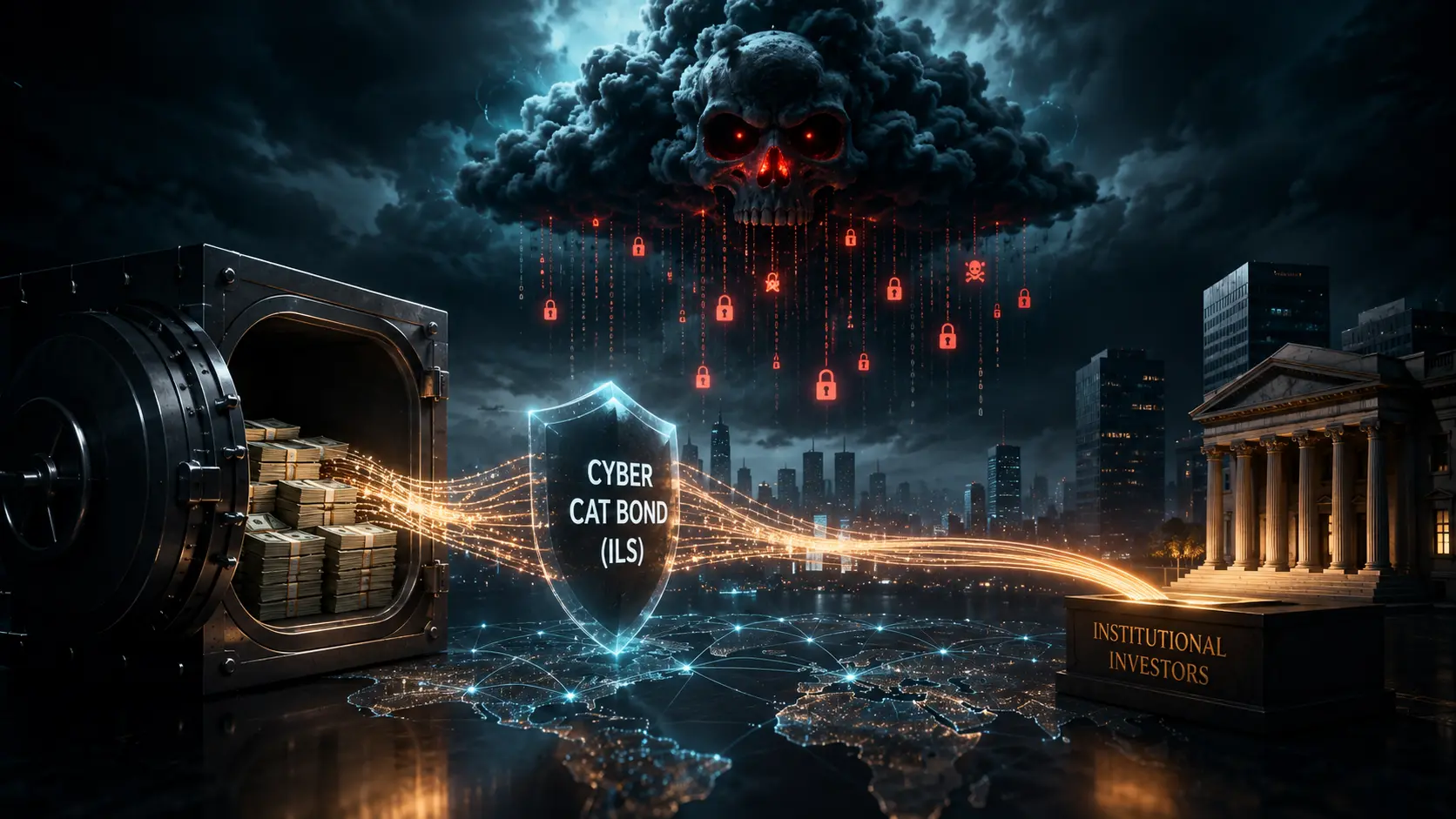

In 2017, the NotPetya ransomware worm escaped a Ukrainian accounting software update and caused $10 billion in global corporate damage within hours. For the insurance industry, it was a terrifying wake-up call. A single, well-executed cyberattack no longer just impacts one company; it cascades through global software supply chains, simultaneously triggering thousands of insurance claims that can instantly bankrupt the insurers themselves. The traditional insurance industry simply does not have the balance sheet to cover this level of systemic risk. If your corporation is relying entirely on standard cyber insurance to survive a catastrophic hack, that safety net is actively fraying.
Why should you care right now? Because Wall Street has stepped in to rescue the cybersecurity market by treating hackers like hurricanes. Financial institutions are bundling the threat of enterprise ransomware into high-yield bonds, allowing hedge funds and pension funds to place multi-million-dollar bets on global cyber resilience. This financial engineering is shifting the ultimate burden of a digital apocalypse away from insurance balance sheets and directly into the global capital markets.
What is Cyber Insurance-Linked Securities (ILS)?
Cyber Insurance-Linked Securities (ILS) are financial instruments that transfer the risk of catastrophic cyberattacks from insurance companies to capital market investors. Through structures like cyber catastrophe bonds, investors provide a pool of capital that pays out to the insurer if a massive, systemic hacking or ransomware event occurs, in exchange for high-yield interest payments.
At a Glance
- Concept: Turning the threat of a global cyberattack into a tradable, high-yield bond. Investors risk their principal in exchange for lucrative interest payouts.
- Why it matters: The corporate demand for cyber insurance far exceeds the supply of insurance money available. By tapping into the $100 trillion global capital markets, ILS provides the infinite financial backing required to insure the modern digital economy.
- Who uses it: Mega-insurers (Beazley, Chubb, Swiss Re) seeking reinsurance, and institutional investors (hedge funds, pension funds) seeking assets that are uncorrelated to the stock market.
- Biggest takeaway: Investors face a binary outcome. If a massive, systemic hack triggers the bond’s specific parameters, the investors lose their entire multi-million-dollar principal overnight to bail out the hacked corporations.
In Simple Words
Imagine a casino where people bet on disasters instead of sports.
An insurance company is terrified that a massive, global computer virus will infect all of its corporate clients on the exact same day. If that happens, the insurance company will go bankrupt paying out all the claims.
To protect itself, the insurance company goes to Wall Street and creates a Cyber Catastrophe Bond.
An investor (like a pension fund) puts $100 million into a locked, secure bank account. In exchange, the insurance company pays the investor $12 million a year in interest.
- Scenario A: For three years, no major global hack occurs. The investor collects $36 million in interest and gets their original $100 million back. A highly profitable investment.
- Scenario B: Tomorrow, a massive ransomware worm shuts down the global internet. The “trigger” is pulled. The locked bank account opens, and the investor’s $100 million is handed directly to the insurance company to pay for the damages. The investor loses everything.
Through this system, the risk of a digital meltdown is transferred from the insurance company to wealthy investors willing to gamble on cybersecurity.
Why This Matters
Corporate Risk Officers and Chief Information Security Officers (CISOs) are currently fighting a two-front war: hackers are becoming more sophisticated, and cyber insurance premiums are volatile and increasingly restrictive.
For Enterprise CIOs and Institutional LPs, the maturation of the Cyber ILS market is the definitive solution to the “capacity crunch.” Without capital market intervention, insurers are forced to strictly cap corporate payouts, leaving Fortune 500 companies dangerously underinsured against a prolonged cloud outage. The influx of ILS alternative capital directly stabilizes premium costs for end-users, ensuring that large-scale corporate cyber insurance remains financially viable throughout the late 2020s.
The Evolution of 144A Cyber Catastrophe Bonds
For decades, the ILS market was strictly associated with natural disasters (property catastrophe bonds). If an investor wanted an asset that did not crash when the stock market crashed, they bought a bond tied to Florida hurricanes or Japanese earthquakes.
The transition to cyber risk, formalized by the first 144A Cyber Cat Bonds in late 2023, represents a profound evolution in global finance. Unlike a hurricane, a cyberattack is not geographically contained. A vulnerability in a widely used operating system can impact a bank in London, a hospital in Tokyo, and a pipeline in Texas at the exact same millisecond. This “borderless accumulation” terrified traditional reinsurers. By securitizing this risk via ILS, the financial sector has officially classified cyber space as a catastrophic domain on par with the planet’s most violent natural phenomena.
How Cyber Insurance-Linked Securities Are Structured
Transforming a chaotic, digital threat into a strict, legally binding financial derivative requires airtight structural engineering. Here is the first-principles breakdown of a Cyber ILS transaction.
1. The Fundamental Problem: Systemic Accumulation Risk
Standard insurance relies on the law of large numbers; if you insure 100 houses against fire, only one is likely to burn down at a time, so the premiums of the 99 cover the losses of the one. Cyber breaks this law. Because companies share the same software (e.g., Microsoft Windows, CrowdStrike, AWS), a single zero-day exploit can cause all 100 “houses” to burn down simultaneously.
2. The Insufficiency of Traditional Reinsurance
Insurers normally buy “insurance for themselves” (reinsurance) to cover these mass events. However, traditional reinsurance balance sheets are too small to absorb a $50 billion to $100 billion global cloud outage. They needed a deeper pool of money.
3. The Core Mechanism: The 144A Cyber Cat Bond
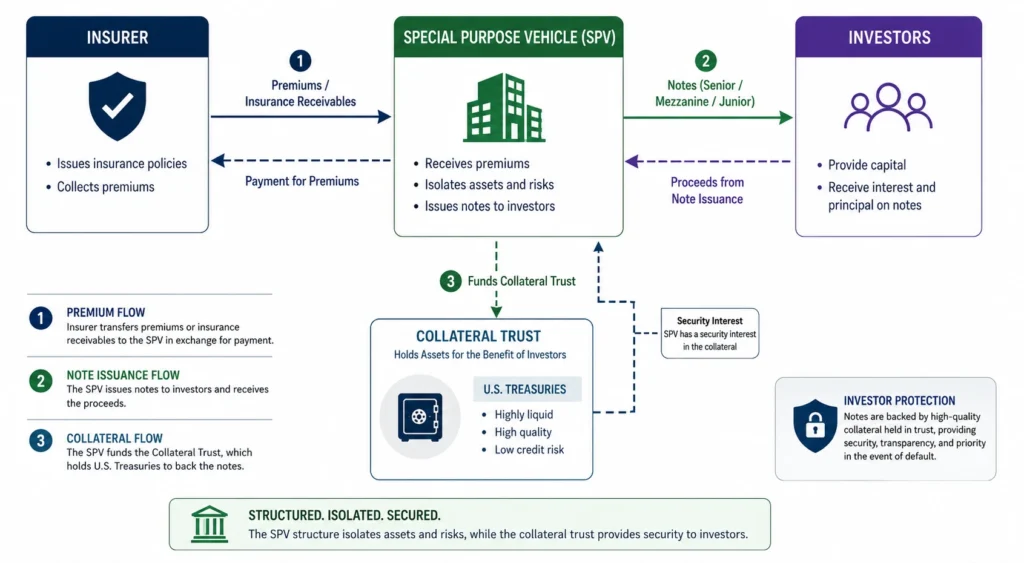
The insurer establishes a Special Purpose Vehicle (SPV) in a tax-neutral, regulatory-friendly jurisdiction (often Bermuda). The SPV issues notes to capital market investors under Rule 144A (a SEC regulation allowing the sale of securities to qualified institutional buyers). The cash raised is deposited into a highly secure, low-risk collateral trust (usually invested in U.S. Treasury money market funds).
4. Technical Depth: Trigger Mechanisms
The central architecture of the bond is the “Trigger”—the exact mathematical condition that dictates whether the investors lose their money.
- Indemnity Triggers: The bond pays out based on the actual financial losses suffered by the insurer. (e.g., If the insurer pays out more than $300 million in claims due to a single cyber event, the investors lose their principal). This is the most common current structure, as it perfectly hedges the insurer’s exact balance sheet risk.
- Parametric Triggers: The bond pays out based on an objective, external metric, regardless of actual financial loss. (e.g., If a specific public cloud provider experiences an uninterrupted outage exceeding 36 hours across three availability zones). Parametric triggers are faster to settle because they do not require months of claims auditing.
5. Real-World Consequences: The Coupon and the Principal
As long as the trigger is not hit, the SPV pays the investors a high-yield quarterly coupon (composed of the return on the U.S. Treasuries plus an insurance premium paid by the sponsor). If a massive ransomware worm breaches the trigger threshold, the SPV immediately liquidates the collateral trust, wiring the principal to the insurer to bail out the hacked corporations.
Commercial Applications of Cyber ILS Capital
The deployment of cyber alternative capital is actively altering the risk posture of the global digital supply chain.
Protecting Against Cloud Outages: As corporations abandon on-premise servers for AWS, Azure, and Google Cloud, a localized physical outage (like a fire at a major data center) or a malicious DDoS attack on cloud infrastructure presents a systemic threat. Cyber ILS provides the macroeconomic backstop that allows primary insurers to write “contingent business interruption” policies for Fortune 500 companies, guaranteeing lost revenue payouts even if the cloud goes dark globally.
Systemic Ransomware Hedging: When ransomware gangs (like LockBit or ALPHV) pivot from targeting single companies to targeting Managed Service Providers (MSPs), they can encrypt the data of thousands of downstream businesses instantly (as seen in the Kaseya VSA attack). Mega-insurers utilize cyber cat bonds to explicitly ring-fence their exposure to these specific, high-velocity ransomware aggregation events.
Nation-State Cyber Warfare: While traditional insurance policies often contain “Act of War” exclusions, attributing a cyberattack to a specific sovereign nation is notoriously difficult and legally ambiguous. Cyber ILS structures force the market to clearly define the parameters of a catastrophic event, creating rigid, objective financial definitions for what constitutes a manageable cybercrime versus an uninsurable act of digital warfare.
Economic & Strategic Impact
The primary economic friction in the Cyber ILS market is the Modeling Uncertainty Premium.
When an investor buys a hurricane bond, they are relying on 100 years of meteorological data and advanced physics models to calculate the probability of loss.
When an investor buys a cyber bond, the models are fighting a sentient adversary. Hackers constantly change their tactics, zero-day vulnerabilities are unknown unknowns, and software architectures evolve monthly. Because the predictive models (built by firms like CyberCube or RMS) are inherently less mature, institutional investors demand a massive “uncertainty premium.” They force insurers to pay incredibly high interest rates (often 10% to 15% above the risk-free rate) just to convince them to take the bet, making the cost of capital intensely expensive for the insurance industry.
Advantages
- Massive Capital Unlocking: Grants the cybersecurity industry direct access to the $100 trillion global capital markets, providing the infinite financial depth required to insure the modern internet.
- Uncorrelated Yield for Investors: The probability of a massive global ransomware attack is completely disconnected from inflation, interest rates, or the stock market, providing hedge funds with a mathematically pure portfolio diversifier.
- Credit Risk Elimination: Because the investor’s principal is parked in a secure collateral trust (U.S. Treasuries) from day one, the insurer faces zero counterparty credit risk; if the hack happens, the money is guaranteed to be there.
Limitations
- Immature Probabilistic Modeling: Cyber risk is synthetic and highly dynamic. Predicting the likelihood of a global software supply-chain hack relies on highly theoretical assumptions, making investors deeply nervous about hidden systemic risks.
- The “Act of War” Attribution Trap: If a devastating hack is triggered by a state-sponsored military intelligence unit, insurers may attempt to deny claims under the “Act of War” exclusion, sparking massive, multi-year litigation battles that trap the ILS investor’s capital in legal limbo.
- High Transaction Costs: Structuring a 144A catastrophe bond requires investment banks, specialized legal counsel, modeling agencies, and regulatory approval, costing millions of dollars in upfront friction and limiting the tool to only the largest mega-insurers.
Common Misconceptions
Misconception: Cyber ILS directly protects the end corporation.
Reality: Corporations do not typically issue cyber cat bonds. The corporation buys a standard cyber insurance policy. The insurance company issues the cyber cat bond to protect itself. It is a business-to-business (B2B) financial backstop.
Misconception: Hackers can target a bond to make it pay out.
Reality: While theoretically possible under a strictly parametric trigger, the overwhelming majority of current cyber cat bonds are “indemnity” triggered. This means the hacker would have to successfully breach hundreds of different, heavily defended corporations simultaneously to generate enough financial claims to trigger the bond, making targeted manipulation nearly impossible.
Misconception: The money sits in cash doing nothing.
Reality: The investor’s principal does not sit idle. It is actively invested in ultra-safe, short-term government securities (U.S. Treasuries). The investor earns the yield from the Treasuries plus the insurance premium, creating a highly lucrative, stacked return profile.
What Most People Miss
The transition toward Parametric Cloud Downtime Triggers.
Currently, almost all cyber ILS structures are indemnity-based (paying out based on the insurer’s actual financial losses).
What most analysts miss is that the future of the market is purely parametric. Waiting for a corporation to audit its losses, file a claim, and have an insurance adjuster verify it takes years. In a parametric structure, the payout is binary and instantaneous. If an independent monitoring agency (the “calculation agent”) confirms that Amazon Web Services (AWS) US-East-1 was down for exactly 24.0 hours, the bond triggers immediately. This eliminates the arduous claims adjustment process, removes the ambiguity of “Act of War” exclusions, and provides immediate, life-saving liquidity to the market within days of a digital disaster.
Comparison Table
| Feature | Traditional Cyber Reinsurance | Cyber Catastrophe Bonds (144A ILS) |
| Capital Source | Reinsurance company balance sheets | Global capital markets (Hedge Funds, Pensions) |
| Capacity Constraint | Strictly limited by corporate capital | Virtually infinite market depth |
| Counterparty Risk | Moderate (Reinsurer could go bankrupt) | Zero (Principal held in collateral trust) |
| Pricing Volatility | Fluctuates heavily with market cycles | Fixed multi-year locked pricing |
| Structuring Cost | Low (Standard B2B contracts) | Very High (Securities law, investment banking) |
Case Study
Situation: By the end of 2023, the global cyber insurance market was facing a severe capacity bottleneck. Ransomware attacks had surged, and primary insurers were terrified of systemic accumulation risk. Beazley, a leading specialist insurer operating in the Lloyd’s of London market, needed a massive influx of external capital to continue underwriting corporate cyber policies without overexposing its own balance sheet.
Challenge: Transferring systemic cyber risk to the capital markets had never been successfully executed under a full Rule 144A catastrophe bond structure, largely due to investor skepticism regarding the maturity of cyber risk modeling.
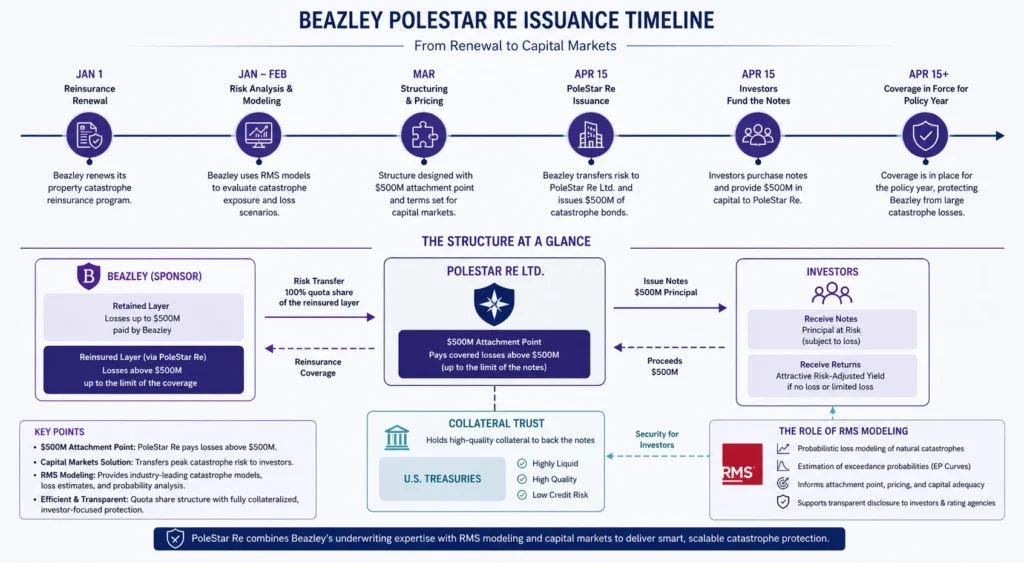
Solution (PoleStar Re): In late 2023, Beazley launched PoleStar Re Ltd., the market’s first 144A cyber catastrophe bond. They utilized an indemnity trigger structure, meaning the bond would pay out if Beazley’s total aggregate losses from catastrophic cyber events exceeded a predefined threshold (an attachment point of $500 million). Beazley partnered with leading cyber risk modeling firm RMS to rigorously quantify the probabilities, providing investors with the mathematical confidence required to participate.
Outcome: The issuance was a massive success, originally targeting $130 million but ultimately securing $140 million due to strong investor demand. It provided Beazley with secure, fully collateralized protection against systemic cyber events through the end of 2025, while offering investors a high-yield return uncorrelated to macroeconomic equities.
Lessons Learned: The PoleStar Re transaction broke the psychological barrier for institutional investors. It proved that systemic cyber risk—despite being a human-engineered threat rather than a natural phenomenon—could be mathematically modeled, reliably priced, and successfully securitized, laying the definitive foundation for the future of global cyber risk transfer.
Future Outlook
Next 12–24 Months
The era of Structural Standardization. Following the pioneering issuances by Beazley, Chubb, and Swiss Re, the next two years will witness a rush of followers. The investment banking syndicates and modeling firms (like CyberCube and RMS) will standardize the legal definitions of a “Catastrophic Cyber Event.” By harmonizing the language around exactly what constitutes a systemic hack versus an act of war, the friction of issuing a 144A bond will plummet, allowing mid-tier insurers to access the capital markets.
Next 3–5 Years
The explosion of Corporate-Sponsored Parametric ILS. By the late 2020s, the market will bypass the insurance companies entirely. Massive, technology-dependent conglomerates (like global airlines or financial clearinghouses) will begin issuing their own parametric cyber cat bonds directly to Wall Street. If a global software outage knocks an airline’s reservation system offline for 48 hours, the parametric bond will trigger automatically, wiring $200 million in emergency liquidity directly to the airline’s treasury without ever dealing with a traditional insurance adjuster.
Next 10 Years
The Real-Time Dynamic Risk Pricing. By the mid-2030s, the integration of AI telemetry will transform the secondary trading of cyber ILS. Hedge funds will not just hold these bonds to maturity; they will trade them daily. As global threat-intelligence feeds detect a massive spike in zero-day exploits actively targeting Microsoft Exchange servers, the secondary market price of a Microsoft-correlated cyber cat bond will instantly crash in real-time. The bond market will become a live, globally traded ticker reflecting the moment-to-millisecond security posture of the internet.
Most Likely Scenario
Cyber Insurance-Linked Securities are not a niche financial experiment; they are a structural necessity. As artificial intelligence drastically lowers the barrier to entry for launching sophisticated, global malware campaigns, the potential financial damage of a digital pandemic will far exceed the capitalization of the insurance industry. Wall Street’s alternative capital is the only mechanism large enough to underwrite the existential risk of the 21st-century digital economy.
Key Takeaways
- Cyber Insurance-Linked Securities (ILS) turn the risk of a catastrophic global cyberattack into a high-yield bond, shifting the financial burden from insurers to Wall Street investors.
- If a predefined hacking event occurs, the investors lose their multi-million-dollar principal, which is given to the insurer to pay the massive influx of corporate claims.
- The market was created to solve “systemic accumulation risk”—the terrifying reality that a single software flaw can bankrupt thousands of companies at the exact same moment.
- Cyber cat bonds rely on “Triggers.” Indemnity triggers pay out based on the insurer’s actual financial loss, while Parametric triggers pay out automatically if a specific event happens (e.g., a 24-hour cloud outage).
- The primary roadblock is “Modeling Uncertainty.” Hackers are sentient and constantly changing tactics, making it much harder to mathematically predict a cyberattack than a hurricane.
- In late 2023, Beazley launched PoleStar Re, the first 144A cyber catastrophe bond, officially proving that institutional investors are willing to bet massive capital on cybersecurity resilience.
Glossary
Attachment Point: The specific financial threshold of losses that an insurance company must suffer before a catastrophe bond “triggers” and the investors’ principal begins to be wiped out to cover the claims.
Catastrophe Bond (Cat Bond): A high-yield debt instrument that raises money in case of a catastrophe (traditionally hurricanes or earthquakes, now cyber). If the event occurs, the principal is forgiven and the issuer (insurer) keeps the money.
Indemnity Trigger: A bond payout mechanism based strictly on the actual, audited financial losses that the sponsoring insurance company experiences.
Insurance-Linked Securities (ILS): Financial instruments whose values are driven by insurance loss events, allowing insurers to transfer risk directly to capital market investors.
Parametric Trigger: A bond payout mechanism that triggers automatically if an objective, measurable metric is met (e.g., a specific cloud provider is offline for 48 hours), regardless of the actual financial damage caused.
Systemic Accumulation Risk: The extreme danger in insurance where a single underlying vulnerability (like a flaw in Windows or AWS) causes thousands of policyholders to file claims at the exact same time.
Sources
[1] Artemis: Cyber Catastrophe Bond Market Directory and Issuance Data (2024/2026 Analysis)
[2] Beazley Group: PoleStar Re Ltd. 144A Cyber Catastrophe Bond Issuance Briefing
[3] CyberCube: Modeling Systemic Cyber Risk for the ILS and Reinsurance Markets
[4] Swiss Re Institute: The Evolution of Cyber Risk Transfer and Alternative Capital
[5] NAIC (National Association of Insurance Commissioners): Insurance-Linked Securities and Cyber Risk Constraints