Advertisement
)

Silicon Valley has successfully built the brain of the humanoid robot. Thanks to Large Language Models and advanced neural networks, robots can now see, reason, and understand complex human commands. But when you ask a prototype robot to pick up a fifty-pound box, step off a curb, or thread a needle, it faces a catastrophic physical crisis. The bottleneck in the artificial intelligence revolution is no longer the software; it is the mechanical knees, hips, and elbows. Standard electric motors spin incredibly fast, but they are incredibly weak. To lift a heavy box without the motor violently burning out, the robot requires a gearbox to convert that high-speed spinning into slow, unstoppable torque.
If you put a standard car gearbox inside a robot, the robot will fail instantly. Standard gears have a tiny bit of “slop” or wiggle room between the metal teeth, known as backlash. A fraction of a millimeter of slop in a robot’s shoulder magnifies into several inches of chaotic shaking at its fingertips, making it impossible to perform precision tasks. Why should you care right now? Because solving this physical limitation relies entirely on a highly obscure, monopolized sector of mechanical engineering: zero-backlash cycloidal and harmonic drives. The multi-trillion-dollar promise of putting a humanoid robot in every factory and home on Earth relies entirely on mass-producing these exact, microscopic gears.
What are Cycloidal and Harmonic Drives?
Cycloidal and harmonic drives are specialized, high-precision mechanical gearboxes used in advanced robotics to reduce the high-speed spinning of an electric motor into slow, incredibly powerful, zero-backlash torque. They act as the highly durable “joints” that allow humanoid robots and industrial arms to lift heavy loads with microscopic precision.
At a Glance
- Concept: Utilizing radically different mechanical physics—bending metal cups and wobbly, off-center discs—to create gear reductions that never slip and have zero play.
- Why it matters: A humanoid robot has 20 to 40 degrees of freedom (joints). If a standard strain-wave gear costs $1,500, the gearbox cost alone is $60,000 per robot, rendering mass commercialization impossible.
- Who uses it: Tesla (Optimus), Boston Dynamics (Atlas), Figure AI, and traditional industrial automation giants like FANUC and Yaskawa.
- Biggest takeaway: The two technologies serve different anatomical purposes. Harmonic drives are lightweight and precise (perfect for wrists and elbows), while cycloidal drives can absorb massive physical impacts without shattering (perfect for hips and knees).
In Simple Words
Imagine two standard gears with normal teeth interlocking. Because the metal teeth must slide past each other, there has to be a tiny gap between them. If you hold one gear still, you can slightly wiggle the other gear back and forth. That wiggle is called backlash. In a robot arm, that wiggle means the robot’s hand will violently shake when trying to hold a cup of coffee.
A Harmonic Drive eliminates the wiggle by bending metal.
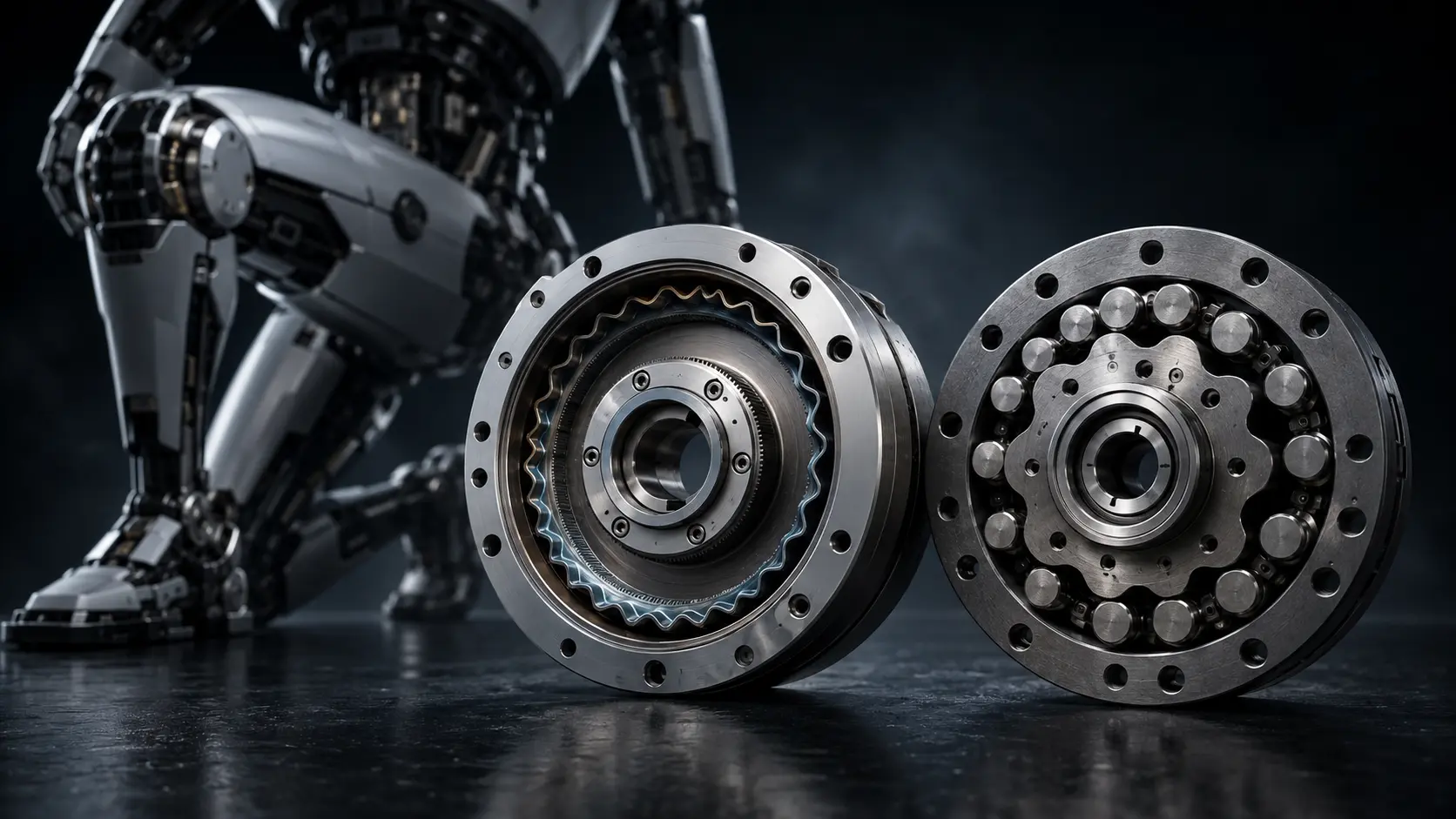
Instead of two rigid gears, it uses a rigid outer ring with teeth, and a flexible, squishy metal cup inside it (the flexspline) with slightly fewer teeth. An oval-shaped plug spins inside the squishy cup, pushing the flexible teeth outward so they perfectly, tightly mesh with the rigid outer ring in exactly two places. Because the teeth are physically jammed together under pressure, there is zero wiggle room.
A Cycloidal Drive eliminates the wiggle by avoiding traditional gear teeth altogether.
Instead of sharp teeth, it uses smooth, wavy-edged discs that wobble off-center around a circle of sturdy metal pins. Because the disc is always pushing smoothly against multiple pins at the exact same time, the load is spread out, creating zero wiggle and allowing the joint to survive massive, heavy impacts (like a robot jumping up and down).
Why This Matters
The world is currently witnessing a venture capital gold rush into humanoid robotics, but the financial models are fundamentally constrained by the Bill of Materials (BOM).
To make a humanoid robot commercially viable as a warehouse worker or home assistant, the retail price must fall below $25,000. The actuators (the motor, the gearbox, and the controller) make up roughly 60 to 70 percent of the robot’s total hardware cost.
For hardware investors and supply chain executives, mastering the manufacturing of these gearboxes is the most lucrative opportunity of the decade. Historically, the strain-wave gear market was a near-monopoly controlled by a single Japanese company (Harmonic Drive Systems Inc.). Now, as Tesla, Figure AI, and dozens of Chinese robotics firms attempt to scale to millions of units, they are actively trying to break this monopoly. The companies that can precision-machine cycloidal and harmonic drives at scale, dropping the cost from thousands of dollars to hundreds of dollars per joint, will control the physical hardware layer of the AI economy.
The Global Supply Chain of Robotic Actuators
The mechanics of advanced robotics represent a severe geopolitical supply chain chokepoint.
Japan has historically dominated global precision robotics, with companies like Harmonic Drive Systems and Nabtesco (which dominates the cycloidal drive market) controlling the overwhelming majority of the global market share for industrial robotic joints.
However, China has designated humanoid robotics and automation as a cornerstone of its “Made in China 2025” and subsequent economic policies. Chinese domestic manufacturers, such as Leaderdrive, are aggressively reverse-engineering and scaling strain-wave technology. By subsidizing the mass production of these complex metallurgical components, China intends to commoditize the robotic joint, attempting to seize control of the humanoid hardware supply chain in the exact same way they captured the global solar panel and battery markets.
How Harmonic Drives and Strain-Wave Gears Work
Creating massive torque without a millimeter of backlash requires manipulating the fundamental fatigue limits of metallurgy. Here is the first-principles breakdown of the Harmonic Drive (Strain-Wave Gear).
1. The Fundamental Problem: Speed vs. Torque
An electric motor is highly efficient when spinning at 3,000 to 5,000 Revolutions Per Minute (RPM), but it generates very little torque. A robot’s elbow needs to move at maybe 30 RPM, but it needs immense torque to lift a 20-pound weight at the end of a long lever arm. This requires a gear reduction ratio of roughly 100:1.
2. The Insufficiency of Planetary Gears
Standard planetary gearboxes can achieve a 100:1 ratio, but they require multiple “stages” (gears stacked on gears). This makes the gearbox incredibly long, bulky, and heavy. More importantly, every gear stage adds mechanical backlash. A multi-stage planetary gear simply cannot provide the microscopic precision required for a humanoid hand.
3. The Core Mechanism: The Strain-Wave components
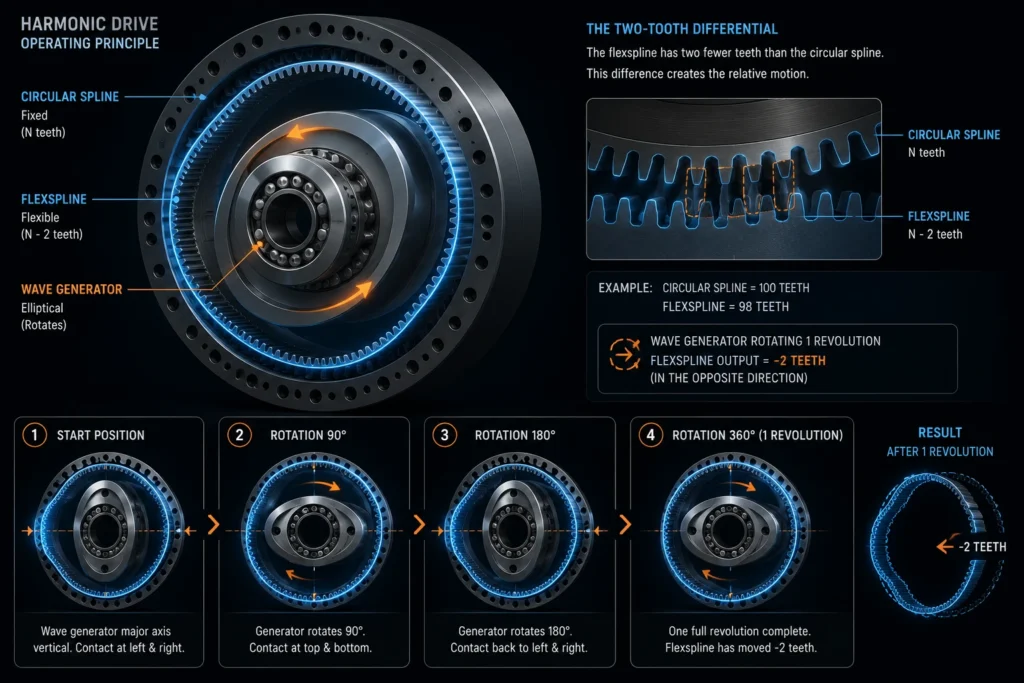
The harmonic drive achieves a 100:1 reduction in a single, incredibly flat stage using three components:
- The Wave Generator: An elliptical (oval) steel plug surrounded by ball bearings, attached directly to the high-speed spinning electric motor.
- The Flexspline: A flexible, thin-walled metal cup with external gear teeth.
- The Circular Spline: A rigid, thick metal outer ring with internal gear teeth.
4. Technical Depth: The Two-Tooth Differential
The magic lies in the math: the rigid outer ring has exactly two more teeth than the flexible cup inside it.
When the motor spins the oval wave generator, it deforms the flexible cup into an oval. The teeth of the flexible cup are pushed outward and interlock perfectly with the rigid outer ring at opposite ends of the oval.
As the oval wave generator completes one full 360-degree high-speed rotation, the flexible cup is forced to walk along the outer ring. Because it has two fewer teeth, the flexible cup physically lags behind by exactly two teeth. If the outer ring has 200 teeth, it takes 100 full rotations of the high-speed motor to make the flexible cup complete just one slow, incredibly powerful 360-degree rotation.
5. Real-World Consequences: Torque Density and Fatigue
The result is astonishing torque density: immense power in a gearbox the size of a hockey puck with absolutely zero backlash. However, the flexspline is literally bending its shape thousands of times a minute. This introduces extreme material fatigue. The entire science of harmonic drives relies on proprietary, highly guarded metallurgical alloys capable of constantly bending for decades without snapping under the strain.
Real-World Robotics: Tesla Optimus & Boston Dynamics
These gearboxes dictate the anatomical capabilities of the world’s most advanced machines.
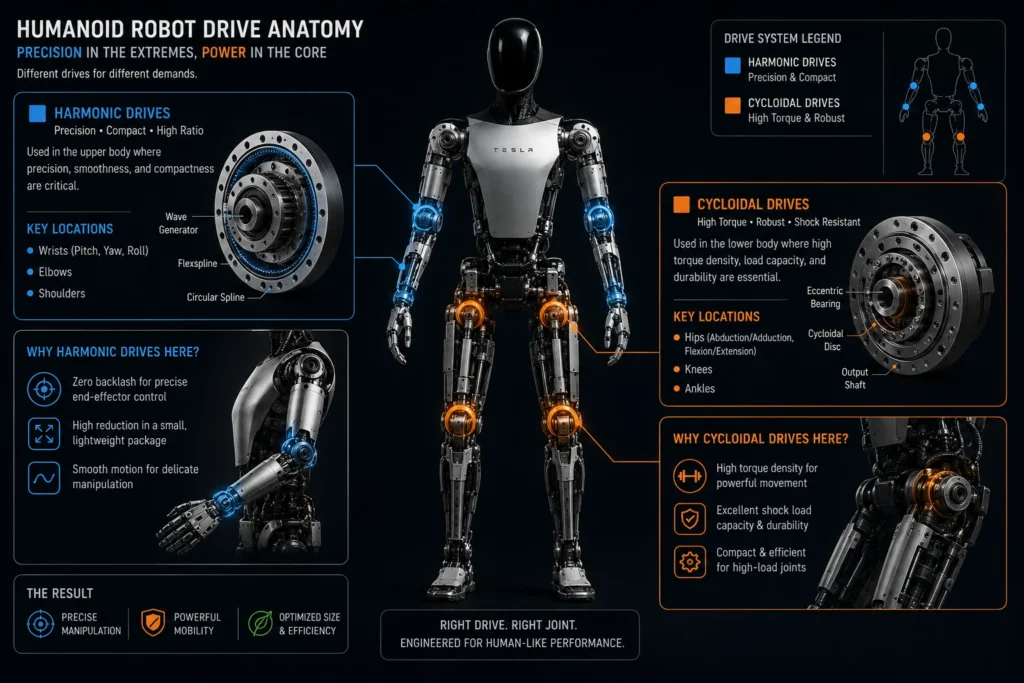
Tesla Optimus (Custom Actuators): When Tesla began designing the Optimus humanoid, they realized that buying off-the-shelf industrial actuators would ruin their target unit economics and add too much weight. Tesla chose to vertically integrate, designing their own custom rotary actuators. They utilize harmonic drives in the arms and wrists where lightweight precision is paramount, allowing the robot to manipulate delicate objects like eggs or batteries without crushing them.
Boston Dynamics Atlas (The Electric Pivot): Boston Dynamics famously relied on complex, heavy hydraulic fluids to power the explosive backflips of its legacy Atlas robot. However, hydraulics are prone to leaking, extremely loud, and require massive centralized pumps. In 2024, Boston Dynamics retired the hydraulic model and unveiled an entirely electric Atlas, relying on custom high-torque electric joints (utilizing cycloidal and strain-wave principles) to achieve smoother, quieter, and vasty more commercially viable 360-degree joint rotations.
Industrial Exoskeletons: Medical and industrial exoskeletons strap robotic joints directly parallel to human joints to help paralyzed patients walk or workers lift heavy car parts. Because these joints must sit flush against the human body, planetary gears are too bulky. Strain-wave gears provide the ultra-flat, “pancake” profile necessary to build sleek, wearable robotics without adding excessive lateral width to the human frame.
Economic & Strategic Impact
The tension between Harmonic Drives and Cycloidal Drives is defined by the Shock-Load Tolerance Matrix.
If a humanoid robot is carrying a 50-pound box and accidentally trips, the sudden impact of its foot hitting the ground sends a massive, instantaneous shockwave up its leg.
If the robot’s knee uses a Harmonic Drive, the microscopic teeth of the thin, flexible metal cup (flexspline) will instantly shear off under the immense shock load, completely destroying the $1,500 joint.
This forces roboticists to use Cycloidal Drives in the lower body (ankles, knees, hips). Because cycloidal drives use thick, solid metal lobes rolling against heavy steel pins instead of tiny teeth, they can absorb 500% shock loads without breaking. However, cycloidal drives are traditionally heavier and suffer from microscopic vibrations (torque ripple). The strategic holy grail for robotics hardware startups is engineering a hybrid cycloidal drive that is light enough for humanoid legs, perfectly smooth, and cheap enough to mass-produce.
Advantages
- Zero Backlash: Harmonic drives provide absolute, perfect positioning accuracy. If the software tells the robotic hand to stop exactly 1.002 millimeters from an object, the mechanical joint halts with zero wiggle.
- Extreme Torque Density: Both systems provide massive gear reduction ratios (50:1 to 160:1) in a single, highly compact stage, drastically reducing the physical size of the robot’s limbs.
- High Shock Tolerance (Cycloidal): Cycloidal drives distribute physical loads across a massive surface area of rolling pins simultaneously, allowing the joint to survive explosive physical impacts and heavy industrial lifting without shattering.
Limitations
- Material Fatigue (Harmonic): The flexible metal cup must constantly bend out of shape. If the metallurgy is slightly flawed during manufacturing, the cup will suffer microscopic stress fractures and eventually fail catastrophically.
- Torque Ripple (Cycloidal): Because of the slightly wobbly, eccentric motion of the internal discs, cycloidal drives can introduce tiny, rhythmic vibrations into the robot’s movement, which is unacceptable for ultra-precise surgical or optical robots.
- Manufacturing Complexity: The tolerances required to build these gears are microscopic. You cannot 3D print them or cast them cheaply. They require highly advanced, expensive CNC machining and proprietary heat treatments, which forms the massive bottleneck in global supply chains.
Common Misconceptions
Misconception: Standard gears are fine for robots; we just need better AI.
Reality: The best AI in the world is useless if the physical hardware cannot execute its commands accurately. If a robot’s shoulder has 1 degree of backlash, the hand will miss a target by several inches. The mechanical hardware is a hard, physical ceiling on AI capability.
Misconception: Harmonic and Cycloidal drives do the exact same thing.
Reality: They solve the same problem (high torque, low speed) but serve different anatomical functions. Harmonic drives are the “wrists and elbows” (high precision, low weight, fragile). Cycloidal drives are the “knees and hips” (heavy, high torque, impact resistant).
Misconception: Anyone can build these gearboxes.
Reality: While the basic patents for harmonic drives expired decades ago, the specific “recipes” for the flexible metal alloys and the heat-treatment processes are fiercely guarded trade secrets. Replicating the design is easy; replicating the 50,000-hour operational lifespan without the metal snapping is incredibly difficult.
What Most People Miss
The necessity of Backdrivability.
In a traditional gearbox (like a worm gear), if you push on the output shaft, the gear locks up; it cannot run backward.
What most people miss is that humanoid robots absolutely must be backdrivable. If a human bumps into the robot’s arm, or if the robot trips, the joint must be able to act like a spring and yield to the force, transmitting the physical impact backward through the gearbox into the motor. If the joint is rigidly locked and cannot be driven backward by external forces, the sudden impact will snap the robot’s metal bones. Advanced cycloidal and harmonic designs must be specifically tuned to allow for this physical compliance, enabling the software to actively “feel” the environment through the resistance in the gears.
Comparison Table
| Feature | Standard Planetary Gear | Strain-Wave (Harmonic) Drive | Cycloidal Drive |
| Backlash (Precision) | High (Noticeable wiggle) | Zero (Absolute precision) | Near-Zero |
| Shock Load Tolerance | Moderate | Poor (Flexspline tears easily) | Excellent (Withstands impacts) |
| Physical Profile | Long, bulky (Multi-stage) | Ultra-flat, pancake profile | Moderate, heavier |
| Primary Limitation | Size and inaccuracy | Material fatigue of the metal cup | Microscopic vibrations (torque ripple) |
| Humanoid Placement | Rarely used (Neck/Sensors) | Wrists, Elbows, Shoulders | Hips, Knees, Ankles |
Case Study
Situation: When developing the Optimus humanoid robot, Tesla’s engineering team faced a massive integration challenge. The human knee is an evolutionary marvel of shock absorption and torque. Replicating it mechanically required a gearbox that could lift the robot’s 160-pound frame from a squatting position while surviving the explosive, repeated impacts of walking on hard concrete.
Challenge: Standard harmonic drives, while precise enough for the task, were completely unsuited for the physical trauma of walking; the flexible metal components would shatter under the shock load. Traditional cycloidal drives were tough enough, but they were too heavy and bulky to fit inside the sleek anatomical constraints of the robot’s thigh.
Solution (Custom Integration): Tesla’s hardware team abandoned the idea of buying off-the-shelf industrial parts. They designed their own proprietary, highly integrated rotary actuators. By analyzing the exact kinematic forces of a human gait, they engineered custom cycloidal-style drives for the lower body that optimized weight without sacrificing the load-bearing pin architecture required for impact survival.
Outcome: By vertically integrating the design, Tesla achieved a dual victory. They secured the mechanical shock-tolerance required for bipedal locomotion, while simultaneously removing the massive profit margins charged by legacy Japanese gearbox monopolies, paving the theoretical path toward a $20,000 mass-market humanoid.
Lessons Learned: The Optimus project proved that the humanoid robot is fundamentally an exercise in mechanical packaging. The barrier to entry for the robotics industry is no longer writing the code; it is possessing the metallurgical manufacturing prowess to compress hundreds of pounds of torque into a joint the size of a human fist.
Future Outlook
Next 12–24 Months
The era of Chinese Hardware Commoditization. Over the next two years, the robotics hardware market will experience severe price compression. Backed by state subsidies, Chinese manufacturers will flood the market with highly capable, low-cost strain-wave and cycloidal drives. While these components may not initially match the 50,000-hour lifespan of premium Japanese or German parts, they will be perfectly adequate for consumer-grade humanoids and rapid prototyping, driving the BOM of robotic joints down by 50 to 70 percent.
Next 3–5 Years
The optimization of Sensor-Fused Actuators. Currently, the motor, the gearbox, and the torque sensor are often assembled as separate parts. By the late 2020s, manufacturers will achieve absolute vertical integration, delivering a single, unified “Smart Joint.” These joints will embed ultra-high-resolution torque sensors directly into the cycloidal pins and harmonic flexsplines, allowing the AI neural network to physically “feel” microscopic resistance across the entire body in real-time, unlocking human-level dexterity.
Next 10 Years
The transition to Direct-Drive and Artificial Muscle. By the 2030s, the industry will attempt to move beyond physical gears entirely. Massive advancements in electromagnetic motor topologies (like axial flux motors) will attempt to create “direct-drive” joints that generate enough native torque to eliminate the need for a gearbox completely. Concurrently, material scientists will push the boundaries of electroactive polymers (artificial muscles) that contract like human tissue when exposed to electricity, fundamentally replacing cold, grinding metal gears with silent, biologically inspired locomotion.
Most Likely Scenario
For the next decade, the cycloidal and harmonic drive duopoly will remain the inescapable physical foundation of the AI robotics revolution. As humanoids move out of R&D labs and onto factory floors, the companies that control the high-precision CNC machining and proprietary metallurgy of these zero-backlash gearboxes will quietly become the most valuable, heavily guarded hardware suppliers in the global economy.
Key Takeaways
- Cycloidal and harmonic drives are advanced gearboxes that convert the fast, weak spin of an electric motor into slow, immense torque with zero mechanical “wiggle” (backlash).
- Zero backlash is mandatory for humanoid robots; without it, the robot’s limbs will shake uncontrollably, making precision tasks impossible.
- Harmonic drives achieve this by bending a flexible metal cup inside a rigid ring. They are ultra-light and precise, but fragile, making them perfect for robotic wrists and elbows.
- Cycloidal drives use wobbling discs and rolling pins to distribute weight. They are heavier but can survive massive physical impacts, making them mandatory for robotic hips and knees.
- The global supply chain for these high-precision parts is a severe bottleneck, historically monopolized by a few elite Japanese manufacturers, driving up the cost of humanoid robots.
- The ultimate goal for robotics companies is to scale domestic or vertically integrated manufacturing to crash the cost of these joints from thousands of dollars down to hundreds of dollars.
Glossary
Backdrivability: The ability of a mechanical joint to yield and be pushed backward by an external force. Mandatory in robotics to prevent gears from shattering during a fall or unexpected impact.
Backlash: The microscopic gap or clearance between the teeth of standard gears. It causes physical “slop” or “play” that ruins precision in robotics.
Cycloidal Drive: A high-torque gearbox that reduces speed using eccentric (off-center) rotating discs and rolling pins instead of standard gear teeth, offering extreme shock resistance.
Degrees of Freedom (DoF): The number of independent physical movements a robot can make. A human arm has 7 DoF. Every DoF in a robot requires its own motor and high-precision gearbox.
Flexspline: The critical component of a harmonic drive; a thin, flexible metal cup with gear teeth that constantly bends and deforms to lock into the outer ring, creating zero-backlash torque.
Harmonic Drive (Strain-Wave Gear): A compact gearbox that achieves massive gear reduction ratios in a single stage by utilizing a continuously bending flexible cup inside a rigid circular spline.
Frequently Asked Questions
Why can’t robots just use the gears found in cars?
Car gears have backlash (slop between the teeth) and are designed to spin very fast in one continuous direction. Robot joints must rapidly change direction back and forth by fractions of a degree with absolute, microscopic precision, which standard car gears physically cannot do without severe shaking.
Do these gearboxes need lubrication?
Yes. Despite their advanced engineering, they are still metal grinding against metal. They require highly specialized, proprietary greases. A major cause of failure in industrial robotic arms is the degradation of the grease inside the strain-wave gear, leading to metal-on-metal friction and total joint failure.
Why are they so expensive?
The engineering tolerances are brutal. The flexible metal cup in a harmonic drive must bend millions of times without snapping. This requires extremely pure metal alloys, microscopic CNC machining, and proprietary heat-treatment processes that only a few companies on Earth have mastered at scale.
Which is better: Cycloidal or Harmonic?
Neither is “better”; they are anatomically specific. Harmonic drives are lightweight and perfect for the upper body (arms/wrists). Cycloidal drives are bulky and heavy but can take a massive beating, making them essential for the lower body (legs/hips) to absorb the impact of walking.
Will AI eventually fix the mechanical problems?
Software cannot fix physics. AI can learn to compensate slightly for mechanical wear and tear, but if a gear has physical backlash or if a joint snaps under the weight of a box, no amount of software or neural network training can stop the robot from dropping it.
Sources
[1] IEEE Robotics and Automation Magazine: Actuation Principles for Humanoid Robotics: Harmonic vs. Cycloidal Drives (2025/2026 Analysis)
[2] Tesla, Inc.: Optimus Humanoid Robot Architecture and Custom Actuator Design (AI Day Engineering Briefs)
[3] Harmonic Drive Systems Inc.: Strain-Wave Gearing Mechanisms and Fatigue Limits
[4] Nabtesco Corporation: Precision Cycloidal Reducers for Heavy Industrial Automation
[5] PitchBook: The Hardware Bottleneck: Supply Chain and BOM Economics in Mass-Market Humanoid Robotics (Q1 2026 Report)