Advertisement
)
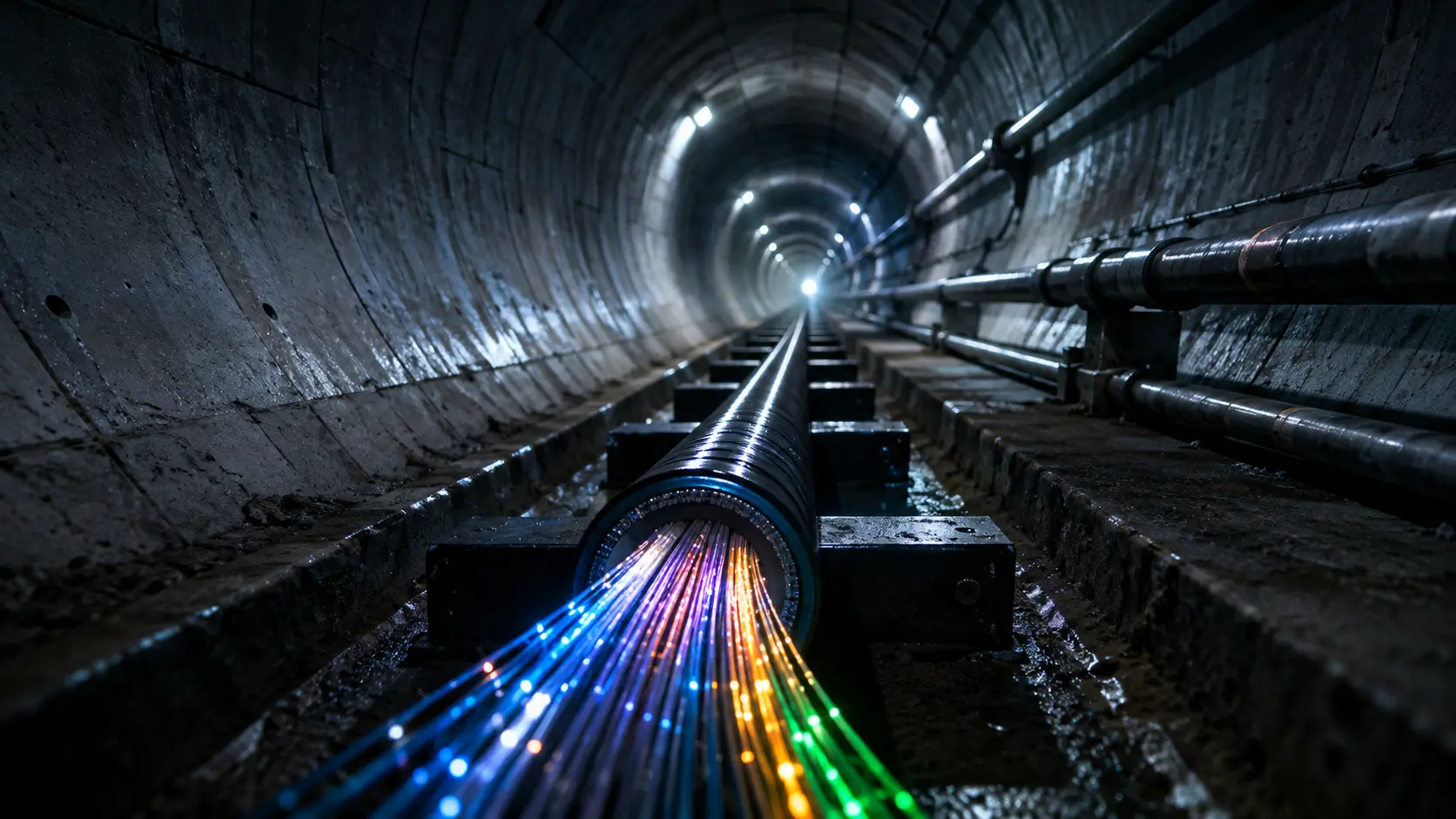

In global financial markets, a single millisecond is an eternity. When a major macroeconomic event moves the price of a stock in New York, the corresponding futures contract in Chicago shifts instantly. The first algorithmic trading firm to recognize this discrepancy and beam a signal between the two cities secures millions in arbitrage profit; the second firm wins absolutely nothing. The problem is that the public internet is a chaotic, winding maze of commercial routers, shared traffic, and unpredictable delays. To win this ruthless speed war, financial titans realized they had to bypass the telecom carriers entirely. They began quietly leasing “dark” fiber—dormant glass cables buried underground—and lighting it with their own proprietary lasers to create private, hyper-direct digital highways.
Why should you care right now? Because the demand for these private optical networks is no longer driven solely by Wall Street. As the artificial intelligence arms race accelerates, tech giants are aggressively acquiring every mile of available dark fiber to seamlessly synchronize massive, multi-billion-dollar GPU clusters across different cities. To understand the true physical infrastructure of the modern digital economy, you must look at the invisible, unlit glass cables actively reshaping the geography of data.
What are Dark Fiber Networks?
Dark fiber networks are dormant, unlit fiber-optic cables that telecom providers lease to private enterprises. Unlike standard commercial internet services where bandwidth is shared, the lessee assumes total control over the dark fiber, installing their own optical transmission equipment to achieve absolute security, unlimited scalability, and ultra-low latency.
At a Glance
- Concept: Renting the bare physical glass cable in the ground, rather than buying an active internet connection from an Internet Service Provider (ISP).
- Why it matters: Standard internet connections route traffic through multiple telecom switches, adding microscopic delays (latency). Dark fiber allows a company to shoot a laser in a straight line from Point A to Point B with zero routing interruptions.
- Who uses it: High-Frequency Trading (HFT) hedge funds, hyperscale cloud providers (AWS, Microsoft, Google), and critical national defense networks.
- Biggest takeaway: The capacity of a dark fiber cable is theoretically infinite. The lessee can continuously upgrade the optical lasers on either end of the cable (from 100G to 800G to 1.6T) without ever having to dig up the ground to lay new wires.
In Simple Words
Think of the public internet like a city bus system. It is cheap, and it goes everywhere, but it stops at dozens of stations, picks up other passengers, and takes a winding route through traffic.
If you buy a premium commercial business internet line, it is like taking a taxi. It is faster and more direct, but you are still subject to the city’s traffic lights, speed limits, and the driver’s chosen route.
Leasing Dark Fiber is the equivalent of buying your own private, underground tunnel between your house and your office.
The tunnel has no lights and no cars. The telecom company simply hands you the keys to the empty tunnel. You have to buy your own high-speed sports car (the optical lasers and networking gear) to drive through it. Because it is your private tunnel, there are no traffic lights, no speed limits, and no other cars. You can drive as fast as the laws of physics allow, taking the absolute straightest line possible from origin to destination.
Why This Matters
For Network Architects and HFT Quants, network latency translates directly into monetary value.
In electronic trading, algorithms exploit price discrepancies between the Chicago Mercantile Exchange (CME) and the matching engines in New Jersey (NASDAQ/NYSE). If an algorithm’s data packet is delayed by a network switch belonging to a commercial ISP, a competing algorithm claims the trade. By leasing dark fiber, a hedge fund assumes total control of the physical layer (Layer 1 of the OSI model). They dictate the exact routing path, strip out all unnecessary networking equipment, and optimize the hardware to transmit data at the absolute edge of optical physics.
For Tech Investors, dark fiber represents a highly constrained, incredibly valuable real asset class. As the physical footprint of AI data centers exceeds the power capacity of single municipal grids, tech companies must split their GPU clusters across multiple cities. To make these geographically separated GPUs function as a single supercomputer, they require thousands of strands of dark fiber, sparking a massive infrastructure gold rush.
The History and Rise of Dark Fiber Networks
The existence of dark fiber is largely an accident of history.
During the dot-com boom of the late 1990s, telecommunications companies spent billions laying vast networks of fiber-optic cables beneath oceans and across continents. They laid far more glass than was necessary, assuming internet demand would consume it all instantly. When the bubble burst in 2001, telecom carriers went bankrupt, leaving millions of miles of optical fiber buried in the dirt, completely unused—literally “dark.”
Two decades later, this massive overbuild became the foundational asset of the modern cloud economy. Hyperscalers and financial institutions began buying up Indefeasible Rights of Use (IRUs) for these dormant strands, turning a historical telecom miscalculation into the premier private infrastructure of the 21st century.
How Dark Fiber Networks Work (DWDM)
Extracting maximum speed and bandwidth from bare glass requires mastering optical physics and bypassing traditional telecommunications protocols. Here is the first-principles breakdown of the architecture.
1. The Fundamental Problem: Active Carrier Routing
In traditional “lit” fiber services (like an MPLS network or a managed wavelength), the telecom provider’s equipment intercepts the light, reads the data packet headers, error-corrects the signal, and routes it to the next node. Every digital inspection introduces microseconds of latency, and the provider dictates the maximum bandwidth allowed.
2. The Insufficiency of Lit Services
For hyperscalers and HFT firms, these commercial handoffs are unacceptable. Not only does the routing add latency, but paying telecom carriers for increasing bandwidth (e.g., jumping from a 10Gbps line to a 400Gbps line) incurs massive, recurring operational expenditures (OpEx).
3. The Core Mechanism: Dense Wavelength-Division Multiplexing (DWDM)
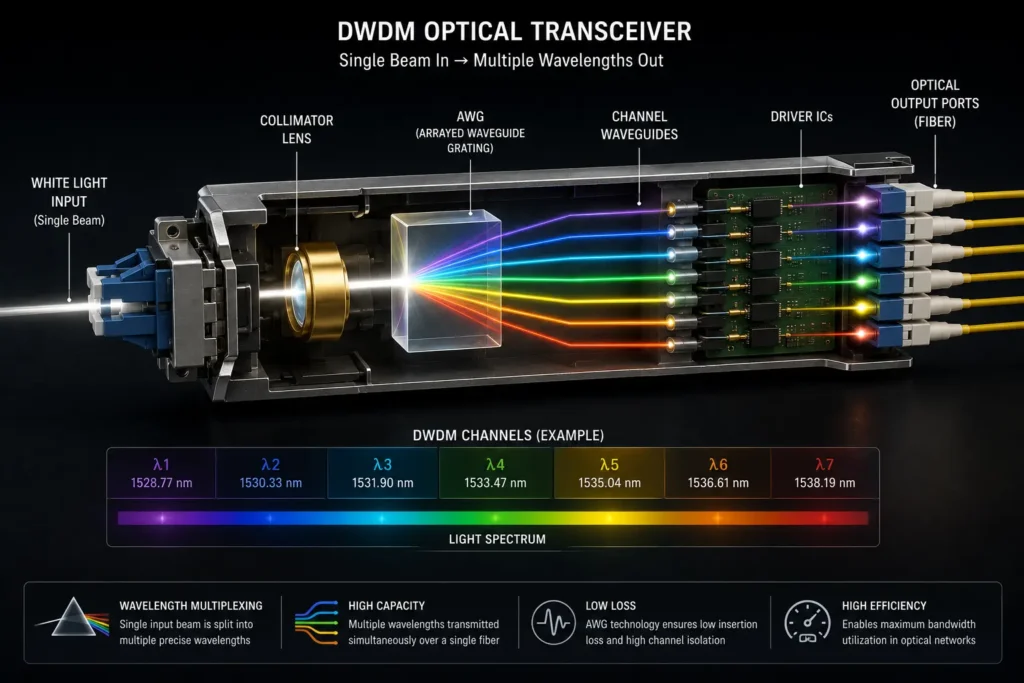
When a firm leases dark fiber, they deploy their own DWDM equipment at the endpoints. DWDM allows the user to split white light into dozens of distinct, highly specific colors (wavelengths). Because different colors of light do not interfere with each other, the user can shoot 80 different data streams down a single strand of microscopic glass simultaneously.
4. Technical Depth: The Refractive Index and Attenuation
Even in dark fiber, speed is physically limited by the medium. Light travels through a vacuum at roughly 300,000 km/s (c). However, standard silica glass has a refractive index of roughly 1.5, meaning light travels through the fiber optic cable about 50% slower than it does through the air.
Furthermore, as light travels through glass, it loses strength (attenuation). Standard single-mode fiber experiences attenuation of roughly 0.2 dB per kilometer. Over long distances, the light beam becomes too dim for the receiver to read.
5. Real-World Consequences: Inline Amplification Huts
To overcome attenuation on a route like Chicago to New York, the dark fiber lessee must build or rent physical “regeneration huts” every 80 to 100 kilometers along the route. Inside these huts, they install Erbium-Doped Fiber Amplifiers (EDFAs). Instead of catching the light and converting it to electricity to boost it (which adds severe latency), an EDFA uses a secondary “pump laser” to physically excite the erbium ions in the glass, optically amplifying the passing light signal without ever converting it to a slow digital format.
Commercial Applications for Dark Fiber Networks
Dark fiber powers the most mission-critical and secretive data corridors on the planet.
The Golden Triangle of HFT: The ultimate proving ground for dark fiber is the financial corridor connecting Chicago (CME) to the major data centers in New Jersey (Secaucus NY4, Mahwah, and Carteret). Trading firms lease private fiber and optimize the route literally foot-by-foot, mapping the geodesic curvature of the earth to ensure their algorithms can arbitrage futures and equities in the absolute mathematical minimum time allowed by physics.
Hyperscale AI Cluster Synchronization: To train frontier AI models, companies like Meta and Google must connect massive GPU clusters spanning different data center campuses. Because AI training requires constant, immense parameter synchronization, the interconnect bandwidth required exceeds commercially available lit services. Hyperscalers lease high-strand-count dark fiber ribbons and illuminate them with their own 800G and 1.6T transceivers to build a unified, contiguous computing fabric.
5G Fronthaul Networks: Mobile carriers heavily utilize dark fiber to connect millions of small-cell 5G radio antennas back to centralized baseband processing units. Because 5G requires incredible density and low latency to function, leasing dark fiber allows carriers to deploy “Cloud RAN” (Radio Access Network) architectures, removing the heavy computing hardware from the actual cell tower and centralizing it miles away.
Economic & Strategic Impact
The economics of dark fiber completely upend the traditional telecommunications model, primarily through the use of Indefeasible Rights of Use (IRU).
An IRU is a long-term lease, typically lasting 15 to 20 years. When a hyperscaler signs an IRU for a pair of dark fiber strands, they secure an exclusive, irrevocable right to use that physical glass. For accounting purposes, an IRU allows the tech company to treat the network as a Capital Expenditure (CapEx) asset rather than an ongoing Operational Expenditure (OpEx).
This financial structure is devastating to traditional telecom carriers. Instead of paying Verizon or AT&T monthly fees for bandwidth that scale up as data demands increase, the tech giant pays a fixed, upfront cost for the bare glass. The tech giant then reaps 100% of the benefit of future optical innovations; when they upgrade their own DWDM lasers from 100Gbps to 800Gbps, their effective bandwidth multiplies by eight, but their dark fiber lease cost remains exactly the same.
Advantages
- Absolute Latency Control: Removes all intermediary telecom switches and routers, allowing data to travel at the physical limit of light in glass.
- Infinite Scalability: The capacity of the fiber is limited only by the end-user’s optical transceivers. Upgrading the network bandwidth requires changing the endpoints, not the physical cable.
- Maximum Security: Because the fiber is unlit and unshared, it is physically isolated from the public internet, making it immune to traditional commercial routing intercepts and highly resistant to cyberattacks.
Limitations
- Massive Upfront CapEx: While OpEx is low, acquiring an IRU and purchasing the highly specialized DWDM optical networking equipment required to light the fiber demands millions of dollars in upfront capital.
- Operational Burden: When a company leases dark fiber, they become their own ISP. If a backhoe accidentally cuts the fiber during road construction (a phenomenon known as “backhoe fade”), the lessee is entirely responsible for managing the routing failover and coordinating the physical splice repair.
- Inline Amplification Costs: For long-haul routes, the lessee must secure physical real estate along the path to build amplification huts, secure grid power to run the amplifiers, and maintain the sites, adding immense logistical complexity.
Common Misconceptions
Misconception: “Dark Fiber” is related to the Dark Web.
Reality: They have absolutely nothing to do with each other. “Dark” simply means the glass cable is unlit—no light (data) is currently passing through it until the customer plugs in their own lasers.
Misconception: Light travels faster in dark fiber than lit fiber.
Reality: The physical speed of light through silica glass is constant. Dark fiber is faster because it takes a straighter geographic route and completely avoids the digital processing delays of commercial network switches, not because the photons are moving faster.
Misconception: Dark fiber guarantees 100% uptime.
Reality: Physical cables are extremely fragile. They are routinely severed by construction crews, derailed trains, or natural disasters. Professional dark fiber networks always require a secondary, geographically diverse backup route to ensure data survival when the primary cut inevitably occurs.
What Most People Miss
The disruptive threat of Hollow-Core Fiber (HCF).
For decades, the physical speed limit of data transmission was dictated by the refractive index of solid silica glass (which slows light down to roughly 68–70% of its speed in a vacuum).
What most analysts miss is that the high-frequency trading and AI sectors are currently migrating to Hollow-Core Fiber (HCF). HCF replaces the solid glass core with an air-filled microscopic channel. Because light travels much faster through air than through glass, HCF reduces signal latency by roughly 30% to 35% per kilometer. Propagation speeds in HCF approach 99.7% of the speed of light in a true vacuum.
In practical terms, this lowers latency from approximately 5 microseconds per kilometer (in conventional solid fiber) to 3.3–3.5 microseconds per kilometer. This generates an incredible 4 to 6 microsecond savings per 1,000 kilometers. For AI infrastructure demanding synchronized distributed GPU computing and financial markets executing microsecond-level trades, laying dedicated HCF dark fiber is the definitive infrastructural arms race of the late 2020s.
Comparison Table
| Feature | Managed “Lit” Wavelength | Standard Dark Fiber | Hollow-Core Dark Fiber (HCF) |
| Transmission Medium | Solid Silica Glass | Solid Silica Glass | Air-filled Micro-channel |
| Speed of Propagation | ~68% of c | ~68% of c | ~99.7% of c |
| Latency per km | >5 µs (Due to routing) | ~5 µs | ~3.3 to 3.5 µs |
| Equipment Control | Telecom Provider | The Lessee | The Lessee |
| Scalability Cost | High (Pay per Mbps) | Low (Fixed lease cost) | Low (Fixed lease cost) |
| Primary Use Case | Enterprise Internet | Standard HFT / Datacenters | Ultra-Low Latency AI/HFT |
Case Study
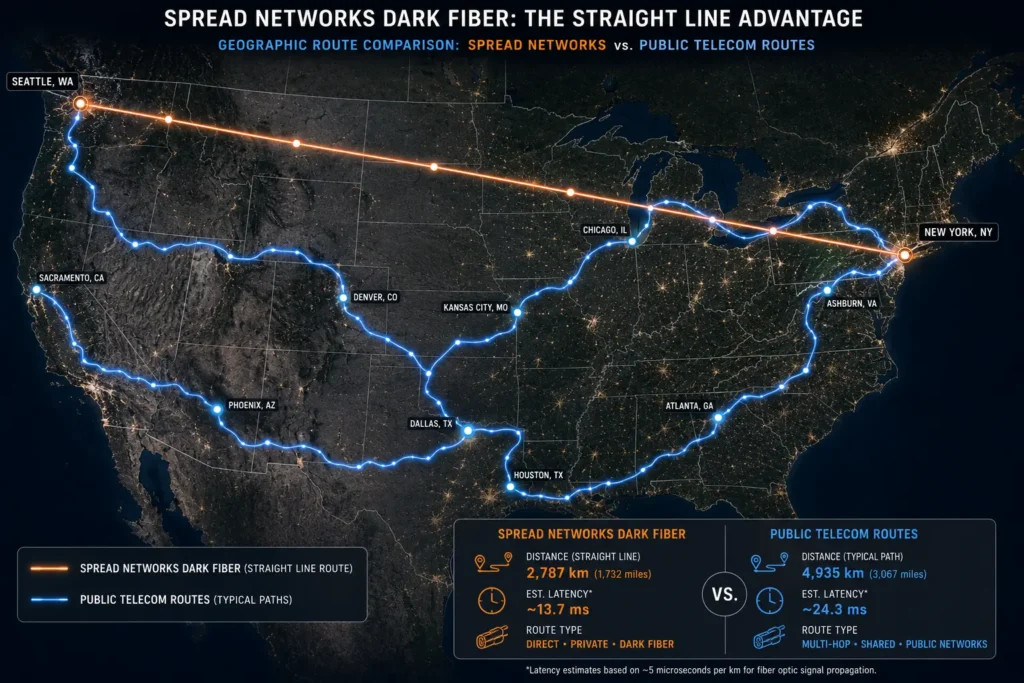
Situation: In the late 2000s, algorithmic trading firms realized that the public telecommunications routes connecting the futures markets in Chicago to the equity markets in New Jersey were deeply inefficient. Traditional telecom lines followed existing railroad tracks and highways, winding haphazardly through cities and adding fatal milliseconds of delay.
Challenge: Achieving the absolute lowest possible latency required defying traditional telecommunications architecture and constructing a fiber-optic route that adhered perfectly to the Earth’s geographic geodesic curve (a perfectly straight line).
Solution (The Spread Networks Project): Founded by Dan Spivey, a company named Spread Networks executed an unprecedented, highly secretive infrastructure project. At a cost of $300 million, they laid 827 miles of dedicated dark fiber in a virtually straight line through mountains, rivers, and rural farmland, connecting Chicago (CME) directly to Carteret, New Jersey (NASDAQ).
Outcome: Unveiled in 2010, the Spread Networks dark fiber route smashed the existing speed limits, initially dropping roundtrip latency from roughly 14.5 milliseconds to 13.1 milliseconds. Through continuous route optimizations, they subsequently pushed the latency down to an astonishing 12.98 milliseconds. High-frequency trading firms were forced to pay astronomical lease fees to access the route; any firm that remained on the old, slower commercial lines was systematically front-run and financially decimated.
Lessons Learned: The Spread Networks undertaking proved that in automated digital economies, the physical topology of the earth dictates financial dominance. It established the paradigm that latency arbitrage is ultimately a real estate and construction business, where shaving 1.5 milliseconds off a transmission equates to hundreds of millions of dollars in highly monopolized market capitalization.
Future Outlook
Next 12–24 Months
The era of Hollow-Core Data Center Interconnects (DCI). The commercial deployment of Hollow-Core Fiber (HCF) will rapidly transition from specialized HFT networks into mainstream AI data center interconnects. As AI clusters scale beyond single buildings, the necessity for synchronized GPU parallelization will force hyperscalers to deploy HCF dark fiber links across metro regions. Breakthroughs in reducing HCF optical attenuation (dropping as low as 0.28 dB/km) and minimizing splicing losses will make these short-to-medium haul deployments economically viable for major cloud providers.
Next 3–5 Years
The scaling of Subsea Dark Fiber Paradigms. The terrestrial dark fiber land-grab will move into the oceans. Rather than buying managed capacity on transoceanic consortium cables, massive tech conglomerates will increasingly finance and own their own private subsea dark fiber systems. By taking total ownership of the wet plant (the subsea cable and repeaters) and managing the terminal equipment themselves, hyperscalers will effectively privatize intercontinental data flow, heavily marginalizing traditional tier-1 global telecom carriers.
Next 10 Years
The Quantum Networking Backbone. By the mid-2030s, standard classical dark fiber will be retrofitted to serve as the foundation of the Quantum Internet. Because dark fiber allows total control over the physical photon, it is uniquely suited for Quantum Key Distribution (QKD) and quantum entanglement distribution. Unlike lit networks, which destroy fragile quantum states via digital amplification, private dark fiber channels will allow financial and military institutions to establish unhackable, cryptographically perfect communication networks using single-photon laser systems.
Most Likely Scenario
The public internet will remain the domain of consumers and small businesses, while the core architecture of global finance, artificial intelligence, and national security will fully retreat into private, deeply engineered dark fiber meshes. The true arbiters of the digital economy will no longer be the software companies that generate the data, but the infrastructure conglomerates that own the unlit glass buried beneath the earth.
Key Takeaways
- Dark fiber networks consist of unlit, dedicated fiber-optic cables leased by corporations, completely bypassing the shared, commercial public internet.
- By leasing the raw glass, companies utilize their own Dense Wavelength-Division Multiplexing (DWDM) lasers to control bandwidth, achieving theoretically infinite scalability without recurring telecom fees.
- The primary advantage of dark fiber is ultra-low latency; it avoids the digital processing delays of commercial network switches, making it indispensable for High-Frequency Trading (HFT).
- In long-haul routes, the optical signal physically dims (attenuates) and must be boosted by purely optical inline amplifiers (EDFAs) to maintain speed without adding digital delay.
- Tech giants secure dark fiber through Indefeasible Rights of Use (IRU)—20-year contracts that treat the network as a capital asset rather than a monthly operating expense.
- The industry is actively shifting toward Hollow-Core Fiber (HCF), which uses an air-filled center to transmit light ~30% faster than solid glass, pushing data transmission to 99.7% of the speed of light.
Glossary
Attenuation: The physical loss of signal strength as light travels through a fiber-optic cable, necessitating inline amplification for long distances.
Dark Fiber: Dormant, unused optical fiber infrastructure that has been laid underground but is not currently “lit” with data-transmitting lasers by a service provider.
DWDM (Dense Wavelength-Division Multiplexing): A technology that puts data from different sources together on an optical fiber, with each signal carried at the same time on its own separate light wavelength (color).
EDFA (Erbium-Doped Fiber Amplifier): An optical amplifier that uses a short segment of erbium-doped fiber to boost the strength of a passing light signal purely optically, without converting it to an electronic signal.
Hollow-Core Fiber (HCF): Next-generation fiber optic cable where the core is air or a vacuum rather than solid glass, allowing light to travel roughly 30% faster and drastically reducing latency.
IRU (Indefeasible Right of Use): A long-term lease contract (typically 15-20 years) granting a company the exclusive, unrestricted right to use a specific strand of dark fiber.
Frequently Asked Questions
Is dark fiber faster than the speed of light?
No, nothing is faster than the speed of light in a vacuum (c). Traditional dark fiber uses solid glass, which slows light down to roughly 68% of its theoretical maximum speed. Emerging hollow-core dark fibers push this speed up to 99.7% of c.
Why doesn’t everyone use dark fiber?
Cost and complexity. While the monthly recurring costs are zero, buying the 20-year lease, purchasing million-dollar optical transceivers, building amplifier huts, and hiring dedicated network engineers to maintain the route requires massive upfront capital.
Who actually lays the dark fiber cables?
Specialized infrastructure companies (like Zayo, Lumen, or Crown Castle) handle the incredibly expensive physical construction—securing right-of-way permits, trenching the earth, and laying the conduits. They then lease the unlit strands to tech companies to recoup the construction costs.
What happens if a dark fiber cable is physically cut?
The network goes down instantly. Because the lessee is acting as their own ISP, they are responsible for ensuring they have a secondary, redundant dark fiber route (a “diverse path”) to automatically route data while the primary cable is physically spliced back together by a repair crew.
How does dark fiber help AI development?
Training massive AI models requires thousands of GPUs to “talk” to each other constantly. If these GPUs are separated across different data centers in a city, the delay of standard internet connections throttles the training process. Dark fiber acts as a high-speed, direct umbilical cord, effectively merging distant GPU clusters into one massive, synchronized supercomputer.
Sources
[1] Wikipedia: Spread Networks
[2] CME Group: Technology Vendor Services – Spread Networks
[3] Light Reading: Spread Networks Reduces Latency
[4] Business Research Insights: Hollow-Core Fibers Market Size, Share, Trend, Industry Analysis 2026-2035
[5] STL Tech Blog: Hollow Core Fiber: The Next Frontier in Ultra-Low-Latency Optical Networks
[6] ESION Tech News: Hollow Core Fiber: The Future of Ultra-Low Latency Optical Networks