Advertisement
)

AT A GLANCE
- Concept: Spent Nuclear Fuel: The highly radioactive uranium pellets removed from a reactor after they can no longer sustain a fission chain reaction efficiently.
- Concept: Multi-Barrier System: An architectural philosophy that uses redundant, overlapping physical shields—both engineered and natural—to prevent radiation leaks.
- Concept: Bentonite Clay: A specialized volcanic clay that swells when exposed to water, physically sealing the radioactive canisters inside the rock tunnels.
- Concept: Crystalline Bedrock: Ancient, geologically dormant stone, like granite, chosen because it lacks major groundwater flow and has not moved in millions of years.
IN SIMPLE WORDS
Nuclear power produces massive amounts of zero-carbon electricity, but it leaves behind a small amount of highly dangerous, radioactive waste. You cannot simply throw this waste in a landfill or sink it in the ocean. It must be kept perfectly isolated from human beings and groundwater for at least 100,000 years.
To solve this, engineers are building the ultimate time capsules: deep geological repositories. They drill half a mile straight down into solid, ancient bedrock that hasn’t shifted since the dinosaurs. They seal the nuclear waste inside massive copper and cast-iron torpedoes, place them in the tunnels, and pack them in a special clay that expands to fill every crack. Finally, they fill the entire tunnel system with concrete and walk away forever. The goal is to build an underground fortress so secure that even if human civilization collapses and forgets it exists, the waste will never reach the surface.
HOW IT WORKS
The engineering of a Deep Geological Repository (DGR) is defined by the multi-barrier containment strategy. The system assumes that over a 100,000-year timeline, individual components will eventually fail. The architecture is designed so that if one barrier breaches, the next barrier instantly absorbs the structural burden.
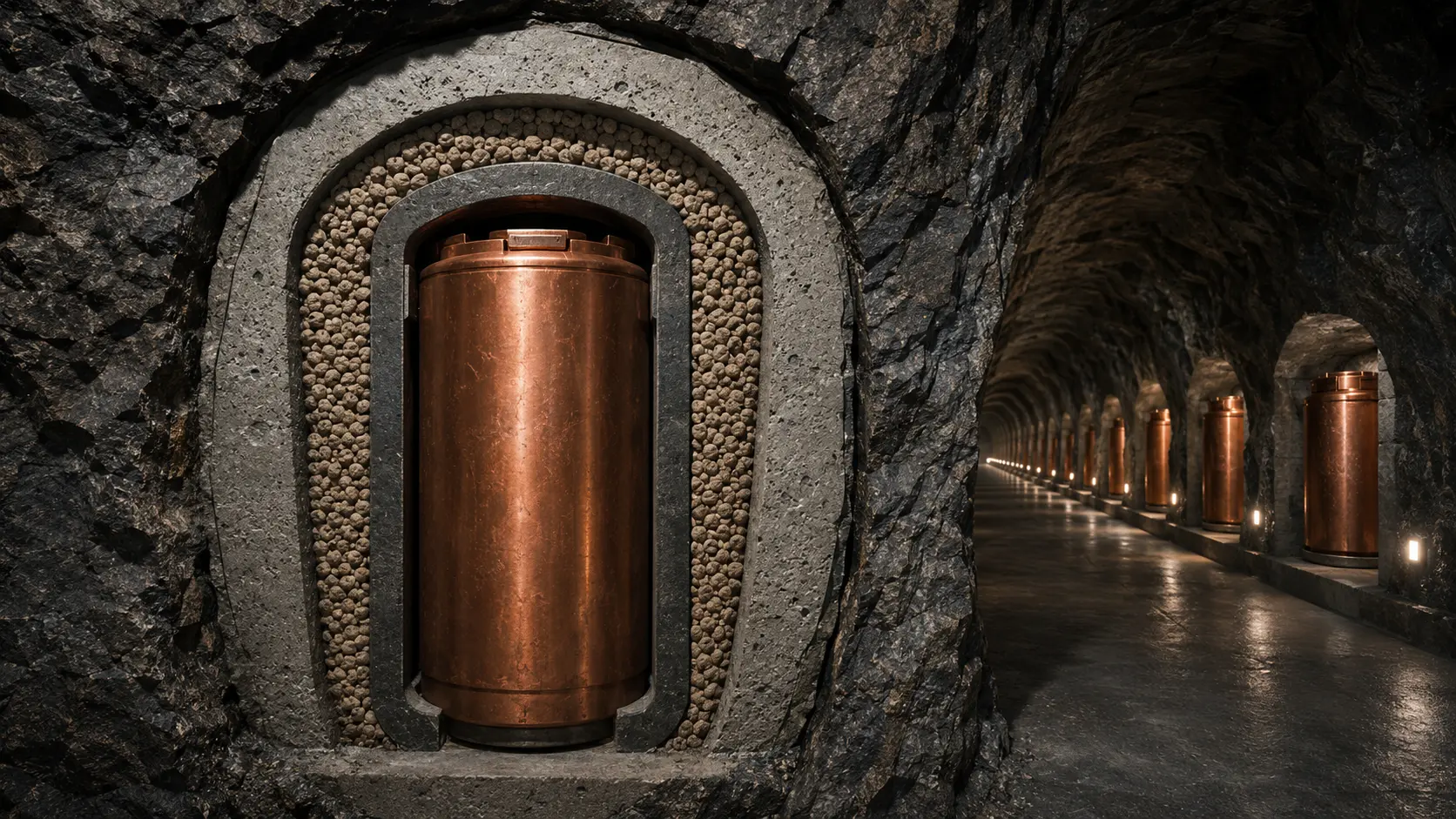
The first barrier is the fuel matrix itself. Spent uranium fuel pellets are solid ceramic. They do not leak or spill like a liquid. These pellets are placed inside the second barrier: the disposal canister. In the widely adopted Swedish KBS-3 method, this canister consists of a massive cast-iron structural insert designed to withstand the crushing lithostatic pressure of the earth, surrounded by a thick outer shell of pure copper. Copper is thermodynamically stable in the oxygen-free (anaerobic) environment deep underground, rendering it virtually immune to corrosion.
These canisters are lowered into deposition holes drilled into the floor of a tunnel situated 500 meters below the surface. Before the canister is placed, the hole is lined with the third barrier: bentonite clay buffer rings.
Bentonite is a highly highly specialized material. In the deep subsurface, tiny fractures in the bedrock may eventually allow trace amounts of groundwater to seep toward the canister. When bentonite absorbs water, it swells massively. This swelling creates intense internal pressure, instantly sealing the microscopic rock fractures and physically choking off the water flow. The clay becomes an impermeable, self-healing solid that freezes the canister in place and absorbs any tectonic shockwaves.
The final, and most critical, barrier is the natural host rock. Engineers seek out crystalline bedrock (like granite) or deep argillaceous clay formations. These geological formations are selected specifically because their hydrogeology is practically static. Groundwater at these depths moves at a rate of a few millimeters per century. Even if the copper canister dissolves and the bentonite fails, the radioactive isotopes would decay into harmless lead tens of thousands of years before the subterranean water could physically carry them up to the biosphere.
REAL WORLD EXAMPLE
Onkalo, located in Eurajoki, Finland, is the first permanent deep geological repository for spent nuclear fuel ever constructed by humanity. Carved directly into 2-billion-year-old Fennoscandian bedrock, the facility consists of a spiraling access tunnel descending 450 meters below the surface.
Posiva, the company managing the site, utilizes the KBS-3 copper canister and bentonite clay method. When fully operational in the mid-2020s, Onkalo will begin receiving highly radioactive spent fuel assemblies from Finland’s nuclear reactors. Once the tunnels are filled with canisters, they will be backfilled with clay and concrete, and the entrance will be permanently sealed, designed to remain completely undisturbed until the next ice age scrapes across the surface of the Earth.
WHY IT MATTERS NOW
The global transition away from fossil fuels requires massive amounts of reliable, always-on baseload electricity. Advanced nuclear fission is the only technology currently capable of providing this zero-carbon baseload at a civilization scale.
However, the expansion of nuclear energy is politically paralyzed by the waste problem. For decades, environmental groups and local governments have effectively blocked the construction of new reactors by pointing out that the industry has no permanent disposal solution.
Currently, thousands of tons of highly radioactive spent fuel are sitting in temporary, water-filled cooling pools or dry concrete casks on the surface, right next to the nuclear power plants. These surface storage facilities require constant human maintenance, active security to prevent terrorist theft, and are highly vulnerable to extreme weather events, sea-level rise, or civilizational collapse.
Proving that deep geological repositories work changes the entire geopolitical calculus of energy. If a nation can definitively prove that it can permanently and safely entomb its nuclear waste, it removes the primary political barrier to building massive fleets of next-generation Small Modular Reactors (SMRs).
COMMON MISCONCEPTIONS
- “The waste is glowing green liquid that can leak into rivers.” Spent nuclear fuel is solid metal and ceramic. It is physically impossible for it to splash or flow into a river like toxic sludge.
- “The repository is basically a giant underground trash dump.” It is one of the most heavily engineered, surgically precise civil infrastructure projects on Earth, requiring more structural modeling than a modern skyscraper.
- “We can just shoot the waste into the sun.” Launching rockets is highly risky. If a rocket carrying tons of highly radioactive waste exploded in the atmosphere, it would create a catastrophic global dirty bomb. Deep geological burial is infinitely safer and cheaper.
WHAT MOST PEOPLE MISS
Geologists and engineers focus heavily on the rock, but they often overlook the complex thermodynamics of the decay heat.
Spent nuclear fuel generates immense physical heat for centuries after it is removed from the reactor. If the canisters are packed too closely together in the repository tunnels, the combined thermal output will literally bake the surrounding bentonite clay. If bentonite is exposed to temperatures exceeding 100 degrees Celsius, it loses its ability to swell and seal fractures. Engineers must precisely space the canisters out over miles of tunnels to ensure the thermodynamic load never structurally degrades the clay buffer.
THE ECONOMIC AND STRATEGIC IMPACT
The primary financial beneficiaries are the specialized civil engineering and geotechnical firms capable of executing multi-decade subterranean mega-projects. Designing the automated, radiation-hardened robotics required to physically maneuver 25-ton copper canisters into tight underground holes without human intervention represents a highly lucrative, niche robotics sector.
Strategically, geological repositories create a new form of sovereign leverage. Very few nations possess the correct combination of stable geology, immense capital, and public political will to build a DGR.
Countries that successfully build repositories—like Finland and Sweden—could potentially lease their underground space to other nations. A country with an active DGR could charge massive premiums to permanently dispose of foreign nuclear waste, turning their stable bedrock into a highly profitable, strategic national asset.
THE TRAJECTORY
Next 12–36 Months: The final operational licensing and commencement of active waste entombment at the Onkalo facility in Finland. This will serve as the global proof-of-concept, establishing the regulatory blueprint for other nations to copy.
Next Five Years: The escalation of deep borehole disposal testing. As an alternative to massive, expensive mining operations, engineers will test drilling extremely narrow holes up to 5 kilometers deep (far deeper than a standard DGR) and dropping customized waste canisters directly into the deep crust, sealing them instantly with the immense pressure of the earth.
Next Ten Years: The integration of nuclear waste recycling. Before sending fuel to the DGR, nations will increasingly adopt advanced reprocessing technologies. This process extracts the remaining usable plutonium and uranium from the spent fuel, generating more electricity and drastically reducing both the volume and the half-life of the final waste that must be buried.
What Could Go Wrong: A severe, localized tectonic shear event. While sites are chosen for geological stability, an unprecedented, massive earthquake could theoretically cause the bedrock to physically shear (slide). If the rock slides enough to shear the massive copper canister in half, and groundwater is present, the multi-barrier system would fail, allowing radioactive isotopes to begin their slow migration upward.
Most Likely Outcome: Deep geological repositories will become the universally accepted, mandatory final stage of the nuclear fuel cycle. The successful entombment of waste will politically unlock the next massive wave of global nuclear reactor construction, securing the grid baseload required for the post-carbon era.
KEY TERMS
- Spent Nuclear Fuel: The highly radioactive uranium and plutonium material left over after a nuclear reactor has extracted its useful energy.
- Deep Geological Repository (DGR): A massive, engineered underground tunnel system designed to permanently isolate nuclear waste deep within stable rock formations.
- Multi-Barrier System: An engineering strategy that uses several independent layers of protection (like copper, clay, and rock) to ensure that if one fails, the others hold.
- Bentonite Clay: A natural clay that swells aggressively when wet, used to seal the waste canisters tightly into the bedrock and block water flow.
- Half-Life: The amount of time it takes for half of the radioactive atoms in a specific isotope to decay into a stable, harmless element.
- Crystalline Bedrock: Ancient, extremely hard rock (like granite) that has minimal groundwater flow and high structural stability, making it ideal for a repository.
BEGINNER FAQ
What happens to nuclear waste right now? Most of it sits in heavily guarded, temporary concrete casks or deep pools of water right outside the nuclear power plants where it was used.
Why do we have to bury it so deep? The waste will remain dangerously radioactive for roughly 100,000 years. We must bury it deep in solid rock so that no future wars, ice ages, or natural disasters on the surface can ever disturb it.
Can the radiation leak through the soil into our drinking water? It is highly unlikely. The waste is sealed in massive copper metal, packed in expanding clay, and buried half a mile deep in rock where water barely moves. Even if it leaked, it would take so long to reach the surface that the radiation would have already died out.
Why use copper for the containers? Deep underground, there is no oxygen. In an environment without oxygen, copper practically never rusts or corrodes, meaning the container can survive intact for hundreds of thousands of years.
What is bentonite clay? It is a special type of volcanic clay. If any water tries to seep through the rock toward the waste, the clay absorbs the water and swells up like a sponge, instantly plugging the leak.
Has any country actually built one of these yet? Yes. Finland is finishing construction on the world’s first permanent repository, called Onkalo, and will begin burying waste there soon.
What if people in the future forget it is down there and dig it up? Engineers and linguists are designing massive, terrifying surface monuments and warnings using symbols and architecture designed to communicate “danger” to future humans or civilizations that might not understand our modern languages.
Can we just recycle the waste instead? Yes, and some countries do. Recycling extracts more energy from the waste, but it is expensive and still leaves behind a small amount of highly radioactive material that ultimately must be buried in a repository anyway.
SOURCES
- International Atomic Energy Agency (IAEA) — Geological Disposal of Radioactive Waste: Technological Implications
- Posiva Oy — The Onkalo Deep Geological Repository and KBS-3 Multi-Barrier System
- Nuclear Energy Agency (NEA) — The Thermodynamics and Hydrology of Bentonite Buffer Materials
- United States Department of Energy (DOE) — Deep Borehole Disposal and Subterranean Isotope Migration